Volusia Regional Juvenile Detention Center Criminal Court Process

Search for an Inmate or Active Arrest Warrant in Volusia County

Criminal Court Process for Volusia County Florida

Volusia County Criminal Court: A Friendly Walk-Through

Volusia County stretches from the beaches of Daytona and New Smyrna to the river towns of DeLand and DeBary. Here, as in every Florida county, criminal charges land in one of two trial courts. Volusia County Court hears misdemeanors (smaller crimes), criminal traffic cases and local ordinance violations. Volusia Circuit Court hears felonies (bigger crimes) and juvenile cases. Volusia is part of the 7th Judicial Circuit, together with Flagler, Putnam and St. Johns counties.

Volusia has three main courthouses for criminal matters:

  • Volusia County Courthouse, 101 N. Alabama Avenue, DeLand, FL 32724. Clerk’s felony desk (386) 736-5909; misdemeanor desk (386) 736-5910.
  • S. James Foxman Justice Center, 251 N. Ridgewood Avenue, Daytona Beach, FL 32114, where east-side felonies are handled. Felony desk (386) 239-7750.
  • Steven C. Henderson Judicial Center, 125 E. Orange Avenue, Daytona Beach, FL 32114, for east-side misdemeanors and traffic. Phone (386) 257-6084.

The county itself runs the jail, the Volusia County Branch Jail in Daytona Beach, through its Division of Corrections.

Free case lookup: Volusia’s clerk runs its own system rather than the shared shared records site. Start at the clerk’s Search Records page. You can look up a case by someone’s name or by the case number and see hearing dates, charges and results at no cost. Sealed, expunged and juvenile records, along with private personal details, are kept out of view.

Federal court: On the federal side, Volusia belongs to the U.S. District Court, Middle District of Florida. Its cases are heard by the Orlando Division at the George C. Young Federal Annex Courthouse, 401 W. Central Boulevard, Orlando. Federal charges come from breaking a national law, or from crimes committed on land that belongs to the federal government. Around here that could mean an offense in the northern part of Canaveral National Seashore near New Smyrna Beach or in the Lake Woodruff National Wildlife Refuge near DeLeon Springs. Threats or weapons at Daytona Beach International Airport, drugs smuggled in by boat along the coast, and cases the Coast Guard brings in off Ponce Inlet can also end up federal. Kennedy Space Center is just south in Brevard County, so crimes there are handled through Brevard, not Volusia. No tribal reservation lies inside Volusia; the Seminole and Miccosukee lands are farther south. Choose a section below.

Immigration holds. If ICE lodges a Volusia detainer on someone:

  • F.S. 908.105 requires telling the Volusia bond judge
  • the Volusia prosecutor gets notice
  • bond is still possible in Volusia
  • ICE gets up to 48 extra hours
  • Volusia counts weekends and holidays in that time
  • a Volusia forcible felony charge plus unlawful status in Volusia means no release before first appearance (F.S. 907.041)
  • after that hearing, Volusia judges start from detention, though Volusia defense lawyers can rebut it

Town courts. Volusia has no city or town courts. The 1972 Article V reform phased them out. In Volusia, a city ordinance case goes to Volusia County Court, which also hears misdemeanors.

Misdemeanor cases in Volusia County Court: shoplifting, DUI, disorderly conduct, simple battery

Lots of Volusia misdemeanors start with a notice to appear. An officer writes down a court date, and you go home. Anyone placed under arrest is booked at the Branch Jail. Within 24 hours, court rules require a hearing in front of a judge, known as first appearance. Since 2024, the Florida Supreme Court has set one bond schedule for the whole state each year. Its job is to set minimum bail amounts for anyone released before that hearing. Bail is money paid so a person can wait for trial at home. Certain charges, like domestic violence, require the person to stay until a judge decides. A judge may also choose pretrial release, which lets someone out with conditions instead of money. Hiring a licensed bondsman costs a nonrefundable premium, fixed by state law at one-tenth of the bond amount, with $100 as the bottom.

Florida misdemeanors come in two sizes. Second-degree ones, like disorderly conduct, are capped at 60 days plus a $500 fine. First-degree ones, like shoplifting $100 to $749 worth of stuff or a first DUI, may cost a full year in the county jail along with a $1,000 fine. Many first-time offenders in Volusia are offered pretrial diversion. Once the classes or service hours are done, the charge goes away.

The State Attorney of the 7th Circuit, chosen by voters, prosecutes all state crimes in Volusia. The 7th Circuit Public Defender may be appointed when a judge decides a person can’t pay for a lawyer. Should a conflict get in the way, Volusia cases shift to the regional conflict counsel, a separate state office (its full name is Criminal Conflict and Civil Regional Counsel). A state statute (Fla. Stat. 938.29) lets a court charge a convicted person for public defender costs, and that charge can become a lien. Misdemeanor trials use six jurors, and unless the defense waives speedy trial, the case should reach trial roughly 90 days after formal charges are filed.

Juveniles: Volusia uses Florida’s civil citation program for many kids caught in a first minor offense. Instead of an arrest, the child completes things like an apology letter, counseling or service hours. Finishing it means no arrest record. Volusia juvenile cases go before the Circuit Court's juvenile division, not County Court.

↑ Back to the top

Felonies in Volusia: burglary, drug trafficking, grand theft, fleeing police

Felonies can lead to state prison, not just county jail. After first appearance, prosecutors review the police reports. If they move forward, they file an information, the written list of charges. At the arraignment, the person enters a plea. Under the speedy trial rule, a Volusia felony must reach trial within 175 days of formal charging, though defendants often give up that right to buy time.

The penalties climb with the degree. Third degree: up to 5 years. Second degree: up to 15. First degree: up to 30. Life felonies: up to life. A scoresheet required by Florida’s Criminal Punishment Code gives points for the charge and for any past record, and the sum marks the lowest sentence the judge may impose. Volusia defendants sent to prison have to finish 85% or more of the term. Guns push the minimums up under 10-20-Life. Carrying one in certain felonies costs at least 10 years. Pulling the trigger makes it 20. Should the bullet kill or gravely injure someone, the range becomes 25 years to life. Drug trafficking charges carry their own mandatory minimums based on weight.

Many Volusia felony cases end in plea bargains. Drug court, probation or community control (a strict form of house arrest) are possible in some cases.

Juveniles: Local children held on felonies are usually taken to a state-run Daytona Beach facility, the Volusia Regional Juvenile Detention Center, operated by the Department of Juvenile Justice. A Volusia judge decides within 24 hours if the child stays or goes home. Prosecutors have the power to direct file, which means charging a child as an adult. For 16- and 17-year-olds it can apply to most felonies. Kids who are 14 or 15 can face it only for the grave offenses named in Fla. Stat. 985.557. Ever since a 2019 change, it’s been optional; no law forces it.

↑ Back to the top

Volusia violent felonies: murder, robbery with a weapon, sexual battery, attempted murder

Violent felonies are usually tried at the Foxman Justice Center or in DeLand. A judge may refuse bond altogether after a pretrial detention hearing when the accused seems dangerous. Robbery with a firearm, sexual battery on a child and attempted murder can all bring life sentences.

First-degree murder is a capital felony. Prosecutors need a grand jury to file it. That panel of Volusia residents hears the evidence privately, then votes on an indictment, the formal accusation. If prosecutors seek the death penalty, 12 jurors hear the case. After a guilty verdict, at least 8 must vote for death, under a law Florida passed in 2023. Otherwise the sentence is life without parole. Death row for men is at Raiford’s Union Correctional Institution. Women sentenced to death stay at Lowell Correctional Institution, outside Ocala.

Victims’ rights in Florida come from Marsy’s Law, approved by Florida voters in 2018 and found at Article I, Section 16(b). These include being notified, being present and speaking in court. Families get support from victim advocates who work for the 7th Circuit prosecutor.

Juveniles: Even a young child, at any age, may be indicted by a grand jury when the offense carries death or life; the case then goes to adult court under Fla. Stat. 985.56. A juvenile cannot be sentenced to death. Before a youth gets life or a very long sentence, the judge must hold a hearing about their age, maturity and chances to change.

↑ Back to the top

Please use this Volusia County overview as a starting point only; it is not legal advice. A Volusia defense attorney can look at your own situation, and case questions can go to the clerk’s felony desk in DeLand at (386) 736-5909.
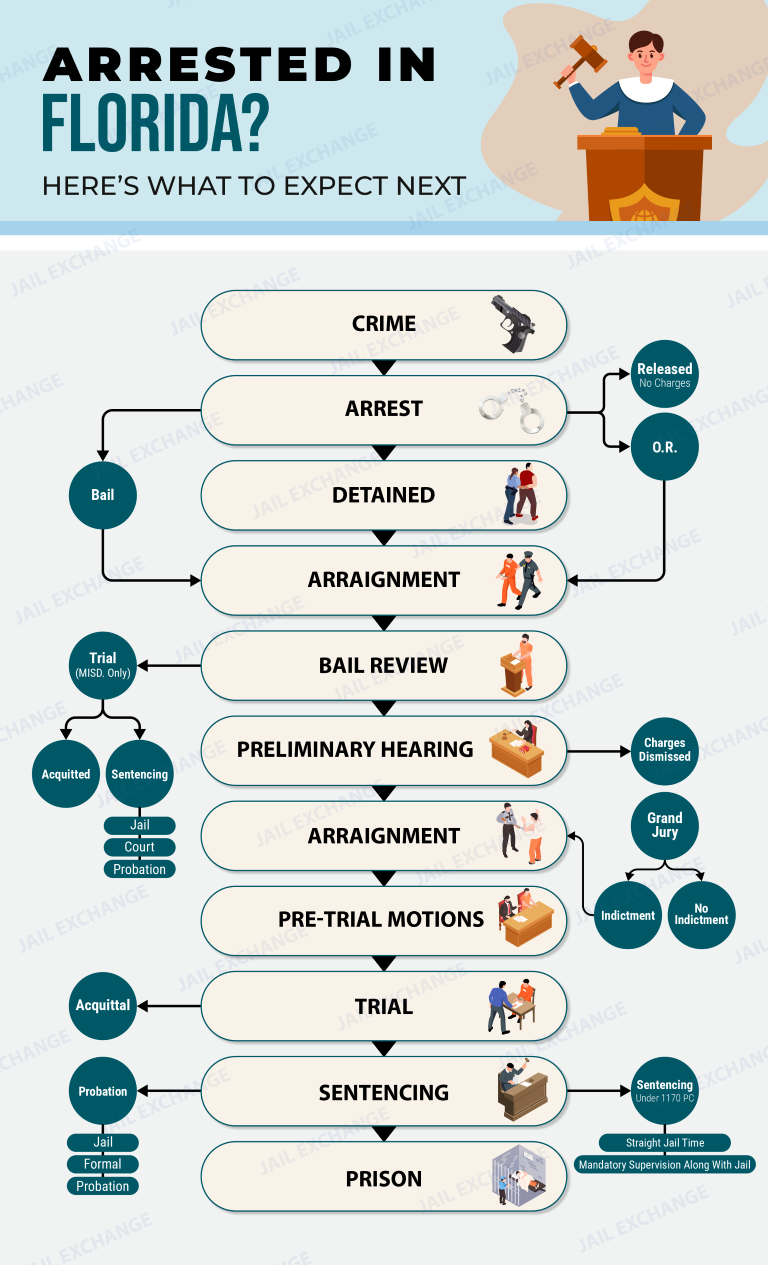
Criminal Court Process for Volusia County Florida

Volusia County Florida Criminal Court System - Definitions

It might be helpful to define some words that will be used on this site, when explaining the Florida Court System and how it works. The definitions on this site are for general information and not legal advice. It is always preferred to follow information given by your attorney or local authorities.

If you scroll down below this content, and the listing of the courts in Volusia County, you will find a simple flowchart diagram and a video that will help you visualize the stages of the Criminal Court Process.

Arrest is when Florida, Volusia County, or local police take a person into custody and start the legal process. The arrested person may or may not be immediately jailed. 

In less serious crimes, the person may only be given a citation ordering that they appear in municipal or Volusia County court on a certain date. In cases involving more serious crimes, the person is usually placed in the county jail until an arraignment, or a judge decides the next step.

Booking is when the Volusia County sheriff or local police gather information such as the detainee’s name, address and why the person is being arrested. Booking also includes fingerprinting, criminal history, investigation and verification of identity.

The prosecution, sometimes called “the government” or “the people” or “the state” is the side that press the charges and seeks punishment for the offense. These are attorneys that work for the state of Florida, Volusia County or a city or town. The prosecuting attorney for the Volusia County or the district is called the State’s Attorney. A U.S. Attorney prosecutes federal cases.

Jurisdiction is an important term in the court system that means whether a court has the obligation or duty or right to handle a case.  For example, if you run a red light in your town or city, a municipal court would likely have jurisdiction over your case, but the next town or city over would not have jurisdiction over your case.  If you attempted to flee from police when they attempted to stop you after you ran the red light, it becomes a more serious crime, and the municipal court might not have jurisdiction so you might be assigned to a higher-level court that has jurisdiction over the more serious crime.  Jurisdiction varies from state to state and sometimes county to county.

Arraignment is when a judge determines whether the charges are supported by the prosecution’s initial evidence and tells the arrested what they are charged with, and the person says whether they are guilty or not guilty. At this time, the person is called the defendant, and the opposing side is called the prosecution. If there is reason to believe that the arrested is guilty, the judge will set bail conditions or send the defendant to jail or release them ROR (release on recognizances). An arraignment is not a trial, and the defendant is entitled to a trial within a reasonable amount of time after the arraignment.

Bail is money paid that is held by the Volusia County or municipal court to make sure that the arrested does not flee the area before their trial. Bail amounts and other conditions are determined at the arraignment.

Once the case is over, the bail money is returned to the defendant. If a person does not pay bail, they remain in the Volusia County jail until their trial.  Bail can be denied if the court feels that the arrested would be a danger to others if released. Sometimes the court decides that there is a good chance that the arrested will show up for trial and not flee so they are released on their own promise, or recognizance without having to pay bail.

A bond proceeding is the determination of how much bail and of January 1, 2024, Florida moved to a statewide uniform bond schedule.  When you are arrested, under most circumstances your bond amount is set during the booking process and the defendant is eligible to bond out before going to court.  Prior to January1, 2024, each county sets their own bond schedule, and the bond amount was set during booking. 

During bond proceedings, the defendant can have an attorney present but does not have the right to an attorney. Jailors, law enforcement and prosecutors do not have authority to set bail, a judge or court officer in the Volusia County or municipal court sets bail. Judges in Florida rely on a statewide bail schedule, which sets out a recommended range of bail amounts for different offenses. Judges can still exercise discretion in setting bail above or below the recommended range.

If someone is arrested for failure to appear or a violation of probation or a violation of pretrial release, there will be no granting of a bond even after first appearance court.

It is always important to have family involvement after being arrested.  Not only can they make calls and communicate on your behalf (not all bond companies will accept collect calls), but family support will show the court that there are people who will make sure that the defendant makes it to court, not only for the defendant’s own good, but because they may have signed bond paperwork and responsible to pay if the defendant does not show in court. Chances of obtaining a bond from a bond company or clerk of court are better if family is involved.  

(There have been phone scams to where a bond company calls and informs a person that their family member has been arrested and they ask for financial information.  A bondsman will not call asking for money without involvement of the arrested.)

All bonds in Florida are secured, meaning that the courts will not allow a personal recognizance bond as other states. A defendant can pay a cash bond however if the bond amount is less than $250, a bondsman will not handle it.

Surety Bond is the most common type of secured bond in Florida.  It is when defendant pays 10 % of the bond amount to a professional bondsman or bail bond company licensed to do business in Florida. The bondsman then signs the bond on behalf of the defendant. The defendant does not receive any of the money back. If the bondsman feels the defendant is a flight risk, they can refuse to give a bond or charge a higher fee. For example, a bondsman may determine a defendant is a flight risk if they are from a state other than Florida.

Property Bond is a bond in which the bond is pledged in land or home real estate (mobile homes are not accepted).  This is handled by a bail bond company. Usually, the property must be in Volusia County and it must be worth 1 ½ or 2 times the bond amount. An appraisal of the property is required and everyone on the deed must sign. 

Transfer Bonds are transferable across state lines but generally a bond company will only assume the loan to adjoining states. For a Florida resident arrested in another state, bond companies will do transfer bonds but the person putting up the security has to be a Florida resident.

A criminal defense attorney (also called lawyer or counsel) is hired or retained to represent the arrested as early as possible after the arrest. If there is a chance that the case might go to trial and the defendant cannot afford an attorney, the 6th Amendment of the U.S. Constitution requires that the court provide an attorney. This is called indigent representation and a public defender or assigned attorney would represent the defendant in all proceedings. Indigent representation is only available misdemeanor and felony cases that could result in jail time, juvenile cases and certain appeal cases.

Everyone is appointed a public defender in Florida at first appearance court (unless you retain private counsel fast enough that they can appear).  The $50 public defender fee gets tacked on to fees and costs once the case is ended.  There are also several offices of conflict counsel that handle cases that the public defenders cannot represent due to a conflict of interest or special subject matter.

For less serious cases or civil cases, there are pro bono volunteers who volunteer legal services for free or for a small fee. They often will hold clinics to teach people how to represent themselves in court or expunge their record which means to legally erase or eliminate a criminal or arrest record from public view.  This website provides contact information for pro bono services in Florida.

Many courts will provide forms and help for people who want to represent themselves, called pro se.  Here is a link for legal self-help centers in Florida.

A district court can refer to the first level of the legal system, or a minor court. District courts are located in the community.  A district court can also refer to a U.S. Federal District Court that hears federal cases. There are three U.S. federal district courts in Florida, with offices throughout the state. It is important that you check the address of the court you are to appear in rather than to ask someone because that person might give you directions to the wrong “district” court. Being late to court can land you in custody as well.

Pretrial proceeding is the process where both sides (prosecution and defense) gather information, interview witnesses, request records, videos etc. Pretrial proceedings also include communications with the judge assigned to the case and these appearances are either in person or by on-line conferencing. Some pretrial proceedings may not require a defendant’s appearance, allowing an attorney to appear in their place. The information that is gathered is called discovery and both sides must share the information that they have gathered.  This information does not include conversations between the arrested and their attorney.

Most cases do not go to trial because both sides reach a plea deal, where both sides try to reach a reasonable punishment based on what was learned in the pretrial proceedings.  A plea deal can only happen if the accused person admits they are guilty in exchange for a lighter punishment.  The reason they must admit guilt is because it would not be fair to punish someone who claims they are not guilty.  There are times in plea bargaining when the prosecution agrees to give a lighter sentence in exchange for information leading to the arrest of more serious criminal related to the crime.  

Trial is where both sides share their information in front of a judge or a judge and jury. After listening to all the evidence, the judge or jury decides the verdict which is whether if the person is guilty or not guilty. If a court has only a judge hearing both sides, it is called a bench trial.  If a jury is selected, it is called a jury trial.  If the defendant is found non-guilty, they are released.  If they are found to be guilty, the next step is sentencing.

Sentencing is the punishment that the judge decides the person should get. This could be jail or prison time, fines, community service, probation, or a combination.

Appeal is asking for a higher court to hear the case again at an appellate court.  If the accused person thinks something went wrong at trial or has new information that was not available during the trial or that the sentence is too harsh, the defense attorney can ask for an appeal. It is not unusual for an appeal when there is a long jail sentence, but an appeal can be denied if the appellate court feels that the original trial or sentencing was fair.

Florida Felony vs Misdemeanor

In Florida, a misdemeanor is divided into two classes. Misdemeanor in the first degree that holds a punishment of a jail sentence up to 1 year and a fine up to $1000. Examples on a first-degree misdemeanor include DUI, simple assault, certain types of theft under $750 and possession of small amounts of controlled substances.  Misdemeanor in the second degree holds a punishment of up to 60 days and a fine up to $500. Examples of second-degree misdemeanor include petty theft, disorderly conduct and certain types of trespassing. 

A felony crime is a more serious crime than a misdemeanor and are divided into different classes which are general guidelines and are based on the crime, prior criminal history and other factors.  Examples of felony crimes are murder, rape, theft, aggravated assault, drug trafficking, kidnapping and identity theft.  In Florida, the classes of felonies are capital felony, life felony, felony of the first degree, second degree and third degree. 

The Volusia County Clerk of Court is an elected official whose responsibilities for Criminal Court’s administrative issues include receiving criminal warrants, receiving bail, creating the trial schedule, receiving fees, fines and maintaining court records.

A warrant is used to get someone to appear in court or to law enforcement.  There must be good reason to believe that the person is involved in a crime. The warrant gives authority to arrest the person and search for evidence for the investigation of the crime. 

A criminal summons is issued to request that a person appear in court at a particular time and date.  It does not involve an arrest.  A traffic ticket, summary citation or lesser misdemeanor could be considered a summons if you are given a court date.

A summary citation, commonly referred to as a ticket, is a criminal summons by a law enforcement officer either in person or via mail accusing the defendant of a minor offense, stating potential fine, listing the court having jurisdiction and instructions for addressing the issue. Defendants may or may not be required to appear in court or handle the matter by entering a plea via mail.

Fines are usually paid to the District Court or Volusia County Clerk of Court and payment methods can be found on the District Court or County Clerk of Court website. If you do not pay your fine on time, you can lose your driver’s license, have to pay additional fees or even have a warrant for your arrest.  It is important to read the instructions on the ticket issued by the police officer or court at the time of your arrest. For a parking ticket or summary citation, the fine amount and how to send payment should be on the ticket. 

Florida Criminal Court System - How it Works

In Florida, the courts system is made up of county courts, circuit courts, district courts of appeal and one Supreme Court. Florida does not have municipal courts. It is important that you get the address of the court that you are to appear at because going to the wrong courthouse is not always an accepted excuse for not showing to court. Being late to court can land you in custody as well.

County courts are in each county of Florida and some call them misdemeanor or traffic court. County court handles all misdemeanor and criminal traffic cases.  Most counties have their own traffic citation courts.

Circuit courts only hear felony cases.  Many cases are heard by a single judge. First appearance court is handled by a single judge in most circuits or it is rotated among all the circuit judges. Also, some circuits have one judge that handles just violations of probation, one judge that handles just post-conviction matters, one judge that handles only capital cases and specialty courts.

Juvenile cases are heard in circuit court. Most counties/circuits have their own juvenile court divisions. The following web page describes services and resources for Florida’s juvenile justice.

Specialty courts or problem-solving courts are being adopted in many states as a way to handle cases that involve non-violent and first-time offender cases in a way to where the offender can retain a job or responsibilities while following specific orders of the court as returned court appearances, periodic evaluations or testing for substances. Florida offers problem-solving courts solutions throughout the state that offer attention to the following areas: adult drug use, juvenile drug use, dependency, DUI, mental health and veteran court.

District courts of appeal conduct review of cases on appeal from county and circuit courts.

Tribal Court is available for the Seminole Tribe.

The Florida Supreme Court is like our United States’ Supreme Court because it has a panel of judges that rule on matters that have to do with someone’s constitutional rights or policies and laws. The Florida State Supreme Court deals with the state constitution or laws or policies. Sometimes the Supreme Court will hear criminal cases on appeal when there is question on the state laws or procedures that lead to the appeal.  

The criminal cases are usually referred from the district courts of appeal.

FEDERAL COURT

Federal Court deals with crimes involving violations of United States laws.  Federal crimes include federal drug trafficking, federal tax evasion and fraud that crossed state lines and include crimes that occur on federal property as post offices or federal buildings.  

Cases involving crimes that involve the FBI or DEA or Immigration agencies are federal crimes. Terrorism is a federal crime. 

There are some differences in the Federal court system as compared to the Florida state court system. For example, the attorneys who work for the courts are called United States Attorneys and Federal judges are called District Court Judges (not to be confused by local state district courts).  

Federal Magistrate Judges hear the case early on, but they do not decide on the cases at a trial like the Federal District Court Judges. In a federal case, a grand jury is used for indictments.

There are three U.S. Federal Judicial Districts in Florida.

Courts

DAYTONA BEACH JUSTICE CTR
251 N RIDGEWOOD AVE
DAYTONA BEACH FL, 32114
386-239-7750
JUDICIARY COURTS-THE STATE-FL
251 N RIDGEWOOD AVE # 3
DAYTONA BEACH FL, 32114
386-239-7710
FIFTH DISTRICT COURT APPEAL
300 S BEACH ST
DAYTONA BEACH FL, 32114
386-947-1576
VOLUSIA COUNTY-CLERK
101 N ALABAMA AVE
DELAND FL, 32724
386-736-5915

Search for an Inmate or Active Arrest Warrant in Volusia County