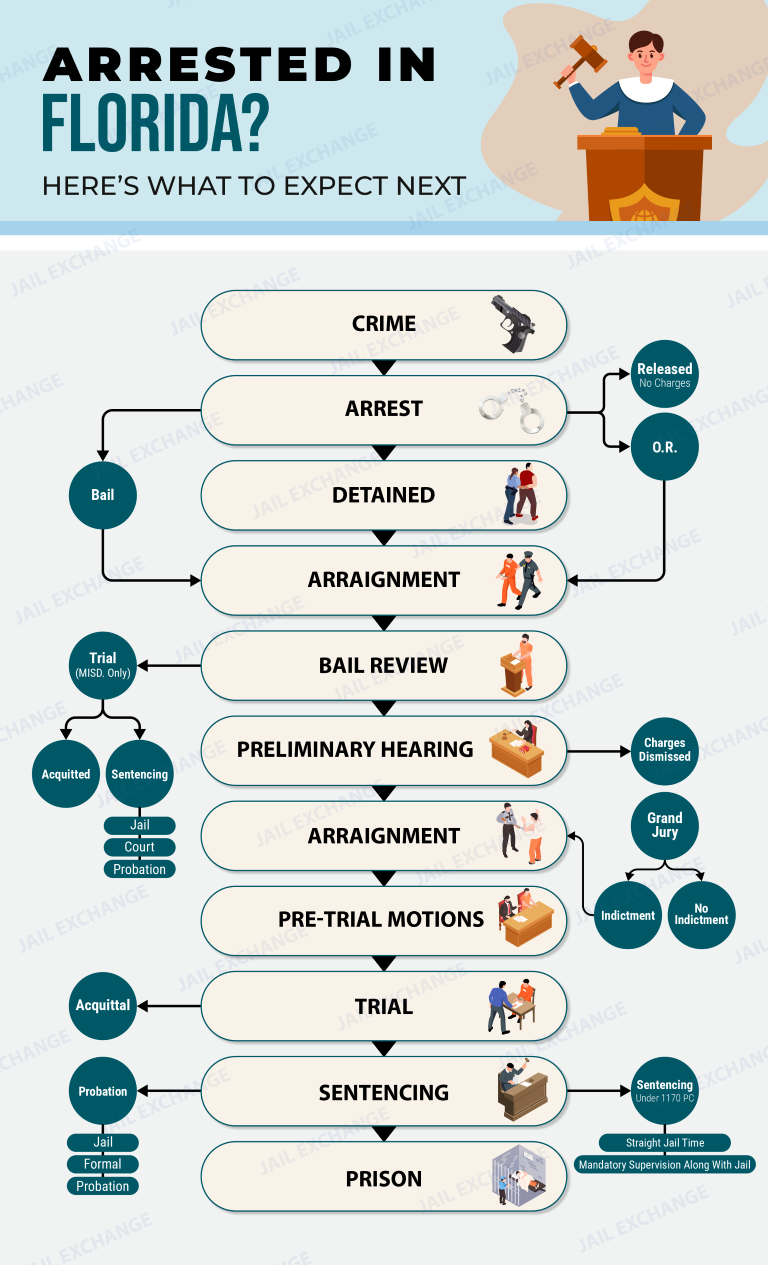
Wakulla County Jail Criminal Court Process
Criminal Court Process for Wakulla County Florida
Wakulla County: Understanding a Criminal Case Step by Step
Wakulla County sits just south of Tallahassee, with springs, forests and a long stretch of Gulf coast. Any criminal charge filed here lands in one of Florida’s two trial courts. Wakulla County Court covers misdemeanors (less serious crimes), criminal traffic offenses such as reckless driving, and county or city ordinance violations. Wakulla Circuit Court covers felonies (more serious crimes) and juvenile cases. Wakulla is one of six counties in the 2nd Judicial Circuit. The others are Franklin, Gadsden, Jefferson, Leon and Liberty. You can also check our bond guide and inmate search guide.
All criminal hearings are held at the Wakulla County Courthouse, 3056 Crawfordville Highway, Crawfordville, FL 32327. Court files are kept by the county clerk’s office, whose number is (850) 926-0905. The State Attorney also has an office inside the same building. In Wakulla, arrested adults go to the sheriff's Wakulla County Jail in Crawfordville.
Free case lookup: WakullaWakulla’s clerk is one of the counties on
1. Wakulla County Court misdemeanors: petit theft, DUI, possession of marijuana, criminal mischief
Not every misdemeanor means a trip to jail. Often a deputy fills out a notice to appear, lists the date to be in court, and lets the person go. Anyone booked into the Crawfordville jail sees a judge in 24 hours or less. In Florida, this short hearing is known as first appearance. For 2026, the Florida Supreme Court adopted a uniform bond schedule, which is a chart of minimum bail amounts for people released before they reach that hearing. Bail is the money that lets you wait at home while your case moves along. A few charges, including many domestic violence arrests, mean no release until a judge has looked at the case. In Wakulla, a bonding company can put up the money, but it charges 10% of the bond, with $100 as the lowest fee.
Here are the limits. The ceiling for a second-degree misdemeanor is 60 days locked up plus $500. A misdemeanor of the first degree can bring up to 1 year and a $1,000 fine. Possessing up to 20 grams of marijuana, with no medical marijuana card, counts as a first-degree misdemeanor. So does a first DUI without injuries, which also costs you your license for a while.
Charges are brought by the 2nd Circuit State Attorney, whom voters elect for all six counties. A judge can appoint the 2nd Circuit Public Defender for defendants without money to hire one. When there’s a conflict of interest, the Criminal Conflict and Civil Regional Counsel takes the case. If a person is convicted, Fla. Stat. 938.29 allows the court to assess public defender fees, which may turn into a lien. First-time offenders can sometimes enter a diversion program and have the charge dropped once they finish it. Misdemeanor juries in Florida have six people. Without a waiver, the state usually must start the trial within 90 days of formal charges.
Young people: A kid caught committing a first minor crime in Wakulla may be given a civil citation in place of an arrest. The child agrees to some tasks, like community service or a counseling class, and when they finish there is no arrest record. Wakulla youth cases that are filed go before a juvenile judge in Circuit Court.
2. Felony cases: burglary of a home, meth possession, grand theft, felony fleeing
The difference between a felony and a misdemeanor is mostly about punishment. Felony convictions can lead to state prison, operated by the Florida Department of Corrections. After first appearance, an assistant state attorney studies the case. If it holds up, the office files an information, the official charging paper. Arraignment comes next. That’s when the accused answers “not guilty,” “guilty” or “no contest.” Without a waiver from the defense, a felony trial should begin no later than 175 days after formal charges are filed.
Felony levels work like this. Third degree tops out at 5 years. Second degree reaches 15. First degree reaches 30. A life felony can mean the rest of a person’s life. Possessing meth is usually a third-degree felony. Burglary of a home is often a second-degree felony. Sentencing in every felony relies on a Criminal Punishment Code scoresheet, which assigns points for the offense itself, any victim injuries and the defendant’s history. Florida requires inmates to serve 85% or more of a prison sentence. Florida’s 10-20-Life gun law adds minimum prison time: 10 years for having a gun during listed felonies, 20 for shooting it, and 25 to life when the shot causes death or great harm.
Most felony cases in Wakulla are settled by plea agreements. Probation, drug treatment and community control are options in many cases.
Young people: Wakulla has no youth detention center, so a teen held on a felony is usually taken to Tallahassee's Leon Regional Juvenile Detention Center, run by the Department of Juvenile Justice. A judge has one day to rule on whether the teen must stay put. The State Attorney may direct file, meaning bring the case in adult court. Prosecutors may do that with nearly every felony if the accused is already 16 or 17, and with specific violent or serious felonies by 14- and 15-year-olds (Fla. Stat. 985.557). Florida dropped its old must-transfer rule in 2019, so the decision is now discretionary.
3. Wakulla violent crime cases: homicide, armed robbery, sexual battery, assault with a deadly weapon
A violent Wakulla case follows the same steps, but the stakes are higher. Prosecutors can ask a judge to keep the person in jail with no bond until trial. Robbery with a firearm and sexual battery with serious force can each lead to life in prison. Judges also tend to bar any contact with the injured person.
First-degree murder is a capital felony under Florida law, and the state allows that charge only by indictment. A grand jury, made of local residents meeting privately, decides whether to issue one. A capital trial uses 12 jurors. If they find the person guilty, they vote on a sentence. A death recommendation requires 8 or more of the 12 votes, a rule Florida adopted in 2023. Otherwise the punishment is life with no parole. Raiford’s Union Correctional Institution houses the men on death row; the women are kept at Lowell, a state prison in Marion County.
Victims in Wakulla can lean on Marsy’s Law, which voters put into the Florida Constitution in 2018 (Article I, Section 16(b)). In Wakulla, that means the right to be told about, attend, and speak at hearings before sentencing. The 2nd Circuit State Attorney’s victim advocates walk them through it.
Young people: Fla. Stat. 985.56 says that for offenses carrying death or life, a grand jury may indict a juvenile no matter how young, and adult court takes over. Wakulla teens, like all minors, are shielded from the death penalty. Before any young person receives life or a decades-long term, the judge has to hold an extra hearing about their youth.
4. Who holds warrants from the Crawfordville courthouse?
Wakulla's Sheriff's Office holds Second Circuit warrants, and its main desk at (850) 745-7100 checks names against birth dates. Docket entries on the online court records search show a capias when one was signed. Arranging a surrender with a lawyer at the Oak Street jail lets you choose the day and makes a release request stronger. The clerk on Crawfordville Highway resets dates, and Panacea, Sopchoppy and St. Marks cases come before judges in that building. FDLE's statewide wanted persons registry picks up warrants from other agencies.
Federal court: Federal prosecutions from Wakulla are heard in Tallahassee, by the Northern District of Florida’s Tallahassee Division, at the U.S. Courthouse, 111 N. Adams Street, Tallahassee. Charges turn federal when the broken rule is an act of Congress, or when the crime took place on federally owned ground. Wakulla has a lot of that land. A big part of the St. Marks National Wildlife Refuge lies along the county’s coast, and a large chunk of the Apalachicola National Forest covers its western side. Poaching, drug labs or assaults in those places can bring federal charges. Drugs smuggled by boat through the Gulf, often stopped by the U.S. Coast Guard, are also federal matters. There is no tribal reservation in Wakulla County. Florida’s Seminole and Miccosukee lands are hundreds of miles south. Pick a topic below.
Immigration holds. If ICE lodges a Wakulla detainer on someone:
- F.S. 908.105 requires telling the Wakulla bond judge
- notice goes to the Wakulla state attorney
- bond is still possible in Wakulla
- ICE may keep the person up to 48 hours past release
- in Wakulla, weekends and holidays count
- F.S. 907.041: in Wakulla, an unauthorized alien facing a Wakulla forcible felony charge stays in the Wakulla jail until first appearance
- at that point a Wakulla judge presumes detention, but the Wakulla defense can rebut it
Town courts. Looking for a Wakulla town court? There is none. Florida's 1972 Article V reform did away with Wakulla town courts, so Wakulla city ordinance cases go to Wakulla County Court.
Wakulla County readers should see this page as a simple guide and not as legal advice. Charged with something in Wakulla? Run your questions by a defense lawyer; for case records, try the Wakulla County Clerk of Court at (850) 926-0905.