
Macomb County Juvenile Justice Center
Macomb County Juvenile Justice Center
Physical Address
400 N. Rose StreetMt. Clemens, MI 48043
Jail Phone Number
586-469-5375Macomb County Inmate Search: Look Up Someone in the Mount Clemens Jail
Anyone arrested by Sheriff's deputies or city police is brought to the Macomb County Jail, 43565 Elizabeth Road, Mount Clemens, MI 48043. The Sheriff's Office operates it. The site has a main building plus an annex. This page covers how to find someone, mugshots, visits, money, mail and what the courts do next.
Start with the county's online jail search. Type the name, and the search shows whether that person is in custody. Write down the inmate number if you see one, because staff ask for it. To learn the charge, the bond or when release may come, phone the jail.
Call the Sheriff's Office at 586-469-5151. Have the surname, first name and birthday ready. Then find out which unit holds them and how much their bond is. For what happens next, see the bail page and the court page.
Read inmate search answers
 Read inmate search answers
1. What do I enter to find a Macomb County inmate?
The Sheriff's Office links one official search from its Locate an Inmate page. It is a JailTracker site. Follow these steps:
- Open the jail search on your phone or computer.
- Enter a surname. Use more of the name if too many people appear.
- Pick the right person from the list. Check the birth date when the page shows one.
- Write down the inmate number and any case numbers or bond amount that appear. You need them to pay a bond or add money.
- Look again later in the day, because a new booking can take time to appear.
Nothing shows up, or the screen looks odd? Call the Sheriff's Office at 586-469-5151 and ask a deputy to check by name.
↑ Back to the question list2. The search finds nothing. Is the person free?
No result does not prove the person is out. Common reasons:
- Booking not finished. Prints, photos and forms take time.
- Held by a police department. City officers may use their own lockup briefly before moving someone to the county jail.
- Released. They may have bonded out early, or a judge let them go at arraignment.
- In another county. They may be in a different county's jail, or in a federal or state place.
- Different spelling. Test other spellings, a nickname or a former name.
- Under 18. Youth are not placed in the adult jail.
The quickest way to know is to phone 586-469-5151. If a city officer made the arrest, the police list at the bottom of this page has that department's number.
↑ Back to the question list3. Where in Macomb County might they be held?
The county's adult prisoners are held at the Macomb County Jail, 43565 Elizabeth Road, Mount Clemens, MI 48043, reached through the Sheriff's Office at 586-469-5151. Here is what the county tells us about the buildings:
- Main jail. The first part opened in 1954. A 12-story tower was finished in 1987.
- Annex. A 200-bed annex was added in 1998.
- Trustee work. Some sentenced inmates who qualify work in the kitchen, laundry, library and housekeeping while staff watch them.
- Planned intake center. The Sheriff says a central intake building with mental health housing is being planned.
Call the jail to ask which housing area a person is in, since the county does not list who goes where. Some city police stations have short-term holding cells. Ask that police department first, using the list at the bottom of this page.
A stop made over the county line may land them in the Oakland County Jail, 1201 N. Telegraph Rd, Pontiac, MI 48341, 248-858-5000. Our pages for Wayne County, St. Clair County and Lapeer County list their jails and phone numbers.
↑ Back to the question list4. Will I see mugshots when I search Macomb?
The Sheriff's Office does not tell families that its search carries mugshots, so call before you count on one. Per OAG 1979-1980 No 5593, a ruling from the Attorney General, booking photos taken by police are public records. Even so, an agency may say no when its release would plainly harm someone's privacy for no good reason.
- To ask for mugshots, send a written request to the arresting police agency. Michigan's open-records statute is FOIA, found at MCL 15.231 and on. For a Sheriff's arrest, call 586-469-5151 and ask how to send a request.
- ICE photos are sought through ICE's records request form.
- Federal agencies usually keep booking photos of their own arrests out of public view. One exception: the U.S. Marshals Service may share an image, for example to find someone who ran.
5. Is there an alert for a transfer or release?
Yes. VINE, a free Michigan service, warns you whenever a person's custody status changes. Sign up at VINELink or call 800-770-7657. It follows people in county jails and in state prison, and it posts hearing updates.
VINE is a backup, not a promise of speed. Check the jail search often, and call 586-469-5151 if the person was moved and you need to know where.
↑ Back to the question list6. How does a person leave a Macomb County cell before trial?
Bond is set by a judge or magistrate in the District Court. Many arraignments run by video link from the jail, and state law bars needless waiting.
- Interim bond. For some minor offenses, if no magistrate can be reached, the deputy in charge at the county jail can take a low-amount interim bond (MCL 780.581). People arrested for domestic violence stay put until a judge or court magistrate acts.
- Arraignment. Judges look first at sending the person home on a written pledge or an unsecured bond. Conditions can include staying away from a person, drug tests, a curfew or giving up firearms. A judge may require money bail only after finding that no softer condition would keep others safe or ensure a court appearance.
- Paying. During court hours, bonds are taken at the court. Other times, the Sheriff's Office takes them. You can also pay online or by phone through the county's payment partner, using the bond line 586-307-9612.
- What is accepted. Cash, a cashier's check made out to Macomb County Prisoner Information, a credit card (with a fee) or a surety bond from an agent on the 16th Circuit Court's approved list.
- The 10 percent deposit. A judge may let you post one tenth of the bail with the court clerk. Since May 1, 2026, Michigan's bond rule lets the clerk keep that tenth only from someone found guilty of a crime named in MCL 780.66. Without that result, you get every dollar back, except fines or costs the court is owed.
Skipping a court date can cost the whole bond. The bail page walks through the full steps, and Michigan bail laws gives the state's rules.
↑ Back to the question list7. Where do I learn what the charge is?
Ask the jail first. Call 586-469-5151 and give the full name. Staff may be able to tell you why the person was arrested. Prosecutors file the official charge later. Their office is at 586-469-5350.
After a case is opened, look the name up in the state's MiCOURT tool. No match? Phone the clerk's office at the court where the case was filed. Court phones and addresses are in the court-date answer below.
↑ Back to the question list8. What if we can't afford a defense lawyer?
At arraignment, the judge asks the person about counsel, and the court names a lawyer for those without money. A person who could pay a bond can still ask for a free lawyer.
- Macomb's Office of Public Defender, 22 Market Street, Mount Clemens, MI 48043, 586-466-8311, is open Monday to Friday, 8:30 a.m. to 4:30 p.m.
- The Michigan Indigent Defense Commission, which oversees this kind of defense statewide, answers at 517-657-3066.
Families can also hire a private lawyer. Only the lawyer should hear the full story of the case.
↑ Back to the question list9. What are the Macomb County jail's video visit rules?
Friends and family visit by video. The jail uses ICSolutions, the video service the Sheriff's page names. Here are the main rules:
- Book a slot a day or more in advance, but not beyond two weeks out. ICSolutions answers at 888-506-8407.
- Each inmate gets two visits a week. Up to three visitors can join, for about 30 minutes. Some trustees get three visits.
- The first visit of each week is free. Later ones cost a fee.
- These visits are non-contact and are recorded.
- Clothing must cover all private body areas.
Ask ICSolutions whether you can join from home. Lawyers, police, probation officers and approved clergy report to the Prisoner Information Office, open seven days a week, 8:00 to 11:30 a.m., 1:00 to 4:00 p.m. and 5:30 to 9:00 p.m. Staff may end a visit that gets out of hand. See our visiting guide for more.
If a person is in the hospital, only close family may visit (parents, a spouse, brothers, sisters, children and grandparents). Get a pass from the Prisoner Information Office. Two visitors may go at a time, twice a week.
↑ Back to the question list10. How can I fund a Macomb inmate's account?
Account money pays for items from the commissary. The account holds at most $400 at one time. You have three choices:
- Online. Use Touchpay at touchpayonline.com, any hour, with a credit or debit card. The facility locator number is 748043.
- By phone. Touchpay takes calls at 866-232-1899. JPay is at 800-574-5729 and jpay.com.
- Walk in. A kiosk in the lobby of the jail accepts either cash or a credit card.
The Sheriff says no money is taken by mail, so never send cash or checks. Questions about a deposit go to 586-307-9542, Monday to Friday, 6 a.m. to 2 p.m. Read our money guide and our commissary guide too.
↑ Back to the question list11. How does my loved one call me from inside?
ICSolutions runs the jail's phones, so open an account with them at 888-506-8407. You need one so the person can call you. The same line helps with billing and with blocking your number. A funded account can also hear voice messages from the person.
Tablets get money through ICSolutions as well. To send messages or photos to someone inside, use GettingOut.com. Assume calls may be recorded; keep case talk for your lawyer. More help: the page on jail calls and the page on inmate messaging.
↑ Back to the question list12. What is the mailing address for Macomb inmates?
Use this address, with the inmate number in parentheses after the name:
Name (inmate number)
P.O. Box 2308
Mount Clemens, MI 48043-2308
Look up the inmate number in the jail search. Do not put checks, bills or receipts in personal mail. Soft cover books can only be ordered by the person through the commissary. Prepaid magazine or paper subscriptions may come from the publisher. Each person may hold five reading items. Nudity, swearing, violence or unlawful acts in the content can get mail refused. The mail page lists more rules.
↑ Back to the question list13. How do I collect a person's property?
Property is released Sunday to Thursday, 9 a.m. to 1 p.m. A person in custody may choose to have only valuables sent out, such as keys, a cell phone, a wallet or jewelry. Call 586-469-5151 to ask where to go, which ID to bring and whether paperwork must be signed.
If the person goes to state prison, the jail boxes the property and holds it 14 days. After that it is thrown away if no approved person has picked it up.
↑ Back to the question list14. What if an inmate needs a doctor?
Wellpath is the jail's medical, dental and mental health provider. To report a need, phone 586-469-5151 and list every medicine, its strength and who prescribed it. Tell the person to put in a care request inside the jail too.
Call 911 for an emergency. Mention any worry about suicide at the start of the call. The Sheriff also links a guide on suicide prevention for families.
↑ Back to the question list15. How do I learn if a Macomb County warrant exists?
The Macomb County Sheriff's Office answers at 586-469-5151. Ask a deputy to check a name, or read the Prosecutor's Warrant Division page and call 586-469-5350. Search MiCOURT Case Search or call the court clerk. To clear one, see a lawyer, then phone the court behind it. The 16th Circuit Court sits at 40 N. Main St., Mount Clemens, MI 48043, 586-469-5351. Clerks at the courts listed in the next answer also take calls about warrants.
↑ Back to the question list16. Which courthouse holds their next hearing in Macomb?
Each judge sets dates for the cases on that docket. A felony begins in a District Court with an arraignment, a probable cause conference and a preliminary exam. Once bound over, a felony moves to the 16th Circuit Court. Misdemeanors stay in District Court. Our court page explains each step.
- 16th Circuit Court, 40 N. Main St., Mount Clemens, MI 48043, 586-469-5351
- Warren, 8300 Common Rd., Warren, MI 48093, 586-574-4900
- Center Line, 7070 E. Ten Mile Rd., Center Line, MI 48015, 586-757-8333
- Clinton Township, 22380 Starks Dr., Clinton Township, MI 48036, 586-469-9300
- Eastpointe, 16101 E. Nine Mile Rd., Eastpointe, MI 48021, 586-445-5020
- New Baltimore, 35071 23 Mile Rd., New Baltimore, MI 48047, 586-725-9500
- Romeo, 14713 33 Mile Rd., Romeo, MI 48065, 586-752-9679
- Shelby Township, 52420 Van Dyke Ave., Shelby Township, MI 48316, 586-739-7325
- St. Clair Shores, 27701 Jefferson Ave., St. Clair Shores, MI 48080, 586-445-5280
- Sterling Heights, 40111 Dodge Park Rd., Sterling Heights, MI 48313, 586-446-2500
Names can be checked in the state's MiCOURT tool. When nothing appears, the clerk at the court handling it can confirm.
↑ Back to the question list17. Who keeps a person charged in federal court?
The federal trial court for Macomb is the Eastern District of Michigan, Southern Division. Its Detroit home is the Theodore Levin U.S. Courthouse, 231 W. Lafayette Blvd., Detroit, MI 48226. The clerk answers at 313-234-5000.
- Early in the case, a federal judge conducts a detention hearing and decides release or jail until trial (18 U.S.C. 3142).
- The U.S. Marshals Service takes custody of people charged federally. Call their Detroit office in the same courthouse, Room 300, at 313-202-0135, to ask where.
- After sentencing, search the Federal Bureau of Prisons inmate locator by name or register number.
18. What if ICE wants to take custody?
The usual order of events:
- First, ICE sends the jail Form I-247A, asking for a hold.
- A federal rule (8 CFR 287.7(d)) says The request can be for the jail to hold the person up to 48 hours after they would otherwise be released.
- After that, ICE takes the person into its own detention system.
- To search, use the ICE Online Detainee Locator. It needs a name and birth country, or else an A-number.
Michigan and Ohio share one ICE office, at 985 Michigan Avenue, Suite 207, Detroit, MI 48226, 313-771-6601. Call it if the locator shows nothing.
↑ Back to the question list19. How do I track someone who went to prison?
After a prison sentence, a person first goes through intake. Men start with 30 to 45 days of intake in Jackson, at the state's Reception and Guidance Center. During it they can get letters and deposits, not visits. For women, intake happens in Ypsilanti. Deputies from Macomb handle the transport.
- Look up a name or prison number in OTIS, the Michigan Department of Corrections' offender database.
- Our Michigan prison directory covers how to visit and write at each one.
20. Where do Macomb teens go after an arrest?
Anyone younger than 18 is handled as a juvenile in Michigan. Cases for young people are heard by the Family Division, part of the 16th Circuit Court, 40 N. Main St., Mount Clemens, MI 48043, 586-469-5351. The law keeps youth in places where adults cannot see or hear them.
The county runs the Juvenile Justice Center, a secure place for youth. Call 586-469-5375 to learn where a young person is and how to reach them. Once a youth reaches 14, a judge can move a serious case to the adult side (MCL 712A.4). Certain grave charges against teens start in Circuit Court under MCL 600.606.
↑ Back to the question list21. Which Macomb County department made the arrest?
The county has many departments. Call the one that made the arrest to ask about mugshots, reports and release.
- Macomb County Sheriff's Office, 43565 Elizabeth Road, Mount Clemens, MI 48043, 586-469-5151. It patrols Armada Township, Bruce Township, Harrison Township, Lenox Township, Macomb Township, Mount Clemens, Ray Township, Richmond Township and Washington Township. It also polices New Haven.
- Cities and villages:
- Armada Village, 586-784-9152
- Center Line, 586-757-2203
- Eastpointe, 586-445-5100
- Fraser, 586-293-1425
- Memphis, 810-392-2144
- New Baltimore, 586-725-2181
- New Haven Village, 586-749-5121
- Richmond, 586-727-4000
- Romeo Village, 586-752-3587
- Roseville, 586-775-2100
- St. Clair Shores, 586-445-5300
- Sterling Heights, 586-446-2810
- Utica, 586-731-2345
- Warren, 586-574-4700
- Townships: Chesterfield Township, 586-949-2322; Clinton Township, 586-493-7800; Shelby Township, 586-731-2121. Per the county's police list, Grosse Pointe Shores Police, 313-881-5500, serves Lake Township.
- Sheriff's substations: Harrison Township 586-469-1098; Lenox Township 586-727-4845; Macomb Township 586-286-3441; Mt. Clemens 586-469-9712; New Haven 586-469-6559; Washington Township 586-781-3104.
- Michigan State Police, Metro North Post, 14350 W. Ten Mile Rd., Oak Park, MI 48237, 248-584-5740.
Information for this service is currently unavailable.
Macomb County Criminal Court Help: Misdemeanors, Felonies and Youth Cases
Macomb County has one Circuit Court and many District Courts, one for each part of the county, such as the 37th in Warren, 586-574-4900. The 16th Circuit Court, 586-469-5351, is at 40 North Main Street, Mt. Clemens, MI 48043. Those held after an arrest stay in the Macomb County Jail, a Sheriff's Office facility at 43565 Elizabeth Road, Mount Clemens, MI 48043.
See if your person is in custody through the Macomb County Inmate Search. Our Recent Arrests list also shows charges and warrants.
Call the Circuit Court clerk at 586-469-5351 for the next hearing date. Need to pay bond? Our bail page shows where.
1. How can you find the right courthouse in Macomb County?
After an arrest, knowing the difference between District Court and Circuit Court can make the next steps less confusing. In Macomb County, Michigan , lower-level criminal charges and the opening stages of felony cases are in most situations handled in District Court . Most felony trials and felony sentencing belong in Circuit Court . Juvenile delinquency cases usually go through the Family Division of Circuit Court. The Macomb County Prosecuting Attorney represents the state. Mount Clemens is the county seat.
2. Someone you love was arrested in Macomb County. What do you do first?
Write down the person’s full name and birth date, the arresting agency, the booking location, the court matter number if available, and the next hearing date. Ask the jail whether the person is still in custody and whether a bond or other release order has been entered. The jail handles custody; the court sets bond and court dates. The District Court ordinarily handles a misdemeanor case and the first felony hearings. The Circuit Court ordinarily handles the felony after the preliminary stage. A family member may be able to attend public hearings, but the judge and appointed lawyer—not a jail officer—determine how the legal case moves forward.
- 16th Circuit Court — 40 N. Main St., Mt. Clemens, MI 48043. 586-469-5351.
- 37th District Court (Warren) — 8300 Common Rd., Warren, MI 48093. 586-574-4900.
- 37th District Court (Center Line) — 7070 E. Ten Mile Rd., Center Line, MI 48015. 586-757-8333.
- 41B District Court — 22380 Starks Dr., Clinton Township, MI 48036. 586-469-9300.
- 38th District Court — 16101 E. Nine Mile Rd., Eastpointe, MI 48021. 586-445-5020.
- 42-2 District Court — 35071 23 Mile Rd., New Baltimore, MI 48047. 586-725-9500.
- 42-1 District Court — 14713 33 Mile Rd., Romeo, MI 48065. 586-752-9679.
- 41A District Court (Shelby) — 52420 Van Dyke Ave., Shelby Township, MI 48316. 586-739-7325.
- 40th District Court — 27701 Jefferson Ave., St. Clair Shores, MI 48080. 586-445-5280.
- 41A District Court (Sterling Heights) — 40111 Dodge Park Rd., Sterling Heights, MI 48313. 586-446-2500.
- District Court: Hears most misdemeanors and holds the first hearings in felony cases, including arraignment and preliminary examination.
- Circuit Court: Handles felony trials, pleas, sentencing, and appeals assigned by Michigan law.
- Family Division of Circuit Court: Handles juvenile delinquency proceedings and related matters.
- Macomb County Prosecuting Attorney: Represents the state in local criminal prosecutions.
- Appointed defense lawyer: People who cannot afford counsel in qualifying criminal cases can request an appointed attorney.
- Local jail and custody: County sheriffs normally manage local jail custody; a court may order release with conditions or continued detention.
Where does a case start? A person arrested in Macomb County may first be booked by police and brought before a judge or magistrate. The criminal accusation determines which court hears the court matter, and the court paperwork controls where the defendant must appear. Michigan District Courts decide most misdemeanors and handle the first steps of felonies. Circuit Court in most situations takes over a felony after a waiver or a finding of probable cause at the preliminary examination.
What happens to someone waiting in jail? The Macomb County sheriff or another authorized jail may hold the defendant while a court considers release. Custody and release decisions are recorded as part of the criminal matter. A courthouse and a detention center are not necessarily on the same property.
This guide explains the usual criminal court process in Macomb County in plain language. The exact charge, criminal history, and judge’s findings affect the outcome. It is general information, not personal legal advice.
↑ Back to the question list2. How does Macomb County handle less serious criminal charges?
For a person new to the court system: In Macomb County, a misdemeanor may start with a ticket or a notice to appear, while a more serious situation can lead to arrest and booking. Examples include certain assaults without serious injury, shoplifting and some impaired-driving charges. The criminal accusation written on the paperwork matters because Michigan has different penalties for different misdemeanors.
Arraignment: what the judge decides about bail
During arraignment, the judge tells the defendant what offense is charged, explains important rights and addresses a plea and release conditions. Some people can leave on a personal promise to return; others may have money bond, supervision, travel limits or no-contact orders. A judge can also deny release where the law permits. Bail is not a punishment or proof of guilt.
The next steps once charges are read
The Macomb County District Court may schedule a pretrial hearing. Lawyers review police reports, videos and other evidence. The prosecuting attorney may offer an agreement, dismiss a charge or proceed to trial. The person charged can contest the evidence rather than accept a plea. Jury-trial rules depend on the offense and the legally available punishment.
When the court pays for an attorney
If the person charged faces a charge that qualifies for appointed counsel and does not have enough money to hire an attorney, the judge is permitted to determine eligibility for a public defender or assigned lawyer. Request this help promptly; do not assume a defender is automatically assigned after booking.
Possible misdemeanor results
Michigan misdemeanors have different maximums. Common statutory limits include 90 or 93 days, one year, and in certain cases two years, with fines fixed by the particular statute. Some offenses also require driver-license action, restitution, classes or probation. The exact charge and prior record matter more than the county name.
↑ Back to the question list3. What is the process for a felony in Macomb County?
A more serious criminal offense accusation in Macomb County normally starts with a District Court arraignment, even when the eventual trial would be in Circuit Court. Prosecutors must establish the legal basis for moving the case forward. A felony carries the possibility of a state-prison sentence, although not every conviction results in prison time.
Probable cause conference and preliminary examination
Michigan usually sets a probable cause conference 7 to 14 days after felony arraignment and schedules the preliminary examination roughly 5 to 7 days after that conference, unless a legal waiver, adjournment or exception changes the schedule. At the preliminary examination the state's attorneys must show probable cause that a crime occurred and that this defendant committed it. That decision is not a finding of guilt.
The handoff from District Court to Circuit Court
When the charge is bound over, Macomb County Circuit Court handles the felony case. The person facing charges may be arraigned again, and the attorneys involved exchange evidence, negotiate, file motions or set a trial. The prosecutor has to establish guilt beyond a reasonable doubt at trial. Defendants who cannot afford legal counsel should request that the court about appointed representation.
What a felony sentence can involve
Michigan sentencing rules look at the offense statute, a record of earlier convictions, the sentencing guidelines when applicable, and any mandatory minimum. A nonviolent first offender might be eligible for probation or another lawful alternative, but some violent or repeat offenses require custody. Do not use a single felony-class chart to predict all Michigan sentences.
↑ Back to the question list4. What happens with violent or very serious crimes in Macomb County?
Murder, armed robbery, criminal sexual conduct and assaults causing serious harm are examples of grave charges that could be prosecuted in Macomb County. Seriousness by itself does not turn a Michigan crime into a federal case. Most such charges remain in the state Circuit Court unless federal law independently applies.
Detention and defense
A judge considers Michigan’s release rules, risk of flight, safety and legally relevant facts. A no-contact order or other condition may be imposed. Some defendants remain in jail while lawyers examine records, DNA or other scientific evidence. These charges need careful legal advice and frequently involve complicated court motions.
Trial and possible prison terms
First-degree murder carries mandatory life without parole for adults under Michigan law, subject to legally applicable exceptions and youth-sentencing rules. Second-degree murder can carry a sentence up to life imprisonment. Armed robbery and several serious criminal sexual conduct crimes can also carry very long terms. Other violent offenses have their own penalty sections. Michigan does not have the death penalty.
Victim and family support
The Macomb County Prosecuting Attorney may have a victim-witness unit that explains hearing notices and available services. The defense attorney protects the legal rights of the person charged. The amount of time a case takes depends on witnesses, evidence, motions and the court calendar.
↑ Back to the question list5. Where do cases involving children and teenagers go in Macomb County?
A youth accused of breaking a criminal law in Macomb County in most situations appears in the Family Division of Circuit Court instead of an adult District Court. Michigan juvenile proceedings emphasize the child’s age, the offense, safety, and whether services can address the problem.
Intake and the first decision
After police contact, juvenile court intake may review a complaint and decide whether it needs a formal petition. Some matters can be diverted or handled through services without a full court trial. If a youth is held, the law provides for prompt judicial review, and parents or guardians should ask where the child is housed.
Hearings and possible outcomes
If a formal petition is filed, the court explains the allegations and the child’s rights. An adjudication hearing decides whether the state's lawyer proved the allegation under the applicable legal standard. Outcomes can involve supervision, probation, counseling, treatment, restitution, or placement through the youth-services system where authorized.
When a juvenile might face adult-style prosecution
Special laws permit designation or waiver for certain serious offenses and ages; an adult criminal matter is not automatic simply because someone is charged with a felony. Juvenile and youthful-offender rules are complicated, so ask for an attorney experienced in youth cases. Many juvenile records are not open to the public.
↑ Back to the question list6. How do courts decide penalties for criminal offenses in Macomb County?
Someone arrested in Macomb County does not receive a sentence just because the police wrote a charge on a report. The prosecutor must prove the case or the person charged must enter a valid plea. If there is a conviction, the judge uses the exact charge and Michigan statute. The amounts below are legal limits for the listed offenses, not a promise that the judge will order those amounts. Fines can be accompanied by court costs, assessments and restitution to a victim.
Specific Michigan charges and their statutory punishments
- Simple assault or assault and battery (MCL 750.81(1)): Up to 93 days in jail and/or a fine up to $500 A basic assault charge without a different applicable enhancement.
- First domestic assault (MCL 750.81(2)): Up to 93 days in jail and/or $500 Prior offenses or added facts can raise penalties.
- Second domestic assault (MCL 750.81(4)): Up to 1 year in jail and/or $1,000 Prior qualifying conviction is required.
- First ordinary drunk-driving offense (OWI) (MCL 257.625(9)(a)): Up to 93 days in jail; $100–$500 fine; up to 360 hours community service Driver’s-license consequences and other costs may also apply.
- First high-BAC OWI, BAC at least .17 (MCL 257.625(1)(c), (9)(a)): Up to 180 days in jail; $200–$700 fine May include ignition-interlock and license restrictions.
- OWI with one prior conviction within 7 years (MCL 257.625(9)(b)): $200–$1,000 fine plus a lawful jail or community-service penalty Specific mandatory minimums and alternative sanctions apply.
- Home invasion, third degree (MCL 750.110a(4), (7)): Up to 5 years in prison and/or $2,000 A felony; the precise grade depends on conduct.
- Home invasion, second degree (MCL 750.110a(3), (6)): Up to 15 years in prison and/or $3,000 A felony; may involve entering a dwelling to commit certain crimes.
- Home invasion, first degree (MCL 750.110a(2), (5)): Up to 20 years in prison and/or $5,000 Aggravating factors include a dangerous weapon or someone lawfully present.
- Felony with no specific punishment stated (MCL 750.503): Up to 4 years in prison and/or $5,000 Default rule only: does not replace a statute that sets its own penalty.
- Misdemeanor with no specific punishment stated (MCL 750.504): Up to 90 days in jail and/or $500 Default rule only: many offenses set different limits.
- First-degree murder (adult conviction) (MCL 750.316): Life imprisonment without possibility of parole, subject to applicable constitutional/youth exceptions Michigan does not have the death penalty.
Why a felony's sentencing-guidelines range may be different
Michigan does not have one statewide table saying all Class A felonies get one sentence and all Class B felonies get another. For eligible felonies, the judge calculates an offense-variable score based on how the crime happened and a prior-record-variable score based on the person's record. Those scores, the crime's offense category and its sentencing classification produce a recommended minimum prison-term range. That recommended range is different from the statutory maximum, which is the most prison time allowed for that crime. Courts can depart from a recommendation when lawful and must explain a reasonable departure. Mandatory minimums can override ordinary guideline calculations.
For example, a five-year maximum for third-degree home invasion does not mean that everyone convicted must serve five years. A particular defendant may receive a lower prison minimum, probation or another lawful sentence depending on the sentencing law and case facts. Michigan prison sentences frequently state both a minimum and a maximum; parole eligibility and release do not automatically happen on the minimum date.
What about probation, restitution and jail?
A judge may order reporting to a probation officer, drug or alcohol testing, classes, treatment, community service, and repayment of a victim's proven losses. Violating probation can lead to another court hearing and a new penalty. Some people serve a local jail term instead of being sent to state prison; others qualify for an alternative sentence. A defendant's lawyer can request the sentencing-information report and explain the actual scored range before sentencing.
↑ Back to the question list7. Which U.S. District Court handles federal criminal cases from Macomb County?
Macomb County is part of the U.S. District Court for the Eastern District of Michigan, Southern Division. This court handles violations of federal criminal law; it is separate from Michigan District Court, despite the similar names. The southeastern Lower Peninsula location of the county determines its federal judicial assignment.
Federal courthouse and contact
- Federal court: U.S. District Court, Eastern District of Michigan, Southern Division
- Courthouse: United States District Court — Eastern District of Michigan, Detroit courthouse. 231 W. Lafayette Boulevard, Detroit, MI 48226.
- Clerk’s office telephone: 313-234-5000.
What makes a crime federal?
Examples may involve trafficking drugs in violation of federal law, bank robbery involving a federally insured institution, certain firearm violations, federal tax crimes, fraud that uses interstate communications, immigration crimes, and offenses on federal property. Crossing a state line may be relevant to some laws, but is not required for every federal charge. A serious local assault or theft is not federal simply because it is serious.
Steps in a federal criminal case
A person may be arrested on a federal complaint or indictment and then appears before a U.S. magistrate judge. The judge reviews rights, counsel and detention or release. Serious federal charges ordinarily involve grand jury indictment unless a lawful exception applies. Discovery and motions follow; a plea or jury trial determines the outcome. A federal judge imposes sentence under federal statutes and sentencing rules, with any mandatory minimums applying where required.
Federal custody and sentences
The U.S. Marshals Service handles federal pretrial custody and transportation, frequently through contracted local facilities. People receiving federal prison sentences are generally placed by the Federal Bureau of Prisons. A person arrested within a Michigan county may therefore be housed far from the county jail and may need to be found through federal channels.
↑ Back to the question list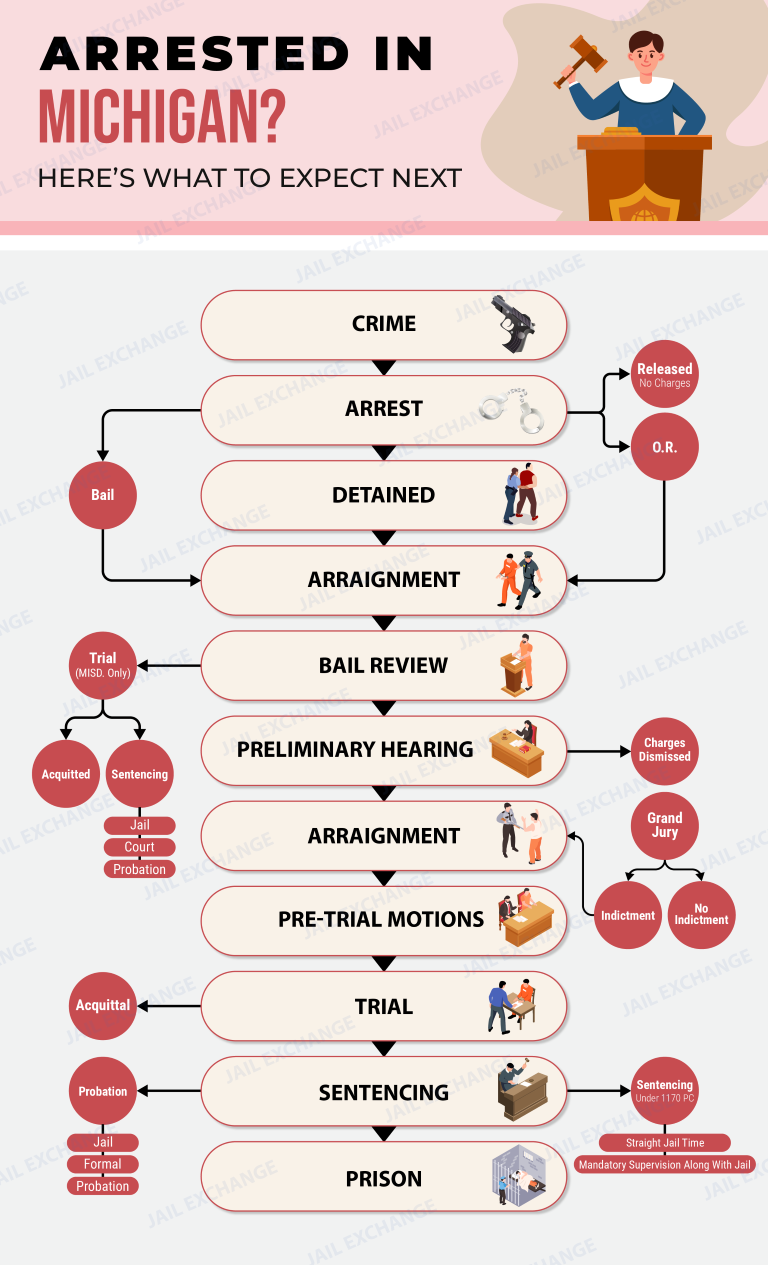
Information for this service is currently unavailable.
Information for this service is currently unavailable.
Information for this service is currently unavailable.
Information for this service is currently unavailable.
Information for this service is currently unavailable.
Information for this service is currently unavailable.
Macomb County County Jails
Nearby counties
- Juvenile Detention: 586-469-5375
The Macomb County Juvenile Justice Center serves the following cities and towns of Macomb County: Center Line, Chesterfield, Clinton, Eastpointe, Fraser, Harrison, Lenox, Macomb, Mount Clemens, New Baltimore, New Haven, Ray, Richmond, Romeo, Roseville, Saint Clair Shores, Shelby, Sterling Heights, Utica, Warren and Washington.