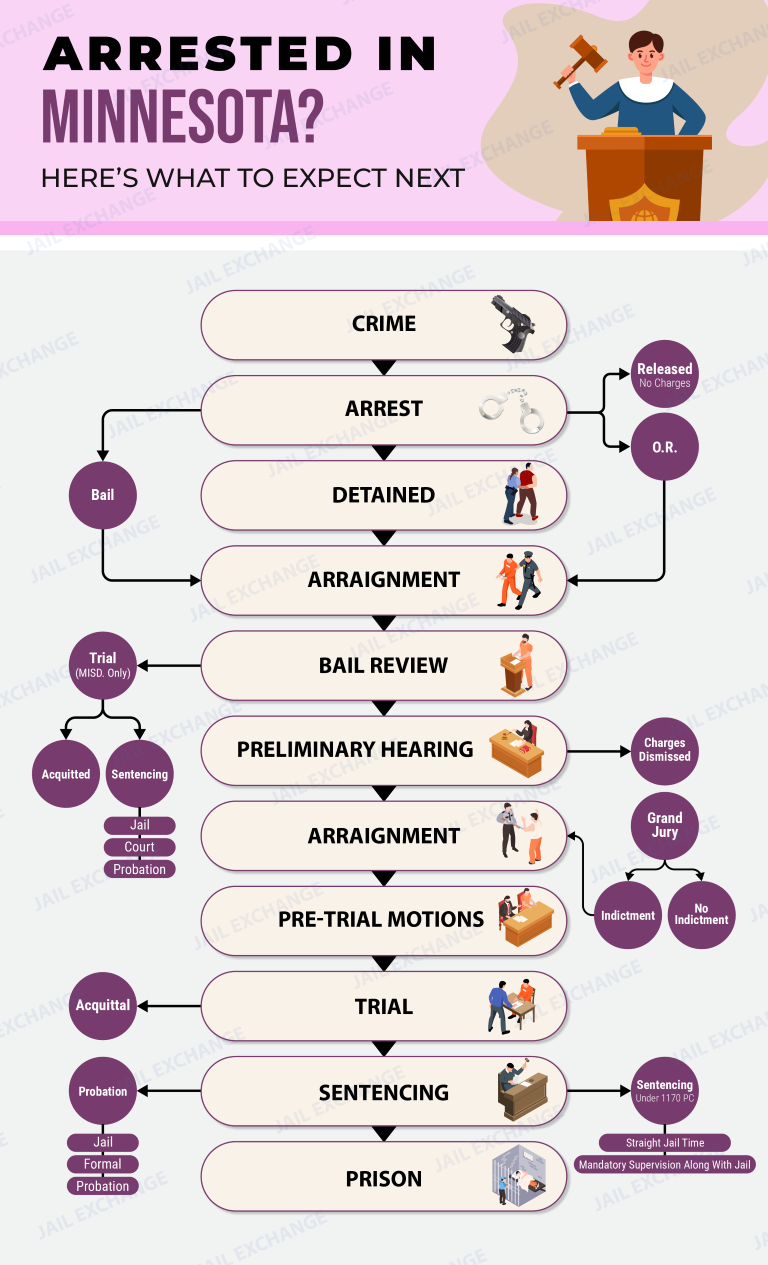
Anoka County, the populous suburban county north of Minneapolis, sends its criminal cases to the Anoka County District Court in the city of Anoka, the county seat. The court belongs to Minnesota's Tenth Judicial District. The elected Anoka County Attorney prosecutes every felony and juvenile case plus misdemeanors from the few remaining townships, while cities such as Blaine, Coon Rapids, Andover, Fridley and Ramsey generally prosecute misdemeanors through their own city attorneys or contracted firms. People held after arrest go to the Anoka County Jail, operated by the Sheriff at the county government center complex in downtown Anoka.
- Anoka County District Court, Court Administration (Tenth Judicial District), Anoka County Courthouse, 2100 Third Avenue, Anoka, MN 55303, (763) 760-6700
- Anoka County Attorney's Office, Anoka County Government Center, 2100 Third Avenue, Anoka, MN 55303, (763) 324-5550
- Tenth Judicial District Public Defender, Anoka office (State Board of Public Defense), representing eligible adults and juveniles in Anoka County; Anoka County clients can reach its Anoka office at 901 West Main Street, Suite 100, Anoka, MN 55303, (763) 422-3350
- Anoka County Jail (Anoka County Sheriff's Office), 325 East Main Street, Anoka, MN 55303, inmate and jail information (763) 324-5100
- Anoka County Community Corrections, Adult Court Services (bail evaluations, pretrial supervision, probation), 2100 Third Avenue, Suite C100, Anoka, MN 55303, (763) 324-4800
- Anoka County Juvenile Center (includes the East Central Regional Juvenile Center), 7555 Fourth Avenue, Lino Lakes, MN 55014, (763) 324-4540
Which court hears your case. Anoka County has a single criminal trial court. A petty misdemeanor ticket from Blaine, a misdemeanor theft from Coon Rapids, a gross misdemeanor DWI from Ham Lake and a felony assault from Columbia Heights are all filed in the Anoka County District Court, because Minnesota does not use city or municipal courts. The charge level decides who prosecutes and which hearings follow. Misdemeanors and gross misdemeanors committed inside a city are usually prosecuted by that city's attorney, which in many Anoka County suburbs is a private law firm the city has hired. Offenses from a township, and every felony regardless of location, are prosecuted by the Anoka County Attorney.
Where pretrial detainees are held. Adults arrested anywhere in Anoka County who are not cited and released are booked into the Anoka County Jail at 325 East Main Street in Anoka, which is part of the same government center complex as the courthouse. Anyone who cannot post bail or satisfy release conditions stays there while the case is pending. Sentenced inmates may later be moved to the separate Anoka County Workhouse run by Community Corrections. For custody status, bail questions and booking information, call the Sheriff's Office at (763) 324-5100.
- The Anoka County courthouse and who works there
- What happens after an arrest in Anoka County
- The Anoka County Jail
- Getting a public defender in Anoka County
- Prosecutors and diversion in Anoka County
- Treatment and specialty courts in Anoka County
- Misdemeanor (for example, theft, a first DWI, fifth-degree assault, trespassing)
- Felony (for example, burglary, felony theft, drug sale, second-degree assault)
- Violent felony (for example, murder, criminal sexual conduct, aggravated robbery)
- Juveniles (under 18) arrested in Anoka County
- Federal cases (U.S. District Court) from Anoka County
The Anoka County courthouse and who works there
Unlike Hennepin County, Anoka County does not spread its criminal calendar across suburban courthouses. Criminal hearings, from arraignments to jury trials, take place at the Anoka County Courthouse at 2100 Third Avenue in Anoka. The building is part of a downtown complex that also houses the County Attorney, Community Corrections and the jail, which means in-custody defendants can be brought to court without leaving the campus.
Several offices share the work of a criminal case there:
- Tenth Judicial District judges preside over Anoka County criminal, juvenile and treatment court calendars.
- Court Administration keeps the files, schedules hearings and accepts fine and bail payments; call (763) 760-6700 with questions about a court date.
- The Anoka County Attorney prosecutes felonies, juvenile delinquency and township misdemeanors.
- City attorneys for the county's cities prosecute misdemeanors and gross misdemeanors from inside city limits.
- The Tenth District Public Defender represents Anoka County defendants who cannot afford a lawyer; its Anoka office is at (763) 422-3350.
- Community Corrections prepares bail evaluations and presentence investigations and supervises people on pretrial release and probation.
Your citation, summons or release paperwork lists the date and courtroom. Arrive early to allow time for security screening.
What happens after an arrest in Anoka County
Anoka County has a dozen or so city police departments plus the Sheriff's Office and the State Patrol, but the process after an arrest is the same no matter which agency made it.
- Citation or custody. For many misdemeanors, officers issue a citation with a court date and the person goes home. For more serious charges, or when there is a safety concern, the person is taken to the Anoka County Jail.
- Booking. Jail staff record personal information, take fingerprints and photographs, inventory property and check for warrants. On many lower-level charges, release is possible by posting an amount set by the court's bail schedule.
- Bail evaluation. For people who remain in custody, Anoka County Community Corrections staff complete a bail evaluation and record check before the first court appearance so the judge has information about ties to the community, prior record and risk.
- The 36-hour rule. A person held in jail must be brought before a judge within 36 hours of arrest, not counting the day of arrest, Sundays or legal holidays. If the arrest was made without a warrant, a judge must also find probable cause within 48 hours.
- First appearance. On a felony or gross misdemeanor this is the Rule 5 hearing; on a misdemeanor it is the arraignment. The judge reads the charge, appoints the public defender if the person qualifies, and sets release terms.
- Release conditions. Anoka County judges typically set two bail amounts: a higher one with no conditions, and a lower one that requires compliance with conditions such as no contact with an alleged victim, no alcohol, electronic monitoring or regular check-ins. Release on recognizance is common for minor cases. Commercial bail bonds are legal in Minnesota.
After release, missing a court date usually leads to a warrant and can result in forfeiture of bail, so keep your contact information current with the court.
The Anoka County Jail
The Anoka County Jail, at 325 East Main Street in Anoka, is run by the Sheriff and holds adults who have been arrested and are awaiting a first appearance, bail or trial. Because it sits in the courthouse complex, defendants in custody are typically escorted directly to their hearings.
Families trying to find someone can use the county's inmate locator or call the Sheriff's Office at (763) 324-5100. Staff can explain whether bail has been set, how it may be posted and when the person is scheduled for court. A bail amount can sometimes be posted at the jail before the first appearance if it was set by schedule; after the hearing, the court's release order controls.
The jail is separate from the Anoka County Workhouse, a Community Corrections facility used primarily for people serving local sentences, and from the Anoka County Juvenile Center in Lino Lakes, which holds youth. Someone convicted and given a local jail term may serve it at the workhouse rather than at the Main Street jail.
Getting a public defender in Anoka County
Public defense in Anoka County is provided by the Tenth Judicial District Public Defender, an office of the State Board of Public Defense that maintains an office in Anoka. Its attorneys represent eligible defendants charged with misdemeanors, gross misdemeanors and felonies, along with juveniles in delinquency cases.
- When to ask. Request a public defender at your first appearance or arraignment. In-custody defendants are often met by a public defender before or at the Rule 5 hearing.
- Who qualifies. Eligibility is based on income, household size and assets. You will complete a financial statement, and the judge decides whether to appoint the office.
- What is covered. Appointed counsel is available whenever a conviction could lead to jail. There is no right to a public defender on a petty misdemeanor, which carries only a fine.
- Conflicts. If the office already represents a co-defendant or has another conflict, the court arranges for a different attorney.
Once appointed, the same attorney or unit usually handles the case through plea or trial and sentencing. If you have not heard from your lawyer before a court date, contact the public defender's Anoka office or ask Court Administration for the attorney's name.
Prosecutors and diversion in Anoka County
Two kinds of prosecutors appear in Anoka County courtrooms. The Anoka County Attorney's Office, at the government center on Third Avenue, charges all felonies, all juvenile delinquency cases and lower-level offenses from township areas. City attorneys, often attorneys at private firms under contract with a city, handle misdemeanors and gross misdemeanors arising within their cities, such as a DWI stop in Andover or a shoplifting case in Blaine.
Diversion is a significant part of the system. Anoka County Community Corrections has run adult diversion assessments at the misdemeanor, gross misdemeanor and felony levels, and participants who complete the program's requirements, which can include classes, restitution, community work and a program fee, can have their charges dismissed. Whether a case qualifies is up to the prosecutor; first-time, nonviolent offenses are the most likely candidates. On the juvenile side, the County Attorney's Office screens delinquency referrals and can route youth to pre-petition diversion.
Prosecutors also make plea offers that may include a continuance for dismissal, a stay of adjudication or a reduced charge. Ask your attorney whether a diversion program or one of these alternatives fits your case.
Treatment and specialty courts in Anoka County
Anoka County operates a treatment court program that combines drug court and veterans treatment court tracks. Participants, usually people whose offenses are tied to substance use or, for veterans, to service-related issues such as PTSD, enter an intensive program with frequent court reviews before a Tenth District judge, chemical dependency treatment, drug and alcohol testing and close supervision by probation. Graduation can lead to a reduced sentence or dismissal, depending on the agreement made at entry.
For repeat or high-risk DWI defendants, Community Corrections has offered intensive pretrial supervision that can include house arrest, remote breath testing and electronic alcohol monitoring, and a domestic assault pretrial program that uses GPS monitoring and testing for higher-risk defendants. Probation also maintains specialized caseloads, including for people with serious mental illness.
Admission to a treatment court is voluntary but selective: the prosecutor, the defense and the treatment team typically must agree. A defense attorney or public defender can explain eligibility and what is expected of participants.
Misdemeanor (for example, theft, a first DWI, fifth-degree assault, trespassing)
Most of the cases on the Anoka County criminal calendar are lower-level offenses. Minnesota groups them into petty misdemeanors, which are not crimes and carry only a fine; misdemeanors; and gross misdemeanors. The last two are crimes that can bring jail and a record.
The arraignment
Whether you arrive with a citation or after a night in the Main Street jail, the first court date is the arraignment. The Tenth District judge explains the charge and your rights, asks whether you want a public defender, takes a plea or sets the case over, and confirms release conditions. If you are prosecuted by a city attorney, a lawyer for that city will be in the courtroom; township and county cases are handled by the County Attorney's Office.
After arraignment
Cases that are not resolved go to a pretrial conference, where the parties discuss diversion or a plea. Anoka County misdemeanors often end in dismissal, a continuance for dismissal, a stay of adjudication (no conviction once probation is completed), a reduced charge, or probation with a fine. A defendant who chooses trial is entitled to a six-person jury that must reach a unanimous verdict, and a speedy-trial demand requires trial within 60 days.
Penalties
- Anoka County petty misdemeanor: a $300 maximum fine, and jail is not an option.
- Anoka County misdemeanor: up to 90 days and $1,000, for offenses such as theft of $500 or less, fifth-degree assault and trespass.
- Anoka County gross misdemeanor: up to 364 days and $3,000; theft of more than $500 up to $1,000 and fifth-degree assault with a qualifying prior fall here.
- First DWI in Anoka County: fourth-degree DWI is a misdemeanor. With one aggravating factor, such as an alcohol concentration of 0.16 or more, a child under 16 in the vehicle, or a test refusal, the charge becomes third-degree DWI, a gross misdemeanor. A chemical use assessment is required, the license revocation proceeds separately from the court case, and ignition interlock, plate impoundment and vehicle forfeiture may apply in aggravated cases.
Most Anoka County misdemeanor cases are completed in one to four months.
Felony (for example, burglary, felony theft, drug sale, second-degree assault)
Felonies, crimes that can bring more than a year in prison, are charged by the Anoka County Attorney through a criminal complaint. Minnesota reserves grand jury indictments for crimes carrying life imprisonment.
Hearings
At the Rule 5 hearing, held within the 36-hour window for a jailed defendant, the judge reviews the complaint, appoints the Tenth District Public Defender when the defendant qualifies, and sets bail and conditions using the Community Corrections bail evaluation. The Rule 8 hearing follows, when the defense receives discovery and the prosecutor may make an offer. At the omnibus hearing the defense can challenge probable cause and seek suppression of evidence obtained through an unlawful search, an improper interrogation or a flawed identification. Many Anoka County felonies resolve at a pretrial settlement conference. A trial requires a unanimous verdict from 12 jurors, and a defendant may demand trial within 60 days.
Sentencing
After a conviction, Community Corrections prepares a presentence investigation. The judge applies the Minnesota Sentencing Guidelines, a grid that matches offense severity with criminal history score to produce a presumptive stayed sentence (probation) or executed sentence (prison). Departures require substantial and compelling reasons.
- Felony theft in Anoka County: over $1,000 can bring up to 5 years, over $5,000 up to 10, and over $35,000 up to 20.
- Burglary in the Tenth District: first degree, up to 20 years; second degree, up to 10; third degree, up to 5.
- Drug sale charged in Anoka: an Anoka County jury's verdict on first-degree sale exposes the defendant to as much as 30 years.
- Second-degree assault charged in Anoka: assault with a dangerous weapon carries up to 7 years, and a firearm triggers a mandatory minimum prison term.
A stay of imposition can leave a misdemeanor on the record instead of a felony after probation is completed. For an executed sentence, two-thirds is ordinarily served in prison and the final third on supervised release. Anoka County felony cases commonly take four to twelve months.
Violent felony (for example, murder, criminal sexual conduct, aggravated robbery)
Violent felonies in Anoka County follow the same Rule 5, Rule 8 and omnibus sequence, but bail is usually high with strict conditions, and many defendants remain in the Anoka County Jail throughout. A first-degree murder charge must be brought by grand jury indictment, which the County Attorney presents.
- First-degree murder in Anoka County: life in prison. Premeditated murder and some other forms carry life without release; for the remaining first-degree murder convictions in Anoka County, parole can be considered after 30 years. Minnesota abolished the death penalty in 1911.
- Second- and third-degree murder: maximums of 40 and 25 years, respectively, in Anoka County.
- First-degree criminal sexual conduct in Anoka County: up to 30 years; 144 months is presumptive for a first offense.
- First-degree aggravated robbery: up to 20 years.
The Tenth District Public Defender represents eligible defendants, often assigning senior trial attorneys. Victims have rights under Minnesota Statutes chapter 611A, including notice of hearings, the right to be present and the right to make a statement at sentencing. Because of forensic work, expert testimony and extensive motions, a violent felony in Anoka County often takes one to two years or longer.
Juveniles (under 18) arrested in Anoka County
Youth under 18 accused of offenses in Anoka County are handled in the juvenile division of the Anoka County District Court. The County Attorney's Office reviews each referral and decides whether to file a delinquency petition; for many first-time and lower-level offenses it uses pre-petition diversion, so the youth can avoid formal charges by completing the program.
Youth who must be held are taken to the Anoka County Juvenile Center at 7555 Fourth Avenue in Lino Lakes, (763) 324-4540, never the adult jail. The center includes secure and non-secure programs and the East Central Regional Juvenile Center, which serves Tenth District counties under a joint powers agreement. A detained youth must have a detention hearing within 36 hours, excluding weekends and holidays. The Tenth District Public Defender represents eligible juveniles.
For serious charges, prosecutors may pursue Extended Jurisdiction Juvenile (EJJ) prosecution for some 14- to 17-year-olds, which adds a stayed adult sentence to the juvenile disposition. Anoka prosecutors can also seek certification to adult court for anyone 14 or older; for 16- and 17-year-olds the law presumes certification when the alleged offense carries a presumptive prison term or involved a firearm. A 16- or 17-year-old in Anoka County charged with first-degree murder is tried as an adult. Most Anoka County juvenile files are kept confidential, but felony records involving youth 16 or older can sometimes be viewed by the public.
Federal cases (U.S. District Court) from Anoka County
Not every arrest in Blaine, Coon Rapids, Fridley or the city of Anoka ends up at the Third Avenue courthouse. When federal law is used, the case moves to the U.S. District Court for the District of Minnesota, and Anoka County is part of that court's Fourth Division, based at the Diana E. Murphy U.S. Courthouse, 300 S. 4th Street, Minneapolis, MN 55415. Federal juries for Anoka County cases are drawn from the Fourth Division and report to Minneapolis, which is also where nearly every hearing takes place, a short drive down Highway 10 or Interstate 35W. For filings and scheduling, the Clerk's Office in Minneapolis answers at (612) 664-5000.
How an Anoka County arrest becomes a federal case
Federal prosecution follows an investigation by a federal agency, sometimes working alongside Anoka County deputies or city police in a joint task force. The usual agencies are the FBI, the DEA, the ATF, Homeland Security Investigations, the IRS and U.S. Postal Inspectors. Charges seen most often include:
- distributing or conspiring to distribute drugs, particularly large quantities or shipments crossing state lines;
- gun crimes, above all possession of a firearm by someone with a felony record;
- fraud schemes involving banks, mail, wire transfers, government programs or investors;
- child exploitation and online enticement offenses;
- robbery of a bank or credit union, and immigration offenses.
A case that starts with an Anoka County Sheriff's arrest can be "adopted" by federal prosecutors, and nothing prevents both Minnesota and the United States from charging the same conduct.
Prosecutor, defense lawyer and Marshals
The U.S. Attorney's Office for the District of Minnesota brings the charges from its Minneapolis office at the U.S. Courthouse, 300 S. 4th Street, Suite 600, Minneapolis, MN 55415, (612) 664-5600; its St. Paul office is at 316 N. Robert Street, Suite 404, St. Paul, MN 55101, (651) 848-1950. Defendants who qualify for appointed counsel are generally represented by the Office of the Federal Defender for the District of Minnesota, 107 U.S. Courthouse, 300 S. 4th Street, Minneapolis, MN 55415, (612) 664-5858. When that office has a conflict, the judge appoints a private lawyer from the Criminal Justice Act (CJA) panel. The U.S. Marshals Service in Minneapolis, (612) 664-5900, transports and holds federal prisoners.
The federal process, start to finish
After an arrest by federal agents, or on a federal warrant or indictment, the defendant goes before a U.S. magistrate judge for an initial appearance, where the charges are explained and a lawyer is appointed if needed. If prosecutors seek detention, a hearing is usually held within three court days. Under the Bail Reform Act, the magistrate judge either releases the person on conditions supervised by U.S. Probation and Pretrial Services or orders detention because no conditions will reasonably assure court appearances and community safety. Bondsmen have no place in this system, and a cash bail amount is seldom set.
A case that began with a criminal complaint needs a grand jury indictment within 30 days of the arrest, or a preliminary hearing, followed by arraignment. The Speedy Trial Act sets a 70-day deadline for trial, measured from indictment or first appearance, but continuances are routine in complex cases. Most federal prosecutions resolve through plea agreements; a trial jury has 12 members and its verdict must be unanimous. Sentencing comes about three months after a plea or verdict, once U.S. Probation finishes a presentence report, and the judge weighs the advisory U.S. Sentencing Guidelines along with any mandatory minimum. Federal prisoners are not paroled. Even with good-conduct time, at least about 85% of the term is served in a Bureau of Prisons facility, and a period of supervised release follows. Appeals are heard by the Eighth Circuit.
Where federal detainees are held
The Marshals Service does not run its own pretrial jail in Minnesota; it houses federal detainees in county jails under contract, across the state and at times outside it. Someone arrested in Anoka County on a federal charge may therefore be moved to a jail in another county. Relatives can call the Minneapolis Marshals office to find out where the person is being held, and once a sentence begins, the Bureau of Prisons inmate locator shows the assigned facility. Anoka County teenagers under 18 are very rarely charged in federal court.
This guide outlines the usual course of a criminal case in Anoka County and is not legal advice. If you or someone close to you has been charged, contact a defense attorney or ask the court to appoint the Tenth Judicial District Public Defender; Anoka County Court Administration can be reached at (763) 760-6700, and the Sheriff's Office jail line at (763) 324-5100.