
Beltrami County Adult Corrections Center
Beltrami County Adult Corrections Center
Jail Phone Number
218-333-4189Beltrami County Inmate Search: Locating Someone Held in Bemidji
Adults held after an arrest in this part of northern Minnesota are taken to the Adult Corrections Center, the county jail at 626 Minnesota Ave NW, Bemidji, MN 56601. The building houses women on its first floor and men on its second, and some people serving time keep their jobs through work release. Below, you can learn about the search, release, visits, deposits, phone time, mail and more.
Start by opening the official jail search. Enter the person's name, and it tells you whether they are behind bars at this moment. Someone booked very recently may not appear yet, so look again a little later. Jail staff on the phone can give the charge, bail and release details.
Phone the jail at 218-333-4189, a number that also reaches the shift supervisor. Have the person's exact name and birthday handy. Staff can then explain the charge, the bail (if any), and the first hearing date. To plan your next move, read our local bail guide and our step-by-step court page.
Read inmate search answers
 Read inmate search answers
1. Is my relative sitting in the Beltrami County jail?
Here is how to run the search:
- Go to the county jail search.
- Type the surname alone at first. If the list is long, add a first name to trim it.
- Nothing there? Try a nickname, then middle or maiden names, then other spellings.
- Once you spot the person, copy down any booking or ID number listed. Staff find the right record faster with it.
- Phone the jail, read that number, and ask about charges, bail and hearings.
Jail staff answer at 218-333-4189. The Sheriff's Records unit handles report requests on weekdays from 8 a.m. to 4:30 p.m. at 218-333-4187.
↑ Back to the question list2. The search shows no result for them. Why?
An empty result usually has an everyday explanation:
- Still in booking. Photos, prints and forms come first, and the record follows.
- Cited and sent home. For most misdemeanors, Minnesota officers may write a ticket that sets a court date and skip the trip to jail (Rule 6.01 of the criminal rules). That choice is off the table for domestic assault, stalking and breaking a protection or no-contact order. Those people are jailed and see a judge (Minn. Stat. 629.72).
- Freed already. Someone posted bail, or the judge set them free at the first hearing.
- Held elsewhere. Picked up across the county line? That county's Sheriff books them.
- Under 18. Kids are handled outside the adult jail.
Still stuck? Call 218-333-4189 and spell out the full name.
↑ Back to the question list3. Where are adults from Beltrami County held?
The county runs one adult jail. Its official name is the Adult Corrections Center, though county pages also call it the county jail.
- Address: 626 Minnesota Ave NW, Bemidji, MN 56601, phone 218-333-4189.
- Who stays there: men on the second floor and women on the first floor.
- Work release: people serving a sentence may ask to keep working. They fill out the jail's Work Release Packet and Questionnaire and bring it back to the jail.
- Size and checks: the Minnesota Department of Corrections licenses the jail and inspects it each year. Its 2026 inspection lists 132 approved beds.
The county is building a new jail on Pioneer Street in Bemidji. The county has not announced a move date, so people are held on Minnesota Avenue for now. The Sheriff's Office sits in the Law Enforcement Center, 613 Minnesota Ave NW, Bemidji, MN 56601, 218-333-9111.
Someone picked up outside the county line is held by that county's Sheriff. Find nearby jails on our list of Minnesota jails.
↑ Back to the question list4. Can I see Beltrami County mugshots?
Minnesota counts mugshots as public records. Booking photos fall under Minn. Stat. 13.82, subd. 26, which makes them public data. An agency can keep one back for a time when releasing it would hurt an active investigation. The arrest record is open too: the charge, whether the person is still held, and when they got out (Minn. Stat. 13.82, subd. 2).
For a copy, go to the agency behind the arrest. When deputies made it, call Sheriff's Records at 218-333-4187 on a weekday. If a city officer did, contact that city's police department.
- Immigration photos: request them with ICE's FOIA form.
- Photos from federal agencies: these generally aren't released. The U.S. Marshals Service may release one, for example while searching for a fugitive.
5. How will I know if they're freed or transferred?
The state's Department of Public Safety offers a free tool called Minnesota VINE. It shows if a person is still in a county jail and names the jail. Signing up brings a notice when the person is let go or transferred.
- Sign up at Minnesota VINELink or by phone at 877-664-8463.
- Registration isn't automatic. Every family member who wants notice has to enroll.
- Once someone moves to state prison, notices come from a Department of Corrections system called Minnesota Haven.
Releases here follow set times. People finishing a sentence usually walk out around 6 a.m. Court-ordered releases happen as soon as the paperwork reaches the jail, as late as 11:59 p.m. For today's status, call 218-333-4189.
↑ Back to the question list6. What decides bail at the first hearing?
A District Court judge makes the release call at the first appearance. For a person arrested with no warrant, Rule 4.02 of the Minnesota Rules of Criminal Procedure sets a 36-hour limit. That count skips the arrest day plus Sundays and legal holidays. Probable cause has a separate 48-hour deadline for the judge, and every day counts toward that one. When the arrest came on a warrant, its own terms control the timing.
- First choice: the judge starts from release on the person's word or an unsecured bond, and Rule 6.02 allows only the conditions that are truly needed.
- Two numbers: a money bail amount with no conditions must be set too. Many orders list a smaller sum that comes with rules and a bigger sum free of them.
- Paying cash: the money goes to the court administrator and stays the defendant's property, even if a relative put it up. Any fines and restitution can come out of it first. By signing court form CRM602, the defendant can send the refund to someone else (Minn. Stat. 629.53).
- Bond agents: an agent needs a Commerce Department license and approval from the state court bail bond program, and Minn. Stat. 60M.02 sets a fee of at least $100, which is never returned.
Call 218-333-4189 to learn where payment is taken today. Court Administration is at 600 Minnesota Ave NW, Suite 108, Bemidji, MN 56601, 218-888-5060. Our bail guide for this county has more detail, and a statewide overview of Minnesota bail law is also available.
↑ Back to the question list7. What charge are they facing?
Call 218-333-4189 for the booking charge. After charges are filed in a formal complaint, Minnesota Court Records Online (MCRO) lists the case. It costs nothing to use. Searching by name or case number brings up each count and the case status. A few juvenile records stay hidden.
Minnesota sorts crimes into four levels, and each has a top penalty:
- Petty misdemeanor: fine only, $300 at most.
- Misdemeanor: the cap is 90 days, a $1,000 fine, or both.
- Gross misdemeanor: the cap is 364 days, a $3,000 fine, or both.
- Felony: a crime punishable by one year or longer in prison, under Minn. Stat. 609.02.
Court Administration can explain what a case entry means. Call 218-888-5060.
↑ Back to the question list8. Who pays for a defense lawyer?
A public defender is an option if money is too tight to hire one. Under Minn. Stat. 611.14, a public defender can be appointed in felony and gross misdemeanor cases, plus any misdemeanor where jail is a possible sentence. Eligibility is decided by the judge after reading a money statement the person fills out under oath. Anyone receiving means-tested benefits is presumed eligible under Minn. Stat. 611.17.
Public defenders who cover this county work out of the Ninth Judicial District's Bemidji office, 619 Beltrami Avenue NW, Suite 240, Bemidji, MN 56601, 218-755-4333.
The first hearing is the right moment to ask. The family is free to hire a private attorney as well. Attorneys get in-person contact visits at the jail.
↑ Back to the question list9. Can family visit, and when?
The jail offers visits seven days a week in three blocks: 7:30 to 11:30 a.m., 2:00 to 5:00 p.m. and 7:00 to 9:00 p.m. A visit has to begin before its block ends. Visits with family happen on screens rather than in person.
- Lobby kiosk: 15 minutes per visit, and a visitor may see only one inmate a day.
- At home: remote video visits run on the TurnKey Corrections system. Create an account at inmatecanteen.com.
- Carry a photo ID in case staff ask. Leave cameras behind.
- Children need a parent or legal guardian along.
- A person covered by a protection, harassment or no-contact order involving the inmate is barred.
- Staff monitor and record every visit.
Read more in our visiting guide, or ask jail staff at 218-333-4189.
↑ Back to the question list10. What ways can I deposit money for them?
Account funds pay for commissary, phone time, email and medical fees. The jail's rules allow these ways in:
- Mail: staff pull cash, money orders and government checks out of letters and post them to the account. The inmate endorses any money order or government check. A money order can be tracked, so it is the safer pick.
- Personal or paycheck checks: they are stored with the person's property rather than deposited.
- Visiting desk: staff accept cash or money orders.
When an inmate owes the jail, half of every deposit pays that balance down. For questions about a lobby kiosk or online deposits, call the jail's administration office at 218-333-4181 on a business day. Our deposit guide covers the basics, and the commissary page lists what it can buy.
↑ Back to the question list11. Can we talk by phone, email or text?
Reliance Telephone runs the jail phones. Inmates call collect or with a prepaid card, bought from staff or at reliancetelephone.com. Jail staff relay incoming calls only in a true emergency.
- Recorded messages: family can leave a brief message on the jail message line, 218-558-3773.
- Email: write through team3.inmatecanteen.com. Each message costs the inmate $0.25. Messages must be in English, and staff review them.
- Texts: an inmate can rent a texting device for $4.00 per 30 days, and each text is $0.09. Load the texting account at reliancetelephone.com.
Since calls can be recorded, discuss the case only in person with the attorney. Our calling guide and e-message guide explain the systems in depth.
↑ Back to the question list12. How should I address a letter?
Use this format, with the inmate's full name on top:
Full Name
Beltrami County Adult Correction Center
626 Minnesota Avenue NW
Bemidji, MN 56601
- Staff scan letters and pictures onto the jail kiosk, where the inmate views them.
- Originals are stored with their belongings and returned when they leave.
- Anything showing gang symbols, graffiti, threats or offensive material is returned.
- If the inmate has been transferred or released, the letter goes back to you.
Before mailing a book or magazine, call 218-333-4189 to ask what is allowed. Our letters guide has general tips.
↑ Back to the question list13. What about clothes and personal items?
The jail stores just what the person had with them when booked. The jail won't accept bags, clothes or other belongings that family drops off later.
Collect leftover items quickly after a release or transfer, because items left more than 30 days get thrown away. Phone 218-333-4189 to ask how to collect them and what ID to bring.
People getting out can also join the jail's Reset Program, a voluntary reentry service run with a social worker. Reach the coordinator at 218-333-8163.
↑ Back to the question list14. Who handles their health care inside?
The county contracts with a medical provider to treat people held here. Tell the jail at 218-333-4189 about any illness, injury or medicine. Give each drug's name and dose, plus the prescriber's name. Inside, the person can tell an officer whenever they feel unwell.
- Each nurse visit is $5.00 and each provider visit is $10.00, charged to the account.
- Care is never refused because someone can't pay.
- Dental work is limited to emergencies.
- If someone plans to turn themselves in, they should bring every current prescription.
Concerns about abuse or sexual assault inside the jail can go to the administration office at 218-333-4181 during business hours.
↑ Back to the question list15. How can I check for a Beltrami County warrant?
The county posts its own warrant lists. To ask whether one exists, call 218-333-9111, or open the county's warrant list and the Sheriff's active warrant listing. The state also keeps a wanted fugitives page for people who broke supervised release.
Open court cases are on the free state case search, though warrants are not part of it.
If a warrant exists, get a lawyer's advice first. Then call court administration for the court that signed the warrant. Turning in at the jail is the other option. Court Administration is at 600 Minnesota Ave NW, Suite 108, Bemidji, MN 56601, 218-888-5060.
↑ Back to the question list16. Where do I find their hearing schedule?
Every state criminal case from this county lands in District Court, which belongs to Minnesota's Ninth Judicial District. Its Court Administration office is in the Judicial Center, 600 Minnesota Ave NW, Suite 108, Bemidji, MN 56601, 218-888-5060.
- The state's free hearing lookup shows coming court dates when you enter a name.
- The omnibus hearing, a session on evidence questions, generally lands in the first 42 days, per Rule 11.01.
- A defendant can insist on a quick trial. Then it has to begin inside 60 days under Rule 11.09.
Under Minn. Stat. 609.49, missing a felony court date is a crime of its own. That extra count goes away when the person comes in on their own within 48 hours. The court process guide explains every stage.
↑ Back to the question list17. Where do federal prisoners from this area go?
A federal case is filed in the U.S. District Court, which covers all of Minnesota as one district and has four courthouses. Fergus Falls is the closest to Bemidji: 118 South Mill Street, Fergus Falls, MN 56537. Reach the clerk at 612-664-5000. Major crimes on the Red Lake Reservation are often prosecuted federally.
- The first steps include a detention hearing under 18 U.S.C. 3142. That is where the judge chooses between release and staying locked up until trial.
- The U.S. Marshals Service keeps custody of federal defendants who are not released before trial. Call its Minneapolis office, 300 South 4th Street, Suite 402, Minneapolis, MN 55415, 612-664-5900, to ask where someone is housed.
- Many federal detainees in Minnesota sleep at the Sherburne County Jail, which is in Elk River. Reach that county's Sheriff's Office at 13880 Business Center Drive NW, Suite 100, Elk River, MN 55330, 763-765-3500.
- There is also a U.S. Probation and Pretrial Services office in Bemidji at 619 Beltrami Avenue, Suite 100, Bemidji, MN 56601, 218-210-6030.
- Once a federal sentence begins, use the BOP's inmate locator.
18. Can ICE keep someone in the Bemidji jail?
When immigration officers want someone held, this is the usual order:
- The paper that starts it all is Form I-247A. Jails call it a detainer.
- On that form, immigration officers ask for the person to be held up to 48 hours after they would otherwise be released. This gives agents a window to come (8 CFR 287.7(d)).
- Minnesota's Attorney General weighed in through an opinion dated February 6, 2025. According to that opinion, state law gives a jail no power to hold someone past release on the detainer alone.
- If ICE takes custody, use the ICE Online Detainee Locator. Have the A-number? Search with it. No A-number? Enter their full name, then choose their birth country.
- Questions can go to ICE's St. Paul Field Office, 1 Federal Drive, Suite 1601, Fort Snelling, MN 55111, 612-843-8600.
19. Where can I trace someone moved to prison?
The Minnesota Department of Corrections handles anyone given a felony prison term. Deputies first drive them from the Bemidji jail to a DOC intake center, where each person is processed and evaluated.
- Look for them on the DOC Offender Locator. Records for brand-new arrivals can lag by a few business days.
- The closing third of most sentences is lived out in the community under DOC supervision. That stretch is called supervised release.
- For prison visits and mail, read our Minnesota state prisons guide.
20. What happens to Beltrami County teens who are arrested?
Under Minnesota law, a person under 18 is a child. Their case belongs in the juvenile court of the District Court. Usually a parent picks the child up. Minn. Stat. 260B.176 sets the limits on holding kids. Holding a child in secure detention for over 36 hours (Saturdays, Sundays and holidays excluded) requires a filed petition plus a court order. Beyond the metro area, a jail or lockup built for adults may hold a youth one day (24 hours) at most, weekends and holidays left out, before that same court step is needed. State inspectors have not approved the Bemidji jail to house juveniles.
The secure youth center in town is the Northwestern Minnesota Juvenile Center, 1231 Fifth Street NW, Bemidji, MN 56619. Court Administration at 218-888-5060 can help you find out where a child is.
For serious charges against 14- to 17-year-olds, there are two other paths. Certification can move the case into adult court. The other route keeps it in juvenile court as an extended jurisdiction juvenile (EJJ) case.
↑ Back to the question list21. Which agencies arrest people in Beltrami County?
The county had an estimated 47,053 residents on April 1, 2025, according to the Minnesota State Demographic Center. Several agencies make arrests here:
- Sheriff's Office: 613 Minnesota Ave NW, Bemidji, MN 56601, inside the Law Enforcement Center, 218-333-9111. That number doubles as the non-emergency dispatch line. Office hours are 8 a.m. to 4:30 p.m., Monday through Friday. For emergencies, use 911.
- City and tribal officers: Bemidji police work inside the city, and tribal officers patrol reservation land. Dispatch can tell you whose officers made the arrest.
- Minnesota State Patrol: its headquarters is 445 Minnesota Street, Suite 130, Saint Paul, MN 55101, 651-201-7100. The State Patrol's contact page lets you choose the county and see the district that covers it.
Ask the arresting agency for its report number when you call.
↑ Back to the question listBeltrami County bail and bond: the Bemidji jail and the new jail on the way
Adults arrested in Beltrami County are held at the Beltrami County Jail, 626 Minnesota Avenue NW, Bemidji, MN 56601. A new jail is being built, so check the address before any visit. This page explains bail and how to pay it.
Look for your person with the sheriff's custody search. Our Beltrami County Inmate Lists page also gives recent arrests and where to turn for a court-appointed lawyer.
Call the Sheriff's Office at 218-333-9111 and ask what the bail is. For hearing dates, see our Beltrami County court page.
1. Is my relative in the Bemidji jail?
Search the name on Beltrami County Inmate Search. It shows custody status and bail when a judge has set one. New bookings can take time to appear.
If the search cannot answer, call the sheriff's office at 218-333-9111. Some websites call the same building the Beltrami County Adult Corrections Center.
↑ Back to the question list2. Is the Beltrami County jail moving to Pioneer Street?
A new jail is planned. The county board voted on November 15, 2022 to go ahead, and the new building is being designed and built at 815 Pioneer Street. The county is still weighing what to do with the old building at 626 Minnesota Avenue NW.
Until the county says the move is done, go to Minnesota Avenue. Phone 218-333-9111 to confirm the front door before you drive.
↑ Back to the question list3. Why is Beltrami building a new jail?
The Minnesota Department of Corrections issued a Notice of Deficiency to the current jail, effective September 30, 2019, calling for large investments. The department's 2026 inspection lists 132 approved beds, with about 119 treated as the working number.
Visits and transfers can change as the project moves forward, so call ahead.
↑ Back to the question list4. How soon will a Beltrami County judge hear the case?
Under Minnesota's rule the first appearance must come within 36 hours of arrest, with the arrest day, Sundays, and legal holidays left out. The probable-cause check has its own 48-hour limit, counting every day.
A person charged only with a misdemeanor who is not seen in time must be let out on a citation.
↑ Back to the question list5. How do I post bail in Bemidji?
The sheriff's office gives the window, hours and payment types by phone, so call it at 218-333-9111 and ask three things: the exact amount, the case number, and where money is taken that day.
State law has the judge order cash bail deposited with the court administrator. Bring photo ID and keep the receipt.
↑ Back to the question list6. What will a bondsman charge in Beltrami County?
A bail bond agent must hold a Commerce license and court approval. The fee is the surety's filed rate, never below $100. The statute names no percentage, so ask for it in writing.
An agent who takes collateral must give a numbered receipt and return it within 21 days of proof the case ended.
↑ Back to the question list7. Can I use land near Bemidji to secure a Beltrami bond?
The rules allow security other than cash, but Beltrami's pages say nothing about property. Call the sheriff at 218-333-9111 and ask which office reviews land or a home, and whether the property must sit in the county. A bondsman cannot take a quitclaim deed as collateral, and any non-cash collateral may be sold only after 30 days' certified-mail notice.
↑ Back to the question list8. What will bail be for a typical Beltrami charge?
There is no statewide schedule in Minnesota, and judicial policy tells courts not to rely on preset ones. A judge looks at the facts, the record, and ties to the community.
A judge can also release with no money at all. Your best source for the real number is Beltrami County Inmate Search after the first hearing.
↑ Back to the question list9. Why does a Beltrami record show no bail or a hold?
Possible reasons: no judge has acted, a probation hold, or a warrant from another county. Minnesota has no death penalty, so bail is a right in every case, yet a judge may limit release when safety is a concern.
For a domestic assault arrest the judge reviews the facts and may order no contact and a firearms turn-in.
↑ Back to the question list10. Where is a Beltrami County teenager taken?
The Beltrami jail has no juvenile hold authority, according to the state inspection, so a youth cannot be kept there. One regional detention center on the state's juvenile list is the Northwestern Minnesota Juvenile Center. Juvenile records are private. Call the sheriff at 218-333-9111 and ask exactly where the youth is.
↑ Back to the question list11. What if tribal police or a city officer made the arrest?
Ask the arresting agency for its name and a report number, then search Beltrami County Inmate Search under the person's full name. If the name still does not appear, give the sheriff's office both the agency and the date.
Court dates always come from whichever court has the case.
↑ Back to the question list12. Who is the free lawyer if we cannot hire one?
The court appoints a public defender to people who qualify, in cases where jail is possible. Ask at the first hearing, or use the state public defender page. The family cannot choose the lawyer. No district office phone is posted on Beltrami's pages, so ask the sheriff's office at 218-333-9111 for the court administration number.
↑ Back to the question list13. What happens if a Beltrami County defendant misses court?
If someone misses a Beltrami hearing, the court can order the bond forfeited and issue a warrant. The court must give the bondsman notice within 30 days, and a judge may forgive part of the penalty in some cases. Call your lawyer and the bondsman right away. A bondsman can also bring the person to court under state law, with a hearing on discharge. Sheriff's dispatch at 218-333-9111 can tell you if a warrant has been entered.
↑ Back to the question list14. Does cash bail come back in Beltrami County?
Yes, usually. Cash bail belongs to the defendant. The court holds the money to the end of the case. A judge may apply it to a fine or restitution, then pay the rest to the defendant or to someone named in writing. Bondsman fees are not returned. Keep the receipt from Beltrami's court administrator and the case number in one folder.
↑ Back to the question list15. How do I avoid a bail scam in the Bemidji area?
Never pay by gift card or an app to someone who phones you. A deputy or clerk will not ask for that. Look up the sheriff yourself and call 218-333-9111.
Bondsmen may not walk the jail looking for clients.
↑ Back to the question list16. Will someone from corrections interview my relative before court?
For some charges, such as crimes of violence and certain domestic assault cases, state law has the local corrections department prepare a pretrial bail evaluation before the first hearing. It can include a financial statement if the person asks for a lawyer. The judge reads it.
The form carries no bail amount. If your relative is asked questions, they should answer truthfully and ask the lawyer later about what was written.
↑ Back to the question listBeltrami County bail and bond contacts
- County jail: Beltrami County Jail, 626 Minnesota Avenue NW, Bemidji, MN 56601
- Bond guide: Jail bail and bond guide
- Custody lookup: Beltrami County Inmate Search
- Sheriff: Jason Riggs; 218-333-9111
- New jail site: 815 Pioneer Street, Bemidji (under construction)
- Public defense: Ask at the first hearing or call 218-333-9111
- Juvenile: No youth hold at the jail; ask the sheriff at 218-333-9111
Numbers, hours, and the jail's location may change as the new building opens. Always confirm with the sheriff before paying.
Beltrami County Visiting Hours and Video Visits
The Beltrami County Adult Corrections Center is at 626 Minnesota Ave NW, Bemidji, MN 56601. Use the jail’s lobby video kiosk, or create an Inmate Canteen account for off-site video visits and email.
Daily visiting hours (Central time)
- 7:30–11:30 a.m.
- 2–5 p.m.
- 7–9 p.m.
The county allows the last visit to start at or before the posted end time. Visits last 15 minutes, and each lobby visitor may visit only one person per day. Bring ID. A visitor younger than 18 must be accompanied by a parent or legal guardian. Cameras are not allowed. Court protection or harassment orders may bar a visit.
For lobby access or help with a visit, call 218-333-4189.

Inmate Canteen Video Visitation allows family members and approved contacts to hold scheduled, face-to-face video visits with incarcerated loved ones from home. Using a computer with a webcam or a mobile device, visitors can connect directly through housing-unit video kiosks without traveling to the correctional facility.
Important: Advance Visitor Clearance Required
Detention centers do not permit unscheduled or unverified video sessions. Correctional facilities require prospective visitors to submit government-issued photo identification and receive administrative clearance before booking an appointment, an approval process that can take up to 48 hours depending on facility staffing. You should verify your visitor approval status with the facility prior to scheduling. If you do not register well in advance, you will miss your loved one's scheduled visiting window for the week.
Step-by-Step Instructions to Register and Schedule a Video Visit
- Visit www.inmatecanteen.com and sign into your account.
- Register your visitor profile and upload a clear photograph of your government-issued ID (driver's license or passport) for facility background review.
- Wait for email notification confirming facility visitor approval.
- Select Video Visitation, choose the detention facility, and select the inmate.
- Browse the available schedule calendar, select an open time slot, and pay the visitation fee using a credit or debit card.
- Log into the website or app 10 minutes prior to the start time on a device with a functioning camera, microphone, and reliable high-speed internet connection.
What the Inmate Needs to Do
The inmate receives a visitation notification on their housing unit video kiosk. At the appointed time, they log in with their PIN and sit before the terminal. Inmates and visitors must strictly observe jail dress and conduct rules; sessions are monitored by staff and will terminate immediately upon any violation.
Official Provider: Inmate Canteen Official Website
Customer Service Telephone: 1-715-690-2965
Support Hours: Monday – Friday, 8:00 AM – 5:00 PM CST
Supported Languages: English and Spanish
Other Services Provided by Inmate Canteen (TurnKey Corrections)
In addition to Remote Video Visitation, Inmate Canteen provides several other communication, financial, and commissary services at participating correctional facilities:
- Commissary & Snack Packs: Order pre-approved snack boxes, food packages, and clothing directly to the jail.
• Learn more on our website: Commissary Orders Guide | • Visit official vendor page: Inmate Canteen Commissary - Digital Messaging & Chirp Texts: Send electronic messages and photos directly to housing pod kiosks and handheld devices.
• Learn more on our website: Digital Messaging Guide | • Visit official vendor page: Inmate Canteen Messaging - Trust & Phone Deposits: Deposit money directly into an inmate's jail trust account or phone calling balance.
• Learn more on our website: Trust & Phone Deposits Guide | • Visit official vendor page: Inmate Canteen Deposits
Beltrami County Criminal Court Help: Misdemeanors, Felonies and Youth Cases
Beltrami County's courthouse office for criminal cases is the District Court in the Ninth Judicial District at 600 Minnesota Avenue NW, Suite 108, Bemidji, MN 56601; court administration is at 218-888-5060. Adults held after arrest go to the Beltrami County Jail, 626 Minnesota Avenue NW, Bemidji, MN 56601, just down the street.
Type a name into the sheriff's jail search to learn who is held. Our Beltrami County Jail Roster page lists warrants and mugshots too.
Ring 218-888-5060 and ask for the next hearing date. If bail was set, our Beltrami County bail page shows what to do.
1. Misdemeanor (for example, theft, a first DWI, fifth-degree assault, trespassing)
Criminal cases from Beltrami County are heard by the Beltrami County District Court in Bemidji, the county seat, as part of Minnesota's Ninth Judicial District. The elected Beltrami County Attorney charges all felonies and juvenile matters plus township misdemeanors, and the City of Bemidji and other cities generally prosecute misdemeanors that happen within their limits. Adults who are held after arrest go to the Sheriff's jail in downtown Bemidji, a few doors from the courthouse.
- Beltrami County District Court, Court Administration (Ninth Judicial District), 600 Minnesota Avenue NW, Suite 108, Bemidji, MN 56601, (218) 888-5060
- Beltrami County Attorney's Office, Bemidji, (218) 333-4219
- Ninth Judicial District Public Defender (State Board of Public Defense), Bemidji office, serving eligible defendants in Beltrami County; Beltrami County clients can reach its Bemidji office at 619 Beltrami Avenue NW, Suite 240, Bemidji, MN 56601, (218) 755-4333
- Beltrami County Jail (Beltrami County Sheriff's Office), 626 Minnesota Avenue NW, Bemidji, MN 56601, Sheriff's Office (218) 333-9111
Which court hears your case. All state criminal charges in Beltrami County, whether a petty misdemeanor, a misdemeanor, a gross misdemeanor or a felony, are filed in the one District Court on Minnesota Avenue NW; Minnesota has no city courts. The seriousness of the charge decides who prosecutes and which hearings follow. A misdemeanor or gross misdemeanor committed in Bemidji or another city is normally prosecuted by that city's attorney or a contracted firm, and the same offense in a township is handled by the County Attorney, who is also the prosecutor on every felony. Offenses involving tribal members within the Red Lake Nation are generally handled by tribal or federal courts rather than this court, so the jurisdiction question can matter in parts of the county.
Where pretrial detainees are held. Adults who are arrested in Beltrami County and not released are booked into the Beltrami County Jail at 626 Minnesota Avenue NW in Bemidji, which the Department of Corrections licenses for about 132 beds and which the county is replacing with a new facility. Defendants who cannot meet bail or conditions stay there until their cases are resolved. The Sheriff's Office can confirm custody status and bail information.
Beltrami County District Court treats petty misdemeanors, misdemeanors and gross misdemeanors as the lower end of the criminal calendar. Only the petty misdemeanor is a non-criminal, fine-only offense; the other two can bring jail and a criminal record.
What happens right after the arrest
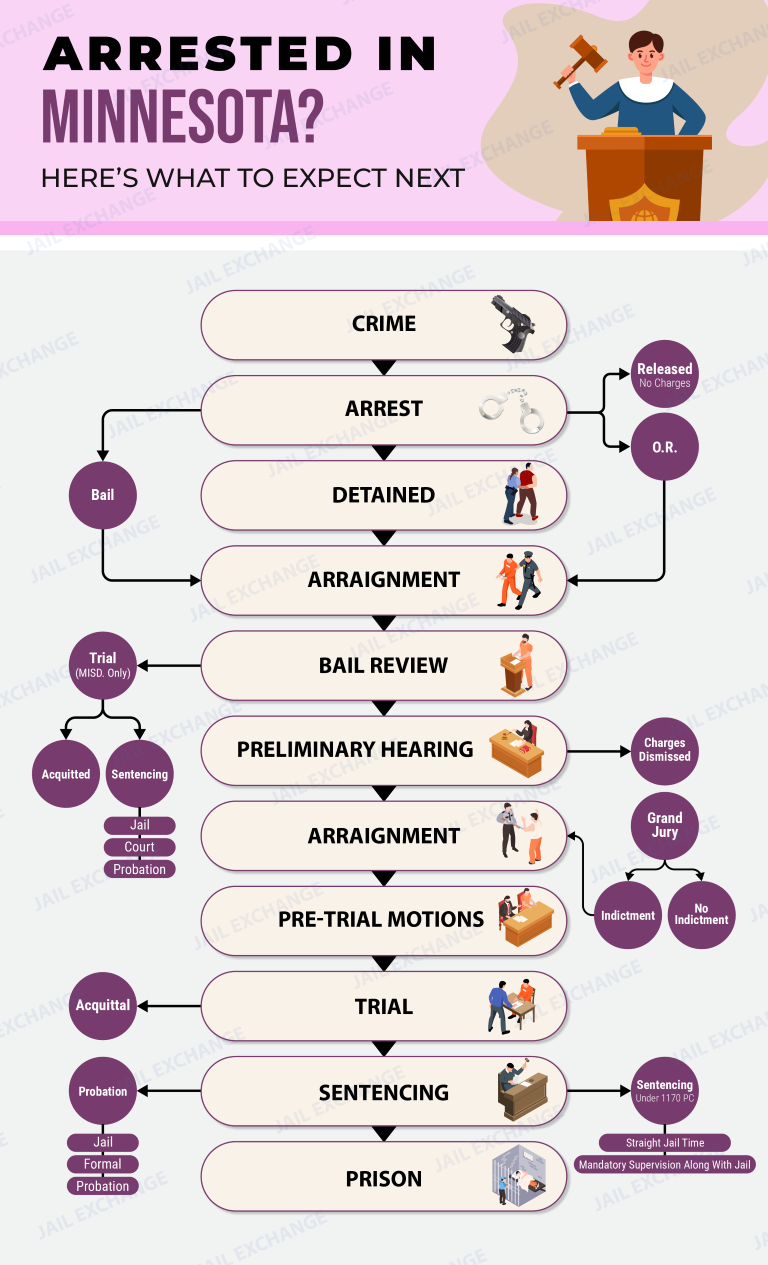
Officers in Bemidji and around Beltrami County often issue a citation and let the person go with a court date. A custodial arrest means booking at the Minnesota Avenue jail, where bail from the standard schedule can sometimes be posted the same day. Those not released must appear before a judge within 36 hours of arrest, leaving out the day of arrest, Sundays and legal holidays, and a warrantless arrest requires a judge's probable-cause review inside 48 hours.
The arraignment in Bemidji
At arraignment a Beltrami County judge informs the defendant of the charge, rights and maximum penalty, then addresses release. The usual approach is to set two bail amounts, one higher and unconditional and one lower that requires the defendant to follow conditions such as no contact, no alcohol or check-ins. Many people are released without posting money. Bail bond companies may operate in Minnesota.
Appointed counsel
Request a public defender at arraignment if you face possible jail and cannot afford an attorney. A financially eligible defendant in Beltrami County is assigned a lawyer from the Ninth District Public Defender's Bemidji office.
Resolution and penalties
After arraignment comes a pretrial conference. Beltrami County misdemeanors commonly end in dismissal, a continuance for dismissal, a stay of adjudication, a plea to a lesser offense, or a sentence of fines and probation. A defendant who goes to trial faces a jury of six that must be unanimous and can demand trial within 60 days.
- Petty misdemeanor (Beltrami County): no jail; fine capped at $300.
- Misdemeanor (Beltrami County): a 90-day jail maximum and a $1,000 fine; this includes theft of $500 or less, fifth-degree assault and trespass.
- Gross misdemeanor (Beltrami County): up to 364 days and $3,000, including theft over $500 but not over $1,000, and repeat fifth-degree assault.
- First DWI (Beltrami County): a fourth-degree misdemeanor in a basic case; one aggravating factor, such as a reading of 0.16 or more, a child under 16 riding along, or a test refusal, makes it third-degree, a gross misdemeanor. License revocation is a separate civil process, a chemical use assessment is required, and interlock, plate impoundment or forfeiture can apply when the case is aggravated.
These cases usually finish in one to four months.
↑ Back to the question list2. Felony (for example, burglary, felony theft, drug sale, second-degree assault)
Felonies, crimes with a potential sentence over one year, are charged in Beltrami County by the County Attorney through a written complaint. A grand jury is convened only for offenses that carry life in prison.
Court steps
For a defendant in custody, the Rule 5 first appearance comes within 36 hours. The Beltrami judge reviews the complaint, appoints counsel for eligible defendants and sets bail and release conditions. The Rule 8 hearing that follows is when the defense receives reports and the prosecution may make an offer. The omnibus hearing is the main opportunity to challenge probable cause or the way police gathered evidence. Most Beltrami County felony cases are settled through negotiation; the remainder are tried before 12 jurors who must reach a unanimous verdict, and a defendant can insist on trial within 60 days.
Representation
Attorneys from the Ninth District Public Defender's Bemidji office represent qualifying felony defendants in Beltrami County through every stage, including sentencing.
Sentencing ranges
Probation prepares a presentence investigation, and the Minnesota Sentencing Guidelines combine the crime's severity ranking with criminal history to point to a presumptive stayed or executed sentence. Judges need substantial and compelling reasons to depart.
- Beltrami felony theft: a 5-year cap above $1,000, 10 years above $5,000, and 20 years above $35,000.
- Beltrami burglary: 20 years at most for first degree, 10 for second degree and 5 for third degree.
- Beltrami drug sale: first-degree sale is punishable by as much as 30 years.
- Beltrami second-degree assault: using a dangerous weapon can bring 7 years, and use of a firearm triggers a mandatory minimum.
A stay of imposition, if probation is successful, leaves a misdemeanor on the record instead of a felony. In a prison case the inmate typically serves two-thirds of the term before release to supervision. Beltrami County felonies generally resolve within four to twelve months.
↑ Back to the question list3. Violent felony (for example, murder, criminal sexual conduct, aggravated robbery)
Violent felonies charged in Beltrami County follow the standard felony hearings, but bail is often high and strict, and many defendants stay in the Bemidji jail for the duration. First-degree murder requires an indictment from a grand jury.
- Beltrami County first-degree murder: life imprisonment, with no release for premeditated murder and certain other forms and parole eligibility at 30 years otherwise. The death penalty has not existed in Minnesota since 1911.
- Second- or third-degree murder: a maximum of 40 or 25 years.
- Beltrami County first-degree criminal sexual conduct: up to 30 years, with a presumptive 144 months on a first conviction.
- First-degree aggravated robbery: up to 20 years.
Eligible defendants are represented by the Ninth District Public Defender. Crime victims may receive notice, attend proceedings and give a statement at sentencing under Minnesota Statutes chapter 611A. A violent felony in Beltrami County often takes one to two years, sometimes longer.
↑ Back to the question list4. Juveniles (under 18) arrested in Beltrami County
When someone under 18 is accused of an offense in Beltrami County, the case belongs to the juvenile division of the Beltrami County District Court. Any delinquency petition comes from the County Attorney, who often sends first-time offenders to diversion instead.
Youth who need to be detained are typically held at the Northwestern Minnesota Juvenile Center in Bemidji, a regional facility with secure detention that receives more Beltrami County youth than any other county's. A detention hearing must be held within 36 hours, not counting weekends and holidays, and the Ninth District Public Defender represents eligible juveniles.
For serious offenses, some 14- to 17-year-olds may be prosecuted as Extended Jurisdiction Juveniles (EJJ), which carries a stayed adult sentence alongside the juvenile disposition. Youth 14 and older can be certified to adult court, and for 16- and 17-year-olds certification is presumed when the charge carries a presumptive prison sentence or involved a firearm. A 16- or 17-year-old charged with first-degree murder is tried in adult court. Juvenile records in Beltrami County are largely confidential, but certain felony records for youth 16 and older may be open.
↑ Back to the question list5. Federal cases (U.S. District Court) from Beltrami County
Beltrami County sends more cases to federal court than most rural counties, largely because of the Red Lake Reservation. Within the District of Minnesota, the county is assigned to the Sixth Division, which sits at the Edward J. Devitt U.S. Courthouse and Federal Building, 118 S. Mill Street, Fergus Falls, MN 56537, roughly two hours southwest of Bemidji. Jurors for a Beltrami County trial come from the Fergus Falls division, but early hearings such as the initial appearance and the detention hearing are often held in Minneapolis or St. Paul.
Red Lake and federal jurisdiction
Minnesota is a Public Law 280 state, meaning the state prosecutes most crimes on reservations. The Red Lake Reservation, which lies mainly in Beltrami and Clearwater counties, is an exception. There, serious offenses listed in the federal Major Crimes Act, including murder, manslaughter, sexual abuse and assault resulting in serious bodily injury, are prosecuted by the United States rather than by the Beltrami County Attorney, typically after investigation by the FBI with tribal law enforcement. Lesser offenses are generally left to the Red Lake tribal court. Which system applies can turn on where the offense happened and who was involved, so a lawyer should look closely at those facts.
Other federal cases from the county
Off the reservation, a federal charge usually follows work by the FBI, DEA, ATF, Homeland Security Investigations, the IRS or U.S. Postal Inspectors, in matters such as drug trafficking (especially quantity or interstate cases), illegal gun possession by people with felony records, fraud, child exploitation, bank robbery and immigration crimes. An arrest by Bemidji police or the Sheriff can be adopted federally, and the same conduct may draw both state and federal charges.
The people and the process
Prosecution is handled by the U.S. Attorney's Office for the District of Minnesota, 300 S. 4th Street, Suite 600, Minneapolis, MN 55415, (612) 664-5600, with a second office at 316 N. Robert Street, Suite 404, St. Paul, MN 55101, (651) 848-1950. The Office of the Federal Defender, 107 U.S. Courthouse, 300 S. 4th Street, Minneapolis, MN 55415, (612) 664-5858, represents most defendants who cannot pay a lawyer; a CJA panel attorney is appointed if it has a conflict. A magistrate judge conducts the first appearance, and a detention hearing generally comes within three court days when the government asks. Release, if granted, is on conditions supervised by U.S. Probation and Pretrial Services, not on a bond bought from a bondsman. Indictment must follow within 30 days of an arrest on a complaint, unless a preliminary hearing is held, and then comes arraignment. The 70-day Speedy Trial Act limit is often extended, most cases end in plea agreements, and a unanimous 12-person jury decides any trial. Sentencing is about three months later under the advisory Guidelines and any mandatory minimum, after a presentence report. There is no federal parole; roughly 85% of the term is served in the Bureau of Prisons even with good-conduct time, then supervised release. Appeals go to the Eighth Circuit.
The U.S. Marshals Service (Minneapolis (612) 664-5900) places pretrial federal detainees in contract county jails around Minnesota and sometimes beyond, so someone arrested near Bemidji may be held in another county; the Marshals can tell family where. The Bureau of Prisons inmate locator covers sentenced prisoners. Federal cases against minors are rare.
↑ Back to the question listThis summary explains the general flow of criminal cases in Beltrami County and should not be taken as legal advice. Speak with a defense attorney about your situation, or ask the judge to appoint the Ninth District Public Defender; Beltrami County Court Administration can be reached at (218) 888-5060.
Inmate Canteen (operated by TurnKey Corrections) allows friends and family members to purchase pre-approved commissary packages, including brand-name snacks, confectionery goods, personal hygiene products, stationery, and apparel kits sent directly to an incarcerated loved one. Every package is packed to adhere strictly to facility security regulations, ensuring items pass institutional intake without being rejected at the loading dock.
Important: Package Deadlines and Delivery Windows Vary
Detention centers do not manage care package deliveries under identical schedules. While some facilities allow weekly orders, others restrict deliveries to bi-weekly or monthly distribution windows, and spending limits vary from jail to jail. You should verify the facility's active cutoff schedule and order allowances by calling them directly. If an order is submitted after the weekly processing deadline, delivery will be held until the following cycle, leaving your loved one waiting an extra cycle for fresh snacks, thermal wear, or personal care supplies.
Step-by-Step Instructions to Place a Commissary Package Order
- Confirm the inmate's legal first and last name, date of birth, and assigned booking or inmate ID number.
- Navigate to www.inmatecanteen.com and sign in or create a user profile.
- Select Commissary / Store and choose your state and detention center.
- Search for the inmate to unlock the facility's approved product catalog.
- Select allowable snack foods, candies, personal care goods, and clothing items up to the facility's allowed spending limit.
- Proceed to checkout, enter your debit or credit card billing details, and submit payment.
- Save your digital receipt and confirmation tracking number for your records.
What the Inmate Needs to Do
The inmate does not need an internet account to receive care packages. TurnKey Corrections prepares the order in secure, tamper-evident packaging and delivers it directly to the jail commissary department. Facility staff inspect the shipment and deliver the items during regular housing unit commissary rounds, where the inmate signs for receipt.
Official Provider: Inmate Canteen Official Website
Customer Service Telephone: 1-715-690-2965
Support Hours: Monday – Friday, 8:00 AM – 5:00 PM CST
Supported Languages: English and Spanish
Other Services Provided by Inmate Canteen (TurnKey Corrections)
In addition to Commissary Care Packages, Inmate Canteen provides several other communication, financial, and visitation services:
- Tablets & Chirp Units: Learn how secure handheld devices allow inmates to communicate, read, and message.
• Learn more on our website: Tablet Programs Guide | • Visit official vendor page: Inmate Canteen Devices - Remote Video Visitation: Schedule and join live face-to-face video visits from your computer or smartphone.
• Learn more on our website: Video Visitation Guide | • Visit official vendor page: Inmate Canteen Video Visits - Digital Messaging: Send electronic messages and photos directly to housing pod kiosks and handheld devices.
• Learn more on our website: Digital Messaging Guide | • Visit official vendor page: Inmate Canteen Messaging - Trust & Phone Deposits: Deposit money directly into an inmate's jail trust account or phone calling balance.
• Learn more on our website: Trust & Phone Deposits Guide | • Visit official vendor page: Inmate Canteen Deposits
Buy Commissary for an Inmate in the Beltrami County Adult Corrections Center
Beltrami County Adult Corrections Center Inmate Commissary - Sending Money or Purchasing Commissary for an Inmate
Beltrami County Adult Corrections Center allows inmates to purchase commissary. This can be snacks, hygiene products, stamps, stationary, clothing and even electronics.
You can buy commissary for an inmate using an online service called Inmate Canteen.
Inmate Canteen Customer Service can be reached at 715-690-2965, or by email at support@inmatecanteen.com.

There is a monthly limit of $200-300 on how much inmates can spend on commissary items.
This amount is subject to change so call the facility at 218-333-4189 in order to confirm the amount that cannot be exceeded.
Inmates have access to both an in-house commissary store, and commissary packages that can be purchased and shipped to the inmate by friends and family.
Scroll down for information on the Beltrami County Adult Corrections Center's service they use for you being able to purchase commissary items online and have them shipped directly to the inmate.
You can also go to our Inmate Money page for information on how to send money to an inmate.
Inmate Canteen Trust & Phone Deposits allow friends and family members to transfer money directly into an incarcerated person's jail trust account or telephone calling balance using a credit or debit card. Deposited funds give your loved one the financial balance needed to buy personal care goods, over-the-counter medication, snacks, and phone talk time from the facility canteen.
Important: Facility Banking Policies Vary Across Jails
Once a person is booked and moved to a cell, facilities do not always allow cash drop-offs or phone payments directly to the jail window. Some might and you should confirm this by calling the facility and asking. But if you do not register online and fund your loved one's trust account immediately, they may be forced to wait days or weeks for standard paper processing, leaving them without essential soap, clean undergarments, basic medical sundries or snacks.
Step-by-Step Instructions to Register and Deposit Funds
- Confirm the inmate's legal first and last name, date of birth, and assigned booking or inmate ID number.
- Navigate to www.inmatecanteen.com on your computer or mobile device.
- Click on Deposit Funds and select whether to fund the Trust Account (for commissary) or Phone Account (for talk time).
- Select the state and facility where the inmate is currently housed.
- Search for the inmate to confirm their active housing record matches the facility roster.
- Enter your deposit dollar amount, review convenience fees, and enter your debit or credit card billing details.
- Submit payment and save the digital confirmation receipt for your financial records.
What the Inmate Needs to Do
The inmate does not need an internet connection to receive trust funds. Once payment clears, the balance posts directly to their accounting profile in the jail's internal system. The inmate can review their updated balance at the pod kiosk terminal and place their regular weekly commissary order or make outbound phone calls.
Official Provider: Inmate Canteen Official Website
Customer Service Telephone: 1-715-690-2965
Support Hours: Monday – Friday, 8:00 AM – 5:00 PM CST
Supported Languages: English and Spanish
Other Services Provided by Inmate Canteen (TurnKey Corrections)
In addition to Trust & Phone Deposits, Inmate Canteen provides several other communication, financial, and commissary services at participating correctional facilities:
- Commissary & Snack Packs: Order pre-approved snack boxes, food packages, and clothing directly to the jail.
• Learn more on our website: Commissary Orders Guide | • Visit official vendor page: Inmate Canteen Commissary - Remote Video Visitation: Schedule and join live face-to-face video visits from your computer or smartphone.
• Learn more on our website: Video Visitation Guide | • Visit official vendor page: Inmate Canteen Video Visits - Digital Messaging & Chirp Texts: Send electronic messages and photos directly to housing pod kiosks and handheld devices.
• Learn more on our website: Digital Messaging Guide | • Visit official vendor page: Inmate Canteen Messaging
Deposit Money for an Inmate in the Beltrami County Adult Corrections Center
The Beltrami County Adult Corrections Center, 626 Minnesota Ave. NW in Bemidji, adds money to a person's account when it comes by mail, at a visit, online or at the kiosk.
- Money order by mail: Make it out to the person's full name and put their inmate ID on the memo line. Mail it to the person's name, Beltrami County Adult Corrections Center, 626 Minnesota Ave. NW, Bemidji, MN 56601. The person signs the back before staff deposit it. Government checks are handled the same way.
- At a visit: The visiting desk takes cash or a money order for the person.
- Online or lobby kiosk: Use Inmate Canteen with a debit or credit card, or the kiosk in the lobby with cash or a card. Questions about either go to the administration office at 218-333-4181 on business days.
Cash found in mail is added too, but a money order can be tracked and cash cannot. Personal checks and paychecks are not deposited; they go into the person's stored property. If the person owes the jail, half of each deposit pays that debt and they get the other half. Money covers commissary, phone time, kiosk emails and medical co-pays.
The Beltrami County Adult Correction Center on Minnesota Avenue NW in Bemidji, Minnesota, is the county jail. Personal letters and the photos in them are scanned at the jail and shown to the inmate on a kiosk, while the paper goes into their property until release. Scanning helps keep out paper that was soaked in drugs and dried before mailing.
Letters, legal mail, money and publications:
Inmate's Full Name & Inmate ID#
Beltrami County Adult Correction Center
626 Minnesota Avenue NW
Bemidji, MN 56601
- Money in the mail: Staff take cash, money orders and government checks out of the envelope and add them to the account. The inmate must sign the back of a money order or government check before it can be deposited. Use the inmate's full name as the payee, with their inmate ID number written in the memo area. If you are unsure, call 218-333-4189 to confirm.
- Checks that won't post: Personal and paycheck checks are put in the inmate's property locker instead.
- Legal mail: Mail from an attorney or a court is opened in front of the inmate and checked for contraband, but staff don't read it.
- Sent back: Letters with gang signs or graffiti, or with offensive or threatening content, are returned to you. So is mail for anyone transferred or released.
- Stamps and envelopes: Any not bought at the jail are stored with the person's property.
- Books and magazines: They must be new and shipped directly by the publisher or a store, and hardcovers are not allowed.
- How to write: Blue or black ink, no markers or crayon, and no glitter, perfume, confetti or drawings. Any greeting card has to be a plain one with no sound chip.
- Your details: Your full name and address need to be printed in the top left corner of the envelope.
Money can also be added through online deposits, and quick notes can be sent as electronic messages.

Reliance Telephone provides telecommunications systems, inmate texting devices, and prepaid calling accounts for county jails across the upper Midwest. Opening a Reliance account allows families to purchase talk time or fund SMS text messaging credits so incarcerated individuals can maintain regular contact from housing unit kiosks and wireless devices.
Important: Mobile Calling Blocks and Messaging Approvals Vary
Inmates cannot receive incoming phone calls, and wireless providers automatically block collect calls from jail systems. While some facilities provide direct text messaging units, device availability and call permissions vary depending on facility housing rules, which you can confirm with the facility directly. If you do not register online and fund your account in advance, your loved one will not be able to connect calls or send text updates to your phone.
Step-by-Step Instructions to Register and Fund Reliance Services
- Visit www.reliancetelephone.com or call 1-800-896-3201.
- Select Create Account and register your 10-digit telephone number and email address.
- Choose your state and the detention facility where the inmate is housed.
- Link the inmate using their full legal name or facility booking ID.
- Select whether to purchase a Phone Card, fund an Inmate Texting Account, or set up Prepaid Collect Calling.
- Enter your debit or credit card billing details, complete payment, and save your receipt.
What the Inmate Needs to Do
The inmate dials your number from a dayroom wall phone or accesses their texting device using their PIN. The system verifies that calling or messaging units are funded and allows the conversation to proceed. All non-privileged communications are subject to recording and monitoring.
Official Provider: Reliance Telephone Official Website
Customer Service Telephone: 1-800-896-3201
Support Hours: Monday – Friday, 8:00 AM – 5:00 PM CST
Supported Languages: English and Spanish
Other Services Provided by Reliance Telephone
In addition to Prepaid Calling Accounts, Reliance offers texting and voice mail features at participating facilities:
- Inmate Texting & Messaging: Send two-way digital text messages to dedicated inmate handheld devices.
• Learn more on our website: Inmate Texting Guide | • Visit official vendor page: Reliance Texting Services
Inmate Canteen Digital Messaging allows friends and family members to send electronic text messages and digital photos directly to an incarcerated loved one. Messages are delivered electronically to housing unit kiosks and Chirp handheld devices within hours, avoiding the lengthy delivery times associated with postal mail.
Important: Electronic Mail Guidelines Vary by Facility
Correctional facilities enforce strict rules regarding incoming correspondence. While some jails continue to accept paper letters, many facilities restrict physical postal mail or mandate digital message screening, which you can verify by checking facility rules. If you do not register online and set up message credits immediately, your loved one may face lengthy periods without direct written contact from family.
Step-by-Step Instructions to Register and Send Messages
- Go to www.inmatecanteen.com and sign in or create a user profile.
- Select Email / Messaging and choose your state and detention facility.
- Search for the inmate using their legal first and last name or booking ID number.
- Purchase messaging credits using a credit or debit card.
- Type your message in the text box and attach approved digital images if permitted by the facility.
- Submit your message to the facility's screening queue.
What the Inmate Needs to Do
All electronic correspondence is screened by facility staff before delivery. Once approved, messages appear in the inmate's inbox on their housing unit kiosk or assigned handheld Chirp device. The inmate opens the message, reads your note, and types an electronic reply using their available account credits.
Official Provider: Inmate Canteen Official Website
Customer Service Telephone: 1-715-690-2965
Support Hours: Monday – Friday, 8:00 AM – 5:00 PM CST
Supported Languages: English and Spanish
Other Services Provided by Inmate Canteen (TurnKey Corrections)
In addition to Digital Messaging, Inmate Canteen provides several other communication, financial, and commissary services at participating correctional facilities:
- Commissary & Snack Packs: Order pre-approved snack boxes, food packages, and clothing directly to the jail.
• Learn more on our website: Commissary Orders Guide | • Visit official vendor page: Inmate Canteen Commissary - Remote Video Visitation: Schedule and join live face-to-face video visits from your computer or smartphone.
• Learn more on our website: Video Visitation Guide | • Visit official vendor page: Inmate Canteen Video Visits - Trust & Phone Deposits: Deposit money directly into an inmate's jail trust account or phone calling balance.
• Learn more on our website: Trust & Phone Deposits Guide | • Visit official vendor page: Inmate Canteen Deposits
Inmate Canteen (TurnKey Corrections) provides specialized handheld tablets and Chirp communication units to incarcerated individuals in county detention centers. Running over a secure internal wireless network, these devices allow inmates to send and receive text messages, submit facility requests, review commissary balance accounts, and read digital materials directly from their living areas.
Important: Tablet Hardware Deployment and Rental Rules Vary
Detention centers do not manage tablet distribution identically. While some agencies issue individual personal tablets to every detainee at booking, others utilize shared pod docking stations or restrict tablet use to specific dayroom hours, which you should confirm with the facility directly. Although core educational and legal resources are generally provided free of charge, sending messages, initiating video calls, or making phone calls from the tablet requires an active balance funded by outside contacts.
Step-by-Step Instructions to Support and Fund Tablet Use
- Confirm that TurnKey Corrections / Inmate Canteen tablets or Chirp devices are active at the facility.
- Navigate to www.inmatecanteen.com and sign into your user profile.
- Link the inmate to your account by state, detention facility, and their legal name or booking ID.
- Select Messaging / Chirp Funds or Trust Deposits to add funds to their available balance.
- Specify your deposit amount, review convenience fees, and enter your credit or debit card billing details.
- Submit payment, save your confirmation receipt, and notify your loved one that their device balance is available.
What the Inmate Needs to Do
The inmate logs into their assigned tablet or Chirp device using their personal PIN. They can review their available messaging balance, read incoming family correspondence, and type replies directly on the device. Tablets are returned to docking stations during facility count times and for overnight charging.
Official Provider: Inmate Canteen Official Website
Customer Service Telephone: 1-715-690-2965
Support Hours: Monday – Friday, 8:00 AM – 5:00 PM CST
Supported Languages: English and Spanish
Other Services Provided by Inmate Canteen (TurnKey Corrections)
In addition to Tablet Services, Inmate Canteen provides several other communication, financial, and commissary services:
- Commissary & Care Packages: Order pre-approved snack boxes, food packages, and clothing directly to the jail.
• Learn more on our website: Commissary Orders Guide | • Visit official vendor page: Inmate Canteen Commissary - Remote Video Visitation: Schedule and join live face-to-face video visits from your computer or smartphone.
• Learn more on our website: Video Visitation Guide | • Visit official vendor page: Inmate Canteen Video Visits - Digital Messaging: Send electronic text messages and digital photos directly to housing pod kiosks and handheld devices.
• Learn more on our website: Digital Messaging Guide | • Visit official vendor page: Inmate Canteen Messaging - Trust & Phone Deposits: Deposit money directly into an inmate's jail trust account or phone calling balance.
• Learn more on our website: Trust & Phone Deposits Guide | • Visit official vendor page: Inmate Canteen Deposits
Beltrami County Juvenile Facilities
- Jail (Main): 218-333-4189
- Sheriff: 218-333-9111
The Beltrami County Adult Corrections Center serves the following cities and towns of Beltrami County: Bemidji, Blackduck, ?ail, Fourtown, Kelliher, Nebish, Northome, Pinewood, Redby, Solway, Tenstrike and Wilton.