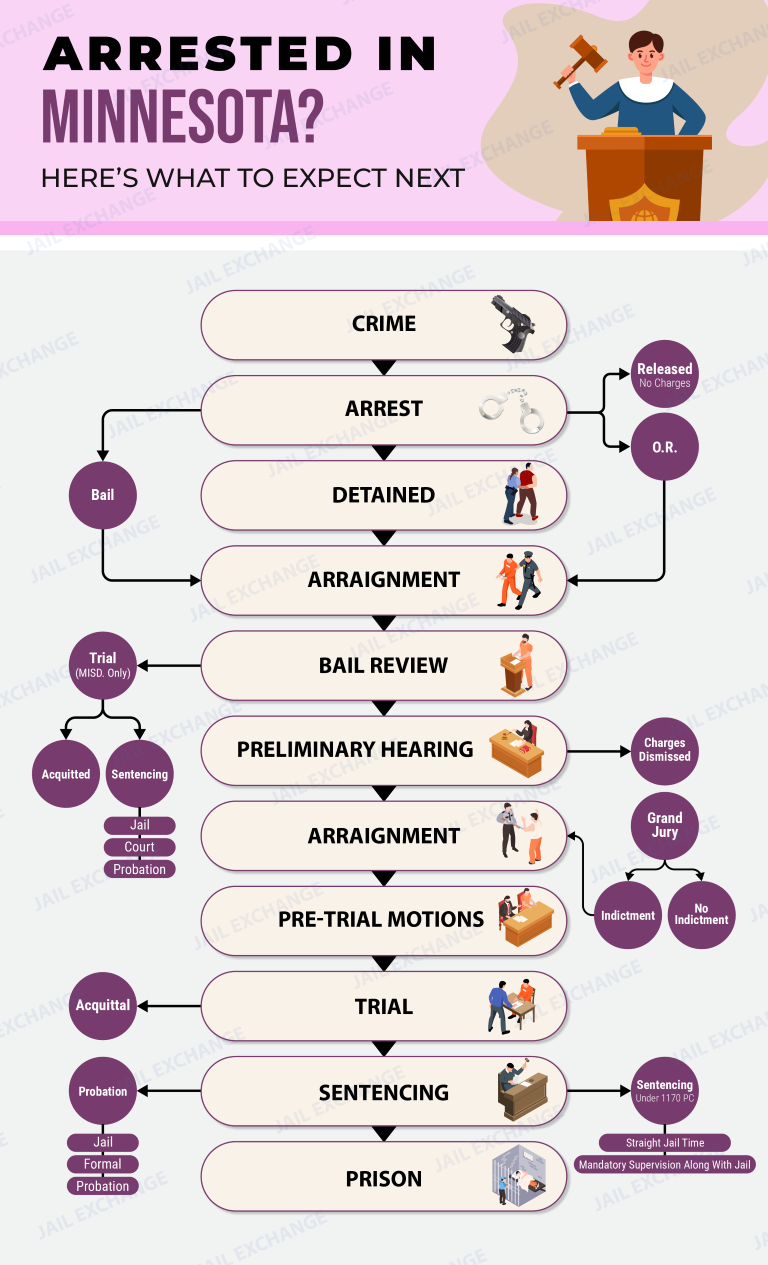
Murray County Jail Criminal Court Process
Criminal Court Process for Murray County Minnesota
Murray County Criminal Court Process: From Arrest to Sentencing in Slayton
The Murray County District Court sits at 2500 28th Street, Slayton, MN 56172, and it belongs to Minnesota's Fifth Judicial District. Every criminal charge from the county lands there. Court administration answers at 507-873-7001. Someone who must stay past 72 hours moves from the short-term holding facility in Slayton to the Lyon County Jail, 611 West Main Street, Marshall, MN 56258.
Want to check on someone first? Type a name into the county jail search to learn if they are held. Our Jail Roster page also covers active warrants and how to reach a public defender.
Ring court administration at 507-873-7001 and give the name of the person charged. A clerk can look up the file and tell you when court meets next. Was money bail ordered? Read our bail steps before you pay.
1. Misdemeanor (for example, theft, a first DWI, fifth-degree assault, trespassing)
Slayton is the county seat of Murray County, and its District Court, part of Minnesota's Fifth Judicial District, hears every criminal charge filed in the county. The Murray County Attorney prosecutes felonies, juvenile matters and offenses committed outside city limits, while cities such as Slayton and Fulda generally use their own prosecuting attorney for misdemeanors. Murray County keeps only a small short-term lockup, so most people held longer than a few days are housed at the Lyon County Jail in Marshall.
- Murray County District Court (Fifth Judicial District), 2500 28th Street, P.O. Box 57, Slayton, MN 56172, (507) 873-7001
- Murray County Attorney, Slayton, (507) 836-6541
- Fifth Judicial District Public Defender (State Board of Public Defense), which represents eligible defendants in Murray County; Murray County clients can reach its Worthington office at 1010 2nd Avenue, 2nd Floor, Worthington, MN 56187, (507) 372-7100
- Murray County Sheriff's Office, Murray County Courts Building, 2558 29th Street, Slayton, MN 56172, (507) 836-6168
- Lyon County Jail (houses Murray County inmates under contract), 611 West Main Street, Marshall, MN 56258, (507) 929-6623
Which court hears your case. There is just one trial court for criminal matters in Murray County, and every level of charge, from a petty misdemeanor ticket to a homicide, is filed with it in Slayton. The seriousness of the offense controls who prosecutes and which hearings take place. A misdemeanor or gross misdemeanor inside a city is usually handled by the city's attorney or a firm under contract with the city; the same charge from a township is the County Attorney's; and felonies are always prosecuted by the Murray County Attorney.
Where pretrial detainees are held. Murray County has no full jail of its own; its small holding facility in Slayton can keep people for up to 72 hours. When someone arrested in Murray County must be held longer while waiting for court, the county houses them with Lyon County at the Lyon County Jail, 611 West Main Street in Marshall, (507) 929-6623. Inmates there appear for Murray County hearings in person or by video.
This section covers all three minor offense levels heard in Slayton. Petty misdemeanors are noncriminal and limited to a fine of $300. Misdemeanors are punishable by up to 90 days and $1,000. Gross misdemeanors carry a maximum of 364 days and $3,000.
Booking, citation and release
A deputy or officer in Murray County may simply issue a citation with a court date. If the person is booked instead, release often comes quickly by posting bail from the court's schedule. Someone who remains in custody has to be brought before a Fifth District judge within 36 hours, not counting the arrest day, Sundays or holidays; for a warrantless arrest, a judge in the Fifth District also has to sign off on probable cause inside 48 hours.
Arraignment
The first Murray County court date is the arraignment. The judge reads the charge, asks whether the person wants a public defender, and decides release. Release on recognizance is common for minor charges. Otherwise the judge typically sets two amounts, a larger one with no conditions and a smaller one that requires following conditions like sobriety or staying away from the complainant. Bail bond agents operate legally in Minnesota and can post either amount for a fee.
The rest of the case
A pretrial conference with the prosecutor follows. Many Slayton misdemeanor cases resolve there through a reduced charge, a continuance for dismissal or a stay of adjudication. A defendant who goes to trial is entitled to a unanimous six-member jury.
Appointed counsel
The Fifth Judicial District Public Defender handles Murray County misdemeanors where jail is possible and the defendant's income qualifies. The judge makes the appointment at arraignment.
Typical Murray County penalties
- Theft prosecuted in Slayton: up to $500 in value is a misdemeanor, and $500 to $1,000 is a gross misdemeanor.
- Fifth-degree assault in Murray County: a misdemeanor for a first offense, a gross misdemeanor if the person has a qualifying prior.
- Trespassing on Murray County farm or business property: ordinarily a misdemeanor.
- First DWI arrest in Murray County: a fourth-degree misdemeanor; one aggravating factor (a test of 0.16 or above, a passenger under 16, or a test refusal) makes it a third-degree gross misdemeanor. The driver's license is revoked in a separate civil process, a chemical use assessment is required, and serious cases can involve ignition interlock, plate impoundment or vehicle forfeiture.
Expect a Murray County misdemeanor to finish in one to four months.
↑ Back to the question list2. Felony (for example, burglary, felony theft, drug sale, second-degree assault)
Felony charges in Murray County are filed by the County Attorney's office as a criminal complaint. The first court appearance, called a Rule 5 hearing, must happen within the 36-hour limit for anyone in custody, and it is often conducted by video when the defendant is being held in Marshall.
Early hearings
At Rule 5 the judge reviews the complaint, appoints the Fifth Judicial District Public Defender for qualifying defendants, and sets bail with and without conditions. The Rule 8 hearing comes next, when discovery is exchanged and the next dates are set. The omnibus hearing gives the defense a chance to contest probable cause and to seek suppression of evidence. Settlement conferences fill the time before trial.
Trial or plea
Most Murray County felonies end with a negotiated plea. A defendant who goes to trial in Slayton faces a jury of 12 that must be unanimous. Filing a speedy-trial demand requires the trial to begin within 60 days.
Sentencing ranges for Murray County felonies
Once a Murray County defendant pleads or is found guilty, a probation agent prepares the presentence investigation. The judge uses the Minnesota Sentencing Guidelines, which pair the offense severity level with the defendant's criminal history score to find a presumptive stayed or executed sentence.
- Felony theft from a Murray County victim: values above $1,000 can bring a 5-year maximum; above $5,000, up to 10; above $35,000, up to 20.
- Burglary in the Fifth District: up to 5 years for third degree, 10 for second degree, and 20 for first degree.
- Selling drugs in Murray County: a first-degree sale conviction in Slayton allows a sentence as long as 30 years.
- Second-degree assault: up to 7 years, and a mandatory minimum applies if a firearm was used.
Possible results range from dismissal to a stay of imposition, which reduces the conviction to a misdemeanor once probation is done, or to probation with local jail time or a prison term. Prison sentences are served about two-thirds inside and one-third on supervised release. Plan on four months to a year for a felony in Slayton.
↑ Back to the question list3. Violent felony (for example, murder, criminal sexual conduct, aggravated robbery)
Violent crime cases are rare in Murray County, but when one is charged the County Attorney prosecutes it in Slayton under the same felony rules, and bail is usually high. Only a charge punishable by life in prison, such as first-degree murder, requires a grand jury indictment.
Penalties
- Murder in the first degree: life imprisonment, without parole for premeditated killings and some other forms; otherwise parole eligibility begins after 30 years. Minnesota has had no death penalty since 1911.
- Murder in the second degree: a maximum of 40 years. Third degree: a maximum of 25 years.
- Criminal sexual conduct in the first degree: up to 30 years, presumptively 144 months for a first conviction.
- Aggravated robbery in the first degree: up to 20 years.
What else to know
Crime victims in Murray County are entitled under Minnesota Statutes chapter 611A to notice of proceedings and a chance to speak at sentencing. The Fifth Judicial District Public Defender defends eligible people charged with these offenses. With forensic evidence and expert testimony involved, these cases typically take one to two years, sometimes more.
↑ Back to the question list4. Juveniles (under 18) arrested in Murray County
A Murray County youth under 18 who is accused of an offense goes to the juvenile division of the District Court in Slayton. The County Attorney files the delinquency petition. If the young person is held rather than released to a parent, a detention hearing must take place within 36 hours, not counting weekends and holidays, and the youth is never kept in the adult lockup; Murray County has no standing contract for secure juvenile beds, so the youth goes wherever a licensed bed is open, usually in Willmar, the Twin Cities metro area or northern Minnesota.
First-time offenders from Murray County are frequently diverted out of court through programs involving restitution or community service. For serious charges, prosecutors may seek Extended Jurisdiction Juvenile (EJJ) status for youth aged 14 to 17, which pairs a juvenile disposition with a suspended adult sentence, or certification to adult court for youth 14 and up. Certification is presumed for 16- and 17-year-olds charged with an offense that carries a presumptive prison term or that involved a firearm, and 16- and 17-year-olds accused of first-degree murder are tried as adults. The public defender represents eligible juveniles. Juvenile court records are mostly confidential, though certain felony records for youth 16 or older may be open.
↑ Back to the question list5. Federal cases (U.S. District Court) from Murray County
Federal charges are uncommon in a county the size of Murray, but when they happen the case moves from Slayton to the Twin Cities. The District of Minnesota places Murray County in its Fourth Division, which sits at the Diana E. Murphy U.S. Courthouse, 300 S. 4th Street, Minneapolis, MN 55415. A jury for a Murray County trial is drawn from Fourth Division counties, and pretrial hearings are often held in Minneapolis, now and then in St. Paul.
Federal jurisdiction usually follows the investigators. When the FBI, DEA, ATF, Homeland Security Investigations, IRS agents or Postal Inspectors develop a case, it tends to be one of a familiar set: substantial or interstate drug trafficking, a person with a felony record caught with a gun, fraud, child exploitation, bank robbery or immigration crimes. A Sheriff's arrest in Murray County can also be adopted by federal prosecutors, and both the state and federal systems may charge the same conduct.
Who is involved
The prosecutor is the U.S. Attorney's Office for the District of Minnesota, headquartered at U.S. Courthouse, 300 S. 4th Street, Suite 600, Minneapolis, MN 55415, (612) 664-5600, with a second office at 316 N. Robert Street, Suite 404, St. Paul, MN 55101, (651) 848-1950. On the defense side, the Office of the Federal Defender (107 U.S. Courthouse, 300 S. 4th Street, Minneapolis, MN 55415, (612) 664-5858) takes appointed cases, and a CJA panel lawyer steps in if it has a conflict. For custody questions, the U.S. Marshals Service in Minneapolis answers at (612) 664-5900.
How a federal case unfolds
- A U.S. magistrate judge holds the initial appearance, explains the accusation and appoints a lawyer.
- If the government asks for detention, a hearing is usually held within three court days. Under the Bail Reform Act, the defendant is either released on conditions overseen by U.S. Probation and Pretrial Services or detained; bondsmen and money bail play almost no role.
- A case started by complaint must be indicted by a grand jury within 30 days of arrest (or go to a preliminary hearing), and arraignment follows.
- The Speedy Trial Act's 70-day limit is often extended. Most defendants plead guilty; a trial verdict must come from all 12 jurors.
- Sentencing, about three months on, rests on a presentence report, the advisory Guidelines and any mandatory minimum. Federal prisoners are never paroled and serve at least about 85% in the Bureau of Prisons, followed by supervised release; appeals go to the Eighth Circuit.
Federal detainees are not tied to the arrangement Murray County uses for its own inmates. The Marshals place pretrial prisoners in contract jails anywhere in Minnesota, or out of state, and the Minneapolis office can say where someone is; once sentenced, the person can be found through the Bureau of Prisons inmate locator. Juveniles are very rarely charged federally.
↑ Back to the question listNothing here is legal advice; it is a general outline of how criminal cases proceed in Murray County. If you have been charged, consult a defense attorney or request the Fifth Judicial District Public Defender at your first hearing, and call Murray County Court Administration at (507) 873-7001 with scheduling questions.