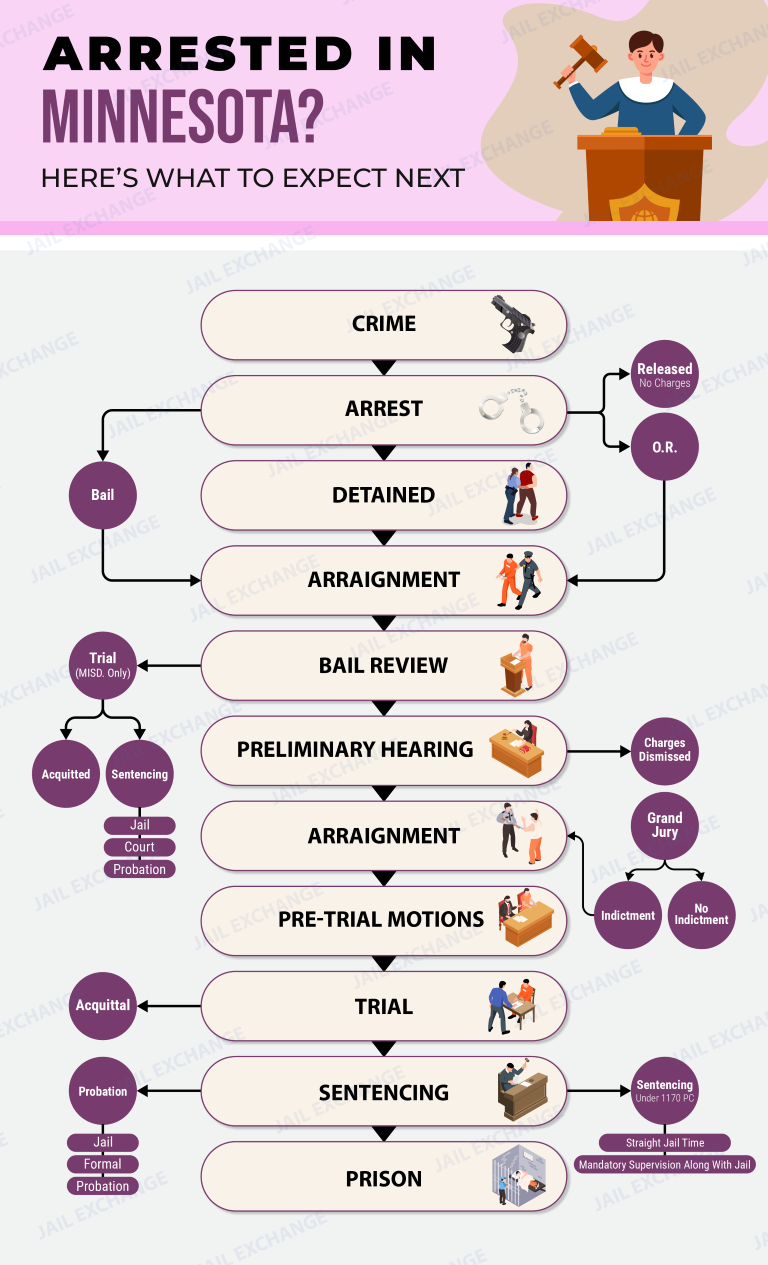
Winona County Detention Center Criminal Court Process
Criminal Court Process for Winona County Minnesota
How a Criminal Case Moves Through the Winona County Courts in Winona
The Third Judicial District's court for Winona County meets at 171 West Third Street, Winona, MN 55987, and hears every criminal charge. Court administration can be reached at 507-615-5183. Anyone a judge has not freed stays in the Sheriff's custody at the county's Detention Center, known as WCDC.
Look the person up in the official jail search before heading to the courthouse. Our Recent Arrests page for Winona lists new bookings and charges and points you to public defenders.
For the hearing date, call court administration at 507-615-5183. Misdemeanors from the city of Winona go through the city attorney, so ask staff which office has the case. Need to post money? See our WCDC bail guide.
1. Misdemeanor (for example, theft, a first DWI, fifth-degree assault, trespassing)
Criminal charges from anywhere in Winona County are heard at the Winona County Courthouse on West Third Street in the city of Winona, the county seat, by the Winona County District Court of Minnesota's Third Judicial District. The Winona County Attorney's Office prosecutes felonies, juvenile delinquency and offenses from outside city limits, and the Winona City Attorney handles misdemeanor-level cases from inside the city. Arrested people who are not released are held by the Winona County Sheriff's Office at the county jail in Winona.
- Winona County District Court (Court Administration, Third Judicial District), Winona County Courthouse, 171 West Third Street, Winona, MN 55987, (507) 615-5183
- Winona County Attorney's Office, Winona, (507) 457-6310
- Winona City Attorney (misdemeanors and gross misdemeanors in the city of Winona), (507) 205-4905
- Third District Public Defender, Winona office (State Board of Public Defense), (507) 474-6440
- Winona County Sheriff's Office and Jail, Winona, (507) 457-6368
- Minnesota Department of Corrections probation, Winona (felony supervision), (507) 205-6100; courthouse unit (507) 457-6470
Which court hears your case. There is one criminal trial court for all of Winona County: the District Court at 171 West Third Street. A petty misdemeanor ticket from St. Charles, a gross misdemeanor from Goodview and a felony from the city of Winona all go to that same court, because Minnesota has no separate municipal courts. The charge level instead controls the prosecutor and the procedure. Misdemeanors and gross misdemeanors that happen inside a city are normally prosecuted by that city's attorney (in Winona itself, the Winona City Attorney); those in townships are prosecuted by the County Attorney, as are all felonies.
Where pretrial detainees are held. People arrested by the Winona Police Department, the Sheriff's Office, another local department or the State Patrol who are kept in custody are booked into the Winona County Jail, which is operated by the Sheriff. A detainee stays there until bail is posted, a judge orders release, or the case ends. Call the Sheriff's Office at (507) 457-6368 with questions about an inmate.
Minor offenses make up most of the Winona County criminal calendar. They fall into three groups: petty misdemeanors (not crimes, fine only), misdemeanors and gross misdemeanors. For an incident inside the city of Winona, expect the Winona City Attorney to be the prosecutor.
Citation, booking and bail
A citation with a court date is the usual starting point for many minor charges in Winona County. People who are arrested and booked can often post bail from the court's schedule and go home. Anyone still in custody has a right to see a judge within 36 hours, with the arrest day, Sundays and legal holidays left out of the calculation, and after a warrantless arrest a judge must make a probable-cause determination within 48 hours.
Arraignment or Rule 5 appearance
A misdemeanor case starts with arraignment; a gross misdemeanor starts with a Rule 5 first appearance. At that hearing a Winona judge explains the accusation and sets the terms of release, from release on recognizance to conditional release that might include alcohol monitoring or an order to stay away from a particular person. If bail is required, there are usually two amounts: one higher and unconditional, one lower with conditions attached. In Minnesota, commercial bail bonds are permitted.
Getting a lawyer appointed
When jail is a possibility and money for a lawyer is not, tell the judge at your first appearance that you want a public defender. The court screens for income eligibility, and lawyers from the Third District Public Defender's Winona office, (507) 474-6440, take the cases.
Resolving the case
A pretrial conference is generally scheduled after the first hearing, and that is where most Winona County misdemeanors are negotiated. A defendant may instead insist on a trial, either to the judge or to six jurors who must agree unanimously, and may file a speedy-trial demand that requires trial within 60 days.
Penalty ranges in Winona County District Court
- Winona petty misdemeanor: fine up to $300 and no possibility of jail.
- Misdemeanor in Winona County: as much as 90 days and $1,000, the level for most fifth-degree assaults, trespassing and theft of $500 or less.
- Gross misdemeanor: as much as 364 days and $3,000 from a Winona judge, the level for theft from $500 to $1,000 and for fifth-degree assault with a qualifying prior.
- First DWI in Winona County: fourth-degree DWI, a misdemeanor, unless an aggravating factor applies; one factor (an alcohol concentration of 0.16 or more, a passenger under 16, or refusing testing) makes it third-degree DWI, a gross misdemeanor. The administrative license revocation is a separate proceeding, a chemical use assessment is mandatory, and aggravated cases can involve ignition interlock, plate impoundment or forfeiture.
Winona County misdemeanors can end in dismissal, a continuance for dismissal, or a stay of adjudication with no conviction entered after probation, and otherwise in fines, probation or jail. One to four months is a normal length.
↑ Back to the question list2. Felony (for example, burglary, felony theft, drug sale, second-degree assault)
Every felony in Winona County, including those from the city of Winona, is prosecuted by the County Attorney's Office on a signed complaint. Only charges carrying a possible life sentence go to a grand jury.
The hearing sequence
- Rule 5 hearing: held within 36 hours if the defendant is jailed. The judge reviews the complaint, appoints the public defender for eligible defendants, and sets bail and conditions; a pretrial evaluation may be part of the record.
- Rule 8 hearing: the second appearance, where discovery is turned over and plea negotiations frequently begin.
- Omnibus hearing: the defense may attack probable cause or seek suppression of evidence such as a search or a statement.
- Pretrial or settlement conference, then trial if no agreement is reached; 12 jurors must all agree to convict.
- Sentencing, after the Department of Corrections prepares a presentence investigation.
Minnesota Sentencing Guidelines
A Winona County felony sentence starts from the Minnesota Sentencing Guidelines grid. The offense's severity level is matched against the defendant's criminal history score, producing a presumptive sentence that is either stayed (probation) or executed (prison). Only substantial and compelling reasons justify a departure.
- Felony theft prosecuted in Winona County: more than $1,000 can bring 5 years, more than $5,000 can bring 10, and more than $35,000 can bring 20.
- Burglary in a Winona case: maximums of 20 years for first degree, 10 for second and 5 for third.
- First-degree controlled substance sale: a Winona sentence can reach 30 years.
- Second-degree assault with a dangerous weapon: up to 7 years in Winona County, with a mandatory minimum when the weapon is a firearm.
Successfully completing probation under a stay of imposition converts the felony to a misdemeanor on the record. When prison is ordered, the usual split is two-thirds in custody and one-third on supervised release. Winona County felonies typically take four to twelve months to resolve.
↑ Back to the question list3. Violent felony (for example, murder, criminal sexual conduct, aggravated robbery)
Violent felonies in Winona County are prosecuted by the County Attorney through the same Rule 5, Rule 8 and omnibus hearings as other felonies. The differences are high bail, demanding release conditions and, for first-degree murder, a required grand jury indictment.
- First-degree murder in Winona County: life in prison; premeditated murder and certain other first-degree killings bring life without release, and other first-degree convictions allow parole after 30 years. Minnesota eliminated the death penalty in 1911.
- Second-degree murder: up to 40 years. Third-degree murder: up to 25 years in a Winona prosecution.
- First-degree criminal sexual conduct: up to 30 years, the guidelines presuming 144 months for a first conviction.
- First-degree aggravated robbery in Winona: a maximum sentence of 20 years.
Crime victims in Winona County have rights under Minnesota Statutes chapter 611A to be notified, to be present and to make a statement at sentencing. The Third District Public Defender's Winona office represents defendants who qualify. These cases often take a year or two, and longer when forensic evidence is contested.
↑ Back to the question list4. Juveniles (under 18) arrested in Winona County
When a Winona County youth under 18 is accused of an offense, the case belongs to the juvenile division of the District Court at the courthouse on West Third Street. The Winona County Attorney decides whether to file a delinquency petition, and first offenses frequently go to diversion instead of court.
Juveniles are not held in the adult jail. A youth who needs to be detained goes wherever a licensed secure bed is open, because Winona County has no contracted juvenile bed nearby; the Houston County juvenile detention center in Caledonia is one of the closer options. A detention hearing must take place within 36 hours after the youth was taken into custody, excluding weekends and holidays, and the judge decides whether the youth can be released to a parent or must stay in detention. Eligible juveniles are represented by the Third District Public Defender.
For some 14- to 17-year-olds, the County Attorney may pursue Extended Jurisdiction Juvenile prosecution, which keeps the case in juvenile court but attaches a stayed adult sentence. Certification to adult court is possible for youth 14 and older, and it is presumed for a 16- or 17-year-old charged with an offense carrying presumptive prison or committed with a firearm. First-degree murder charges against Winona County youth aged 16 and 17 are prosecuted in adult court. Records of juvenile cases are generally confidential, though some felony records for youth 16 and older can be public.
↑ Back to the question list5. Federal cases (U.S. District Court) from Winona County
Winona County belongs to the District of Minnesota's Division 3, so a federal criminal case from Winona, St. Charles, Goodview or Lewiston goes to the Warren E. Burger Federal Building and U.S. Courthouse, 316 N. Robert Street, St. Paul, MN 55101, about two hours up the river from the courthouse on West Third Street. Jurors for Division 3 trials report to St. Paul. The initial appearance and detention hearing after a federal arrest in the county are often held in St. Paul or Minneapolis. With Wisconsin just across the Mississippi, keep in mind that conduct on the Wisconsin side would be charged in a Wisconsin federal court. Clerk of Court: (612) 664-5000.
Federal versus state charges
A Winona County matter becomes federal when it violates federal law, usually after an investigation by the FBI, DEA, ATF, Homeland Security Investigations, U.S. Postal Inspectors or the IRS. The categories seen most are drug trafficking involving large amounts or interstate supply, firearms crimes such as possession by a person with a felony record, fraud schemes, child exploitation, bank robbery and immigration offenses. Federal prosecutors can adopt an arrest made by Winona police or the Sheriff, and the same conduct can produce charges in both systems.
Who is involved
- Prosecutor: U.S. Attorney's Office for the District of Minnesota, St. Paul office, 316 N. Robert Street, Suite 404, St. Paul, MN 55101, (651) 848-1950; main office, U.S. Courthouse, 300 S. 4th Street, Suite 600, Minneapolis, MN 55415, (612) 664-5600.
- Defense: Office of the Federal Defender for the District of Minnesota, 107 U.S. Courthouse, 300 S. 4th Street, Minneapolis, MN 55415, (612) 664-5858, or a CJA panel attorney appointed when the Federal Defender has a conflict.
- Custody: U.S. Marshals Service, St. Paul (651) 848-1435; Minneapolis (612) 664-5900.
The path of a federal case
It starts with an arrest by federal agents or on a federal warrant or indictment, then an initial appearance in front of a U.S. magistrate judge, who explains the charges and appoints a lawyer for a defendant who needs one. If prosecutors request detention, the detention hearing usually comes within three court days. Under the Bail Reform Act, the judge chooses between release on conditions supervised by U.S. Probation and Pretrial Services and detention, which is ordered when no conditions will assure appearance and safety. Bail bondsmen have no role and money bail is rare. A complaint must be replaced by an indictment from a grand jury within 30 days of arrest, or a preliminary hearing is held, before arraignment. Trial is supposed to begin within 70 days under the Speedy Trial Act, though continuances are frequently granted. Plea agreements end most cases, and a federal trial verdict requires all 12 jurors. Around three months after a plea or verdict, after a presentence report, sentencing proceeds under the advisory Sentencing Guidelines and any mandatory minimum. The federal system offers no parole, so at least about 85% of the term is served with good-conduct time in a Bureau of Prisons facility, followed by supervised release. Appeals go to the Eighth Circuit.
Detention and locating a person
Federal pretrial detainees are housed by the Marshals in contract county jails across Minnesota and occasionally in other states, so someone arrested in Winona County may be moved out of the county. The Marshals can tell relatives where the person is held, and the Bureau of Prisons inmate locator covers sentenced people. Federal court rarely prosecutes anyone under 18.
↑ Back to the question listThis overview describes how criminal cases usually proceed in Winona County and is not legal advice. Anyone charged with an offense should consult a criminal defense attorney or ask for a public defender; the Third District Public Defender in Winona can be reached at (507) 474-6440, and Court Administration at (507) 615-5183.