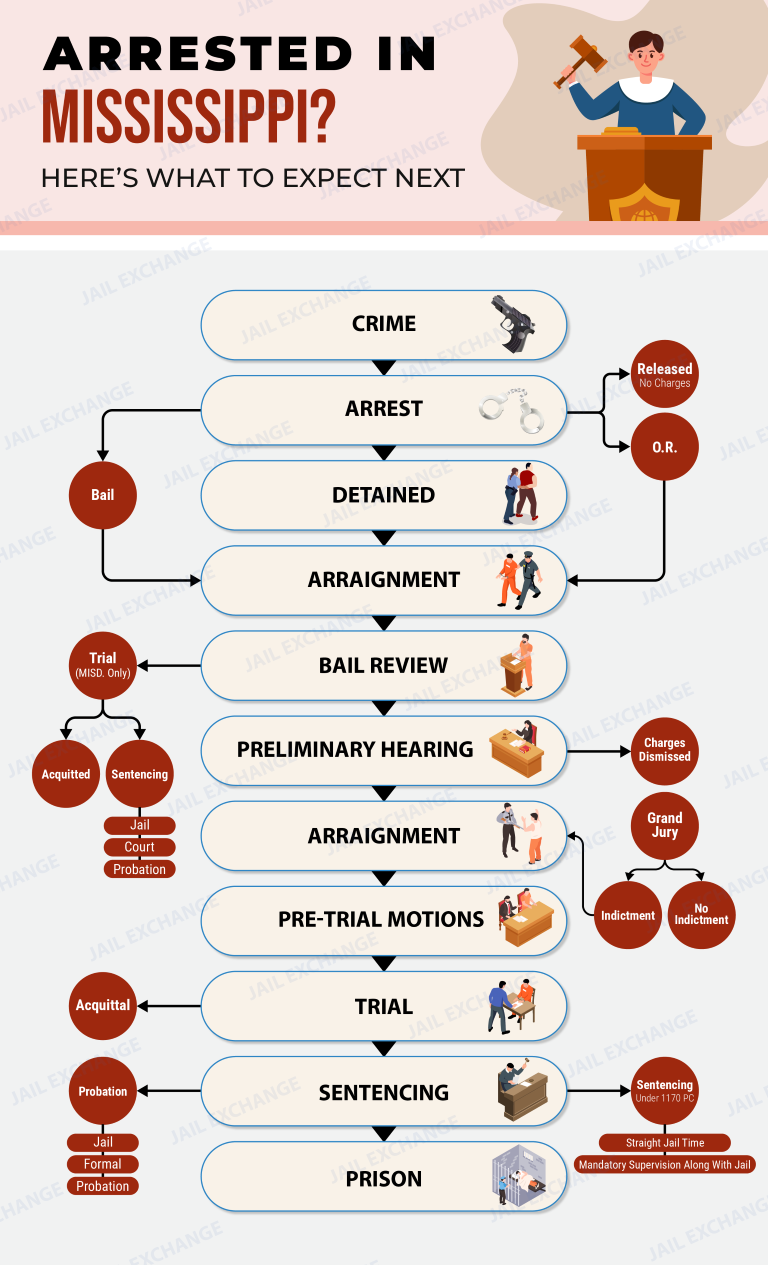
Covington County Jail Criminal Court Process
Criminal Court Process for Covington County Mississippi
Covington County, Mississippi — Criminal Courts, Bail, and Sentencing
Felony cases here go to Circuit Court, while Justice Court takes many smaller charges and the first steps. Both sit at the Covington County Courthouse, 101 S. Dogwood Ave., Collins, MS 39428, phone 601-765-6581. Anyone booked after an arrest is kept at the Covington County Jail.
To see where your loved one stands today, try the official jail lookup. Our Jail Roster page adds charges, warrants and a way to ask about a public defender.
For case papers and hearing dates, ring the Circuit Clerk at 601-765-6506. Then see how release money works in our bail guide.
Questions answered in this county guide
- Which courts handle criminal charges in Covington County?
- How does booking and the first court appearance work in Covington County?
- What happens in court for a misdemeanor in Covington County?
- What is the path from felony arrest to trial in Covington County?
- What happens with murder, robbery, and other serious cases in Covington County?
- What happens when someone under 18 is arrested in Covington County?
- What are the sentencing limits for common crimes in Covington County?
- What makes a criminal case federal in Covington County?
1. What makes a criminal case federal in Covington County?
U.S. District Court for the Southern District of Mississippi — Hattiesburg Division: 701 N. Main St., Suite 200, Hattiesburg, MS 39401. Telephone: 601-255-6400.
For Covington County residents, the key distinction is whether the charge violates Mississippi law or United States law. Federal indictments are brought by the United States, and the federal court handles federal criminal hearings.
A federal case typically includes an initial appearance before a magistrate judge, a detention or release decision, an indictment when required, plea or trial proceedings, and sentencing under federal law. Pretrial federal detainees may be housed under U.S. Marshals contracts; a federal prison sentence is handled by the Bureau of Prisons.
This guide explains general criminal-court procedures, not advice for an individual charge. The formal charging documents and court orders control the person’s case.
2. Which courts handle criminal charges in Covington County?
Covington County Courthouse: 101 S. Dogwood Ave., Collins, MS 39428. Courthouse telephone: 601-765-6581. This is the courthouse directory number, not necessarily the direct line for every individual clerk.
- County Court and Youth Court: Covington County may have a county court handling assigned matters; in counties without one, youth matters can be handled in chancery court. Juvenile court arrangements are not identical everywhere in Mississippi.
- Circuit Court: the principal felony trial court for Covington County. The circuit clerk handles circuit filings and maintains case records. A courthouse may also house other courts, but they have separate clerks and calendars.
- Justice Court: hears many state-law misdemeanors occurring in the county and performs early proceedings in felony accusations. Ask for the justice-court docket, not the circuit felony docket, when a citation names justice court.
- Municipal Court: where a city has one, this handles municipal offenses and some state-law misdemeanors within its jurisdiction. A city court cannot conduct a full felony trial.
The courthouse address above is a verified county courthouse listing. It is not a claim that every juvenile, municipal, or justice-court hearing takes place in that same courtroom. Read the name and location on the summons or hearing notice.
3. How does booking and the first court appearance work in Covington County?
After an arrest in Covington County, officers record identifying information, the alleged offense, and any active warrants. The sheriff’s detention operation generally manages county inmates, but a city arrest may have a different initial stop.
The judge or other authorized judicial officer decides whether the defendant may go home before trial and on what terms. Some people are released on their own promise to return. Others must meet bond terms or remain detained under a lawful order.
For the Covington County case, write down the person’s legal name, booking number if available, charge, next hearing date, and bond terms. A release decision does not end the prosecution.
4. What happens in court for a misdemeanor in Covington County?
Misdemeanors are the less serious class of crimes, but a conviction can still affect work, housing, and driving privileges. The first appearance explains the charge and begins the process of entering a plea.
A charge filed in city court can stay there for a lower-level offense. The city judge does not conduct a full felony trial; serious charges must move through the appropriate state courts.
A Covington County misdemeanor can conclude with dismissal, a lawful diversion or negotiated resolution, or trial. The result will depend on the accusation and evidence, not on the fact of an arrest.
5. What is the path from felony arrest to trial in Covington County?
The circuit court is Mississippi’s main trial court for felony prosecutions. A grand jury indictment generally formally charges the offense, followed by arraignment and further hearings.
If the accusation in Covington County is a felony, watch for the circuit-court case and indictment information. A grand jury decides whether a formal accusation should issue; it does not decide that the accused is guilty.
An appointed defense attorney may be available to an eligible person who cannot afford representation. The judge determines appointment under the governing rules.
6. What happens with murder, robbery, and other serious cases in Covington County?
An accusation involving a weapon or serious injury does not tell the whole sentencing story. Prosecutors must prove the elements of the charged law, and enhancements can change the available range.
For a violent felony arising in Covington County, the state circuit court is generally the trial court unless a federal law supplies jurisdiction. Victims’ rights, protective orders, witness issues, and release restrictions may all matter.
7. What happens when someone under 18 is arrested in Covington County?
Youth court focuses on a child’s case and possible supervision or services, not simply applying adult jail sentences. The court’s authority and possible transfer rules depend on the offense and age.
For a youth from Covington County, the family should pay particular attention to the written notice of detention, youth-court date, and who is allowed to attend. Ordinary adult court-contact rules do not automatically apply.
8. What are the sentencing limits for common crimes in Covington County?
An offense’s statutory limit is not an automatic sentence. A first offender and a person with prior convictions may face very different outcomes under applicable law.
- Simple assault (Miss. Code § 97-3-7(1)(a)): up to six months in county jail, a fine of up to $500, or both.
- Petit larceny, ordinary property worth under $1,000 (§ 97-17-43(1)): potentially up to six months in county jail and a fine up to $1,000; the law generally requires suspended jail time with probation or a fine unless the court makes specified findings.
- Aggravated assault (§ 97-3-7(2)(a)): up to one year in county jail or up to 20 years in state custody for the usual offense; enhanced situations carry different rules.
- Aggravated domestic violence (§ 97-3-7(4)(a)): 2 to 20 years in state custody for the basic offense; repeated convictions may increase the sentencing range.
- Simple domestic violence (§ 97-3-7(3)(a)): up to six months in jail, a fine up to $500, or both; qualifying repeat cases can become felonies.
Mississippi does not assign every felony a single universal sentencing range. The offense statute sets its own punishment, and repeat-offender laws can substantially change the time ordered.