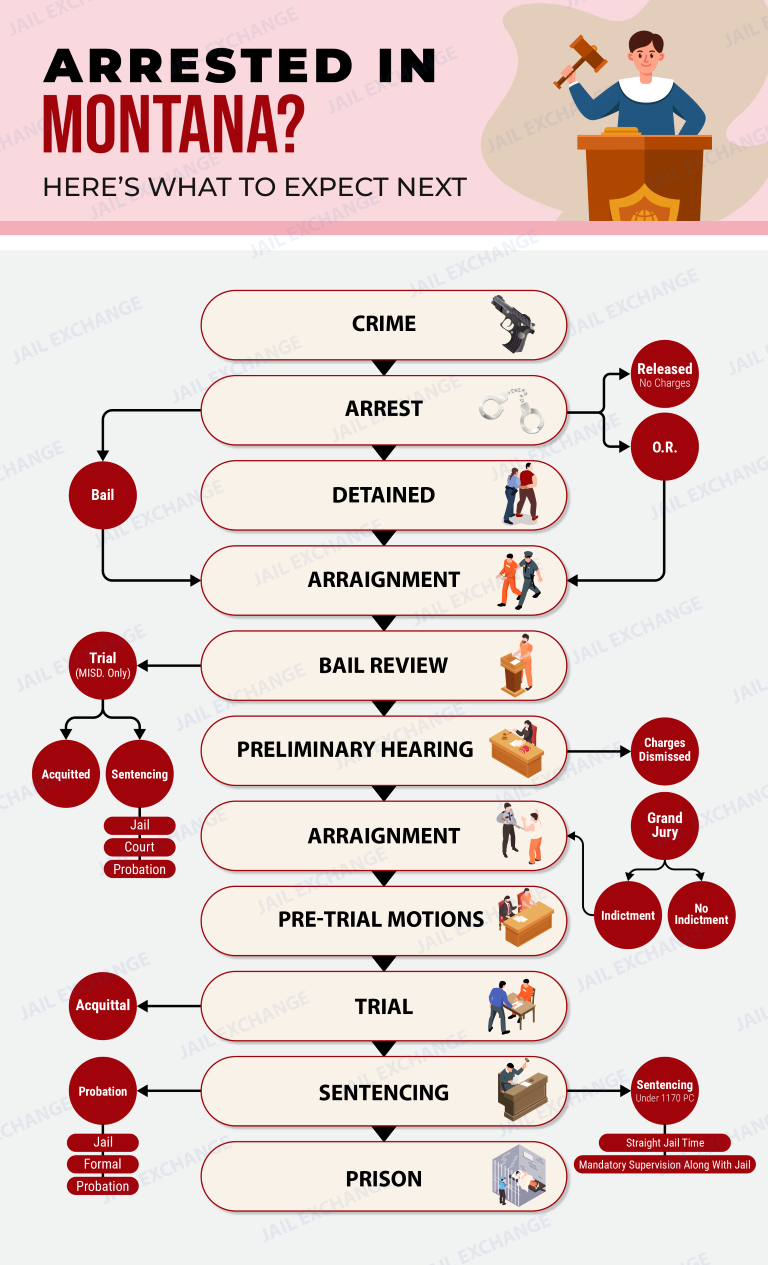
Prairie County Sheriff's Office Criminal Court Process
Criminal Court Process for Prairie County Montana
Prairie County Criminal Court Guide for Families
With no county jail, a defendant waiting on court is housed in a neighboring county. That may be the Custer County Detention Center in Miles City, the Dawson County jail in Glendive or the Fallon County Detention Center in Baker. This page covers the one courthouse in Terry, its two courts and each step a case goes through.
Use a general inmate lookup to check the name once you know the jail. Custody matters live on our Inmate Search page. It tells you how to learn if a person is still held and spot open warrants or recent bookings. It also covers what a charge means, mugshots, free lawyers and getting things back.
Call the Sheriff's Office at 406-635-5738 to ask which jail it is. Then find out the charges and the day of the first hearing. Our bail page walks through release.
1. Misdemeanor or felony: which court gets a Prairie County case?
The worst possible sentence picks the court:
- Justice Court hears misdemeanors and traffic matters countywide. Think of a ceiling of 6 months or $500 as its home ground (MCA 3-10-303). Some heavier misdemeanors it shares with District Court.
- Terry City Court takes offenses committed in town (MCA 3-11-103). One judge runs both lower courts.
- District Court gets each felony, which in Montana means a possible prison stay longer than one year (MCA 45-2-101).
- Youth Court runs inside District Court and takes defendants younger than 18.
Felonies can start below. A justice court holds a preliminary examination unless the defendant waives it or the prosecutor files straight in District Court (MCA 46-10-105).
↑ Back to the question list2. What court offices share the building on West Park Street?
Four offices you may need sit under one roof. Each has its own mailbox number:
- Justice of the Peace and City Judge: 217 West Park Street, Terry, MT 59349 (mail to PO Box 124). Phone 406-635-4466, and ask about hours, since they vary.
- Clerk of District Court: 217 West Park Street, Terry, MT 59349 (mailbox 125). Phone 406-635-5575, weekdays 8:00 a.m. to noon and 1:00 to 5:00 p.m.
- County Attorney: 217 West Park Street, Terry, MT 59349 (letters to PO Box 564). Phone 406-635-4529.
- Sheriff: 217 West Park Street, Terry, MT 59349 (box 126). Phone 406-635-5738, same weekday hours as the clerk.
3. Who handles tickets and crimes inside Terry's town limits?
Town residents are policed by deputies, because the town pays the Sheriff's Office for coverage instead of running a department. Any arrest within town is made by the Sheriff's people.
Town charges are heard by the City Judge, who wears a second hat as the county's Justice of the Peace. City court fines show up as a line in the town budget, so this court does hear cases. Ring 406-635-4466 for a date or a fine. Justice Court takes charges from the rest of the 1,730 square miles that deputies cover.
↑ Back to the question list4. How does the Seventh Judicial District cover Prairie County?
Five counties share this district: Dawson, McCone, Richland, Wibaux and this one. Since no judge is seated locally, one rides the circuit in.
- Law and Motion: first Thursday of each month at 2:00 p.m. in the courthouse courtroom.
- Remote hearings: the clerk lists Zoom rooms, a Tuesday Law and Motion room among them, for days the judge appears from afar.
- Judges' chambers: 207 W. Bell St., PO Box 1249, Glendive, MT 59330, 406-377-2666, and 300 12th Ave NW, Suite 2, Sidney, MT 59270, 406-433-5939.
Felony, youth and other district files go through the Clerk of District Court, who also calls jurors. Clerks are barred from legal advice, so a lawyer gets those questions.
↑ Back to the question list5. Where does a defendant wait while the case moves along?
Out of county. The Sheriff's Office places each prisoner and knows where the person is now: 406-635-5738, weekday office hours. Off hours, the Southeastern Montana Dispatch Center picks up at 406-232-3411.
Likely spots, in no special order:
- Fallon County Detention Center, 10 W. Fallon Ave., Baker, MT 59313, 406-778-2879
- Custer County Detention Center, 1010 Main Street, Miles City, MT 59301, 406-874-3301
- Dawson County jail, 440 Colorado Boulevard, Glendive, MT 59330, 406-377-7600
Miles of highway don't cancel a hearing. A first appearance may happen over two-way video, and the judge keeps the power to require the person in the courtroom (MCA 46-7-101).
↑ Back to the question list6. What happens at a defendant's opening court date?
Montana's phrase is "without unnecessary delay": that is how fast police must bring an arrested person to the nearest judge (MCA 46-7-101). The judge then runs through a required list (MCA 46-7-102):
- the charges, one by one
- counsel, and a public defender when money is short
- the basics of getting out before trial
- the choice to say nothing, since statements can be used at trial
- firearm rights, which a conviction can take away under state and U.S. law
- for felony complaints, a chance to make the state show probable cause
Release terms get decided before everyone leaves the room (MCA 46-9-109).
↑ Back to the question list7. What path does a misdemeanor case take in Justice Court?
County misdemeanor charges are filed by the County Attorney. Next comes a plea. Say not guilty and the court schedules trial. Prosecution or defense may demand a jury of six (MCA 46-17-201). The clock runs 6 months from the plea, and missing it means dismissal, unless the defense caused the delay or good cause exists (MCA 46-13-401).
Penalty ranges an adult could face:
- DUI, first time: a minimum of 24 hours up to 6 months, and $600 to $1,000 (MCA 61-8-1007)
- Theft of property worth $1,500 or under: as much as 6 months and $1,500 (MCA 45-6-301)
- Partner or family assault, first time: a minimum of 24 hours up to 1 year, and $100 to $1,000 (MCA 45-5-206)
- Default for other misdemeanors: 6 months and $500 at most (MCA 46-18-212)
A deferred sentence can last up to a year. Finish it cleanly, and the judge may dismiss the case (MCA 46-18-204).
↑ Back to the question list8. Step by step, how does a Prairie County felony unfold?
- Opening appearance. The judge reads the charge and sets release terms.
- Probable cause. One road is a preliminary hearing in Justice Court. The other is a sworn request to District Court (MCA 46-11-201). If the judge agrees, the prosecutor files the felony charge, called an information.
- Arraignment. Open court in District Court, where the defendant is handed the charging papers and enters a plea (MCA 46-12-201).
- Trial. A panel of 12 decides, and all of them must agree. Written consent from both sides lets a judge rule alone (MCA 46-16-110).
- Sentence. The judge imposes it after a guilty verdict or plea.
Absent a specific penalty law, a felony can draw 10 years and $50,000 (MCA 46-18-213). Stealing over $1,500 can bring 10 years. Drug possession tops out at 5 years (MCA 45-9-102). First-time possession comes with a built-in tilt toward deferral.
↑ Back to the question list9. Do assault and family violence charges follow special rules?
They do, and the differences show up early:
- Judge first. Chart bail is off in four kinds of case: partner assault, choking a partner, stalking, and protection order violations (MCA 46-9-302).
- Three strikes. Conviction number three for partner assault is a felony (MCA 45-5-206), with up to 5 years.
- Monitoring. Felony stalking or felony partner assault brings a presumed ankle monitor, if one exists locally (MCA 46-9-108).
- Victim call. Jail staff owe the alleged victim word of the release as soon as they can manage (MCA 46-9-108).
- No second break. One earlier felony conviction (MCA 46-18-201) rules out a deferred felony sentence.
Flat denial of bail is reserved for capital charges backed by strong proof. Short of that, detention is possible when no condition would keep others safe (MCA 46-9-106).
↑ Back to the question list10. Who prosecutes in Prairie County, and who defends?
Felony prosecutions, county misdemeanor prosecutions and legal advice to the commissioners all come from the County Attorney. Reach that office at 217 West Park Street, Terry, MT 59349, 406-635-4529.
Defendants without money for a lawyer can ask for a public defender. Felony charges qualify, as do youth cases and misdemeanors with possible jail.
- Region 3 public defender, Glendive: 100 1/2 S. Merrill, Suite 3, Glendive, MT 59330, 406-987-6010
- Should Glendive have a conflict, the case may shift to Region C conflict defenders at 208 N. Broadway, Suite 414, Billings, MT 59101, 406-247-4857
- Apply online with AdvOPD. The judge signs off on eligibility (MCA 47-1-111).
11. Can a case number or court date be found online?
Montana's judicial branch hosts two free search sites. Type in a name or case number:
- Lower courts search, which holds justice and city court records
- District Court search, which holds felony records
Cases about minors, and anything sealed, are kept out. If nothing turns up, or you need the hour of a hearing, call. Justice Court is 406-635-4466, and the felony clerk is 406-635-5575. Keep the person's birth date and legal name close by.
↑ Back to the question list12. Worried about a warrant? Here is how to check
Deputies serve every warrant in the county, Terry included, because the town contracts with the Sheriff for policing. Ask about one at 406-635-5738. Statewide, the DOC offender search tags anyone listed as an escapee or a probation or parole absconder. Pending local cases appear in the lower courts search and the District Court search. Clearing a warrant starts with a lawyer. Next, call the issuing court to ask for a fresh date, or set up a surrender through the Sheriff's Office. Justice Court warrants run through 406-635-4466. The felony clerk takes the rest at 406-635-5575.
↑ Back to the question list13. Where can people get free legal help nearby?
Courts can't coach anyone, but these state programs explain the process:
- Court Help Connect books video sessions from 207 W Bell St, Glendive, MT 59330. Call 406-444-9300 Monday to Friday, 8:00 a.m. to 5:00 p.m.
- Self-help kiosk at the Glendive Public Library, 200 S. Kendrick Ave., Glendive, MT 59330.
- Montana Legal Services Association takes civil problems for low-income people. Its HelpLine is 800-666-6899, Monday to Friday, 9:00 a.m. to 1:00 p.m.
For a criminal charge, none of these stands in for defense counsel. Apply to the public defender instead.
↑ Back to the question list14. Federal agents filed the charge. What now?
Federal cases from here go to Billings. Address: 2601 2nd Avenue North, Suite 1200, Billings, MT 59101, in the James F. Battin Federal Courthouse. Clerk: 406-247-7000, open 8:00 a.m. to 5:00 p.m. on weekdays.
- Whether the defendant waits at home is argued at the first federal appearance (18 U.S.C. 3142).
- The U.S. Marshals Service guards and moves federal prisoners: 2601 2nd Avenue North, Suite 2300, Billings, MT 59101, 406-200-6004.
- Release reports for the judge come out of Suite 1300, home to U.S. Probation and Pretrial Services, 406-657-6287.
- Federal filings sit on PACER. To track someone after sentencing, try the Federal Bureau of Prisons inmate locator.
15. Can an immigration hold change how a case ends?
The state case goes on, yet release day can look very different. With Form I-247A in the file, a jail may keep someone up to 48 hours after they would otherwise be released, which gives ICE a window to collect them (8 CFR 287.7(d)).
- A Montana officer holding that request has to arrest on it and explain the reason (MCA 27-16-801).
- That duty disappears when credible papers show citizenship or legal status.
- A 2025 change (MCA 46-5-401) lets police who lawfully pulled someone over or stopped them try to learn whether that person is here legally.
- Montana is served by ICE's Utah field office, 2975 Decker Lake Drive, Suite 100, West Valley City, UT 84119, 801-736-1200.
- After ICE takes custody, use the ICE Online Detainee Locator.
16. Where is prison time from a Prairie County case served?
State felony sentences are carried out by the Montana Department of Corrections. Most people sit in a county jail first while the state assesses them. After that, the department picks prison, prerelease or a treatment setting.
- Check status and placement on the Montana offender search.
- For facility profiles, open our Montana state prisons guide.
- Parole sits with a state board: 1002 Hollenbeck Road, Deer Lodge, MT 59722, 406-846-1404 (Board of Pardons and Parole).
17. What does Youth Court do when a teen is charged?
Teen cases go to Youth Court (MCA 41-5-203), with the district judge presiding. Those records are filed with the clerk and stay out of public searches.
- A detained youth must get a probable cause hearing in 24 hours, with weekends and holidays skipped (MCA 41-5-332).
- A youth as young as 12 can be moved to adult court (MCA 41-5-206), but only for a narrow set of very serious crimes and only if the County Attorney asks.
- Under-16s never go to a state prison.
- The Yellowstone County Youth Services Center, based in Billings, serves the eastern region as needed.
Families can call the Sheriff's Office at 406-635-5738 or reach Youth Court through the clerk at 406-635-5575. The probation officer who serves Youth Court in Dawson, Wibaux and Prairie counties is at 406-377-4675.
↑ Back to the question list18. What help is there for victims of a crime in Prairie County?
The County Attorney's Office brings the case, so it is the first call for a victim: 406-635-4529.
- Felonies and cases with injury or threats trigger a duty (MCA 46-24-104). Prosecutors must hear from the victim before they drop the case, cut a deal or agree to let the accused out.
- VINE texts, emails or calls with custody news on state felony offenders. Register on VINELink or at 800-456-3076.
- Montana's crime victim compensation program covers up to $25,000 of costs. Call 800-498-6455.
- The Dawson County Domestic Violence Program serves the area from 122 West Bell, PO Box 505, Glendive, MT 59330. Office: 406-377-6477. Crisis line, any hour: 406-989-1318.