Cheyenne County Jail Criminal Court Process

Search for an Inmate or Active Arrest Warrant in Cheyenne County

Criminal Court Process for Cheyenne County Nebraska

An arrest in Cheyenne County can lead to a short county-court case or a much longer felony prosecution. Knowing which office has the case can prevent a wasted trip.

Where are the county criminal courts and whom can my family call?

Think of County Court as the usual starting point for a Cheyenne County misdemeanor or felony complaint. The more serious cases advance to District Court, where felony pleas and trials occur.

  • Cheyenne County Court: 1000 10th Ave., Sidney, NE 69162; 308-254-2929. County Court clerk contact.
  • {E(name)} District Court Clerk: {E(da)}; {phone(dp)}. The directory gives this as a mailing/contact address; it is not necessarily the public entrance.

Who does what?

The County Court clerk can identify county-court case dates and filings. The District Court clerk handles records for felony proceedings in that court. A sheriff or jail is a separate office; a court clerk cannot promise release or change bond. In Douglas, Lancaster and Sarpy counties, a separate Juvenile Court hears most juvenile cases.

↑ Back to the top of the Cheyenne County guide

What happens right after someone is arrested?

Not every Cheyenne County arrest leads to an overnight jail stay. Some people receive a citation. Those brought to a jail are searched, processed and evaluated for urgent health needs.

Bail and the first appearance

A judge or authorized judicial officer determines whether to release the person, require a bond, or impose conditions such as no contact with another person. A defendant must follow the written release order and return to court. A cash percentage, a bondsman's fee, or a specific amount should never be assumed without seeing the actual bond order.

What should relatives have ready?

Keep the person's legal name and birth date, find out which jail has custody, write down the charge and next court date, and ask whether an attorney has been appointed. Medical concerns should be communicated to the detention facility directly.

↑ Back to the top of the Cheyenne County guide

How does a misdemeanor case move through court?

With a Cheyenne County misdemeanor, the person usually stays in the county-court system instead of having a felony case transferred to District Court.

Possible steps before a verdict

The court may schedule discussions between the prosecutor and defense, hear motions about evidence, or set a trial. A defendant may plead guilty, plead not guilty, or make another plea allowed by law. A plea offer is optional; it is not the same as a court finding of guilt.

Penalties are based on the charge's class

  • Class I misdemeanor: up to 1 year in jail, a fine up to $1,000, or both.
  • Class II misdemeanor: up to 6 months in jail and/or $1,000.
  • Class III misdemeanor: up to 3 months and/or $500.
  • Class IIIA misdemeanor: up to 7 days and/or $500.
  • Class IV misdemeanor: no jail; maximum $500 fine.
  • Class V misdemeanor: no jail; maximum $100 fine.
  • Class W misdemeanor: a special classification for DUI and implied-consent offenses; sentencing depends on prior convictions, testing, and court-authorized alternatives.

A class maximum is a legal ceiling, not a promise that the judge will impose it. Court costs, restitution, probation, and driving restrictions can matter too.

↑ Back to the top of the Cheyenne County guide

What happens if the accusation is a felony?

A felony is not ordinarily tried to completion in Cheyenne County Court. A preliminary hearing asks whether the accusation has probable cause; it does not decide guilt.

County Court to District Court

At a preliminary hearing the state presents enough information for the judge to decide whether the felony may continue. If the judge finds probable cause, the charge is bound over to District Court. The case can also follow another lawful charging procedure. The District Court then handles arraignment, scheduling, motions, trial and sentencing.

Lawyers and a possible jury trial

A person who cannot afford counsel should ask the court about a court-appointed attorney and complete the required financial information. Felony defendants should not assume a public defender is automatically assigned. A plea can end the case without a trial. When there is a criminal jury trial, a guilty verdict must satisfy the constitutional unanimity requirement.

↑ Back to the top of the Cheyenne County guide

How are serious violent charges treated?

For a family confronting a Cheyenne County homicide, sexual assault or serious weapons case, early legal representation matters because pretrial decisions may shape the entire prosecution.

Release decisions and evidence

A judge may assess public safety, risk of missing court, the charge and the facts when considering bail and conditions. Lawyers may review medical records, videos, witness statements, laboratory testing and other evidence. The court may hold hearings about what proof can be used at trial.

How serious can the punishment be?

Nebraska authorizes life imprisonment and, for Class I felonies under applicable law, the death penalty. Other violent offenses may carry long mandatory minimums. The exact penalty depends on the charged statute and any proven enhancements, not merely the label “violent.”

↑ Back to the top of the Cheyenne County guide

What if police arrest a child under 18?

A parent whose child is taken into custody in Cheyenne County should ask whether the matter is in juvenile court and whether the child is being released or detained.

Which juvenile court applies?

County Court usually handles juvenile matters here, using its juvenile jurisdiction rather than treating the youth as an ordinary adult defendant. The prosecutor, court and probation staff may consider supervision, services, family involvement or placement if authorized.

Detention, hearings and records

Detaining a child is not the same as sentencing that child to prison. Youth detention and placement decisions require the proper juvenile-court process. Parents or guardians should ask about the next hearing, an attorney for the child, and contact rules. Juvenile records generally have protections that do not apply to open adult records, subject to statutory exceptions.

↑ Back to the top of the Cheyenne County guide

What are the actual jail, prison, and fine limits?

A Cheyenne County judge must use the penalty law that applies to the convicted offense. Two defendants accused of similar conduct can receive different sentences because their facts and histories differ.

Actual misdemeanor maximums — Neb. Rev. Stat. § 28-106

  • Class I misdemeanor: up to 1 year in jail, a fine up to $1,000, or both.
  • Class II misdemeanor: up to 6 months in jail and/or $1,000.
  • Class III misdemeanor: up to 3 months and/or $500.
  • Class IIIA misdemeanor: up to 7 days and/or $500.
  • Class IV misdemeanor: no jail; maximum $500 fine.
  • Class V misdemeanor: no jail; maximum $100 fine.
  • Class W misdemeanor: a special classification for DUI and implied-consent offenses; sentencing depends on prior convictions, testing, and court-authorized alternatives.

Actual felony ranges — Neb. Rev. Stat. § 28-105

  • Class I: death.
  • Class IA: life imprisonment.
  • Class IB: 20 years to life.
  • Class IC: mandatory minimum 5 years, maximum 50 years.
  • Class ID: mandatory minimum 3 years, maximum 50 years.
  • Class II: 1 to 50 years.
  • Class IIA: up to 20 years, without a statutory minimum for the class.
  • Class III: up to 4 years in prison and 2 years post-release supervision, or a fine up to $25,000, or both, subject to sentencing provisions.
  • Class IIIA: up to 3 years in prison and 18 months post-release supervision, or a fine up to $10,000, or both.
  • Class IV: up to 2 years in prison and 12 months post-release supervision, or a fine up to $10,000, or both.

Sentencing details families should understand

For the highest felony classes, the stated minimums may be required; for other classes the law allows different outcomes, including probation when permitted. Habitual-criminal enhancements and special offense provisions can increase the exposure. Nebraska generally places felony sentences with maximum terms of one year or more in state correctional institutions; misdemeanor jail terms ordinarily are served locally. Federal crimes have their own separate sentencing laws.

↑ Back to the top of the Cheyenne County guide

When is a charge federal, and where does that case go?

Being arrested in Cheyenne County does not by itself put someone in federal court. The federal government needs a law giving it authority over the alleged offense.

Examples of federal offenses

Federal charges may involve drug distribution across state lines, certain firearm offenses, bank robbery, federal-program fraud, or crimes committed on federal land. Some behavior violates both state and federal laws, but many ordinary assaults, thefts and DUI cases remain state matters.

United States District Court for the District of Nebraska

Nebraska has one federal judicial district. Its main courthouse and federal clerk contacts are listed below. The location of a particular hearing is controlled by the case assignment and court order, not simply by the county of arrest.

  • Omaha — Roman L. Hruska Federal Courthouse: 111 South 18th Plaza, Suite 1152, Omaha, NE 68102; (402) 661-7350.
  • Lincoln — Robert V. Denney Federal Building: 100 Centennial Mall North, Room 593, Lincoln, NE 68508; (402) 437-1900.
  • North Platte federal court sessions: Lincoln County Courthouse, 301 North Jeffers Street, North Platte, NE 69101. For federal clerk assistance use the Omaha or Lincoln clerk's number.

The federal criminal process

A federal defendant may appear before a U.S. magistrate judge for an initial hearing and a release-or-detention decision. A grand jury indictment or other lawful charging document may follow; later stages can include arraignment, evidence exchange, motions, a plea or jury trial, and sentencing under federal statutes and advisory guidelines. Federal public defenders or appointed counsel may represent those who qualify.

↑ Back to the top of the Cheyenne County guide

This page is an educational overview of criminal proceedings, not advice about an individual case. Court orders, the specific charged statute, and judicial findings control the result.
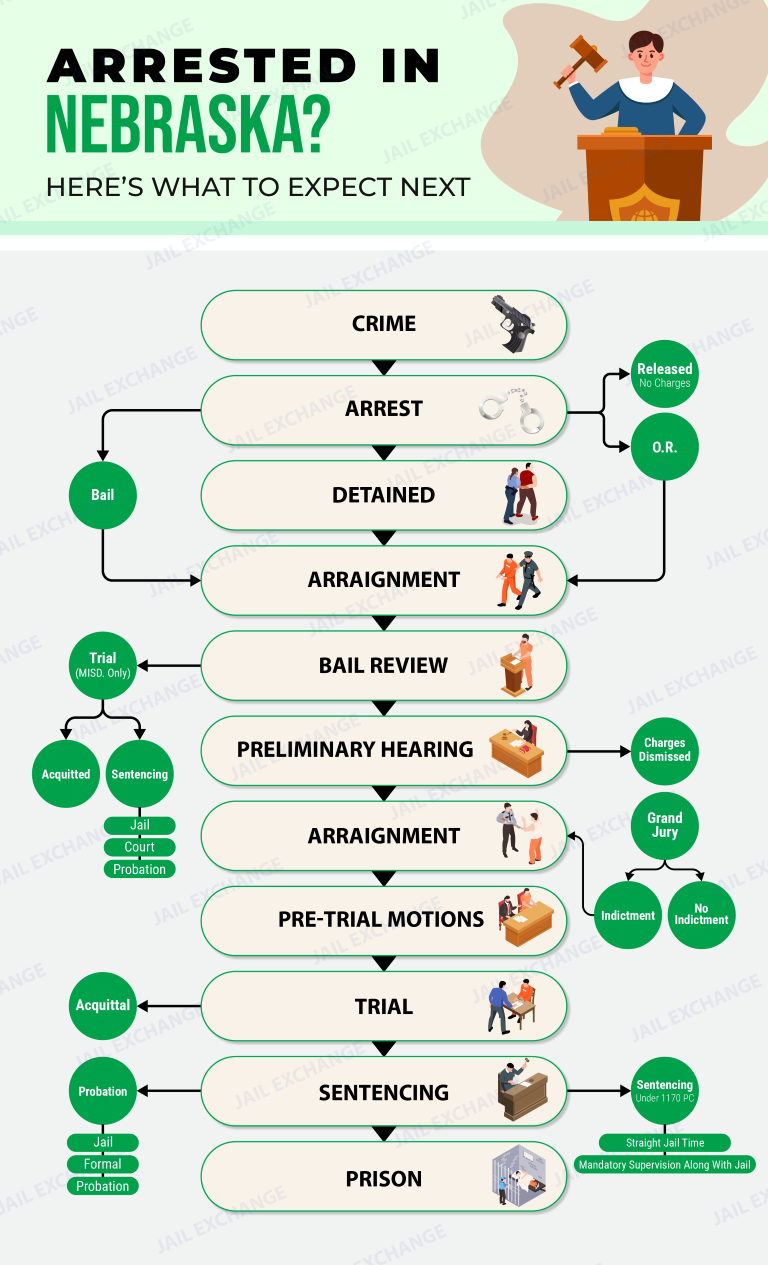
Criminal Court Process for Cheyenne County Nebraska

Cheyenne County Nebraska Criminal Court System – Definitions

It might be helpful to define some words that will be used on this site, when explaining the Nebraska Court System and how it works. The definitions on this site are for general information and not legal advice. It is always preferred to follow information given by your attorney or local authorities.

If you scroll down below this content, and the listing of the courts in Cheyenne County, you will find a simple flowchart diagram and a video that will help you visualize the stages of the Criminal Court Process.

Arrest is when Nebraska, Cheyenne County or local police take a person into custody and start the legal process. The arrested person may or may not be immediately jailed. 

In less serious crimes, the person may only be given a citation ordering that they appear in municipal or Cheyenne County court on a certain date. In cases involving more serious crimes, the person is usually placed in the county jail until an arraignment, or a judge decides the next step.

Jurisdiction is an important term in the court system that means whether a court has the obligation or duty or right to handle a case.  For example, if you run a red light in your town or city, a municipal court would likely have jurisdiction over your case, but the next town or city over would not have jurisdiction over your case.  If you attempted to flee from police when they attempted to stop you after you ran the red light, it becomes a more serious crime, and the municipal court might not have jurisdiction so you might be assigned to a higher-level court that has jurisdiction over the more serious crime.  Jurisdiction varies from state to state and sometimes county to county.

Booking is when the Cheyenne County sheriff or local police gather information such as the detainee’s name, address and why the person is being arrested. Booking also includes fingerprinting, criminal history, investigation, and verification of identity. 

Bail is money paid that is held by the Cheyenne County court to make sure that the arrested does not flee the area before their trial.  Bail for lower-level crimes may be set right after booking so the arrested can “bail or bond out” before being detained.

The initial hearing, also called arraignment is when a judge determines whether the charges are supported by the prosecution’s initial evidence and tells the arrested what they are charged with, and the person says whether they are guilty or not guilty. At this time, the person is called the defendant, and the opposing side is called the prosecution. If there is reason to believe that the arrested is guilty, the judge will set bail conditions or send the defendant back to jail or release them ROR (release on recognizances). 

During bond proceedings, the defendant can have an attorney present but does not have the right to an attorney. Judges in Nebraska rely on a statewide bail schedule, which sets out a recommended range of bail amounts for different offenses. Judges can still exercise discretion in setting bail above or below the recommended range.

An initial hearing or arraignment is not a trial, and the defendant is entitled to a trial within a reasonable amount of time after the arraignment.

Nebraska does not allow private bond companies but rather the county courts and jailer process the paperwork needed for the bond.  The defendant can either pay the full cash amount or ask the court for a cash percentage bond where the defendant pays 10% to the court, which is not returned and covers court costs.  The full bail amount will become due if the defendant does not show to court and the court issues a warrant for arrest with the Sheriff’s department.

There may be other conditions for release in addition to the bail amount.  Conditions usually include drug testing, abstaining from drug and alcohol use, meeting with a Pretrial Release officer and having no contact with the victim.

It is always important to have family involvement after being arrested.  Not only can they make calls and communicate on your behalf but family support will show the court that there are people who will make sure that the defendant makes it to court. 

(There have been phone scams where a bond company calls and informs a person that their family member has been arrested and they ask for financial information There are no bond companies in Nebraska.)

The prosecution, sometimes called “the government” or “the people” or “the state” is the side that presses the charges and seeks punishment for the offense. These are attorneys that work for the state of Nebraska, Cheyenne County or a city or town.  The prosecuting attorney for Cheyenne County or the district is called the County Attorney. A U.S. Attorney prosecutes federal cases.

A criminal defense attorney (also called lawyer or counsel) is hired or retained to represent the arrested as early as possible after the arrest.

If there is a chance that the case might go to trial and the defendant cannot afford an attorney, the 6th Amendment of the U.S. Constitution requires that the court provide an attorney. This is called indigent representation and a public defender or assigned attorney would represent the defendant in all proceedings. Indigent representation is only available misdemeanor and felony cases that could result in jail time, juvenile cases, and certain appeal cases.  

In Nebraska, each county determines the method to use for public defense. The counties with larger populations as Douglas, Lancaster and Sarpy have public defenders and some of the public defenders work part time and have their own practices.

For less serious cases or civil cases, there are pro bono volunteers who volunteer legal services for free or for a small fee. They often will hold clinics to teach people how to represent themselves in court. This website provides contact information for pro bono services in Nebraska.

Many courts will provide forms and help for people who want to represent themselves, called pro se.  Here is a link for legal self-help centers in Nebraska.

A district court can refer to the first level of the legal system, or a minor court. District courts are in the community.  A district court can also refer to a U.S. Federal District Court that hears federal cases. There is one U.S. federal district court in Nebraska, with offices throughout the state. It is important that you check the address of the court you are to appear in rather than to ask someone because that person might give you directions to the wrong “district” court. Being late to court can land you in custody as well.

Pretrial proceeding is the process where both sides (prosecution and defense) gather information, interview witnesses, request records, videos etc. Pretrial proceedings also include communications with the judge assigned to the case and these appearances are either in person or by on-line conferencing. Some pretrial proceedings may not require a defendant’s appearance, allowing an attorney to appear in their place. The information that is gathered is called discovery and both sides must share the information that they have gathered.  This information does not include conversations between the arrested and their attorney.

Most cases do not go to trial because both sides reach a plea deal, where both sides try to reach a reasonable punishment based on what was learned in the pretrial proceedings.  A plea deal can only happen if the accused person admits they are guilty in exchange for a lighter punishment.  The reason they must admit guilt is because it would not be fair to punish someone who claims they are not guilty.  There are times in plea bargaining when the prosecution agrees to give a lighter sentence in exchange for information leading to the arrest of a more serious criminal related to the crime.  

Trial is where both sides share their information in front of a judge or a judge and jury. After listening to all the evidence, the judge or jury decides the verdict which is whether the person is guilty or not guilty. If a court has only a judge hearing both sides, it is called a bench trial.  If a jury is selected, it is called a jury trial.  If the defendant is found not guilty, they are released.  If they are found to be guilty, the next step is sentencing.

Sentencing is the punishment that the judge decides the person should get. This could be jail or prison time, fines, community service, probation, or a combination.

Appeal is asking for a higher court to hear the case again at an appellate court.  If the accused person thinks something went wrong at trial or has new information that was not available during the trial or that the sentence is too harsh, the defense attorney can ask for an appeal. It is not unusual for an appeal when there is a long jail sentence, but an appeal can be denied if the appellate court feels that the original trial or sentencing was fair.

Nebraska Felony vs Misdemeanor

In Nebraska, misdemeanors are classified into five classes and Class W.

  • Class 1 (I) holds a maximum sentence of 1 year imprisonment in county jail and/or $1000.
  • Class 2 (II) holds a maximum sentence of 6 months imprisonment in county jail and/or $1000.
  • Class 3 (III) holds a maximum sentence of 3 months imprisonment in county jail and/or $500.
  • Class 3A (IIIA) holds a maximum sentence of 7 days imprisonment in county jail and/or $500.
  • Class 4 (IV) holds no jail time and a maximum of $500 fine.
  • Class 5 (V) holds no jail time and a maximum of $100 fine.

Class W is for Driving under the influence charges and depending on whether it is the first or third conviction, can hold a maximum sentence of 60 days in jail and/or $500 up to 1 year in jail and/or $1000 fine for the third conviction.

In Nebraska, felonies are classified into 10 classes.

  • Class 1 (I) sentence is the death penalty.
  • Class 1A (IA) sentence is life in state prison.
  • Class 1B (IB) holds a minimum sentence of 20 years and maximum sentence of life imprisonment.
  • Class 1C (IC) holds a minimum sentence of 5 years and maximum sentence of 50 years imprisonment.
  • Class 1D (ID) holds a minimum sentence of 3 years and maximum sentence of 50 years imprisonment.
  • Class 2 (II) holds a minimum sentence of 1 year and maximum sentence of 3 years imprisonment.
  • Class 2A (IIA) holds a maximum sentence of 50 years imprisonment.
  • Class 3 (III) holds a maximum sentence of 4 years imprisonment and 2 years post-release supervision and/or $25,000.
  • Class 3A (IIIA) holds a maximum sentence of 3 years imprisonment and 18 months post-release supervision or $10,000 or both.
  • Class 4 (IV) holds a maximum sentence of 2 years imprisonment and 12 months post-release supervision or $10,000 or both.

The Cheyenne County Clerk of Court is an elected official whose responsibilities for Criminal Court’s administrative issues include receiving criminal warrants, receiving bail, creating the trial schedule, receiving fees, fines and maintaining court records.

A warrant is used to get someone to appear in court or to law enforcement.  There must be good reason to believe that the person is involved in a crime. The warrant gives authority to arrest the person and search for evidence for the investigation of the crime. 

A criminal summons is issued to request that a person appear in court at a particular time and date.  It does not involve an arrest.  A traffic ticket, summary citation or lesser misdemeanor could be considered a summons if you are given a court date.

A summary citation, commonly referred to as a ticket, is a criminal summons by a law enforcement officer either in person or via mail accusing the defendant of a minor offense, stating potential fine, listing the court having jurisdiction and instructions for addressing the issue. Defendants may or may not be required to appear in court or handle the matter by entering a plea via mail.

Fines are usually paid to the District Court or clerk of court and payment methods can be found on the District Court or Cheyenne County Clerk of Court website. If you do not pay your fine on time, you can lose your driver’s license, must pay additional fees or even have a warrant for your arrest.  It is important to read the instructions on the ticket issued by the police officer or court at the time of your arrest. For a parking ticket or summary citation, the fine amount and how to send payment should be on the ticket. 

Nebraska Criminal Court System - How it Works

Nebraska’s Supreme court and Court of Appeals hears cases that have asked for appeal from the “lower courts”. Nebraska’s lower courts include municipal courts, county courts and district courts.
Municipal courts handle violations of municipal ordinances (city laws), traffic violations, parking violations and criminal misdemeanor offenses that occur within the city or towns police jurisdiction.  If a municipal court has not been established, then municipal ordinance violation cases are handled in county courts.

County courts handle criminal misdemeanor cases. Juvenile cases are handled in a special division of county court except in Douglas, Lancaster and Sarpy Counties that have separate Juvenile courts.  County courts handle preliminary hearings for felony cases then transfer them to be prosecuted in District court. There is some overlap with the district court in some misdemeanor cases and traffic infraction cases.

District courts in Nebraska handle all types of criminal cases, misdemeanor and felonies.  Though most cases start in the municipal or county court, some cases start and be tried in District court. District courts can also hear appeals from the Municipal courts.

Specialty Courts are becoming more prevalent in individual states.  They serve people who would benefit from alcohol, drug and other rehabilitative services.  Nebraska has a Problem-Solving Court that operates within the district, county or juvenile courts that addresses the special problems and needs of the individuals who have been identified for the Problem-Solving Court.

District courts of appeal conduct review of cases on appeal from county and circuit courts.

The Nebraska Supreme Court is like our United States’ Supreme Court because it has a panel of judges that rule on matters that have to do with someone’s constitutional rights or policies and laws. The Nebraska State Supreme Court deals with the state constitution or laws or policies. Sometimes the Supreme Court will hear criminal cases on appeal when there is a question on the state laws or procedures that lead to the appeal.  

The criminal cases are usually referred from the district courts of appeal.

FEDERAL COURT

Federal Court deals with crimes involving violations of United States laws.  Federal crimes include federal drug trafficking, federal tax evasion and fraud that crossed state lines and include crimes that occur on federal property as post offices or federal buildings.  

Cases involving crimes that involve the FBI or DEA or Immigration agencies are federal crimes. Terrorism is a federal crime. 

There are some differences in the Federal court system as compared to the Nebraska state court system. For example, the attorneys who work for the courts are called United States Attorneys and Federal judges are called District Court Judges (not to be confused by local state district courts).  

Federal Magistrate Judges hear the case early on, but they do not decide on the cases at a trial like the Federal District Court Judges. In a federal case, a grand jury is used for indictments.

There is one U.S. Federal Judicial District in Nebraska.

Search for an Inmate or Active Arrest Warrant in Cheyenne County