
Howard County Jail
Howard County Jail
Physical Address
c/o Hall County Jail110 Public Safety Drive
Grand Island, NE 68801 Inmate mailing address
Jail Phone Number
308-754-5433Howard County Inmate Search: Finding and Contacting a Family Member
To find someone arrested in Howard County, call the Sheriff at 308-754-5433 and ask which jail received the person. Have the full legal name, birth date and approximate arrest time ready, then ask whether booking is complete and which booking number to keep.
The Sheriff’s office contact is 612 Indian Street, Suite 13, St. Paul, NE 68873. An office address does not confirm detention. You can also check NEVCAP for participating Nebraska custody records and alert options. Confirm the actual receiving jail before visiting, mailing a letter or paying for a service.
The questions below explain mugshots, warrants, calls, visits, mail, money and urgent family concerns. Our Bail guide covers release questions, while the Court guide covers Howard County records, clerk contacts and hearing locations.
Read inmate search answers
 Read inmate search answers
1. How do I find someone arrested in Howard County?
Call the Howard County Sheriff at 308-754-5433 and ask whether booking is complete and which jail currently holds the person. Have the full legal name, birth date and approximate arrest time ready. Write down the booking number and any transfer information.
You can also check Nebraska Victims of Crime Alert Portal (NEVCAP) for participating Nebraska custody records and alert options. Match the person and agency carefully. A missing entry does not prove release, and a record filed in Howard County does not establish that the person is detained in St. Paul. Confirm housing before arranging a visit or payment.
2. What if I cannot find a recent arrest online?
Ask the department that made the arrest where officers took the person and whether another agency now has custody. For Howard County Sheriff assistance use 308-754-5433. Keep the event date, location, incident number and any brief family message available.
Booking, medical care and a transfer can make the first hours confusing. Do not infer release from a missing web entry or choose a destination simply because it is nearby. Follow the receiving agency’s information and ask for the name and phone number of any next holding facility.
3. Where is the Howard County jail, and which number should I call?
The Sheriff’s published office contact is 612 Indian Street, Suite 13, St. Paul, NE 68873, 308-754-5433. Ask which jail currently holds the person. An office address, an older jail listing or a past housing agreement does not establish the individual’s current detention location.
For a visit, payment or property pickup, obtain the receiving jail’s directions, correct entrance, identification and appointment requirements. Do not treat courthouse office hours as a visiting schedule.
4. Can I see a mugshot or request an arrest report?
Ask the department that created the record about its public-records procedure. Give the person’s name, event date and incident or booking number, and explain whether you want a booking photograph, police report or court filing. Availability and copying charges can differ.
A photograph or arrest allegation does not establish guilt or explain the final outcome. Use the related court case for that. Keep a request for copies separate from an urgent call about someone’s location, medication or safety.
5. How can I receive custody notifications?
Use Nebraska Victims of Crime Alert Portal (NEVCAP) to check the available registration options for the person and agency. The Nebraska Attorney General describes the service as free and confidential, with text and email notifications. Keep your registration details private and update a changed phone number or email address.
Read which events the registration covers. A notification is useful, but confirm the actual holding location with staff before driving, sending money or mailing a letter. Do not rely on a notification service as the only response to an immediate safety concern.
6. How do I find the bond amount and help with release?
Call 308-754-5433 and ask which case and order control release, the authorized bond form, the amount currently required and where payment is accepted. Ask whether another case, warrant or agency hold could prevent release after this bond is paid.
Our Howard County Bail guide explains percentage deposits and review of conditions; the Nebraska Bail guide gives statewide context. An inmate spending deposit does not pay a court bond. Save the receipt and written conditions, and get pickup instructions from staff after processing.
7. Where can I read the filed charges and court records?
Use the Nebraska Judicial Branch case-search services and match Howard County, the person and case number. Online one-time searches have a fee; the Judicial Branch also provides free courthouse-kiosk and law-library access. Check current prices and access terms before paying.
Booking information and the filed charge can differ. Read the latest docket entries and ask the clerk for the appropriate access route when a record is missing or restricted. A lawyer can explain what a charge change, dismissal or release condition means.
8. How can someone ask for a public defender?
Ask Howard County Court at 308-754-4192 about applying for appointed counsel and supplying financial information. Give the case number, next hearing and actual jail location. The court decides eligibility and appointment.
Family can help organize records, but an inquiry does not appoint a lawyer or postpone a hearing. Ask how a detained applicant can submit paperwork. Federal and other proceedings have their own appointment processes.
9. How do I arrange a visit?
Call the jail at 308-754-5433 to confirm current housing, visitor approval, identification, appointment requirements and the actual visit location. Explain whether a child will attend. Ask whether the available contact is onsite or remote before planning travel or purchasing a session.
Our visitation guide helps organize those questions. The Sheriff’s business-lobby hours are not by themselves an inmate visiting schedule. Check current access for your relative, keep the appointment confirmation and ask how cancellations or restrictions will be communicated.
10. How do I put money on an inmate’s account?
Ask the actual holding jail for its approved account-funding route, recipient identifier, accepted payment methods and current fees. If you do not know the receiving facility, start with the Sheriff at 308-754-5433. Do not assume a service used by another county also applies here.
Our money page and commissary guide help distinguish spending money, goods and other purchases. A communication balance and a bond are separate transactions. Keep the receipt and recheck the receiving jail’s arrangements if the person moves.
11. How can I receive calls or send electronic messages?
Ask the holding jail at 308-754-5433 to confirm the current phone or video provider, registration route and services available for your relative. Verify the facility and recipient before adding funds. Read the current costs and protect your account details.
Our phone guide and electronic-contact page help you prepare. A paid account does not guarantee immediate contact. Ask staff separately how to report an urgent family concern and retain any service error when requesting provider support. Ordinary office calls may not be transferred to housing.
12. Where should I send a letter or photograph?
Ask the Sheriff’s Office at 308-754-5433 for the current personal-mail address, required name and booking number, and rules for photographs and stationery. Do not assume the Sheriff’s courthouse mailing address or an older jail address is the approved destination.
Review the mail guide before sending anything. Legal mail, books and subscriptions may follow different instructions from ordinary letters. Get approval before enclosing funds or ordering an item. After a transfer, confirm the receiving jail’s rules and do not rely on automatic forwarding.
13. How can I collect belongings or deliver clothing?
Ask which agency holds the item and what authorization is required. Intake belongings, evidence, a vehicle and clothing needed for court may involve different employees or departments. Have the inventory or incident number ready and ask about identification, hours and appointment requirements.
Get an approved delivery list before buying clothing or bringing a bag. Permission to visit or provide a ride does not authorize collection of property or delivery of medicine. Keep the release paperwork and receipt, especially if another person collects items on the owner’s behalf.
14. How do I report medication needs or an urgent safety concern?
Call the actual holding jail promptly. For the Howard County Sheriff’s Office use 308-754-5433 and ask for the staff member responsible for medical or safety concerns. Identify the person clearly, explain the risk and leave a callback number. Ask how a clinician can securely supply prescriptions or relevant records.
Do not drop off medication without instructions. Staff may receive important information even when privacy limits what they can tell a relative. Keep medical details out of public posts. Call 911 for an emergency occurring outside the jail.
15. How can I check for a warrant in Howard County?
Ask the Howard County Sheriff at 308-754-5433 about its current warrant-verification procedure and identification requirements. A court docket may help identify an order, but an empty public search does not certify that no warrant exists.
Counsel can help identify the issuing court and the proper response to a missed hearing or surrender question. Keep separate case numbers when several counties or states are involved. Independently verify a caller’s demand for immediate payment through the published office contact, and keep any written order resolving the warrant.
16. Who can confirm the next court appearance?
Howard County’s County Court and District Court listings share 308-754-4192. County Court lists 612 Indian Street, Suite 6; court mail goes to P.O. Box 47, St. Paul, NE 68873. Specify the court division and case number, then confirm the hearing location and room.
Our Court guide explains records and hearings. A transfer does not itself move the case, release does not cancel a hearing, and a relative’s call does not excuse an appearance.
17. What if another jail is holding my relative?
Ask the Sheriff at 308-754-5433 for the receiving jail, transfer time and booking number. A case filed in Howard County and detention elsewhere can involve different offices. An older agreement or past arrest report does not establish current custody.
Nearby counties include Buffalo, Greeley, Hall, Merrick, Nance and Sherman. If staff confirm Valley County custody, its published office is 125 South 15th Street, Ord, NE 68862, 308-728-3906. Confirm the individual’s current jail and its visiting, mail and account rules. A past agreement does not establish placement.
18. Where do I look after a federal arrest?
Nebraska has one U.S. District Court district. The federal clerk’s Omaha office is at 111 South 18th Plaza, Suite 1152, Omaha, NE 68102, 402-661-7350; the Lincoln office is at 100 Centennial Mall North, Room 593, Lincoln, NE 68508, 402-437-1900. Follow the actual hearing notice.
Use the Bureau of Prisons locator for federal corrections records. A recent pretrial detainee may be in a contract jail rather than a federal prison. If the locator does not explain a recent arrest, ask the responsible federal agency or counsel about placement.
19. How can I find someone transferred to ICE?
Use the ICE detainee locator and follow its identity-search instructions. If a local jail reports an immigration transfer, ask which agency received the person and when. Do not assume that a state bond ends separate immigration proceedings.
An immigration detainer requests holding up to 48 hours after they would otherwise be released. Ask qualified counsel about the interaction of criminal and immigration matters. For agency documents, follow ICE’s records-request instructions.
20. How do I find someone in a Nebraska state prison?
Use the Nebraska Department of Correctional Services incarceration search. Compare identifying information and the reported facility, and retain the corrections number for future questions. A county booking number and a state corrections number serve different systems.
After confirming arrival, read the receiving prison’s current guidance for calls, visits, mail and money. A county visitor approval or service balance does not automatically carry over. Our Nebraska prison directory helps locate facility information.
21. How can a parent locate a detained child?
Ask Howard County Court at 308-754-4192 for the assigned juvenile-case contact. Identify yourself as the parent or guardian seeking placement, hearing and attorney information. An adult custody search does not locate every juvenile placement.
Confirm the actual housing facility through the assigned officer or attorney before traveling. A court office is not necessarily where the child stays. Ask which adults may visit and what identification or permission is needed. Keep hearing notices separate from placement and visitor instructions.
22. Which local department should I contact?
For routine law-enforcement assistance in St. Paul or Howard County, call non-emergency dispatch at 308-754-5458. The Sheriff’s administrative office is at 612 Indian Street, Suite 13, St. Paul, NE 68873, 308-754-5433.
St. Paul’s city website announced a law-enforcement services transition in October 2026. Ask dispatch which agency currently handles your inquiry and where officers delivered the person. Do not assume an older police listing or shared office identifies a jail. Use 911 for emergencies.
Howard County bail and bond: from St. Paul, Elba, and Dannebrog to the Ord jail
The Howard County Sheriff's Office at 612 Indian Street, Suite 13, St. Paul, covers St. Paul, Elba, Dannebrog, Cushing, Boelus, and Cotesfield. Office: 308-754-5433. Inmate search: Howard County Inmate Search.
Where are Howard County inmates housed?
In Ord. Howard County lists an annual agreement with Valley County for "Valley County Jail-House Inmates" (Howard County interlocal report, 2025). The Howard County Sheriff's Office says the sheriff manages all inmates arrested in Howard County.
What is the Howard County non-emergency number?
308-754-5458, the Howard County Communications Center. It dispatches for the Sheriff, St. Paul Police, and the Nance County Sheriff. Office hours are 8 a.m. to 5 p.m., Monday to Friday. Sheriff fees are cash or check only (Howard County Sheriff's Office).
Which court sets bond on a St. Paul misdemeanor?
Howard County Court in St. Paul. It hears misdemeanors and traffic cases, and it holds the first appearance and preliminary hearing in felony cases. Clerk: 612 Indian Street, Suite #6 St. Paul, NE 68873, 308-754-4192. The judge explains the release terms at that hearing (Neb. Rev. Stat. 29-901.06).
Where are Howard County felonies tried?
Howard County District Court, in the Eighth Judicial District (Neb. Rev. Stat. 24-301.02). Clerk: P.O. Box 47, St. Paul, NE 68873, 308-754-4192. A felony bond can be reviewed again there.
How is bail set after an arrest in Howard County?
Bail in Howard County is set by a judge, usually at the first appearance. The judge looks at the charge, past court dates, and what the person can pay (Neb. Rev. Stat. 29-901). A 10% deposit is usually allowed. For many misdemeanors, jail staff can take bond right away under the bail schedule the County Court judges adopt (Neb. Rev. Stat. 29-901.05).
How does the 10% deposit work for a bond set in St. Paul?
Nebraska has no commercial bail bondsmen. Bail is posted with the court or the jail, usually as a cash deposit. The judge sets a bond amount. You may post a deposit of up to 10% of that amount with the clerk, and never less than $25 (Neb. Rev. Stat. 29-901). On a $5,000 bond, the deposit is $500. When every court date is kept, 90% of the deposit comes back. The clerk keeps 10% of the deposit as a bond fee. That fee is 1% of the full bond, so $50 on a $5,000 bond, and you get $450 back.
Does a minor charge in Howard County need money bail?
Often not. For Class IIIA, IV, and V misdemeanors and city or county ordinance violations, Nebraska says the person must be released without a money bond, unless three things are all true: the person missed court in the last six months, the judge finds release unsafe or unlikely to bring them back, and the arrest was on a warrant (Neb. Rev. Stat. 29-901). This rule does not cover partner assault or DUI charges.
What if a Howard County bond is too high to pay?
If the person is still in jail 24 hours after a county judge sets bond, they can ask that judge to review it. The hearing happens on the first regular court day. If they cannot afford a lawyer, the judge appoints one for that hearing (Neb. Rev. Stat. 29-901.03). The judge must also think about what the person can pay before setting money bond (Neb. Rev. Stat. 29-901).
Can a bail bondsman post bond for someone in a Howard County case?
No. Nebraska has no commercial bail bondsmen. Bail is posted with the court or the jail, usually as a deposit of 10% of the bond amount (Neb. Rev. Stat. 29-901). A judge may approve a personal surety instead. Each surety must swear to twice the bond amount and list Nebraska real estate worth that much above any debt. With the deposit, 90% of what you paid comes back.
When does the Howard County clerk return the deposit?
After the person makes every required court date, the clerk returns 90% of the deposit (Neb. Rev. Stat. 29-901). If no charge is ever filed, or the charges are dropped before the court date, all of it comes back. If the judge lowers the bond after you post, the clerk refunds the extra bond fee. If the case moves to another Nebraska court, the 90% moves with it, and no new fee is charged.
What happens after a missed court date in St. Paul?
The judge must declare the bail forfeited (Neb. Rev. Stat. 29-1106) and can issue a warrant. The court can set the forfeiture aside if justice does not require it (Neb. Rev. Stat. 29-1107). A forfeited cash deposit goes to the county treasury after court costs (Neb. Rev. Stat. 29-1108). A surety can turn the person in to the sheriff before judgment to get off the bond (Neb. Rev. Stat. 29-906).
How does a St. Paul defendant get a court-appointed lawyer?
The judge appoints a lawyer at the first appearance when the person cannot pay and jail is possible (Neb. Rev. Stat. 29-3903). Ask for one at that hearing in St. Paul.
What happens if a teenager is arrested in Howard County?
Officers must try right away to reach a parent, guardian, or relative (Neb. Rev. Stat. 43-250). Only Douglas, Lancaster, and Sarpy have separate juvenile courts. In Howard County, the County Court sits as the juvenile court. Youth cases do not use the adult bond deposit.
Where would a federal case from St. Paul be heard?
In the U.S. District Court for the District of Nebraska, which sits in Omaha, Lincoln, and North Platte. Prosecutors ask for trial in Omaha or Lincoln when they file. North Platte is used only if the court grants a motion (NECrimR 18.1). Federal judges set release terms. The county deposit rules do not apply there.
How can I spot a scam call about St. Paul bail?
Bond money goes to the court clerk or the jail, not to a stranger. No Nebraska court takes gift cards, crypto, or payment-app transfers from a caller. A real bond is paid in person at the jail or clerk's window, or through the court's own posted payment service.
Who do I call to confirm a Howard County bond?
Call the Howard County Sheriff's Office at 308-754-5433.
Howard County bail contacts
- Sheriff
- Howard County Sheriff's Office, 612 Indian St., Suite 13, St. Paul; 308-754-5433
- Holding jail
- Valley County Jail, Ord
- Inmate search
- Howard County Inmate Search
- County Court
- 612 Indian Street, Suite #6 St. Paul, NE 68873; 308-754-4192
- District Court
- Eighth Judicial District; P.O. Box 47, St. Paul, NE 68873; 308-754-4192
- Federal court
- U.S. District Court for the District of Nebraska
Hours, fees, amounts, and phone numbers change, and judges set bail case by case. Call the jail or the court to check before you hand over money. Nothing here is legal advice.
Howard County Court Guide: Case Paths, Locations and Family Help
An arrest in Howard County can lead to a short county-court case or a much longer felony prosecution. Knowing which office has the case can prevent a wasted trip.
1. Where are the county criminal courts and whom can my family call?
Think of County Court as the usual starting point for a Howard County misdemeanor or felony complaint. The more serious cases advance to District Court, where felony pleas and trials occur.
- Howard County Court: 612 Indian St., Suite 6, St. Paul, NE 68873; 308-754-4192. County Court clerk contact.
- {E(name)} District Court Clerk: {E(da)}; {phone(dp)}. The directory gives this as a mailing/contact address; it is not necessarily the public entrance.
Who does what?
The County Court clerk can identify county-court case dates and filings. The District Court clerk handles records for felony proceedings in that court. A sheriff or jail is a separate office; a court clerk cannot promise release or change bond. In Douglas, Lancaster and Sarpy counties, a separate Juvenile Court hears most juvenile cases.
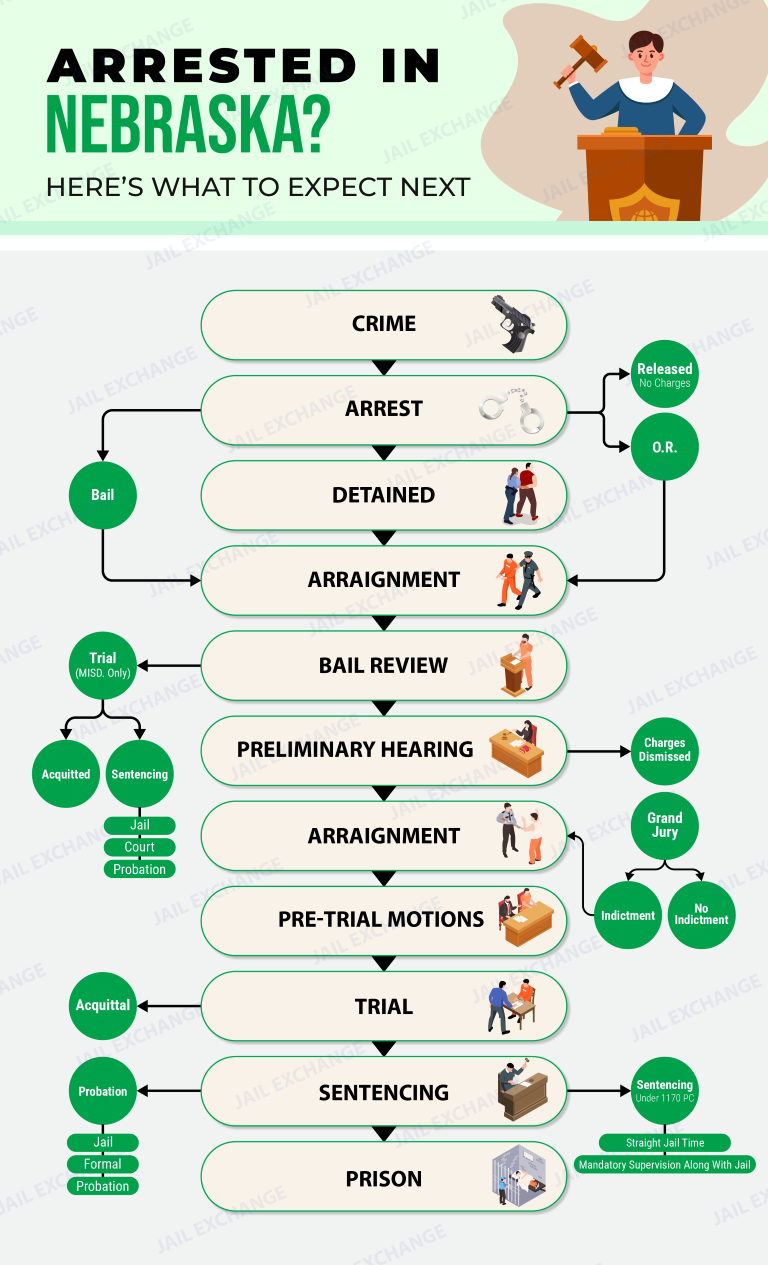
2. What happens right after someone is arrested?
Not every Howard County arrest leads to an overnight jail stay. Some people receive a citation. Those brought to a jail are searched, processed and evaluated for urgent health needs.
Bail and the first appearance
A judge or authorized judicial officer determines whether to release the person, require a bond, or impose conditions such as no contact with another person. A defendant must follow the written release order and return to court. A cash percentage, a bondsman's fee, or a specific amount should never be assumed without seeing the actual bond order.
What should relatives have ready?
Keep the person's legal name and birth date, find out which jail has custody, write down the charge and next court date, and ask whether an attorney has been appointed. Medical concerns should be communicated to the detention facility directly.
3. How does a misdemeanor case move through court?
With a Howard County misdemeanor, the person usually stays in the county-court system instead of having a felony case transferred to District Court.
Possible steps before a verdict
The court may schedule discussions between the prosecutor and defense, hear motions about evidence, or set a trial. A defendant may plead guilty, plead not guilty, or make another plea allowed by law. A plea offer is optional; it is not the same as a court finding of guilt.
Penalties are based on the charge's class
- Class I misdemeanor: up to 1 year in jail, a fine up to $1,000, or both.
- Class II misdemeanor: up to 6 months in jail and/or $1,000.
- Class III misdemeanor: up to 3 months and/or $500.
- Class IIIA misdemeanor: up to 7 days and/or $500.
- Class IV misdemeanor: no jail; maximum $500 fine.
- Class V misdemeanor: no jail; maximum $100 fine.
- Class W misdemeanor: a special classification for DUI and implied-consent offenses; sentencing depends on prior convictions, testing, and court-authorized alternatives.
A class maximum is a legal ceiling, not a promise that the judge will impose it. Court costs, restitution, probation, and driving restrictions can matter too.
4. What happens if the accusation is a felony?
A felony is not ordinarily tried to completion in Howard County Court. A preliminary hearing asks whether the accusation has probable cause; it does not decide guilt.
County Court to District Court
At a preliminary hearing the state presents enough information for the judge to decide whether the felony may continue. If the judge finds probable cause, the charge is bound over to District Court. The case can also follow another lawful charging procedure. The District Court then handles arraignment, scheduling, motions, trial and sentencing.
Lawyers and a possible jury trial
A person who cannot afford counsel should ask the court about a court-appointed attorney and complete the required financial information. Felony defendants should not assume a public defender is automatically assigned. A plea can end the case without a trial. When there is a criminal jury trial, a guilty verdict must satisfy the constitutional unanimity requirement.
5. How are serious violent charges treated?
For a family confronting a Howard County homicide, sexual assault or serious weapons case, early legal representation matters because pretrial decisions may shape the entire prosecution.
Release decisions and evidence
A judge may assess public safety, risk of missing court, the charge and the facts when considering bail and conditions. Lawyers may review medical records, videos, witness statements, laboratory testing and other evidence. The court may hold hearings about what proof can be used at trial.
How serious can the punishment be?
Nebraska authorizes life imprisonment and, for Class I felonies under applicable law, the death penalty. Other violent offenses may carry long mandatory minimums. The exact penalty depends on the charged statute and any proven enhancements, not merely the label “violent.”
6. What if police arrest a child under 18?
A parent whose child is taken into custody in Howard County should ask whether the matter is in juvenile court and whether the child is being released or detained.
Which juvenile court applies?
County Court usually handles juvenile matters here, using its juvenile jurisdiction rather than treating the youth as an ordinary adult defendant. The prosecutor, court and probation staff may consider supervision, services, family involvement or placement if authorized.
Detention, hearings and records
Detaining a child is not the same as sentencing that child to prison. Youth detention and placement decisions require the proper juvenile-court process. Parents or guardians should ask about the next hearing, an attorney for the child, and contact rules. Juvenile records generally have protections that do not apply to open adult records, subject to statutory exceptions.
7. What are the actual jail, prison, and fine limits?
A Howard County judge must use the penalty law that applies to the convicted offense. Two defendants accused of similar conduct can receive different sentences because their facts and histories differ.
Actual misdemeanor maximums — Neb. Rev. Stat. § 28-106
- Class I misdemeanor: up to 1 year in jail, a fine up to $1,000, or both.
- Class II misdemeanor: up to 6 months in jail and/or $1,000.
- Class III misdemeanor: up to 3 months and/or $500.
- Class IIIA misdemeanor: up to 7 days and/or $500.
- Class IV misdemeanor: no jail; maximum $500 fine.
- Class V misdemeanor: no jail; maximum $100 fine.
- Class W misdemeanor: a special classification for DUI and implied-consent offenses; sentencing depends on prior convictions, testing, and court-authorized alternatives.
Actual felony ranges — Neb. Rev. Stat. § 28-105
- Class I: death.
- Class IA: life imprisonment.
- Class IB: 20 years to life.
- Class IC: mandatory minimum 5 years, maximum 50 years.
- Class ID: mandatory minimum 3 years, maximum 50 years.
- Class II: 1 to 50 years.
- Class IIA: up to 20 years, without a statutory minimum for the class.
- Class III: up to 4 years in prison and 2 years post-release supervision, or a fine up to $25,000, or both, subject to sentencing provisions.
- Class IIIA: up to 3 years in prison and 18 months post-release supervision, or a fine up to $10,000, or both.
- Class IV: up to 2 years in prison and 12 months post-release supervision, or a fine up to $10,000, or both.
Sentencing details families should understand
For the highest felony classes, the stated minimums may be required; for other classes the law allows different outcomes, including probation when permitted. Habitual-criminal enhancements and special offense provisions can increase the exposure. Nebraska generally places felony sentences with maximum terms of one year or more in state correctional institutions; misdemeanor jail terms ordinarily are served locally. Federal crimes have their own separate sentencing laws.
8. When is a charge federal, and where does that case go?
Being arrested in Howard County does not by itself put someone in federal court. The federal government needs a law giving it authority over the alleged offense.
Examples of federal offenses
Federal charges may involve drug distribution across state lines, certain firearm offenses, bank robbery, federal-program fraud, or crimes committed on federal land. Some behavior violates both state and federal laws, but many ordinary assaults, thefts and DUI cases remain state matters.
United States District Court for the District of Nebraska
Nebraska has one federal judicial district. Its main courthouse and federal clerk contacts are listed below. The location of a particular hearing is controlled by the case assignment and court order, not simply by the county of arrest.
- Omaha — Roman L. Hruska Federal Courthouse: 111 South 18th Plaza, Suite 1152, Omaha, NE 68102; (402) 661-7350.
- Lincoln — Robert V. Denney Federal Building: 100 Centennial Mall North, Room 593, Lincoln, NE 68508; (402) 437-1900.
- North Platte federal court sessions: Lincoln County Courthouse, 301 North Jeffers Street, North Platte, NE 69101. For federal clerk assistance use the Omaha or Lincoln clerk's number.
The federal criminal process
A federal defendant may appear before a U.S. magistrate judge for an initial hearing and a release-or-detention decision. A grand jury indictment or other lawful charging document may follow; later stages can include arraignment, evidence exchange, motions, a plea or jury trial, and sentencing under federal statutes and advisory guidelines. Federal public defenders or appointed counsel may represent those who qualify.
This page is an educational overview of criminal proceedings, not advice about an individual case. Court orders, the specific charged statute, and judicial findings control the result.
Information for this service is currently unavailable.
Information for this service is currently unavailable.
Howard County, Nebraska, does not run a jail of its own in St. Paul. The Howard County Sheriff's Office sends the people it arrests to a jail in a neighboring county. The Hall County Jail in Grand Island and the Valley County Jail in Ord have both housed Howard County prisoners, and the case still stays in Howard County court.
Mail for a Howard County inmate at the Hall County Jail:
Hall County Jail
110 Public Safety Drive
Grand Island, NE 68802-2008
- Step one: Search for the person on the inmate search, or call the Howard County Sheriff's Office at 308-754-5433, to learn which jail has them.
- Step two: Mail your letter to that jail and follow its rules. If the person is in Ord, use the Valley County Jail's address instead of the one above.
- On the envelope: Use the person's full booking name and their inmate ID number, plus your own name and return address.
- At the Hall County Jail: Mail comes only through the post office on weekdays, books and magazines mailed in are stored with the person's property until release, and checks are not taken as deposits.
Information for this service is currently unavailable.
Information for this service is currently unavailable.
Information for this service is currently unavailable.
Howard County County Jails
Howard County Juvenile Facilities
Nearby counties
- Jail (Main): 308-754-5433
- 308-754-5433
The Howard County Jail serves the following cities and towns of Howard County: Dannebrog, Elba, Farwell, Saint Libory, Saint Paul and Wolbach.