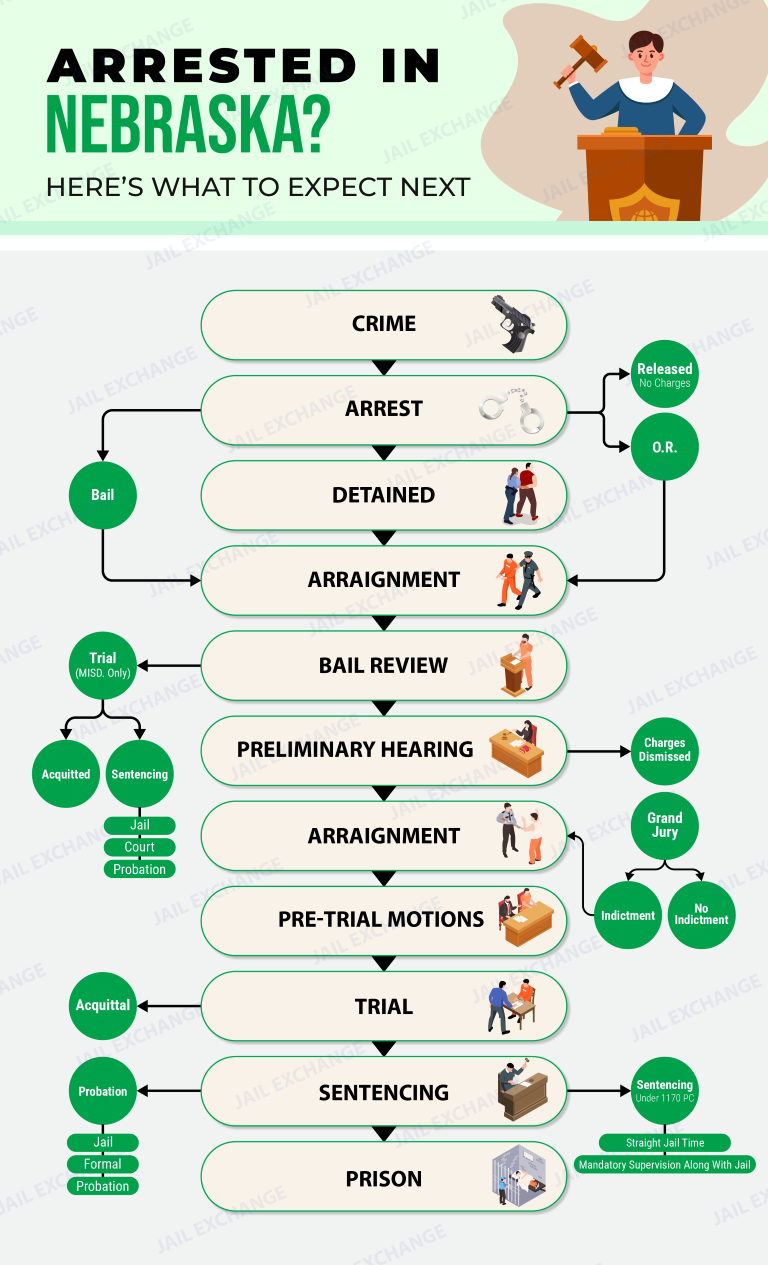
Merrick County Jail Criminal Court Process
Criminal Court Process for Merrick County Nebraska
Merrick County Court Guide: Case Searches, Locations and Family Help
For Merrick County court records and hearing information, call County Court at 308-946-2812 or the District Court clerk at 308-946-2461. County Court lists 1510 18th Street, Central City, NE 68826; mail P.O. Box 27; the District Court clerk lists 1510 18th Street, Central City, NE 68826; mail P.O. Box 27. Confirm the actual hearing room before traveling.
County Court handles most misdemeanors, traffic cases and preliminary felony proceedings. District Court handles felony trials and sentencing in the Fifth Judicial District. The Nebraska Judicial Branch case-search services explain online searches and free courthouse access.
For an arrest and actual housing, call the Sheriff at 308-946-2345. Ask which jail received the person; a court office does not confirm detention. Our Inmate Search guide helps locate someone, and our Bail guide explains release and bond.
1. Which Merrick County court handles the case, and where should I call?
District Court hears felony trials and sentencing.
- Merrick County Court: P.O. Box 27, Central City, NE 68826; 308-946-2812. This is a published mailing/contact address, not a verified courtroom entrance.
- Merrick County District Court Clerk: 1510 18th Street, Central City, NE 68826; mail P.O. Box 27; 308-946-2461. The directory gives this as a mailing/contact address; it is not necessarily the public entrance.
Who does what?
The County Court clerk can identify county-court case dates and filings. The District Court clerk handles records for felony proceedings in that court. A sheriff or jail is a separate office; a court clerk cannot promise release or change bond. In Douglas, Lancaster and Sarpy counties, a separate Juvenile Court hears most juvenile cases.
2. What happens right after someone is arrested?
An officer may give someone a ticket with a date to appear or take the person into custody. A custodial arrest in Merrick County is followed by identification checks, fingerprinting and a booking record.
Bail and the first appearance
A judge or authorized judicial officer determines whether to release the person, require a bond, or impose conditions such as no contact with another person. A defendant must follow the written release order and return to court. A cash percentage, or a specific amount should never be assumed without seeing the actual bond order.
What should relatives have ready?
Keep the person's legal name and birth date, find out which jail has custody, write down the charge and next court date, and ask whether an attorney has been appointed. Medical concerns should be communicated to the detention facility directly.
3. How does a misdemeanor case move through court?
Most misdemeanor charges filed in Merrick County are decided in County Court. The first court date explains the accusation and provides a chance to enter a plea.
Possible steps before a verdict
The court may schedule discussions between the prosecutor and defense, hear motions about evidence, or set a trial. A defendant may plead guilty, plead not guilty, or make another plea allowed by law. A plea offer is optional; it is not the same as a court finding of guilt.
Penalties are based on the charge's class
- Class I misdemeanor: up to 1 year in jail, a fine up to $1,000, or both.
- Class II misdemeanor: up to 6 months in jail and/or $1,000.
- Class III misdemeanor: up to 3 months and/or $500.
- Class IIIA misdemeanor: up to 7 days and/or $500.
- Class IV misdemeanor: no jail; maximum $500 fine.
- Class V misdemeanor: no jail; maximum $100 fine.
- Class W misdemeanor: a special classification for DUI and implied-consent offenses; sentencing depends on prior convictions, testing, and court-authorized alternatives.
A class maximum is a legal ceiling, not a promise that the judge will impose it. Court costs, restitution, probation, and driving restrictions can matter too.
4. What happens if the accusation is a felony?
When Merrick County prosecutors allege a felony, the County Court can hold a preliminary hearing to decide whether enough evidence exists to move the case forward.
County Court to District Court
At a preliminary hearing the state presents enough information for the judge to decide whether the felony may continue. If the judge finds probable cause, the charge is bound over to District Court. The case can also follow another lawful charging procedure. The District Court then handles arraignment, scheduling, motions, trial and sentencing.
Lawyers and a possible jury trial
A person who cannot afford counsel should ask the court about a court-appointed attorney and complete the required financial information. Felony defendants should not assume a public defender is automatically assigned. A plea can end the case without a trial. When there is a criminal jury trial, a guilty verdict must satisfy the constitutional unanimity requirement.
5. How are serious violent charges treated?
A charge involving serious injury, sexual violence or a death in Merrick County can expose the accused to penalties far beyond those for a routine misdemeanor.
Release decisions and evidence
A judge may assess public safety, risk of missing court, the charge and the facts when considering bail and conditions. Lawyers may review medical records, videos, witness statements, laboratory testing and other evidence. The court may hold hearings about what proof can be used at trial.
How serious can the punishment be?
Nebraska authorizes life imprisonment and, for Class I felonies under applicable law, the death penalty. Other violent offenses may carry long mandatory minimums. The exact penalty depends on the charged statute and any proven enhancements, not merely the label “violent.”
6. What if police arrest a child under 18?
If a person younger than 18 is accused of an offense in Merrick County, the rules may be very different from an adult criminal case.
Which juvenile court applies?
County Court usually handles juvenile matters here, using its juvenile jurisdiction rather than treating the youth as an ordinary adult defendant. The prosecutor, court and probation staff may consider supervision, services, family involvement or placement if authorized.
Detention, hearings and records
Detaining a child is not the same as sentencing that child to prison. Youth detention and placement decisions require the proper juvenile-court process. Parents or guardians should ask about the next hearing, an attorney for the child, and contact rules. Juvenile records generally have protections that do not apply to open adult records, subject to statutory exceptions.
7. What are the actual jail, prison, and fine limits?
In Merrick County, the maximum punishment comes from Nebraska law and the offense proved in court, not from a county-specific price list.
Actual misdemeanor maximums — Neb. Rev. Stat. § 28-106
- Class I misdemeanor: up to 1 year in jail, a fine up to $1,000, or both.
- Class II misdemeanor: up to 6 months in jail and/or $1,000.
- Class III misdemeanor: up to 3 months and/or $500.
- Class IIIA misdemeanor: up to 7 days and/or $500.
- Class IV misdemeanor: no jail; maximum $500 fine.
- Class V misdemeanor: no jail; maximum $100 fine.
- Class W misdemeanor: a special classification for DUI and implied-consent offenses; sentencing depends on prior convictions, testing, and court-authorized alternatives.
Actual felony ranges — Neb. Rev. Stat. § 28-105
- Class I: death.
- Class IA: life imprisonment.
- Class IB: 20 years to life.
- Class IC: mandatory minimum 5 years, maximum 50 years.
- Class ID: mandatory minimum 3 years, maximum 50 years.
- Class II: 1 to 50 years.
- Class IIA: up to 20 years, without a statutory minimum for the class.
- Class III: up to 4 years in prison and 2 years post-release supervision, or a fine up to $25,000, or both, subject to sentencing provisions.
- Class IIIA: up to 3 years in prison and 18 months post-release supervision, or a fine up to $10,000, or both.
- Class IV: up to 2 years in prison and 12 months post-release supervision, or a fine up to $10,000, or both.
Sentencing details families should understand
For the highest felony classes, the stated minimums may be required; for other classes the law allows different outcomes, including probation when permitted. Habitual-criminal enhancements and special offense provisions can increase the exposure. Nebraska generally places felony sentences with maximum terms of one year or more in state correctional institutions; misdemeanor jail terms ordinarily are served locally. Federal crimes have their own separate sentencing laws.
8. When is a charge federal, and where does that case go?
A prosecution from Merrick County becomes federal only when the conduct falls under a federal criminal law and federal prosecutors bring the case.
Examples of federal offenses
Federal charges may involve drug distribution across state lines, certain firearm offenses, bank robbery, federal-program fraud, or crimes committed on federal land. Some behavior violates both state and federal laws, but many ordinary assaults, thefts and DUI cases remain state matters.
United States District Court for the District of Nebraska
Nebraska has one federal judicial district. Its main courthouse and federal clerk contacts are listed below. The location of a particular hearing is controlled by the case assignment and court order, not simply by the county of arrest.
- Omaha — Roman L. Hruska Federal Courthouse: 111 South 18th Plaza, Suite 1152, Omaha, NE 68102; (402) 661-7350.
- Lincoln — Robert V. Denney Federal Building: 100 Centennial Mall North, Room 593, Lincoln, NE 68508; (402) 437-1900.
- North Platte federal court sessions: Lincoln County Courthouse, 301 North Jeffers Street, North Platte, NE 69101. For federal clerk assistance use the Omaha or Lincoln clerk's number.
The federal criminal process
A federal defendant may appear before a U.S. magistrate judge for an initial hearing and a release-or-detention decision. A grand jury indictment or other lawful charging document may follow; later stages can include arraignment, evidence exchange, motions, a plea or jury trial, and sentencing under federal statutes and advisory guidelines. Federal public defenders or appointed counsel may represent those who qualify.
9. How do I search a Merrick County case and confirm the next hearing?
Use the Nebraska Judicial Branch case-search services for public County Court and District Court records. Online one-time searches have a fee; free access is available at courthouse kiosks and participating law libraries. Match Merrick County, the person and case number. Newly filed and restricted matters may not appear publicly.
County Court: 1510 18th Street, Central City, NE 68826; mail P.O. Box 27, 308-946-2812. District Court clerk: 1510 18th Street, Central City, NE 68826; mail P.O. Box 27, 308-946-2461. Follow the hearing notice and confirm the assigned room, entrance and any remote-appearance instructions. A court contact address is not proof of where someone is held.