
Eureka County Jail
Eureka County Jail
Jail Phone Number
775-237-5330Eureka County Inmate Search: Justice Facility Custody and Family Steps
For a Eureka County inmate search, begin with the custody lookup and the Sheriff’s detention staff. The Eureka County Jail serves the county at the Justice Facility, 411 North Main Street, Eureka, NV 89316; non-emergency dispatch is 775-237-5330.
Open the official inmate-search link and compare the name and identifiers. Nevada S.A.V.E. is another route to participating custody information and alerts, while dispatch can direct a question about a new booking.
Ask whether the person is still at the Justice Facility, which inmate number applies and whether release or transport is pending. The Eureka County Bail page explains release, and the Court page covers case records and hearing locations.
Read inmate search answers
 Read inmate search answers
1. How do I start a Eureka County inmate search?
Use the custody lookup and keep a record of the name and inmate number returned. If using Nevada S.A.V.E., its search accepts a full or partial name or an identifier.
- Enter the legal name first.
- Compare possible matches with known identifying details.
- Note the holding agency and reference number.
- Direct a current detention question through 775-237-5330.
An arrest record and the court’s final disposition are different things. Do not treat a booking as a conviction.
↑ Back to the question list2. Why would a Eureka booking not appear?
New intake and record entry take time, and a name may be entered differently from the spelling your family uses. A release or movement to another agency can also change a current custody result. Have a birth date and arrest time available for a staff inquiry.
Dispatch at 775-237-5330 handles routing to detention and other Sheriff’s services. Ask whether the person was booked, remains inside or has a receiving facility elsewhere. Keep the answer with the incident and case numbers before arranging money, mail or travel.
↑ Back to the question list3. Which facility holds Eureka County adults?
Eureka County Jail is associated with the Sheriff’s Justice Facility at 411 North Main Street, Eureka, NV 89316, 775-237-5330. The county’s Detentions Division manages custody and transports inmates for court appearances; those transportation duties do not mean everyone appearing in court is housed elsewhere.
Ask for the actual location when a transfer is involved. Use the Nevada jail directory only after the agency identifies another county, rather than choosing a neighboring jail on a map and assuming it has the person.
↑ Back to the question list4. Where do Eureka County mugshot inquiries go?
Identify the custody record through the official lookup, then ask the Sheriff about the booking photograph or related record. The office is at 411 North Main Street, Eureka, NV 89316, 775-237-5330, with office mail to P.O. Box 736, Eureka, NV 89316.
Specify whether you need a mugshot, incident report or court paper, because they may have different custodians and access requirements. Supply the arrest date and report identifier. A public image associated with a booking does not prove that the allegations resulted in a conviction.
↑ Back to the question list5. Can I get notified about release or transfer?
Use Nevada S.A.V.E. to locate the relevant custody or supervision entry and request notifications. The state replaced its VINE service in 2025, so use the current registration process even if older paperwork mentions VINE.
Check the individual carefully before selecting an alert and retain the confirmation information. A notice does not authorize a visit, cancel a court date or guarantee a pickup time. Contact the holding agency directly when a current safety or transportation decision cannot wait for an automated update.
↑ Back to the question list6. What controls release from the Eureka jail?
The court determines the release terms for the individual case. A payable bail amount, another warrant or a separate agency’s hold can each affect what happens. Under NRS 178.4849, Nevada generally requires a pretrial release hearing within 48 hours, with exceptions and permitted continuances.
Reach detention through 775-237-5330 to ask about the actual order and use the Eureka County Bail page before sending funds. Spending money for the inmate and a court-approved bail payment are separate transactions.
↑ Back to the question list7. How can I obtain the filed Eureka charges?
Eureka County Justice Court hears misdemeanor matters and handles preliminary proceedings for more serious charges. Its Eureka department is at 701 South Main Street, Eureka, NV 89316, 775-237-5540. Ask for the complaint, case number and next hearing when a booking description is unclear.
Use the official Justice Court page to identify the correct department. The Beowawe department has a separate Crescent Valley location. The charge at arrest may later be amended, so follow the court file rather than only the original booking label.
↑ Back to the question list8. How is an appointed attorney requested here?
Tell the judge that the defendant cannot afford a lawyer and request the financial eligibility paperwork. The court makes the appointment; family should obtain the name and contact details of the lawyer actually assigned rather than choose an office based only on an old directory.
For the initial Justice Court process, contact 701 South Main Street, Eureka, NV 89316, 775-237-5540. District Court file inquiries go through the county clerk at 775-237-5263. Keep the appointment order, hearing notice and detention location together for counsel.
↑ Back to the question list9. How are Eureka County visits conducted?
The county describes video visiting through its approved communications portal while inmates have day-room access. Follow the Visitation page for the account route and visitor restrictions, and establish the person’s current housing before arranging a session.
Ask detention through 775-237-5330 about any approval, identification or scheduling question. Video availability does not remove security and conduct rules. For an attorney, use professional contact arrangements rather than assuming an ordinary family account provides a confidential legal visit.
↑ Back to the question list10. What should I check before an inmate deposit?
Use the Money page and identify the current Eureka County booking. Ask which approved deposit route, payee, inmate number and payment form are needed, and whether the funds are intended for commissary or communication.
Review fees and retain a receipt showing the destination account. If a court payment is your goal, follow the bail order instead of adding spending money. After a transfer, ask whether the balance remains at the original facility and how it will be returned or forwarded before sending additional funds.
↑ Back to the question list11. How do calls and electronic messages work?
The Detentions Division describes telephone and video access through the approved communication system. Use the Phone page and Email page for account setup and supported messaging. Check the inmate identifier and your own receiving number.
An unsuccessful call can reflect access times, an account issue or a housing change. Keep your telephone available and avoid relying on ordinary messages for urgent medical matters. Ask the lawyer for the confidential communication arrangements used for advice about evidence and the defense.
↑ Back to the question list12. Which address should go on an inmate letter?
Follow the Mail page for the inmate’s postal address and required identifying number. The Sheriff’s physical and office mailing addresses serve different purposes, so explain that the envelope is intended for a particular person in detention when asking about the format.
Use your return address and check restrictions before enclosing photographs, greeting cards or other material. Legal mail and subscriptions may require separate instructions. If the person is transferred, obtain the new facility’s exact format rather than assuming the original jail will forward every item.
↑ Back to the question list13. How can belongings be released to a relative?
Ask detention staff whether the property is stored from booking or held as evidence, and whether the inmate must authorize pickup. The answer can differ for clothing, keys, money and a seized electronic device. Keep any property inventory and the current booking number.
Before visiting the Justice Facility at 411 North Main Street, Eureka, NV 89316, call 775-237-5330 for the pickup location, time and required identification. A release order for the defendant does not automatically authorize every relative to take possession of the stored belongings.
↑ Back to the question list14. How do I report an urgent health issue?
Call 775-237-5330 and ask for detention assistance when your loved one may need urgent care, an essential prescription or assessment for withdrawal or self-harm. Give the full name, birth date, condition and reason for concern so staff can locate the proper record.
Prepare the medication, dosage, prescriber and pharmacy details. Ask how health staff want records or medical equipment submitted. Do not place medicine in mail or bring it inside without acceptance instructions. Even when privacy limits the response, you can still provide information that may help staff assess the person.
↑ Back to the question list15. How do I check a Eureka County warrant?
The Sheriff at 411 North Main Street, Eureka, NV 89316, 775-237-5330, can explain local warrant inquiries. Also check the court that issued the order. Eureka Justice Court’s department at 701 South Main Street, Eureka, NV 89316, is reached at 775-237-5540; its official page covers court resources and the Beowawe location. Counsel can arrange the appropriate appearance or surrender and obtain a resolving order. Keep that paperwork. An inmate search does not establish that a person has no outstanding warrant, and unexpected payment demands should be independently verified.
↑ Back to the question list16. Which Eureka or Beowawe court location applies?
The Eureka Justice Court department is at 701 South Main Street, Eureka, NV 89316. Its Beowawe department is at 5041 Tenabo Avenue, Crescent Valley, NV 89821. Both use 775-237-5540; the court’s posted schedule distinguishes the two locations.
Use the Eureka County Court page and the case notice to identify the hearing. Ask the clerk about any remote appearance and courtroom assignment. A shared court phone number does not mean every hearing takes place at the same street address.
↑ Back to the question list17. How do I check for federal detention?
Ask the jail or defense lawyer where the Marshals have placed the person and which federal case number applies. A federal detention order and the county’s release order are separate matters. The Reno federal clerk is at 400 South Virginia Street, Reno, NV 89501, 775-686-5800.
Search the BOP inmate locator for federal prison records by name or register number. A pretrial detainee can be in a contract jail without a listed BOP institution, so establish the physical holding location through counsel or detention staff.
↑ Back to the question list18. How can family locate someone in ICE custody?
The ICE public locator uses a nine-digit A-Number and country of birth, or the required biographical details. It excludes records for children under 18. Call the detention inquiry line, 888-351-4024, when the search does not resolve the location.
An I-247A detainer requests a hold for up to 48 hours after they would otherwise be released. Ask whether the person is still in county detention or has been picked up by ICE; a local bail payment does not resolve the separate immigration case.
↑ Back to the question list19. How do I find a state prison assignment?
Use the Nevada corrections offender search for state prison custody. Search with an offender number when available, or compare the name and identifying details. It is separate from the records used for a new county booking.
After a prison sentence, intake and classification precede placement. Check the actual institution in our Nevada prison directory. Establish that transport has occurred before changing family accounts, mailing letters to a prison or arranging a visit at the new location.
↑ Back to the question list20. Who coordinates help for a detained youth?
Eureka County Juvenile Probation works under the Seventh Judicial District Court. Its office is at 10 South Main Street, Eureka, NV 89316, 775-237-5450. A parent or guardian should ask about the child’s current placement, the next hearing and approved communication.
A probation office is not necessarily the secure facility housing the child. Obtain that destination before traveling and give staff any medication or disability information promptly. Ordinary juvenile proceedings have restricted records, so do not rely on an adult custody search to locate a child.
↑ Back to the question list21. Which office handles a Eureka County arrest?
The Sheriff’s office and Justice Facility are at 411 North Main Street, Eureka, NV 89316. The county’s non-emergency dispatch number is 775-237-5330; the Communications Division also publishes 775-237-5252. Dispatch routes routine inquiries for patrol, records and detention.
For incidents around Eureka, Crescent Valley or Beowawe, start with the agency named on the report and ask where officers took the person. State or federal arrests may have another record custodian. Keep the incident number and use 911 for an emergency requiring immediate help.
↑ Back to the question listEureka County bail and bond: the Justice Facility, a short work week, and two court days a month
Eureka County bail and release depend on the court’s order for the case and any other hold. Detention is handled at the Justice Facility, 411 North Main Street, Eureka, NV 89316, with inquiries routed through 775-237-5330.
Check the official custody lookup before arranging a payment. Our Eureka County Inmate Search page also explains bookings, warrants, mugshots and how to locate someone after a transfer.
Ask which court set the requirements, where payment is accepted and whether the person has a separate hold. The Eureka County Court page distinguishes the Eureka and Beowawe locations and the District Court process.
1. How do I find my relative in the Eureka jail?
Type the full name into Eureka County Inmate Search. The record shows the booking and the charge. If the name has not posted, call dispatch at 775-237-5330 and give the legal name and date of birth. Eureka County Justice Facility is the building at 411 North Main Street, Eureka, NV 89316; mail goes to P.O. Box 736.
2. Who works inside the Justice Facility?
It opened in 1989. A sergeant and deputies work varying shifts, run security, supervise work projects and drive inmates to court. They also serve as bailiffs for Eureka Justice Court and the Seventh Judicial District Court. Fingerprint cards are by appointment. Visits run over CIDNET video, and inmates can use the phone and video in the day room. Dispatch, 775-237-5330, can explain the visiting rules.
3. What are the office hours, and what about Fridays?
The administrative office is open Monday through Thursday, 7:00 a.m. to 5:30 p.m., with a break from 12:30 to 1:00 p.m. It is closed on Fridays. A Friday arrest still needs attention, so use the dispatch line, 775-237-5330, instead of waiting for Monday.
4. When does a judge hear the case?
Eureka Justice Court, P.O. Box 496, Eureka, 775-237-5540, handles the first hearing. Nevada law requires a pretrial release hearing within 48 hours after a person is taken into custody (NRS 178.4849). A judge can delay it for good cause, and the judge, prosecutor and lawyer may join by phone or video. Felony cases that go forward move to the Seventh Judicial District Court.
5. Where is the district court, and when does it sit?
It is at 10 South Main Street, Eureka, with mail to P.O. Box 540. The clerk's office answers at 775-237-5263. Call before you go, because hours differ by county department. Court days fall on the first and third Fridays of each month at the Eureka County Courthouse.
6. Who decides the amount?
Only a judge. Under NRS 178.498 the amount must be enough to bring the person back and keep others safe. The judge looks at the offense, the person's ability to pay, work, family and past court record (NRS 178.4853). Bail that is not the least restrictive option cannot be imposed, and the prosecutor must prove the need by clear and convincing evidence (NRS 178.4851).
7. Is there a standard figure for my charge?
There is no county price chart to quote. Look in Eureka County Inmate Search after the first hearing. Only domestic violence battery has a statewide default when nobody sets bail after 12 hours: $3,000, $5,000 or $15,000, based on prior convictions and strangulation or serious injury (NRS 178.484). Dispatch, 775-237-5330, can read the number on the booking.
8. Where do I pay, and what do I take?
Call dispatch at 775-237-5330 for the payment point and accepted forms before you drive. Take photo ID, the person's legal name and the booking number. For a case already assigned to a court, the justice court at 775-237-5540 or the district clerk at 775-237-5263 can confirm how to pay. Every receipt should show the case, the court and the amount.
9. Should I use a bail agent?
You pay at most 15 percent of the bond, or $50 if that is more (NRS 697.300). The fee is one time, with no renewal premium. Interest cannot be charged on a premium paid in installments. Agents must be licensed by the Division of Insurance and registered with the Sheriff and district court clerk (NRS 697.270). Bad conduct can be reported on the state complaint form.
10. Is a property bond possible?
Through an agent, collateral must be fair for the bond, held apart and returned when the bond ends (NRS 697.320). A deed taken this way has to state that it is part of a security transaction. For a bond directly with the court, call the Clerk-Recorder at 775-237-5263 before you bring titles.
11. When is release refused?
Only first-degree murder can be held without bail, and only when the proof is evident or the presumption great. Felony arrests of people on probation or parole go through the court or the supervising agency (NRS 178.484). Alcohol DUI waits for breath alcohol under 0.04, and drug DUI, domestic battery and protective-order cases wait 12 hours. Another county's warrant is also a hold.
12. Does Eureka County have a public defender office?
No office exists. The county contracts with private counsel, and the Clerk-Recorder, 775-237-5263, handles the contract. Ask the judge at the first appearance to appoint a lawyer. Give the lawyer your proof of income and local ties.
13. What about a juvenile arrested here?
Call dispatch, 775-237-5330, or Eureka Justice Court, 775-237-5540, for the location and hearing time. Juvenile cases are private, so the adult search may not show a minor. Have the child's legal name, birth date and a parent's ID ready.
14. What happens after a missed court date?
The court orders a warrant within 14 judicial days and, for larger bonds, notifies the surety or depositor. The bail is forfeited 180 days after the notice is mailed or sent (NRS 178.508). Phone the lawyer and the court, 775-237-5540, the same day. A forfeiture can be set aside only on grounds such as illness or detention by other authorities (NRS 178.512).
15. Who gets the bail money back?
The depositor, after the court exonerates the bail (NRS 178.522), minus anything applied to fines, fees, costs or restitution at judgment (NRS 178.528). A bail agent's fee is kept by the agent. Collateral comes back after the secured debt is paid.
16. Is a jail account deposit the same as a bond?
No. Phone and video money goes to the facility vendor and will not free anyone. Bail goes to the court for one case. Anyone who pressures you to pay by gift card or app is a scammer. Call dispatch, 775-237-5330, to check.
Eureka County bail contacts
- County jail
- Eureka County Justice Facility, 411 North Main Street, Eureka, NV 89316; dispatch 775-237-5330
- Bond guide
- Jail bail and bond guide
- Custody lookup
- Eureka County Inmate Search
- Sheriff's Office
- 411 North Main Street, P.O. Box 736, Eureka, NV 89316; 775-237-5330
- Justice court
- Eureka Justice Court, P.O. Box 496, Eureka, NV 89316; 775-237-5540
- District court
- 10 South Main Street, Eureka, NV 89316; P.O. Box 540; clerk 775-237-5263
- Public defense
- Contract counsel through the Clerk-Recorder, 775-237-5263
- Juvenile
- Dispatch 775-237-5330; justice court 775-237-5540
Office hours changed in 2026 and may change again, so a short call saves a long drive. The explanations here are written for families, not as legal advice for a particular case.
Eureka County Jail: arrange a CIDNET video visit
Start by confirming that the person is being held in Eureka. Call the Sheriff’s non-emergency line at 775-237-5330 and ask for Detentions. The Eureka County Justice Facility is at 411 N. Main St., Eureka, NV 89316.
The Sheriff directs families to CIDNET for video visits. Select the exact facility and check availability and any cost for the person you want to visit. If you plan to go to the facility, call first to confirm which visit options are available and how to arrange one.
The Sheriff’s rules require remote visitors to remain fully dressed. For a visit at the jail, avoid hats, sleeveless or revealing clothes, and leave phones, cameras, food, drinks and bags outside the visiting area. Staff may monitor visits and can end a visit or suspend access for a rule violation.

CIDNET Video Visitation allows families to conduct live, face-to-face video visits with incarcerated loved ones from home. Using an internet-connected smartphone, tablet, or personal computer equipped with a webcam, visitors connect directly through housing-unit video stations or handheld tablets without traveling to the facility or waiting in jail visitor lobbies.
Important: Advance Registration and Visitor Clearance Required
Detention centers do not permit unscheduled or unverified video sessions. Correctional facilities require prospective visitors to submit government-issued photo identification and receive administrative clearance before booking an appointment, an approval process that can take up to 48 hours depending on facility staffing. You should verify your visitor approval status with the facility prior to scheduling. If you do not register well in advance, you will miss your loved one's scheduled visiting window for the week.
Step-by-Step Instructions to Register and Schedule a Video Visit
- Visit customer.cidnet.net or launch the CIDNET app.
- Register your visitor profile and upload a clear photograph of your government-issued ID and a verification photo.
- Wait for email notification confirming institutional visitor approval.
- Ensure your account has sufficient Data Points to cover the duration of the visit.
- Select Video Visitation, select the detention facility, and pick an available calendar time slot.
- Log into the website or mobile app 10 minutes prior to the start time on a device with a functioning camera, microphone, and stable high-speed internet connection.
What the Inmate Needs to Do
The inmate receives a schedule notification on their housing unit video kiosk or tablet. At the appointed time, they log in with their PIN and sit before the screen. Inmates and visitors must strictly observe jail dress and conduct rules; sessions are monitored by staff and will terminate immediately upon any violation.
Official Provider: CIDNET Customer Portal | Encartele Corporate
Customer Service Telephone: 1-888-984-1903
Support Hours: Monday – Friday, 8:00 AM – 5:00 PM CST
Supported Languages: English and Spanish
Other Services Provided by CIDNET
In addition to Remote Video Visitation, CIDNET provides several other communication channels:
- Data Points (Unified Funding): Purchase the central credits that power video visitation, calling, and messaging.
• Learn more on our website: CIDNET Data Points Guide | • Visit official vendor page: Buy CIDNET Data - Inmate Messaging & Digital Mail: Send electronic text messages and digital photo attachments directly to an inmate's terminal.
• Learn more on our website: CIDNET Messaging Guide | • Visit official vendor page: CIDNET Messaging Portal - Phone PINs & Voice Calling: Fund prepaid telephone calling so your loved one can call your mobile device.
• Learn more on our website: CIDNET Phone Calling Guide | • Visit official vendor page: CIDNET Voice Calling
Eureka County Criminal Court Guide
Eureka County court information depends on the assigned department and court level. Justice Court’s Eureka office is at 701 South Main Street, Eureka, NV 89316, 775-237-5540, while its Beowawe department is at 5041 Tenabo Avenue, Crescent Valley, NV 89821.
Misdemeanors and early felony proceedings can begin in Justice Court, with serious cases moving to the Seventh Judicial District Court. The custody lookup and Eureka County Inmate Search page help establish the separate detention location.
Ask the clerk which department, date and appearance instructions apply to the case number on the notice. Our Eureka County Bail page explains release questions, while the court questions below cover the stages of prosecution.
1. Where are the Eureka County courts, and whom should I call?
A court notice in Eureka County can be confusing because Nevada uses both Justice Courts and District Courts. The state directory publishes a postal box for District Court, not a confirmed public entrance. Justice Court lists its South Main Street location. The court shown on the charging papers decides where the person must appear; the larger District Court ordinarily handles felony trials.
- 7th Judicial District — Eureka County District Court: Eureka, NV 89316 (mailing: PO Box 694). Phone: 775-237-5263.
- Eureka Justice Court: 701 South Main Street, Eureka, NV 89316. Phone: 775-237-5540.
Where do I go? The location printed on the summons or court order controls. In Nevada, municipal courts may handle city-ordinance and some misdemeanor cases; township Justice Courts are not interchangeable when a county has several locations.
↑ Back to the question list2. After a Eureka County arrest, how does release or bail work?
An arrest does not mean the accused has been convicted. After a jail search and booking record, the accused is brought into the judicial process. A court looks at public safety and the risk of missing court before deciding on release. Relatives can help most by obtaining the full name, date of birth and case or booking number.
How can a family member help?
Write down the full name, date of birth, booking number if available, arresting agency and upcoming court date. Contact the court handling the hearing for case-number questions; custody questions belong to the detention facility. If the person is ill or in withdrawal, notify detention medical staff promptly. A private lawyer or appointed lawyer can explain the release order.
↑ Back to the question list3. What happens in Eureka County for a misdemeanor?
For everyday criminal citations, Justice Court is usually the place to begin. The prosecutor must prove each part of an offense if the accused fights it. Negotiated resolutions and diversion may be considered in eligible cases, but their availability depends on the charge and the prosecutor or court.
What does the prosecutor have to prove?
A guilty verdict requires proof beyond a reasonable doubt. The person can challenge evidence and request legal counsel when eligible. Ordinary misdemeanor and gross-misdemeanor charges do not have the same maximum punishments; the sentencing box below explains the distinction.
In Eureka County, the first contact is usually Eureka Justice Court, telephone 775-237-5540. Another township may be responsible if the arrest or citation occurred elsewhere in Eureka County.
Jail and fine ceilings for lesser charges
When reading a Eureka County charging paper, look for the statute number. It determines whether the ordinary misdemeanor limit or a special penalty applies.
- Ordinary misdemeanor — NRS 193.150: As much as 6 months in a county or city jail, a fine up to $1,000, or both. Community service may replace all or part of the ordinary punishment if ordered under the statute.
- Gross misdemeanor — NRS 193.140: No more than 364 days in the county jail, a fine up to $2,000, or both, unless the specific offense provides a different sentence.
- Petit larceny — NRS 205.240: Stealing covered property worth less than $1,200 is generally a misdemeanor; the ordinary limit is up to 6 months and/or $1,000. Theft involving other circumstances can be charged differently.
- First DUI within 7 years — NRS 484C.400: Generally a $400–$1,000 fine and either 2 days–6 months of jail or qualifying residential confinement, or 48–96 hours of community service, plus required education. Treatment-related exceptions and other conditions may apply.
- Second DUI within 7 years — NRS 484C.400: Generally 20 days–6 months in jail or residential confinement, plus $750–$1,000 or permitted equivalent community service, along with treatment requirements. These are the updated statutory figures.
- First domestic-violence battery within 7 years — NRS 200.485: Generally 2 days–6 months in jail, 48–120 hours of community service and a $200–$1,000 fine. Other requirements or higher penalties can apply based on the facts and prior convictions.
These figures are statutory punishments, not predictions of a sentence. Court assessments, restitution, treatment and driving restrictions can create additional obligations. A charge under a city ordinance may have its own penalty provision. The offense date and any prior convictions matter.
↑ Back to the question list4. How does a felony reach 7th Judicial District?
The first felony hearing is only the start. There may be bail review, a preliminary hearing, a later District Court arraignment and several pretrial dates. A felony trial requires the state to prove guilt beyond a reasonable doubt. Many cases resolve by a negotiated plea instead.
Preliminary hearing versus trial
At a preliminary hearing the judge asks whether enough evidence exists to continue the prosecution. That is not a decision that the accused committed the crime. A felony trial or guilty plea in 7th Judicial District can lead to sentencing under the particular Nevada law charged.
District Court contact: Eureka, NV 89316 (mailing: PO Box 694), 775-237-5263. The assigned courtroom and hearing time appear on the case notice.
↑ Back to the question list5. What if the allegation involves a serious violent crime?
When prosecutors accuse someone of a violent crime, the District Court may be asked to decide difficult questions about evidence and witness testimony before trial. A family should not assume the charge label itself tells them the sentence. Exact statutory provisions and enhancements matter.
Possible penalties
Nevada’s first-degree murder statute, NRS 200.030, provides different sentencing possibilities based on the findings and legal requirements, including life imprisonment; death can be authorized in qualifying cases. A deadly-weapon enhancement under NRS 193.165 may add punishment to certain crimes, subject to statutory limits and exceptions. Robbery and sexual assault have their own specific sentencing statutes, so no one range covers all violent felonies.
Evidence and preparation often take longer in serious cases. The defense should understand whether the prosecution has alleged an enhancement, repeat-offender treatment or a mandatory minimum.
↑ Back to the question list6. What happens if the arrested person is under 18?
Juvenile cases are not simply smaller versions of adult prosecutions. Parents or guardians are often involved, school and treatment issues may be considered, and records have special access rules. Secure detention and out-of-home placement require legal grounds and judicial review.
Where will the juvenile appear?
Juvenile matters are handled within 7th Judicial District or its juvenile services arrangement. Hearings and juvenile placements do not necessarily occur in the same room as adult felony trials. Court orders govern release, attendance, counseling and any detention.
↑ Back to the question list7. How much jail time, prison time or fines are possible?
The judge first looks at the statute charged. Under the general Nevada rules, misdemeanor punishment tops out at six months in county custody and $1,000; a gross misdemeanor can reach 364 days and $2,000. Court costs, restitution and other conditions may be additional when authorized.
State prison felony ranges under NRS 193.130
- Category C: 1–5 years in state prison; fine up to $10,000 unless another statute provides otherwise.
- Category D: 1–4 years; fine up to $5,000 unless law sets another amount.
- Category E: 1–4 years is the statutory range, but probation with a suspended sentence is generally required unless an exception applies; a fine up to $5,000 may apply.
- Category B: the crime-specific law determines the range, within the broad 1–20-year category limits.
- Category A: penalties can include life imprisonment or death where the particular law allows; there is no single fixed range.
How do these numbers affect a real case?
Nevada commonly uses a minimum and maximum prison term; the minimum generally cannot exceed 40% of the imposed maximum, except where the law says otherwise. For a category B offense the particular criminal statute sets its own minimum and maximum. Some crimes have mandatory terms, special fines or rules about whether probation is available. Community supervision, restitution, required treatment and suspended sentences can be part of eligible cases. A judge does not give everyone charged under one category the same sentence.
↑ Back to the question list8. Could this become a federal criminal case?
Federal criminal prosecutions use a different courthouse system from Nevada Justice and District Courts. Conduct involving federal property, interstate transactions, qualifying firearm offenses or federal drug laws may lead to federal charges. A federal grand jury may indict, and federal sentencing uses federal statutes and advisory guidelines.
U.S. District Court for the District of Nevada
Bruce R. Thompson United States Courthouse, 400 South Virginia Street, Reno, NV 89501-2193. Clerk telephone: 775-686-5800. Nevada has one federal judicial district with federal courthouses in both Las Vegas and Reno. Federal judges may assign hearings at the appropriate location; the filed notice determines where a specific person must appear.
What happens after federal arrest?
The accused is normally brought before a federal magistrate judge for an initial appearance, counsel and a release or detention decision. Federal felony charges can proceed by grand-jury indictment, followed by arraignment, discovery, plea or trial, and sentencing under federal law. Federal prisoners may be housed outside the county or even outside Nevada.
↑ Back to the question list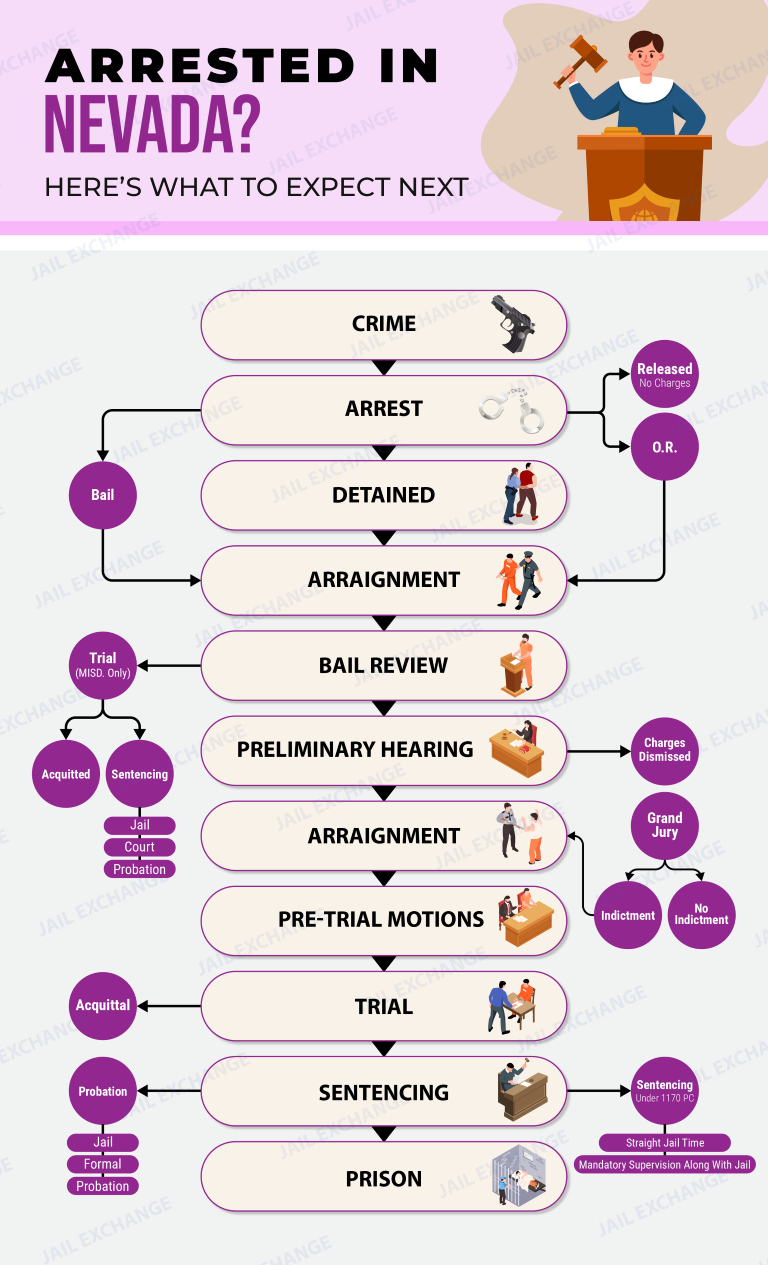
Before sending commissary money to Eureka County Jail
Eureka County houses people at its Justice Facility, which also supervises weekend stays. Call 775-237-5330 before sending money or ordering anything. Ask whether the person is still at the Eureka facility and whether they can use commissary during their stay.
If they can order, ask staff how to put money on the jail spending account and when orders are due. Money for CIDNET calls and video is not a deposit to that spending account. If the person has transferred, use the receiving jail’s instructions instead.
Money meant for phone calls and video visits in Eureka County sits in its own account with the phone company. That balance is separate from the jail account, and bail can't be paid from either one.
As for the jail account itself, the Eureka County Sheriff's Detentions Division at 411 N. Main Street in Eureka keeps its deposit options off the public record. Staff share them by phone at 775-237-5330; have the person's name and birthdate handy.
- When to reach the office: Monday to Thursday, 7:00 a.m. until 5:30 p.m. Fridays it is closed.
- Likely method: rural jails most often take postal money orders, either at the front counter on N. Main Street during office hours or by mail. Ask staff who to make one out to before you buy it.
- Postal address: P.O. Box 736, Eureka, NV 89316. The Sheriff's Office chooses not to say whether a money order mailed there is accepted, so confirm at 775-237-5330 before any money goes in an envelope.
The Eureka County Jail, which the county calls the Eureka County Justice Facility, was built in 1989 on North Main Street in the town of Eureka, Eureka County, Nevada. It is run by the Detentions Division of the Eureka County Sheriff's Office. Letters and publications both go to the post office box in Eureka, and mail is delivered on weekdays.
Letters, legal papers, books and magazines:
Inmate's Full Name & Inmate ID #
Eureka County Jail
PO Box 736
Eureka, NV 89316
- Your address: Write your name and mailing address in the top left corner, or the letter will likely be thrown away.
- Ink: Stick to blue or black. Letters written in felt marker, crayon or colored ink are not accepted.
- No decorations: No drawings on the envelope or postcard, and nothing like glitter, confetti, lipstick or perfume.
- Reading material: New books, newspapers and magazines must come directly from the publisher or a store. Books with extreme violence, pornography or obscene pictures are thrown out, and staff keep any magazine that shows weapons, profanity or adult content.
- Greeting cards: Plain, with no music.
- Stamps: Inmates buy their own from commissary, so don't send any. Those who can't afford them receive two or three a week.
- Restricted mail: No letters with co-defendants, with people held in any jail or prison, or with anyone covered by a no-contact order.
- Limits: None on how many letters an inmate can receive.
- Packages: Only from the third-party commissary vendor.
- Rule breaking: The jail enforces a zero-tolerance mail policy.
Visits at the Eureka County jail are done by video, and the inmate can use phones and video visits from the day room.
CIDNET Phone Calling enables incarcerated individuals to place outbound voice calls from housing-unit wall phones or handheld tablets directly to approved cell phones and landlines. Because jail phone systems cannot accept incoming calls, setting up a CIDNET account and purchasing Data Points ensures outbound calls connect immediately without wireless carrier collect blocks.
Important: Mobile Networks Block Inmate Calls Without Data Points
Wireless cellular carriers automatically block collect calls originating from jail telecommunications systems. While some traditional landline telephone providers may support monthly operator billing, mobile smartphones and VoIP numbers require an active prepaid CIDNET balance, which you can verify with your provider. If you do not register your 10-digit number online and purchase Data Points immediately, your loved one will hear an automated operator recording stating that your phone number cannot accept calls.
Step-by-Step Instructions to Set Up and Fund Voice Calling
- Go to customer.cidnet.net or launch the CIDNET Customer mobile app.
- Register your account using the primary 10-digit telephone number where you want to receive calls.
- Upload your driver's license or state ID for identity verification.
- Select the detention center where the inmate is held and link them to your contact profile.
- Purchase Data Points using a debit or credit card to cover per-minute calling rates.
- Confirm your mobile phone allows calls from automated or unknown correctional numbers and does not send them to spam.
What the Inmate Needs to Do
The inmate approaches a pod wall phone or opens the phone app on their tablet, enters their assigned inmate PIN, and dials your 10-digit number. CIDNET's automated system verifies that your account has sufficient Data Points and connects the call once you accept the automated prompt. All non-privileged conversations are recorded and monitored by the facility.
Official Provider: CIDNET Customer Portal | Encartele Corporate
Customer Service Telephone: 1-888-984-1903
Support Hours: Monday – Friday, 8:00 AM – 5:00 PM CST
Supported Languages: English and Spanish
Other Services Provided by CIDNET
In addition to Phone Calling, CIDNET operates messaging and video visitation services:
- Data Points (Unified Funding): Purchase the central credits used to pay for telephone talk time.
• Learn more on our website: CIDNET Data Points Guide | • Visit official vendor page: Buy CIDNET Data - Remote Video Visitation: Schedule and join live video visits from home using your computer or smartphone.
• Learn more on our website: CIDNET Video Visits Guide | • Visit official vendor page: CIDNET Video Visitation - Inmate Messaging & Digital Mail: Send text messages and digital photo attachments directly to an inmate's terminal.
• Learn more on our website: CIDNET Messaging Guide | • Visit official vendor page: CIDNET Messaging Portal
CIDNET Inmate Messaging provides a secure digital messaging and picture-sharing service for families of incarcerated individuals. Powered by CIDNET Data Points, outside contacts can compose electronic letters and upload JPEG photographs directly through the CIDNET web app, delivering correspondence to inmate screens within hours and avoiding paper mail sorting delays.
Important: Postal Mail Transition and Screening Rules Vary
Inmates cannot receive incoming phone calls, and physical postal mail policies differ across jurisdictions. While some detention centers accept handwritten envelopes, many facilities contracting with CIDNET have prohibited physical paper mail in favor of electronic mail scanning and direct digital messaging, which you can verify by checking facility rules. If you do not register online and purchase Data Points immediately, your loved one may face lengthy periods without direct written communication from family.
Step-by-Step Instructions to Register and Message an Inmate
- Log into your account at customer.cidnet.net or launch the CIDNET app.
- Ensure your identity verification (photo ID and selfie) is approved by the facility.
- Confirm your account has an active Data Point balance; purchase additional points if needed.
- Select Messages from your navigation menu and click on your linked contact.
- Type your message in the text editor and attach clear JPEG photo files if authorized by the facility's media rules.
- Review the estimated Data Point cost for the message length and image attachments.
- Click Send to submit your transmission to the institutional mailroom screening queue.
What the Inmate Needs to Do
All messages and photographs pass through facility screening filters. Once approved, the message arrives in the inmate's inbox on their housing unit kiosk or assigned tablet. The inmate opens the message, views the images, and types a digital response, which draws against available account points.
Official Provider: CIDNET Customer Portal | Encartele Corporate
Customer Service Telephone: 1-888-984-1903
Support Hours: Monday – Friday, 8:00 AM – 5:00 PM CST
Supported Languages: English and Spanish
Other Services Provided by CIDNET
In addition to Inmate Messaging, CIDNET provides several other communication and visitation options:
- Data Points (Unified Funding): Purchase universal credits that power voice calling, messaging, and video visits.
• Learn more on our website: CIDNET Data Points Guide | • Visit official vendor page: Buy CIDNET Data - Remote Video Visitation: Schedule and join live video visits from home using your computer or smartphone.
• Learn more on our website: CIDNET Video Visits Guide | • Visit official vendor page: CIDNET Video Visitation - Phone PINs & Voice Calling: Fund outbound voice telephone calls so your loved one can call your telephone directly.
• Learn more on our website: CIDNET Phone Calling Guide | • Visit official vendor page: CIDNET Voice Calling
CIDNET provides secure handheld wireless tablets designed specifically for correctional housing units. Operating over a private, encrypted facility network, these devices allow incarcerated individuals to exchange messages, place voice calls, conduct remote video visits, read approved digital books, access law library materials, and complete rehabilitative courses directly from their cells.
Important: Tablet Hardware Deployment and Rental Rules Vary
Detention centers do not manage tablet distribution identically. While some agencies issue individual personal tablets to every detainee at booking, others utilize shared pod docking stations or restrict tablet use to specific dayroom hours, which you should confirm with the facility directly. Although core educational and legal resources are generally provided free of charge, sending messages or making calls from the tablet requires an active balance of Data Points funded by friends or family.
Step-by-Step Instructions to Support Tablet Use
- Confirm that CIDNET handheld tablets are active and deployed at your loved one's specific detention facility.
- Register your verified user account at customer.cidnet.net.
- Complete identity verification by uploading your government photo ID.
- Link the inmate to your profile and purchase a reserve of CIDNET Data Points.
- Notify your loved one that funds are available so they can open the communication apps on their tablet.
What the Inmate Needs to Do
The inmate unlocks their assigned tablet using biometric verification or their unique facility PIN. Once logged on, they can browse institutional announcements, access educational materials, or select approved outside contacts to read messages and start calls. When quiet hours begin or tablets require recharging, inmates return devices to designated pod docking carts.
Official Provider: CIDNET Customer Portal | Encartele Corporate
Customer Service Telephone: 1-888-984-1903
Support Hours: Monday – Friday, 8:00 AM – 5:00 PM CST
Supported Languages: English and Spanish
Other Services Provided by CIDNET
In addition to Inmate Tablet Services, CIDNET provides several core communication channels:
- Data Points (Unified Funding): Purchase the digital currency required to power all tablet communications.
• Learn more on our website: CIDNET Data Points Guide | • Visit official vendor page: Buy CIDNET Data - Inmate Messaging & Digital Mail: Send text messages and photos directly to an inmate's tablet screen.
• Learn more on our website: CIDNET Messaging Guide | • Visit official vendor page: CIDNET Messaging Portal - Remote Video Visitation: Conduct scheduled live video calls directly to their tablet or pod kiosk.
• Learn more on our website: CIDNET Video Visits Guide | • Visit official vendor page: CIDNET Video Visitation
Eureka County Juvenile Facilities
Nearby counties
- Jail (Main): 775-237-5330
- Sheriff: 775-237-5330
The Eureka County Jail serves the following cities and towns of Eureka County: Crescent Valley and Eureka.