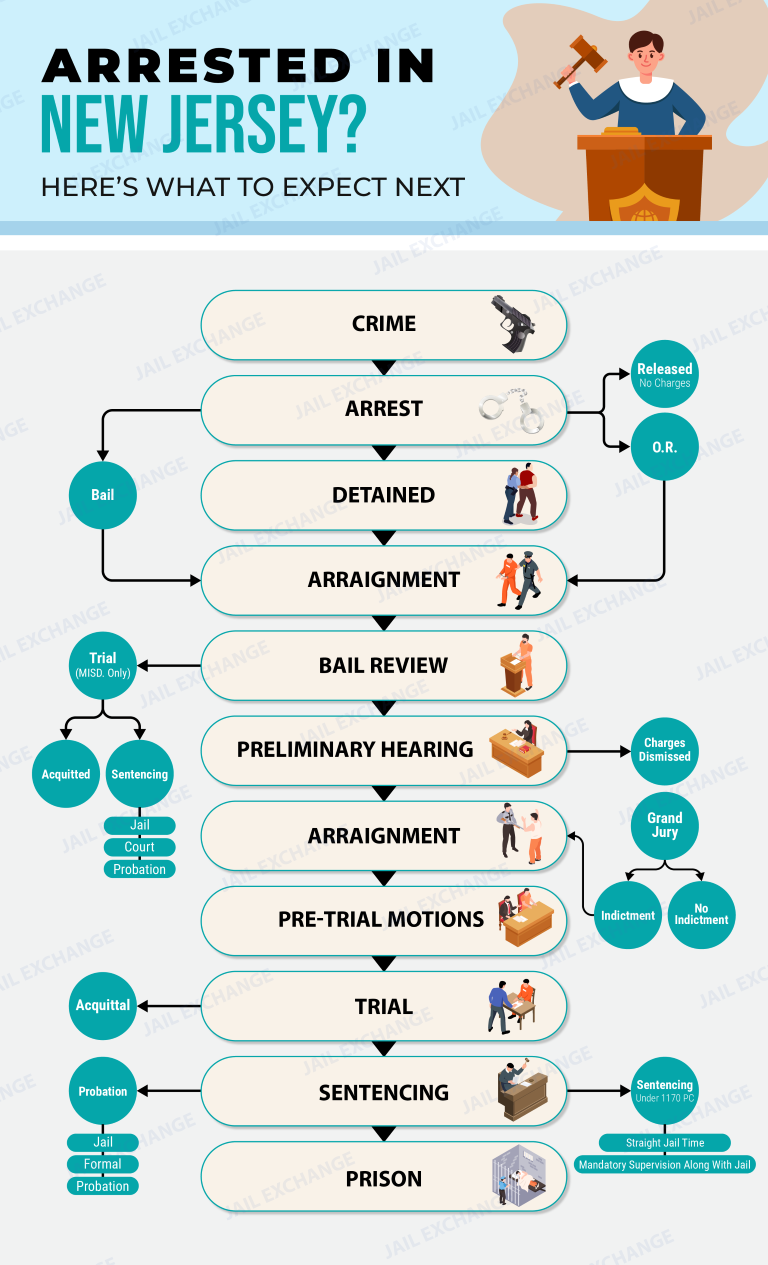
Essex County Correctional Facility Criminal Court Process
Criminal Court Process for Essex County New Jersey
Essex County Criminal Court Guide
Serious cases from all 22 towns in Essex County go to the Superior Court's Criminal Division at the Veterans Courthouse, 50 West Market Street, Newark, NJ 07102. Lesser charges and tickets go to one of 19 municipal courts. Adults who are held wait at the county jail, 354 Doremus Avenue, Newark, NJ 07105. In Newark, police first hold people at their Municipal Processing Unit, 480 Clinton Avenue, Newark, NJ 07108, for up to about a day. Read on for the courthouses, town courts, the first 48 hours, PTI and other diversion, the path from charge to trial, and warrants.
To see who is being held, open the county's Inmate Lookup. On the custody side, our Inmate Search page helps find who is locked up and covers recent arrests, current charges, open warrants, booking photos, appointed lawyers and picking up property.
For the next Superior Court date, call 973-776-9300 and ask for Criminal Case Management, extension 57113. Spell the name and give the birth date, then ask when and where the person must appear. To learn how release and bail work now, read our bail page.
1. Which New Jersey court handles crimes, and which handles lesser offenses?
New Jersey sorts charges by how serious they are, and it uses its own words for them:
- Indictable crimes are ranked in four degrees. A first-degree crime is the most serious. Think of them as New Jersey's version of felonies. They belong to the Superior Court of New Jersey, Law Division, Criminal Part.
- Disorderly persons offenses are the lower charges, a lot like misdemeanors. The mildest kind is called petty disorderly persons. Town courts hear these, plus traffic, local law, fish and game cases.
- Youth cases for people under 18 go to the Family Part of Superior Court.
Many crimes start as complaints filed in a town court and then move up. Going the other way, a prosecutor can downgrade a charge to a disorderly persons offense and return it to the local court.
↑ Back to the question list2. Where are the Essex County Superior Court buildings?
The court's buildings sit close together in the center of the city, with probation in East Orange. All use one main phone, 973-776-9300, and each office has its own extension. Offices keep business hours on weekdays.
- Veterans Courthouse, 50 West Market Street, Newark, NJ 07102. Criminal Division (ext. 55932), Criminal Case Management in Room 912 (ext. 57113), CJP first appearances (ext. 56950), the Finance Division's Bail Unit (ext. 56892) and the court's ombudsman in Room 132 (ext. 56886).
- Historic Courthouse, 470 Dr. Martin Luther King Jr. Blvd., Newark, NJ 07102.
- Dr. Martin Luther King, Jr. Justice Building, 495 Dr. Martin Luther King Jr. Blvd., Newark, NJ 07102.
- Family Courthouse, Robert N. Wilentz Justice Complex, 212 Washington Street, Newark, NJ 07102. Family Division (ext. 57048) and the Juvenile Unit (ext. 56775).
- Probation Services, 60 Evergreen Place, East Orange, NJ 07018 (7th floor), ext. 53021.
The office that supervises all town courts, the Municipal Division, takes calls at ext. 56889. Treatment cases in Recovery Court have a separate number, 973-776-9461.
↑ Back to the question list3. Which town court covers each Essex County municipality?
Every town court takes its own town's tickets, ordinance cases and disorderly persons charges. Phones and court days below come from the Judiciary's session list. Where no street is shown, call the court for its address.
- Belleville Municipal Court (Belleville): 973-450-3319. Court on Thursdays and every other Wednesday.
- Bloomfield Municipal Court (Bloomfield): 973-680-4078. Court on Monday, Wednesday and Thursday.
- Caldwell Municipal Court (Caldwell): 973-403-4630. Court on the second Wednesday.
- Cedar Grove Municipal Court (Cedar Grove): 525 Pompton Avenue, Cedar Grove, NJ 07009, 973-239-1410, ext. 207. Sessions run by video on the first four Wednesdays at 1 p.m.
- East Orange Municipal Court (East Orange): 221 Freeway Drive East, East Orange, NJ 07018, 973-266-5300. Court Monday through Thursday.
- Fairfield Municipal Court (Fairfield): 973-882-2700. Court on Thursdays.
- Glen Ridge Municipal Court (Glen Ridge): 973-748-8116. Court on the first and third Tuesday.
- Irvington Municipal Court (Irvington): criminal window 973-399-6674, traffic window 973-399-6671. Court Monday through Thursday.
- Livingston Municipal Court (Livingston): 973-535-7970. Court on Thursdays.
- Shared Municipal Court of Maplewood and South Orange (Maplewood, South Orange): 1618 Springfield Avenue, Maplewood, NJ 07040, 973-762-2839. Walk-in help weekdays 9:00 a.m. to 3:30 p.m., plus late hours on Tuesday from 3:00 to 6:00 p.m.
- Millburn Municipal Court (Millburn): 973-564-7066. Court on Tuesdays.
- Montclair Municipal Court (Montclair): Public Safety Building, 647 Bloomfield Avenue, Montclair, NJ 07042, 973-509-4774. Court on Tuesday and Wednesday.
- Newark Municipal Court (Newark): 31 Green Street, Room 105, Newark, NJ 07102, call center 973-733-6520. Open weekdays 8:30 a.m. to 4:00 p.m., with some sessions on Zoom.
- Shared Municipal Court of North Caldwell, Essex Fells and Verona (all three towns): 141 Gould Avenue, North Caldwell, NJ 07006, 973-228-6420.
- Nutley Municipal Court (Nutley): 973-284-4945. Court on Wednesdays.
- Orange Municipal Court (Orange): 29 N. Park Street, Orange, NJ 07050, 973-952-6315. Phones answered weekdays 9:00 a.m. to 4:00 p.m.
- Roseland Municipal Court (Roseland): 973-226-0641. Court on the first and third Wednesday.
- West Caldwell Municipal Court (West Caldwell): 973-226-3373. Court on the first and third Wednesday.
- West Orange Municipal Court (West Orange): 60 Main Street, West Orange, NJ 07052, 973-325-4080. Office open weekdays 9:00 a.m. to 4:00 p.m.
4. What happens at CJP, the first hearing after a warrant arrest?
Anyone jailed on a complaint-warrant gets a judge's release ruling no more than 48 hours after booking (N.J.S.A. 2A:162-17). In this county, that first appearance happens at Central Judicial Processing, or CJP, the one central court the rules call for (R. 3:4-2). To ask about times, dial 973-776-9300 and ask for ext. 56950.
Before the hearing, Pretrial Services scores the case with a Public Safety Assessment, a short risk tool built from data, and suggests release terms. At the hearing the judge:
- tells the person the charges and their rights
- can assign the Office of the Public Defender
- decides on release, from a signed promise up to strict monitoring
- holds a detention hearing if the prosecutor has filed for one
The Prosecutor's CJP Unit argues for the state at these hearings. Its lawyers also screen new charges and may drop them, lower them or send them to a town court, Family Court or a treatment court. How release terms are set is laid out on our bail page.
↑ Back to the question list5. What should I expect in a town court case?
Town court cases start with a ticket or a complaint. The first court date is on that paper. The court reads the person their rights at the start of the session, and a municipal prosecutor handles the state's side.
- Disorderly persons: as much as six months behind bars and a $1,000 fine.
- Petty disorderly persons: as much as 30 days and $500.
- There is no jury in town court. The judge decides the case.
- Many traffic tickets can be paid or pleaded online on NJMCdirect. Non-traffic complaints can be looked up on the Judiciary's municipal court page.
Two programs can end a minor case with no conviction. Conditional discharge is for a first minor drug charge, with up to three years of supervision (N.J.S.A. 2C:36A-1). Conditional dismissal covers other first-time disorderly persons charges, with one year of monitoring, though domestic violence and DWI are left out. Each one is a one-time chance with a $75 application fee. The town court has the paperwork.
↑ Back to the question list6. What are the steps in an indictable case at the Veterans Courthouse?
A crime of the first through fourth degree moves through these stages:
- Complaint and probable cause. A judge must find good reason for the charge, or it is dismissed.
- First appearance at CJP, where release is decided.
- Pre-indictment conference within 45 days. Plea offers and Pretrial Intervention often come up here.
- Grand jury. Residents picked at random, 23 at most, review the evidence, and 12 votes are needed to indict.
- Arraignment within 14 days of the indictment, when the charges are formally read.
- Status conferences, usually two, and then a pretrial conference. Plea deals normally close after that point.
- Trial before a jury, which must agree on its verdict.
- Sentencing. The judge gives reasons out loud, and the final order is called a judgment of conviction.
Penalties climb with each degree. Fourth: up to 18 months in prison. Third: 3 to 5 years. Second: 5 to 10. First: 10 to 20 (N.J.S.A. 2C:43-6). The top fine for a first-degree crime is $200,000.
↑ Back to the question list7. What changes when the charge involves a gun or violence?
The rules tighten at almost every step:
- Holding before trial. Prosecutors may seek detention for violent, gun and domestic violence crimes. For murder and life-term crimes, the law presumes the person stays in jail.
- Graves Act. When a listed crime involves a gun, the person must serve at least 42 months or half the term, if that is longer, before parole (N.J.S.A. 2C:43-6(c)).
- No Early Release Act. For crimes such as murder, robbery, carjacking, aggravated assault and sexual assault, 85% of the term must be served before parole. Extra parole follows: five years for first degree, three for second.
- Domestic violence. When money bail is set on these charges, the 10% cash option is off the table.
- Diversion. Pretrial Intervention is much harder to get when the charge carries a presumption of prison.
8. Can a first charge end without a conviction?
Yes, often. Superior Court offers two main paths:
- Pretrial Intervention (PTI). Mostly for first-time offenders. Apply online or at the Criminal Division, the earlier the better, and at the latest before the first conference that follows arraignment. The fee is $75, which can be waived. The case is put on hold for up to 36 months, and the charges are dropped if every condition is met. PTI is off limits to someone who went through it, or through conditional discharge or dismissal, before.
- Recovery Court. A one- to two-year treatment program for adults struggling with drugs or alcohol who face non-violent charges. Graduates may later be able to clear their record, though that isn't promised. Call 973-776-9461.
Ask the defense lawyer which path fits, and do it early, since the deadlines are strict.
↑ Back to the question list9. Who prosecutes in Essex County, and where is the public defender?
Indictable crimes are handled by the County Prosecutor's Office, Veterans Courthouse, 50 West Market Street, Newark, NJ 07102, 973-621-4700. It is open weekdays from 8:30 a.m. to 4:30 p.m. Its Juvenile Unit works from 212 Washington Street, Newark, NJ 07102. In town courts, each town's municipal prosecutor handles the cases.
Free defense comes from the Office of the Public Defender:
- Trial office for adults: 31 Clinton Street, Newark, NJ 07101, 973-648-6200. A judge reviews the 5A money form and decides who qualifies.
- Office of Law Guardian, for children in some Family Part cases: 31 Clinton Street, Newark, NJ 07101 (2nd floor), 973-648-4572.
- Municipal public defenders take town court cases when jail, loss of a license or more than $800 in penalties is possible. The town may charge up to $200 to apply.
Read the state's guide to applying for a public defender.
↑ Back to the question list10. Tracking a case and its next hearing
A phone call usually gets the answer quickest. For a Superior Court case, dial 973-776-9300 and ask for Criminal Case Management, ext. 57113. Keep the spelling of the name and the birth date at hand. Online tools help too:
- Promis/Gavel public access holds Superior Court criminal files from 1980 on.
- From the Judiciary's municipal courts page you can open the Municipal Court Case Search, and NJMCdirect for tickets.
- For copies of court records, call Judiciary Customer Services at 609-421-6100.
For a town court date, phone that court. Each number is in the town court list on this page. The jail can also tell you if a held person has a court trip on the books.
↑ Back to the question list11. How do I check for an Essex County warrant and clear it?
The Sheriff's Office serves warrants countywide, with town police serving their own. Call the Sheriff at 973-621-4111, or its Fugitive Squad at 973-621-4181. You can view the Sheriff's Most Wanted page, the Prosecutor's Wanted page and the State Police Most Wanted page. A town court warrant can be checked by calling that court. To clear one, first get a lawyer, who can arrange a surrender at the jail, 354 Doremus Avenue, Newark, NJ 07105, or call the judge's court staff to get a fresh date. Superior Court warrants go through the Criminal Division, Veterans Courthouse, 50 West Market Street, Newark, NJ 07102, 973-776-9300, ext. 55932.
↑ Back to the question list12. Where do federal charges from Newark go?
Federal crimes from anywhere in the county go to the U.S. District Court for the District of New Jersey, which sits downtown. The clerk's office is at 50 Walnut Street, Room 4015, Newark, NJ 07101, 973-645-3730, open weekdays 9:00 a.m. to 4:00 p.m.
- A magistrate judge meets the person on arrest day or shortly after. The judge explains the charges and lines up a lawyer.
- A detention hearing decides custody before trial. It happens at that first appearance unless a delay is asked for (18 U.S.C. 3142).
- U.S. Pretrial Services, Room 1018, 973-645-2230, reports to the judge on release.
- People kept in custody before a federal trial answer to the U.S. Marshals, whose office is at 50 Walnut Street, Room 2009, Newark, NJ 07102, 973-645-2404.
- The Federal Public Defender, 1002 Broad Street, Newark, NJ 07102, 973-645-6347, represents those who can't pay.
Case files are on PACER. Federal case numbers that begin with "2:" belong to this courthouse. After a prison sentence, search the Federal Bureau of Prisons inmate locator.
↑ Back to the question list13. Does an ICE detainer stop or change the state charges?
The state charge keeps going in its own court. A detainer only affects what happens at release:
- ICE lodges Form I-247A at the jail.
- It requests that the jail keep the person up to 48 hours after they would otherwise be released (8 CFR 287.7(d)).
- ICE officers take custody. The Newark Field Office, 970 Broad St., Newark, NJ 07102 (11th floor), 973-776-3274, covers the whole state.
- Look for the person on the ICE Online Detainee Locator.
New Jersey's Immigrant Trust Directive cuts step 2 back. Local jails can't share release dates with ICE or hold anyone past release on a detainer alone, unless there is a violent or serious charge, a recent indictable conviction, or a removal order a federal judge signed. Any such hold ends at 11:59 p.m. that day. ICE can interview a detained person only with written consent, and the jail must tell the person in writing of any ICE request. The Directive also bans 287(g) deals that let local officers act as immigration agents. A criminal lawyer should check how any plea could affect immigration status.
↑ Back to the question list14. Where does a New Jersey prison sentence begin?
A sentence over one year goes to the New Jersey Department of Corrections. Shorter jail terms are served at the county jail.
- Men go first to the Central Reception and Assignment Facility, P.O. Box 7450, Trenton, NJ 08628, 609-984-6000.
- Women go to Edna Mahan, the women's prison in Clinton (mail: P.O. Box 4004, Clinton, NJ 08809), 908-735-7111.
- Reception staff test, score and assign each person to a prison and custody level.
- Use the DOC's Offender Information page to reach its search.
- The State Parole Board takes parole questions (mail: P.O. Box 862, Trenton, NJ 08625), 609-292-4257.
- Prison by prison details are in our guide to New Jersey state prisons.
15. How are youth charges handled in Family Court?
Charges against anyone under 18 go to the Family Part at the Wilentz Justice Complex, 212 Washington Street, Newark, NJ 07102. Reach the Juvenile Unit at 973-776-9300, ext. 56775.
- Youths who are held go to the county youth detention center, 80 Duryea Street, Newark, NJ 07103, 973-849-0942. Youths from Union and Passaic counties stay there too.
- When the charge is one of a handful of grave crimes, a judge may move the case to adult court after a hearing if the teen was 15 or older. The prosecutor must ask within 60 days (N.J.S.A. 2A:4A-26.1).
- While that question is open, the teen usually stays in youth detention, not the adult jail.
16. What help do Essex County crime victims get?
The Prosecutor's Victim-Witness Advocacy Office is on the third floor of the Veterans Courthouse, 50 West Market Street, Newark, NJ 07102, 973-621-4687. Staff explain each court step and help victims attend.
- The state constitution promises victims fair, caring treatment and a place in open court (N.J. Const. art. I, para. 22).
- The Crime Victims Bill of Rights adds the right to updates on the case, to speak before sentencing and to be safe from threats (N.J.S.A. 52:4B-36).
- The state's Victims of Crime Compensation Office may cover costs like hospital care, therapy, missed wages or a funeral. Call 877-658-2221 or visit NJVictims.org. Police must get the report within 9 months, and the claim is due within 5 years of the crime.
- Free custody alerts come through VINELink or 877-846-3465.