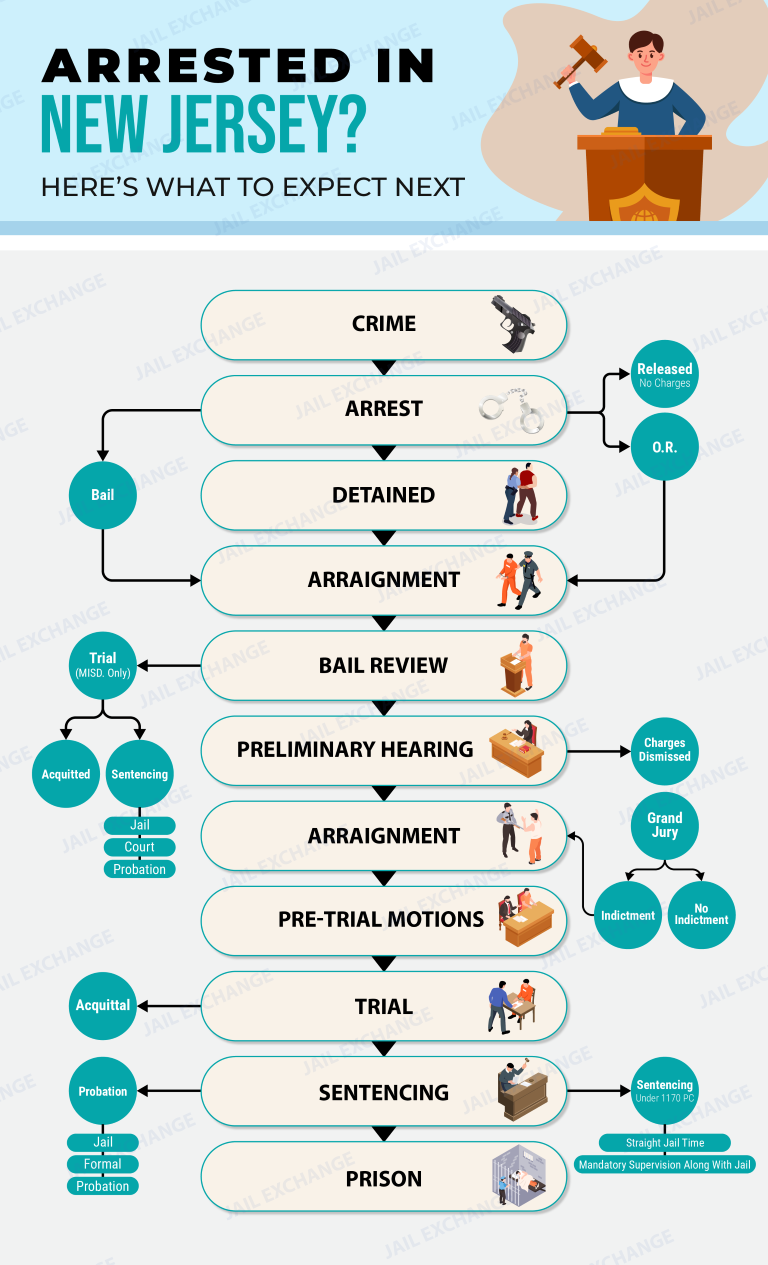
Middlesex County Adult Correction Center Criminal Court Process
Criminal Court Process for Middlesex County New Jersey
Middlesex County Criminal Court Guide
Serious charges from any of Middlesex County's 25 towns are heard in New Brunswick, mainly at the county courthouse, 56 Paterson Street, New Brunswick, NJ 08903. Lighter charges and tickets stay in the local municipal court. People who are not freed after booking are held at the Adult Correction Center, Apple Orchard Lane, North Brunswick, NJ 08902. This page walks through every stage of a case, plus warrants, teen charges and help for victims.
The county inmate lookup lists the people inside the jail right now. Our Inmates in Custody page covers the arrest and jail stay: finding a person, new arrests, warrants, charges, mugshots, appointed lawyers and picking up property.
On a weekday, phone the court line at 732-645-4300 and ask to be connected to the Criminal Division. Ask which court has the case, its number and the next date the person must appear. Release before trial, including the rare cash cases, is explained on our bail and release page.
1. Superior Court or town court: who gets the charge?
Courtrooms here sort charges with their own vocabulary. This is how it maps:
- Indictable crimes are ranked by degree, from first (most serious) down to fourth. Think of them as this state's version of a felony. Superior Court handles them, in the Criminal Part of its Law Division.
- Disorderly persons offenses, plus the even smaller petty disorderly persons offenses, play the role misdemeanors play elsewhere. Town courts take these.
- Traffic tickets, town ordinance cases and fish and game charges are heard locally. The court is in the town where it happened.
- Charges against anyone under 18 belong to the Family Part.
A crime case usually opens with a complaint, many times in a town court. Once a judge finds probable cause, it heads to Superior Court. Sometimes the charge gets downgraded instead, and the case returns to the town court.
↑ Back to the question list2. Where are the Middlesex County Superior Court buildings?
Three court buildings stand a short walk apart downtown. One number, 732-645-4300, reaches them all; tell the operator which office you want.
- Middlesex County Courthouse, 56 Paterson Street, New Brunswick, NJ 08903. Most criminal hearings take place here. Criminal Finance, which handles property bail, is extension 88670.
- Superior Court building, 14 Kirkpatrick Street, New Brunswick, NJ 08903.
- Family Courthouse, 120 New Street, New Brunswick, NJ 08903, where youth cases go.
New Jersey groups its trial courts into 15 regions called vicinages. This county is one by itself. Court offices work normal weekday business hours. Phone ahead for the room number, because a hearing can be moved from one building to another.
↑ Back to the question list3. Which town court hears each Middlesex County case?
Every town has its own municipal court, except that Cranbury's cases are heard in Plainsboro under a shared service deal. Phones and session days below come from the Judiciary's statewide court sessions list. Session days can change, so call first.
- Carteret: 732-541-3900. Mondays, Wednesdays and Fridays.
- Dunellen: 732-968-3400. Wednesdays.
- East Brunswick: 732-390-6915. Mondays and Tuesdays.
- Edison: 100 Municipal Boulevard, Edison, NJ 08817 (Public Safety Wing, ground floor), 732-248-7328. Office open weekdays 8 a.m. to 4:30 p.m.; the window closes at 4 p.m. Court sits Mondays, Wednesdays and Fridays.
- Helmetta: 732-521-4946. Second Tuesday of the month.
- Highland Park: 732-777-6010. First and third Tuesdays; second, third and fourth Wednesdays.
- Jamesburg: 732-521-2222. First and third Tuesdays.
- Metuchen: 732-632-8505. Fridays.
- Middlesex Borough: 732-356-4644. Mondays.
- Milltown: 732-247-3936. Thursdays.
- Monroe Township: 732-521-4020. Tuesdays and the first four Thursdays.
- New Brunswick: 732-745-5089. Mondays, Wednesdays and Thursdays.
- North Brunswick: 732-247-0922. Tuesdays, Wednesdays and Thursdays.
- Old Bridge, which covers Laurence Harbor too: 732-721-5600. Tuesdays and Wednesdays.
- Perth Amboy: 361 New Brunswick Avenue, Perth Amboy, NJ 08861, 732-442-6011. Office open weekdays 8 a.m. to 4:45 p.m. In-person sessions run Tuesday and Thursday mornings and Wednesday afternoons, with virtual sessions late Tuesday and Thursday afternoons.
- Piscataway: 732-562-2330. Tuesdays, Wednesdays and Thursdays.
- Plainsboro, which also serves Cranbury: 641 Plainsboro Road, Plainsboro, NJ 08536, 609-799-0863. Sessions are held Wednesdays at 9 a.m. by Zoom.
- Sayreville: 732-525-5446. Thursdays.
- South Amboy: 732-525-5929. First and third Tuesdays; second and fourth Thursdays.
- South Brunswick, covering Dayton, Kendall Park and Monmouth Junction: 732-329-4000. Second and fourth Tuesdays, second and third Wednesdays, third and fourth Thursdays.
- South Plainfield: 908-226-7651. First through fourth Wednesdays.
- South River: 732-257-1233. Tuesdays and Wednesdays.
- Spotswood: 732-251-0700. Two Thursdays and one Tuesday each month.
- Woodbridge, whose township takes in Avenel, Fords, Iselin, Port Reading and Sewaren: 1 Main Street, Woodbridge, NJ 07095, 732-636-6430. Office open weekdays 9 a.m. to 4 p.m. Court sits Monday through Friday.
4. What happens at the hearing after a warrant arrest
A person jailed on a complaint-warrant must get a release decision within 48 hours of reaching the jail, and most cases move faster. For crimes, the law sends these hearings to one central courtroom and a judge the Chief Justice chooses (R. 3:4-2), a setup often called Central Judicial Processing, or CJP. The usual steps:
- The charges are read out, and the person learns their rights.
- The judge can appoint the Office of the Public Defender on the spot.
- Pretrial Services shares its risk score, the Public Safety Assessment, along with a release plan.
- Release is decided then and there, unless the prosecutor filed to hold the person, which leads to a detention hearing.
Phone 732-645-4300 and ask the Criminal Division for the hearing time. Someone charged on a summons instead gets a first court date no more than 60 days out.
↑ Back to the question list5. How do shoplifting, fights and other town court charges move?
Many low-level cases, such as a small shoplifting charge or a scuffle outside a bar, are disorderly persons offenses. A lawyer the town hires, called the municipal prosecutor, brings them in that town's court. A typical case goes like this:
- A court date arrives in the mail or is printed on the summons.
- On that day, the judge goes over your rights and takes a plea.
- Short on money for a lawyer? Ask the court for the town's public defender.
- For a not guilty plea, the judge alone hears the trial. A jury sits only when the charge carries a possible term over 6 months.
Maximum penalties under state law:
- A disorderly persons conviction can mean as long as 6 months in jail, plus a fine as high as $1,000.
- A petty disorderly persons conviction tops out at 30 days, plus a fine as high as $500.
First-timers may get a second chance. Conditional discharge fits minor drug charges, and conditional dismissal fits most other disorderly cases. Either one ends in a dismissal after a stretch of good behavior, works only once in a lifetime and carries a $75 fee.
↑ Back to the question list6. From complaint to sentence on Paterson Street
Crime cases at 56 Paterson Street, New Brunswick, NJ 08903, pass through these stages in order:
- Complaint and first appearance. The judge settles release.
- Pre-indictment conference. Scheduled inside 45 days of that first appearance, it is a chance for an early deal or a move into diversion.
- Grand jury. As many as 23 county residents hear the state's evidence behind closed doors. An indictment, which is the formal charge, needs 12 votes.
- Arraignment. Inside two weeks of the indictment, the defendant is formally told the charges.
- Conferences. A case gets at most two status conferences, then a pretrial conference. Plea offers usually end there.
- Trial. A guilty verdict takes every juror.
- Sentencing. Reasons are stated on the record, and a signed judgment of conviction follows.
Prison time by degree (N.J.S.A. 2C:43-6), with the top fine for each:
- First degree: 10 to 20 years; $200,000
- Second degree: 5 to 10 years; $150,000
- Third degree: 3 to 5 years; $15,000
- Fourth degree: as much as 18 months; $10,000
7. Do gun and violent charges carry tougher rules?
They do, from the first hearing to the parole date:
- Detention. Violence, guns and domestic abuse are among the charges where prosecutors most often ask to keep someone locked up until trial. With murder, or another crime punished by life, the law presumes detention, and the defense has to overcome that.
- No Early Release Act. For crimes this law names, like robbery, carjacking, kidnapping, aggravated assault and sexual assault, the person must finish 85 percent of the prison term before any parole (N.J.S.A. 2C:43-7.2). Parole supervision of 3 or 5 years comes after that.
- Graves Act. Bringing a firearm into certain crimes sets a parole-free stretch of 42 months, or half the sentence if that is longer.
- Domestic violence and bail. On the rare chance a judge sets money, the 10 percent option can't be used.
8. Can a first offense end without a record?
Pretrial Intervention, called PTI, gives many first-time crime defendants a way out without a conviction. Key points:
- Send the application online, or hand it in at the courthouse Criminal Division. File early, before indictment if you can. The cutoff falls at the first disposition conference held after the arraignment.
- Applying costs $75, and the fee is waived for people who can't pay it.
- The judge freezes the case for as long as 36 months while the person meets the program's terms.
- Complete it, and the charges are dropped. No conviction goes on the record.
- One try only: anyone who already had PTI, conditional discharge or conditional dismissal is out.
Recovery Court suits adults whose crimes tie back to an addiction. Violent cases are kept out. It mixes one to two years of treatment with frequent check-ins before the judge, and an assistant prosecutor assigned to it reviews each case.
↑ Back to the question list9. Who prosecutes in Middlesex County, and who defends?
Crimes in Superior Court are brought by the County Prosecutor's Office, third floor of the Public Safety Building, 25 Kirkpatrick Street, New Brunswick, NJ 08901, 732-745-3300. Its lawyers weigh each complaint to see if the evidence will hold up. Lesser charges are argued in each town court by a municipal prosecutor the town appoints.
Every indictable charge comes with a right to counsel, money or no money. The court hands over the 5A form about money and assets, and a judge rules on it. Approved cases go to the Office of the Public Defender, 550 Jersey Avenue, New Brunswick, NJ 08901, 732-937-6400. Its how-to-apply page spells out the process.
Town court has its own appointed lawyers. Pick up the form at the court window. A fee of no more than $200 may apply, and judges can shrink it. If you'd rather hire someone, call the county bar's Lawyer Referral Service at 732-828-0053.
↑ Back to the question list10. Tracking a case and the next hearing date online
Free state court tools let you search by name or complaint number:
- Promis/Gavel public access holds Superior Court crime cases filed since 1980.
- Municipal Court Case Search pulls up a town court complaint or ticket.
- NJMCdirect handles traffic and parking tickets. You can pay there, plead not guilty or move a date.
- The Judiciary's case-finder hub links every search in one spot.
Superior Court dates come from criminal case management; call 732-645-4300. Town dates come from the town court on the ticket. Lost track of which town issued a ticket, or need certified copies? Judiciary Customer Services takes those calls at 609-421-6100.
↑ Back to the question list11. How can someone check and clear a Middlesex County warrant?
Local police handle warrants inside their towns, while the Sheriff's Office, 701 Livingston Avenue, New Brunswick, NJ 08901, 732-745-3271, covers the whole county. People who skip Superior Court are hunted by the Prosecutor's Fugitive Unit, 732-745-3300, alongside a U.S. Marshals task force. Look at the State Police most wanted page and the jail's wanted list. A town warrant shows up on the Municipal Court Case Search, or ask that court by phone. To settle one, hire or call a lawyer first, then walk in together to the jail at Apple Orchard Lane, North Brunswick, NJ 08902, or have the lawyer ask for a fresh court date. Superior Court warrants run through 56 Paterson Street, New Brunswick, NJ 08903, 732-645-4300.
↑ Back to the question list12. Which federal courthouse takes charges from this county?
Federal crimes are tried in the U.S. District Court for the District of New Jersey, which draws a line through this county along the Raritan River:
- Newark, for places on the north bank: 50 Walnut Street, Room 4015, Newark, NJ 07101, 973-645-3730
- Trenton, for places south of it: 402 East State Street, Room 2020, Trenton, NJ 08608, 609-989-2065
Clerk's windows run 9 a.m. to 4 p.m. on weekdays. Jail or home gets argued before a magistrate judge at the very first appearance (18 U.S.C. 3142(f)), with U.S. Pretrial Services preparing a report. Reach Pretrial Services at 973-645-2230 in Newark or 609-989-2056 in Trenton. For a no-cost lawyer, the Federal Public Defender keeps offices at 1002 Broad Street, Newark, NJ 07102, 973-645-6347, or 22 South Clinton Avenue, Trenton, NJ 08609 (Station Plaza #4, fourth floor), 609-989-2160. Filings sit on PACER, and after sentencing the Federal Bureau of Prisons inmate locator gives the prison.
↑ Back to the question list13. How does an immigration detainer touch the state case?
A detainer leaves the criminal charges alone. Its only target is the moment of release. The usual path:
- Federal immigration officers send Form I-247A, a request for custody up to 48 hours after they would otherwise be released (8 CFR 287.7(d)).
- Agents from the Newark Field Office, 970 Broad St., 11th Floor, Newark, NJ 07102, 973-776-3274, arrive to collect the person.
- From there, ICE may book them into a detention site like the Elizabeth Contract Detention Facility, 625 Evans Street, Elizabeth, NJ 07201, 908-282-5700.
- Relatives can find them on the ICE Online Detainee Locator.
Step 1 works differently in New Jersey because of the Immigrant Trust Directive, an Attorney General order first issued in 2018 and revised in 2019. A detainer alone won't keep anyone in a county jail past release time. Extra time is allowed in just three situations. First, a pending charge or old conviction from the Directive's violent or serious list. Second, an indictable conviction dated within the five years before. Third, a removal order made final with a federal judge's signature. Even then, the clock runs out at 11:59 p.m. on the release date. Local 287(g) partnerships with ICE are banned. Staff also hand the person paperwork, in their own language, showing each ICE request.
↑ Back to the question list14. Where does a state prison term start?
State prison sentences are run by the New Jersey Department of Corrections. First comes a reception center, where staff test health and needs and give a custody rating:
- For men: Central Reception and Assignment Facility, P.O. Box 7450, Trenton, NJ 08628, 609-984-6000
- For women: Edna Mahan Correctional Facility for Women, P.O. Box 4004, Clinton, NJ 08809, 908-735-7111
The DOC's offender information page links its inmate search. Our New Jersey state prisons guide describes each prison. For parole, phone the State Parole Board, 609-292-4257.
↑ Back to the question list15. Teen charges and the Family Part on New Street
When someone under 18 is charged, the case is called a delinquency matter. The Family Part hears it at the Family Courthouse, 120 New Street, New Brunswick, NJ 08903, 732-645-4300. The Prosecutor's Juvenile Unit brings these cases and also runs Clean Slate and other diversion options that keep some teens out of court.
- Teens ordered held stay at the county's Juvenile Detention Center on the Route 130 grounds in North Brunswick, 732-297-8991.
- Adult court can take over only when the teen was 15 or older and faces one of the very serious charges the law lists. The motion must be filed in the first 60 days after the prosecutor gets the complaint (N.J.S.A. 2A:4A-26.1).
- The Office of the Public Defender, 732-937-6400, can represent the teen, though parents may be billed.
16. What support do Middlesex County crime victims get?
Victims have rights written into the state constitution, which calls for fairness, compassion and respect (N.J. Const. art. I, para. 22). For help close to home, reach the Prosecutor's Victim-Witness Advocacy unit, 25 Kirkpatrick Street, New Brunswick, NJ 08901-1968, 732-745-3394.
- State law lets victims follow the case, address the court in person before sentencing and stay free of intimidation (N.J.S.A. 52:4B-36).
- Costs from the crime, like hospital bills, therapy, missed work or a funeral, may be covered by the Victims of Crime Compensation Office. Applications are due no later than 5 years after the crime; call 877-658-2221 or start at NJVictims.org.
- VINE sends free alerts when an offender's custody status changes. Register at VINELink or by calling 877-846-3465.