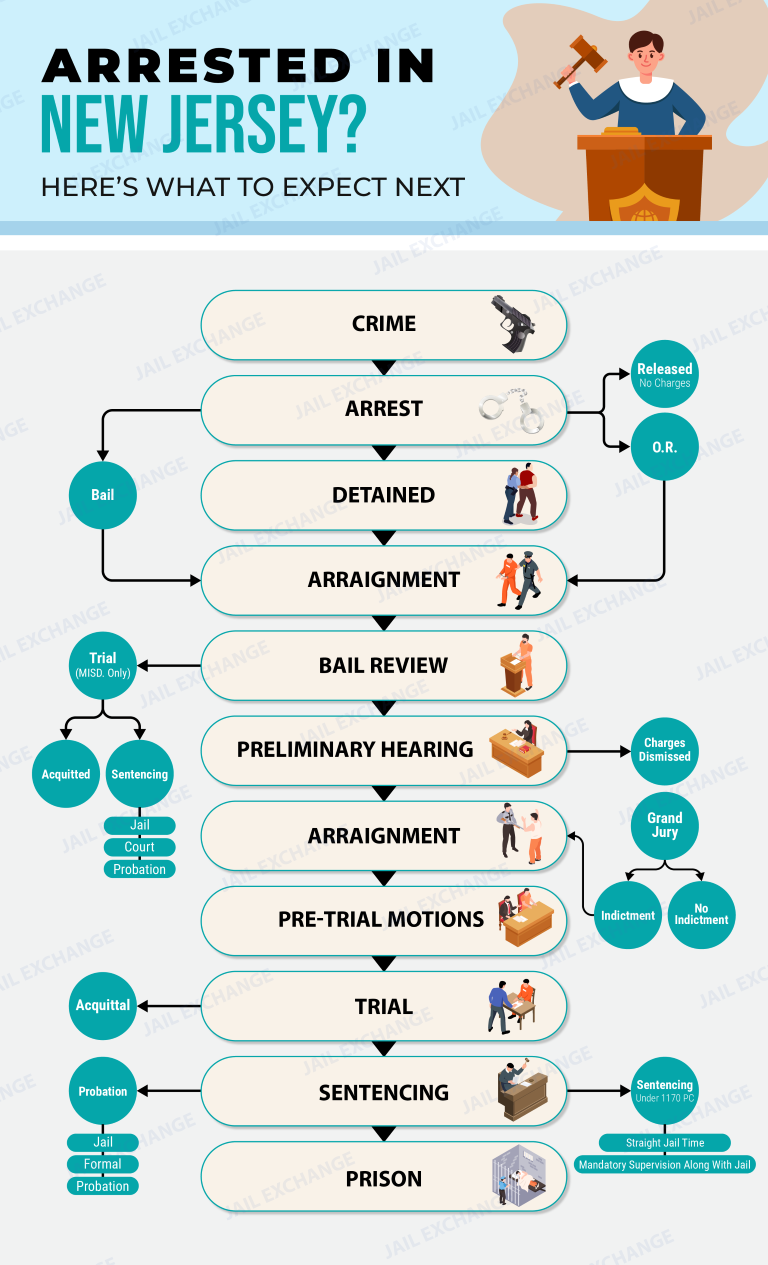
Salem County Correctional Facility Criminal Court Process
Criminal Court Process for Salem County New Jersey
Salem County Criminal Court Guide
Criminal charges from the 15 towns in this county go one of two ways. Lesser ones stay in a municipal court, and crimes move up to Superior Court at the county courthouse, 92 Market Street, Salem, NJ 08079. Anyone kept in custody waits at the Salem County Correctional Facility, 125 Cemetery Road, Woodstown, NJ 08098. Read on for each step, from first hearing through sentence.
The Sheriff's Inmate LookUp tells you whether your person remains in Woodstown. Then visit our Inmates in Custody page for the jail side of the arrest. There you can learn about recent bookings, who is locked up, warrants, the charges, mugshots, appointed lawyers and returned property.
To find the next court date, call the Criminal Division on the courthouse's second floor at 856-878-5050, extension 15850, during business hours. Share the defendant's name and ask what is scheduled and in which courtroom. Release and money bail are covered on our bail page.
1. Which court takes a crime, and which takes a lesser offense?
The state grades every charge, and its labels differ from most of the country:
- Indictable crimes, first to fourth degree, are New Jersey's version of felonies. First degree: 10 to 20 years, fines to $200,000. Second degree: 5 to 10 years, fines to $150,000. Third degree: 3 to 5 years, fines to $15,000. Fourth degree: up to 18 months, fines to $10,000. Superior Court's Criminal Part, a branch of the Law Division, tries them.
- Disorderly persons offenses fill the slot misdemeanors fill in most states. Jail is six months at most, plus a fine capped at $1,000. The petty version caps at 30 days and $500.
- Municipal courts take those lower charges. They also handle tickets, broken local ordinances, and fishing or hunting violations from their own towns.
- The Family Part of Superior Court hears charges against anyone under 18.
Salem shares a court region with Cumberland and Gloucester. The courts call a region a vicinage, and a Judiciary notice names this one Vicinage 15. Now and then a prosecutor lowers a crime one step, to the disorderly persons level, and the file returns to the town where it began.
↑ Back to the question list2. Where does the Superior Court sit for Salem County?
Every Superior Court matter is handled in Salem City, at the county courthouse, 92 Market Street, Salem, NJ 08079. Dial the Judiciary's main number there, 856-878-5050, then one of these extensions:
- Criminal Division, second floor: ext. 15850. The criminal case management office and the criminal records room share the building.
- Family Division, for juvenile and family cases: ext. 15881.
- Municipal Division office for the vicinage, which helps with town court questions: ext. 15290.
Probation works from the Fenwick Building (lower level), 85 Market Street, Salem, NJ 08079. Recovery Court, a treatment-based court, meets in the main courthouse. Offices keep business hours, so phone before driving in. Sheriff's deputies in the Courthouse Services Division run the entrance screening, keep order in courtrooms and move jailed defendants to and from hearings.
↑ Back to the question list3. Which town courts serve Carneys Point, Pennsville, Penns Grove and the city?
- Carneys Point-Pennsville Joint Municipal Court, 303 Harding Highway, Carneys Point, NJ 08069, 856-299-1013. Carneys Point Township and Pennsville Township share it. Since May 12, 2025, a Judiciary order has also placed all Penns Grove cases here, until the courts say otherwise. The window is open Monday to Friday, 8:30 a.m. to 4:00 p.m. Sessions are mostly virtual, at 8:00 on two or three Friday mornings a month.
- Lower Alloways Creek and Elsinboro joint court, 501 Locust Island Road, Hancocks Bridge, NJ 08038, 856-935-1957. Both townships use it, and it sits on the second Monday of each month.
- Salem City Municipal Court, 125 West Broadway, Salem, NJ 08079, 856-935-1734. The window is open weekdays, 9 a.m. to 4 p.m. Court meets on two Tuesdays a month, in person at 9:00 a.m. and online at 10:00 a.m.
If a Penns Grove notice shows an older State Street address, call the Carneys Point court to check where to go.
↑ Back to the question list4. Which courts cover Woodstown, Pilesgrove, Pittsgrove and the farm towns?
- Mid-Salem County Municipal Court, 25 West Avenue, Woodstown, NJ 08098, 856-769-2424. Its five towns are Mannington, Woodstown, Quinton, Elmer and Oldmans. The window takes visitors weekdays from 9 a.m. to 2 p.m., and sessions fall on the second and fourth Thursdays.
- Pilesgrove Joint Municipal Court, 1180 Route 40, Pilesgrove, NJ 08098, 856-769-1275. It handles Pilesgrove and Upper Pittsgrove. Office hours are 9 a.m. to 1 p.m. on Monday and Thursday, 9 a.m. to 3 p.m. on Tuesday and Wednesday, with Friday closed. Sessions land on the second and fourth Wednesdays.
- Cumberland Salem Regional Municipal Court, 1325 Highway 77, Seabrook, NJ 08302, 856-455-8722. Pittsgrove Township's cases go to this court in Upper Deerfield, which is open weekdays from 9 a.m. to 4 p.m.
- Alloway Township: to find out which court has a case, ask the vicinage Municipal Division at 856-878-5050, ext. 15290. The township building is at 49 S. Greenwich Street, Alloway, NJ 08001, 856-935-4080.
Every town court has its own municipal prosecutor, and each one can appoint a municipal public defender.
↑ Back to the question list5. Arrested on a warrant: what goes on at the first court date?
Within 48 hours of being booked, the person must have a first appearance. On indictable charges, that hearing is held in one central place, in front of a judge chosen by the Chief Justice (R. 3:4-2). New Jersey calls this Central Judicial Processing, or CJP. The county Prosecutor notes these hearings are frequently streamed for the public.
- Charges and rights are read out to the person.
- The court can appoint the Office of the Public Defender right there.
- Pretrial Services hands the judge a release recommendation based on the Public Safety Assessment.
- The judge decides on release. If the prosecutor has filed for detention, a detention hearing comes next, usually at that same appearance.
A person charged by summons gets a first appearance within 60 days instead. For hearing times, phone the Criminal Division, 92 Market Street, Salem, NJ 08079, at 856-878-5050, ext. 15850. The bail page goes over release choices.
↑ Back to the question list6. Tickets and disorderly persons charges: how does town court handle them?
Most cases in the county start and end at a town court. Expect these steps:
- A complaint or ticket names the court and a date.
- At the first session, the judge goes over the defendant's rights, such as having a lawyer. Someone with low income who risks jail, a license suspension or over $800 in penalties can ask for a municipal public defender.
- Next comes the plea. Pleading not guilty sets up a trial heard by the judge alone. Jury trials are only for charges carrying more than six months in jail, so town courts never use juries.
- After a guilty finding, the judge picks the sentence. It tops out at six months and $1,000 on a disorderly persons charge. A petty one tops out at 30 days and $500.
A person with a clean record may qualify for a program instead of a conviction. Conditional discharge is for certain drug charges, and conditional dismissal fits many other lesser charges. Both carry a $75 fee and are a one-time chance. Fines and tickets can be settled online through NJMCdirect.
↑ Back to the question list7. What steps does a Salem County crime case go through?
Here is the usual road for a first- to fourth-degree charge in Superior Court:
- Probable cause check. A judge reviews the complaint within 12 hours. If the judge finds no probable cause, it is dismissed.
- First appearance. The release ruling comes within 48 hours, as covered above.
- Early conference. The court schedules it no later than 45 days after the first appearance. Plea talks happen here, and so do early moves into Pretrial Intervention.
- Grand jury. No more than 23 residents look at the evidence. An indictment needs at least 12 votes. For a jailed defendant, the grand jury gets 90 days, not counting excused delays.
- Arraignment. The charges are formally read within two weeks of indictment.
- Status conferences. Up to two. The opening one goes by the initials ICDC.
- Pretrial conference. Usually the last chance for a plea deal. After it, a late plea needs the presiding criminal judge to sign off.
- Trial. All jurors must agree on the verdict. A jailed defendant's trial must open by day 180 after indictment, with excused delays not counted.
- Sentencing. The judge states the reasons out loud in court, then signs a written judgment of conviction (JOC).
8. Why do gun and violent charges bring tougher terms?
A handful of laws tie a judge's hands at sentencing:
- Graves Act. A gun in the picture during certain crimes sets up a parole bar. No parole comes before half the term or 42 months, whichever runs longer (N.J.S.A. 2C:43-6(c)).
- No Early Release Act. Parole waits until 85% of the term is done for crimes on its list (N.J.S.A. 2C:43-7.2). That list takes in murder, robbery, carjacking, sexual assault and home invasion, among others. Supervised parole lasts 5 more years after a first-degree term, and 3 after second degree.
- Detention. Prosecutors seek pretrial detention most often on charges like these. For murder, or any charge that can bring life, the starting point flips: jail is assumed, and the defense must rebut it.
- Domestic violence. If money bail is set, the 10% cash deposit can't be used.
With charges like these, bring in a defense lawyer from day one.
↑ Back to the question list9. In a Salem County case, who prosecutes and who defends?
- Salem County Prosecutor's Office, 87 Market Street, Salem, NJ 08079. It handles indictable crimes and decides if a case has the merit and proof to go forward. The office answers on the county line, 856-935-7510, ext. 8333, and at 856-769-3508 around the clock for non-emergencies.
- Municipal prosecutors handle the cases in each town court. Ask the court clerk who it is.
- Office of the Public Defender, county office, 199 E. Broadway, 5th Floor, Salem, NJ 08079, 856-935-2212. It represents people charged with indictable crimes once a judge reviews their 5A money form and finds them unable to pay.
- Municipal public defenders work in the town courts. The court may charge up to $200 to apply, and it has the power to reduce or waive that fee.
- Law Guardians represent children in some Family Part cases. This county shares an office with Camden and Gloucester at 20 East Clementon Road, Suite 301, Gibbsboro, NJ 08026, 856-346-8008.
10. Which online tools list a case and when it's next in court?
Three free state tools cover most needs:
- Promis/Gavel Public Access: Superior Court criminal cases since 1980.
- Criminal Judgments Public Access for sentences after a conviction.
- Municipal Court Case Search for a town court complaint or ticket number.
Lost track of which town court wrote a ticket? Judiciary Customer Services at 609-421-6100 can sort it out. The same office supplies copies of court records, which fall under Court Rule 1:38 and not the public records law. For a Superior Court hearing date, the Criminal Division, 92 Market Street, Salem, NJ 08079, is at 856-878-5050, ext. 15850. For a town court date, ring that court.
↑ Back to the question list11. How can a Salem County warrant be checked and cleared?
The Sheriff's Warrant and Fugitive Squad serves Superior Court warrants and every municipal court warrant in the county. Reach it at 94 Market Street, Salem, NJ 08079, 856-935-7510, ext. 8211, 1880, 8540 or 1805. The State Police post New Jersey's Most Wanted. To check a name, phone the squad or look on Promis/Gavel for Superior Court matters. A town court warrant is best checked with the court that signed it. Clearing one starts with a lawyer. As a courtesy, the squad allows a surrender: phone in, leave a name and callback number. Another path is asking the court to reschedule. The Criminal Division sits at 92 Market Street, Salem, NJ 08079, 856-878-5050, ext. 15850.
↑ Back to the question list12. Where do federal charges from South Jersey end up?
The U.S. District Court's Camden office takes federal cases from this county. Room 1050 holds the clerk's office, inside the Mitchell H. Cohen federal building (856-757-5021), Fourth and Cooper Streets, Camden, NJ 08101, open weekdays 9:00 a.m. to 4:00 p.m.
- A magistrate judge sees the arrested person quickly, often the same day, explains the charges and sees to a lawyer.
- Release or custody is argued at that hearing, unless either side gets a short delay (18 U.S.C. 3142).
- Federal defenders for South Jersey work at 800-840 Cooper Street, Suite 350, Camden, NJ 08102, 856-757-5341.
- Until trial, a defendant who stays locked up is held by the U.S. Marshals, 400 Cooper Street, Room 1017, Camden, NJ 08102, 856-757-5024. The county jail on Cemetery Road is one of the places federal clients stay.
- Once a sentence starts, use the Federal Bureau of Prisons inmate locator. Case files are on PACER.
13. Can an immigration detainer change how the state case goes?
No. The state charge moves forward on its own. A detainer matters only at the moment the state would let the person go.
- Step one is ICE's detainer request, Form I-247A.
- The detainer seeks a hold lasting up to 48 hours after they would otherwise be released (8 CFR 287.7(d)).
- Agents then come to take custody. Within New Jersey, one site used is the Elizabeth Contract Detention Facility, 625 Evans Street, Elizabeth, NJ 07201, 908-282-5700.
- Search the ICE Online Detainee Locator, or phone ICE in Newark at 973-776-3274.
State policy puts limits on step 2. The Immigrant Trust Directive lets county jails honor a detainer alone only for three groups. Group one: the current charge, or any old conviction, is on the Directive's Appendix A list. Group two: a non-violent indictable conviction within the past five years. Group three: the jail has been handed the person's final removal order, which a federal judge signed. The hold still expires at 11:59 p.m. that same day. No police agency or jail here may sign a 287(g) agreement with ICE, and a 2021 state law (P.L.2021, c.199) bars local agencies from new or renewed immigration detention contracts. Let the defense lawyer know the day a detainer turns up.
↑ Back to the question list14. Where is a state prison term served, and how do I find them?
State prisons are run by the New Jersey Department of Corrections, Whittlesey Road, PO Box 863, Trenton, NJ 08625, 609-292-4036. A new prisoner starts at a state intake site, where staff look at medical, mental health and treatment needs. A points-based system then places them in a custody level, from close custody at the top to community status at the bottom, and a classification committee picks the prison. Reviews happen yearly or more often.
- Find someone through the DOC Offender Information page.
- For parole, contact the State Parole Board, P.O. Box 862, Trenton, NJ 08625-0862, 609-292-4257.
- Each state prison has its own page in our New Jersey prisons list.
15. How does a Salem County youth case work?
Delinquency charges against anyone younger than 18 are heard by the Family Part, in the county courthouse at 92 Market Street, Salem, NJ 08079. The Family Division is at 856-878-5050, ext. 15881.
- Held youths go to a juvenile detention center, never the adult jail. Ask the Family Division where your child is being kept.
- Some grave charges, like murder or carjacking, can be moved to adult court if the teen had turned 15 when it happened. The prosecutor has to ask. That request must be filed within 60 days, and the Family Part rules on it after a hearing. While it is pending, the youth is presumed to stay in juvenile detention.
- The public defender's office at 856-935-2212 can defend the youth. Parents may have to repay the cost.
16. What help is there for people hurt by a crime?
Article I of the state constitution calls for fairness, compassion and respect toward every victim (N.J. Const. art. I, para. 22). Under the Crime Victims Bill of Rights, they can also be kept up to date on the case, address the judge in person before sentencing and be protected from threats (N.J.S.A. 52:4B-36).
- Victim-Witness Unit of the county Prosecutor, 87 Market Street, Salem, NJ 08079, 856-935-7510, ext. 8364.
- Victims of Crime Compensation Office, 877-658-2221. It can help pay for things like a hospital bill, therapy, missed paychecks or a funeral. Two deadlines apply: tell police within 9 months, and file within 5 years of the crime date.
- VINE gives a heads-up by phone, text or email when an inmate's custody changes. Register on VINELink or at 877-846-3465.
- Domestic violence matters, including restraining orders, go to the Family Court. Ask for the Family Division, ext. 15881, on the court line.
17. Can a first charge be dismissed through PTI or another program?
Yes, for some people. These programs swap a conviction for supervision and goals:
- Pretrial Intervention (PTI) mostly serves people with no record who face indictable charges. PTI paperwork can be filed online or at the Criminal Division, 92 Market Street, Salem, NJ 08079, 856-878-5050, and the deadline comes early, before the first case disposition conference. A $75 fee applies unless the court waives it. Once someone is accepted, the case pauses (36 months at most). Meet every condition, and the court dismisses the charges.
- Recovery Court is a treatment court for adults with drug or alcohol problems and non-violent charges. Treatment often takes one to two years. It meets at the main courthouse on Market Street.
- Conditional discharge and conditional dismissal cover lesser charges in town court, as explained above.
- Veterans' Diversion is offered through the county Prosecutor's Office. Ask the defense lawyer about it.
When charges are dismissed, a court can order the record cleared right away. Other records can be expunged later through the free eCourts Expungement System.
↑ Back to the question listCriminal Court Process for Salem County New Jersey
Salem County New Jersey Criminal Court System – Definitions
It might be helpful to define some words that will be used on this site, when explaining the New Jersey Court System and how it works. The definitions on this site are for general information and not legal advice. It is always preferred to follow information given by your attorney or local authorities.
If you scroll down below this content, and the listing of the courts in Salem County, you will find a simple flowchart diagram and a video that will help you visualize the stages of the Criminal Court Process.
Arrest is when New Jersey, Salem County or local police take a person into custody and start the legal process. The arrested person may or may not be jailed right away.
In New Jersey, a person is charged on either a summons or a warrant. A person charged on a summons is released with a date to appear in court. A person charged on a warrant is taken to the county jail until a judge decides if they can be released.
Booking is when the jail or local police gather information such as the person’s name, address and why they are being arrested. Booking also includes fingerprinting, a criminal history check and making sure of the person’s identity.
For a person held on a warrant, Pretrial Services staff use a risk tool called the Public Safety Assessment. They send the judge a recommendation on whether the person should be released and with what conditions.
The prosecution, sometimes called “the government” or “the state,” is the side that presses the charges and seeks punishment for the offense. Each New Jersey county has its own County Prosecutor’s Office, which decides if a case has enough evidence to move forward. A U.S. Attorney prosecutes federal cases.
Jurisdiction is an important term in the court system that means whether a court has the obligation or duty or right to handle a case. For example, if you run a red light in your town or city, a municipal court would likely have jurisdiction over your case, but the next town or city over would not have jurisdiction over your case. If you attempted to flee from police when they attempted to stop you after you ran the red light, it becomes a more serious crime, and the municipal court might not have jurisdiction so you might be assigned to a higher-level court that has jurisdiction over the more serious crime. Jurisdiction varies from state to state and sometimes county to county.
The first appearance is the person’s first time before a judge. For a person held on a warrant, the judge must make a release decision within 48 hours of the person being placed in the county jail. The judge can release the person on their own recognizance (ROR), release them with conditions, or, if the prosecutor asks, hold a detention hearing. The court can also assign the Office of the Public Defender at this time.
The detention hearing is held at the first appearance unless it is put off. The prosecutor can ask for up to 3 more days, and the defense can ask for up to 5 more days. At the hearing, the person has the right to a lawyer.
Arraignment is when the defendant is formally told the charges in an indictment. In New Jersey, it happens within 14 days after the indictment is returned or unsealed. An arraignment is not a trial.
Before 2017, most people in New Jersey had to pay money bail to get out of jail. Since Criminal Justice Reform began on January 1, 2017, release is based on risk, not money. Most people are released, often with conditions. A judge can still set money bail, but it is rare. People who are a serious danger or flight risk can be held until trial.
Conditions can include reminder calls or texts, reporting to a Pretrial Services officer, electronic monitoring, home detention and no contact with an alleged victim. A person held in jail must be indicted within 90 days and have a trial start within 180 days after that, not counting some delays. There is an overall limit of 2 years from detention to trial.
It is always important to have family involvement after being arrested. Not only can they make calls and communicate on your behalf, but family support will show the court that there are people who will make sure that the defendant makes it to court.
(Watch out for phone scams. Some callers say they are from a bail company or the jail, say a family member was arrested, and ask for money or bank information. Do not pay a caller you don’t know. Call the jail or the Salem County Sheriff’s Office yourself to check.)
Release on recognizance (ROR) means the person is released on their own promise to come to court, with no money paid. An unsecured appearance bond is a signed promise to pay a set amount only if the person misses court.
A criminal defense attorney (also called lawyer or counsel) is hired or retained to represent the arrested as early as possible after the arrest.
The New Jersey Constitution gives a person charged with a crime the right to a lawyer. If they cannot afford one, the court can appoint one. This is called indigent representation. In New Jersey, every person charged with an indictable crime (first to fourth degree) who cannot pay is represented by the Office of the Public Defender. The person fills out a form about their income and money, called the 5A form, and the court decides if they qualify.
In municipal court, a municipal public defender can be appointed if the person faces jail, loss of a driver’s license or penalties over $800 and qualifies financially. There is an application fee of up to $200, which the court can lower or waive. The time to ask for a public defender is as soon as possible.
For less serious cases or civil cases, there are pro bono volunteers who volunteer legal services for free or for a small fee. They often will hold clinics to teach people how to represent themselves in court or expunge their record which means to legally erase or eliminate a criminal or arrest record from public view. This website provides contact information for pro bono services in New Jersey.
Many courts will provide forms and help for people who want to represent themselves, called pro se. Here is a link for legal self-help in New Jersey.
A district court in New Jersey means the U.S. District Court for the District of New Jersey, which hears federal cases. It has courthouses in Newark, Trenton and Camden. New Jersey has no state district courts. Local cases go to municipal court, and crimes go to the Superior Court. Always check the court name and address on your papers, because going to the wrong court can make you late. Being late for court can land you in custody as well.
Pretrial proceeding is the process where both sides (prosecution and defense) gather information, interview witnesses, request records, videos etc. Pretrial proceedings also include communications with the judge assigned to the case and these appearances are either in person or by on-line conferencing. Some pretrial proceedings may not require a defendant’s appearance, allowing an attorney to appear in their place. The information that is gathered is called discovery and both sides must share the information that they have gathered. This information does not include conversations between the arrested and their attorney.
Most cases do not go to trial because both sides reach a plea deal, where the defendant pleads guilty in exchange for a lighter punishment. In New Jersey, a plea deal usually cannot be accepted after the pretrial conference without the approval of the Criminal Presiding Judge. There are times in plea bargaining when the prosecution agrees to give a lighter sentence in exchange for information leading to the arrest of a more serious criminal related to the crime.
Trial is where both sides share their information in front of a judge or a judge and jury. After listening to all the evidence, the judge or jury decides the verdict which is whether the person is guilty or not guilty. If a court has only a judge hearing both sides, it is called a bench trial. If a jury is selected, it is called a jury trial. In New Jersey, a jury verdict must be unanimous. If the defendant is found not guilty, they are released. If they are found to be guilty, the next step is sentencing.
Sentencing is the punishment that the judge decides the person should get. This could be jail or prison time, fines, community service, probation, or a combination.
Appeal is asking for a higher court to hear the case again at an appellate court. If the accused person thinks something went wrong at trial or has new information that was not available during the trial or that the sentence is too harsh, the defense attorney can ask for an appeal. It is not unusual for an appeal when there is a long jail sentence, but an appeal can be denied if the appellate court feels that the original trial or sentencing was fair.
New Jersey Felony vs Misdemeanor
Unlike most other states, New Jersey does not use the words “felony” and “misdemeanor”. Instead, offenses are Crimes, Disorderly Persons offenses (DP) and Petty Disorderly Persons offenses (PDP).
Crimes are graded first, second, third and fourth degree. They are called indictable crimes and are like “felonies” in other states. First-degree crimes are the most serious and fourth-degree crimes are the least serious.
An example of a first-degree crime would be murder. An example of a fourth-degree crime would be stalking. Theft offenses, depending on the dollar amount of the property stolen, can be a first-, second-, third-, or fourth-degree crime.
An example of a Disorderly Persons offense would be possession of drug paraphernalia. An example of a Petty Disorderly Persons offense would be simple assault when both parties in a fight mutually agreed to fight.
Disorderly persons and petty disorderly persons offenses are not indictable. They are like “misdemeanors” in other states.
- First-degree crime – possible term of 10 to 20 years in state prison, fine up to $200,000
- Second-degree crime – possible term of 5 to 10 years in state prison, fine up to $150,000
- Third-degree crime – possible term of 3 to 5 years in state prison, fine up to $15,000
- Fourth-degree crime – up to 18 months in state prison, fine up to $10,000
- Disorderly Persons offense – up to 6 months in county jail, fine up to $1,000
- Petty Disorderly Persons offense – up to 30 days in county jail, fine up to $500
The judge decides the sentence within these limits. Some crimes carry required prison time before parole. Under the Graves Act, many gun crimes carry a minimum term of 42 months or half the sentence, whichever is more. Under the No Early Release Act, people convicted of certain violent crimes must serve 85% of the sentence before parole.
The Criminal Division of the Superior Court in Salem County manages indictable cases from the time of arrest until the case ends. It sets court dates and keeps the case moving. Municipal court cases are handled by the municipal court in the town where the offense happened.
A warrant is a court order. An arrest warrant lets police arrest a person and bring them to court. A search warrant lets police search a place for evidence. There must be good reason to believe that a crime was committed.
A criminal summons is issued to request that a person appear in court at a particular time and date. It does not involve being held in jail. A traffic ticket or a disorderly persons complaint could be considered a summons if you are given a court date.
A ticket is a summons from a police officer for a traffic, parking or other minor offense. It lists the court and what to do next. Many tickets can be paid, or a not guilty plea entered, online at NJMCdirect.com. Some tickets require you to go to court.
Fines for municipal court tickets can be paid online at NJMCdirect.com with a credit card, or by check or cash at the court. The court may allow a payment plan. If you do not pay or do not show up on time, you can face more fines, lose your driver’s license or even be arrested. Always read the instructions on your ticket or court papers.
New Jersey Criminal Court System - How it Works
New Jersey Municipal Courts handle traffic and parking tickets, local ordinance violations, and disorderly persons and petty disorderly persons offenses that happen in that town. Some courts serve more than one town. Many serious cases also start out as complaints in municipal court before moving to Superior Court.
If a crime charge in Superior Court is lowered to a disorderly persons offense, it can be “remanded,” or sent back, to municipal court. DPs and PDPs are most often handled in local municipal court, right alongside traffic offenses.
New Jersey Superior Courts handle all indictable crimes, from first degree to fourth degree. A judge must find probable cause for the charge, and a grand jury decides whether to indict. Appeals from municipal court also go to the Superior Court. Crimes are most often handled in the Superior Court for the county.
Specialty courts or problem-solving courts handle some cases in a way that lets the person keep a job or family duties while following court orders such as court check-ins and drug testing. In New Jersey, Recovery Court is a Superior Court program for adults with substance use problems who are charged with non-violent crimes. Treatment usually lasts one to two years. For a brochure about Recovery Court, click this link. Many first-time offenders can also apply for Pretrial Intervention (PTI). If they finish the program, the charges are dismissed.
The New Jersey Supreme Court is like our United States’ Supreme Court because it has a panel of judges that rule on matters that have to do with someone’s constitutional rights or policies and laws. The New Jersey Supreme Court deals with the state constitution or laws or policies. Sometimes the Supreme Court will hear criminal cases on appeal when there is a question on the state laws or procedures that lead to the appeal.
Most criminal appeals are first heard by the Appellate Division of the Superior Court.
FEDERAL COURT
Federal Court deals with crimes involving violations of United States laws. Federal crimes include federal drug trafficking, federal tax evasion and fraud that crossed state lines and include crimes that occur on federal property as post offices or federal buildings.
Cases investigated by federal agencies such as the FBI or DEA often go to federal court. Terrorism is a federal crime.
There are some differences in the Federal court system as compared to the New Jersey state court system. For example, federal prosecutors are called United States Attorneys and work for the U.S. Department of Justice, and Federal judges are called District Court Judges.
Federal Magistrate Judges hold the first hearing, usually the same day or the day after the arrest, and decide on custody or release. They do not decide the cases at a trial like the Federal District Court Judges. In a federal felony case, a grand jury is used for indictments.
There is one U.S. Federal Judicial District in New Jersey, with courthouses in Newark, Trenton and Camden.