Erie County Correctional Facility Criminal Court Process
Criminal Court Process for Erie County New York
Erie County Criminal Court Guide
Criminal cases in Erie County are split between two levels of court, both part of New York's 8th Judicial District. Felonies that reach an indictment are tried in County Court, which sits in the court building at 25 Delaware Avenue, Buffalo, NY 14202, 716-845-9301. Its doors are open 8:30 a.m. to 5:00 p.m. on weekdays. Misdemeanors, violations and the opening steps of every felony belong to the local courts: three city courts and 36 town and village justice courts.
The Sheriff's custody roster shows who is held right now. When the worry is the arrest or the stay in jail, turn to our Jail Roster page. Families use it to learn where someone is booked, scan the newest arrests, look for warrants, read the charge list, view booking mugshots, find a public defender and get personal items back.
Anyone over 18 who isn't sent home is held by the Sheriff, most often at the Holding Center, 40 Delaware Avenue, Buffalo, NY 14202, a maximum-security jail for people kept after arrest. To find someone, call it at 716-858-7638. The other jail is the Correctional Facility, 11581 Walden Avenue, Alden, NY 14004, 716-937-9101, a bigger site where men and women stay while a case is open or after a sentence. Release and bail are in our Erie bail guide.
1. Misdemeanor or felony: which Erie County court gets it?
The answer turns on the class of the charge. New York sorts crimes into three groups:
- Violations, like disorderly conduct, count as offenses but not crimes. They carry 15 days in jail at most.
- Misdemeanors are lesser crimes, in class A or B. The most is 364 days in a local jail.
- Felonies are serious crimes, in classes A through E. State prison is possible.
Violations and misdemeanors stay in a local court from start to finish. That means a city court, like the one at 50 Delaware Avenue, Buffalo, NY 14202, 716-845-2600, or a town or village justice court. A felony also starts in a local court for the arraignment and a possible hearing. Once a grand jury indicts, or the accused agrees to skip that step, the case moves up to County Court. Supreme Court also sits in that building. Appeals go to the Appellate Division, Fourth Department.
↑ Back to the question list2. Where are the downtown and city courthouses?
All of these handle criminal cases. Hours are weekdays.
- County Court (felony trials) and its Youth Part, 25 Delaware Avenue, Buffalo, NY 14202, 716-845-9301. Open 8:30 a.m. to 5:00 p.m. Supreme Court parts also sit here.
- Buffalo City Court, 50 Delaware Avenue, Buffalo, NY 14202, 716-845-2600. Open 9:00 a.m. to 5:00 p.m. Criminal records are at 716-845-2661. It runs a mental health court too.
- Lackawanna City Court, City Hall, 714 Ridge Road, Lackawanna, NY 14218, 716-845-7220. Open 8:30 a.m. to 4:30 p.m. Criminal court meets Tuesdays and Wednesdays at 9:00 a.m. and 2:00 p.m. A treatment court meets Mondays.
- Tonawanda City Court, City Hall, 200 Niagara Street, Tonawanda, NY 14150, 716-845-2160. Open 8:30 a.m. to 4:30 p.m. Drug court meets Thursdays at 1:00 p.m.
- Family Court, housed at One Niagara Plaza, Buffalo, NY 14202, 716-845-7400. Open 8:30 a.m. to 5:00 p.m. It handles youth cases and family offense petitions.
Federal charges are heard across Niagara Square at 2 Niagara Square, Buffalo, NY 14202, 716-551-1700.
↑ Back to the question list3. Which justice courts serve Erie County's towns and villages?
Each of these local courts hears misdemeanors, violations, traffic tickets and felony arraignments from its own town or village. Call before you go, since many meet only on certain days or nights.
Northtowns
- Amherst Town Court: 400 John James Audubon Parkway, Amherst, NY 14228, 716-689-4200
- Williamsville Village Court: 5565 Main Street, Williamsville, NY 14221, 716-632-0450
- Tonawanda Town Court: 1835 Sheridan Drive, Kenmore, NY 14223, 716-876-5536, ext. 371 or 373
- Kenmore Village Court: 2919 Delaware Avenue, Kenmore, NY 14217, 716-873-4554
- Grand Island Town Court: 2255 Baseline Road, Grand Island, NY 14072, 716-773-9600, ext. 650 or 652
- Clarence Town Court: 1 Town Place, Clarence, NY 14031, 716-741-8948
- Newstead Town Court: 5 Clarence Center Road, Akron, NY 14001, 716-542-4575
- Akron Village Court: 21 Main Street, Akron, NY 14001, 716-542-9636
Eastern suburbs and towns
- Cheektowaga Town Court: 3223 Union Road, Cheektowaga, NY 14227, 716-686-3462
- Depew Village Court: 85 Manitou Street, Depew, NY 14043, 716-683-0978
- Lancaster Town Court: 525 Pavement Road, Lancaster, NY 14086, 716-683-1814
- Lancaster Village Court: 5423 Broadway, Lancaster, NY 14086, 716-683-6780
- Alden Town Court: 3311 Wende Road, Alden, NY 14004, 716-937-3411
- Alden Village Court: 13336 Broadway, Alden, NY 14004, 716-937-9216, ext. 14
- Elma Town Court: Town Hall, 1600 Bowen Road, Elma, NY 14059, 716-652-1855
- Marilla Town Court: 1740 Two Rod Road, Marilla, NY 14102, 716-652-1213
- Wales Town Court: Wales Memorial Building, 11006 Emery Road, South Wales, NY 14139, 716-652-5585
- Aurora Town Court: Town Hall, 571 Main Street, East Aurora, NY 14052, 716-652-5275
Southtowns
- West Seneca Town Court: 1250 Union Road, West Seneca, NY 14224, 716-558-3251
- Orchard Park Town Court: 4295 S. Buffalo Street, Orchard Park, NY 14127, 716-662-6415
- Orchard Park Village Court: S-4295 South Buffalo Street, Orchard Park, NY 14127, 716-662-9327
- Hamburg Town Court: S-6100 South Park Avenue, Hamburg, NY 14075, 716-649-6111, ext. 2391, 2396 or 2398
- Hamburg Village Court: 100 Main Street, Hamburg, NY 14075, 716-649-7204
- Blasdell Village Court: 121 Miriam Avenue, Blasdell, NY 14219, 716-821-7908
- Boston Town Court: 8500 Boston State Road, Boston, NY 14025, 716-941-6115
- Colden Town Court: S-8812 State Road, Colden, NY 14033, 716-941-6242
- Holland Town Court: 47 Pearl Street, Holland, NY 14080, 716-537-2770
Lakeshore and southern towns
- Evans Town Court: 8787 Erie Road, Angola, NY 14006, 716-549-3707
- Angola Village Court: 41 Commercial Street, Angola, NY 14006, 716-549-1126
- Eden Town Court: 2795 East Church Street, Eden, NY 14057, 716-992-3559
- Brant Town Court: Route 249, Brant, NY 14027, 716-549-0300
- North Collins Town Court: 10543 Main Street, North Collins, NY 14111, 716-337-3712
- Collins Town Court: 14093 Mill Street, Collins, NY 14034, 716-532-3340
- Concord Town Court: 86 Franklin Street, Springville, NY 14141, 716-592-9898
- Springville Village Court: 65 Franklin Street, Springville, NY 14141, 716-592-5360
- Sardinia Town Court: Community Center, 12320 Savage Road, Sardinia, NY 14134, 716-496-8900
Cases from the villages of East Aurora, Farnham, North Collins and Sloan go to a neighboring justice court. To learn which one, phone the town court for the town that surrounds the village.
↑ Back to the question list4. What should the family expect at arraignment?
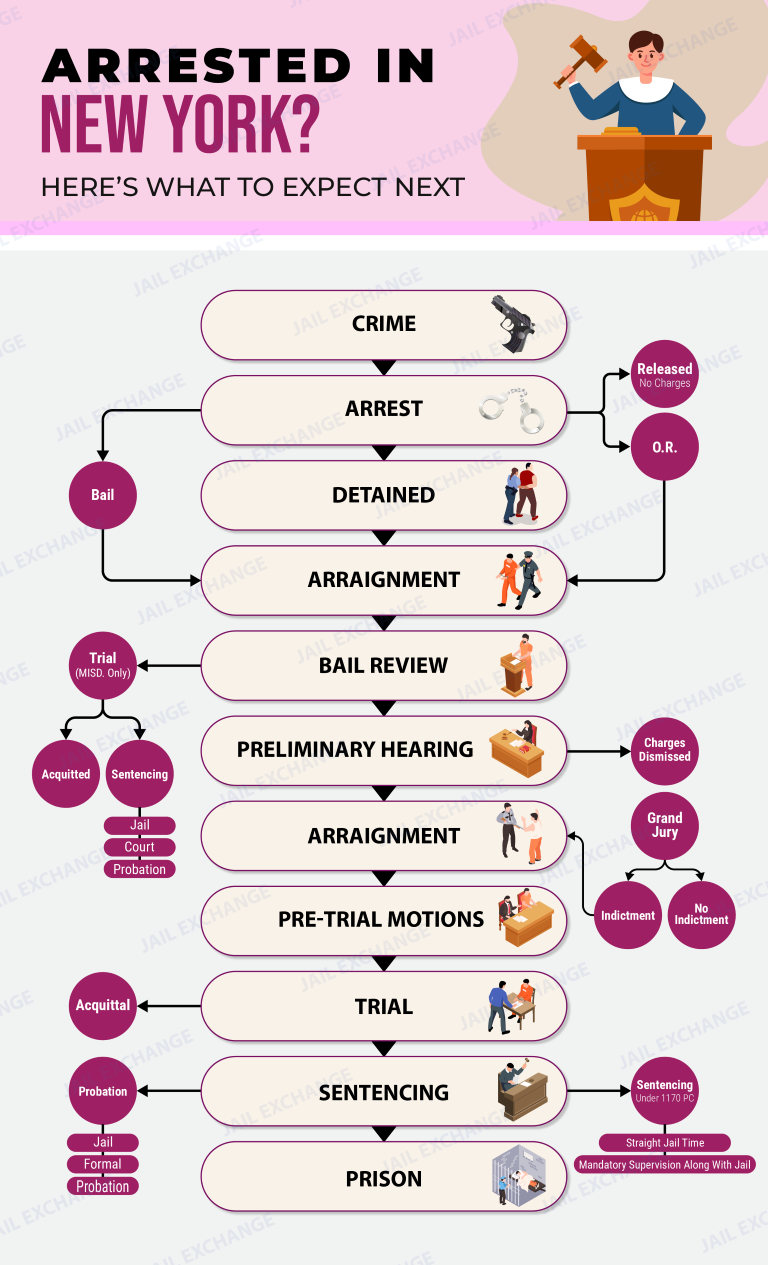
Arraignment is the name for that first appearance before a judge. It usually comes within about 24 hours of an arrest. People given an appearance ticket instead come in on the date printed on it. At the arraignment:
- The judge reads or hands over the charges.
- A lawyer stands with the accused. One is assigned for free if the person can't pay.
- The judge decides on release: own promise, set conditions, bail or, for a few serious felonies, jail with no bail.
- On a misdemeanor, the person usually enters a not-guilty plea and gets a next date.
- On a felony, the judge sets a date for a hearing or for the grand jury to act.
Even a city, town or village judge can arraign a felony. Release on a class A felony, or for a person already convicted of two felonies, is beyond their power. A County Court judge decides those, at 25 Delaware Avenue, Buffalo, NY 14202, 716-845-9301. Our release page explains what the judge weighs.
↑ Back to the question list5. How do DWI, shoplifting and other misdemeanor cases move?
Charges like a first drunk driving case, petit larceny for shoplifting, or third-degree assault are misdemeanors. They stay in the local court that has them. The usual path looks like this:
- Arraignment and a release decision.
- Discovery. The DA gives the defense police reports, videos and other proof. If the accused is in jail, that is due in 20 days. If not, it is due in 35 days (CPL 245.10).
- Talks and motions. Many cases end with a plea to a lesser charge, a dismissal, or a treatment program.
- Trial, if no deal is reached. Speedy trial rules give the DA 90 days to get ready on a class A misdemeanor, and 60 days on a class B (CPL 30.30).
Possible sentences under Penal Law § 70.15 and § 80.05:
- Class A misdemeanor: as long as 364 days in a cell, and a fine of up to $1,000.
- Class B misdemeanor: up to 3 months and up to $500.
- Violation: up to 15 days and up to $250.
A class A misdemeanor can bring two or three years of probation. A conditional discharge means no jail and no probation officer, just rules to follow for one year.
↑ Back to the question list6. How does an Erie County felony case move?
A felony moves from the local court up to County Court. Here are the steps:
- Arraignment in the local court on a felony complaint.
- The 120-hour limit. If the person is held, there must be a hearing or grand jury vote within 120 hours, or 144 over a weekend or holiday. If not, the person must be released (CPL 180.80).
- Grand jury. A group of citizens hears the evidence in private and decides whether to indict. The accused has a right to tell their side to the grand jury, but must send the DA a written request ahead of time (CPL 190.50).
- Arraignment on the indictment in County Court, 25 Delaware Avenue, Buffalo, NY 14202, 716-845-9301.
- Discovery, motions and plea talks. On a felony, the DA has six months to be trial-ready (CPL 30.30).
- Trial or plea, then sentencing.
Penal Law § 70.00 sets the longest terms. A class A felony can mean life. The cap is 25 years on a B, 15 years on a C, seven years on a D, and four years on an E. For some class D and E felonies, a judge may give one year or less in the county jail. Felony fines can reach $5,000 or double what the person gained. A person aged 16 to 18 may get youthful offender status, which replaces the conviction (CPL 720.10). Some drug-related felonies can go to judicial diversion, a court-run treatment track.
↑ Back to the question list7. Why do violent felony charges hit harder?
Violent felonies are a named list in Penal Law § 70.02. They include first-degree robbery and burglary, first-degree manslaughter, second-degree assault and second-degree weapon possession. These cases carry four big differences:
- Bail or remand is possible. Every violent felony is on the qualifying list, which means the judge may set money bail or hold the person with no bail (CPL 510.10(4)).
- Set prison terms. The judge picks a fixed number of years. It is 5 to 25 for class B, 3.5 to 15 for C, 2 to 7 for D and 1.5 to 4 for E.
- Supervision after prison. Parole-style monitoring, called post-release supervision, is added once the person gets out.
- Fewer second chances. Armed felonies limit youthful offender status, and violent felonies can never be sealed by application later.
Prosecutors in these cases often seek an order of protection for the alleged victim, which the court can issue with its release order.
↑ Back to the question list8. Who prosecutes and who defends in Erie County?
The elected District Attorney's office brings every state criminal case here. Lawyers for people without money come from two groups under the county's plan (County Law § 722):
- District Attorney's Office, 25 Delaware Avenue, Buffalo, NY 14202, 716-858-2400.
- Legal Aid Bureau of Buffalo, 290 Main Street, Suite 400, Buffalo, NY 14202, 716-853-9555. Its caseload has included city court arraignments, misdemeanors and D and E felonies.
- Assigned Counsel Program (Aid to Indigent Prisoners Society), 403 Main Street, Suite 215, Buffalo, NY 14203, 716-856-8804. Its panel of private attorneys takes town and village court cases and the more serious felonies.
A free lawyer must be in place at arraignment (Executive Law § 832(4)). Someone in jail is presumed to qualify. Courts can assign a lawyer right away and sort out the paperwork later.
↑ Back to the question list9. How do you find a case or next court date?
The state's WebCrims search covers County Court here and about 60 city courts across New York. Search by first and last name, then pick the county. It shows only open cases with a future court date. Closed cases, sealed cases, youthful offender cases and cases with an open warrant will not appear.
Town and village cases are found by phoning that court. Give the clerk the full name and birth date. Useful numbers:
- City court criminal records, 50 Delaware Avenue, Buffalo, NY 14202: 716-845-2661
- County Court, 25 Delaware Avenue, Buffalo, NY 14202: 716-845-9301
- Lackawanna City Court, 714 Ridge Road, Lackawanna, NY 14218: 716-845-7220
- Tonawanda City Court, 200 Niagara Street, Tonawanda, NY 14150: 716-845-2160
Ask the defense lawyer for the calendar too, and jot each date on paper or in your phone.
↑ Back to the question list10. How do you check for and clear an Erie County warrant?
Deputies serve warrants through the Sheriff's Warrant Office, 716-858-3287, weekdays 8:00 a.m. to 4:00 p.m. Search names on the Sheriff's warrant list, and check the State Police wanted page. You can also call the court that may have issued one, or ask at its clerk's window. To clear it, go to that court with a lawyer, or call it for a new date. Waiting only adds risk. City cases are at 50 Delaware Avenue, Buffalo, NY 14202, 716-845-2600. Felonies after indictment are at County Court, 25 Delaware Avenue, Buffalo, NY 14202, 716-845-9301.
↑ Back to the question list11. What happens in a Western New York federal case?
Federal prosecutions starting here go to the Buffalo Division of the U.S. District Court for the Western District of New York. The Robert H. Jackson U.S. Courthouse is at 2 Niagara Square, Buffalo, NY 14202, 716-551-1700. The clerk works weekdays 9:00 a.m. to 5:00 p.m.
- First appearance. That same day, the judge holds a detention hearing on whether to keep the person in custody, unless a lawyer needs a short delay (18 U.S.C. 3142).
- Custody. Anyone denied release is turned over to the U.S. Marshals Service, whose Western District office shares that courthouse, 716-348-5300. It places them in jails that hold federal prisoners.
- Defense. The Federal Public Defender, 300 Pearl Street, Suite 200, Buffalo, NY 14202, 716-551-3341.
- After sentencing. The person moves into Bureau of Prisons custody. Search the Federal Bureau of Prisons inmate locator.
Docket sheets are on PACER, which charges by the page.
↑ Back to the question list12. Immigration detainers: how do they affect a criminal case?
The state charges keep going no matter what ICE does. What a detainer changes is the moment of release. It works like this:
- ICE sends the jail Form I-247A, which requests advance notice of release and a longer hold.
- The request is for a hold of up to 48 hours after they would otherwise be released (8 CFR 287.7(d)).
- If ICE takes custody, the Buffalo field office, 130 Delaware Avenue, Buffalo, NY 14202, 716-843-7600, takes over.
- Detainees in this region may be held at the Batavia Service Processing Center, 4250 Federal Drive, Batavia, NY 14020, 585-344-6500.
- The ICE Online Detainee Locator searches by A-number. Name plus birth country also works.
New York sets its own limits. The 2018 appellate case People ex rel. Wells v DeMarco is the key one here. The judges ruled that New York gives its local police no power to arrest for civil immigration matters, which made a detainer-only hold illegal. State guidance says to honor detainers only with a warrant signed by a judge. Since August 25, 2026, Executive Law § 170-k has banned 287(g) agreements. Civil Rights Law § 28 keeps people traveling to and from court safe from civil immigration arrest without a judge's signed warrant or order. A defense lawyer should know about any immigration risk before a plea.
↑ Back to the question list13. Where does someone serve a New York prison term?
A term of a year or under is done at the county jail. Anything longer on a felony go to state prison, run by the Department of Corrections and Community Supervision (DOCCS). The person first goes to a reception center, where the state reviews them and picks a prison.
- Look them up with the DOCCS Incarcerated Lookup. Use the DIN, or a last name and birth year.
- Read up on the prisons themselves with our New York state prisons guide.
- Track a parole release with the DOCCS parolee lookup.
Under the Clean Slate Act, many convictions are sealed on their own later on. Misdemeanors are sealed after three years and felonies after eight, counted from release, if no new case is open (CPL 160.57).
↑ Back to the question list14. What if the accused is 17 or younger?
Raise the Age moved most teen cases out of adult court. Here is where they go:
- Felonies at age 16 or 17 start in the Youth Part, Part 18, 25 Delaware Avenue, Buffalo, NY 14202, 716-845-9301. Nonviolent felonies move to Family Court within 30 days unless the DA shows extraordinary circumstances (CPL 722.23).
- Violent felonies can stay in the Youth Part. To keep them there, the DA must show that someone was badly hurt, that a gun or other weapon was shown, or that there was a sex crime.
- Misdemeanors, plus children ages 12 to 15, are sent to probation first. After that, they are heard in Family Court, located at One Niagara Plaza, Buffalo, NY 14202, 716-845-7400. The Youth Part intake desk, Part 15 on the third floor, answers at 716-845-2735.
Young people who are held go to the Youth Services Center, 810 East Ferry Street, Buffalo, NY 14211, never the adult jail. Its 24-hour intake line is 716-923-4062.
↑ Back to the question list15. What help do Erie County crime victims get?
Victims have a right to be heard and to get help. Start with these offices:
- DA's Victim/Witness Bureau, 25 Delaware Avenue, 6th Floor, Buffalo, NY 14202, 716-858-4640. Staff explain court dates and help with statements.
- Sheriff's Domestic Violence Unit, 134 West Eagle Street, 4th Floor, Buffalo, NY 14202. The hotline is 716-858-7999.
- Office of Victim Services, which may pay medical, counseling or funeral costs. Call 800-247-8035.
When the accused is a family or household member, the judge may order them to stay away or stop contact while the case is open (CPL 530.12). To get a call when someone leaves jail or prison, register with VINE or phone 888-846-3469.
↑ Back to the question list