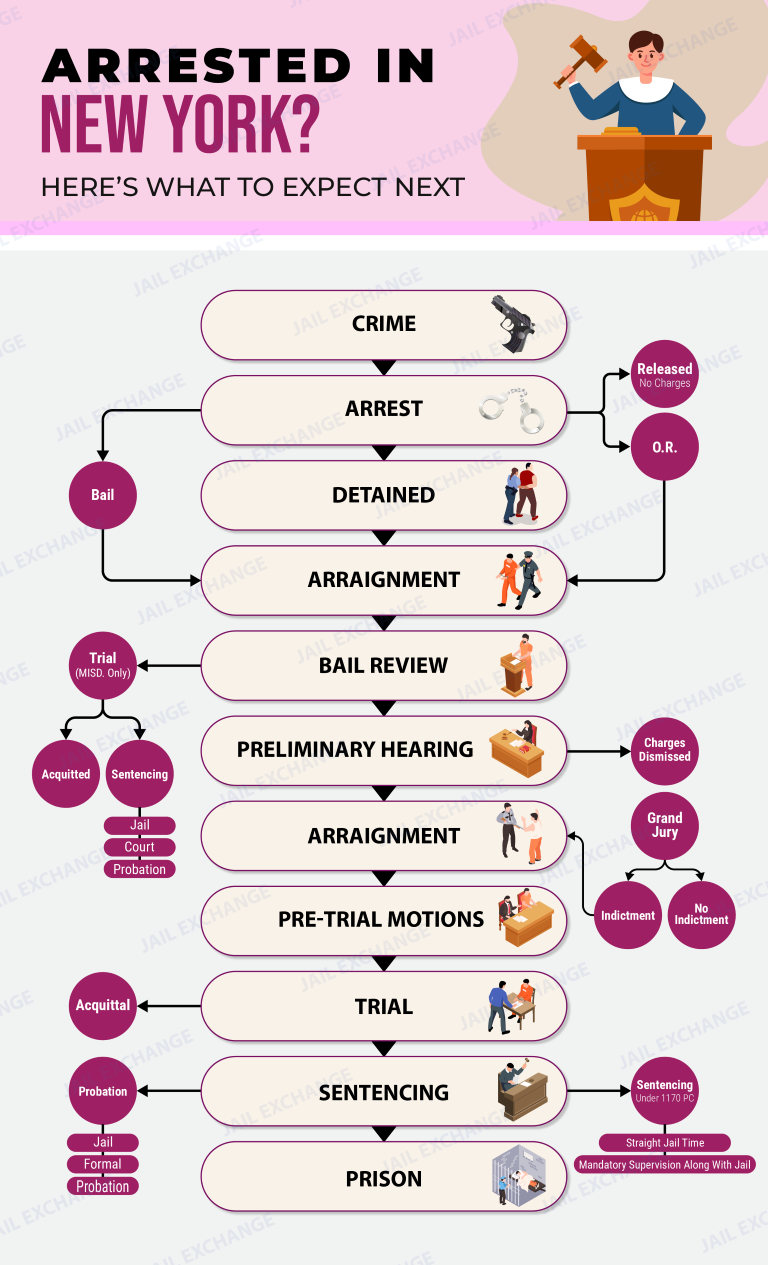
Ontario County covers the northern Finger Lakes between Rochester and Geneva, with its county seat in the city of Canandaigua. Arrests are first handled by the City Courts of Canandaigua and Geneva or by a town or village justice, while indicted felonies belong to Ontario County Court at the historic courthouse on North Main Street, within the Seventh Judicial District. The Ontario County District Attorney, also on North Main Street, prosecutes them. Pretrial detainees are held at the Sheriff's Ontario County Jail on County Complex Drive, just outside downtown Canandaigua.
- Ontario County Court (felonies and Youth Part), Ontario County Courthouse, 27 North Main Street, Canandaigua, NY 14424, (585) 412-5300
- Ontario County Family Court, 27 North Main Street, Canandaigua, NY 14424, (585) 412-5299
- Canandaigua City Court, 2 North Main Street, Canandaigua, NY 14424, (585) 412-5170
- Geneva City Court, 255 Exchange Street, Geneva, NY 14456, (315) 237-6575
- Ontario County District Attorney, Ontario County Courthouse, 3rd Floor, 27 North Main Street, Canandaigua, NY 14424, (585) 396-4010
- Ontario County Public Defender (criminal cases; walk-in eligibility interviews weekdays 9 a.m. to 4 p.m.), reached through Ontario County government, 20 Ontario Street, Canandaigua, NY 14424, (585) 396-4451
- Ontario County Conflict Defender (Family Court and conflict cases), Canandaigua, (585) 396-4284
- Ontario County Jail (Sheriff's Office, Corrections), 3045 County Complex Drive, Canandaigua, NY 14424, (585) 396-1800
Which court hears your case. An Ontario County ticket or arrest for a violation, misdemeanor or DWI is returnable wherever the alleged offense took place: Canandaigua City Court or Geneva City Court inside those cities, Clifton Springs Village Court in that village, and the town justice court everywhere else, from Victor and Farmington in the north to Naples and South Bristol in the south. Off-hours arraignments are not done in sixteen separate courtrooms. Since 2018 the county has used a Centralized Arraignment Part, first housed at the Hopewell Town Court and now listed by the court system at the county jail, where local judges rotate through evening and weekend duty with a prosecutor and defender on call. Felony complaints get their first hearing at the CAP or in the local court; the North Main Street courthouse inherits the case after indictment, or after the accused consents to proceed by superior court information. Teen felony defendants, ages 16 and 17, are routed to that court's Youth Part, covered below under juveniles.
Where pretrial detainees are held. After booking by the Sheriff, the State Police, or the Canandaigua, Geneva, Victor or another local department, anyone the arraigning judge does not send home is lodged in the Ontario County Jail, 3045 County Complex Drive, Canandaigua. The jail's automated information line, (585) 396-1800, answers questions about whether a person is in custody, and the jail lobby is at the same address.
- Local courts in Ontario County (city, town and village courts)
- Misdemeanor (for example, petit larceny, a first DWI, third-degree assault, criminal trespass)
- Felony (for example, burglary, grand larceny, drug sale, second-degree assault)
- Violent felony (for example, murder, rape, robbery)
- Juveniles (under 18) arrested in Ontario County
- Federal cases (U.S. District Court) from Ontario County
Local courts in Ontario County (city, town and village courts)
Ontario County's two cities each have a full-time City Court. All sixteen towns have justice courts, which meet on set evenings or mornings, and only one village, Clifton Springs, keeps a separate court. The East Bloomfield court serves both the town and the village of Bloomfield, and West Bloomfield's cases are heard in the East Bloomfield courtroom although its clerk keeps a separate office.
City Courts
- Canandaigua City Court — 2 North Main Street, Canandaigua, NY 14424, (585) 412-5170
- Geneva City Court — 255 Exchange Street, Geneva, NY 14456, (315) 237-6575
Town Courts
- Town of Bristol Court — 6740 County Road 32, Canandaigua, NY 14424, (585) 229-4523
- Town of Canadice Court — 5949 County Road 37, Springwater, NY 14560, (585) 367-3590
- Town of Canandaigua Court — 5440 Routes 5 & 20 West, Canandaigua, NY 14424, (585) 394-9040
- Town and Village of East Bloomfield Court — 99 Main Street, East Bloomfield, NY 14443, (585) 657-7248
- Town of Farmington Court — 1023 Hook Road, Farmington, NY 14425, (315) 986-8195
- Town of Geneva Court — 3750 County Road 6, Geneva, NY 14456, (315) 789-1100
- Town of Gorham Court — 4736 South Street, Gorham, NY 14461, (585) 526-6298
- Town of Hopewell Court — 2716 County Road 47, Canandaigua, NY 14424, (585) 394-1963, ext. 6
- Town of Manchester Court — 1272 County Road 7, Clifton Springs, NY 14432, (585) 289-3010
- Town of Naples Court — 106 South Main Street, Naples, NY 14512, (585) 374-2111
- Town of Phelps Court — 1331 Route 88, Phelps, NY 14532, (315) 548-2090
- Town of Richmond Court — 8690 Main Street, Honeoye, NY 14471, (585) 229-4006
- Town of Seneca Court — 4224 South Street, Stanley, NY 14561, (585) 526-4780
- Town of South Bristol Court — 6500 Gannett Hill Road West, Naples, NY 14512, (585) 374-6355
- Town of Victor Court — 11 Framark Drive, Victor, NY 14564, (585) 924-5262
- Town of West Bloomfield Court — clerk at the Highway Garage, 2560 County Road 37, West Bloomfield, NY 14585 (court sits at 99 Main Street, East Bloomfield), (585) 624-9860
Village Courts
- Village of Clifton Springs Court — 1 West Main Street, Clifton Springs, NY 14432, (315) 462-3048
The villages of Manchester, Naples, Phelps, Shortsville and Victor are not listed with their own courts; tickets written there are returnable to the surrounding town court.
Misdemeanor (for example, petit larceny, a first DWI, third-degree assault, criminal trespass)
Retail theft at Eastview Mall in Victor, a bar fight in Geneva and summer DWI stops on Routes 5 and 20 make up much of Ontario County's misdemeanor docket. Plenty of those cases never involve a night in custody, because officers book the person and issue an appearance ticket. People kept in custody see a judge at the Centralized Arraignment Part, which was set up with the goal that nobody waits more than about 12 hours for a judge.
At the arraignment
A public defender is present for the arraignment. The judge reviews the charge and decides release. Bail is off the table for most misdemeanors under New York law, so the realistic choices are release on recognizance or release under a non-monetary condition through the probation department's pretrial program. For a qualifying misdemeanor, which includes many domestic-violence-related charges, bail may be set, but the amount must take the defendant's means into account and be payable in at least two forms. Orders of protection are routinely issued in domestic cases.
Getting a lawyer after arraignment
The Ontario County Public Defender's Office conducts walk-in eligibility interviews on weekdays between 9 a.m. and 4 p.m. Bring the charge papers, the court name, the judge's name, the next court date, recent pay stubs and information about any public assistance. When the office has a conflict, the Conflict Defender, (585) 396-4284, or an assigned private attorney takes the case.
How cases end
The DA's office must produce its evidence to the defense promptly, as Article 245 requires, and CPL 30.30 holds Canandaigua prosecutors to readiness deadlines of three months on an A misdemeanor and two on a B. Ontario County's town justices and city judges close most files through negotiated outcomes: an ACD, a reduced plea to a violation, conditional discharges, fines, community service, or probation. Jail is more common for repeat DWI and domestic-violence cases. One to six months is typical.
Penalty ceilings
- Violations: 15 days.
- Class B misdemeanors (trespass 3rd is the common one): three months; $500.
- Class A misdemeanors (second-degree criminal trespass, third-degree assault, and petit larceny when the property is valued at $1,000 or less): 364 days; $1,000.
- First DWI: a one-year jail maximum; $500–$1,000 fines; revocation lasting six months or longer; the state's DWI education course; an interlock device for a year or more. A BAC of .18 or higher is Aggravated DWI, and the fine range moves up to a $1,000 minimum and $2,500 maximum, with a year-long minimum revocation. DWAI, the lesser impaired-driving charge, is a traffic infraction. Leandra's Law makes the offense a felony if a child aged 15 or younger is riding along.
Felony (for example, burglary, grand larceny, drug sale, second-degree assault)
For an Ontario County felony, the road usually runs from the arraignment courtroom to the third-floor DA's office for negotiations and finally to County Court on North Main Street.
- First appearance. The arraigning judge, often at the Centralized Arraignment Part, addresses release. If the felony is not a qualifying one (most third-degree burglaries and grand larcenies are not), the judge has to choose between recognizance and non-cash conditions. A qualifying felony, such as a violent felony or a felony charged while another felony case is open, allows bail.
- Five-day limit. A defendant held on County Complex Drive has a right under CPL 180.80 to be freed after 120 hours, or 144 across a weekend, unless the case has gone to the grand jury or through a preliminary hearing by then.
- Grand jury or waiver. Either an Ontario County grand jury hears the evidence and votes on an indictment, or, typically as part of accepting a plea offer, the defendant signs away that right in exchange for a superior court information.
- County Court proceedings. After arraignment on the indictment, discovery is completed, motions are filed, and hearings are held on issues such as the legality of a search or the voluntariness of a statement. The prosecution must be ready for trial within six months, not counting excludable delay.
- Disposition. Most felony cases are resolved by plea. At trial, a jury of twelve must agree unanimously.
What sentence is possible
The statutory tops for nonviolent felonies are 4 years (Class E, such as theft above $1,000), 7 years (Class D, such as burglary 3rd or theft above $3,000), 15 years (Class C, such as theft above $50,000) and 25 years (Class B, such as a third-degree drug sale). For first offenders, the actual sentence is frequently probation, a split sentence or a short term. A first conviction for assault in the second degree, a violent D felony, can mean a definite prison term from two to seven years, then post-release supervision. Ontario County also operates treatment-court options, and in County Court a drug-involved defendant can request evaluation for Article 216 diversion. A predicate felony within the previous ten years raises the sentencing floor.
From arrest to sentencing, plan on six to eighteen months.
Violent felony (for example, murder, rape, robbery)
The arraigning judge in a violent felony case can set bail or remand the defendant because these are qualifying offenses, and in homicide, rape and armed robbery cases, remand to the County Complex Drive jail is common. The DA typically presents the case to the grand jury quickly, and the County Court judge then manages a longer schedule of forensic discovery, suppression hearings and expert testimony.
Sentencing
Murder in the first degree is punished by life without parole or by life with a 20-to-25-year minimum; New York does not carry out executions. For murder in the second degree the minimum ranges from 15 to 25 years under a life maximum, and only specific aggravated versions allow life without parole. Rape 1st draws a determinate sentence of five to twenty-five years, followed by supervision and a sex-offender registration requirement. Robbery scales by degree: 5 to 25 years at the first, 3½ to 15 at the second, and at the third a nonviolent D felony. Inmates on violent felony terms can earn only one-seventh off, so they serve about six-sevenths.
Time and victims' rights
These cases typically take one to two years or more. The DA's victim services staff provide notice of proceedings, help victims prepare impact statements for sentencing and assist with applications to the state Office of Victim Services.
Juveniles (under 18) arrested in Ontario County
Raise the Age reached 16-year-olds in the fall of 2018 and 17-year-olds a year later. In Ontario County, it sorts youth cases this way:
- Juvenile delinquents (ages 12 to 15): cases go to Ontario County Family Court, 27 North Main Street, (585) 412-5299. Probation does intake and may adjust the matter without a petition; otherwise the County Attorney presents the case.
- Juvenile offenders, the term for a child of 13 through 15 accused of one of the specific violent felonies listed in the law: the Youth Part of Ontario County Court.
- Adolescent offenders (16- or 17-year-olds facing felony charges): the Youth Part as well, with most cases removed to Family Court unless the charge involved significant physical injury, the display of a weapon or a sex offense, or the DA proves extraordinary circumstances.
- Misdemeanors by 16- and 17-year-olds: Family Court.
No youth detention center operates in Ontario County. Young people ordered held are typically sent out of county to a state-certified secure or non-secure program, such as Monroe County's Children's Detention Center in Rochester, and held adolescent offenders go to a specialized secure detention unit, never County Complex Drive. Proceedings involving juveniles are closed to the public, and records are confidential. In Family Court, the Conflict Defender's office, (585) 396-4284, handles many juvenile and family matters.
Federal cases (U.S. District Court) from Ontario County
For federal purposes, Canandaigua and Geneva fall within New York's Western District. Although 28 U.S.C. §112 names Canandaigua among the Western District's court sites, the local criminal rules typically send Ontario County cases to Rochester, to the Keating Federal Building in downtown Rochester, where the clerk's office can be reached at (585) 613-4000.
A federal case is its own prosecution under federal statutes, usually developed by federal agents or a task force that includes Ontario County officers. Examples include large drug-distribution cases, firearms offenses by prohibited persons, bank robbery, fraud and child-exploitation crimes. Both the state and federal governments can prosecute the same conduct.
Contacts in Rochester
- U.S. Attorney's Office, Rochester, 100 State Street, Suite 500, Rochester, NY 14614, (585) 263-6760
- Federal Public Defender, Rochester, 28 East Main Street, First Federal Plaza, Suite 400, Rochester, NY 14614, (585) 263-6201
- U.S. Marshals Service, Rochester, Keating Federal Building, 100 State Street, Room 2240, Rochester, NY 14614, (585) 263-5787
Steps in the case
First comes an initial appearance in Rochester, where a magistrate judge deals with counsel and release. A detention hearing, if the prosecutor requests one, usually takes place within three court days. The magistrate then decides under the Bail Reform Act whether to release with U.S. Pretrial Services oversight or to detain. If the charge is by complaint, an indictment from a federal grand jury must follow within 30 days. Trial is supposed to begin within 70 days of indictment, but excluded time often stretches that out. Guilty pleas resolve most cases. When there is a trial, twelve jurors hear it and their verdict has to be unanimous.
Before sentencing, U.S. Probation prepares a presentence report computing the advisory Sentencing Guidelines range. The judge considers that range and any mandatory minimum. Without federal parole, a defendant sentenced in Rochester can expect to serve roughly 85 percent of the prison term before moving to supervised release. Appeals go to the Second Circuit.
Federal detainees from Rochester-division cases are held by the Marshals in contract jails; the Marshals Service has published agreements with western New York county jails including the Livingston County Jail. Prosecuting a juvenile in federal court is rare.
Nothing here is legal advice; it is a general sketch of Ontario County's criminal courts, and the details of a real case can change everything. To get a free lawyer, complete an eligibility interview with the Ontario County Public Defender (call the county at (585) 396-4451 for directions) or ask the judge to assign counsel; the Conflict Defender's number is (585) 396-4284.