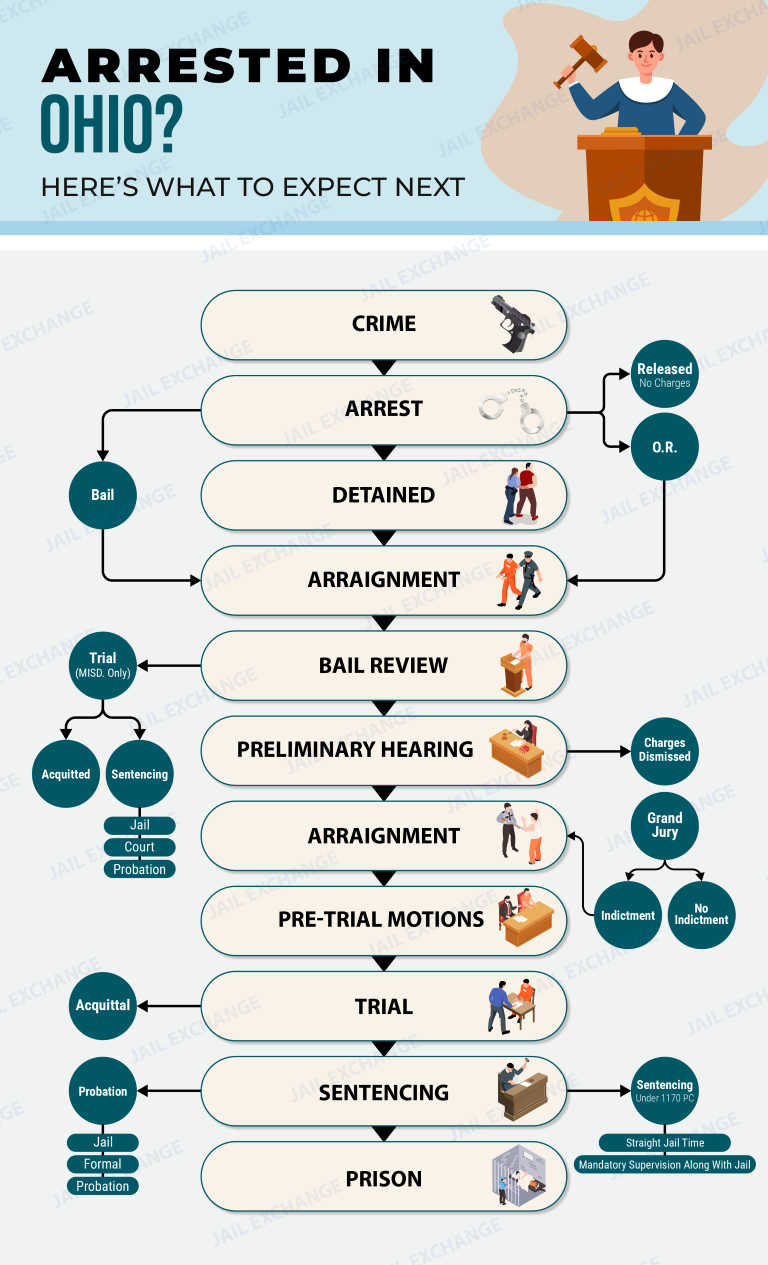
Holmes County Jail Criminal Court Process
Criminal Court Process for Holmes County Ohio
Holmes County's courts all sit in or near the courthouse square in Millersburg, the county seat. The Holmes County Municipal Court takes misdemeanor, OVI and traffic cases from every part of the county and opens each felony case, and the Holmes County Court of Common Pleas tries felonies after indictment. Felony and juvenile cases are prosecuted by the elected Holmes County Prosecuting Attorney, and appeals go to Ohio's Fifth District Court of Appeals. Adults who are not released after arrest stay in the Holmes County Jail, run by the Sheriff on Township Road 574 just north of Millersburg.
- Holmes County Court of Common Pleas (General and Domestic Relations Divisions), Holmes County Courthouse, 1 East Jackson Street, Millersburg, OH 44654, (330) 674-1876
- Holmes County Municipal Court, 1 East Jackson Street, Suite 101, Millersburg, OH 44654, (330) 674-4901
- Holmes County Juvenile Court (Court of Common Pleas, Probate and Juvenile Division), 1 East Jackson Street, Millersburg, OH 44654, (330) 674-5841; probate (330) 674-5881
- Holmes County Prosecuting Attorney, 164 East Jackson Street, Millersburg, OH 44654, (330) 674-4841
- Holmes County Jail (Holmes County Sheriff's Office), 8105 Township Road 574, Holmesville, OH 44633, (330) 763-0014
- Appointed counsel: Holmes County assigns lawyers through the court where the case is pending; start with the Municipal Court at (330) 674-4901, or call the Ohio Public Defender at (800) 686-1573
Which court hears your case. By statute the Holmes County Municipal Court's territory is the whole county, so it hears every misdemeanor, OVI and traffic case, whether the stop happened in Millersburg, Berlin, Walnut Creek, Killbuck or out on a township road. Holmes has no county court, and no Holmes municipality appears on the Supreme Court of Ohio's mayor's court report, so there is no separate ticket court to sort out. When the charge is a felony, the Municipal Court still handles the opening steps, meaning the first appearance, the bond decision and a preliminary hearing if one is held. The case transfers to the Common Pleas Court, General Division, upstairs in the same courthouse once a Holmes County grand jury indicts or the defendant consents to a bill of information.
Where pretrial detainees are held. Sheriff's deputies, Millersburg police and the State Highway Patrol bring arrestees to the Holmes County Jail at 8105 Township Road 574 in Holmesville. It is a small facility, roughly 60 beds, and it holds both people awaiting trial and people serving local sentences; when it is full, the Sheriff may place some inmates in other counties' jails. Bond, visiting and property questions go to the Sheriff's Office at (330) 763-0014.
- Local courts in Holmes County (municipal, county and mayor's courts)
- Misdemeanor (for example, petty theft, a first OVI, assault, criminal trespass)
- Felony (for example, burglary, felony theft, drug trafficking, felonious assault)
- Violent felony (for example, murder, rape, aggravated robbery)
- Juveniles (under 18) arrested in Holmes County
- Federal cases (U.S. District Court) from Holmes County
1. Local courts in Holmes County (municipal, county and mayor's courts)
Holmes County has one local trial court for misdemeanors, and it shares the courthouse building with the Common Pleas Court.
Municipal court
- Holmes County Municipal Court — 1 East Jackson Street, Suite 101, Millersburg, OH 44654, (330) 674-4901. Territory: all of Holmes County, including the villages of Millersburg, Holmesville, Killbuck, Nashville and Glenmont, plus all 14 townships.
County courts
There are none; the countywide Municipal Court leaves no area for a county court to cover.
Mayor's courts
The Supreme Court of Ohio's mayor's court report lists no court for any Holmes County village or city. Ordinance and traffic citations written inside Millersburg or the villages are filed in the Municipal Court.
Besides criminal and traffic cases, the Municipal Court hears civil claims up to $15,000, small claims and evictions. The clerk can tell you your next court date, how to pay a waivable ticket, and whether a warrant has been issued.
2. Misdemeanor (for example, petty theft, a first OVI, assault, criminal trespass)
Tourist traffic through Berlin and Walnut Creek, rural roads shared with buggies, and the county's busy stores give Holmes a steady stream of OVI, traffic and shoplifting cases. Officers frequently issue a summons and let the person go home. Someone taken to the jail, typically for OVI, domestic violence or a warrant, can often be released quickly by posting the amount on the Municipal Court's bond schedule.
Arraignment in Millersburg
If bond was not posted, the person is brought before the Municipal Court judge, in person or by video, usually the next business day. Since Ohio voters amended the Constitution in 2022, judges setting bail must consider public safety along with the seriousness of the charge, prior record and the chance the person will skip court. Release may be on recognizance, on a 10 percent deposit, in cash, or through a licensed bail bondsman. The judge also explains the charge and the right to counsel and takes a plea.
Getting a lawyer
A defendant who cannot pay a lawyer and faces any possibility of jail can complete an affidavit of indigency at arraignment, and the judge will appoint one from the county's list. Ohio allows a modest application fee for appointed counsel, which the court may waive.
Resolving the charge
Most Holmes misdemeanors settle at a pretrial conference. Common results are dismissal after restitution, a reduced charge, a diversion agreement, intervention in lieu of conviction for substance-related offenses, or a plea to community control, a fine and possibly a short jail term. Trial before eight jurors is available only on a timely written jury demand, and their verdict has to be unanimous; otherwise the judge decides. Ohio's speedy-trial statute allows 90 days for M1 and M2 cases and 45 days for M3 and M4 cases, subject to waivers and delays the defense requests. A typical case closes within one to four months.
Penalties
An M1, including petty theft under $1,000 and assault, can bring up to 180 days in jail and a $1,000 fine. An M2 is punishable by up to 90 days and $750, an M3 by 60 days and $500, and an M4, such as criminal trespass, by 30 days and $250. Minor misdemeanors carry only a fine of up to $150. A first OVI is an M1 that requires either three consecutive days in jail or a 72-hour intervention program (six days if the test was .17 or higher), a fine of $375 to $1,075, and a one-to-three-year license suspension; limited driving privileges are commonly granted. Sealing a misdemeanor conviction is possible after a waiting period for most offenses, though OVI convictions generally cannot be sealed.
3. Felony (for example, burglary, felony theft, drug trafficking, felonious assault)
Felony charges in Holmes County range from thefts from farms and businesses to drug trafficking and assaults. Each one runs through a fixed sequence of hearings, first in the Municipal Court and then in Common Pleas.
Before indictment
At the first appearance the Municipal Court judge sets bond and assigns counsel. Criminal Rule 5(B) then calls for a preliminary hearing within 10 consecutive days for a jailed defendant, or 15 days if the person is out on bond, unless the grand jury indicts first. At that hearing a judge asks only whether there is probable cause; in practice the Holmes County Prosecuting Attorney often presents the case directly to the grand jury, which makes the hearing unnecessary.
After indictment
The indicted defendant is arraigned in the Court of Common Pleas, General Division, and a schedule for discovery and pretrial conferences follows. A defendant can also waive indictment and plead to a bill of information, a route used when a negotiated plea is ready early. Ohio's speedy-trial law requires trial within 270 days of arrest, and any day in jail on that charge counts as three days. Felony juries have 12 members and must be unanimous, but most Holmes felonies are resolved by plea. Before sentencing, the adult probation department completes a presentence investigation.
Sentencing ranges
- F5: 6 to 12 months; community control is the presumption for many first-time nonviolent offenders
- F4: 6 to 18 months
- F3: 9 to 36 months; certain listed offenses carry 12 to 60
- F2: 2 to 8 years, indefinite under the Reagan Tokes Law for offenses on or after March 22, 2019
- F1: 3 to 11 years, also indefinite under Reagan Tokes, with a maximum of up to 50 percent more than the minimum
Theft becomes an F5 at $1,000 and an F4 at $7,500, rising further above $150,000. Burglary is an F2 if a person is likely to be present in the occupied structure, and usually an F3 otherwise. Felonious assault is an F2. Drug trafficking degrees follow the kind and weight of drug, from F5 for small amounts up to F1. A firearm specification adds a mandatory prison term served before the main sentence, while intervention in lieu of conviction offers a treatment-based route for some drug-driven offenses. Count on four months to a year from arrest to sentencing.
4. Violent felony (for example, murder, rape, aggravated robbery)
Homicides and violent sexual assaults are rare in Holmes County, and each draws heavy involvement from the Sheriff's detectives, the state crime lab and the County Prosecuting Attorney. Expect a high bond or a denial of bail, with the defendant held at the Holmes County Jail or another jail under contract for the life of the case.
Aggravated murder. A conviction brings life imprisonment, either without parole or with parole eligibility at 20, 25 or 30 years, unless the case is charged and tried as a capital case. Ohio retains the death penalty in law, though the state has not executed anyone since 2018 while governors have issued reprieves.
Murder. The sentence is 15 years to life.
Rape. This F1 offense carries an indefinite Reagan Tokes sentence; when the victim is under 13 and force or other aggravating circumstances are proven, life imprisonment is possible.
Aggravated robbery. Also an F1, it is often paired with a firearm specification that adds mandatory years.
Preparing these cases takes time: DNA and digital-forensic results, expert witnesses, mental-health evaluations and pretrial motions are routine. Defendants usually waive the 270-day speedy-trial limit, and a year or two from indictment to trial is common. Under Marsy's Law, victims and their families have a constitutional right to notice of every stage, to attend, and to be heard on bond, pleas and sentencing.
5. Juveniles (under 18) arrested in Holmes County
The Holmes County Juvenile Court, part of the Court of Common Pleas' Probate and Juvenile Division, decides delinquency cases from its offices in the courthouse at 1 East Jackson Street; call (330) 674-5841. The County Prosecuting Attorney files the delinquency complaint, and a child accused of an offense has a right to a lawyer, appointed free of charge when the family qualifies.
How cases start
Police refer the matter to the court's intake staff, who decide whether it can be handled unofficially. Diversion is common for a first minor offense; the youth may agree to restitution, classes, community service or counseling, and the complaint is never formally adjudicated if the youth completes the terms. Other cases are set for an adjudicatory hearing, decided by the judge alone.
Holding a youth
Holmes youths are almost never held in the adult jail. When detention is necessary, Holmes, which has no juvenile detention center of its own, sends the youth to a juvenile detention facility in a nearby county under contract, for example a multi-county center in Stark County or the Tuscarawas County center. A judge must hold a detention hearing promptly, within 72 hours or by the next court day, to decide whether the youth stays in custody. Parents can learn the location by calling the Juvenile Court.
Possible outcomes
- Probation, community service, restitution, counseling or treatment
- Out-of-home placement or commitment to the Ohio Department of Youth Services (DYS) for felony-level offenses
- Mandatory bindover to adult court for some 16- and 17-year-olds charged with the gravest offenses, and for 14- and 15-year-olds in certain cases
- Discretionary bindover for youth 14 and older after the judge holds an amenability hearing
- Serious Youthful Offender sentencing, which adds a stayed adult sentence to the juvenile disposition
Juvenile files are largely closed to the public, and sealing is available for most records once the case ends.
6. Federal cases (U.S. District Court) from Holmes County
Which federal court covers Holmes County?
Holmes belongs to the Northern District of Ohio, Eastern Division. Cases from Holmes are generally assigned to the Akron courthouse, about an hour north of Millersburg, rather than to Cleveland or Youngstown.
- John F. Seiberling Federal Building and U.S. Courthouse, 2 South Main Street, Akron, OH 44308, clerk (330) 252-6000
- U.S. Attorney's Office, Northern District of Ohio — main office at 801 West Superior Avenue, Suite 400, Cleveland, OH 44113, (216) 622-3600; a branch office also operates in Akron
- Federal Public Defender, Northern District of Ohio — Akron branch office (main office in Cleveland)
- U.S. Marshals Service, Seiberling Federal Building, 2 South Main Street, Room 314, Akron, OH 44308, (330) 375-5800
What kinds of Holmes cases are federal?
Federal charges come from federal agencies or task forces and from conduct that federal law specifically reaches: interstate drug trafficking, illegal gun possession, child pornography, bank and wire fraud, tax offenses, and threats sent across state lines. Sometimes a case that starts with a county arrest is adopted by the U.S. Attorney because federal penalties are stiffer.
What happens after a federal arrest?
The defendant is brought to a magistrate judge in Akron for an initial appearance, where a Federal Public Defender or Criminal Justice Act panel lawyer is appointed for those who qualify. A prosecution request for detention generally leads to a hearing within three court days. The Bail Reform Act lets the magistrate release the defendant on conditions monitored by U.S. Pretrial Services or detain the person if no conditions will ensure safety and appearance; bail bondsmen are not part of the system. A defendant charged by criminal complaint must be indicted by a grand jury within 30 days, and the Speedy Trial Act sets a 70-day trial deadline that is regularly extended by excludable delays.
How do federal cases end?
Most defendants plead guilty under an agreement. The rare trial is decided by 12 jurors who must all agree. U.S. Probation prepares a presentence report, the judge works through the advisory Sentencing Guidelines, and any mandatory minimum set by Congress must still be imposed. Federal prisoners are not paroled; they serve at least about 85 percent of the term with good-conduct credit, in a Bureau of Prisons facility, then begin supervised release. Appeals are taken to the U.S. Court of Appeals for the Sixth Circuit.
Where is a detained federal defendant held?
The Marshals Service keeps custody and places detainees in jails it contracts with in northern Ohio; the specific jail can change, so Holmes County relatives can check the Federal Bureau of Prisons inmate locator for a defendant from Millersburg via name or register number. Millersburg-area defendants held pending trial at a contract jail may also appear on that jail's roster. Federal charges against anyone under 18 are uncommon.
The information on this Holmes County page is general and is not legal advice; local rules and schedules in Millersburg can change at any time. A person who has been charged should consult a defense lawyer or ask the Holmes County Municipal Court, (330) 674-4901, about appointed counsel.