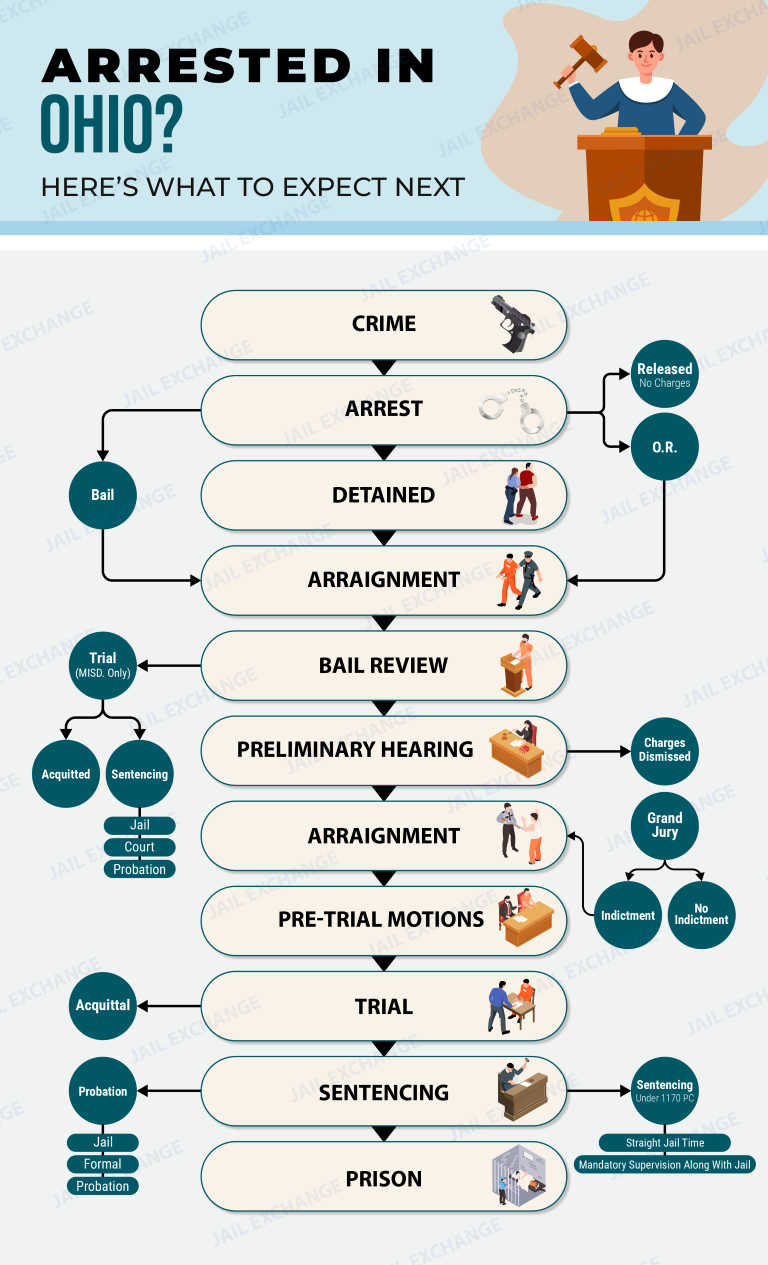
West Central Juvenile Detention Facility Criminal Court Process
Criminal Court Process for Miami County Ohio
Miami County, just north of Dayton, has its courts in Troy, the county seat. A single court, the Miami County Municipal Court, hears every misdemeanor and OVI charge in the county, from Piqua and Tipp City to West Milton and Covington, and it also handles the first stage of felony cases. Felonies are tried in the Miami County Court of Common Pleas. The Miami County Prosecuting Attorney brings felony charges, and city law directors prosecute most misdemeanors filed by their police departments. Adults held after arrest are kept by the Miami County Sheriff in the county's jail facilities in Troy.
- Miami County Court of Common Pleas, Safety Building, 201 W. Main Street, Third Floor, Troy, OH 45373, (937) 440-6010
- Miami County Municipal Court, 201 W. Main Street, Troy, OH 45373, (937) 440-3910
- Miami County Common Pleas Court, Juvenile Division, 201 W. Main Street, Troy, OH 45373, (937) 440-5970
- Miami County Prosecuting Attorney, 201 W. Main Street, Troy, OH 45373; county offices (937) 440-5900
- Miami County Sheriff's Office and Jail, Safety Building, 201 W. Main Street, Troy, OH 45373, (937) 440-6085
- Miami County Public Defender, 201 W. Main Street, 2nd Floor, Troy, OH 45373, (937) 440-3950; eligibility is decided by the court hearing the case
Which court hears your case. Because the Miami County Municipal Court's territory covers the whole county (including the part of Bradford that crosses into Darke County), every misdemeanor, OVI and traffic charge goes to that one court in Troy, whichever police agency wrote it. The county has no separate county court, and the Supreme Court of Ohio's most recent mayor's court list shows no mayor's courts here. A felony arrest also starts in the municipal court, where the initial appearance and any preliminary hearing take place. The case then moves upstairs to the Court of Common Pleas, General Division, after a grand jury indictment or a waiver of indictment on a bill of information. Appeals go to the Second District Court of Appeals.
Where pretrial detainees are held. The Miami County Sheriff operates two adult jail facilities: the full-service Miami County Jail in the Safety Building in downtown Troy, and the minimum-security Miami County Incarceration Facility north of Troy. New arrests are booked downtown, and the Sheriff assigns housing by classification. Call the Sheriff's Office at (937) 440-6085 to ask whether someone is in custody and what bond has been set.
- Local courts in Miami County (municipal, county and mayor's courts)
- Misdemeanor (for example, petty theft, a first OVI, assault, criminal trespass)
- Felony (for example, burglary, felony theft, drug trafficking, felonious assault)
- Violent felony (for example, murder, rape, aggravated robbery)
- Juveniles (under 18) arrested in Miami County
- Federal cases (U.S. District Court) from Miami County
1. Local courts in Miami County (municipal, county and mayor's courts)
Miami County has one of Ohio's simpler local court setups: a single countywide municipal court and no county court.
Municipal court
- Miami County Municipal Court — 201 W. Main Street, Troy, OH 45373, (937) 440-3910. Covers all of Miami County: Troy, Piqua, Tipp City, West Milton, Covington, Bradford (including its Darke County side), Pleasant Hill, Ludlow Falls, Laura, Fletcher, Casstown and every township.
County courts
There are none. The municipal court's countywide territory leaves no area for a county court to serve.
Mayor's courts
The Supreme Court of Ohio's latest published mayor's court list includes no Miami County municipality, so ordinance and traffic violations from Piqua, Troy, Tipp City and the villages go to the municipal court in Troy.
The municipal court also handles small claims, evictions and civil cases up to its monetary limit. For a criminal case, the clerk can confirm hearing dates, fines and payment options.
2. Misdemeanor (for example, petty theft, a first OVI, assault, criminal trespass)
Most people charged with a misdemeanor in Miami County never stay in jail overnight. Officers in Piqua, Troy and Tipp City, and Sheriff's deputies in the townships, usually issue a summons or citation for shoplifting or trespass. Jail is more likely after an OVI, a domestic violence arrest, or when there is an outstanding warrant. Those defendants are booked in Troy and either post a scheduled bond or wait to see a municipal judge, usually the next weekday and often by video.
Inside the municipal court
At arraignment the judge reads the charge and the possible penalties and asks for a plea. A defendant who cannot afford counsel can ask for one; the court decides eligibility from a financial affidavit, and qualifying defendants are usually represented by the Miami County Public Defender, (937) 440-3950. A not-guilty plea leads to a pretrial conference with the prosecutor. A jury trial on a jailable misdemeanor must be requested in writing, and the jury will have eight members who must agree unanimously. Without that request, the judge decides the case. The prosecution has 90 days to bring an M1 or M2 to trial and 45 days for an M3 or M4, and each day spent in jail on the charge counts as three.
Penalties
- First-degree (M1): as much as 180 days and $1,000. Theft under $1,000 and assault are M1s.
- Second-degree (M2): 90 days, $750.
- Third-degree (M3): 60 days, $500.
- Fourth-degree (M4): 30 days, $250. Criminal trespass is usually an M4, while aggravated trespass is an M1.
- Minor misdemeanor: a fine of no more than $150, with no jail.
First-offense OVI
A first OVI in Miami County carries three days in jail, or a 72-hour driver intervention program instead, a fine between $375 and $1,075, and a court license suspension of one to three years. The suspension follows an administrative license suspension that starts at arrest after a failed or refused test. A breath or blood result of .17 or more raises the minimum to six days. Judges commonly allow limited driving privileges, and unlimited privileges with an ignition interlock may be granted in some cases. An assessment and treatment are also routinely ordered.
Cases end in dismissal, diversion, intervention in lieu of conviction, a reduced plea, fines, community control or jail. A Miami County misdemeanor usually takes one to four months, and record sealing is possible later.
3. Felony (for example, burglary, felony theft, drug trafficking, felonious assault)
Miami County's courts are all in the Safety Building, so a felony case starts in the municipal court and moves upstairs to the Common Pleas courtroom once the defendant is indicted.
The first weeks
At the first municipal appearance, the judge sets bond. In doing so the judge must consider public safety, the person's record, the seriousness of the charge and the risk of not appearing, as the 2022 constitutional amendment requires. The bond may be a recognizance bond, a 10 percent deposit, or cash or surety, and licensed bail bond agents can post surety bonds. A preliminary hearing is set within 10 days for a jailed defendant and 15 days for one who is free. Often the prosecutor presents the case to the grand jury first, and the preliminary hearing is canceled.
In Common Pleas
Once indicted, the defendant is arraigned in the Common Pleas Court and the case is assigned to a judge. Discovery follows, then pretrial conferences, and possibly motions to suppress evidence. The trial deadline is 270 days, with three days of credit for each day in jail on the charge. Most Miami County felonies end with a plea agreement, often to reduced counts. If the case goes to trial, a 12-person jury must reach a unanimous verdict. Before sentencing, the court usually orders a presentence investigation.
Ranges by degree
- F5: 6–12 months, for example theft of $1,000 to $7,500. Many first-time nonviolent offenders are presumed eligible for community control.
- F4: 6–18 months, for example theft of $7,500 to $150,000.
- F3: 9–36 months, or 12–60 months for some offenses. Burglary without a person likely present is often an F3.
- F2: 2–8 years. Felonious assault, and burglary when someone is likely to be present, are F2s.
- F1: 3–11 years, for example aggravated burglary.
Drug trafficking ranges from F5 to F1, depending on the drug and the quantity. F1 and F2 offenses committed since March 22, 2019 receive Reagan Tokes indefinite sentences, which add up to half the minimum term on top of it. A firearm specification adds a mandatory prison term. Defendants whose drug use drove the offense may qualify for intervention in lieu of conviction, and community control is common at the lower degrees. Felony cases here generally take four months to a year.
4. Violent felony (for example, murder, rape, aggravated robbery)
Violent felony charges in Miami County bring high bonds or a request by the prosecutor to deny bail. The charges are presented to the grand jury quickly, and the case is handled personally by the Prosecuting Attorney or senior assistants.
- Aggravated murder: a sentence of life in prison (parole possible only after 20, 25 or 30 years, or never) or, with proven specifications, death. The death penalty remains in Ohio law, but no executions have been carried out since 2018.
- Murder: an indefinite term of 15 years to life.
- Rape: a first-degree felony with a Reagan Tokes indefinite sentence. Life terms are possible in some cases involving children under 13.
- Aggravated robbery: a first-degree felony, usually with a firearm specification attached when a gun was used.
Marsy's Law gives victims in these cases constitutional rights to notice, to be present and to be heard. Investigations involving forensic testing, competency evaluations or expert witnesses often stretch these cases past a year, and two years or more is not unusual for a homicide.
5. Juveniles (under 18) arrested in Miami County
Delinquency cases go to the Juvenile Division of the Miami County Court of Common Pleas, located in the same Safety Building at 201 W. Main Street, Troy, (937) 440-5970. Complaints are filed by the Prosecuting Attorney or by police and are screened at intake. Many first-time or low-level matters are handled unofficially through diversion, with conditions such as counseling, restitution or community work. A youth who completes them avoids a formal finding.
When a youth is held
Miami County youths who are detained are taken to the West Central Juvenile Detention Center in Troy, the detention facility listed with the Miami County juvenile court. A detained child is entitled to a prompt detention hearing, within roughly 72 hours or by the next court day, where the judge or magistrate decides whether the child can safely go home while the case continues.
How cases can end
- Dismissal, probation, community service, treatment or electronic monitoring.
- Commitment to the Ohio Department of Youth Services (DYS) for felony-level conduct.
- Transfer to adult court (bindover). Ohio makes transfer mandatory for some 16- and 17-year-olds, and in narrower cases 14- and 15-year-olds, charged with the gravest offenses. For other felonies, a judge may transfer a child 14 or older after a hearing on whether the child is amenable to juvenile rehabilitation.
- A Serious Youthful Offender disposition, which pairs a juvenile sentence with an adult sentence that is put on hold.
Children are entitled to a lawyer, and one is appointed when the family cannot afford one. Juvenile records are generally confidential, and sealing is available.
6. Federal cases (U.S. District Court) from Miami County
Where the case is heard
Miami County is in the Southern District of Ohio, Western Division, and its federal cases are heard about 20 miles south of Troy in Dayton, at the Walter H. Rice Federal Building and U.S. Courthouse, 200 W. Second Street, Dayton, OH 45402.
Who is involved
- Prosecution: U.S. Attorney's Office, Dayton branch, 200 W. Second Street, Suite 600, Dayton, OH 45402, (937) 225-2910.
- Defense for those who qualify: Federal Public Defender, 1 S. Main Street, Suite 490, Dayton, OH 45402, (937) 225-7687, or a private CJA panel lawyer appointed by the court.
- Custody and transport: U.S. Marshals Service, 200 W. Second Street, Suite 108, Dayton, OH 45402, (937) 225-2917.
When a Miami County case goes federal
A case moves to federal court when the conduct violates federal law and the case is investigated or adopted by an agency such as the FBI, DEA, ATF or HSI. Typical examples are trafficking along the I-75 corridor, felon-in-possession gun charges, child exploitation cases and bank or wire fraud.
The process
The defendant first appears before a U.S. magistrate judge in Dayton. If the government seeks detention, a hearing is generally held within three court days; the judge then either releases the defendant on conditions monitored by U.S. Pretrial Services or orders detention under the Bail Reform Act. A defendant charged by complaint must be indicted within 30 days, and the Speedy Trial Act sets a 70-day trial clock, which is frequently extended. Most defendants plead guilty. Those who go to trial face a unanimous 12-person jury. Sentencing begins with a presentence report and the advisory Guidelines range, and any mandatory minimum still applies. There is no federal parole, so a prisoner serves roughly 85 percent of the sentence in the Bureau of Prisons before supervised release begins. Appeals go to the Sixth Circuit.
Detention
People held on federal charges are in Marshals custody and are housed in county jails under contract with the Marshals Service; Troy-area households can query the Federal Bureau of Prisons inmate locator for a Miami County defendant via name or register number. Troy-area defendants waiting for trial inside a contract jail may turn up on the facility's roster. Federal charges against anyone under 18 are very unusual.
The information on this Miami County page is general and educational, not legal advice, and local procedures can change. If you or a family member has been charged, consult a criminal defense lawyer or ask the court in Troy for appointed counsel; the Miami County Public Defender can be reached at (937) 440-3950, and the Common Pleas Court at (937) 440-6010.