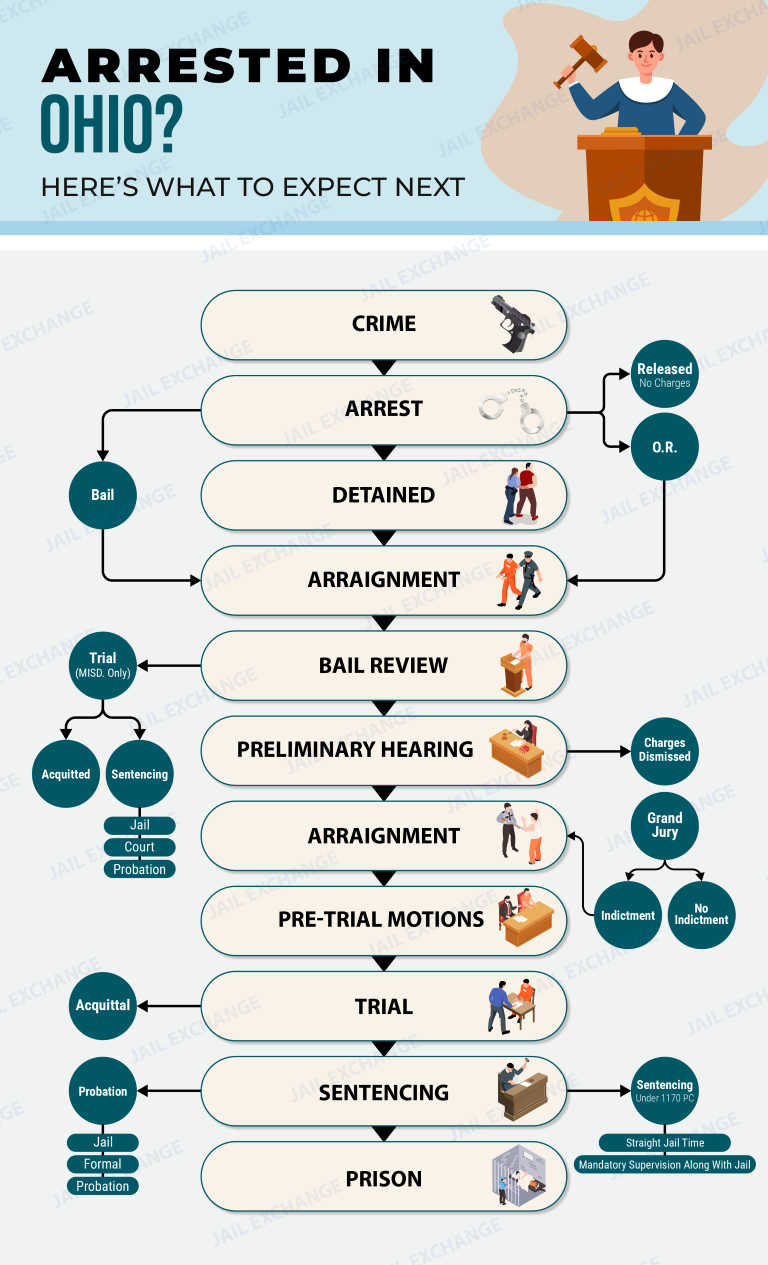
Washington County Jail Criminal Court Process
Criminal Court Process for Washington County Ohio
Washington County lies along the Ohio River across from Parkersburg, West Virginia, and its county seat is Marietta, the oldest city in the state. Misdemeanors, OVI and traffic charges from across the county go to the Marietta Municipal Court, which also handles the first hearings in felony cases; indicted felonies are tried in the General Division of the Washington County Court of Common Pleas. Felonies are prosecuted by the elected Washington County Prosecuting Attorney, and municipal-court misdemeanors by the city law director's office or the prosecutor assigned to that court. Anyone held after arrest is jailed by the Sheriff at the Washington County Jail in Marietta.
- Washington County Court of Common Pleas (General and Domestic Relations Division; Probate and Juvenile Division), Washington County Courthouse, 205 Putnam Street, Marietta, OH 45750
- Marietta Municipal Court, 259 Butler Street, Marietta, OH 45750, (740) 373-4474
- Washington County Sheriff's Office, 309 Fourth Street, Marietta, OH 45750, (740) 376-7070
- Washington County Jail (the Sheriff's Corrections Division), Marietta, OH 45750, (740) 374-7677
- Washington County Public Defender, 125 Putnam Street, Suite 200, Marietta, OH 45750, (740) 373-1441
- Washington County Prosecuting Attorney, Washington County Courthouse, 205 Putnam Street, Marietta, OH 45750
Which court hears your case. The Marietta Municipal Court has territorial jurisdiction over all of Washington County, so a misdemeanor, OVI or traffic case from Marietta, Lowell, Waterford or any township is filed there; the county has no separate county court. In three communities, the City of Belpre and the villages of Beverly and Matamoras, local police may instead send ordinance and traffic citations to a mayor's court, which sits without a jury and can transfer a case, or be asked by the defendant to transfer it, to the Marietta Municipal Court. A felony arrest begins in the Marietta Municipal Court with an initial appearance, bond and possibly a preliminary hearing, and the case moves to the Common Pleas Court on Putnam Street after a grand jury indictment or a bill of information. Washington County appeals go to Ohio's Fourth District Court of Appeals.
Where pretrial detainees are held. The Sheriff runs the Washington County Jail, a 124-bed facility in Marietta that holds both pretrial defendants and people serving local sentences. Arrests by Marietta and Belpre police, deputies and troopers all end there when the person is not released. Call the Sheriff's Office at (740) 376-7070 for custody, bond or visiting information.
- Local courts in Washington County (municipal, county and mayor's courts)
- Misdemeanor (for example, petty theft, a first OVI, assault, criminal trespass)
- Felony (for example, burglary, felony theft, drug trafficking, felonious assault)
- Violent felony (for example, murder, rape, aggravated robbery)
- Juveniles (under 18) arrested in Washington County
- Federal cases (U.S. District Court) from Washington County
1. Local courts in Washington County (municipal, county and mayor's courts)
Washington County has a single municipal court with countywide reach, plus three mayor's courts that hear local ordinance and traffic matters.
Municipal court
- Marietta Municipal Court — 259 Butler Street, Marietta, OH 45750, (740) 373-4474. Covers the entire county: the cities of Marietta and Belpre, every village and all 22 townships.
County court
There is none. Because the Marietta Municipal Court serves every part of the county, no area is left for a county court.
Mayor's courts
- Belpre Mayor's Court — City of Belpre, Belpre, OH 45714; contact the Belpre city offices.
- Beverly Mayor's Court — Village of Beverly, Beverly, OH 45715; contact the village offices.
- Matamoras Mayor's Court — Village of Matamoras, New Matamoras, OH 45767; contact the village offices.
A mayor's court can impose fines and short local penalties for ordinance and traffic offenses but cannot hold a jury trial. Defendants who want a jury, or whose case falls outside what the mayor's court may hear, have the matter sent to the Marietta Municipal Court. Session days in the three mayor's courts are limited, so call ahead.
2. Misdemeanor (for example, petty theft, a first OVI, assault, criminal trespass)
Misdemeanor arrests in Washington County range from shoplifting at stores along Pike Street in Marietta to fights, trespassing and OVI stops on State Route 7. A large share of these cases start with a citation and a court date instead of booking. When officers do make a custodial arrest, typically for OVI, domestic violence or a warrant, the person is booked at the county jail.
How release works
The Marietta Municipal Court uses a bond schedule for many misdemeanors, so a person may be able to post bond soon after booking. Charges outside the schedule wait for the judge at the next session. The court can release a defendant on recognizance, accept a 10 percent deposit, or require a full cash or surety bond, and bail bond agents may post surety bonds. Ohio's 2022 constitutional amendment requires the judge to factor in public safety, prior record, the seriousness of the charge and the chance the person will not appear.
Arraignment and pretrial
At arraignment in Marietta, the judge explains the charge and its penalties and takes a plea. Not guilty pleas move to a pretrial with the prosecutor, where many cases are resolved. A defendant who wants a jury must ask for one in writing; Ohio misdemeanor juries have eight members and must be unanimous.
Maximum penalties
- M1: 180 days and $1,000 at most (petty theft of property worth less than $1,000 and assault are M1 offenses).
- M2: 90 days and $750 at most.
- M3: 60 days and $500 at most.
- M4: 30 days and $250 at most. Criminal trespass usually falls at this level; aggravated trespass is an M1.
- Minor misdemeanor: fine only, up to $150.
First OVI
For a first OVI, a first-degree misdemeanor, the Marietta Municipal Court must order either three days in a row in jail or a 72-hour driver intervention program; six days is the minimum after a test of .17 or higher, or in certain refusal cases. The fine is $375 to $1,075. Drivers face an administrative license suspension at arrest after failing or refusing a test, and the court adds a one- to three-year suspension upon conviction. Limited privileges are often granted, and some drivers qualify for unlimited privileges with an ignition interlock.
Lawyers and how cases end
The Washington County Public Defender, (740) 373-1441, represents eligible defendants in the municipal court. Applicants complete a financial affidavit, and a small application fee may be charged. Speedy-trial rules call for trial within 90 days for M1 and M2 charges and within 45 days for M3 and M4 charges, unless the defense waives or extends that time. Possible results include dismissal, diversion, intervention in lieu of conviction, a fine, community control or jail. Most misdemeanor cases in Marietta finish within one to four months, and sealing may be available later.
3. Felony (for example, burglary, felony theft, drug trafficking, felonious assault)
A felony arrest in Washington County is followed by booking at the county jail and an initial appearance in the Marietta Municipal Court, usually by the next business day. The judge reviews the complaint, sets bond and conditions, and arranges counsel through the Public Defender for those who qualify.
Path of the case
- Preliminary hearing: held in municipal court within 10 consecutive days if the defendant is jailed or 15 days if not, unless waived or replaced by an indictment. The judge determines only whether probable cause exists.
- Grand jury: the Washington County Prosecuting Attorney presents the case, and the grand jury decides whether to indict. Defendants may waive indictment and proceed by bill of information.
- Common Pleas arraignment: the defendant enters a plea at the courthouse at 205 Putnam Street, and the court sets a schedule.
- Discovery and pretrials: the prosecution turns over evidence, and the lawyers negotiate; most cases are resolved by plea.
- Trial: a 12-member jury, which must be unanimous, or a bench trial if the defendant waives a jury in writing.
- Sentencing: often after a presentence investigation by the probation department.
Under Ohio's speedy-trial statute, the state must bring a felony to trial within 270 days of arrest, and each day spent in jail on that charge alone counts as three. Defense continuances stop the count.
Sentencing ranges
- F5, such as theft of $1,000 to $7,500: 6 to 12 months, with a presumption of community control for many first-time nonviolent offenders.
- F4, such as theft of $7,500 to $150,000: 6 to 18 months.
- F3: generally 9 to 36 months, stretching to 12 to 60 months for a short list of designated offenses. A burglary where no person was likely present is usually an F3.
- F2: a minimum of 2 to 8 years. Burglary of an occupied structure with a person likely present and felonious assault are F2s.
- F1: a minimum of 3 to 11 years.
F1 and F2 offenses committed on or after March 22, 2019 carry indefinite sentences under the Reagan Tokes Law, with a maximum that can reach 50 percent above the minimum. Drug trafficking can be charged from F5 up to F1 depending on the substance, amount and location. Firearm specifications carry their own mandatory prison time. Intervention in lieu of conviction lets some defendants with a substance-use problem complete treatment and have the charge dismissed.
Defense and timeline
The Washington County Public Defender, 125 Putnam Street, Suite 200, (740) 373-1441, handles felony cases for eligible defendants, with appointed private counsel in conflict cases. Felony cases in the Common Pleas Court commonly take four to twelve months.
4. Violent felony (for example, murder, rape, aggravated robbery)
Washington County's most serious cases, including homicides, sexual assaults and armed robberies, move through the Marietta Municipal Court, the grand jury and the Common Pleas Court in the same order as other felonies. They differ in how long they take, how much evidence is involved and what is at stake.
Bond
Judges set high bonds in violent felony cases and must consider public safety and the defendant's record. For certain serious charges, the prosecutor may ask for a hearing to deny bail altogether. A defendant who cannot be released remains in the Washington County Jail through trial.
Possible sentences
- Aggravated murder — the possible sentences are death, life with no parole, or life with parole consideration after 20, 25 or 30 years served; Ohio has carried out no execution since 2018.
- Murder — a Washington County murder conviction means 15 years to life.
- Rape — a first-degree felony with an indefinite Reagan Tokes sentence; if the victim was under 13 and force or other aggravating circumstances are proven, the sentence can be life.
- Aggravated robbery — a first-degree felony, with additional mandatory time for a firearm specification.
Victims' rights and how long it takes
Marsy's Law, which Ohio voters added to the constitution in 2017, guarantees victims notice of court proceedings and the right to attend and speak at key hearings. The prosecutor's victim-witness staff keep families informed. A violent felony in Washington County typically takes one to two years or longer to resolve, especially when lab results, experts or out-of-state witnesses are involved.
5. Juveniles (under 18) arrested in Washington County
When someone under 18 is accused of an offense in Washington County, the case goes to the Probate and Juvenile Division of the Washington County Court of Common Pleas in Marietta. The county Prosecuting Attorney files delinquency complaints, and the juvenile court's intake officers review each referral.
Unofficial cases and diversion
First-time, low-level offenses are often handled informally. The youth and a parent meet with court staff, and the youth agrees to conditions such as community service, restitution, counseling or school attendance; completing them ends the matter without a formal finding. More serious or repeated conduct leads to an official complaint and an adjudication hearing.
Detention
Most youths go home with a parent after arrest. A youth who presents a danger or a flight risk is held in a secure juvenile detention center; Washington County typically uses a regional or nearby county's detention facility under contract. The court must hold a detention hearing promptly, generally within 72 hours or by the next court day.
Dispositions
Options after an adjudication include probation, community service, treatment, electronic monitoring, a residential placement, or, for felony-level delinquency, commitment to the Ohio Department of Youth Services, which can hold a youth until age 21.
Bindover and Serious Youthful Offender cases
Ohio law makes bindover to adult court mandatory for some 16- and 17-year-olds charged with the most serious violent offenses, and in specific situations for 14- and 15-year-olds. For other youths 14 and older, the prosecutor may seek discretionary bindover, which requires an amenability hearing. The Serious Youthful Offender option allows a blended sentence, a juvenile disposition paired with an adult sentence that is stayed and imposed only if the youth fails to comply.
Juvenile records are confidential in most circumstances, and many can be sealed after the case ends.
6. Federal cases (U.S. District Court) from Washington County
Which federal court covers Washington County?
The Southern District of Ohio, Eastern Division. Federal criminal cases from Marietta, Belpre and the rest of the county are generally heard at the Joseph P. Kinneary U.S. Courthouse, 85 Marconi Boulevard in Columbus. The West Virginia side of the river is a different federal district, so a case that crosses the bridge to Parkersburg may involve prosecutors in both states.
When does a case become federal?
When the conduct breaks a federal law and federal prosecutors choose to charge it. In this region that often means drug trafficking networks moving methamphetamine or fentanyl along the river corridor, gun crimes by people barred from having firearms, child exploitation, bank robbery, or fraud against Medicare, Social Security or other federal programs.
Who prosecutes, defends and holds defendants?
- U.S. Attorney's Office, Southern District of Ohio: 303 Marconi Boulevard, Suite 200, Columbus, OH 43215, (614) 469-5715.
- Federal Public Defender, Columbus office: 10 West Broad Street, Suite 1020, Columbus, OH 43215, (614) 469-2999; private Criminal Justice Act panel attorneys also take appointments.
- U.S. Marshals Service, Columbus: 85 Marconi Boulevard, Room 460, Columbus, OH 43215, (614) 469-5540. The Marshals place federal detainees in contract jails. The Federal Bureau of Prisons inmate locator allows Marietta-area households to search for a person from Washington County by name or by register number. Washington County prisoners waiting for trial in a jail under contract can be listed in the jail's listing.
What happens after a federal arrest?
The defendant first appears before a U.S. magistrate judge. If the government requests detention, the hearing is usually within three court days, and the judge applies the Bail Reform Act, choosing release on conditions supervised by U.S. Pretrial Services or detention until trial. Federal court has no commercial bail bonds. A defendant charged by complaint must be indicted within 30 days, and the Speedy Trial Act sets a 70-day deadline for trial that is frequently extended. Most cases end in a guilty plea; trials use a 12-person jury that must be unanimous.
How are federal sentences decided and served?
A U.S. Probation officer prepares a presentence report. The judge calculates the advisory Sentencing Guidelines and must impose any statutory mandatory minimum. There is no federal parole, so a prisoner serves roughly 85 percent of the term with good-conduct credit in the Bureau of Prisons, then a period of supervised release. Appeals go to the Sixth Circuit in Cincinnati. Federal charges against juveniles are rare.
Nothing on this Washington County page is legal advice; it is a general description of local court procedure, and details such as schedules and phone numbers can change. People facing charges in Marietta or Belpre should consult a defense attorney or contact the Washington County Public Defender at (740) 373-1441, and hearing dates can be confirmed with the Marietta Municipal Court at (740) 373-4474.