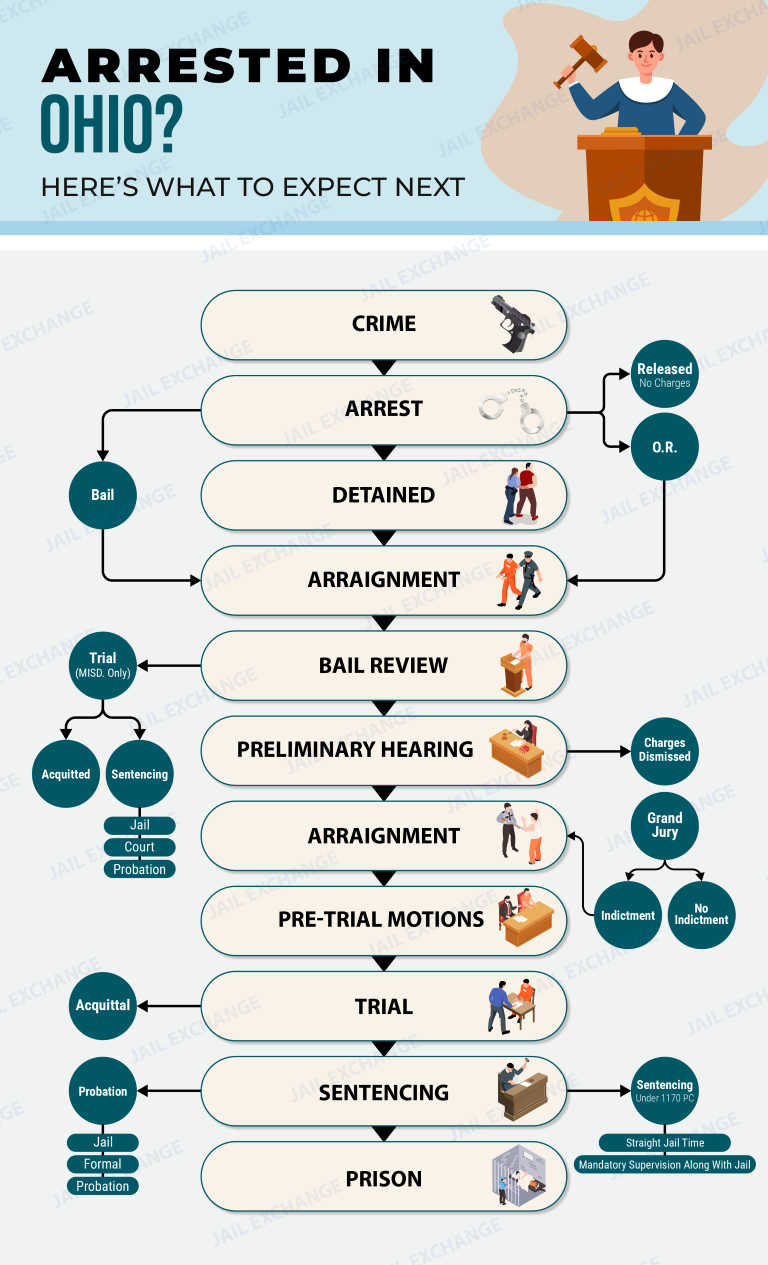
Corrections Center of Northwest Ohio Criminal Court Process
Criminal Court Process for Williams County Ohio
Toledo Municipal, Suburban Courts and Common Pleas in Lucas County
Four city courts take misdemeanors and first hearings here: Toledo, Sylvania, Maumee and Oregon. Felony cases then move up to Common Pleas, which sits in the Lucas County Courthouse, 700 Adams Street, Toledo, OH 43604. Anyone not released is kept at the Lucas County Corrections Center, 1622 Spielbusch Avenue, Toledo, OH 43604.
Look for the person on the jail booking list, a file the Sheriff updates twice a day. Our Jail Roster page lists people held right now, the charges they face and any open warrants.
Not sure which court has the case? For a Toledo arrest, phone the city court clerk at 419-936-3650. When a felony gets to the 700 Adams Street building, the Clerk of Courts at 419-213-4484 can give you the case number and next date. Then read our bail and bond guide to learn how to get your person home.
1. Local courts in Lucas County (municipal, county and mayor's courts)
Toledo is the county seat of Lucas County and home to most of its courts, clustered downtown between Adams Street and Spielbusch Avenue. Misdemeanors and the first stages of felonies are handled by four municipal courts: Toledo, Maumee, Oregon and Sylvania. Felony trials belong to the General Division of the Lucas County Court of Common Pleas at the 1897 Lucas County Courthouse at 700 Adams Street, where the elected Lucas County Prosecuting Attorney brings the charges. Adult detainees are held at the Sheriff's Lucas County Corrections Center on Spielbusch Avenue.
- Lucas County Court of Common Pleas, General Division, Lucas County Courthouse, 700 Adams Street, Toledo, OH 43604; Clerk of Courts (419) 213-4484
- Toledo Municipal Court, 555 N. Erie Street, Toledo, OH 43604, (419) 936-3650
- Lucas County Prosecuting Attorney, Lucas County Courthouse, 700 Adams Street, Toledo, OH 43604, (419) 213-4700
- Lucas County Juvenile Court and Juvenile Detention Center, Juvenile Justice Center, 1801 Spielbusch Avenue, Toledo, OH 43604, (419) 213-6722
- Lucas County Corrections Center (Lucas County Sheriff's Office), 1622 Spielbusch Avenue, Toledo, OH 43604; jail (419) 213-4425, Sheriff (419) 213-4900
- Toledo Legal Aid Society (public defender for Lucas County), 555 N. Erie Street, Suite 248, Toledo, OH 43604
Which court hears your case. Lucas County's misdemeanor, OVI and traffic cases are assigned by geography: the municipal court whose territory includes the spot where the offense happened takes the case. Toledo Municipal Court covers the city of Toledo and nearby areas; Sylvania Municipal Court covers Sylvania and the county's western townships and villages; Maumee Municipal Court covers Maumee and the communities to its south and west; and Oregon Municipal Court covers Oregon and the east side of the Maumee River. Lucas County has no county court. Berkey, a village in the northwest corner of the county, holds a mayor's court for local tickets written under village ordinances; it cannot hold jury trials, so a defendant who wants one, or simply prefers it, can have the case moved to municipal court. A felony also opens in that municipal court. Its judge conducts the initial appearance, fixes bond and, if needed, holds the preliminary hearing; Common Pleas (General Division) takes over after an indictment, or after a signed waiver allowing the prosecutor to proceed by information. The Sixth District Court of Appeals hears Lucas County appeals.
Where pretrial detainees are held. Toledo police, the Sheriff's Office, suburban departments and the State Highway Patrol bring adult arrestees to the Lucas County Corrections Center, 1622 Spielbusch Avenue, next to the downtown courts. People who do not post bond stay there pending trial, and some inmates may be moved to CCNO, the Corrections Center of Northwest Ohio at Stryker, a regional jail in which Lucas County and the city of Toledo participate. For custody and bond information, call the jail at (419) 213-4425 or the Sheriff's Office at (419) 213-4900.
Four municipal courts share Lucas County, and one village mayor's court handles local tickets. The territories below are summarized; your ticket or bond paper names the court.
Municipal courts
- Toledo Municipal Court — 555 N. Erie Street, Toledo, OH 43604, (419) 936-3650. The county's largest court; covers the city of Toledo, the village of Ottawa Hills and adjoining areas.
- Sylvania Municipal Court — 6700 Monroe Street, Sylvania, OH 43560, (419) 885-8975. Covers the city of Sylvania and much of western Lucas County, including its townships and villages such as Berkey and Holland.
- Maumee Municipal Court — 400 Conant Street, Maumee, OH 43537, (419) 897-7136. Covers Maumee and communities in southwestern Lucas County, including Waterville and Whitehouse.
- Oregon Municipal Court — 5330 Seaman Road, Oregon, OH 43616, (419) 698-7010. Covers Oregon and the eastern part of the county, including Harbor View and Jerusalem Township.
County court
None; the four municipal courts cover the whole county.
Mayor's court
- Berkey Mayor's Court — 5817 N. Berkey-Southern Road, Berkey, OH 43504, (419) 829-3810. Hears village ordinance and traffic cases.
A Berkey case that requires a jury, or that the mayor's court is not permitted to hear, goes to the municipal court with territory over the village.
↑ Back to the question list2. Downtown Toledo courthouses
- Lucas County Courthouse, 700 Adams Street — felony courtrooms of the General Division, the Clerk of Courts' office, Probate Court and the Prosecuting Attorney.
- Toledo Municipal Court, 555 N. Erie Street — misdemeanor arraignments, OVI and traffic dockets, felony initial appearances and preliminary hearings for Toledo cases. The Toledo Legal Aid Society's office is in the same building.
- Juvenile Justice Center, 1801 Spielbusch Avenue — Lucas County Juvenile Court and the juvenile detention center.
- Family Court Center, 429 N. Michigan Street — Domestic Relations Division (civil protection orders and divorce matters rather than criminal cases).
- James M. Ashley and Thomas W.L. Ashley U.S. Courthouse, 1716 Spielbusch Avenue — federal court for northwest Ohio.
The Lucas County Corrections Center at 1622 Spielbusch Avenue sits a few blocks from these buildings, which is why detainees can be brought to court on short notice. Expect security screening at every courthouse entrance.
↑ Back to the question list3. From arrest to first court date in Lucas County
1. Booking on Spielbusch Avenue
Whoever made the arrest, Toledo police, a Sylvania or Oregon officer, a deputy or a trooper, the trip usually ends at the Corrections Center. Deputies there log your identity, take prints and a photo, run you for other warrants and bag your property. On a weekend night this can stretch for hours.
2. Posting bond
If your charge appears on the bond schedule of the municipal court that has the case, you can often pay that figure and walk out before any judge sees you. Felonies, and a number of domestic-violence and similar cases, wait for a judicial decision. Ohio's 2022 constitutional amendment lists what the judge has to think about when picking a dollar figure: danger to the community, your prior record, how grave the accusation is, and whether you are likely to show up. You may be released on your own recognizance, on a 10 percent deposit, on full cash, or through a bail bondsman. Electronic monitoring, a no-contact order or reporting to pretrial services can be attached.
3. The first hearing
If you are still in custody, you go before a judge of the municipal court with territory, by video or in person, typically the next business day. On a misdemeanor you plead and receive a pretrial date. On a felony no plea is taken; the judge looks at bond, assigns a lawyer if you ask and qualify, and calendars the preliminary hearing.
4. Where it goes next
A misdemeanor never leaves the municipal court. A felony either goes through the preliminary hearing or is taken straight to the Lucas County grand jury, and then you are arraigned again at 700 Adams Street.
↑ Back to the question list4. The Lucas County Corrections Center
The Lucas County Corrections Center, 1622 Spielbusch Avenue, Toledo, OH 43604, is the county jail run by the Lucas County Sheriff. It holds people awaiting trial on municipal and Common Pleas charges, people serving local jail sentences, and people held for other agencies. Lucas County and the city of Toledo also take part in the Corrections Center of Northwest Ohio, a regional jail in Stryker, and some Lucas County inmates may be housed there.
- Jail information: (419) 213-4425
- Sheriff's Office: (419) 213-4900
- Bond can generally be posted at the facility once a judge or the schedule sets the amount. Check current rules for visits, deposits and mail with the Sheriff before going.
- Detainees appear by video for many first hearings, and are transported to court for others.
5. Public defense in Lucas County
The Toledo Legal Aid Society serves as Lucas County's public defender. Its attorneys represent low-income people facing charges that could lead to jail or prison in the Lucas County Court of Common Pleas, including its drug court, and in municipal courts including Toledo and Sylvania. The office is at 555 N. Erie Street, Suite 248, in the Toledo Municipal Court building. When the public defender has a conflict, the court appoints a private attorney.
To get a lawyer, let the judge know at your first hearing that hiring counsel is beyond your means and complete the financial affidavit. Eligibility is based on income and assets. The court can collect a small application fee, though nobody eligible is turned away for not paying it. For Common Pleas cases you can also contact the Clerk of Courts at (419) 213-4484 to find out who has been appointed. The Office of the Ohio Public Defender handles many appeals and post-conviction matters, (614) 466-5394.
↑ Back to the question list6. Prosecutors, diversion and victim services
The Lucas County Prosecuting Attorney, 700 Adams Street, (419) 213-4700, charges every felony in the county, runs the grand jury presentations and files juvenile delinquency cases. Misdemeanors belong to the city side: Toledo's city prosecutor carries the heavy Toledo Municipal Court docket, and the Maumee, Oregon and Sylvania prosecutors cover their courts, frequently prosecuting for surrounding townships and villages by contract.
Diversion and alternatives
A person with little or no record may be steered toward pretrial diversion, in which a period of supervision, counseling or repayment leads to the charge being dropped. Separately, intervention in lieu of conviction (ILC) lets a Common Pleas or municipal judge hold a case open while you complete treatment, if addiction, mental illness or an intellectual disability contributed to the offense, and then dismiss it. The city prosecutors have their own misdemeanor programs. Violent offenses and some others are commonly ineligible, and admission is a case-by-case call.
Victims
Since 2017, Marsy's Law has written victims' rights into Ohio's constitution: victims are entitled to hear about court dates, attend them, address the judge before bond, plea and sentencing rulings, and request restitution. Advocates in the Prosecuting Attorney's office and the city prosecutors' offices handle the notices.
↑ Back to the question list7. Specialty dockets in Lucas County
Lucas County judges run certified specialized dockets under Supreme Court of Ohio standards. In exchange for close monitoring, treatment, random testing and regular check-ins with the judge, a participant who graduates may see charges reduced or dismissed or receive a lighter sentence.
- Common Pleas drug court for people facing felony charges tied to addiction.
- Municipal court programs, which can include OVI, drug, mental health and veterans dockets.
- Targeted dockets, such as programs some Ohio courts operate for defendants whose charges stem from being trafficked.
Offerings shift over time. Ask your attorney to raise a referral with the judge or prosecutor if one of these dockets fits.
↑ Back to the question list8. Misdemeanor (for example, petty theft, a first OVI, assault, criminal trespass)
Your misdemeanor will be heard in Toledo, Sylvania, Maumee or Oregon Municipal Court, whichever covers the place of the offense, or in Berkey's mayor's court if it is a village ordinance ticket. Plenty of Lucas County misdemeanors start with a citation instead of handcuffs.
What each degree can carry
- M1 — 180 days / $1,000 (petty theft, assault)
- M2 — 90 days / $750
- M3 — 60 days / $500
- M4 — 30 days / $250 (criminal trespass)
- Minor — $150, no jail
First OVI in Toledo or the suburbs
Your first OVI is charged as an M1, and Ohio sets floors the judge cannot go below. The minimum is 72 straight hours, served either in jail or in a residential driver intervention program; a reading of .17 or above, or some refusal situations, makes it six days. The fine falls between $375 and $1,075. Separate from the administrative suspension imposed roadside, the court orders a suspension lasting one to three years. Expect to be able to apply for limited driving privileges, and ask whether an ignition interlock would let you drive without limits.
Your case after arraignment
Pretrial conferences are where most Lucas County misdemeanors get worked out. If you want a jury you must ask in writing, in time; eight jurors hear the case and all must agree. Otherwise the judge decides. You might see the charge dismissed, enter diversion or ILC, plead to something lesser, or receive community control, a fine or jail. Ohio's trial deadlines are 90 days (M1, M2) and 45 days (M3, M4), paused whenever your side asks for more time. Lucas County misdemeanors generally wrap up within one to four months; sealing can be requested afterward.
↑ Back to the question list9. Felony (for example, burglary, felony theft, drug trafficking, felonious assault)
In municipal court
Your first felony hearing is in the municipal court covering the arrest. Bond is set there and a lawyer appointed if you qualify. Criminal Rule 5 promises a preliminary hearing in 10 days if you are locked up and 15 if you are free, yet Lucas County prosecutors frequently secure an indictment first, and the hearing never happens. When a judge does hold it and finds probable cause, the file goes to the grand jury.
At 700 Adams Street
Grand jurors meet privately and vote on an indictment. Some defendants skip the grand jury by agreeing to a bill of information, typically when an early plea is in the works. At the courthouse you are arraigned, then attend pretrials while discovery is exchanged and motions are argued. A trial jury is 12 people, and a guilty verdict must be unanimous. Most defendants plead instead. Before sentencing, the court's probation department generally prepares a presentence investigation.
How long you can expect
By statute your felony trial must begin within 270 days after arrest; days you spend jailed only on this case count three times. Every continuance you request extends it. Expect four months to a year.
Prison exposure by degree
- Fifth: six months to a year
- Fourth: 6 to 18 months
- Third: nine months to three years (some offenses five)
- Second: two to eight years
- First: three to eleven years
Crimes of the first or second degree committed since March 22, 2019, fall under Reagan Tokes: the judge announces a minimum and the parole board can hold you past it, up to an extra 50 percent. A first-time, nonviolent F4 or F5 usually comes with a presumption against prison. Theft climbs to F5 at $1,000 and to F4 at $7,500. Breaking into a home where people were likely present is generally an F2 burglary; felonious assault is an F2; trafficking's degree, F5 at the bottom and F1 at the top, turns on the substance and its weight. Gun specifications mean extra mandatory years, and ILC may be available for addiction-driven crimes.
↑ Back to the question list10. Violent felony (for example, murder, rape, aggravated robbery)
Expect a Toledo homicide or shooting case to be indicted fast and assigned to a Common Pleas judge within days. High bonds and no-bond detention orders are common, so defendants in these cases usually remain at the Corrections Center from arrest to verdict.
- Aggravated murder: the most severe sentencing range in Ohio. A capital conviction can bring death. The non-capital options are life with no release, or life with a minimum of 20, 25 or 30 years before the parole board may act. No Ohio inmate has been put to death since 2018; gubernatorial reprieves keep pushing scheduled dates back.
- Murder: 15-to-life.
- Rape: a first-degree felony, indefinite under Reagan Tokes; life is available if the state proves the victim was under 13 together with force or a comparable aggravating fact.
- Aggravated robbery: an F1, very often with gun-specification time stacked on.
Marsy's Law entitles victims and families to be notified and to address the court. Appointed lawyers in a death-penalty case must hold special certification. Because of lab analysis, experts and large volumes of discovery, plan on one to two years, sometimes more.
↑ Back to the question list11. Juveniles (under 18) arrested in Lucas County
The Lucas County Juvenile Court (the Juvenile Division of Common Pleas) handles delinquency cases at the Juvenile Justice Center, 1801 Spielbusch Avenue, Toledo, (419) 213-6722. Juvenile complaints come from the county Prosecutor's juvenile unit.
Intake
An intake officer reviews each police or school referral. For many first and minor offenses, your child may be offered diversion or an unofficial case: complete some community service, classes, counseling or repayment, and the matter closes without a delinquency finding.
Lucas County Juvenile Detention Center
A youth who cannot be sent home safely is held at the Lucas County Juvenile Detention Center, which occupies part of the Spielbusch Avenue complex. The juvenile rules require a fast detention hearing, inside 72 hours of admission (or the next court day), at which the court decides whether your child remains in detention or returns home with conditions.
Possible results
There is no jury; a judge or magistrate rules. Probation, treatment and restitution are the usual results; felony-level findings can mean commitment to a youth prison; those facilities belong to the Ohio Department of Youth Services. In addition, mandatory bindover sends some older teens charged with the gravest crimes, and in narrow situations some 14- and 15-year-olds, to adult court. In other felony cases the prosecutor may seek a discretionary transfer of a child 14 or older, which needs an amenability hearing first. Under the Serious Youthful Offender law, a case adds an adult sentence that is held back unless the youth fails. Juvenile files are mostly confidential, and your child can usually seek sealing or expungement later.
↑ Back to the question list12. Federal cases (U.S. District Court) from Lucas County
Toledo is the seat of the Northern District of Ohio's Western Division, so a federal charge from Lucas County generally stays in town, at the James M. Ashley and Thomas W.L. Ashley U.S. Courthouse, 1716 Spielbusch Avenue, Toledo, OH 43604, (419) 213-5500. The building is a short walk from the county jail and the Juvenile Justice Center.
Who is who
- U.S. Marshals Service, Toledo office — Ashley U.S. Courthouse, 1716 Spielbusch Avenue, Suite 313A, Toledo, OH 43604, (419) 376-3094
- Federal prosecutors: the Northern District U.S. Attorney's Toledo branch, reached through the Cleveland main number, (216) 622-3600
- Federal defenders: the Federal Public Defender's Toledo branch office
Why your case might be federal
Your case lands in federal court if it charges a federal crime: a drug-trafficking conspiracy, a gun offense, bank robbery, fraud, a crime that crosses the Michigan line, or child exploitation, for example. Because Toledo officers and Lucas County deputies serve on federal task forces, an arrest that starts on the local docket is sometimes adopted by the U.S. Attorney.
What happens in federal court
You first appear before a magistrate judge at the Ashley courthouse. When the government moves to detain you, expect that hearing inside three court days. Bail Reform Act standards govern whether you go home on conditions, with Pretrial Services checking compliance, or stay locked up. A complaint must be replaced by an indictment within 30 days. On paper, the Speedy Trial Act gives 70 days to trial, but excluded time stretches it in most cases. Most federal defendants plead guilty; a trial means 12 jurors who must all agree.
If you are convicted
A U.S. Probation officer writes the presentence report, and the judge calculates the advisory Guidelines range and applies any statutory minimum. The sentence is served in a Bureau of Prisons facility; with no parole available, good-conduct credit trims it to roughly 85 percent, and then begin supervised release. While the case is pending, detained defendants stay in jails or centers holding federal prisoners under Marshals Service contracts. Relatives back home in Toledo can use the Federal Bureau of Prisons inmate locator for a Lucas County defendant with a name or register number. Lucas County detainees held before trial at a contracting jail may be listed on its posted roster. The Sixth Circuit hears appeals, and juveniles seldom face federal charges.
This Lucas County guide summarizes how criminal cases generally proceed and is not legal advice. For court dates, contact the municipal court on your paperwork or the Lucas County Clerk of Courts at (419) 213-4484; for a lawyer, speak up at your first appearance or visit the Toledo Legal Aid Society's office in the Toledo Municipal Court building; the state Public Defender's line is (614) 466-5394.
↑ Back to the question list