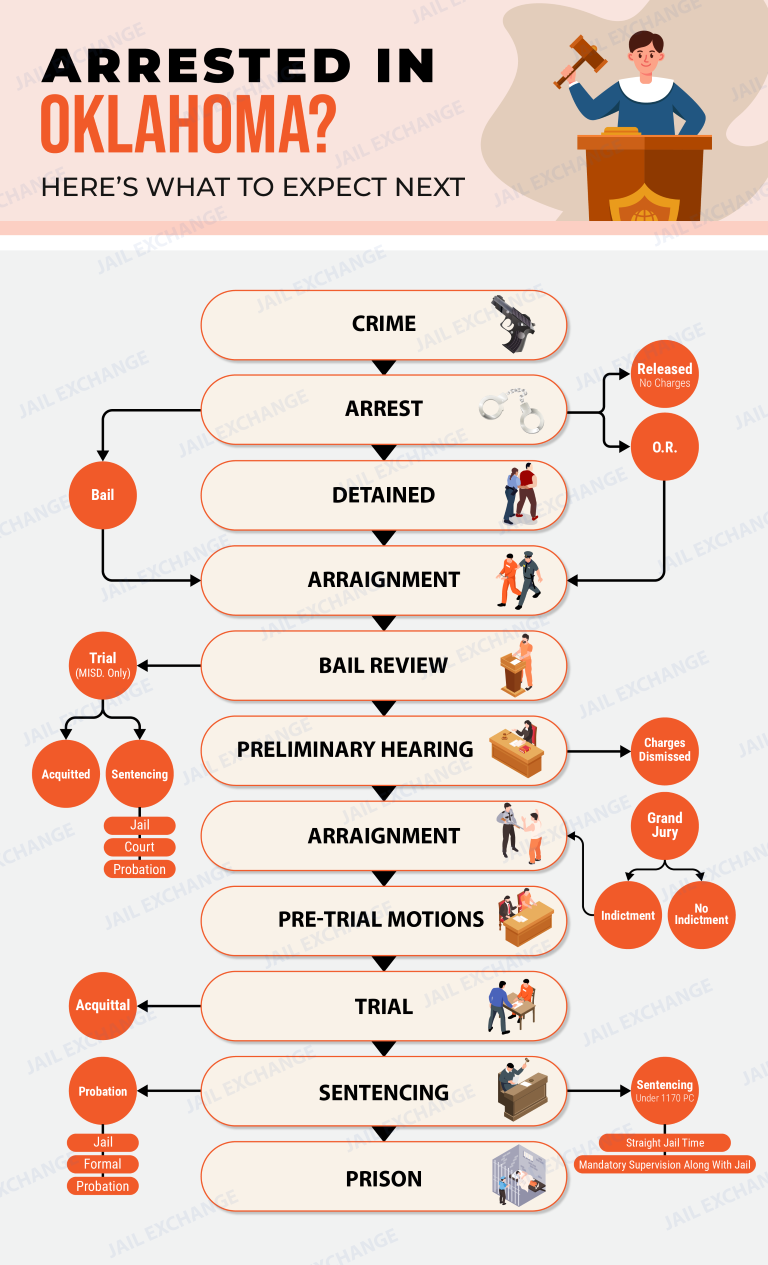
Choctaw County Jail Criminal Court Process
Criminal Court Process for Choctaw County Oklahoma
Choctaw County Criminal Court Guide
Every state charge from this corner of southeast Oklahoma is heard by the District Court at the courthouse, 300 E. Duke, Hugo, OK 74743. A defendant who can't get out waits at the Choctaw County Jail, 305 E Jefferson St., Hugo, OK 74743. This guide maps out the courts, how a case moves, who argues each side and how to keep up with dates.
Peek at the Sheriff's jail roster first to see if the person is still in a cell and which charges were booked. Our Inmates in Custody page answers custody questions. It shows current inmates and fresh bookings, and it explains warrants, charges, mugshots, appointed counsel and how belongings get released.
Dial 580-326-2000, the Sheriff's main line, before anything else. Jot down the case number and next hearing, and ask how to reach the Court Clerk. If your person is still inside, turn to our bail page for bonds and costs.
1. Misdemeanor or felony: who hears the case locally?
The same court takes both. Oklahoma gives each judicial district one District Court, and that court may hear any kind of case at all (Okla. Const. art. VII § 7(a)). Here, Judicial District 17 ties this county to McCurtain and Pushmataha. Its bench mixes district judges with associate district and special judges (Okla. Const. art. VII § 8(a)).
- Felonies can send someone to state prison. A felony jury has twelve members.
- Misdemeanors are lesser crimes. Any jail sentence is spent locally, and six jurors hear a District Court misdemeanor trial.
- Breaking a town or city rule goes to municipal court, whose work is limited to criminal and traffic matters (Okla. Const. art. VII § 1).
When a defendant appeals a conviction, the case moves on to Oklahoma's Court of Criminal Appeals. Every local criminal hearing starts on Duke Street.
↑ Back to the question list2. Where is the Choctaw County Courthouse, and when is it open?
Find it at 300 E. Duke, Hugo, OK 74743. Three offices families deal with sit under that one roof: the Court Clerk, the District Attorney and the local Office of Juvenile Affairs. The clerk's window keeps regular business hours, Monday through Friday.
- Court Clerk: files bonds and other court papers. The Sheriff's Office at 580-326-2000 can give you the clerk's own number.
- District Attorney, District 17: 580-326-9606.
- Juvenile Affairs: 580-326-7112.
Federal cases are tried in Muskogee, at 101 North 5th Street, Room 208, Muskogee, OK 74401, 918-684-7920. Tribal matters go to the Choctaw Nation, whose Judicial Center sits at 2250 Chukka Hina, Durant, OK 74701, 580-920-7027.
↑ Back to the question list3. Do Hugo, Fort Towson and the little towns hold city court?
State law lets a city or town hold a municipal court for its own ordinances, limited to criminal and traffic matters (Okla. Const. art. VII § 1). A state or county charge stays in District Court no matter which officer wrote it.
The county has five incorporated places. Here is who to ask about a local ticket:
- Hugo, the only city: call city offices at 580-326-5616. If its officers wrote the ticket, the police line is 580-326-2550.
- Fort Towson, a town: 112 East Valliant Street, Fort Towson, OK 74735, 580-873-2628, staffed 8:00 am to 4:00 pm.
- Boswell, Sawyer and Soper, all towns: check with the Court Clerk at the courthouse on Duke Street. The Sheriff's Office, 580-326-2000, can connect you.
Two facts help with city cases. If a defendant skips a municipal court date, the judge declares the bond forfeited that same day (11 O.S. § 27-118). A 2026 law, SB 1775, voids any part of a city fine above the legal cap and lowers it to that cap.
↑ Back to the question list4. At the arraignment, what does a family see?
Expect an arraignment, where the charges and bond get reviewed and the judge asks about a lawyer. For a felony, nobody enters a plea at this first District Court arraignment.
- Is the person sitting in some other county's jail? Then the arraignment can be done over video (SB 1711, 2024).
- Speedy trial reviews count from this first appearance. Under SB 325 (2024), a court review is due at 9 months when the person is jailed on this charge alone, or 18 months when the person is free.
- Victims may speak up about release (Okla. Const. art. II § 34).
Courtrooms are open to the public, so family can come and watch. Show up early with the case number in hand, since dockets run long. For the day and time, ask the jail at 580-326-2000.
↑ Back to the question list5. What happens with a DUI, drug or theft misdemeanor?
A misdemeanor is the lower level of crime, and jail time for one is spent locally rather than in prison. State Question 780 made simple drug possession, and theft of property under $1,000, misdemeanors starting July 1, 2017.
- Arraignment: charge read, plea entered.
- Counsel: when a jail sentence is on the table, a court-appointed lawyer is available to those who can't pay, misdemeanor or not. That rule comes from a 2025 ruling by the state's top criminal court, Spybuck v. State.
- Pretrial dates: both sides get ready, and a plea deal may come up.
- Trial or plea: a District Court misdemeanor jury seats six.
- Sentence: fines, probation or county jail time.
DUI repeaters face stricter handling. Starting November 1, 2025, anyone booked on a second or later DUI must wait for a judge to set bail and give written reasons (HB 1222).
↑ Back to the question list6. What are the stages of an Oklahoma felony case?
Felonies are charges serious enough for prison. A typical path in District Court:
- Felony arraignment. Charges and bond are reviewed. Pleas wait.
- Preliminary hearing. Not a trial. Prosecutors must prove three things: that a crime occurred, that there's probable cause pointing to this defendant, and that the crime took place in this county.
- Second arraignment. In District Court, cases that survive the hearing get a plea.
- Trial or plea agreement. Felony juries hold 12 people.
- Sentencing. Judgments now must name the felony class and the minimum time to be served (HB 2105).
A felony committed January 1, 2026 or later falls into one of Oklahoma's new lettered classes, ranked from Y and A1 down through D2 and D3. Lawmakers passed this in HB 1792 and adjusted it with HB 2104 and HB 2105. Older crimes keep the old sentencing rules. The defense lawyer can say which class fits.
↑ Back to the question list7. Why do violent felonies carry tougher rules?
Violent charges get harder treatment at every step. Bail may be refused for them, but a judge needs strong proof and must find that no conditions could keep the public safe (Okla. Const. art. II § 8). A fresh violent charge filed while the person is free on bond in an earlier violent case comes with a presumption of detention (HB 3782).
- 85% crimes. For crimes on this list, no parole review comes before 85% of the sentence is served (21 O.S. § 13.1). The list covers Murder I, Rape I, Robbery I, Burglary I, child abuse, human trafficking and shooting with intent to kill.
- Life on an 85% crime. The math assumes a 45-year term, so parole eligibility arrives at 38 years and 3 months.
- Credits on hold. Time credits earned in the first stretch are not applied until the 85% point.
- Felony classes. Most violent felonies are rated Class Y, A or B. SB 1238 (2026) makes domestic abuse in a child's presence a Class B5 felony.
8. Who prosecutes in Choctaw County, and who is the defense?
Prosecution: District Attorney District 17 brings state charges here, as well as in McCurtain and Pushmataha. The county office is in the courthouse, 300 E. Duke, Hugo, OK 74743, 580-326-9606.
Defense: someone too broke to hire a lawyer may ask the judge for one, and the judge may appoint the Oklahoma Indigent Defense System (OIDS).
- The Court Clerk hands out the application. From jail, ask an officer for one.
- The $40 filing fee belongs to the court fund. Paying it can wait until the case is done.
- A judge may consider bail money when judging need, but bail can't decide it alone.
Contract lawyers do OIDS trial work for District 17: 113 N Central Ave, Idabel, OK 74745, 918-688-8319. OIDS headquarters is 111 N. Peters Ave, Suite 500, Norman, OK 73069, 405-801-2601.
↑ Back to the question list9. How can I look up a Choctaw County case or court date?
For court record searches, the Sheriff's helpful links page lists Oklahoma District Court Records (ODCR). The Oklahoma State Courts Network (OSCN) is another state court search. To use one:
- Choose this county from the list of courts.
- Enter the defendant's name, last name first. A case number is even better.
- Click the matching case for charges, the filing date and upcoming hearings.
- Save that case number. The clerk, the bondsman and the lawyer will all ask for it.
Very new filings may lag a day or more. When nothing shows, phone the Sheriff's Office at 580-326-2000 for the clerk's number, or visit the clerk at 300 E. Duke, Hugo, OK 74743.
↑ Back to the question list10. Has a judge signed a warrant, and what clears it?
Sheriff's deputies serve warrants countywide. Ask about one at 305 E Jefferson St., Hugo, OK 74743, 580-326-2000. Official wanted pages: the Sheriff's Most Wanted, Oklahoma's Attorney General 10 Most Wanted, the DOC Orange Alert page for prison escapes and the federal Marshals 15 Most Wanted. Search filed cases on ODCR. To clear one, line up a lawyer, then walk into the jail together, or ask the Court Clerk at 300 E. Duke, Hugo, OK 74743, about bond or a new date. Deputies never call anyone about warrants.
↑ Back to the question list11. When could a case leave state court for tribal court?
This county sits within the Choctaw Nation's service area. After McGirt v. Oklahoma (July 9, 2020), the Court of Criminal Appeals found that Congress never did away with the Choctaw reservation. So the place of the crime and the person's tribal status can move a case:
- Tribal citizen, crime inside reservation lines: tribal or federal court, usually, rather than District Court.
- Major crimes by a tribal citizen there, like murder: federal court, under the Major Crimes Act.
- When the accused isn't Indian but the victim is: the state and the federal government share the power to prosecute (Oklahoma v. Castro-Huerta, June 29, 2022).
Choctaw Nation courts: Tribal Courthouse, 302 Church Street, Talihina, OK 74571, 918-567-3582, and the Judicial Center, 2250 Chukka Hina, Durant, OK 74701, 580-920-7027. Choctaw Nation police dispatch: 1802 Chukka Hina, Durant, OK 74701, 580-920-1517. Court rulings in this area keep coming, so have a lawyer confirm the right court.
↑ Back to the question list12. How does a federal prosecution unfold from here?
Federal prosecutors bring cases from this area in the U.S. District Court for the Eastern District of Oklahoma. Federal law names Hugo among the towns where that court may hold sessions. Its clerk works in Muskogee, at 101 North 5th Street, Room 208, Muskogee, OK 74401, 918-684-7920.
- Prosecutor: U.S. Attorney's Office, 520 Denison Ave, Muskogee, OK 74401, 918-684-5100.
- Detention hearing: held under 18 U.S.C. 3142, where a judge rules on release before trial.
- Custody: the Marshals Service keeps the defendant, often in a county jail that has a contract with it. Ask its office at 101 North 5th Street, Suite 136, Muskogee, OK 74401, 539-239-5500.
- Defense: Federal Public Defender, 112 North 7th Street, Muskogee, OK 74401, 918-687-2430.
- Once sentenced: use the Federal Bureau of Prisons inmate locator.
13. Will an ICE detainer stall the state charges?
A detainer adds a second hold, but the state charge still has to be dealt with in District Court. Here is the order of events:
- Form I-247A, the federal detainer, goes from ICE to the jail holding the person.
- Once the state case would free them, the jail may hold the person up to 48 hours after they would otherwise be released (8 CFR 287.7(d)).
- ICE's Dallas Field Office, in charge of Oklahoma, then takes custody. It runs an Oklahoma City office at 1220 Sovereign Row, Oklahoma City, OK 73108, 405-219-3199.
- ICE uses Cimarron Correctional Facility for Oklahoma detainees: 3200 S. Kings Hwy., Cushing, OK 74023, 918-225-3336.
- Track them on the ICE Online Detainee Locator.
Oklahoma also passed HB 4156, which made "impermissible occupation" a state crime (21 O.S. § 1795). A federal court blocked the law, and Oklahoma's appeal still awaits a ruling. Before any plea, an immigration lawyer can explain the risk to status.
↑ Back to the question list14. Where is prison time from Choctaw County served?
With a prison sentence, the Oklahoma Department of Corrections (DOC) takes over. Before that handoff, months in the county jail are common. In DOC's estimate, that stretch runs 6 to 9 months past sentencing, though people with short terms may move sooner.
- A DOC custody assessment looks at things like the offense and how long the term is. The score steers the person to a fitting prison.
- Once there, the person's case manager answers family questions.
- Letters to a prison need the person's ODOC number next to their name.
- Look them up with the DOC Offender Lookup. Each prison is profiled on our Oklahoma state prisons page.
The DOC headquarters is at 4345 N. Lincoln Blvd, Oklahoma City, OK 73105, 405-425-2500.
↑ Back to the question list15. How are charges against a minor handled?
Here, youth cases run through District 7 of the Office of Juvenile Affairs (OJA). A youth may be kept at a police station or sheriff's office for up to 6 hours during processing. A detention hearing must follow by the next court day, or by the second court day when there is good cause. Before a petition is filed, detention can last up to five court days.
- Youthful offender: a track for teens aged 15 through 17 facing certain grave crimes, and for first degree murder cases against 13 or 14 year olds.
- Certification: a judge can shift a youth's case into the adult system, and reverse certification undoes that shift.
- Adult jail: brief stays only, kept out of sight and sound of adults (OAC 310:670-5-5).
Who to call: OJA in the courthouse, 300 E. Duke, Hugo, OK 74743, 580-326-7112; the OJA District 7 office, 205 S.W. 2nd Street, Antlers, OK 74523, 580-298-5568; or the local youth services agency, 101 W. Jefferson, Hugo, OK 74743, 580-326-3382.
↑ Back to the question list16. Which rights and services reach Choctaw County crime victims?
Oklahoma's constitution has a Victims Bill of Rights (Okla. Const. art. II § 34). People call it Marsy's Law. It promises victims fair treatment and respect for their safety and privacy. It also gives them a voice at hearings on release, pleas, sentencing and parole, plus restitution and a case that moves without stalling.
- Case notices: the DA's office needs a written request listing the defendant's name, case number and county, and your own mailing address and phone. The office sits at 300 E. Duke, Hugo, OK 74743, 580-326-9606.
- Jail alerts: register with Oklahoma VINE, or call 877-654-8463.
- Help with costs: Oklahoma's Crime Victims Compensation Program can help pay for medical and dental care, counseling, lost wages, crime scene cleanup or a funeral. Phone 800-745-6098.
- Protective orders: when the respondent is in county jail, the order is served first in line, and the first service try must come within 24 hours (SB 623).