
Carter County Jail
Carter County Jail
Jail Phone Number
580-223-6014Carter County Inmate Search: Locating Someone Booked in Ardmore
Whether the arrest happened in Healdton, Lone Grove or out on a county road, adults land in the county jail at 100 South Washington, Ardmore, OK 73401. The Sheriff's Office operates it. Below are the steps for finding someone inside, plus what to know about visits, mail, deposits, lawyers, warrants and transfers.
Open the Sheriff's in-custody search and type the last name. Results show when the person was booked, what they are charged with and a few added notes, sorted with recent bookings first. The Sheriff's page says the list is refreshed every hour.
Next, phone 580-223-6014, the Sheriff's main line, and ask for jail staff. With the full legal name and birthday in hand, staff can share the charges, how much bond is and when the next hearing falls. For release steps, open our bail page. To follow hearings, use our court page.
Read inmate search answers
 Read inmate search answers
1. Using the Sheriff's in-custody search, step by step
Only people held right now appear in the Sheriff's search. To use it:
- Pull up the in-custody search.
- Enter the last name. Common surnames can return a long list.
- Pick out your person using the first name and the booking date.
- Open the listing to read the charges and the added notes.
- Jot down the booking date and charges. Staff can pull up the file quicker with them.
Now and then the page shows a message that the search is being updated. Wait a while and reload, or ring the Sheriff's Office at 580-223-6014. Dispatch picks up 24 hours a day.
↑ Back to the question list2. Why a recent Carter County arrest may not show yet
Most gaps have a simple cause:
- Booking isn't done. Prints, a photo and forms come before the listing appears.
- Already out. Someone paid the bond, or the court released the person.
- Transferred. Another county, the state prison system or the federal government may now hold them.
- Typos and nicknames. Search again with fewer letters, or with a second surname the person also uses.
- Under 18. Teens are held in juvenile detention, so the adult list leaves them out.
Jail staff can settle it fast through 580-223-6014. For a city arrest, Ardmore police Records Division at 580-223-1930 takes questions about the city's arrest reports.
↑ Back to the question list3. Neighboring jails that might hold someone from Carter County
The county keeps its own adult jail on South Washington. Someone caught near a county line, or wanted by a neighbor, could sit in one of these instead:
- Johnston County Jail, 110 N Capital Ave, Tishomingo, OK 73460, 580-371-2691
- Murray County Jail, 700 West 10th Street, Sulphur, OK 73086, 580-622-5106
- Love County Jail, 8339 US-77, Marietta, OK 73448, 580-276-3150
- Marshall County Jail, 207 N. 4th Street, Madill, OK 73446, 580-795-2221
- Garvin County Detention Center, 201 West Grant, Pauls Valley, OK 73075, 405-238-7591
- Stephens County Jail, 245 South 10th, Duncan, OK 73533, 580-255-3131
- Jefferson County Jail, 218 N. Main, Waurika, OK 73573, 580-228-2375
Johnston, Love, Marshall and Murray share the 20th Judicial District with this county, so one court district can touch all five jails.
↑ Back to the question list4. Booking photos and the Carter County roster
Names, booking dates and charges make up the core of each Sheriff's listing. To ask whether a booking photo can be released, call the Sheriff's Office at 580-223-6014 during office hours.
Under the Open Records Act, police agencies open certain arrest records to anyone. That covers an arrested person's name, description and charge, the facts of the arrest and jail booking logs (51 O.S. § 24A.8). Booking photos go unmentioned in that law.
- Booking photos ICE took are released only by request through its ICE records request page.
- Mugshots from federal bookings stay private. A fugitive's photo is the exception, released when the U.S. Marshals Service wants help finding someone.
5. Release and transfer alerts through VINE
A link to VINE, Oklahoma's free custody tracker, sits on the Sheriff's search page. VINE can ring, text or email you when the person leaves, moves, escapes or dies in custody. Signing up takes three steps:
- Search the name on VINELink.
- Confirm the facility and custody status it lists.
- Add the phone number or email that should get notices.
Prefer the phone? VINE answers toll-free at 877-654-8463. A move from a county jail to a DOC prison brings a new ID number, so register again under the new record. For same-day release news, a call to the jail still beats waiting.
↑ Back to the question list6. Bond and release basics after a Carter County arrest
For state charges, bail is a District Court judge's call. Oklahoma's constitution makes bail the rule for most people (Okla. Const. art. II § 8). A person may leave on a signed promise to return, a cash deposit, a licensed bondsman's bond or a pledge of property.
- Repeat DUI arrests stay put until a judge sets bail (HB 1222).
- Since 2025, families can post bond on another Oklahoma town's or county's hold so it lifts too (HB 1991).
- The court clerk turns away bonds with sloppy or unnotarized paperwork.
- Paying state bail does not lift an ICE or federal hold.
Jail staff at 580-223-6014 can quote the amount. Payments, refunds and bondsmen get full treatment on our bail page.
↑ Back to the question list7. Learning the exact charges
Arrest charges show on the in-custody listing. After that, prosecutors decide what to formally file in District Court, and the court record lists those charges in full.
- Check Oklahoma District Court Records by name. A second free search is the Oklahoma State Courts Network, run by the state judiciary.
- The Court Clerk at 580-223-5253 can give the case number.
- Prosecutors for District 20 work in Carter County Annex #1, 107 1st Ave. SW, Ardmore, OK 73401, 580-223-9674.
Oklahoma's records law also opens the reason for an arrest and the arresting officer's name to the public (51 O.S. § 24A.8).
↑ Back to the question list8. Requesting a court-appointed lawyer from jail
Every felony and every misdemeanor that could mean jail comes with a right to counsel. Short on money? The person can request the appointed-counsel application from staff inside the jail. Completed forms go to the Court Clerk, and the judge weighs the person's finances before saying yes or no.
- In this county, the Oklahoma Indigent Defense System assigns cases to contract counsel at 333 W Main St, Suite 475, Ardmore, OK 73401, 580-223-2599.
- Filing carries a $40 Court Fund fee. Payment can be deferred to the final hearing if the judge agrees.
- Phoning the state program will not get a lawyer named. That decision belongs to the local judge.
Some families hire their own lawyer instead. Attorney visits are booked with the jail's administrator; call the Sheriff's Office at 580-223-6014 to set one up.
↑ Back to the question list9. How families book jail visits and video calls
One outside company runs both personal visits and inmate phones for the Sheriff's Office. Every visit is scheduled ahead of time on that company's website:
- Sign up for an account.
- From the facility list, choose the county jail.
- Select the person by name.
- Book an open date and time slot.
Video visits from home are booked on that same site. Oklahoma's jail standards cap visitor numbers and visit length only as security requires, and any minor who visits comes with a parent or legal guardian (OAC 310:670-5-9). Ask the jail what that means for your family. Visiting days, ID and dress rules come from the jail at 580-223-6014. Our visiting guide adds more pointers.
↑ Back to the question list10. Adding money and ordering commissary
Commissary for a loved one is ordered online through the vendor linked on the Sheriff's commissary page. Look the person up by last name there. A separate web deposit button on that site sends money to their account.
- Order cutoff: Sunday, 4:30 p.m.
- Delivery day: Wednesday.
- Cash in an envelope is never safe. Don't mail it.
Limits, fees and any other deposit options can be checked at 580-223-6014. For background, see our inmate money guide and the commissary page on what accounts can buy.
↑ Back to the question list11. Calls home and electronic messages
Under Oklahoma's jail standards, a newly booked person may make no fewer than two local or collect calls once a reasonable time has passed (OAC 310:670-5-1). Families should be ready to accept a collect charge on that early call.
Later calls go through the company that also books visits. On its website, families set up an account and load money onto it, which lets the person phone them. Rates, call length and any messaging or tablet service are questions for the jail at 580-223-6014.
Jail calls are a poor place to talk about the case. Save that for the lawyer. Our phone page and our inmate email page explain more.
↑ Back to the question list12. Mail rules at the county jail
Put the sender's first and last name and full address on every envelope, along with the same details for the person inside. The Sheriff's mail page gives one street address, 100 South Washington, Ardmore, OK 73401. Mail with any of these gets rejected:
- lipstick, lip gloss or scents on anything
- metal clips or stickers of any kind
- blank paper, envelopes or stamps
- printed social media pages, newspaper clippings and comic strips
- graphic or suggestive pictures
Photos are fine on real photo paper up to 4 x 6 inches. Breaking a rule brings a rejection notice. Under state standards, mail volume has no cap, and letters from a court or lawyer get opened only with the person watching (OAC 310:670-5-9). Before sending, confirm the address at 580-223-6014. Our mail guide has more.
↑ Back to the question list13. Personal property held at booking
At booking, staff write up each item the person carried, then lock it away. Release day means checking each item against that list, and the person signs to show it was all returned (OAC 310:670-5-1).
Picking up belongings on behalf of a person still in custody? Phone the Sheriff's Office at 580-223-6014 on a weekday between 9:00 a.m. and 4:00 p.m. Ask if the person must sign something first and what ID to carry to 100 South Washington, Ardmore, OK 73401. Evidence seized by city police is a different matter, handled by the city Property Clerk at 580-221-2570.
↑ Back to the question list14. Medical care and medicine in custody
State rules call for a health screening the moment someone is admitted. Within two days of a proper written request, a licensed nurse, doctor or other medical staff member must see the person, faster in an urgent case (OAC 310:670-5-8). Staff must also explain how sick call works. The law also requires adequate medical care in every jail (74 O.S. § 192).
Worried about a condition or a prescription? Call the jail at 580-223-6014 and give the medication's name, its daily amount and how to reach the prescriber. Emergencies go to 911 first.
Complaints about jail health or safety can be sent to the state inspectors at the Oklahoma State Department of Health Detention Program, 123 Robert S. Kerr Ave., Suite 1702, Oklahoma City, OK 73102, 405-426-8170.
↑ Back to the question list15. Warrant checks in Carter County
District Court warrants are issued by the Court Clerk and served by deputies. Ask about a possible warrant at the Sheriff's Office, 580-223-6014. Official wanted pages include the Sheriff's most wanted list, Oklahoma's Attorney General's 10 Most Wanted, escapes posted under DOC Orange Alert and the national U.S. Marshals 15 Most Wanted. Search court filings on ODCR or OSCN. A lawyer should guide any surrender. Surrender to the issuing court, or ask its clerk how to post bond or reset the hearing. The Court Clerk's office is at the county courthouse, 20 B Street SW, Ardmore, OK 73401, 580-223-5253.
↑ Back to the question list16. Upcoming hearing dates
State cases are heard at the county courthouse, 20 B Street SW, Ardmore, OK 73401. The Court Clerk at 580-223-5253 gives court dates on weekdays from 8:30 a.m. to 4:30 p.m.
- Search by name on ODCR or OSCN.
- City cases go to the municipal court, 23 South Washington St, 1st Floor, Ardmore, OK 73401, 580-223-4436.
Our court page walks a case from arraignment through sentencing.
↑ Back to the question list17. Locating a federal prisoner
A federal arrest here belongs to the Eastern District of Oklahoma, whose clerk sits at 101 North 5th Street, Room 208, Muskogee, OK 74401, 918-684-7920.
- Soon after the arrest, a detention hearing settles whether the defendant can go home before trial (18 U.S.C. 3142).
- Pending trial, the Marshals (the U.S. Marshals Service) decide where a federal defendant sleeps, sometimes in a county jail under contract. Its Muskogee district office, reached at 539-239-5500 can say which jail has your person.
- Some people pass through the Federal Transfer Center, 7410 S. MacArthur Blvd, Oklahoma City, OK 73169, 405-682-4075.
- After sentencing, search the Federal Bureau of Prisons inmate locator by name or register number.
18. Finding someone taken by ICE
For someone booked on South Washington who draws ICE interest, the process tends to run in five steps:
- A detainer on Form I-247A reaches jail staff from ICE.
- The jail may keep the person up to 48 hours after they would otherwise be released (8 CFR 287.7(d)).
- Agents take custody. Oklahoma falls under ICE's Dallas Field Office, and the agency's Oklahoma City office is at 1220 Sovereign Row, Oklahoma City, OK 73108, 405-219-3199.
- A common destination is the Cimarron Correctional Facility, 3200 S. Kings Hwy., Cushing, OK 74023. Its detainee information line, 918-225-3336, runs 8 a.m. to 3 p.m.
- Enter the person's name and country of birth (or A-number) in the ICE Online Detainee Locator.
Oklahoma's state-level crime for unlawful presence (HB 4156, 21 O.S. § 1795) sits frozen under a federal court injunction while Oklahoma's appeal plays out.
↑ Back to the question list19. Tracking someone moved to a DOC prison
Sentenced people often stay months in the county jail before DOC picks them up, usually 6 to 9 months after sentencing by the department's own estimate. DOC first runs an intake review at an assessment and reception center. The custody level set there decides the prison.
- Run the name through the state's DOC Offender Lookup.
- Each facility gets a write-up on our Oklahoma state prisons page.
- The state explains sending money to prisoners and prison visits on its own pages. Letters must carry the person's name and ODOC number.
- DOC headquarters: 4345 N. Lincoln Blvd, Oklahoma City, OK 73105, 405-425-2500.
20. If the person held is a teenager
Teens booked here are sent to juvenile detention, so they never appear on the adult list. Adult jails may keep a youth just six hours, and only for paperwork or a transfer, with no ongoing contact, by sight or sound, with anyone over 18 held there (OAC 310:670-5-5). The state's Office of Juvenile Affairs oversees youth cases from this county.
- A held youth usually sees a judge for a detention hearing by the following court day.
- For grave charges against someone aged 15 to 17, prosecutors may use the Youthful Offender Act.
To learn where a teen was placed, phone the Office of Juvenile Affairs at 405-530-2800 (2501 N. Lincoln Blvd, Suite 500, Oklahoma City, OK 73105), or ask the Sheriff's Office at 580-223-6014.
↑ Back to the question list21. Police agencies across Carter County
The Census Bureau counted about 48,910 residents countywide as of July 1, 2025, with 24,956 inside the county seat. Here are the agencies that patrol and book in the county:
- Sheriff's Office, 100 South Washington, Ardmore, OK 73401, 580-223-6014, dispatch around the clock. Deputies cover rural areas and unincorporated places.
- Ardmore Police Department, 23 S. Washington, Ardmore, OK 73401, 580-223-1212. Records Division 580-223-1930.
- Wilson Police Department, 1065 US Hwy 70A, Wilson, OK 73463, 580-668-2136.
- Lone Grove, Healdton and Dickson police departments. Reach them through the Sheriff's Office line.
- Springer, Gene Autry, Ratliff City and Tatums. Ask the Sheriff's Office which agency answers calls in these towns.
- Oklahoma Highway Patrol, Troop F, based in the county seat, 580-223-8800.
- Chickasaw Nation Lighthorse Police, WinStar precinct, 11051 Vegas Road, Thackerville, OK 73459, 580-436-1166. Its officers serve this county. Under McGirt v. Oklahoma, a tribal citizen's case from the reservation may go to tribal or federal court.
Carter County Bail and Release
Deputies, city officers and state troopers who make an arrest in this corner of south-central Oklahoma bring the person to the county jail at 100 South Washington, Ardmore, OK 73401. The Sheriff's Office runs that jail. The answers below cover the judge's role, Oklahoma's bond types, bondsmen, refunds and the holds that may keep a person inside after the bond is posted.
Start by checking the Sheriff's in-custody list for the last name. Our Jail Roster page then covers custody from every side, from who was arrested lately and which warrants are open to the charges, booking photos, appointed lawyers and property pickup.
Right now, phone the Sheriff's Office at 580-223-6014. Ask staff to connect you with the jail, then find out whether a bail amount exists yet, what it is and which court holds the case. After that, our criminal court page shows what happens next.
1. Which judge decides bail on a Carter County charge?
Bail on a state charge here comes from a District Court judge. This court belongs to the 20th Judicial District, shared with Johnston, Love, Marshall and Murray counties. The judges keep their office on the third floor, Room 304, of the county courthouse at 20 B Street SW, Ardmore, OK 73401, 580-223-3803.
Oklahoma's district courts use three ranks of judge: district, associate district and special (Okla. Const. art. VII § 8). The state constitution promises every county an associate district judge.
The wait for that first look at bail turns on the charge and the day. Some lower charges move fast. Others wait on a judge. A repeat DUI is in that second group. Since November 1, 2025, a sheriff or officer may not free someone arrested on a repeat DUI charge before a judge or magistrate grants bail and gives written reasons for the amount (HB 1222). The Court Clerk can give the hearing date at 580-223-5253 on a weekday.
↑ Back to the question list2. Own recognizance, cash, surety or property?
Oklahoma gives judges a handful of tools. Which one fits depends on the charge and the person's history.
- Own recognizance. Nothing is paid at the window. A signature on the bond stands in for money, backed by a pledge to attend every hearing. State law sets rules for these bonds and for collecting if the person skips court (22 O.S. § 1108.1).
- Cash bond. Someone pays the whole amount in money to an official allowed to accept it. The payer can be the person held or a supporter. Release follows (59 O.S. § 1323).
- Surety bond. For a premium paid by the family, a licensed bondsman guarantees the full amount.
- Property bond. Land or a home is pledged in place of cash. Whoever files it covers the filing fees (59 O.S. § 1331).
- Release on terms. The state's Pretrial Release Act covers bail schedules, ankle monitors and pretrial release programs (22 O.S. § 1105.2, § 1105.3).
To learn if a pretrial program screens people from this court, ask the Court Clerk at 580-223-5253.
↑ Back to the question list3. What will bail cost on everyday local charges?
The amount depends on three things: what the charge is, any earlier record and which judge sets it. Oklahoma law lets courts use a schedule for many smaller offenses (22 O.S. § 1105.2). For a serious felony, a judge picks an amount after reading the case.
Some state rules shape what families see:
- State Question 780 turned plain drug possession into a misdemeanor on July 1, 2017. A lighter charge tends to carry lighter bail.
- That same change made a property crime a felony only at $1,000 or more.
- A repeat DUI arrest rules out a quick bond from the list. A judge must act first.
- A person picked up for unpaid fines or court costs falls under a local rule. Cash posted on that bond goes toward the balance owed (Local Court Rule 5.4).
The figure on your person's charge comes from jail staff, reached through the Sheriff's Office at 580-223-6014. Once a case number exists, the Court Clerk at 580-223-5253 can read it to you as well.
↑ Back to the question list4. Steps for bonding out at 100 South Washington
The jail sits inside the Sheriff's Office, 100 South Washington, Ardmore, OK 73401. Dispatchers work 24 hours a day. Office staff work Monday through Friday, 9:00 a.m. to 4:00 p.m. Go in this order:
- Phone 580-223-6014 and ask for jail staff.
- Spell out the person's name. Then say their birth date.
- Request the bail figure charge by charge. Check too whether a judge has yet to set one.
- Ask which kinds of payment staff will accept today, and whose name a money order must carry.
- Ask if another county, a city or an agency has placed a hold.
- Arrive with photo ID and the right amount, and save the receipt.
Expect some waiting after payment. Staff check the paperwork and hand back the person's property before the door opens.
↑ Back to the question list5. Paying at the Carter County Court Clerk or city court
For District Court cases, the Court Clerk's office handles fines, fees and forfeitures. It is inside the county courthouse at 20 B Street SW, Ardmore, OK 73401, 580-223-5253, open 8:30 a.m. to 4:30 p.m. on weekdays. Before driving over, ask whether the clerk can accept the bond in your person's case, what forms of money it takes and which papers to carry.
A city charge belongs to the municipal court at 23 South Washington St, 1st Floor, Ardmore, OK 73401, 580-223-4436. Its window is open Monday to Thursday, 7:30 a.m. to noon and 1:00 to 5:00 p.m., and Friday 7:30 to 11:00 a.m. The municipal court's page links a portal for paying fines online. That portal is built for tickets, so phone the court about bond for someone sitting in jail.
↑ Back to the question list6. Which money does the jail window accept?
Accepted payments can change from week to week. Phone the jail at 580-223-6014 before you head out. Ask about cash, money orders, cashier's checks and cards, and get the name to write on the payment.
- Carry the exact sum if you are bringing cash.
- Hold on to every receipt, since a refund depends on it.
- A bondsman writes the premium on the bond before filing it and gives you a receipt with its own number (59 O.S. § 1316).
- Cash should never go through the mail, whether to the jail or the court.
7. Hiring a bondsman for a Carter County bond
Every bondsman in Oklahoma answers to the state Insurance Department, which handles licensing and oversight. Nobody may work as a bondsman without qualifying and getting licensed (59 O.S. § 1303). Registration with the local court clerk comes first, before any bond gets written (59 O.S. § 1320).
- The Sheriff's Office warns that the court clerk will reject a bond that is filled out or notarized wrong, and the person can be jailed again.
- That paperwork is the bondsman's duty, not the jail staff's. When a case has already been filed, its number belongs on the bond.
- Jailers and police officers are barred from the bail bond business (59 O.S. § 1315). Soliciting customers where prisoners are held or arraigned can lead to discipline (59 O.S. § 1310).
- The premium is earned only after the person is out and held nowhere. When that never happens, the bondsman returns the premium and collateral right away (59 O.S. § 1327).
Look up a bondsman with the state's bail bondsmen licensee lookup. Problems go to the department's bail bond division at 400 NE 50th Street, Oklahoma City, OK 73105, 405-521-6610, or through its complaint page.
↑ Back to the question list8. Paid bond, but still inside: why?
A bond only reaches the case it was written for. Before paying, have jail staff at 580-223-6014 list every hold. These come up often:
- Another Oklahoma town or county wants them. Since November 1, 2025, someone held on an outside hold may post bond for that place too and get the hold dropped (HB 1991).
- A second or third DUI. Bail waits for a judge's written order (HB 1222).
- Separate city and county cases. The municipal court and District Court each set their own bond.
- Old fines. A warrant for unpaid costs may need its own payment.
- Federal or ICE holds. State bail leaves both in place.
9. No bail at all: which charges allow that?
Under the state constitution, bail is the normal rule. Refusing it is allowed for just five groups of charges (Okla. Const. art. II § 8):
- a capital crime where guilt is plain
- violent crimes
- crimes that can bring a life sentence
- any felony after two or more earlier felony convictions from separate events
- drug charges carrying 10 years or more at the top end
For every item except the capital one, denial also takes strong proof of guilt plus a finding that release terms of any kind would still leave people in danger. Lawmakers widened that list on November 1, 2025, so a felony DUI charge on someone's third or later arrest now qualifies too (SB 981). Someone already out on bond for one violent crime who gets arrested for a second one will usually be held, since the law presumes it (HB 3782). Excessive bail is also off limits (Okla. Const. art. II § 9).
A request to hold someone without bail comes from the District 20 District Attorney's office, Carter County Annex #1, 107 1st Ave. SW, Ardmore, OK 73401, 580-223-9674.
↑ Back to the question list10. Getting a bond amount reduced
A defense lawyer files a written motion asking the judge to cut the bond or change its terms. Since excessive bail breaks the state constitution, the motion can show why the family can't reach the amount (Okla. Const. art. II § 9).
- Line up a lawyer, hired or court-appointed.
- Collect pay stubs, a lease or deed nearby, family ties and an honest budget.
- Propose terms, such as weekly check-ins or an ankle monitor, that answer the judge's safety concerns.
- Know that the alleged victim may speak. Victims may be heard at any hearing on release (Okla. Const. art. II § 34).
The 20th District's local rules let a judge weigh an earlier failure to appear after a summons was served (Local Court Rule 5.3). The Court Clerk at 580-223-5253 can explain how a motion gets set for hearing.
↑ Back to the question list11. Court-appointed lawyers in Carter County
The state's top criminal appeals court has said that anyone facing possible jail, whether the charge is a felony or a misdemeanor, is owed a lawyer (Spybuck v. State, 2025). In this county, the Oklahoma Indigent Defense System pays private lawyers under contract to do that work. Its contract office for Carter, Johnston, Love, Marshall and Murray counties is at 333 W Main St, Suite 475, Ardmore, OK 73401, 580-223-2599.
- Pick up the court-appointed lawyer form from the Court Clerk on B Street and turn it in there. From inside the jail, the person requests one from a detention officer.
- A judge decides who qualifies, using a sheet of income, debts and property. Money for bail may be weighed, but by itself it can't sink the request.
- Filing the form costs $40. The money goes to the Court Fund, and a judge who grants a request can push the due date to the end of the case.
The statewide office is at 111 N. Peters Ave, Suite 500, Norman, OK 73069, 405-801-2601. Staff there can't hand out a lawyer over the phone, since appointments come from the judge.
↑ Back to the question list12. Courthouses for arrests in and around Ardmore
- District Court (felonies and state misdemeanors): county courthouse, 20 B Street SW, Ardmore, OK 73401. Court Clerk 580-223-5253, weekdays 8:30 a.m. to 4:30 p.m. Judges' office in Room 304, 580-223-3803.
- Municipal court (city ordinance and traffic cases within city limits): 23 South Washington St, 1st Floor, Ardmore, OK 73401, 580-223-4436.
- Chickasaw Nation District Court (tribal cases): Judicial Building, 821 N. Mississippi, Ada, OK 74820, 580-235-0281.
- U.S. District Court for the Eastern District of Oklahoma (federal cases): 101 North 5th Street, Room 208, Muskogee, OK 74401, 918-684-7920.
This county sits in the area patrolled by the Chickasaw Nation's police. Since McGirt v. Oklahoma (2020), state appeals rulings have kept the Chickasaw reservation in place. If the accused is a tribal citizen and the crime happened on that land, state court is usually not where it ends up. Tribal or federal court takes it. Under Castro-Huerta (2022), the state may still charge a non-Indian when the victim is an Indian and the crime happened there. Your person's lawyer can sort out which court has the power to hear it.
↑ Back to the question list13. Refund or forfeit: where does posted cash go?
When the case wraps up and no court date was missed, posted cash is paid back. Money on deposit is also refunded when the person is surrendered (59 O.S. § 1328). Bring your receipt and ID, and phone the Court Clerk at 580-223-5253 to learn the refund steps.
Part of it may be kept. A local rule puts an appearance bond posting fee among the costs due at a plea or at sentencing. Anyone who can't pay all at once can fill out a financial form and ask for installments (Local Court Rule 5.5).
Skipping court starts a forfeiture, the legal word for losing the bond (59 O.S. § 1332):
- A warrant for the person's arrest must be issued within ten days.
- Within fifteen days the court files its forfeiture order. The clerk then has thirty days to send notice.
- A bondsman who returns the person inside ninety days gets the forfeiture erased.
- Past that window, the bondsman must deposit the bond's full face value with the court clerk.
14. Picking up a released person's cash and things
Under state jail rules, staff must identify the person with certainty before letting them go. Belongings get matched to the booking inventory, with a signature on file to show they came back (OAC 310:670-5-1).
Before your person walks out, ask about any balance left on their account and anything still in storage. Phone 580-223-6014 during office hours, Monday through Friday from 9:00 a.m. to 4:00 p.m. Ask how leftover money is returned and whether you can collect items for them if they sign a note. Bring photo ID to 100 South Washington, Ardmore, OK 73401. Our guide to inmate accounts covers how deposits and refunds tend to work.
↑ Back to the question list15. Federal arrests and the detention hearing
Any federal case begun here goes before the Eastern District of Oklahoma's federal court. Its clerk's office is at 101 North 5th Street, Room 208, Muskogee, OK 74401, 918-684-7920, open weekdays 8:30 a.m. to 4:30 p.m. Ardmore is also one of the cities where federal law says that court may sit.
- Locked up or free before trial? A federal judge settles that at a detention hearing (18 U.S.C. 3142).
- Before trial, a federal defendant's jailer is the U.S. Marshals Service. Its Muskogee office for the district sits at 101 North 5th Street, Suite 136, Muskogee, OK 74401, 539-239-5500. Call there to learn where your person is held.
- During transfers, federal prisoners may pass through the Federal Transfer Center, 7410 S. MacArthur Blvd, Oklahoma City, OK 73169, 405-682-4075.
- The district's Federal Public Defender works from 112 North 7th Street, Muskogee, OK 74401, 918-687-2430.
- After sentencing, track the person on the Federal Bureau of Prisons inmate locator.
16. Bail and an ICE detainer
A state bond leaves an immigration hold untouched. For someone booked at South Washington, the steps tend to run like this:
- A detainer arrives first. Immigration and Customs Enforcement (ICE) writes it on federal Form I-247A.
- Through that form, agents ask staff to keep the person up to 48 hours after they would otherwise be released (8 CFR 287.7(d)).
- ICE agents pick the person up. The ICE Dallas Field Office covers Oklahoma from 8101 N. Stemmons Frwy, Dallas, TX 75247, 972-367-2200. The agency also has an office at 1220 Sovereign Row, Oklahoma City, OK 73108, 405-219-3199.
- One place detainees may go is the Cimarron Correctional Facility, 3200 S. Kings Hwy., Cushing, OK 74023, detainee information line 918-225-3336.
- Search by full name and country of birth on the ICE Online Detainee Locator.
Oklahoma lawmakers also created a crime under state law for remaining here without legal status (HB 4156, 21 O.S. § 1795). A federal court has blocked that law for now. The state's appeal is still open.
↑ Back to the question list17. After a prison sentence: DOC transfer and lookup
State prison time is served under the Oklahoma Department of Corrections. Sentenced people often wait in the county jail first. By DOC's own estimate, that transfer usually happens 6 to 9 months out. The person then spends time at an assessment and reception center. Staff rate the person's case for a custody level, and that score steers where they are housed.
- The DOC Offender Lookup searches by name or DOC number.
- Details on every prison are on our Oklahoma state prisons page, with notes on every facility.
- DOC headquarters is at 4345 N. Lincoln Blvd, Oklahoma City, OK 73105, 405-425-2500.
Days already spent in jail before sentencing are nearly always credited toward the prison term.
↑ Back to the question list18. Teens arrested in Carter County
Only four counties run their own juvenile bureaus. Here, youth cases go through the state's Office of Juvenile Affairs. A teen is placed in a juvenile detention center instead of the adult lockup. One state jail rule, OAC 310:670-5-5, caps a youth's stay in a jail at six hours, and only to identify, book or move the teen. The teen must be kept out of steady sight and earshot of adult prisoners.
- The Youthful Offender Act reaches teens aged 15 through 17 charged with grave crimes.
- Certification is a second path. With it, a judge sends the youth's case over to adult court.
To find which center took the teen and when court is, phone the Office of Juvenile Affairs, 2501 N. Lincoln Blvd, Suite 500, Oklahoma City, OK 73105, 405-530-2800. For a local arrest, the Sheriff's Office at 580-223-6014 can say where the youth was sent.
↑ Back to the question listCarter County Jail Visitation Schedule
Book a video visit at Carter County Jail
The Carter County Sheriff uses NCIC for personal video visits and inmate phone service. To book, create an NCIC account, choose the Carter County facility, select the person you want to visit and pick an available date and time.
Before making the trip to 100 South Washington Street in Ardmore, check the visit type in NCIC. If you are not sure whether to join online or check in at the jail, call 580-223-6014. Attorneys and other counsel arrange their visits separately with the jail administrator.
Remote Visitation
All Visitation services are provided by City Tele Coin.
To register for a direct pay account (prepaid) call 318-746-1114 or visit online at CityTelecoin website.
After your account has been created you can download the City Tele Coin app from iTunes or Google Play.
To video chat and send emails using the app or the City Tele Coin website, select Carter County Jail to set up a remote account for your inmate.
Carter County Criminal Court Guide
All state criminal charges in this county go before judges at the county courthouse, 20 B Street SW, Ardmore, OK 73401. Anyone held while a case waits sits in the county jail, 100 South Washington, Ardmore, OK 73401. Read on to learn which court takes which charge, how a case moves, who prosecutes and defends, and how to follow it.
To make sure the person is still locked up, search the Sheriff's list of current inmates. Beyond that list, our Inmates in Custody page gathers the custody side in one spot, with recent arrests, warrants still open, filed charges, mugshots, public defenders and reclaiming property.
On a weekday between 8:30 a.m. and 4:30 p.m., phone the Court Clerk at 580-223-5253. Ask for the case number, each charge and the next court date. If getting the person home comes first, our bail page explains how.
1. Misdemeanor or felony: who hears each one?
Oklahoma puts both kinds of state charge in one place, the District Court. The constitution gives that court power over "all justiciable matters," so it takes every felony and every state misdemeanor filed here (Okla. Const. art. VII § 7).
- Misdemeanors are lower-level crimes. Jail time for them is served in the county jail.
- Felonies are the higher-level crimes, the ones that can bring a term in state prison.
- City cases go to a city or town court. By law those courts hear only criminal and traffic cases (Okla. Const. art. VII § 1).
For any felony dated January 1, 2026, or later, the state uses lettered classes. Classes Y and A1 hold the gravest crimes, while D2 and D3 hold the mildest (HB 1792, HB 2104, HB 2105). Each judgment must list the class plus the least time the person must serve.
↑ Back to the question list2. Carter County courthouse address, phones and hours
One building handles the state criminal docket: the county courthouse at 20 B Street SW, Ardmore, OK 73401.
- Court Clerk: 580-223-5253, open 8:30 a.m. to 4:30 p.m., Monday through Friday. The clerk keeps misdemeanor, felony and traffic files, takes fines and fees, issues warrants, accepts protective order petitions and runs jury service, with six jury dockets a year.
- District Court judges: third floor, Room 304, 580-223-3803. The district judge, associate district judge and special judge all work from this office.
The prosecutor works nearby in Carter County Annex #1, 107 1st Ave. SW, Ardmore, OK 73401. The 20th Judicial District's local court rules set many of the day-to-day steps, such as costs, motions and payment plans.
↑ Back to the question list3. Ardmore's municipal court and the smaller towns
Ardmore runs its own municipal court for city ordinance and traffic cases. It is at 23 South Washington St, 1st Floor, Ardmore, OK 73401, 580-223-4436.
- Window hours are Monday to Thursday, 7:30 a.m. to noon and 1:00 to 5:00 p.m., and Friday 7:30 to 11:00 a.m.
- Traffic court meets each Wednesday at 7:30 a.m. in the third-floor Commission Chamber of City Hall, 23 S. Washington, Ardmore, OK 73401.
- Fines can be paid through the portal linked on the municipal court page.
The county's other cities and towns are Dickson, Gene Autry, Healdton, Lone Grove, Ratliff City, Springer, Tatums and Wilson. If the ticket came from one of these places, phone its town hall. You can also reach the Court Clerk at 580-223-5253 to find out which court has the file. Under a 2026 state law, a city fine above the legal cap is void and drops to the lawful amount (SB 1775).
↑ Back to the question list4. The first court date after an arrest
A person held on a state charge first goes before a District Court judge at the courthouse. At this hearing the judge explains the charges, looks at bond and checks on a lawyer. Money troubles? That is the moment to request an appointed lawyer.
- The accused gets a speedy, public trial before a fair jury from the county where the crime happened (Okla. Const. art. II § 20).
- The same section gives the accused the right to be heard in person and through a lawyer.
- Arraignment by video is allowed for a defendant locked up in another county (SB 1711, 2024).
- Speed is reviewed starting at the first appearance. If this case is the only thing keeping someone locked up, review comes at 9 months. For someone out on bond, the mark is 18 months (SB 325, 2024).
The timing of that first hearing varies. Ask the Court Clerk at 580-223-5253 for the date and courtroom.
↑ Back to the question list5. DUI, drug possession or petty theft: the misdemeanor path
Misdemeanor cases here are filed in District Court by the District Attorney's office. Plain drug possession has been a misdemeanor since State Question 780 took effect July 1, 2017. That vote also moved the felony line for property crimes from $500 up to $1,000. So stealing something worth less than that is usually charged as a misdemeanor.
- The case opens with an arraignment. The accused answers the charge there.
- When the answer is not guilty, a trial date is set. Six jurors decide a misdemeanor in District Court.
- After a plea or verdict, the judge sentences. Court costs come due then, and the local rules include an appearance bond posting fee among them (Local Court Rule 5.5).
People who can't pay all at once may fill out the court's financial form to ask for installments. Each August, quiet criminal cases go on a special disposition docket so they don't drift (Local Court Rule 1.9).
↑ Back to the question list6. From charge to verdict in a Carter County felony
A felony moves through more steps, and every one happens in District Court:
- Initial appearance. The judge reads the charge, reviews bond and starts the lawyer process.
- Preliminary hearing. No one is found guilty at this stage. Prosecutors only need to prove a crime happened in this county and show probable cause tying the accused to it.
- Arraignment in District Court. The person is formally told the charges. Most felony motions, other than discovery requests, must be filed by this point (Local Court Rule 5.6).
- Trial. Twelve jurors sit on a felony case.
- Sentencing. On crimes from January 1, 2026, onward, the judgment states the felony class along with the minimum stay before release is possible (HB 2105).
Ranges were written into the new law only for C and D class crimes. Other felonies keep the ranges they had before.
↑ Back to the question list7. Tougher rules for violent and 85% crimes
The most serious charges carry extra rules at almost every stage:
- Bail. Denial is possible on violent charges or charges with a possible life term, after finding strong proof and no safe release terms (Okla. Const. art. II § 8). Someone out on bond in one violent case who picks up another starts with a presumption of no release (HB 3782).
- Crimes on the 85% list. For these, parole can't even be considered until 85% of the sentence is behind bars (21 O.S. § 13.1). Child abuse, armed robbery, first degree burglary, first degree rape and first degree murder are on that list, with many more.
- Life terms. When one of those crimes brings a life sentence, jurors learn parole eligibility starts after 38 years and 3 months.
- Abuse near a child. When domestic abuse happens where a child is present, the charge becomes a Class B5 felony (SB 1238, 2026).
- No release during an appeal. A person convicted of child abuse or intimate partner abuse can't get bail while appealing (HB 1066).
8. District 20 prosecutors and appointed defense
State charges are prosecuted by the District Attorney for District 20, which serves Carter, Johnston, Love, Marshall and Murray counties. The office is in Carter County Annex #1, 107 1st Ave. SW, Ardmore, OK 73401, 580-223-9674. Its Bogus Check Division answers at 580-226-2721.
Too poor to hire a lawyer? Ask the judge to appoint one. The state's appeals court has held that this right covers any charge, felony or misdemeanor, that could bring jail time (Spybuck v. State, 2025). The Oklahoma Indigent Defense System provides those lawyers here through contract counsel at 333 W Main St, Suite 475, Ardmore, OK 73401, 580-223-2599.
- File the application at the Court Clerk's office. From jail, ask staff for the form.
- The judge decides who qualifies. Expect a $40 application fee. The judge can let it wait for the final hearing.
- The statewide office is at 111 N. Peters Ave, Suite 500, Norman, OK 73069, 405-801-2601.
9. Tracking a Carter County case online or by phone
The Court Clerk's own page points people to two free statewide court record searches:
Try both with the person's full name. Once you have a case number, use it, since it gives the cleanest result. Fresh filings can lag behind the arrest by a day or more.
For a firm date, ring the Court Clerk at 580-223-5253 on a weekday from 8:30 a.m. to 4:30 p.m. City tickets are handled by the municipal court at 580-223-4436.
↑ Back to the question list10. Checking for a Carter County warrant and clearing it
District Court warrants come from the Court Clerk's office and are served by sheriff's deputies. For questions about a possible warrant, phone the Sheriff's Office at 580-223-6014. Wanted lists worth a look: U.S. Marshals 15 Most Wanted nationally, escape notices under DOC Orange Alert, Oklahoma's Attorney General's 10 Most Wanted, plus the deputies' own most wanted list. Open cases also show on ODCR and OSCN. Clearing a warrant starts with a lawyer. With that help, turn yourself in where the warrant was issued, or ask that office about bond or a new court date. Clerk's office: county courthouse, 20 B Street SW, Ardmore, OK 73401, 580-223-5253.
↑ Back to the question list11. Federal prosecution from south-central Oklahoma
This county is part of the Eastern District of Oklahoma. The federal clerk's office is at 101 North 5th Street, Room 208, Muskogee, OK 74401, 918-684-7920, weekdays 8:30 a.m. to 4:30 p.m. Federal law lists Ardmore among the places this court may hold sessions.
- Prosecutor: the U.S. Attorney's Office, 520 Denison Ave, Muskogee, OK 74401, 918-684-5100.
- Defense: the Federal Public Defender, 112 North 7th Street, Muskogee, OK 74401, 918-687-2430.
- Detention hearing: held early in the case, it decides release or jail for the months before trial (18 U.S.C. 3142).
- Custody: the U.S. Marshals Service holds people until trial and drives them to each hearing. Find the district office at 101 North 5th Street, Suite 136, Muskogee, OK 74401, 539-239-5500.
- After sentencing: the Federal Bureau of Prisons inmate locator shows the assigned prison.
12. Immigration detainers in the middle of a state case
An immigration hold does not stop the state charge from moving through District Court. The hold shows its force at release time:
- Federal immigration agents send the jail Form I-247A. This request is called a detainer, and it comes from Immigration and Customs Enforcement (ICE).
- Staff may then hold the person up to 48 hours after they would otherwise be released, giving ICE time to collect them (8 CFR 287.7(d)).
- ICE runs its Oklahoma work from the Dallas Field Office, 8101 N. Stemmons Frwy, Dallas, TX 75247, 972-367-2200. The Oklahoma City office is at 1220 Sovereign Row, Oklahoma City, OK 73108, 405-219-3199.
- From there, ICE can house detainees at the Cimarron Correctional Facility, 3200 S. Kings Hwy., Cushing, OK 74023, 918-225-3336.
- Find them through the ICE Online Detainee Locator.
State law has a section on checking the citizenship of people held in jail (22 O.S. § 171.2). A separate state crime for unlawful presence (HB 4156, 21 O.S. § 1795) is blocked by a federal court while Oklahoma's appeal is decided.
↑ Back to the question list13. Serving a state prison term after a Carter County sentence
Once a judge imposes prison time, the Oklahoma Department of Corrections takes over. DOC says the transfer out of the county jail normally comes half a year to nine months after the sentence. Very short sentences tend to get moved up the line. At an assessment and reception center, staff weigh the crime and sentence length to set a custody level.
- Search the person's name in the DOC Offender Lookup.
- Facility profiles sit on our Oklahoma state prisons page.
- DOC asks families to bring questions to the person's case manager. If you don.t know who that is, call the prison itself and request the records officer. Department headquarters is at 4345 N. Lincoln Blvd, Oklahoma City, OK 73105, 405-425-2500.
Time served in jail before sentencing is almost always credited.
↑ Back to the question list14. When the accused is a minor
Juvenile matters from this county go through the state's Office of Juvenile Affairs, because only four large counties operate juvenile bureaus. Detention, when needed, happens in a juvenile center. Inside an adult jail, a youth may stay six hours or less, just for identification, processing or transfer, in a space kept apart from the adult inmates (OAC 310:670-5-5).
- Detention centers screen each youth within two days of intake, ahead of the first detention hearing.
- The Youthful Offender Act covers teens 15, 16 and 17 accused of serious crimes.
- Three paths can move a case: certification to adult court, reverse certification back to juvenile court, and youthful offender status.
- A youth found delinquent is put on probation or placed in state custody.
Parents trying to locate a child, or learn the hearing date, can phone the Office of Juvenile Affairs at 405-530-2800. Its main office is at 2501 N. Lincoln Blvd, Suite 500, Oklahoma City, OK 73105.
↑ Back to the question list15. Rights and help for crime victims
Victims in Oklahoma have rights in the state constitution. People call them Marsy's Law (Okla. Const. art. II § 34). Courts must treat them fairly and guard their safety, dignity and privacy. At a release hearing, a plea or a sentencing, a victim may be heard. They are owed full restitution and a case wrapped up without stalling.
- Notice of court events starts with a letter. Write the District Attorney's office and list the defendant, the county, the case number, where mail reaches you and a phone number.
- The DA's Victim Witness office answers at 580-221-5536.
- Costs such as counseling, medical and dental care, missed pay and funerals may be covered by the state's Crime Victims Compensation Program. Call 405-264-5006.
- Free custody alerts come through VINELink or 877-654-8463.
- Protective order petitions are filed with the Court Clerk. If the person to be served is in county jail, service gets priority, and the law calls for an attempt within one day (SB 623).
16. Tribal land and the Chickasaw Nation court
The county lies within the region served by the Chickasaw Nation's Lighthorse Police. In McGirt v. Oklahoma (2020), the U.S. Supreme Court ruled that the Creek reservation still exists. State appeals rulings then found the same for the Chickasaw reservation. That means a charge against a tribal citizen for a crime on the reservation tends to go to tribal or federal court instead of District Court. Castro-Huerta (2022) added that the state shares power with federal courts over non-Indians charged with harming Indians on that land.
- Chickasaw Nation District Court: Judicial Building, 821 N. Mississippi, Ada, OK 74820, 580-235-0281.
- Lighthorse Police, WinStar precinct: 11051 Vegas Road, Thackerville, OK 73459, 580-436-1166.
Judges keep refining these rules case by case. A defense lawyer can say which court has power over a given case.
↑ Back to the question list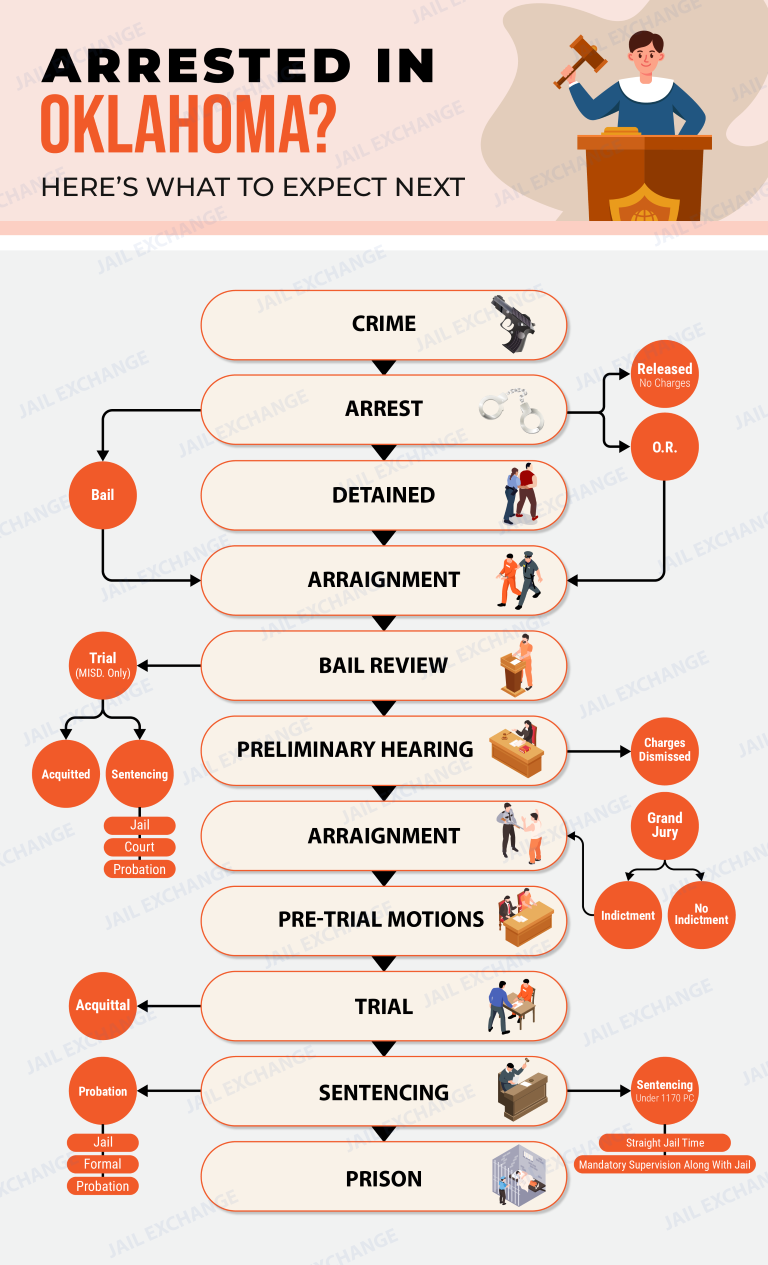

Tiger Commissary provides specialized food service and commissary solutions for county jails and regional detention centers. The online ordering portal allows friends and family members to purchase pre-approved snack boxes, meat and seafood pouches, hygiene items, writing supplies, and clothing packages delivered directly to an incarcerated loved one.
Important: Package Cutoff Deadlines and Spending Limits Vary
Detention centers do not manage care package distribution under identical rules. While some facilities allow weekly web orders, others limit deliveries to bi-weekly or monthly windows, and spending limits vary from jail to jail. You should verify the facility's active cutoff schedule and order allowances by calling them directly. If an order is submitted after the weekly processing deadline, delivery will be held until the following cycle, leaving your loved one waiting an extra cycle for fresh supplies and personal toiletries.
Step-by-Step Instructions to Place a Tiger Commissary Order
- Obtain the inmate's legal first and last name, date of birth, and assigned facility booking ID number.
- Navigate to orders.tigercommissary.com on your computer or mobile device.
- Select your state and detention center from the facility directory.
- Search for the inmate to unlock the jail's approved product catalog and view active ordering balances.
- Select allowable food packs, snack items, personal hygiene products, and apparel up to the facility's order limit.
- Proceed to checkout, enter your debit or credit card billing information, and submit payment.
- Save your digital receipt and confirmation number for tracking purposes.
What the Inmate Needs to Do
The inmate does not need an internet account to receive care packages. Tiger Correctional Services fulfills the order in tamper-evident security packaging and delivers it directly to the jail commissary department. Facility staff inspect the shipment and deliver the items during regular housing unit distribution, where the inmate signs the delivery roster.
Official Provider: Tiger Commissary Official Website
Customer Service Telephone: 1-877-844-3726
Support Hours: Monday – Friday, 8:00 AM – 5:00 PM CST
Supported Languages: English and Spanish
Other Services Provided by Tiger Correctional Services
In addition to Package Ordering, Tiger Correctional Services operates electronic trust and banking solutions:
- Web Deposits & Inmate Trust: Send money directly into an inmate's jail trust account for independent canteen purchases.
• Learn more on our website: Inmate Trust Deposits Guide | • Visit official vendor page: Tiger Web Deposits
Buy Commissary for an Inmate in the Carter County Jail
Carter County Jail Inmate Commissary - Sending Money or Purchasing Commissary for an Inmate
Carter County Jail allows inmates to purchase commissary. Ask the jail what its commissary sells; snacks and hygiene items are common.
You can buy commissary for an inmate using an online service called Tiger Services.

Call the facility at 580-223-6014 to ask whether there is a limit on how much an inmate can spend on commissary.
Tiger Commissary's site shows whether friends and family can order commissary for an inmate at this jail.
Scroll down for information on the Carter County Jail's service they use for you being able to purchase commissary items online and have them shipped directly to the inmate.
You can also go to our Inmate Money page for information on how to send money to an inmate.
Tiger Correctional Web Deposits allow family members to send money directly into an incarcerated person's jail trust and commissary ledger. Deposited funds give your loved one the financial balance required to independently buy food items, hygiene supplies, writing materials, and medical copays from the facility store.
Important: Facility Deposit Rules and Window Intake Vary
Once a person is booked and moved to a housing unit, facilities do not always allow cash drop-offs or phone payments directly to the jail window. Some might and you should confirm this by calling the facility and asking. But if you do not register online and fund your loved one's trust account immediately, they may be forced to wait days or weeks for standard paper processing, leaving them without essential soap, clean undergarments, basic medical sundries or snacks.
Step-by-Step Instructions to Register and Deposit Funds
- Confirm the inmate's legal first and last name, date of birth, and assigned booking or inmate ID number.
- Visit orders.tigercommissary.com on your computer or phone.
- Select Deposit Money or Web Deposits from the service dashboard.
- Select the state and facility where the inmate is currently detained.
- Search for the inmate to confirm their active housing status matches the facility roster.
- Enter your deposit dollar amount and review the calculated transaction and convenience fees.
- Input your debit or credit card billing details, complete payment, and save your digital receipt.
What the Inmate Needs to Do
The inmate does not need an internet account to receive funds. Once the electronic transaction clears, the balance posts directly to their jail trust ledger according to facility accounting schedules. The inmate can review their updated balance at a dayroom pod kiosk or on their weekly trust statement and place orders on their regular commissary day.
Official Provider: Tiger Commissary Official Website
Customer Service Telephone: 1-877-844-3726
Support Hours: Monday – Friday, 8:00 AM – 5:00 PM CST
Supported Languages: English and Spanish
Other Services Provided by Tiger Correctional Services
In addition to Trust Web Deposits, Tiger Correctional Services provides direct care package delivery:
- Tiger Commissary Web Package Ordering: Order pre-approved snack boxes, food packages, and clothing directly to the jail.
• Learn more on our website: Commissary Package Ordering Guide | • Visit official vendor page: Tiger Commissary Packages
Deposit Money into an Inmate's Account
Food, clothing and hygiene items for people at the Carter County Jail in Ardmore come through Tiger Commissary, the company the Sheriff's Office works with, and family money goes there as well.
- Open the Carter County Jail's Tiger Commissary web deposit page.
- Search for the inmate by last name and make the deposit.
Prefer to buy the items yourself? Tiger handles that too. Orders need to be in by Sunday at 4:30 p.m., and they're delivered on Wednesdays. Dropping off commissary items in person isn't allowed.
Whether there is a deposit kiosk, whether money orders are taken, the payee and the address are all things the Sheriff's Office keeps unpublished. For any of them, phone 580-223-6014 with the inmate's full name and date of birth.
Mail for the Carter County Jail in Ardmore is delivered on paper to the sheriff's office on South Washington. The jail wants the first and last name and the full address of both the sender and the inmate on every envelope. Mail that does not follow its rules gets a rejection notice, and the jail administrator answers questions about the policy.
Letters, legal mail and publications:
Inmate's Full Name & Inmate ID #
Carter County Jail
100 South Washington
Ardmore, OK 73401
- Pictures: Real photo paper only, 4 x 6 inches or smaller. Graphic, suggestive or otherwise inappropriate photos are not allowed.
- Printed pages: Social media printouts are refused, and so are newspaper clippings and comic strips.
- On the paper: No lipstick, lip gloss or scents, and no metal pieces or stickers of any kind. Write in blue or black ink, never crayon or marker.
- Supplies: Blank paper, envelopes and stamps cannot be mailed in.
- Greeting cards: Plain, non-musical cards are allowed.
- Books, newspapers and magazines: Only new copies mailed by the publisher, and no hardcovers.
- Who can write: Inmates may not write to other inmates or to people in a rehab facility without approval.
- Money: Families put money on accounts and order commissary online. For money on the account itself, send money online to the Carter County Jail.
The sheriff's inmate search is updated every hour.

NCIC Inmate Communications provides telecommunications services that allow incarcerated individuals to place outbound voice calls from dayroom telephones to family and friends. Because correctional facilities do not permit incoming phone calls, establishing an NCIC prepaid calling account connects calls directly to your cell phone or landline without being blocked by wireless carriers.
Important: Mobile Phones Automatically Block Inmate Calls
Cellular phone carriers automatically reject standard collect calls originating from jail phone systems. While some residential landlines might permit direct monthly billing, mobile devices and internet-based telephone lines require an active prepaid calling balance, which you can verify by checking with your provider. If you do not register online and fund an NCIC account right away, your loved one will receive an automated disconnect announcement when attempting to call your number.
Step-by-Step Instructions to Register and Fund an Account
- Visit account.ncic.com or call NCIC customer care at 1-800-943-2189.
- Click Create Account and register using the primary 10-digit telephone number where you want to receive calls.
- Select the state and correctional facility where your loved one is currently detained.
- Search for and add the inmate using their full legal name or booking ID number.
- Select your deposit dollar amount and enter your debit or credit card billing details.
- Submit payment and ensure your mobile phone settings allow calls from automated or unfamiliar correctional numbers.
What the Inmate Needs to Do
The inmate dials your 10-digit number from any dayroom telephone and keys in their assigned PIN. The automated system verifies that your phone number has an active prepaid balance and prompts you to press a digit to accept the call. All personal telephone conversations are recorded and monitored by facility staff.
Official Provider: NCIC Official Website
Customer Service Telephone: 1-800-943-2189
Support Hours: 24 hours a day, 7 days a week, 365 days a year
Supported Languages: English and Spanish
Other Services Provided by NCIC Inmate Communications
In addition to Prepaid Phone Calling, NCIC provides several other digital communication and visitation services at participating facilities:
- Remote Video Visitation: Schedule and join live face-to-face video visits from home using your computer or smartphone.
• Learn more on our website: Video Visitation Guide | • Visit official vendor page: NCIC Video Visits - Inmate Messaging Services: Send electronic messages and photos directly to an inmate's housing unit terminal.
• Learn more on our website: Inmate Messaging Guide | • Visit official vendor page: NCIC Messaging
NCIC Inmate Messaging allows friends and family members to exchange electronic text messages and digital photos directly with an incarcerated loved one. Messages are delivered electronically to housing unit terminals and tablets within hours, avoiding the lengthy transit times associated with physical postal mail.
Important: Electronic Messaging Screening Rules Differ
Inmates cannot receive incoming phone calls, and traditional postal mail rules differ across correctional agencies. While some facilities still allow regular handwritten letters, many jails have transitioned to digital-only mail scanning or restrict postal delivery, which you can verify by checking facility rules. If you do not register online and purchase messaging credits immediately, your loved one may face lengthy periods without direct written contact from family.
Step-by-Step Instructions to Register and Send Messages
- Go to account.ncic.com and sign in or create a user profile.
- Select Messaging from your dashboard options.
- Select your state and detention center, then search for the inmate using their full legal name or booking ID.
- Purchase a messaging credit bundle using a debit or credit card.
- Type your message in the composition window and attach approved JPEG photos if permitted by the facility.
- Submit your message to the facility's screening queue.
What the Inmate Needs to Do
All electronic correspondence is screened by facility staff before delivery. Once approved, messages appear in the inmate's inbox on their housing unit terminal or tablet. The inmate opens the message, reads your note, and types an electronic reply using their available credits.
Official Provider: NCIC Official Website
Customer Service Telephone: 1-800-943-2189
Support Hours: 24 hours a day, 7 days a week, 365 days a year
Supported Languages: English and Spanish
Other Services Provided by NCIC Inmate Communications
In addition to Inmate Messaging, NCIC provides calling and video visitation services at participating facilities:
- Prepaid Phone Calling Accounts: Fund a calling balance tied directly to your phone number.
• Learn more on our website: Prepaid Calling Accounts Guide | • Visit official vendor page: NCIC Prepaid Calling - Remote Video Visitation: Schedule and join live face-to-face video visits from your computer or smartphone.
• Learn more on our website: Video Visitation Guide | • Visit official vendor page: NCIC Video Visits
NCIC Inmate Communications deploys secure, corrections-grade handheld tablets to incarcerated individuals in county detention centers. Operating on a secure internal wireless network, these devices allow inmates to conduct remote video visits, make voice telephone calls, send electronic messages, stream music, read eBooks, and access self-help and educational resources directly from their housing pods.
Important: Tablet Hardware Deployment and Rental Rules Vary
Detention centers do not manage tablet distribution identically. While some agencies issue individual personal tablets to every detainee at booking, others utilize shared pod docking stations or restrict tablet use to specific dayroom hours, which you should confirm with the facility directly. Although core educational and legal resources are generally provided free of charge, sending messages, listening to music, or making phone calls from the tablet requires an active balance funded by outside contacts.
Step-by-Step Instructions to Support and Fund NCIC Tablets
- Verify that NCIC handheld tablets are active at your loved one's specific detention facility.
- Navigate to account.ncic.com on your computer or mobile device.
- Sign into your verified user account and link the inmate's legal name and booking ID number.
- Select Tablet Media / Messaging or Inmate PIN Debit to add funds to their available balance.
- Specify your deposit dollar amount, review convenience fees, and enter your credit or debit card billing details.
- Submit payment, save your confirmation receipt, and notify your loved one that their device balance is available.
What the Inmate Needs to Do
The inmate unlocks their assigned tablet using their PIN or biometric login. Their available balance appears on the screen, allowing them to download songs, read digital books, write messages, and communicate with approved family members. Devices are returned to charging carts during quiet hours and shift counts for overnight recharging.
Official Provider: NCIC Official Website
Customer Service Telephone: 1-800-943-2189
Support Hours: 24 hours a day, 7 days a week, 365 days a year
Supported Languages: English and Spanish
Other Services Provided by NCIC Inmate Communications
In addition to Tablet Services, NCIC provides several other communication, financial, and visitation options:
- Prepaid Phone Calling Accounts: Prepay for phone calling credits so your loved one can call your telephone directly.
• Learn more on our website: Prepaid Calling Accounts Guide | • Visit official vendor page: NCIC Prepaid Calling - Remote Video Visitation: Schedule and join live face-to-face video visits from your computer or smartphone.
• Learn more on our website: Video Visitation Guide | • Visit official vendor page: NCIC Video Visits - Inmate Messaging Services: Send electronic messages and photos directly to an inmate's terminal or tablet.
• Learn more on our website: Inmate Messaging Guide | • Visit official vendor page: NCIC Messaging - Inmate Trust & Commissary Money Deposits: Send canteen funds directly into an incarcerated person's jail trust account.
• Learn more on our website: Trust Deposits Guide | • Visit official vendor page: NCIC Trust Deposits
Carter County Juvenile Facilities
- Jail (Main): 580-223-6014
- Sheriff: 580-223-6014
The Carter County Jail serves the following cities and towns of Carter County: Ardmore, Burneyville, Dickson, Elmore City, Gene Autry, Healdton, Lone Grove, Ratliff City, Ringling and Wilson.