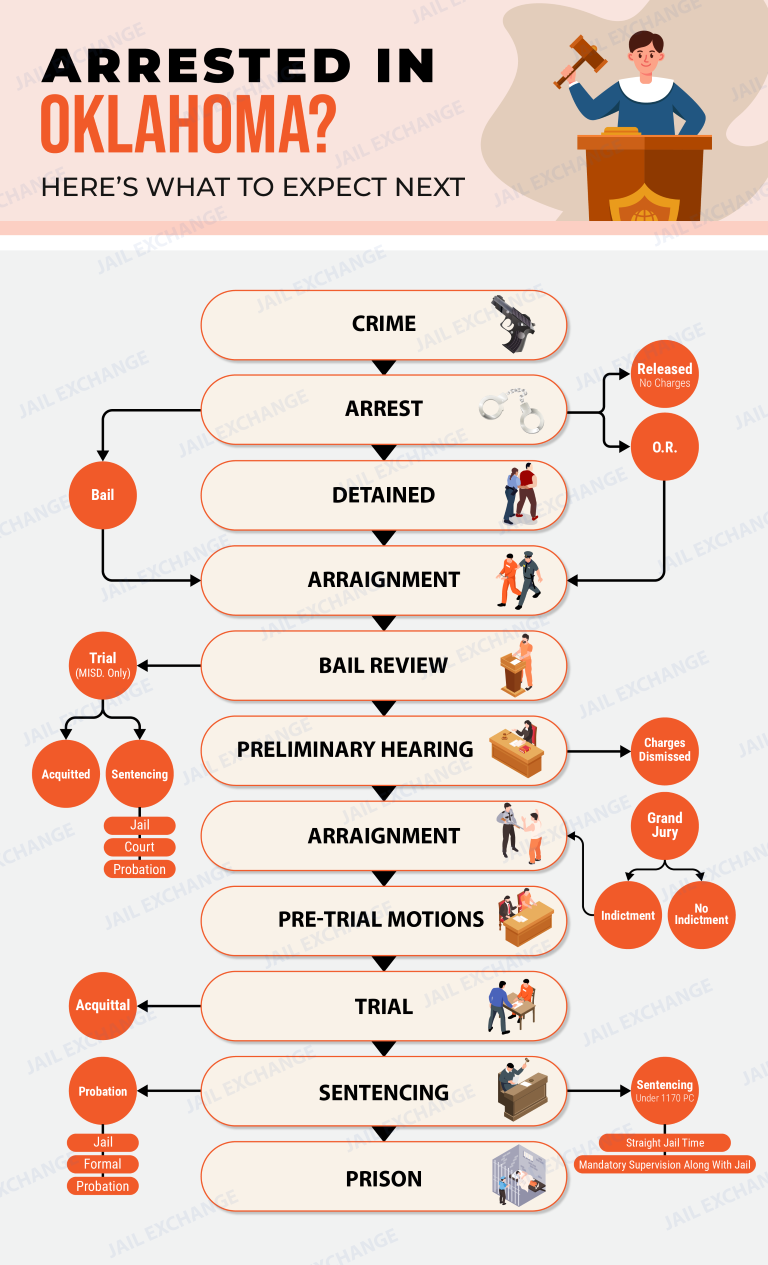
Delaware County Jail Criminal Court Process
Criminal Court Process for Delaware County Oklahoma
Delaware County Criminal Courts and Cases
State criminal charges filed here are heard in District Court at the county courthouse, 327 S. 5th Street, Jay, OK 74346. Adults arrested in the county wait in the Delaware County Jail in the same block. Read on for each local court, the path a charge takes, the lawyers on each side and ways to keep tabs on hearings.
Check custody before anything else. The Sheriff's jail search finds people by name, newest bookings first. For everything tied to an arrest and a stay behind bars, from today's custody list and recent bookings to open warrants, the charges, mugshots, appointed lawyers and property release, turn to our Inmates in Custody page.
Then ring the Court Clerk at 918-253-4420. Get the case number, when the judge will hear it next and which courtroom to find. Still trying to get your person home first? Our bail and bond page covers release.
1. Is a misdemeanor heard in a different court than a felony?
One court handles both. There is just one District Court per judicial district in Oklahoma, and it may take any case (Okla. Const. art. VII § 7). This county is paired with Ottawa County in District 13.
- Felonies are crimes that can mean prison. They are filed in District Court.
- Misdemeanors are lesser crimes punished with county jail time, fines or both. State misdemeanors are filed in District Court too.
- City ordinance cases, like many traffic and public order tickets written by town police, go to a municipal court. Those courts may hear only criminal and traffic matters (Okla. Const. art. VII § 1).
District Court judges come in three ranks. District judges sit at the top, then associate district judges, then special judges (art. VII § 8). Each county is owed at least one associate district judge. A losing side's appeal is heard by the Court of Criminal Appeals.
↑ Back to the question list2. Where is the Delaware County courthouse?
The courthouse holds the District Court, the Court Clerk and the District Attorney's local office.
- Court Clerk: 327 S. 5th Street, Jay, OK 74346, 918-253-4420. Hours are 8:00 a.m. to 4:30 p.m. Mail goes to P.O. Box 407, Jay, OK 74346. The office email is delawareclerk@oscn.net.
- District Judge's office: 918-253-4329. Its mail goes to P.O. Box 489, Jay, OK 74346.
The clerk keeps every case file, takes filings and fees, and can tell you which courtroom and time a hearing is set for. Bring a photo ID when you visit, and give the person's full name or the case number at the counter.
↑ Back to the question list3. Do Grove, Jay and the towns have their own courts?
Several do. Each hears tickets and city ordinance cases from its own police.
- Grove Municipal Court: Council Chambers, 1201 NEO Loop, Grove, OK 74344, 918-786-6107. Court sits Wednesdays at 9 a.m. It hears city ordinance violations, traffic tickets and misdemeanors.
- Jay Municipal Court: 102 N 5th St, Jay, OK 74346, 918-253-4277. The city lists its dates on a court calendar.
- West Siloam Springs Municipal Court: town hall, 4880 Cedar Drive, Colcord, OK 74338, 918-422-5101. The court clerk works weekdays 8 a.m. to 4 p.m.
- Ketchum Municipal Court: Ketchum City Hall, 124 E. Broadway Ave, Ketchum, OK 74349, 918-782-2244. It meets the second Thursday of the month at 5:30 p.m.
For a ticket from Colcord, call Colcord Town Hall, 128 S Colcord Ave, Colcord, OK 74338, 918-326-4200. For Kansas, call Kansas Town Hall, 150 South Cherokee Street, Kansas, OK 74347, 918-868-2198. For Bernice or Oaks, ask the Court Clerk at 918-253-4420 which court has the case.
↑ Back to the question list4. How does the first court appearance usually go?
Someone held in jail is brought before a judge early on. The judge then reads the charge aloud, looks at bond and finds out if a free lawyer is needed. A 2024 law, SB 1711, lets a person jailed in some other county join an arraignment by video.
The state's victim services guide notes one surprise in felony cases: the person doesn't answer guilty or not guilty at the District Court arraignment. That comes later. How soon the first date arrives depends on the court's calendar, so ask the jail at 918-253-4530 or the Court Clerk at 918-253-4420.
- Bring proof of a job or home in case bond comes up.
- Write down the next date before you leave the courtroom.
- Ask for a court-appointed lawyer form if the person can't pay for one.
5. What happens with DUI, drug and theft misdemeanors?
Most misdemeanors follow the same path: charge, first appearance, a plea or a trial, then sentencing. Many end with a plea deal worked out by the lawyers.
- Holding drugs for personal use moved down to a misdemeanor when State Question 780 kicked in on July 1, 2017.
- Property theft under $1,000 is usually a misdemeanor under that same change.
- A first DUI is often a misdemeanor. A second one means a judge must set bail before release (HB 1222).
A misdemeanor jury in District Court has six people. Punishment can include county jail time, fines, probation and court costs. The judge, or a plea deal the judge accepts, sets the exact sentence. A 2024 law, SB 325, adds a speedy trial check. The clock starts at the first appearance: 9 months when this case is the only thing holding the person in jail, 18 months if they are out.
↑ Back to the question list6. Which stages does a felony charge go through?
- Charge. The DA's office puts the felony charge on file.
- First appearance. The judge reviews bond and the right to a lawyer.
- Preliminary hearing. Only a judge listens, and nobody is found guilty at this stage. Prosecutors must persuade the judge of two things: a crime happened inside county lines, and there is good cause to link the person to it.
- Arraignment in District Court. The case is set for trial or plea.
- Plea or trial. Many felonies are settled by a plea. If not, twelve jurors hear the trial.
- Sentencing. The judge sets the term, often after a report.
Oklahoma now sorts felonies into lettered classes for crimes done on January 1, 2026 or later. Class Y and A1 sit at the severe end, and D2 and D3 at the mild end (HB 1792 of 2024, later amended). Every judgment must list the class plus the minimum time behind bars. An older crime is still sentenced under the law in place when it happened.
↑ Back to the question list7. Are violent or serious felonies handled differently?
Yes, in a few big ways:
- Bail. A judge may refuse bail for violent crimes and some others, after a hearing (Okla. Const. art. II § 8).
- Time served. People convicted of listed crimes must serve 85% of a prison term before parole is even considered (21 O.S. § 13.1). Murder in the first degree is on that list, along with armed robbery, rape in the first degree, child abuse, home burglary in the first degree and human trafficking.
- Class. The top three letter groups, Y, A and B, are where violent felonies land.
- Repeat cases. If someone already on bond for a violent case is charged with another violent crime, the law starts from a presumption that they stay in (HB 3782).
SB 1238, passed in 2026, ranks domestic abuse that a child sees as Class B5. At sentencing, judges nearly always subtract the days the person already sat in the county jail.
↑ Back to the question list8. Who prosecutes Delaware County cases, and who defends?
Prosecutor. The elected District Attorney for District 13 (Delaware and Ottawa counties) files state charges. The DA keeps a local office in the courthouse at 327 S. 5th Street, Jay, OK 74346, with mail to P.O. Box 528, Jay, OK 74346, 918-253-4217. City courts use their own city prosecutors.
Defense for people who can't pay. The Oklahoma Indigent Defense System covers this county through a contract defense office, 204 W 4th St, Suite C, Grove, OK 74344, 918-314-3487.
- The judge rules on eligibility after reading the person's sworn form listing income, debts and property.
- That paper goes to the Court Clerk once it is filled in. From jail, ask staff for one.
- Filing costs $40 for the Court Fund. A request to defer it lets the person pay once the case wraps up.
The OIDS main office is at 111 N. Peters Ave, Suite 500, Norman, OK 73069, 405-801-2601.
↑ Back to the question list9. Is there an online case search for court dates?
For this county's court records, the Court Clerk points to Oklahoma District Court Records (ODCR). Pick the county, type the last name and then the first, and open the case to see charges, filings and dates.
- The statewide Oklahoma State Courts Network also has dockets and court rules for many counties.
- Grove, Jay and town court cases are kept by each city. Jay posts a court calendar.
- Can't find it? Call the Court Clerk at 918-253-4420 with the full name and birth date.
Dates can move. Check again the week of the hearing, and keep the case number handy.
↑ Back to the question list10. Warrant worries: how do we check and clear one?
Here, the Sheriff's deputies are the ones who serve court warrants. Call 918-253-2700 to ask if one is out. Four official wanted lists cover this area: the Sheriff's own Most Wanted page for local fugitives, the Attorney General's statewide 10 Most Wanted, prison escapes on DOC's Orange Alert page, and the national 15 Most Wanted run by the U.S. Marshals. Open county cases appear on ODCR, and Grove Municipal Court, 1201 NEO Loop, Grove, OK 74344, 918-786-6107, holds city warrant records. Settling a warrant goes best with a lawyer's help. Surrender at the court whose judge signed it, or phone the Court Clerk, 327 S. 5th Street, Jay, OK 74346, 918-253-4420, to ask about a bond amount or a fresh court date.
↑ Back to the question list11. Which court takes Delaware County federal charges?
Cases under federal law land in the U.S. District Court for the Northern District of Oklahoma, Page Belcher Federal Building, 333 W. 4th Street, Room 411, Tulsa, OK 74103, 918-699-4700.
- Prosecutor: U.S. Attorney's Office, 110 West 7th Street, Suite 300, Tulsa, OK 74119, 918-382-2700.
- Defense: Federal Public Defender, 1 West 3rd Street, Suite 1225, Tulsa, OK 74103, 918-581-7656.
- Detention hearing: a federal judge weighs release or custody under 18 U.S.C. 3142. Pretrial officers work from 333 W. 4th Street, Room 3820, Tulsa, OK 74103, 918-699-4800.
- Custody: the U.S. Marshals Service keeps people held for trial, sometimes in a county jail or at the Federal Transfer Center in Oklahoma City. Call its Tulsa office at 918-200-0600 to ask where.
After a federal prison sentence, the Federal Bureau of Prisons inmate locator shows where the person is held.
↑ Back to the question list12. Can an ICE hold change the state case?
The charge in District Court goes on as normal. An ICE detainer only bites at release time. Step by step:
- The paper ICE uses is Form I-247A, sent straight to the jail. It asks staff to warn ICE before release and to keep the person in custody.
- The jail may hold the person up to 48 hours after they would otherwise be released (8 CFR 287.7(d)).
- ICE takes custody. Oklahoma is under the Dallas Field Office, 8101 N. Stemmons Frwy, Dallas, TX 75247, 972-367-2200. The Oklahoma City office is at 1220 Sovereign Row, Oklahoma City, OK 73108, 405-219-3199.
- Detainees may go to Cimarron Correctional Facility, 3200 S. Kings Hwy., Cushing, OK 74023, 918-225-3336.
- Find them with the ICE Online Detainee Locator.
A plea can change someone's immigration future, so ask the defense lawyer before taking a deal. HB 4156 (21 O.S. § 1795), Oklahoma's state-level immigration crime, sits frozen by a federal injunction while the appeal is decided.
↑ Back to the question list13. After sentencing, where does prison time happen?
Prison sentences go to the Oklahoma Department of Corrections. After the judge rules, the wait for a DOC bed is spent in the jail in Jay. DOC says the transfer normally comes 6 to 9 months later. People with very short sentences may move sooner.
- A DOC assessment and reception center reviews each person and sets a custody level. Then DOC picks a prison.
- Use the DOC Offender Lookup to find their prison.
- Our roundup of Oklahoma state prisons covers each facility.
- For questions after the move, DOC sends families to the person's case manager.
14. What happens when a teen is charged?
Youth cases here are handled with the Office of Juvenile Affairs. Its local district office is at 1431 North Main, Jay, OK 74346, 918-253-8920, open weekdays 8:00 a.m. to 5:00 p.m.
- A police station or the Sheriff's Office can keep a youth no more than 6 hours for processing.
- If the youth stays locked up, a judge holds a detention hearing, most often the next day court is open.
- A youth in detention is held at a juvenile center, not the adult jail.
- Under the Youthful Offender Act, serious crimes by teens 15 through 17 can bring special handling. At 13 or 14, it applies to a charge of murder in the first degree.
- A judge can move a youth's case up to adult court, called certification, or send an adult case back down, called reverse certification.
Ask the OJA office which detention center has the youth and when the next hearing is.
↑ Back to the question list15. What does Marsy's Law give victims in Delaware County?
Victims' rights are written into the Oklahoma Constitution (art. II § 34). People call that section Marsy's Law. Among other things, a victim may:
- Be treated fairly, with care for their safety, dignity and privacy
- Speak up at hearings about release, a plea, sentencing or parole
- Be paid back in full, and on time, for losses from the crime
- Have the case move without needless delay
Want word of each court event? Write the District Attorney's office, P.O. Box 528, Jay, OK 74346. In it, name the accused, list the county and case number, and add where the office can mail you and a number to call. Custody alerts are free through VINELink. Ask the state's Crime Victims Compensation Program, 405-264-5006, about help paying for medical care, counseling, lost pay or a funeral.
↑ Back to the question list16. When does a Cherokee Nation court hear the case?
All or part of the county lies in the Cherokee Nation Reservation. In McGirt v. Oklahoma (2020), the U.S. Supreme Court said state courts generally can't try Indians for crimes in Indian country. The state's criminal appeals court later held that the Cherokee reservation was never ended either.
- Say the accused is a tribal citizen. If the crime happened on the reservation, tribal court is the usual home for the case. Major crimes go to federal court instead.
- Under Oklahoma v. Castro-Huerta (2022), if the accused is not Indian but the victim is, the state can bring charges too.
- Cherokee Nation District Court: P.O. Box 1097, Tahlequah, OK 74465, 918-207-3900.
- Cherokee Nation Justice Services: P.O. Box 948, Tahlequah, OK 74465, 918-453-5610.
Rulings in this area keep coming, so a defense lawyer is the best guide to which court has the case.
↑ Back to the question list