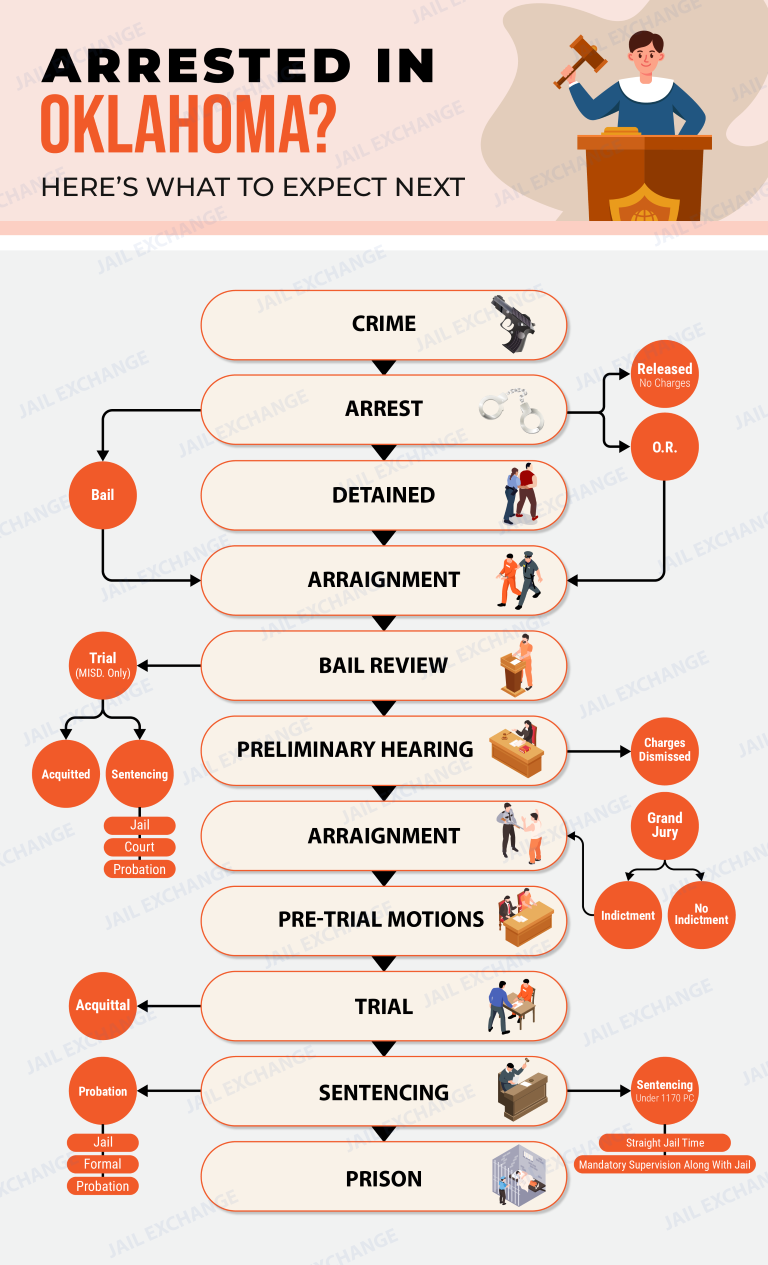
Jackson County Jail Criminal Court Process
Criminal Court Process for Jackson County Oklahoma
Jackson County Criminal Court Guide
Every state criminal charge filed in this county lands before the District Court in the Jackson County Courthouse, 101 N. Main Street, Altus, OK 73521. While a case is open, an arrested adult sits in the Jackson County Jail, 600 S Main St., Altus, OK 73521, unless bond is made. Below you'll find the courts, the path a case follows, lookups and warrant help.
Is your person still in custody? Put their name into the Sheriff's jail search. For the wider custody picture, our Jail Roster page covers locating an inmate, who is booked today, fresh arrests, warrants, mugshots, the charges, property pickup and public defenders.
Begin with one phone call to the Sheriff's Office, 580-482-0408. Find out which court holds the case, its case number and the next hearing on the calendar. If the first hurdle is raising bond money, start with our bail and release page.
1. Do misdemeanors and felonies share one court here?
They do. Oklahoma's Constitution hands the District Court "unlimited original jurisdiction" over all kinds of cases (Okla. Const. art. VII § 7). Locally, the court is part of Judicial District 3, joined with Greer, Harmon, Kiowa and Tillman.
- Misdemeanors are the smaller crimes. Any jail sentence is spent in the county lockup, never a state prison.
- Felonies are the big ones. A conviction can mean years with the Department of Corrections.
- Ordinance violations, like many city traffic tickets, belong to municipal court.
Judges in District Court come in three ranks. Besides district judges, there are associate district judges and special judges. Each of the 77 counties is guaranteed an associate district judge by the Constitution (Okla. Const. art. VII § 8). District and associate judges win their seats in nonpartisan elections.
No tribal reservation recognized under McGirt v. Oklahoma (2020) covers this county, so state charges here are tried in state court.
↑ Back to the question list2. Where is the Jackson County Courthouse?
One building on North Main Street serves all state criminal cases. Judges hold hearings there, juries meet there, and the Court Clerk keeps the files there.
- District Court and Court Clerk: Jackson County Courthouse, 101 N. Main Street, Altus, OK 73521. The clerk's counter keeps normal weekday business hours. To get the clerk on the line, dial the Sheriff's Office at 580-482-0408 and request a transfer.
- District Attorney, county office: 101 N. Main Street, Suite 104, Altus, OK 73521, 580-482-5334. Restitution, DA supervision and similar fees are paid down the hall at Suite 140.
Carry a photo ID and show up ahead of time. A single docket call can list dozens of defendants.
↑ Back to the question list3. Which towns here have a municipal court?
Okla. Const. art. VII § 1 limits a city or town court to cases about breaking that town's own ordinances, such as local traffic tickets and petty offenses.
- Altus Municipal Court: 509 S Main St, Altus, OK 73521, 580-477-1950. Callers reach the city's general switchboard and can ask for the court.
Blair, East Duke, Eldorado, Elmer, Friendship, Headrick, Martha and Olustee are the other incorporated towns. Got a ticket from one of them? Phone that town's office about where it is heard, or ask at the District Court Clerk's window in the courthouse, 101 N. Main Street, Altus, OK 73521.
Charges brought by the District Attorney, such as a felony or a state DUI, are always District Court cases, whichever town the arrest happened in.
↑ Back to the question list4. What happens on the first trip to court?
Expect a quick hearing. In most first appearances:
- The charges are read aloud or explained.
- Bond is set, kept or adjusted, sometimes with release conditions.
- Anyone too broke to hire counsel can request an appointed lawyer.
- The judge schedules the next date.
State law fixes no exact deadline for this hearing, so timing follows the docket. SB 1711, in force since November 2024, allows arraignment by video for a defendant housed in another county's jail.
When a felony is first arraigned in District Court, OSBI notes, the defendant enters no guilty or not guilty plea at that stage. Relatives are welcome to watch from the benches. Dress simply and silence your phone.
↑ Back to the question list5. How do DUI, theft and possession misdemeanors play out?
Lower-level crimes such as a first DUI, petty theft and simple drug possession are misdemeanors. Since July 1, 2017, State Question 780 has treated simple possession that way. SQ 780 also set $1,000 as the point where a property crime becomes a felony.
- Arraignment. The charge is explained and a plea is entered.
- Negotiation. Prosecutor and defense may agree to a plea, a deferred sentence or a dismissal.
- Trial. District Court misdemeanor juries seat six people.
- Sentencing. Possible results include fines, court costs, probation, classes or county jail.
A 2025 ruling, Spybuck v. State, found that a defendant facing possible jail time on a misdemeanor is owed a lawyer. A repeat DUI gets tougher handling from the start, because only a judge may set its bond.
↑ Back to the question list6. How does a Jackson County felony case move?
A felony moves through more stages and takes more time. The usual order:
- Filing. The District Attorney files the charge.
- First arraignment. Bond is set and the charge explained. No plea is entered at this point.
- Preliminary hearing. It is not a trial. Prosecutors need to show probable cause that the accused committed a crime, and that it took place within county lines.
- Second arraignment. Once the case is sent on for trial, the person pleads.
- Plea deal or jury trial. A felony trial uses 12 jurors.
- Sentence. Punishment is handed down by the judge.
A newer system took effect January 1, 2026. Felonies from that date forward get a letter grade, ranging from Y and A1, the harshest, to D2 and D3, the lightest. HB 1792 created it, and HB 2104 and HB 2105 adjusted it. SB 325 adds a speedy trial check. It comes 9 months after first appearance for a defendant held only on that charge, or after 18 months for one out on bond.
↑ Back to the question list7. Are violent felonies treated differently in Oklahoma?
They are, at nearly every stage:
- Release. Violent offenses are on the constitutional list where bail can be refused after a hearing (Okla. Const. art. II § 8). Picking up a new violent charge while bonded out on another starts the defense off against a presumption of detention (HB 3782).
- Time served. Some crimes require 85% of a prison term to be served before any parole review (21 O.S. § 13.1). Murder I, Robbery I, Rape I and Burglary I are on that list, with child abuse and human trafficking.
- Class. Lawmakers grouped violent felonies at the top of the new letter scale, in Y, A and B.
- Abuse with a child present. Since 2026, abusing a partner in a child's presence counts as a Class B5 felony (SB 1238).
DOC reports that county jail days before sentencing are nearly always counted against the prison sentence.
↑ Back to the question list8. Which offices charge and defend criminal cases here?
Prosecution is handled by District Attorney District 3, which covers this county plus four neighbors to the north, west and east. The local office: 101 N. Main Street, Suite 104, Altus, OK 73521, 580-482-5334.
Free defense for those who qualify is the job of the Oklahoma Indigent Defense System (OIDS). Its regional office: 123 W Commerce St, Suite 100, Altus, OK 73521, 580-782-2429. Headquarters: 111 N. Peters Ave, Suite 500, Norman, OK 73069, 405-801-2601.
- Get the application from the Court Clerk. Inside the jail, staff hand it out on request.
- A District Court judge studies the person's earnings, bills and belongings.
- A finding of indigence leads the judge to appoint OIDS.
- Expect a $40 fee payable to the Court Fund. Deferral to the close of the case may be requested.
9. Where can I find a Jackson County case online?
Two free statewide record sites cover Oklahoma courts:
- The free statewide OSCN docket search
- The ODCR site, Oklahoma District Court Records
- Pick this county from the court list.
- Type the surname and given name, or a case number you already have.
- Open the result for the charges, each docket entry and any hearing ahead.
Fresh filings can lag behind by several days. For a hearing date you can rely on, check with the Court Clerk at 101 N. Main Street, Altus, OK 73521. The Sheriff's Office at 580-482-0408 can patch you through to the clerk.
↑ Back to the question list10. Is someone wanted, and how is a warrant settled?
Sheriff's deputies carry out county warrants. Phone 580-482-0408 and ask Records whether one is active. Official wanted lists include the Sheriff's own Most Wanted page, the Attorney General's statewide Oklahoma 10 Most Wanted and, for people sought by federal agents, the U.S. Marshals 15 Most Wanted. Filed cases, including bench warrants, appear on OSCN. A lawyer is the best first call. Then turn yourself in before the court behind the warrant, or ring its clerk to ask about a new date or a bond. The District Court Clerk works in the courthouse, 101 N. Main Street, Altus, OK 73521.
↑ Back to the question list11. How are federal charges from southwest Oklahoma handled?
Federal charges, such as many firearm, drug trafficking or fraud cases, go to federal court, here the Western District of Oklahoma.
- Closest clerk's office: 410 SW 5th Street, Lawton, OK 73501, 580-355-6340. The court warns that Lawton has limited staff, so phone before visiting.
- Main clerk's office: 200 NW 4th Street, Oklahoma City, OK 73102, 405-609-5000, Monday to Friday 8:30 a.m. to 4:30 p.m.
- Federal prosecutors: U.S. Attorney's Office, 210 Park Avenue, Suite 400, Oklahoma City, OK 73102, 405-553-8700.
- Federal defenders: Federal Public Defender, 215 Dean A. McGee Avenue, Oklahoma City, OK 73102, 405-609-5930.
- Pretrial Services in Lawton: 410 SW 5th, Room 101, Lawton, OK 73501, 580-353-0387.
A federal detention hearing settles whether the accused may wait for trial outside a cell (18 U.S.C. 3142). Until then the U.S. Marshals Service, 200 Northwest 4th Street, Room 2022, Oklahoma City, OK 73102, 405-231-4206, has custody. Following sentencing, look up a federal prisoner through the Federal Bureau of Prisons inmate locator.
↑ Back to the question list12. What changes when ICE files a detainer?
The state prosecution goes on even with ICE in the picture. What the detainer changes is release day:
- The jail gets an immigration hold on Form I-247A, asking for continued custody.
- Staff may hold the person up to 48 hours after they would otherwise be released (8 CFR 287.7(d)).
- ICE then arrives to take custody.
- ICE may transfer detainees to the Cimarron Correctional Facility, 3200 S. Kings Hwy., Cushing, OK 74023, 918-225-3336. ICE's Oklahoma City office is 1220 Sovereign Row, Oklahoma City, OK 73108, 405-219-3199.
- Search the ICE Online Detainee Locator by name and country of birth.
For a noncitizen, pleading guilty may bring deportation risks. Get legal advice before entering any plea. Separately, HB 4156 (21 O.S. § 1795) tried to turn presence here without legal status into a state offense. Federal court has blocked that law, and that order stands as the state's appeal moves forward.
↑ Back to the question list13. Where do Oklahoma prison sentences get served?
Prison sentences go to the Oklahoma Department of Corrections (DOC). Until DOC has space, the person waits in the county jail. DOC tells families to plan on roughly 6 to 9 months.
- Intake is handled at a DOC assessment and reception center, which processes new state prisoners.
- A custody form scores the offense, sentence length and other factors.
- That score decides which prison receives the person.
- The DOC Offender Lookup tracks a sentenced person.
- For each DOC site, see our Oklahoma state prisons page.
- DOC wants family questions sent to the person's case manager. Headquarters: 4345 N. Lincoln Blvd, Oklahoma City, OK 73105, 405-425-2500.
14. Do Jackson County teens go to juvenile court?
Charges against a child are usually heard on the juvenile docket of District Court. Local services come through the Office of Juvenile Affairs (OJA) district office, 118 W. Broadway, Suite 101, Altus, OK 73521, 580-482-2085, open 8:00 a.m. to 5:00 p.m. on weekdays.
- A detained youth gets a detention hearing by the following judicial day, or two judicial days when there is good cause.
- Holding a youth while a petition is prepared is capped at five judicial days. Once filed, detention needs a fresh recommendation every 10 days.
- Youth 15 through 17 accused of listed crimes, like armed robbery or Rape I, can face the Youthful Offender Act.
- Certification shifts a youth's case into adult court. The opposite step, reverse certification, puts it back on the juvenile docket.
OJA headquarters: 2501 N. Lincoln Blvd, Suite 500, Oklahoma City, OK 73105, 405-530-2800.
↑ Back to the question list15. What does Marsy's Law promise local crime victims?
Since voters passed Marsy's Law, crime victims have rights written into Okla. Const. art. II § 34. Among them:
- Fair treatment that respects their safety, dignity and privacy
- A voice in any proceeding on release, plea, sentencing or parole
- Full and timely restitution
- A case free of unreasonable delay
Victims who want case notices must ask in writing. Send the letter to the District Attorney's county office, 101 N. Main Street, Suite 104, Altus, OK 73521, 580-482-5334. Put the defendant's name in the letter, along with this county, the case number, your postal address and a phone number.
Oklahoma's Crime Victims Compensation Program can step in on bills for doctors, therapy, missed paychecks or burial, 405-264-5006. Custody alerts are free through VINELink.
↑ Back to the question list