Clatsop County Juvenile Detention Center Criminal Court Process
Criminal Court Process for Clatsop County Oregon
Clatsop County Criminal Court Guide
On this part of the coast, every state crime, from a small misdemeanor to a serious felony, is filed in one circuit court building in Astoria. Adults who stay locked up meanwhile wait at the Clatsop County Jail, 1190 SE 19th St., Warrenton, OR 97146. Below are the city courts as well, each stage from arraignment to sentence, case lookups, warrants and federal charges.
Wondering whether someone is still in custody? Search the Sheriff's online roster. For the wider custody story, our Inmate Lists page covers the arrest itself: who is held now, the newest bookings, open warrants, what someone was booked for, booking photos, appointed defense lawyers and collecting property.
Make your first call to the circuit court's criminal desk at 503-325-8555 (press 3). Get the case number, the exact charge and when the next hearing is. If your person hasn't come home yet, our bail and release page explains the deposit and where it gets paid.
1. Here, where do misdemeanors and felonies get heard?
Both go to the same place. Oregon's trial courts are its circuit courts, 36 of them, sorted into 27 judicial districts (ORS 3.012). This county is a district on its own, the 18th. Its circuit court takes felonies, misdemeanors, violations and youth cases alike.
- Felonies are the gravest crimes. The prison cap for a Class A felony is 20 years. For Class B the cap is 10 years; for Class C it is 5.
- Misdemeanors are lesser crimes. A Class A carries a maximum of 364 days. Class B allows up to 6 months. A Class C conviction allows up to 30 days.
- Violations are fine-only, with no jail.
City courts are a separate world. In Oregon, a municipal court handles city code breaks and some state law cases inside city limits, and it isn't part of the state courts. Cannon Beach's court page, for one, says major misdemeanors, felonies and DUII cases are passed to the District Attorney for circuit court. For the courthouse, call 503-325-8555.
↑ Back to the question list2. When is the Clatsop County courthouse open, and what's inside?
The circuit court works out of the Clatsop County Courthouse, 749 Commercial Street, Astoria, OR 97103. Letters can go to PO Box 835, Astoria, OR 97103. Dial 503-325-8555 and choose a desk from the menu:
- Option 2: violations and tickets
- Option 3: criminal cases (email Criminal.Clatsop@ojd.state.or.us)
- Option 5: docketing, the desk that schedules hearings
- Option 6: family law and the Family Resource Center
- Option 7: juvenile cases
- Option 8: jury service
Service windows open from 8 a.m. to 4 p.m. on weekdays, and phones are picked up until 5 p.m. The court closes for state holidays and for one hour, 4 to 5 p.m., on the first Wednesday of every month. After the windows close, filings can go in the drop box.
Inside are four courtrooms: 100 downstairs, 200 on the main floor, 300 upstairs, and 200B, which runs fully remote. Short hearings with no witnesses usually happen over Webex video, while trials and other evidence hearings mostly happen face to face.
The court also runs treatment courts: an Adult Drug Court, a Mental Health Treatment Court and a Family Treatment Court for parents.
↑ Back to the question list3. Which coast towns hold their own city court?
All five cities do. Each city court handles local citations. Here is where each one meets:
- Astoria Municipal Court, City Hall, third floor, 1095 Duane St., Astoria, OR 97103, 503-325-3939. Sessions are Wednesday evenings at 5:15 p.m. City police citations for parking, animal control and city code end up here.
- Seaside Municipal Court, 989 Broadway, Seaside, OR 97138, 503-738-5511. Court meets Tuesdays at 1 p.m. at City Hall, and the office keeps weekday hours, 8 a.m. to 5 p.m. It covers minor traffic, parking, city ordinances and misdemeanors inside the city.
- Gearhart Municipal Court, Council Chambers, Gearhart City Hall, 698 Pacific Way, Gearhart, OR 97138, 503-738-5501. It meets the first Monday of the month at 2 p.m., and people can join by Zoom. A month with few tickets may be canceled.
- Cannon Beach Municipal Court, PO Box 368, Cannon Beach, OR 97110, 503-436-1581. City Hall stands at 163 E. Gower, Cannon Beach, OR 97110. Court sits the fourth Wednesday at 10 a.m., skipping January, February, November and December. Its docket is tickets for driving, parking and breaking city rules.
- Warrenton Municipal Court handles that city's citations. For its address and court days, ask the circuit court at 503-325-8555.
City court cases don't appear in the state's online case search, so call the city court itself.
↑ Back to the question list4. At the first hearing, what does the judge decide?
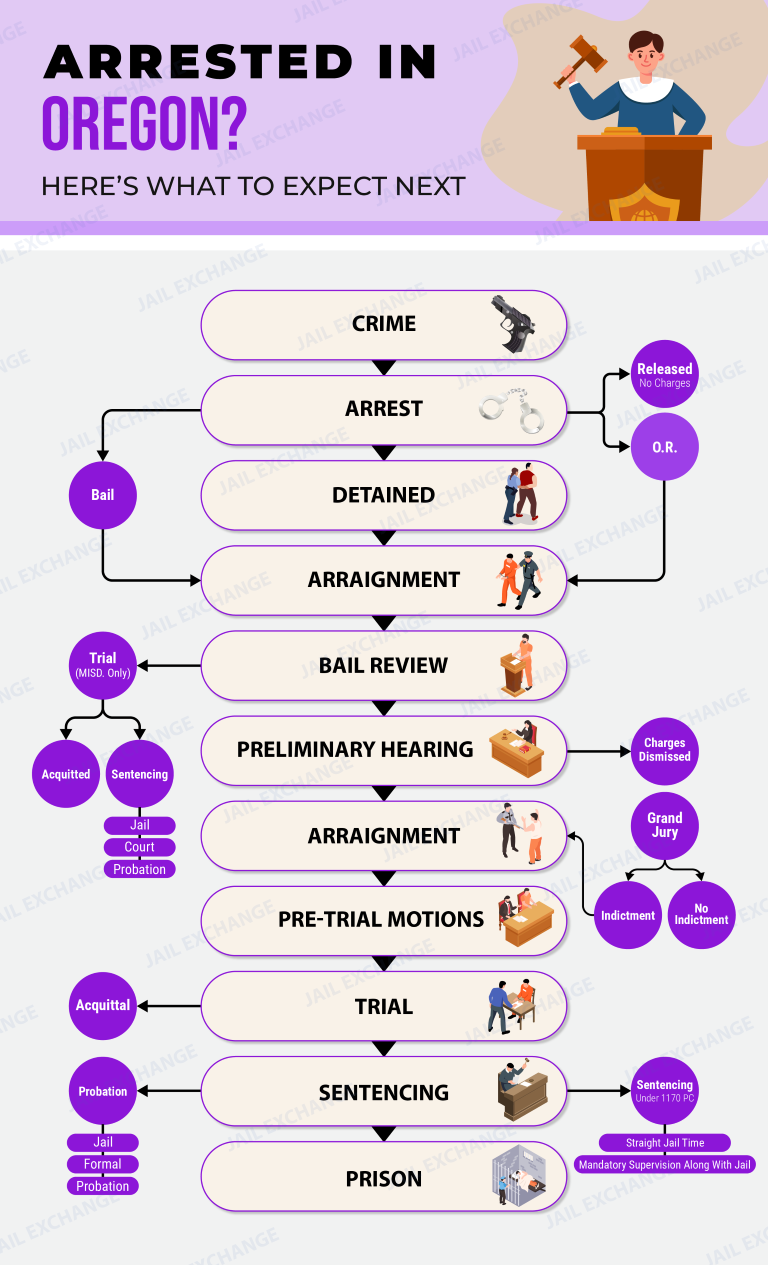
A person held in jail has to be arraigned during their first 36 hours there. The 36-hour clock stops for weekends and holidays (ORS 135.010). Here, in-custody arraignments are generally set for 1:15 p.m. daily, and the person usually takes part over a video link from the jail.
At the hearing, expect the judge to do four things:
- read each charge aloud and take a plea (ORS 135.020);
- explain that counsel is available and, for felonies, that the defense can seek a preliminary hearing (ORS 135.070);
- take up any request for a court-appointed lawyer;
- make the release call, or set a release hearing inside the next 48 hours (ORS 135.245).
Felony defendants have to be there in person, but in a misdemeanor case a lawyer may appear for the client (ORS 135.030). Anyone let out of jail without a court date learns their arraignment day and time from jail staff. If the person stays in custody, a case management conference usually follows about three weeks later.
↑ Back to the question list5. DUII, theft or a drug charge: what is the usual path?
Lots of these cases begin with a ticket, not handcuffs. Officers may write a criminal citation for a misdemeanor (ORS 133.055). The cited person then has a court date, generally inside 30 days (ORS 133.060). A no-show on that date may lead the judge to order an arrest.
- DUII. Under the statewide release rules, a DUII arrest usually means going home with conditions. The court's treatment court page also links a DUII Diversion program.
- Theft. First, second and third degree theft usually fall in the group released on a signed promise to return.
- Drug possession. Since September 1, 2024 (HB 4002), having a small amount is once more against the law. It is an unclassified drug misdemeanor that can bring a jail stay of 180 days at most. Prosecutors usually must offer probation with treatment first. If the person finishes, the charge is dropped.
Local residents charged with drug or alcohol crimes may also petition for Adult Drug Court within 45 days of their first appearance. It is a one-year program, and people charged with person crimes or selling drugs can't join.
The prosecutor may sometimes choose to treat a misdemeanor as a violation, which means a fine with no jail (ORS 161.566). For a court date, call the criminal desk at 503-325-8555.
↑ Back to the question list6. What are the stages of a Clatsop County felony?
Felony charges carry the risk of state prison. In this circuit court, a case usually moves like this:
- Arraignment. A felony defendant has to attend in person.
- Charging. The prosecutor either seeks an indictment from a grand jury or asks a judge to hear it at a preliminary hearing. For someone in jail, that hearing comes within five court days (ORS 135.070). Without probable cause, the judge has to let the person go (ORS 135.175).
- Case management. The lawyers review the evidence, and a plea offer may come up.
- Plea or trial. A jury verdict of guilty must be unanimous, per the 2020 Ramos v. Louisiana decision from the nation's top court.
- Sentencing. Oregon uses a sentencing grid. One side tracks the crime's seriousness, the other the person's record, and the box where they meet suggests a term in months.
The longest possible prison term depends on the class: two decades for A, one decade for B and half a decade for C. To ask where a case stands, phone the criminal desk at 503-325-8555.
↑ Back to the question list7. Why are Measure 11 and violent cases handled differently?
Oregon voters approved Measure 11 in 1994. Under it, serious crimes against people carry a set minimum stay in prison. Time served under it can't be shortened for good behavior. Murder, for one, means 25 years or more. Assault I and Robbery I bring a 90-month minimum.
- Release. These charges almost always mean waiting in jail for a judge. For a violent felony, a judge who finds after a hearing that the person endangers the victim or the public may refuse release (ORS 135.240).
- Contact. Where the charge is a domestic violence, sex or bias crime, contact with the victim is barred. That includes messages sent through family (ORS 135.247).
- Teens. Since SB 1008 (2019), 15 to 17 year olds facing Measure 11 charges begin in juvenile court. A waiver hearing must come before any shift to adult court.
Prosecutors handle these cases at the District Attorney's Office, 800 Exchange Street, Astoria, OR 97103, 503-325-8581.
↑ Back to the question list8. Who files charges in Clatsop County, and who defends?
The District Attorney is an elected post with a four-year term (ORS 8.610). Here, that office files state criminal charges in circuit court. It is at 800 Exchange Street, Astoria, OR 97103, 503-325-8581.
The defense side runs through the Oregon Public Defense Commission (OPDC), the state agency that pays for appointed lawyers. Its business office is at 198 Commercial Street SE, Suite 205, Salem, OR 97301, 503-378-2700.
- The person requests a lawyer at arraignment and answers questions about income, which a court screener checks.
- Expect a $20 fee to apply, unless the court excuses it. The judge may later order a contribution.
- An empty wallet never means going without a defender.
- Lawyers are in short supply. Under a federal order tied to the Betschart case, someone sitting in jail with no lawyer a week past arraignment generally must be released on conditions, while the charges continue.
The criminal desk at 503-325-8555 can tell you which defense lawyer got the case. People hiring their own lawyer can use the Oregon State Bar's referral service at 503-684-3763.
↑ Back to the question list9. Where can I check a case or upcoming hearing online?
There's no charge and no registration for the state courts' lookup, called OJD Records and Calendar Search.
- Go to the circuit court record search.
- Type the person's last and first name. A birth date helps if the name is common.
- Open the case to see party names, filed events and outcomes.
- For upcoming hearings, try the circuit court calendars.
It gives basic case facts but no copies of court papers. Youth cases and city court cases are left out. For the official record, there is a paid service called OJCIN OnLine.
When the site isn't working, use a free public terminal at the courthouse. Clerks can also read you case details over the phone, though they can't give legal advice. Call 503-325-8555 and press 3.
↑ Back to the question list10. Suspect an open warrant? How do you confirm and settle it?
Deputies, city officers and state troopers can all arrest on a warrant. Every county warrant is filed at the jail, which is staffed around the clock. Ask about one through the Sheriff's Office at 503-325-8635, or look the name up in the OJD case search. Fugitive pages for this area include the Oregon DOC Most Wanted (tips 877-831-0389), the Marshals' 15 Most Wanted list and FBI Portland, 9109 NE Cascades Parkway, Portland, OR 97220, 503-224-4181. Before clearing a warrant, call a lawyer. Next, report to the jail at 1190 SE 19th St., Warrenton, OR 97146, or have the court set a new date. The clerk is at 749 Commercial Street, Astoria, OR 97103, 503-325-8555.
↑ Back to the question list11. What is different about a federal prosecution?
When the U.S. government charges someone from the North Coast, the case is heard in the Portland Division of the U.S. District Court for the District of Oregon. The clerk's office is at 1000 Southwest Third Avenue, Suite 740, Portland, OR 97204 (Mark O. Hatfield U.S. Courthouse), 503-326-8000. The building is open 7 a.m. to 5 p.m. on weekdays.
- Prosecutor: the U.S. Attorney's Office, 1000 SW Third Ave, Suite 600, Portland, OR 97204, 503-727-1000.
- Detention hearing: a federal judge rules early on release versus detention before trial (18 U.S.C. 3142). Pretrial Services, 1000 Southwest Third Avenue, Suite 440, Portland, OR 97204, 503-326-8500, reports to the judge.
- Custody: the U.S. Marshals, 1000 Southwest 3rd Avenue, Room 401, Portland, OR 97204, 503-326-2209, hold federal defendants, sometimes at FCI Sheridan, 27072 Ballston Road, Sheridan, OR 97378, 503-843-4442.
- Defense: the Federal Public Defender, 101 SW Main, Suite 1700, Portland, OR 97204, 503-326-2123.
After sentencing, track the person with the Federal Bureau of Prisons inmate locator.
↑ Back to the question list12. Will an ICE hold derail the circuit court case?
An ICE hold doesn't pause or end the charges in circuit court. It runs on a federal track of its own:
- The hold begins with a detainer on Form I-247A that ICE lodges with the jail.
- The paper asks for custody of up to 48 hours after they would otherwise be released (8 CFR 287.7(d)).
- Oregon law then limits what the jail does (ORS 181A.820 to 181A.829, strengthened by HB 3265 in 2021). Unless a judge signed it, an immigration request gives Oregon police and jails no power to act. In practice, Oregon county jails generally turn down ICE detainers that stand alone, and they keep release details from immigration enforcement.
- HB 3265 also bars civil arrests at a courthouse that lack a judge's warrant or order.
- Questions about ICE custody go to its Portland office, 4310 S Macadam Ave, Suite 300, Portland, OR 97239, 503-326-4165, part of the Seattle Field Office.
- To find someone ICE took, use the ICE Online Detainee Locator.
13. Prison sentence: where does the time start?
Shorter sentences can be served at the county jail, which holds sentenced people as well as those awaiting trial. A prison sentence goes to the Oregon Department of Corrections. Coffee Creek Correctional Facility, 24499 SW Grahams Ferry Road, Wilsonville, OR 97070, is the intake stop for each new prisoner, and that process takes around 30 days. After that, men transfer to whichever prison DOC picks, and women remain at Coffee Creek.
- Names can be checked on the Oregon Offender Search.
- Reach DOC's switchboard at 503-945-9090.
- Our Oregon state prisons section describes each prison.
Probation after a sentence is supervised by Community Corrections, part of the Sheriff's Office, at 1190 SE 19th Street, Warrenton, OR 97146, 503-861-2875.
↑ Back to the question list14. What if the accused hasn't turned 18?
Oregon's county juvenile departments serve young people ages 12 to 17. Youth cases go to juvenile court inside the circuit court, and you won't find those files in the online search.
- Juvenile Department: 800 Exchange St., Suite 200, Astoria, OR 97103, 503-325-8601.
- Juvenile court: call 503-325-8555, option 7, or email delinquency.clatsop@ojd.state.or.us.
- Detention: this county rents beds at the Yamhill County Youth Services Center, 535 NE 5th Street, McMinnville, OR 97128, 503-434-7407. The adult jail never houses them.
- State custody: the Oregon Youth Authority runs youth correctional facilities. Boys sent there start at MacLaren Youth Correctional Facility, 2630 N Pacific Highway, Woodburn, OR 97071, 503-981-9531.
Since SB 1008 (2019), a teen of 15 to 17 with a Measure 11 charge stays in juvenile court at first. Before any move to adult court, a judge holds a waiver hearing.
↑ Back to the question list15. Which rights and services protect victims in Clatsop County?
Oregon's Constitution gives crime victims rights, including being present at key hearings, being told about release and getting restitution (Or. Const. art. I § 42 and § 43). Some rights apply on their own. Others start only when the victim asks for them, so speak up early.
- Victim assistance: the District Attorney's victim program, PO Box 149, Astoria, OR 97103, 503-440-7869.
- Release alerts: sign up with VISOR, Oregon's free custody notice service, at 855-691-6246. Registration is confidential.
- Costs: Crime Victims' Compensation (an Oregon Department of Justice program), 1162 Court St. NE, Salem, OR 97301-4096, 800-503-7983. After a violent crime, it may pay toward hospital care, counseling and missed wages, plus up to $5,000 for a funeral. Property losses aren't covered.