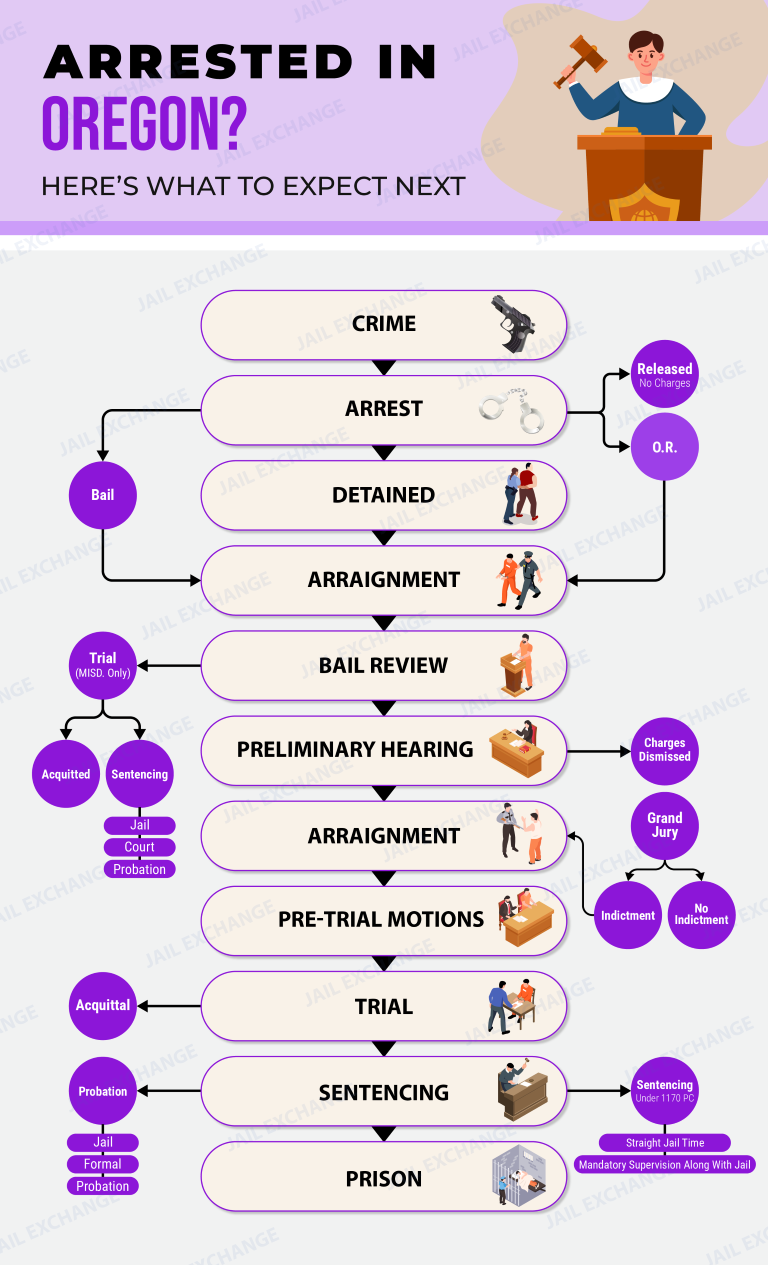
Columbia County Jail Criminal Court Process
Criminal Court Process for Columbia County Oregon
Columbia County Criminal Court Guide
Most criminal charges here end up at the Columbia County Circuit Court, 230 Strand Street, Saint Helens, OR 97051, part of Oregon's 19th Judicial District. While they wait for court, adults are held at the county jail, 901 Port Avenue, Saint Helens, OR 97051. This guide walks through each courthouse, how cases move, penalties, lawyers, warrants and finding a court date.
See who is locked up today on the Sheriff's Inmate Census. Our Recent Arrests page centers on custody: locating someone behind bars, what they are accused of, public defenders, outstanding warrants, getting property back and mugshots.
Weekdays, the circuit court clerk answers at 503-397-2327. Write down the case number, then the date and room of the next hearing. Still waiting on release? Our security and bail page lays out every step.
1. Felony or misdemeanor: which court gets the case?
Oregon's trial courts are called circuit courts. There is one in each of the 36 counties, and they are grouped in 27 districts. Here the county forms the 19th all alone (ORS 3.012). Cases get sorted like this:
- Circuit Court hears every felony and most misdemeanors. It is a state court run by the Oregon Judicial Department.
- Municipal courts in several cities handle city ordinance violations plus certain state offenses committed inside city limits.
- The county Justice Court in Vernonia takes traffic, boating, weighmaster, fish and game and park tickets, plus county and city ordinance citations.
City and justice courts belong to local governments, not the state court system. A violation, such as most traffic tickets, brings a fine but never jail time.
↑ Back to the question list2. Where are Columbia County's criminal courthouses?
Check the paperwork for the court's name before you drive anywhere, since these buildings sit in different towns.
- Circuit Court, 230 Strand Street, Saint Helens, OR 97051, 503-397-2327. The front counter is open Monday to Thursday from 8:30 a.m. to 4:00 p.m., and Friday from 8:30 a.m. to 1:00 p.m. Phones are answered weekdays from 8:30 a.m. to 4:00 p.m. Arraignments for people out of custody, pretrial and settlement conferences and trials all happen in person.
- Justice Court, 1001 Bridge Street, Vernonia, OR 97064, 503-429-2441. Its window is open weekdays from 8:30 a.m. to 4:00 p.m. Its hearings take place in Vernonia, away from the main courthouse.
- Federal court, Portland Division, 1000 SW Third Avenue, Suite 740, Portland, OR 97204, 503-326-8000, open weekdays from 7:00 a.m. to 5:00 p.m.
Pretrial Services works out of the circuit courthouse and can answer release questions at 503-986-6404.
↑ Back to the question list3. St. Helens, Scappoose and more: which cities have courts?
Five cities keep a court for local cases. Call the one on the ticket or charge paper:
- St. Helens Municipal Court, 277 Strand Street, Saint Helens, OR 97051, 503-397-6272
- Scappoose Municipal Court, 33568 E Columbia Avenue, Scappoose, OR 97056, 503-543-7146
- Rainier Municipal Court, 106 West B Street, Rainier, OR 97048, 503-556-4027
- Columbia City Municipal Court, 1840 2nd Street, Columbia City, OR 97018, 503-397-4010
- Clatskanie Municipal Court, 503-728-3011
The state's list shows no city court for Vernonia or Prescott. For a charge from either town, phone the circuit court at 503-397-2327 to learn which court holds it. City courts keep their own files, so ask them directly for dates and fines.
↑ Back to the question list4. What goes on at arraignment day?
If the person is in custody, arraignment must happen within 36 hours, and weekends and holidays are skipped when counting (ORS 135.010). Plenty of these hearings are done on a video screen at the jail. If the person was cited and released, they come to the courthouse.
- The judge reads the charge and asks for a plea (ORS 135.020).
- The judge tells them they may have a lawyer. In a felony case they may also request a preliminary hearing (ORS 135.070).
- Felony defendants must attend themselves, while a lawyer may appear for someone facing a misdemeanor (ORS 135.030).
- The judge makes the release decision now, or within 48 hours (ORS 135.245).
- Anyone who wants a court-appointed lawyer applies at this hearing.
Bring the paperwork you got at release, and get there early to find the courtroom.
↑ Back to the question list5. Shoplifting, DUII, drug possession: how do misdemeanors go?
A misdemeanor case often starts with a citation, a paper ticket that sets a court date, usually within 30 days (ORS 133.060). Others start with an arrest. After arraignment come a pretrial conference, a settlement conference about a plea deal, and a trial if no deal is reached.
Each level has a jail cap under Oregon law:
- Class A misdemeanor: jail cap of 364 days
- Class B misdemeanor: jail cap of half a year
- Class C misdemeanor: jail cap of 30 days
- Violation: fine only, no jail
On September 1, 2024, HB 4002 made drug possession a crime once more. Lawmakers call it an unclassified drug enforcement misdemeanor, and jail time tops out at 180 days. The usual path is treatment plus probation. Many first cases end in a conditional discharge: a year of probation with no plea entered, after which the charge is thrown out if all goes well. On a DUII charge, the court usually sets release conditions.
↑ Back to the question list6. How does a Columbia County felony move toward trial?
Felonies follow a longer road through circuit court:
- Arraignment on a complaint, with the release decision.
- Charging. Grand jurors may hand up an indictment. If they don't, a judge checks the evidence in a probable-cause hearing, which is owed within five judicial days to anyone still jailed (ORS 135.070).
- Pretrial work. Both sides share evidence, argue motions and sometimes settle on a plea.
- Trial. Since Ramos v. Louisiana (2020), a jury can convict only if all its members vote guilty.
- Sentencing. Oregon uses a grid. It weighs the crime's seriousness against the person's past record.
Prison caps: Class C felonies, 5 years; Class B, 10; Class A, 20.
↑ Back to the question list7. Why are Measure 11 cases handled differently?
Measure 11, a 1994 ballot measure, guarantees a minimum prison stay for the worst person crimes, like murder, first-degree assault and first-degree robbery. Good behavior does not shorten those terms. One example: murder brings a minimum of 25 years.
- Release. Measure 11 and other violent charges normally keep the person jailed until a judge rules. Release can be denied for a violent felony after a hearing (ORS 135.240).
- No contact. In a sex offense, bias crime or domestic violence case, the defendant must leave the victim alone. Relatives may not pass messages either (ORS 135.247).
- Younger defendants. Since 2020, teens 15 to 17 are no longer moved to adult court just because the crime is on the Measure 11 list (SB 1008).
Ask the defense lawyer early whether a charge falls under Measure 11, because it changes every choice in the case.
↑ Back to the question list8. Prosecutor and public defense: who handles which side?
Voters in each Oregon county choose a District Attorney every four years (ORS 8.610). The Columbia County District Attorney's Office sits in the Courthouse Annex, 230 Strand Street, Saint Helens, OR 97051, 503-397-0300, open weekdays from 8:30 a.m. to 5:00 p.m.
People who can't afford a lawyer ask for one at arraignment and file an Affidavit of Eligibility. There is usually a $20 fee, and a judge can waive it. Call the court at 503-397-2327 and ask for the Court Verifier if the form is confusing.
- Oregon Public Defense Commission, which oversees appointed lawyers statewide: 503-378-3349
- Columbia County Indigent Defense Corporation: 503-366-1790
- Justice Alliance of Columbia County: 971-813-6245
Lawyers are in short supply in Oregon. Under a federal order called Betschart, a jailed defendant still lacking a lawyer 7 days after the first appearance must, in most cases, go free on conditions while the charges proceed.
↑ Back to the question list9. How can I look up a Columbia County case or court date?
Circuit court cases are searchable free, with no sign-up:
- OJD Records and Calendar Search shows basic case facts, parties and events by name or case number. Court papers themselves are left out.
- Circuit court calendars show hearings coming up soon.
- For the official court register, OJCIN OnLine sells a low-cost subscription.
When the site isn't working, try the free public terminals in the courthouse, or call the clerks at 503-397-2327 for case details by phone. They can't give legal advice. Juvenile records never appear in OJD's public search, and city and justice court cases aren't in it either, so call those courts. Pretrial Services at 503-986-6404 can sign a defendant up for text reminders.
↑ Back to the question list10. Is a warrant out? Checking and clearing it
Sheriff's deputies carry out most county warrants. Call 503-366-4611 and ask for Records/warrants. City officers handle some inside their towns. For state and federal fugitive lists, see the Marshals' 15 Most Wanted list, FBI Portland and the Oregon DOC Most Wanted page (tips 877-831-0389). A name search in OJD Records and Calendar Search can show a case. To clear a missed-court warrant, phone the circuit court at 503-397-2327 for a warrant appearance, held Mondays at 9:00 a.m. Know the case number, plus your legal name and birthday, or let your lawyer set it. The warrant stays active until you appear at 230 Strand Street, Saint Helens, OR 97051.
↑ Back to the question list11. Federal court: what happens after a federal arrest?
The Portland Division of Oregon's federal trial court hears federal crimes from here. It sits at 1000 SW Third Avenue, Suite 740, Portland, OR 97204, 503-326-8000.
- The U.S. Attorney's Office prosecutes, from 1000 SW Third Avenue, Suite 600, Portland, OR 97204, 503-727-1000.
- The Federal Public Defender is at 101 SW Main, Suite 1700, Portland, OR 97204, 503-326-2123.
- A detention hearing settles pretrial custody (18 U.S.C. 3142).
- Before trial, people charged federally are U.S. Marshals Service prisoners, housed in contract jails. The county jail is one of those. The Marshals' district office is at 1000 SW Third Avenue, Room 401, Portland, OR 97204, 503-326-2209.
- After sentencing, track the person with the Federal Bureau of Prisons inmate locator.
12. Immigration detainers and the state case: what happens?
Immigration agents can step in, but the Oregon charge still moves ahead on its own track. A detainer works in these steps:
- Using Form I-247A, ICE requests advance word from the jail before the person leaves.
- Under federal rules the request seeks custody up to 48 hours after they would otherwise be released (8 CFR 287.7(d)).
- Oregon's sanctuary laws (ORS 181A.820 to 181A.829; HB 3265, 2021) say an immigration document carries no weight with local police or jails unless a judge signed it. As a result, local jails generally refuse to hold a person on the detainer alone, and they generally don't share release plans for enforcement.
- Oregon also protects people at court: no civil arrest is allowed in a court facility without a judicial warrant or judicial order.
- ICE's Portland office, part of its Seattle Field Office, is at 4310 S Macadam Avenue, Suite 300, Portland, OR 97239, 503-326-4165. Look up anyone ICE holds with the ICE Online Detainee Locator.
13. If the sentence is prison, where is it served?
Everyone sentenced to state prison first spends about a month at the intake center of Coffee Creek Correctional Facility, 24499 SW Grahams Ferry Road, Wilsonville, OR 97070. When intake is done, men head to a long-term prison. Every woman in Oregon's prison system lives at Coffee Creek, so women remain there.
- Calls and letters reach people in intake, and in-person visits start later. Mail to the Wilsonville address with the person's State ID (SID) number.
- Intake questions: 503-570-2259. Other DOC questions: 503-945-9090.
- Use the state's Oregon Offender Search to find them. Our Oregon prisons page profiles each prison.
Shorter terms and probation stay local. Community Justice, Adult Division, supervises probation and parole from 901 Port Avenue, Saint Helens, OR 97051, 503-397-6253.
↑ Back to the question list14. Teen charged in Columbia County: which court?
When the accused is 12 to 17, the county Juvenile Department takes the referral first. Its staff do intake and choose the next step. The office is in the Historic Courthouse, 230 Strand Street, Saint Helens, OR 97051, 503-397-0275, weekdays from 8:30 a.m. to 5:00 p.m. Call ahead, since staffing gaps can close the office without warning.
- Youth who must be detained go to Cowlitz County Juvenile Detention, 1725 1st Avenue, Longview, WA 98632, 360-577-3101, under a county contract.
- A judge may order county probation, or send the youth to the Oregon Youth Authority, which runs the state's youth facilities.
- Adult court is possible for 15 to 17 year olds only after a waiver hearing (SB 1008).
- OJD's online search leaves juvenile cases out, so call the Juvenile Department for hearing dates.
15. Help and rights for crime victims in Columbia County
Victims hold rights under the state constitution (Or. Const. art. I § 42 and art. I § 43). A few apply with no request, like speaking up when release terms are set or a sentence is handed down. Others, like getting word before hearings or a release, switch on only by request.
- The District Attorney's Victim Assistance Program can explain each step: 503-366-3914.
- Register with VISOR to get a call, text or email when the person is released or moved, 855-691-6246. You can stay anonymous.
- Victims of violent crime can apply to a state fund, Crime Victims' Compensation, run by the Oregon DOJ. It covers costs such as hospital care, counseling, lost wages and funerals: 800-503-7983.
Victims also have a right to restitution from the person convicted.
↑ Back to the question list16. Does the circuit court offer treatment courts?
Yes. Treatment courts pair close court check-ins with treatment and testing. The circuit court runs four programs, and each one requires living in the county:
- Adult Treatment Court: for drug or alcohol addiction, ages 18 and up, with a suspended prison sentence at entry.
- Behavioral Health Court for people with a diagnosed mental illness and a new felony or a felony probation or parole violation. Misdemeanors are looked at one case at a time.
- Veterans Treatment Court for people who served in the military.
- Family Treatment Court for parents whose children are in state care.
The court posts a referral packet for each program. Talk it over with the defense lawyer, or ask the clerk at 503-397-2327 where to find the packet.
↑ Back to the question list