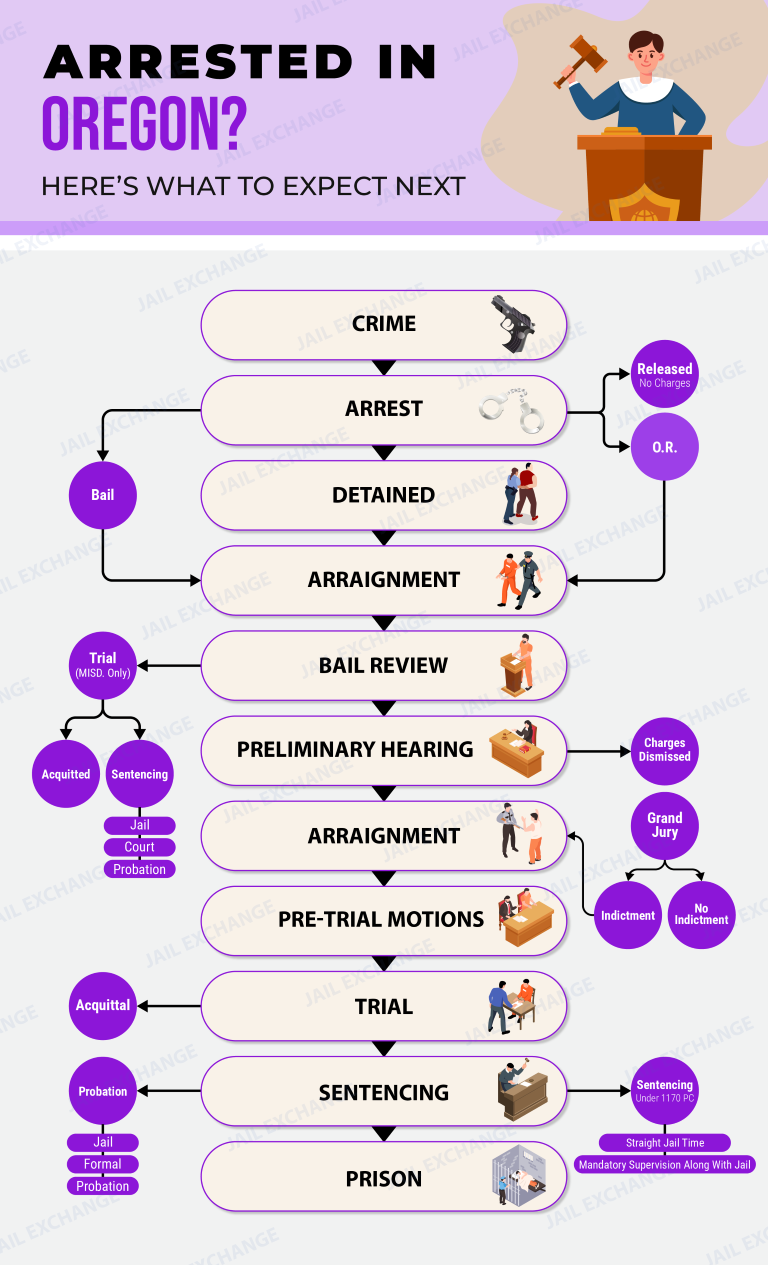
Marion County Jail Criminal Court Process
Criminal Court Process for Marion County Oregon
Marion County Criminal Court Guide
Criminal cases here go to two circuit court buildings: the courthouse at 100 High Street NE, Salem, OR 97301, or the Criminal Court Annex, 4000 Aumsville Highway SE, Salem, OR 97317. The Annex sits on the same campus as the county jail, where adults wait for court. Next door, the 144-bed Transition Center, 3950 Aumsville Hwy SE, Salem, OR 97317, houses sentenced people on work release and people who broke probation or parole terms. This guide shows which court takes a charge, each step to sentencing, and whom to call.
First, check the Sheriff's Web Jail Viewer. It shows each booking charge and where the person is housed. For the arrest and the days inside, open our Inmates in Custody page. It handles today's bookings, warrant checks, plain-English charges, mugshots, a court-appointed lawyer and returned property.
On a weekday, ring the Criminal Department at 503-588-8489 between 8:00 a.m. and 5:00 p.m. Write down three things they tell you: the case number, the next court day, and the courtroom. If you are hoping to bring the person home first, our security and release page explains the deposit.
1. Which court handles misdemeanors, and which handles felonies?
The state circuit court, sitting as the Third Judicial District, takes every felony from the county and most misdemeanors. Statewide, 36 circuit courts sit in 27 districts; here, one county makes up the whole district (ORS 3.012). Smaller courts take some lighter cases:
- Justice Court, run by the county, hears some misdemeanors and many violations. It is at 4660 Portland Road NE, Suite 107, Salem, OR 97305, 503-576-7200.
- City (municipal) courts take local ordinance tickets plus certain state charges that town police file.
How serious a charge is decides the penalty. These are the top limits, and most sentences are far lower:
- Felony prison caps: a Class A conviction can mean 20 years, Class B half that, and Class C a quarter.
- Misdemeanor maximums: 364 days for Class A, 6 months for Class B, 30 days for Class C.
- Violations: money penalties, never a jail sentence.
2. Where are the Marion County courthouses?
All circuit court offices keep weekday hours, 8:00 a.m. to 5:00 p.m., and close on legal holidays. Mail for every location goes to P.O. Box 12869, Salem, OR 97309.
- Marion County Courthouse (main): 100 High Street NE, Salem, OR 97301, 503-588-5105. Treatment courts meet here, and the Sheriff's Records Unit is in the basement.
- Criminal Court Annex: 4000 Aumsville Highway SE, Salem, OR 97317, Criminal Department 503-588-8489. It shares the jail's address.
- Juvenile Court: 2970 Center Street NE, Salem, OR 97301, 503-566-2974.
- Justice Court: 4660 Portland Road NE, Suite 107, Salem, OR 97305, 503-576-7200.
Court Administration can help with general questions at 503-584-4714. Two treatment courts meet in the main courthouse: Adult Drug Court on Friday mornings in Courtroom 2B, and Veterans Treatment Court on the first, second and fourth Thursdays in Courtroom 1A. Both answer at 503-584-7741. A Mental Health Court also meets on those Thursdays in Courtroom 4C.
↑ Back to the question list3. Do Keizer, Salem and other towns have city courts?
A citation from city police goes to that city's municipal court. These courts are run by the cities, and OJD's online case search leaves them out, so call them directly.
- Salem Municipal Court: 2850 Broadway Street NE, Salem, OR 97303, 503-588-6146. The lobby is open weekdays 7:30 a.m. to 5:00 p.m., and the court takes some criminal misdemeanor cases.
- Woodburn Municipal Court: at City Hall, 270 Montgomery Street, Woodburn, OR 97071, 503-982-5222. Court sits on the first four Tuesdays of each month.
- Keizer Municipal Court: 930 Chemawa Road NE, Keizer, OR 97303, 503-390-3700.
In these towns, call the number shown to ask whether city court meets there, and when: Aumsville 503-749-2188, Aurora 503-678-1283, Detroit 503-854-3496, Gates 503-897-2669, Gervais 503-792-4900, Hubbard 503-981-9633, Jefferson 541-327-2768, Mill City 503-897-2302, Mount Angel 503-845-9291, Silverton 503-873-5321, Stayton 503-769-2668 and Turner 503-743-2155.
For Donald, Idanha, Scotts Mills, St. Paul or Sublimity, ask the circuit court at 503-588-5105 where a case will be heard.
↑ Back to the question list4. Inside the arraignment: what to expect
For a person kept in custody, the arraignment has to happen inside 36 hours, skipping Saturdays, Sundays and holidays (ORS 135.010). In-custody hearings often happen by video from the jail. At the arraignment:
- The court reads out the accusation and asks for a plea (ORS 135.020).
- The judge covers the right to counsel. Felony defendants also hear about their right to a preliminary hearing (ORS 135.070).
- Release is decided on the spot, or at a follow-up hearing no more than 48 hours later (ORS 135.245).
- A person who needs a public defender asks for one and fills out a money form.
On a felony, the person must appear in person. For misdemeanors, defense counsel can stand in for the client (ORS 135.030).
↑ Back to the question list5. How do DUII, theft and assault misdemeanors move?
Many misdemeanors begin with a citation instead of a jail stay. The officer hands over a paper with a court date, usually within 30 days (ORS 133.055, 133.060). Skipping that date can bring a warrant.
- Arraignment. A plea is entered, most often not guilty at this early stage.
- Talks and offers. The DA and the defense lawyer may agree on a plea deal.
- Trial. A judge or jury hears the case if there is no deal.
- Sentence. Fines, probation, classes or jail, up to the class limit.
Drug possession changed on September 1, 2024 (HB 4002). Possession is now charged as a drug enforcement misdemeanor with no class, carrying as much as 180 days in jail, but people are usually offered probation and treatment, and the charge can be dismissed if they finish. The county's Adult Drug Court and Veterans Treatment Court are other routes for people whose cases tie to addiction.
↑ Back to the question list6. From arrest to verdict in a felony case
- Arraignment on the first filed charge, with a release decision.
- Grand jury or preliminary hearing. Either grand jurors vote on an indictment, or a judge weighs probable cause at a preliminary hearing. For a person in jail, that hearing comes within five judicial days (ORS 135.070). Without probable cause, the person is let go (ORS 135.175).
- Plea. The person answers the formal charge, and the lawyers trade evidence and file motions.
- Trial. Since Ramos v. Louisiana (2020), a jury must agree unanimously to convict.
- Sentencing under Oregon's guidelines grid, which weighs how serious the crime is and the person's record.
Prison limits climb with the class. The lowest felony class allows 5 years behind bars; the highest allows 20.
↑ Back to the question list7. How are violent crimes and Measure 11 cases different?
The most serious person crimes follow tougher rules from start to finish:
- Mandatory prison. Ballot Measure 11, passed in 1994, set minimum terms that cannot be shortened for good conduct. Murder brings a floor of 25 years. Robbery or assault in the first degree brings a floor of 90 months.
- Jail before trial. Murder, aggravated murder and treason can be held with no bail when guilt is clear. Other violent felonies can be held after a danger hearing (ORS 135.240).
- Wait for a judge. Measure 11, Class A, sex and domestic violence charges wait for a judge under the Chief Justice's release guidelines.
- No contact. The accused in a family violence, sexual or hate crime case must stay away from the victim, and relatives may not relay messages (ORS 135.247).
8. Who prosecutes and who defends the case?
The elected District Attorney prosecutes state crimes in this county (ORS 8.610). The office is at 555 Court Street NE, Suite 3250, Salem, OR 97301. Its Victim Assistance program answers at 503-588-5253.
The Oregon Public Defense Commission (OPDC) pays for lawyers for people who qualify. The court's own page links two local defense groups:
To get one, the person must come to the hearing and complete the money form, which is also on the court's forms page. A $20 fee usually applies, but a judge can waive it.
A federal court order adds a safety valve. Seven days in jail after arraignment with no lawyer generally means release on conditions, while the case goes on. To find out which office took the case, call the Criminal Department at 503-588-8489.
↑ Back to the question list9. Looking up a case number or hearing
- OJD Records and Calendar Search is free and needs no account. Type a name or case number to see parties, hearings and outcomes. Court papers and youth cases stay off it.
- Circuit court calendars list upcoming hearings.
- OJCIN OnLine is a paid service with fuller records.
Each courthouse has free public computers, and clerks can read case details over the phone, though they cannot give legal advice. For a criminal date, call 503-588-8489. City courts and the Justice Court keep their own records, so call those courts for their cases.
↑ Back to the question list10. Clearing up an open warrant
Deputies arrest on warrants in rural areas and contract towns, while each city's officers do it inside city limits. The Sheriff's Records Unit, in the courthouse basement at 100 High Street NE, Salem, OR 97301, takes warrant questions weekdays at 503-588-5071. After hours, call the jail at 503-581-1183. The OJD case search shows each case and its events. Wanted lists to check: Salem police's Top Ten Most Wanted, the state prison system's DOC Most Wanted, the FBI's Portland office and the Marshals' 15 Most Wanted. Before turning in, talk the plan over with a defense lawyer. Then go to the jail, 4000 Aumsville Highway SE, Salem, OR 97317. The Criminal Department at that address answers at 503-588-8489.
↑ Back to the question list11. How a federal case runs from here
Cases under federal law go to the Eugene Division, which serves this part of Oregon. Federal paperwork is filed at the Morse courthouse, 405 East Eighth Avenue, Suite 2100, Eugene, OR 97401, weekdays 8:00 a.m. to 5:00 p.m., 503-326-8000.
- The U.S. Attorney's Eugene Branch prosecutes: 405 East 8th Avenue, Suite 2400, Eugene, OR 97401, 541-465-6771.
- The Federal Public Defender defends people who can't pay: 859 Willamette Street, Suite 200, Eugene, OR 97401, 541-465-6937.
- Custody before trial turns on a detention hearing held near the start of the case (18 U.S.C. 3142).
- Federal defendants stay in Marshals custody, and deputy marshals bring them to court: 1000 SW Third Avenue, Room 401, Portland, OR 97204, 503-326-2209.
- U.S. Probation keeps an office in Salem at 530 Center Street NE, Room 406, Salem, OR 97301, 503-399-5715.
When a federal term begins, track the person with the Federal Bureau of Prisons inmate locator.
↑ Back to the question list12. Will an ICE hold pause the Oregon charges?
No. Hearings and deadlines carry on as before. ICE paperwork affects one thing, the release from jail:
- Immigration officers (ICE) sometimes lodge a detainer on Form I-247A.
- That request covers up to 48 hours after they would otherwise be released (8 CFR 287.7(d)).
- Oregon's sanctuary laws (ORS 181A.820 to 181A.829, and HB 3265 of 2021) stop Oregon police and jails from acting on ICE requests unless a judge signed them. So the jail generally releases the person on schedule and keeps release plans from ICE.
- Oregon also protects people at court. Inside a court facility, a civil arrest is allowed only with a judicial warrant or court order (HB 3265).
- ICE's Eugene check-in office covers this county: 211 East 7th Avenue, Suite 120, Eugene, OR 97401, 541-434-3231. The Seattle Field Office oversees it.
- Look for anyone in ICE custody on the ICE Online Detainee Locator.
Before taking any plea offer, a noncitizen should have the lawyer explain what it could mean for staying in the country.
↑ Back to the question list13. Where do prison sentences from Marion County begin?
A felony prison term goes to the Oregon Department of Corrections. Intake happens at Coffee Creek Correctional Facility, 24499 SW Grahams Ferry Road, Wilsonville, OR 97070, and lasts about a month. Women stay there, and men go on to an assigned prison.
- Find their prison and status on the Oregon Offender Search.
- Reach DOC at 503-945-9090, or its intake desk at 503-570-2259.
- Our Oregon state prisons guide covers each facility.
After prison, post-prison supervision is run locally by the Sheriff's Office Parole and Probation unit, 4040 Aumsville Highway SE, Salem, OR 97317, 503-588-8492.
↑ Back to the question list14. How does juvenile court work in Marion County?
Charges against youths ages 12 to 17 go to Juvenile Court, 2970 Center Street NE, Salem, OR 97301, 503-566-2974. The county Juvenile Department works next door at 2960 Center Street NE, Salem, OR 97301.
- Youths who are locked up stay at juvenile detention at 2970 Center Street NE, Salem, OR 97301, open 24 hours at 503-588-5321. Youths from Clackamas County are held there too.
- Juvenile cases stay off the OJD online search.
- Since SB 1008 (2019), teens ages 15 to 17 go to adult court on Measure 11 charges only after a waiver hearing.
- A youth placed in state custody goes to the Oregon Youth Authority. Boys first go to MacLaren Youth Correctional Facility, 2630 N Pacific Highway, Woodburn, OR 97071, 503-981-9531.
15. Support for victims of Marion County crimes
The DA's Victim Assistance program, 555 Court Street NE, Suite 3237, Salem, OR 97301, helps victims follow the case. Call 503-588-5253 or toll-free 866-780-0960, weekdays 8:00 a.m. to 5:00 p.m.
- Article I, sections 42 and 43 of the Oregon Constitution protect people harmed by crime. Some protections apply on their own, such as speaking up at a release ruling or at sentencing. Others, like notice of release, must be asked for.
- Register with VISOR to get word when the person leaves custody. The 24-hour line is 855-691-6246.
- The state Justice Department's Crime Victims' Compensation program may cover treatment costs, therapy and missed pay. Call 800-503-7983.
- The release agreement in a domestic violence case bars the accused from contacting the victim (ORS 135.250).