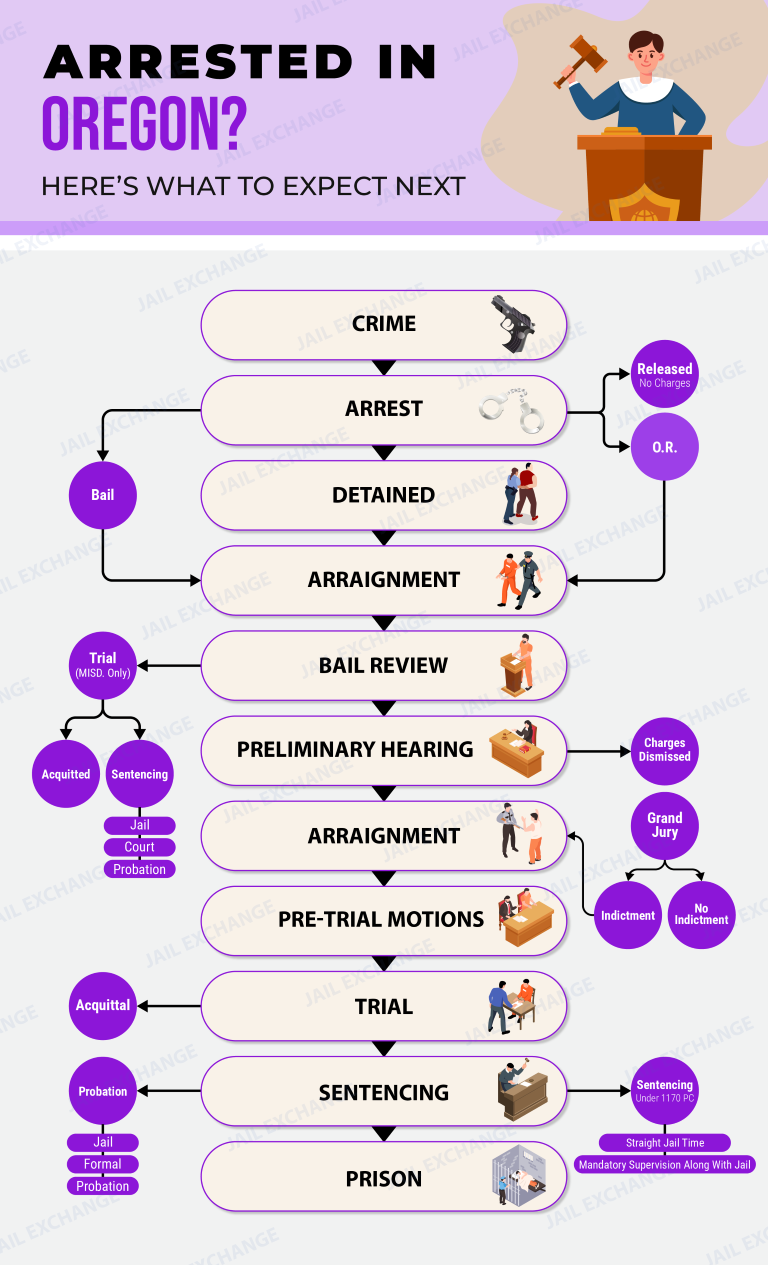
Polk County Jail Criminal Court Process
Criminal Court Process for Polk County Oregon
Polk County Criminal Court Guide
Every crime charged in this county lands first before the circuit court in Dallas, and anyone held while the case runs stays at the Polk County Jail, 884 SE Jefferson Street, Dallas, OR 97338. Hearings for people in custody take place in that same jail building. Read on for the city courts, each step from arraignment to sentencing, case lookups, warrants, and federal and youth cases.
The Sheriff's Inmates In Custody list gives the charges, the bail and the next court date for each person held. For more on custody itself, see our Inmates in Custody page: recent arrests, criminal charges, open warrants, public defenders, picking up property and Oregon's mugshot law.
Call the circuit court clerk at 503-623-3154. Ask staff for three facts: the case number, the appointed lawyer's name, and the day and hour of the next hearing. Is your person still behind bars? Our release and bail page explains how families can help get them out.
1. Which Polk County court hears a felony or misdemeanor?
Nearly every crime charged here ends up in one place: the county's circuit court, which is Oregon's trial court. Its Criminal Division handles violations, misdemeanors and felonies alike. This county forms the 12th of Oregon's 27 judicial districts, which together hold 36 circuit courts (ORS 3.012).
- Felonies are the serious crimes, punished by state prison time. Only the circuit court can hear them.
- Misdemeanors are lesser crimes, with any jail time served in the county jail. Circuit court takes most of them, but a city court can keep some that happen within its borders.
- Violations, such as many traffic tickets, bring fines and no jail time.
Cities, not the state courts, operate the municipal courts. Misdemeanors that a city court does not take go to circuit court. For help sorting out which court holds a case, call the circuit court at 503-623-3154.
↑ Back to the question list2. Where are Polk County's criminal courtrooms?
The circuit court uses three buildings in Dallas. Three judges and a hearings referee share the work.
- Courthouse and annex: 850 Main Street, Dallas, OR 97338, 503-623-3154. The historic courthouse dates from 1899 and the annex from 1965. The main records office is on the annex's third floor. Mail goes to Room 301 at this address.
- Jail building: 884 SE Jefferson Street, Dallas, OR 97338, across the street from the annex. The Criminal Division and its records window are on the second floor, and in-custody arraignments are held here.
Offices are open weekdays from 8 a.m. to noon and from 1 to 5 p.m. On the last Thursday of each month they close at 4 p.m., and they close on court holidays. Under local rules, contested hearings, pleas and trials happen in person in Courtroom 4. Federal charges go to Portland, covered further down this page.
↑ Back to the question list3. Which towns have their own municipal court?
Several cities run small courts for tickets, city code cases and some lesser crimes inside their limits. OJD's online search leaves these courts out, so call them directly:
- Independence Municipal Court: 555 South Main Street, Independence, OR 97351, 503-838-1212. It handles parking, traffic and city code citations from Independence police. The clerk works Monday to Thursday, 7:30 a.m. to 5:30 p.m., and arraignments are the first Wednesday of the month at 5:30 p.m.
- Willamina Municipal Court: 411 NE C Street, Willamina, OR 97396, 503-876-2242. It meets in the City Hall conference room on the third Wednesday of each month at 3:30 p.m. and hears traffic and city code cases plus certain misdemeanors.
- Dallas Municipal Court: 503-831-3576.
- Monmouth Municipal Court: 503-751-0136.
- Salem Municipal Court, for city cases from West Salem: 2850 Broadway St NE, Salem, OR 97303, 503-588-6146.
For a Falls City case, call City Hall, 299 Mill St., Falls City, OR 97344, at 503-787-3631, or the circuit court at 503-623-3154. Grand Ronde has a Tribal Court at 9615 Grand Ronde Rd., Grand Ronde, OR 97347, 503-879-2303, but because Oregon is a Public Law 280 state, county and state courts take most crimes there.
↑ Back to the question list4. What goes on at an Oregon arraignment?
The first hearing is the arraignment. Someone held in jail must have it within 36 hours, counting only weekdays that are not holidays (ORS 135.010). Here, people in custody see a judge each business day at 1:15 p.m. in the jail building. Out-of-custody arraignments are Monday to Friday at 1:15 p.m. and Wednesday at 2:30 p.m., and the person must come in person.
During the hearing:
- The charges are spelled out, and the person answers with a plea (ORS 135.020).
- A person charged with a felony must be there in person (ORS 135.030).
- If the person cannot afford a lawyer and meets the income test, the judge names one on the spot.
- The judge decides on release, or sets a release hearing within 48 hours (ORS 135.245).
- A jailed person on a felony is told of the right to a preliminary hearing, due within five court days (ORS 135.070).
Later pretrial and scheduling meetings are often held by video unless the jail brings the person over.
↑ Back to the question list5. DUII, shoplifting or drug charge: what comes next?
Lower-level cases like DUII, shoplifting, trespass and small drug charges move faster than felonies. Many start with a citation, a ticket telling the person when to show up in court, usually within 30 days (ORS 133.055, 133.060). Missing that date leads to an arrest warrant.
Jail limits depend on the class. The most a Class A misdemeanor allows is 364 days. Class B allows six months, and Class C allows 30 days. A violation means a fine only.
Since September 1, 2024, simple drug possession is a crime again under HB 4002. It is a special drug enforcement misdemeanor with up to 180 days in jail. Prosecutors usually offer probation with treatment, and finishing it gets the charge dropped. OJD's treatment court list shows a Family Treatment Court for this county.
A typical misdemeanor goes from arraignment to a pretrial conference, then to a plea deal or trial, then sentencing. The clerk at 503-623-3154 can give hearing dates.
↑ Back to the question list6. How does a Polk County felony case unfold?
Felonies carry the heaviest penalties. A Class C felony tops out at 5 years in prison, Class B at 10 years and Class A at 20 years. A felony case usually moves like this:
- Arraignment in person, with a lawyer appointed if needed.
- Formal charge. A grand jury may vote to indict. Or a judge holds a hearing to check that the state has enough proof (ORS 135.175, 135.185).
- Judge assigned. Local rules say in-custody cases are given to a judge within 30 days.
- Pretrial work. Conferences, often by video, to trade evidence and talk about a plea.
- Plea or trial. These happen in person in Courtroom 4. A jury must agree on guilt unanimously (Ramos v. Louisiana, 2020).
- Sentencing. A state chart sets a normal range by matching how serious the crime is with the person's record.
The District Attorney's Office presents cases to the grand jury. For the date of any step, call the clerk at 503-623-3154.
↑ Back to the question list7. Why are Measure 11 and violent charges handled differently?
Measure 11 dates from a 1994 public vote. It locks in minimum prison sentences for the gravest person crimes. Nobody earns early release from those terms for good conduct. A few examples: murder, 25 years. First-degree manslaughter, 10 years. Robbery I and Assault I: 90 months each, or seven and a half years.
Charges like these change a case from the start:
- The person usually waits in jail until a judge decides on release.
- For a violent felony, the state can ask for a hearing to keep the person jailed until trial (ORS 135.240).
- In domestic violence, sex crime and bias crime cases, a no-contact order with the victim starts right away (ORS 135.247).
- Victims of violent felonies have a right to be consulted on plea deals (Or. Const. art. I, § 42).
These cases are always heard in circuit court, at 850 Main Street, Dallas, OR 97338, 503-623-3154.
↑ Back to the question list8. Which offices prosecute and defend Polk County cases?
Voters here choose the District Attorney every four years, as in each Oregon county (ORS 8.610). The office is at 850 Main Street, Dallas, OR 97338, 503-623-9268, open weekdays 8 a.m. to noon and 1 to 5 p.m.
On the defense side, the judge appoints a lawyer at arraignment for anyone who qualifies on income. The person fills out a sworn form about money, and a court screener reviews it. The application fee is usually $20, which can be waived, and the judge may set a contribution later. Being broke never means facing a charge alone.
Court-appointed lawyers are paid through the Oregon Public Defense Commission, which became part of the executive branch on January 1, 2025. Oregon has too few defenders. At the close of 2025, around 2,500 people across the state were on the waiting list, about 160 of them jailed. A federal court order sets a seven-day limit. A jailed person with no lawyer by then, counting from the first hearing, generally goes free on conditions. The charges remain. The jail roster names the lawyer once one is assigned.
↑ Back to the question list9. Where can families look up hearings online?
Oregon's free court website, OJD Records and Calendar Search, works without an account:
- Circuit court record search: enter a case number or a person's name to view the parties, events and outcome. Court papers are left out.
- Circuit court calendars: upcoming hearings.
- OJCIN OnLine: a paid subscription that shows judgment dockets and the official case register.
Juvenile cases are kept out of the online search, and city courts are not part of it. If the portal is down, use a free public computer at the courthouse, 850 Main Street, Dallas, OR 97338, or call the clerk at 503-623-3154. Staff can share case facts by phone but cannot give legal advice. The jail roster also lists the next court date for anyone in custody.
↑ Back to the question list10. How is a warrant checked and cleared here?
Outside city limits, a warrant is usually served by a deputy. Dallas, Monmouth and Independence officers do the same inside their cities. Reach the Sheriff's Office at 850 Main Street, Dallas, OR 97338, 503-623-9251, and ask for Records. Court Records at 503-623-3154 can tell you if a warrant or bail amount is on file, and the free OJD case search shows open cases. Official fugitive lists: Oregon DOC Most Wanted (tips 877-831-0389), U.S. Marshals 15 Most Wanted (tips 800-336-0102), FBI Portland (503-224-4181) and Salem Police's Top Ten Most Wanted. Plan a surrender with a lawyer's help at the jail, 884 SE Jefferson Street, Dallas, OR 97338. The issuing court can also be asked for a new date.
↑ Back to the question list11. What changes when the charge is federal?
U.S. crimes charged in this county go to Portland, to the division of the U.S. District Court for the District of Oregon that sits there. Cases are tried in the Hatfield building, formally the Mark O. Hatfield U.S. Courthouse, 1000 Southwest Third Avenue, Suite 740, Portland, OR 97204, 503-326-8000.
- On the other side is the U.S. Attorney's Office, 1000 SW Third Ave, Suite 600, Portland, OR 97204, 503-727-1000.
- A federal magistrate holds a detention hearing and decides if the person goes home before trial (18 U.S.C. 3142). U.S. Pretrial Services has its office at 1000 Southwest Third Avenue, Suite 440, Portland, OR 97204, 503-326-8500.
- The Marshals office, 1000 Southwest 3rd Avenue, Room 401, Portland, OR 97204, 503-326-2209, keeps federal defendants before trial. Staff can say whether one is at a county jail or at FCI Sheridan, 27072 Ballston Road, Sheridan, OR 97378.
- Free federal defense: 101 SW Main, Suite 1700, Portland, OR 97204, 503-326-2123.
- After sentencing, find the person with the Federal Bureau of Prisons inmate locator.
12. Will ICE paperwork stop the Oregon case?
An ICE request leaves the Oregon charges in place, and the court goes on either way. This is the usual order:
- ICE starts by sending Form I-247A, which names the person it wants held.
- The form asks the jail to hold that person up to 48 hours after they would otherwise be released (8 CFR 287.7(d)).
- Oregon law steps in here (ORS 181A.820 to 181A.829; HB 3265, 2021). Under it, officers and jail staff may only honor immigration papers a judge has signed. So the jail generally will not hold someone on the detainer alone or share release facts for immigration enforcement.
- Civil arrests are off-limits inside a courthouse unless a judge has signed an order or warrant allowing it.
- ICE may still pick the person up elsewhere. Oregon is part of the region run by ICE's Seattle Field Office. Families may phone its Portland office: 4310 S Macadam Ave, Suite 300, Portland, OR 97239, 503-326-4165.
To learn whether ICE has taken someone, search the ICE Online Detainee Locator by name and country of birth.
↑ Back to the question list13. Where do people serve Oregon prison terms?
A judge may send someone to the Oregon Department of Corrections (DOC) after a felony conviction. Men and women both begin at Coffee Creek Correctional Facility, 24499 SW Grahams Ferry Road, Wilsonville, OR 97070, where intake lasts about a month. Men then head to an assigned prison, while women stay at Coffee Creek.
- During intake, family can phone and write but cannot visit. Mail needs the person's State ID (SID) number. For intake questions, call 503-570-2259.
- Look them up by name on the Oregon Offender Search. DOC's main line is 503-945-9090.
- Our guide to Oregon state prisons covers every facility.
County Community Corrections handles probation and post-prison supervision. It works out of 820 SW Church St. Ste. 100, Dallas, OR 97338, 503-623-5226, apart from the jail.
↑ Back to the question list14. What if the person charged is 17 or younger?
Youth cases start at the Juvenile Department, 820 SW Church St, Suite 101, Dallas, OR 97338, 503-623-2349, not at the adult jail. It serves youth ages 12 to 17. The lobby is open weekdays 1 to 5 p.m., and a juvenile probation officer can be reached any hour by following the voicemail steps. Juvenile court records are kept in the historic courthouse.
- Only a judge, or a person the court chooses, can send a youth to a juvenile detention center. Staff contact parents as soon as practical.
- Juvenile cases stay out of the online court search.
- Since SB 1008 took effect in 2020, a teen of 15, 16 or 17 goes to adult court for a Measure 11 crime only after a waiver hearing.
- Youth committed to state custody go to the Oregon Youth Authority, 530 Center Street NE, Salem, OR 97301, 503-373-7205.
Phone the department for the youth's location and first hearing time.
↑ Back to the question list15. What help is there for Polk County crime victims?
Crime victims hold rights written into the Oregon Constitution (Or. Const. art. I, §§ 42 and 43). Some apply on their own, such as a voice at release and sentencing hearings. Others must be asked for, such as advance notice of key hearings and notice when the defendant is let out.
- Victim assistance: the District Attorney's Office, 850 Main Street, Dallas, OR 97338, 503-623-9268. Ask for victim assistance.
- Release alerts: register with VISOR, a free DOC service. Its phone line is open day and night at 855-691-6246. The person in custody is not told you signed up.
- Money help: after a violent crime, a state fund may repay costs like a hospital stay, mental health care, time off work or burial. It is Crime Victims' Compensation at the Oregon Department of Justice, 1162 Court St. NE, Salem, OR 97301, 800-503-7983.
A victim may also ask the court for restitution, which is money the convicted person must pay back for losses.
↑ Back to the question list