Lehigh County Men's Community Corrections Center Criminal Court Process
Criminal Court Process for Lehigh County Pennsylvania
Lehigh County Criminal Court Guide
Each criminal case here begins at one of 14 neighborhood district courts, and serious ones climb to the Court of Common Pleas at 455 W. Hamilton Street, Allentown, PA 18101. Until their case wraps up, jailed adults stay at the county jail, 38 North Fourth Street, Allentown, PA 18102, the maximum-security building for pretrial and short-sentence inmates. Sentenced residents on work release live at the Community Corrections Center, 1600 Riverside Drive, Bethlehem, PA 18016.
To confirm someone is behind bars today, use the official inmate lookup. Then turn to our Jail Roster page for the arrest as a whole. It deals with fresh bookings, current inmates, warrants and charges. Mugshots, public defenders and property release are there as well.
Ring the criminal clerk's office, formally the Clerk of Judicial Records, at 610-782-3077. Request three items: the docket number, the next listing and its courtroom. Someone still waiting in a cell? Our bail page covers paying for release.
1. Which Lehigh County court hears misdemeanors and which hears felonies?
Criminal cases here pass through two tiers of state court.
- Magisterial district courts are the starting point. They handle summary cases such as traffic tickets, disorderly conduct and many retail thefts. For misdemeanors and felonies they hold the first two hearings and set bail.
- The Court of Common Pleas of the 31st Judicial District receives misdemeanor and felony charges once a preliminary hearing sends them up. Guilty pleas, jury trials and sentences happen there. A person convicted of a summary offense can also appeal to it and be tried all over again.
No other county shares the 31st district. Its criminal judges keep each case from the day it is assigned until it ends, and a later probation violation goes back to that same judge.
↑ Back to the question list2. Where is the main criminal courthouse in Allentown?
Common Pleas sits in one downtown building, with district offices spread around the county.
- County courthouse, 455 W. Hamilton Street, Allentown, PA 18101, 610-782-3000. Doors are open Monday to Friday, 8:00 a.m. to 4:30 p.m.
- Clerk of Judicial Records, Criminal Division, Room 122 in that building, 610-782-3077. It holds every criminal file and records pleas, ARD, DUI and bail matters.
- Court Administrator, same building, 610-782-3160.
- Historic Courthouse, 501 W. Hamilton Street, Allentown, PA 18101, home to two district courts: 31-1-02 at 610-432-8700 and 31-2-01 at 610-782-3834.
- Federal court, Edward N. Cahn U.S. Courthouse, 504 W. Hamilton Street, Allentown, PA 18101. The federal clerk answers at 215-597-7704.
3. Which district court covers each Lehigh County town?
There are no city or borough courts here. Local cases go to a magisterial district court, named by number. Use the court's Find My MDJ search, in effect since January 2, 2024, to match an address to its office.
Allentown and nearby:
- 31-1-01: 1401 West Green Street, Allentown, PA 18102, 610-432-3080
- 31-1-02: 501 W. Hamilton Street, Suite 117D, Allentown, PA 18101, 610-432-8700
- 31-1-03: 1428 West Hamilton Street, Allentown, PA 18101, 610-434-7903
- 31-1-04: 1501 Lehigh Street, Suite 104, Allentown, PA 18103, 610-797-0906
- 31-1-05: 1007 Union Boulevard, Allentown, PA 18109, 610-439-0661
- 31-1-08: 2851 Old South Pike Avenue, Suite A, Allentown, PA 18103, 610-797-8724
- 31-1-09: 413 North 3rd Street, Allentown, PA 18102, 610-778-5410
- 31-2-01: 501 Hamilton Street, Suite 106, Allentown, PA 18101, 610-782-3834
- 31-2-02: 3900 Hamilton Boulevard, Suite 101, Allentown, PA 18103, 610-434-2070
- 31-3-02: Green Hills Commerce Center, 5925 Tilghman Street, Suite 500, Allentown, PA 18104, 610-398-1167
Elsewhere in the county:
- 31-1-06 (Bethlehem side): 623 West Union Boulevard, Suite 4-5, Bethlehem, PA 18018, 610-691-3950
- 31-1-07 (Whitehall): 3678 Crescent Court East, Whitehall, PA 18052, 610-437-6096
- 31-3-01 (Slatington): 106 South Walnut Street, Slatington, PA 18080, 610-767-8641
- 31-3-03 (Coopersburg): Village Center, 21 North Main Street, Coopersburg, PA 18036, 610-282-1555
4. What takes place at the preliminary arraignment?
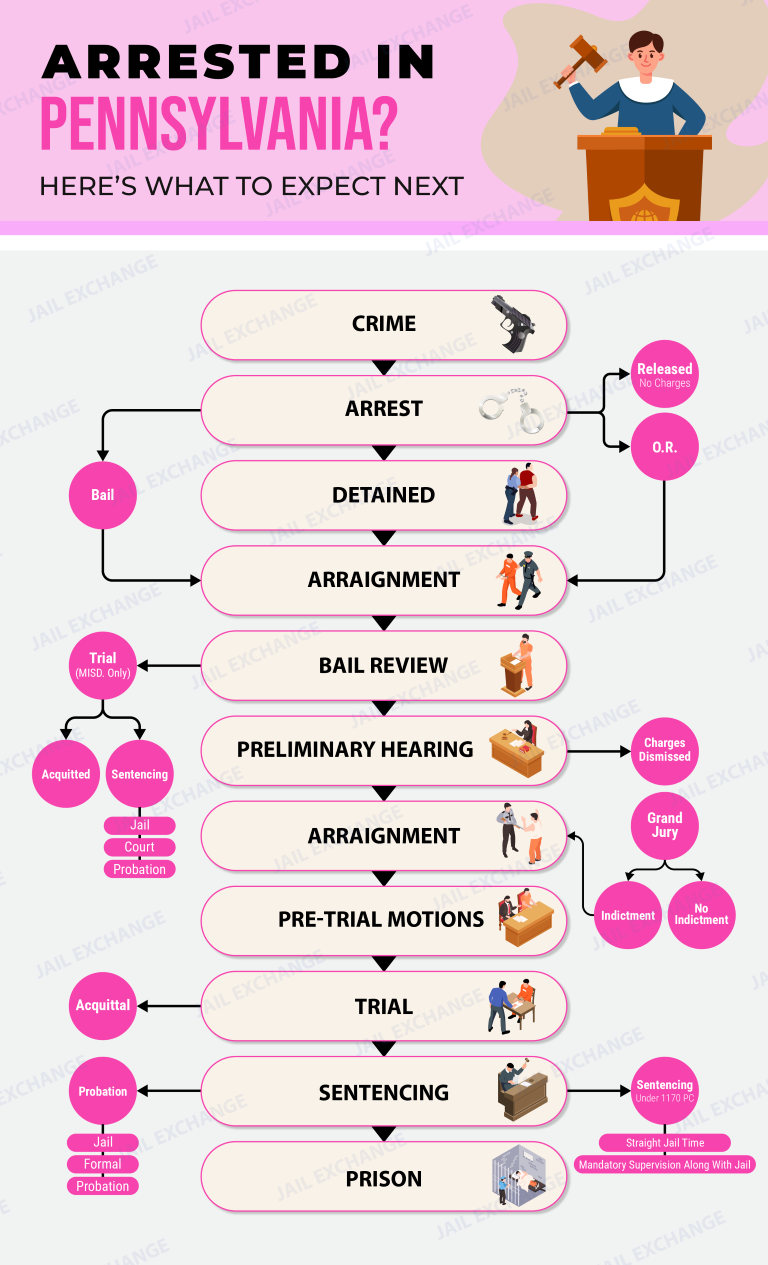
Things begin with the preliminary arraignment before a district judge. Many are done by video, and the state's victim services office puts it within roughly six hours of arrest. During it, the accused:
- receives the criminal complaint, a paper listing each charge
- learns their rights, a lawyer among them
- learns the bail decision
- gets a date for the preliminary hearing (Pa.R.Crim.P. 540)
The rule sets a clock for that hearing: 14 days for someone jailed, 21 days for someone free. There the DA's office has to make out a prima facie case. Put simply, the proof must suggest a crime happened and that the accused probably did it. The defense may also waive it and send the case straight up.
↑ Back to the question list5. What happens in a DUI or other misdemeanor case?
Early on, a misdemeanor travels the same road as a felony. A summary offense, such as a traffic ticket or some retail thefts, stays with the district judge. A guilty verdict there can be taken up to Common Pleas for a brand-new trial, but only within 30 days.
Misdemeanor penalties top out at these levels (18 Pa.C.S. § 1104):
- M1: 5 years and a $10,000 fine
- M2: 2 years and $5,000
- M3: 1 year and $2,500
- Summary: 90 days and $300
A first DUI is usually a misdemeanor, but the grade climbs with prior offenses and test refusals (75 Pa.C.S. § 3803). Many first-time DUI cases go to ARD, short for Accelerated Rehabilitative Disposition. Only the District Attorney can offer it, and a judge has to sign off. Complete the classes, supervision and fees, and the charge is wiped out by dismissal. An expungement petition can then erase the arrest record. ARD forms are on the court's ARD page. For eligibility, call the District Attorney's main line at 610-782-3100.
↑ Back to the question list6. What are the steps in a Lehigh County felony case?
- Preliminary arraignment with a district judge, where bail is set.
- Preliminary hearing, also at the district court. If the judge finds a prima facie case, the charges are "held for court."
- The information. This is the formal charging paper the DA files in Common Pleas. The DA may add or drop counts in it.
- Formal arraignment. A month or two on, the defendant pleads guilty or not guilty.
- Pretrial conference. Many plea deals are reached at this stage.
- Trial. Twelve jurors decide, and their verdict has to be unanimous. A defendant may pick a judge-only trial instead.
- Sentencing. Adult Probation writes up the person's history, and the judge studies it before ruling.
Felony ceilings are 20 years and $25,000 for F1, 10 years and $25,000 for F2, and 7 years and $15,000 for F3 (18 Pa.C.S. §§ 1101, 1103). Appeals go to the Superior Court.
↑ Back to the question list7. How are murder and violent felony cases handled differently?
- No-bail holds. Only two kinds of case allow it. One is a crime that carries death or life. The other is a person no conditions could make safe to release. Evidence at a hearing is required (Pa. Const. art. I, § 14).
- Murder. First-degree murder is punished by death or life imprisonment, and second degree by life. Third degree is capped at 40 years (18 Pa.C.S. § 1102).
- Teens. At 15, 16 or 17, a homicide charge, or one of the named violent crimes committed with a deadly weapon, places the case in adult court from the start (42 Pa.C.S. § 6302).
- Victims' voices. In injury cases and burglaries, victims may comment before a plea deal, a dismissal or sentencing.
- Long sentences. Once the maximum hits 5 years, the time is served in a state prison (42 Pa.C.S. § 9762).
8. Who are the prosecutors and the public defenders here?
State charges in this county are prosecuted by the Office of the District Attorney. It is in Room 307 of the courthouse, 455 W. Hamilton St., Allentown, PA 18101, 610-782-3100, open weekdays from 8:30 a.m. to 4:30 p.m. County detectives work out of the same office and number.
A defendant who can't hire a lawyer applies to the county Public Defender through its online application, in English or Spanish. Upload the criminal complaint, then allow 5 to 7 business days. The applicant signs a sworn money statement, and false answers count as perjury (16 P.S. § 9960.1 and following). For help with the form, call the courthouse at 610-782-3000 and ask for the Public Defender's Office.
↑ Back to the question list9. Does Lehigh County run drug, mental health or DUI courts?
Yes. Adult Probation & Parole runs a Recovery Court program with two tracks of special court:
- Treatment Court, the drug court, for defendants whose crimes tie back to addiction.
- Wellness Court, the mental health court, aimed at defendants living with serious mental illness.
Both are voluntary and built for non-violent cases. Track I is diversion, offered only if the District Attorney agrees. Track II is the standard track, and Track III serves people on probation who slipped. A defendant, a police officer or a lawyer can apply. Call the Treatment Court Coordinator at 610-782-3423. A separate DUI Court unit can be reached at 610-782-3574.
Adult Probation is in Room G09, 455 West Hamilton Street, Allentown, PA 18101.
↑ Back to the question list10. How do I find a docket or a court date?
Lehigh criminal and summary appeal dockets can be read on the state's UJS Portal case search at no cost, with no account.
- Pick the participant name option. A docket number search works too.
- Type the surname and given name, then select this county.
- Click into the docket sheet to read charges, bail, hearing dates and the courtroom.
Brand-new entries may lag behind. Cases for minors, and sealed or expunged ones, never appear. Jail location is outside what the portal covers. For a date you can't find, phone the Criminal Division at 610-782-3077 with the full name and birth date.
↑ Back to the question list11. How can I learn of a Lehigh County warrant and settle it?
Deputies with the Sheriff's Office carry out Common Pleas bench warrants. The office is in Room 253, 455 West Hamilton Street, Allentown, PA 18101, 610-782-3175. Police and constables serve other warrants, and city files sit with the Allentown Police Warrant Unit, 610-437-7664. Public wanted pages: the PSP Ten Most Wanted list, the Marshals' top 15 fugitives, the FBI's wanted list, Allentown's wanted persons and Bethlehem's tips and wanted page. Any open case also shows on the UJS Portal, or you can ask the Sheriff by phone. To clear a warrant, get a lawyer on the phone first, and then surrender to the issuing court. Common Pleas files are at the Clerk, Room 122 of that courthouse, 610-782-3077.
↑ Back to the question list12. How do federal charges from the Lehigh Valley proceed?
The Eastern District of Pennsylvania is the federal court for this area. Its judges in Reading, Allentown and Easton hear the cases that start here. The courthouses are 201 Penn Street, Reading, PA 19601; 504 W. Hamilton Street, Allentown, PA 18101; and 101 Larry Holmes Drive, Easton, PA 18042. The clerk's office is at 215-597-7704.
- Federal prosecutors keep an office at 504 West Hamilton Street, Suite 3701, Allentown, PA 18101, 215-861-8540.
- Pretrial freedom is argued and decided at a detention hearing (18 U.S.C. 3142).
- Held defendants are in U.S. Marshals custody. The district office is at 601 Market Street, Room 2110, Philadelphia, PA 19106, 215-597-7272.
- Free defense comes from Federal Community Defender lawyers at 601 Walnut Street, Suite 540 West, Philadelphia, PA 19106, 215-928-1100.
- Prison time after a conviction is tracked through the Federal Bureau of Prisons inmate locator.
13. Does an immigration detainer change the state case?
An ICE hold does not pause the state charges. It matters most at the moment the person could walk out.
- The agency lodges Form I-247A. That detainer seeks advance word of the release date and a brief hold.
- The hold can last up to 48 hours after they would otherwise be released (8 CFR 287.7(d)).
- ICE officers then take custody. Pennsylvania cases fall under the Philadelphia Field Office, 114 N. 8th Street, Philadelphia, PA 19107, 215-656-7164.
- Locate the person on the ICE Online Detainee Locator.
A detainer is only a request. The Third Circuit appeals court settled that point in a 2014 ruling, Galarza v. Szalczyk. That lawsuit named this county, and the court held that a jail keeping someone on a detainer alone owns that decision. Jails therefore set their own detainer rules. Mention any detainer to the defense lawyer early on. Pleading guilty to some charges can affect immigration status. The jail's policy question goes to 610-782-3270.
↑ Back to the question list14. Which sentences send someone to a state prison?
Look at the top number of the sentence (42 Pa.C.S. § 9762). Anything with a maximum under 2 years is county time. A maximum of 5 years or longer is state time. For maximums from 2 up to 5 years, state prison applies unless jail officials, the DA and the judge agree to keep the person in the county.
- New state inmates begin at a reception and classification center. Testing there runs weeks to months.
- The DOC inmate locator finds people by name or by their state number.
- The Pennsylvania Department of Corrections main office: 1920 Technology Parkway, Mechanicsburg, PA 17050, 717-728-2573.
- Each prison's visiting and mail rules appear on our Pennsylvania state prisons page.
15. Where does a case against a teen get heard?
Under the Juvenile Act, nearly every case against someone younger than 18 belongs in juvenile court (42 Pa.C.S. § 6302), and police usually refer them through Juvenile Probation. Youth dockets are hidden from UJS Portal searches. The defense can ask to move an adult-court case down to juvenile court.
Since the county's youth detention center shut in 2014, held youths are placed out of county, for example at the Bucks County Youth Center, 1750 Easton Rd., Doylestown, PA 18901, 215-340-8300, or the Chester County Youth Center, 505 South Wawaset Rd., West Chester, PA 19382, 610-344-6700. Juvenile Probation, Room 710, 455 West Hamilton Street, Allentown, PA 18101, 610-782-3143, knows where a teen is placed.
↑ Back to the question list16. Which protections do Lehigh County crime victims get?
Under Pennsylvania's Crime Victims Act, victims have a say at many points in the case (18 P.S. § 11.101 and following).
- Victims can weigh in on bail. For crimes that caused injury, and for burglaries, they may also comment on plea offers and the sentence.
- In injury cases they may get word of a release from the county jail. A person with a protection order can be told at once when bail is posted.
- PA SAVIN sends free custody alerts. Register through VINELink, or call 866-972-7284 (TTY 866-847-1298).
- Crime victims compensation pays some costs, such as counseling or lost wages. Call 800-233-2339.
- The District Attorney's Victim/Witness Coordinator is at 610-782-3890.
One caution for the defendant's family. Reaching out to the victim, even to deliver a note, risks a bail violation and new charges.
↑ Back to the question list