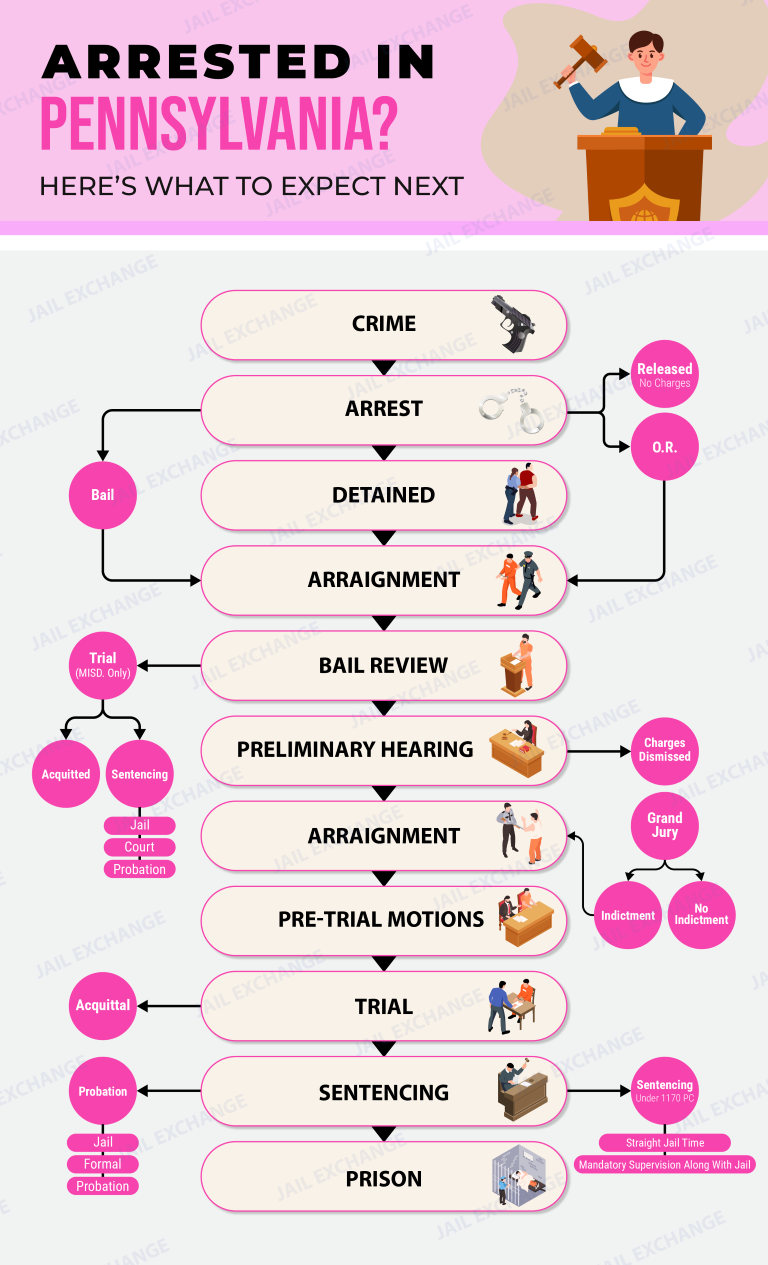
Westmoreland County Regional Youth Services Center Criminal Court Process
Criminal Court Process for Westmoreland County Pennsylvania
Westmoreland County Criminal Court Guide
Here, a criminal case opens before a magisterial district judge and, when it is serious, climbs to the Court of Common Pleas at the courthouse, 2 North Main Street, Greensburg, PA 15601. While they wait, jailed adults stay at the Westmoreland County Prison, 3000 South Grande Boulevard, Greensburg, PA 15601. This guide walks from the first video hearing to sentencing, then covers lookups, warrants and special cases.
The county's prison inmate list answers who is inside right now. It shows booking numbers and housing units. Our Inmate Lists page follows the arrest itself: new arrests, current custody, open warrants, charges, booking photos, public defenders and belongings left at the prison.
Next, phone the Clerk of Courts at 724-830-3734 on a weekday. Ask for the docket number, the coming court date and which office or courtroom has the file. If your person has not come home yet, see our bail page for each route to release.
1. Which judges take minor cases, and which take felonies?
Two tiers of state judges split criminal work in this county:
- Magisterial district judges (MDJs). They try summary offenses. Those are Pennsylvania's lightest charges, like a typical traffic ticket or disorderly conduct. MDJs also run the opening two steps of every misdemeanor and felony.
- Common Pleas judges. Westmoreland alone forms the 10th Judicial District. Its Common Pleas bench gets each misdemeanor and felony an MDJ sends up. Pleas, trials and sentences all happen there.
A summary conviction can go up to Common Pleas if the appeal is filed within 30 days. The case is then heard fresh, from the start. Common Pleas jury trials seat 12 people, and their verdict must be unanimous.
↑ Back to the question list2. Where is the courthouse for Westmoreland County criminal cases?
Most court offices you will need sit inside the Westmoreland County Courthouse, 2 North Main Street, Greensburg, PA 15601. Pick the right door:
- Clerk of Courts, Suite 203, up one floor, 724-830-3734. Criminal files live here. The bail window is open weekdays, 8:30 a.m. to 4:00 p.m.
- Court Administration, Room M3 on the mezzanine, 724-830-3828. It sets calendars and supports the district court offices.
- Adult Probation and Parole, in the same building at 2 North Main Street, Greensburg, PA 15601, 724-830-3700. Officers here write presentence reports and watch county probation cases.
Deputies from the Sheriff's Office guard the building. Their office line is 724-830-3822. Carry photo ID through security, and leave pocketknives and similar items in the car.
↑ Back to the question list3. How do the magisterial district courts work here?
A magisterial district judge, or MDJ, is a local judge chosen by voters in one part of the county. Pennsylvania has more than 550 of them. This county has several district court offices spread across its towns and townships. Each office has a number that begins with 10, the county's judicial district.
- MDJs decide bail at the preliminary arraignment.
- The preliminary hearing usually lands before the MDJ who covers the place where the alleged crime happened.
- They also hold summary trials and sign search or arrest warrants.
- At night, Night Court takes over by video, 4:00 p.m. to 10:00 p.m., with MDJs taking turns.
Which office has your person's case? Look at the summons, the complaint or the docket on the UJS Web Portal. The state also has a district judge finder that searches by county, court number or ZIP code. You can also phone Court Administration at 724-830-3828 or the Clerk of Courts at 724-830-3734.
↑ Back to the question list4. The first video hearing, step by step
This short hearing is the first time the arrested person faces a judge. Pennsylvania's victim services walkthrough says it is usually held within six hours. Here it most often runs on a two-way video screen between the prison and an MDJ, or Night Court after 4:00 p.m.
During it, the MDJ will (Pa.R.Crim.P. 540):
- give the person the criminal complaint on paper
- go over each charge
- tell them about their rights, such as having a lawyer
- choose bail or another form of release
- schedule the preliminary hearing, 14 days out at most for someone jailed and 21 for someone released
Nobody enters a plea yet, and the whole thing can last only minutes. Relatives usually just watch, if they can at all. The real help is getting a lawyer lined up before the preliminary hearing.
↑ Back to the question list5. How do DUI cases and other misdemeanors move?
A misdemeanor starts out just like a felony. After the arraignment, an MDJ holds the preliminary hearing. When the case survives it, Common Pleas takes over: arraignment there, a pretrial conference, then a plea or a trial.
Misdemeanors carry one of three grades, each with its own ceiling (18 Pa.C.S. § 1104; 18 Pa.C.S. § 1101):
- M1: no more than 5 years and a $10,000 fine.
- M2: no more than 2 years and a $5,000 fine.
- M3: no more than 1 year and a $2,500 fine.
A basic-level DUI, first or second, is usually a misdemeanor that can bring six months behind bars at most (75 Pa.C.S. § 3803). Lawmakers have changed DUI grading several times lately, so get a lawyer's read on the exact grade.
First offenders, including many people with a first DUI, are often offered Accelerated Rehabilitative Disposition, or ARD (Pa.R.Crim.P. 310). The DA's office makes the offer to whomever it chooses, subject to a judge's approval. Expect supervision, classes, fees and usually community service. Those who complete it see the charge dismissed, and the record can then be expunged. Have the defense lawyer bring up ARD with the prosecutor early.
↑ Back to the question list6. What happens in a felony case in Westmoreland County?
Here is the usual road for a felony:
- Preliminary arraignment. Bail is set by an MDJ, usually on video.
- Preliminary hearing. The DA must lay out a prima facie case. Put simply, that means showing a crime likely took place and the accused likely did it. Weak cases get thrown out here. The defense can also choose to skip, or waive, this hearing.
- The information. Once the case is held for court, prosecutors file this document, which lists the final counts. Some may be added and others dropped.
- Common Pleas arraignment. It often comes four to eight weeks past the MDJ stage. The accused gets the information and pleads.
- Pretrial conference. Plea bargains often close the case at this stage.
- Trial. Twelve jurors, or a judge with no jury if the defense picks that. The Commonwealth must prove guilt with no reasonable doubt left.
- Sentencing. The judge reads a presentence report from county probation and checks the state guidelines.
Felony ceilings climb by grade. F3 tops out at 7 years and $15,000. F2 tops out at 10 years and $25,000. F1 tops out at 20 years and $25,000 (18 Pa.C.S. § 1103). Appeals climb to the Superior Court and, after that, to the state Supreme Court.
↑ Back to the question list7. How are violent or very serious charges treated?
The gravest charges come with tighter rules:
- Murder. The first degree brings death or life in prison. The second degree brings life. The third degree brings as much as 40 years (18 Pa.C.S. § 1102).
- Bail denied. Only two grounds allow it: a charge punishable by death or life, or proof that no conditions would protect others. The DA carries that burden at a hearing (Commonwealth v. Talley).
- Youths tried as adults. Every murder charge starts in adult court. So do certain violent charges with a deadly weapon against someone 15 or older (42 Pa.C.S. § 6302).
- Victims heard. When someone was injured, the victim gets a say before any plea bargain or dismissal, and again at sentencing.
- Surety duties. A person who signs as surety must tell police within 24 hours if the accused breaks a stay-away or protection order (42 Pa.C.S. § 5750).
- Longer time. Five-year-plus maximums mean a state prison term (42 Pa.C.S. § 9762).
8. Who prosecutes in Westmoreland County, and who defends?
Adult criminal cases here are brought by the elected District Attorney's Office. Its County Detectives Bureau is at 2 N Main Street, Greensburg, PA 15601, 724-830-3287. The DA's office also keeps a Victim Witness Waiting Room, so victims can wait apart from the defendant's family.
When money is too tight for a private lawyer, the county Public Defender steps in (16 P.S. § 9960.1 and following). An income affidavit, signed under oath, starts the request. The county then applies its own money limit. Public defenders cover preliminary hearings, trials and probation or parole revocations. Act 34 of 2023 brought the first state dollars for this county work.
From inside the prison, the person can ask staff for an application. Relatives can call Court Administration at 724-830-3828 for the defender's number. Hiring private counsel is allowed at any point too. Local Common Pleas judges also run a Drug Treatment Court and a Veterans Court, and defense counsel can check if the person fits one.
↑ Back to the question list9. Where to read the docket and hearing dates
Every Pennsylvania court feeds one free public search, the UJS Web Portal. You do not need to sign up.
- Pick the participant name search, or the docket number search.
- With a name, add first and last name plus the county.
- Open the docket sheet. MDJ and Common Pleas cases both show up.
- Scan for charges, bail, upcoming events and the courtroom or MDJ office.
Fresh filings can lag behind. Sealed, expunged and juvenile cases are kept out. The portal does not track where someone is jailed, so the county's prison list answers that.
The Clerk of Courts, 724-830-3734, can read off a Common Pleas date over the phone. Know the full name and birth date before dialing.
↑ Back to the question list10. Warrants: who serves them and how to clear one
Sheriff's deputies, 724-830-3822, carry out bench warrants that Common Pleas judges sign, and they can field warrant questions. Town police and constables serve other warrants. Wanted lists worth a look: the State Police Ten Most Wanted, the DOC's parole absconders list and the Marshals' 15 Most Wanted. A name search on the UJS Web Portal may turn up an open case. Speak with a lawyer or the public defender before acting. Then reach the issuing court. For Common Pleas, that means the Clerk of Courts, 2 North Main Street, Suite 203, Greensburg, PA 15601, 724-830-3734.
↑ Back to the question list11. Federal charges out of this county
Westmoreland sits in the Western District of Pennsylvania, and its federal cases go to Pittsburgh. Hearings take place at the federal courthouse on Grant Street, 700 Grant Street, Pittsburgh, PA 15219, 412-208-7500.
- Prosecutors at the U.S. Attorney's Office handle the charges from 700 Grant Street, Suite 4000, Pittsburgh, PA 15219, 412-644-3500.
- A detention hearing comes within days of the first appearance. It settles home or a cell until trial (18 U.S.C. 3142).
- Deputy U.S. marshals keep detained defendants and drive them to each court date. The district office is at 700 Grant Street, Room 2360, Pittsburgh, PA 15219, 412-644-3351.
- Defendants without funds are assigned the Federal Public Defender, 1001 Liberty Avenue, Suite 1500, Pittsburgh, PA 15222, 412-644-6565.
- After sentencing to federal prison, use the Federal Bureau of Prisons inmate locator.
12. Does an ICE detainer stall the court case?
An immigration detainer does not pause the criminal case. Hearings go on as planned. The detainer matters on release day.
- Step one: an I-247A detainer form arrives from ICE. It requests a hold of up to 48 hours after they would otherwise be released, giving agents time to come (8 CFR 287.7(d)).
- No judge signs that form, and it binds no one. That is the holding of Galarza v. Szalczyk (3d Cir. 2014), from the federal appeals court that hears Pennsylvania cases. It added that counties answer for holds based on nothing more than such a form. County jails each make their own rule. Reach the prison at 724-830-6000.
- After ICE takes the person, its Philadelphia Field Office runs the case: 114 N. 8th Street, Philadelphia, PA 19107, 215-656-7164.
- Look for them on the ICE Online Detainee Locator.
For a noncitizen, a guilty plea can carry immigration fallout. Raise that with defense counsel before any plea.
↑ Back to the question list13. State prison time: where it is spent
A Pennsylvania sentence names a low number and a high number, and the high one decides where the person goes. A high number below 2 years keeps the person on Grande Boulevard. A high number of 5 years or above means a state institution. In between, state prison is normal, and a local stay needs the prison, the DA and the sentencing judge to agree (42 Pa.C.S. § 9762).
New state prisoners are processed first at a reception and classification center. Security level and program needs are set there, over a period of weeks or months. A permanent prison is assigned after that.
- Type a name or inmate number into the DOC inmate locator.
- DOC headquarters: 1920 Technology Parkway, Mechanicsburg, PA 17050, 717-728-2573.
- Our guide to Pennsylvania state prisons explains visits, mail and money at each one.
14. What happens when a Westmoreland County teen is charged?
The Juvenile Act covers most young people under 18 (42 Pa.C.S. § 6301 and following). Their cases run through Juvenile Probation instead of the adult Clerk of Courts. None of these files appear on the UJS Web Portal.
- Juvenile Probation and the county's detention unit both work out of the Juvenile Services Center, 2771 S Grande Blvd, Greensburg, PA 15601, 724-830-4200.
- A detained youth is kept at the Regional Youth Services Center there, away from adults.
- Adult court is the starting point for any murder count, and for some weapon-involved violent counts once a youth turns 15 (42 Pa.C.S. § 6302). Defense lawyers can ask a judge to move such a case down to juvenile court.
Parents and guardians should phone Juvenile Probation for the hearing date and next steps.
↑ Back to the question list15. Victims' rights and alert services
Victims have rights of their own under the Crime Victims Act (18 P.S. § 11.101 and following). Among them:
- basic facts about victim services, plus notice of key hearings
- the right to comment on bail conditions
- in injury cases, input before a plea bargain or dismissal and at sentencing
- word of the person's release from the county prison, and immediate word if a protection order is in place
- repayment of losses through restitution
Release and transfer alerts come free from PA SAVIN, by phone, text or email. Register on VINELink or by phone at 866-972-7284 (TTY 866-847-1298). For crime-related bills, the Victims Compensation Assistance Program answers at 800-233-2339.
If you are close to the accused, stay away from the victim and never carry messages. Contact like that can violate bail and bring new charges.
↑ Back to the question list