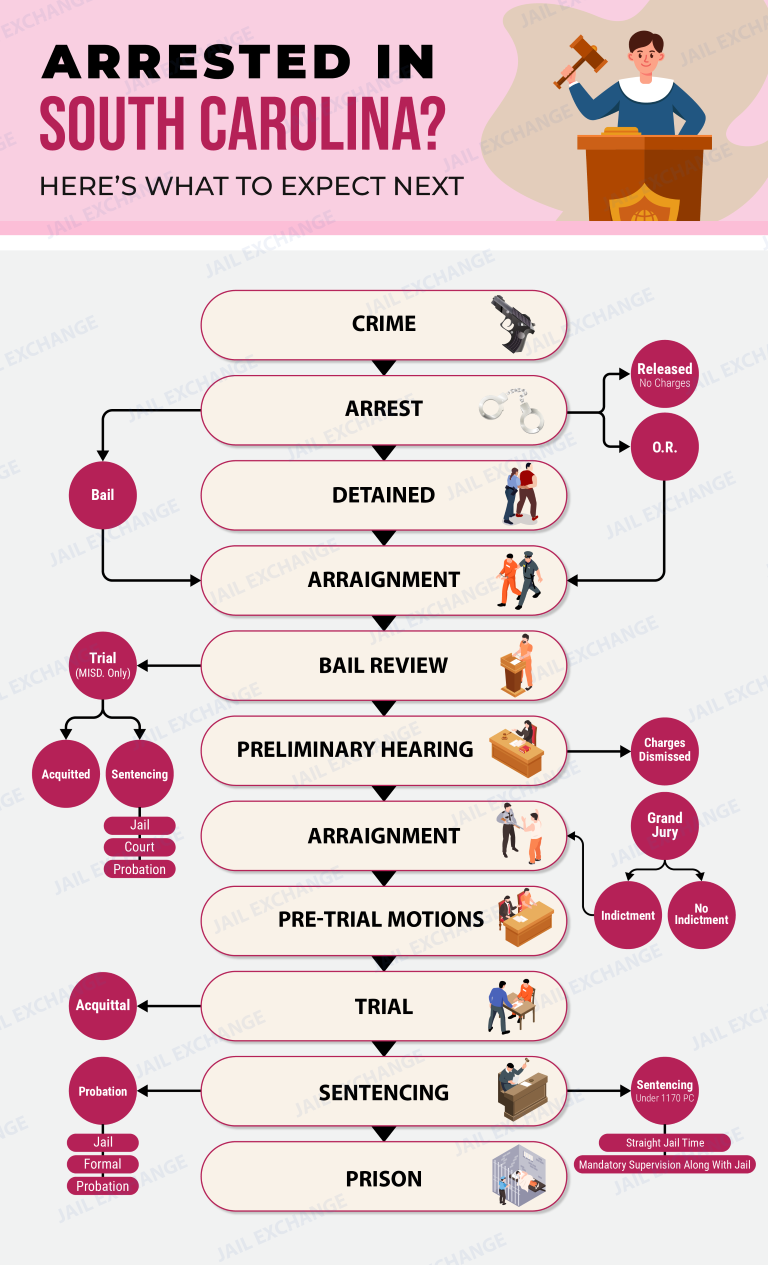
Hill-Finklea Detention Center Criminal Court Process
Criminal Court Process for Berkeley County South Carolina
Berkeley County Criminal Court Guide
Two courts handle most criminal charges here. Magistrates take minor ones, and the Court of General Sessions at the county courthouse takes felonies. Those not released before trial stay at the Hill-Finklea Detention Center, 300 California Avenue, Moncks Corner, SC 29461. Below, each court is listed, and a case is traced from its video bond hearing to sentencing, with federal, immigration and youth cases too.
Check first that the person is in jail. Use the Sheriff's official inmate lookup for that. Our Jail Roster page tackles everything about custody: who is in a cell today, recent arrests, outstanding warrants, booked charges, mugshots, public defenders and property pickup.
Next, call the Clerk of Court at 843-719-4400. Give the full name, and learn which court holds the file and the date it comes up next. Bond questions get their own answers on our bail and release page.
1. Which Berkeley County court gets a misdemeanor, and which gets a felony?
Two kinds of court split the work. The lighter cases go to summary courts, which means the magistrates and any town judges. A magistrate can try a charge with a fine of $500 or less, a jail stay of no more than 30 days, or both (S.C. Code 22-3-550). Town judges work under the same limit (S.C. Code 14-25-65). So does shoplifting of goods worth $2,000 or less, where the fine can reach $1,000 (S.C. Code 16-13-110). A magistrate jury has six members (S.C. Code 22-3-545).
Felonies, and misdemeanors with more than 30 days possible, belong to the Court of General Sessions. General Sessions is the name South Carolina gives the circuit court when it hears crimes. Its sessions for this county are held at the county courthouse. The county shares the Ninth Judicial Circuit with Charleston County (S.C. Code 14-5-610).
Charges against anyone under 18 usually start in Family Court instead.
↑ Back to the question list2. Where do criminal courts meet, and what are their hours?
- Berkeley County Courthouse: 300-B California Avenue, Moncks Corner, SC 29461. The Clerk of Court handles General Sessions, Common Pleas and Family Court records here, 843-719-4400, Monday to Friday, 9 a.m. to 5 p.m. Mail goes to PO Box 219, Moncks Corner, SC 29461. Deputies screen everyone who walks in.
- Family Court (same building): 843-719-4500.
- Live Oak Complex: 223 North Live Oak Drive, Moncks Corner, SC 29461. The central criminal and traffic court, preliminary hearings and small claims for the north end meet here. The Magistrate Courts line is 843-719-4050.
- Goose Creek Magistrate: reopened on May 5, 2025, on Red Bank Road in Goose Creek, 843-553-7080. Staff can give the exact address and office hours.
- St. Stephen Magistrate: has worked since July 2024 from a temporary spot in the St. Stephen Police Department building on Hood Street, 843-567-7400. Call to check where it sits today.
For magistrate hours, call the office you need before you go.
↑ Back to the question list3. Do Goose Creek, Hanahan and other towns run their own courts?
Several towns in the county have their own police: Goose Creek, Hanahan, Moncks Corner, St. Stephen, Bonneau and Jamestown. Parts of Charleston, North Charleston and Summerville also reach into the county. A town court in South Carolina is called a municipal court. Its judge can hear the same small cases a magistrate hears (S.C. Code 14-25-65) and can set bond (S.C. Code 14-25-115).
A ticket or charge from a town officer may land in that town's court or with a county magistrate. To find out, call the Magistrate Courts at 843-719-4050 or the Clerk of Court at 843-719-4400 and give the person's full name. Staff can tell you which court holds the case and where it meets.
↑ Back to the question list4. How does the video bond hearing work?
The bond hearing comes fast. A magistrate or town judge must hold it inside 24 hours of the arrest (S.C. Code 22-5-510). Here the hearing happens over video, which the Sheriff's court security unit began in 2019. The judge then decides on release.
Before or during the hearing, the arresting agency hands over the person's record, pending cases and any other bonds (S.C. Code 22-5-510(E)). Any victim must be told the hearing is coming and may address the judge. When that notice comes late, the judge has to wait (S.C. Code 16-3-1525).
Murder, and any charge with a possible life or death sentence, sits outside what a magistrate may bond. That hearing goes to a circuit judge later.
One date matters right away. When the charge is above what a magistrate can try, the defense must ask in writing for a preliminary hearing no later than 10 days after bond is set (Rule 2(a), SCRCrimP). The magistrate's job there is to decide if the State can show probable cause to keep the case alive.
↑ Back to the question list5. Assault, shoplifting and other minor charges: how do they move?
Three paths open up in summary court: plead guilty, have the judge hear the case alone, or pick a six-person jury. Penalties for common charges in summary court:
- Third-degree assault and battery: up to $500, 30 days, or both (S.C. Code 16-3-600(E)(2)).
- Shoplifting of $2,000 or less: up to $1,000, 30 days, or both (S.C. Code 16-13-110(B)).
Bigger misdemeanors move up to General Sessions. Class A misdemeanors top out at three years. For Class B the cap is two years, and for Class C it is one (S.C. Code 16-1-20).
The county's magistrates run separate sessions for domestic violence charges in Goose Creek and Moncks Corner. Ask about the court date at 843-719-4050.
Some people can skip a conviction. The Solicitor runs an Alcohol Education Program open to those aged 17 through 20 who are charged with alcohol offenses, for a $250 fee that can be lowered (S.C. Code 17-22-520 and 17-22-550). A Traffic Education Program covers small tickets worth four points or less, one time only (S.C. Code 17-22-310).
↑ Back to the question list6. How does a felony travel through Berkeley County courts?
A felony follows several steps after the bond hearing:
- Preliminary hearing. If the person asks within 10 days of bond court, a magistrate looks at the evidence. In this county, those hearings take place at the Live Oak Complex, 223 North Live Oak Drive, Moncks Corner, SC 29461.
- Case moves to General Sessions. The file goes to the courthouse at 300-B California Avenue, Moncks Corner, SC 29461. The Solicitor's Office schedules criminal trials, 843-719-4529.
- Talks and choices. The defense and the Solicitor discuss the case. Pretrial Intervention is worth asking about for a first offense with no violence.
- Plea or trial. A guilty plea ends the fight, or a circuit judge presides over a trial.
- Sentence. Punishment must stay within what the statute allows.
South Carolina sorts felonies into six classes (S.C. Code 16-1-20). Class A tops out at 30 years. Class B allows up to 25 and Class C up to 20. Class D carries as much as 15 years, Class E as much as 10, and Class F as much as 5. A few crimes, like murder, sit outside the classes.
↑ Back to the question list7. Why are violent charges treated more harshly?
State law lists certain crimes as violent (S.C. Code 16-1-60). The list takes in armed robbery, carjacking, kidnapping, voluntary manslaughter, murder and attempted murder, plus first- and second-degree criminal sexual conduct, burglary and arson. Since 2026, shooting into a dwelling or other building is on that list too.
That label changes a lot:
- A magistrate can deny bond outright for certain violent offenses named in state law. On murder or other life-or-death charges, only a circuit judge sets bond.
- A violent charge rules out Pretrial Intervention (S.C. Code 17-22-50).
- A second violent or gun felony arrest, made during release on the first such bond, cancels that first bond automatically (S.C. Code 17-15-55(C)).
- Someone on bond for a violent charge who commits a second violent crime faces a separate felony. It can add up to five years (S.C. Code 17-15-270).
The penalty for murder is death or 30 years to life behind bars (S.C. Code 16-3-20(A)).
↑ Back to the question list8. Prosecutor and defender offices for Berkeley County cases
The Ninth Circuit Solicitor brings criminal cases in General Sessions and handles youth cases in Family Court. Its local office is at 300-B California Avenue, Moncks Corner, SC 29461, 843-719-4529. The office also runs Pretrial Intervention for first-time adults with nonviolent charges. A person who completes PTI walks away with the charge dismissed and can apply for expungement (S.C. Code 17-22-150). PTI costs a $100 application fee plus $250 to take part, $350 in all, and the state lets the fees be waived for people without money (S.C. Code 17-22-110).
For defense, the public defender's office sits at 105 Gulledge Street, Moncks Corner, SC 29461, 843-899-2777. The Ninth Circuit's public defender line is 843-958-1850. Applying means a sworn money statement and a $40 fee, which the clerk can cut or drop (S.C. Code 17-3-30). Statewide, the South Carolina Commission on Indigent Defense is at 1330 Lady Street, Suite 401, Columbia, SC 29201, 803-734-1343.
↑ Back to the question list9. Who can tell me when court is?
The fastest way is a phone call to the right office:
- General Sessions (felony) dates: Clerk of Court, 300-B California Avenue, Moncks Corner, SC 29461, 843-719-4400, weekdays 9 a.m. to 5 p.m.
- Trial scheduling for criminal cases: the Solicitor's Office, 843-719-4529.
- Magistrate cases, traffic and preliminary hearings: Magistrate Courts, 223 North Live Oak Drive, Moncks Corner, SC 29461, 843-719-4050.
- Family Court: 843-719-4500.
Keep the full name, a birth date and any case number from the bond papers close by when you call. To see whether someone is still held and on what charges, use the Sheriff's inmate lookup.
↑ Back to the question list10. Checking for a Berkeley County warrant and clearing one
Deputies in the Sheriff's Judicial Services Division serve arrest warrants, check warrants and bench warrants from magistrate court, General Sessions and Family Court. Their base is the Live Oak Complex, 223 North Live Oak Drive, Moncks Corner, SC 29461. To check a name, phone 843-719-4465 and ask for Warrants. Town officers handle warrants inside town limits. The state's probation agency (PPP) also keeps a wanted list of people who left supervision. Anyone named in a warrant should call a defense lawyer before doing anything else. Together you can arrange a surrender at the jail or seek a fresh court date. General Sessions bench warrants trace back to the Clerk of Court at 300-B California Avenue, Moncks Corner, SC 29461, 843-719-4400.
↑ Back to the question list11. Federal charges from this county: what to expect
The U.S. District Court for the District of South Carolina hears these cases in its Charleston Division. Hearings happen at the J. Waties Waring Judicial Center, 83 Meeting Street, Charleston, SC 29401, 843-579-1401. Business hours run 8:30 a.m. to 4:30 p.m. on weekdays.
Under 18 U.S.C. 3142, the judge decides on detention at the defendant's first appearance. Release can come on a signed promise or with conditions, or the judge can order detention for the life of the case. Short delays are possible: at most five days if the defense wants one, or three if prosecutors do. The person stays in custody during the pause.
When the judge orders detention, deputy U.S. marshals hold the person. The Charleston office is at 85 Broad Street, Room 260, Charleston, SC 29401, 843-727-4255. After sentencing, the Federal Bureau of Prisons inmate locator lets you search by name or BOP register number.
↑ Back to the question list12. Does an ICE detainer stop the state prosecution?
No. Prosecution on the state charges continues even with ICE in the picture. The hold itself works like this:
- Immigration officers deliver a detainer to the jail using Form I-247A.
- The jail is then allowed to keep the person up to 48 hours after they would otherwise be released (8 CFR 287.7(d)).
- ICE takes custody during that time, or the hold lapses.
- After ICE takes over, search the ICE Online Detainee Locator. The A-number gives the best match. Lacking that, type the full name and pick the person's home country.
State law adds a 72-hour deadline: after a criminal booking, the jail must find out whether the person is unlawfully present. A positive result goes to the Department of Homeland Security (S.C. Code 23-3-1100). Bond judges have to consider unlawful presence and flight risk (S.C. Code 22-5-510(D)(4)).
Tell the defense lawyer about any detainer at once. ICE's Charleston-area office, which covers South Carolina, is at 3950 Faber Place Drive, North Charleston, SC 29405, 843-746-9800.
↑ Back to the question list13. Which state system takes a longer sentence?
A term of 90 days or under is usually done in the local jail (S.C. Code 24-3-30). For anything longer, custody passes to the South Carolina Department of Corrections, and SCDC decides where (S.C. Code 24-3-20).
The first stop is reception and evaluation. No face-to-face visits happen in that phase unless it lasts over a month (30 days). After that, SCDC sends the person on to a regular prison. The SCDC inmate search lists the state's prisoners as they stood at midnight the night before. SCDC headquarters is at 4444 Broad River Road, Columbia, SC 29210, 803-896-8500. For each prison's contact details, see our state prisons in South Carolina page.
↑ Back to the question list14. How does Family Court handle a teen's charge?
Family Court hears cases against anyone younger than 18. Seventeen-year-olds lose child status when the felony is in one of the four highest classes (A to D), or when its maximum is 15 years or longer (S.C. Code 63-19-20(1)). Family Court meets in the county courthouse at 300-B California Avenue, Moncks Corner, SC 29461, 843-719-4500.
An adult lockup can keep a child six hours, no longer, and a child 10 or younger can never be jailed (S.C. Code 63-19-820). A detention hearing has to follow within 48 hours of custody, though weekends and legal holidays are not part of that count (S.C. Code 63-19-830). Youth from most counties are held at DJJ's Juvenile Detention Complex, 1725 Shivers Road, Columbia, SC 29210, 803-896-9440 (visits line).
The Solicitor's Office runs Juvenile Arbitration and Juvenile Diversion, programs that may resolve a first offense without a trial. For ages 14 to 16, a serious felony may land in adult court, but only after an investigation and a judge's hearing (S.C. Code 63-19-1210). The local DJJ office is at 109 West Main Street, Moncks Corner, SC 29461, 843-761-8194.
↑ Back to the question list15. How does Berkeley County support crime victims?
Under S.C. Const. art. I, § 24, a crime victim must be kept informed about the arrest and each bond hearing and may speak at those hearings. Police must try to notify the victim first, and a late notice forces the judge to push the bond hearing back (S.C. Code 16-3-1525). Victims also have a right to restitution.
The Solicitor's office runs a Victim-Witness Assistance Program, which victims can reach through the local office at 843-719-4529. Help is also available from the Attorney General's Victim Advocacy Division at 803-737-3739. Custody alerts through VINE are free in English or Spanish: register through VINELink South Carolina online, or by phone at 866-727-2846.
Relatives and friends of the defendant need to avoid the victim completely. Passing along notes or messages counts too, and it can violate the bond.
↑ Back to the question list