Sheriff Al Cannon Detention Center Criminal Court Process
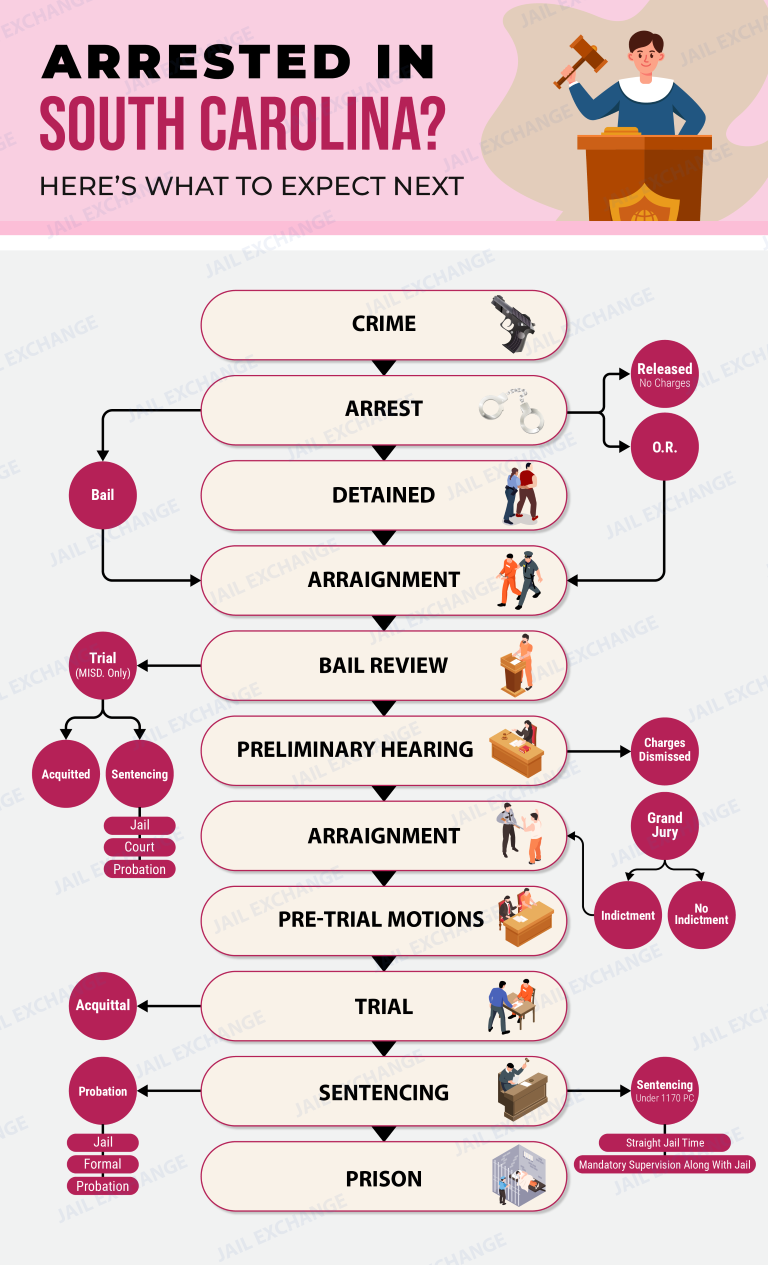
Criminal Court Process for Charleston County South Carolina
Charleston County Criminal Court Guide
People charged with a crime in Charleston County wait for court at the Sheriff Al Cannon Detention Center, 3841 Leeds Ave., North Charleston, SC 29405. Its Tower A has eight housing units, while Towers B and C add 21 more along with medical care, an infirmary and visiting space. Teens are held apart at a juvenile detention center. This guide covers magistrate, city and circuit courts and every step from bond court to sentencing.
Check custody on the official inmate lookup. It also links to the state's court records search. Our Inmates in Custody page stays with the arrest itself: the latest jail intakes, plain-English charge details, warrants on file, booking pictures, court-appointed counsel and claiming property.
Then call the court. For a felony, ring the Clerk of Court at 843-958-5000. For a smaller charge, the magistrates answer at 843-202-6600. Ask for the case number and hearing date, and keep both somewhere handy. When release matters most right now, our bail page walks you through bond.
1. Magistrate, city or circuit court: who hears what?
In South Carolina, the most a judge could give for a charge decides where it is heard.
- Summary courts are the magistrate and city courts. They try charges with a top penalty of a $500 fine, 30 days in jail or both (S.C. Code 22-3-550; S.C. Code 14-25-65). Shoplifting of $2,000 or less also stays here, with fines up to $1,000. A jury in magistrate court has six people (S.C. Code 22-3-545). These courts also hold bond hearings and preliminary hearings.
- The Court of General Sessions handles criminal matters for the circuit court. It tries felonies and bigger misdemeanors, always in the county where the alleged crime happened.
- Family Court hears most charges against people under 18.
This county shares the Ninth Judicial Circuit with Berkeley County (S.C. Code 14-5-610). That means one Circuit Solicitor and one circuit public defender serve both.
↑ Back to the question list2. Where are the Charleston County criminal courthouses?
Early hearings take place on Leeds Avenue, beside the jail. Felony trials move to Broad Street downtown.
- Centralized Bond Court, 3831 Leeds Avenue, Suite 200, North Charleston, SC 29405. Sessions run weekdays at 10 a.m., 2 p.m. and 6 p.m., and weekends and holidays at 10 a.m. and 2 p.m.
- Centralized Preliminary Hearing Court, 3831 Leeds Avenue, Suite 100, North Charleston, SC 29405. It meets daily.
- Summary Court office, 4045 Bridge View Drive, Suite B143, North Charleston, SC 29405, 843-202-6600. This number serves all three magistrate sites above.
- Clerk of Court for General Sessions, 100 Broad Street, Suite 106, Charleston, SC 29401, 843-958-5000. Open Monday to Friday, 8:30 a.m. to 5 p.m.
- Family Court clerk, 100 Broad Street, Suite 143, Charleston, SC 29401, 843-958-4400.
Plan for the security line at each building, and arrive early.
↑ Back to the question list3. Which Charleston County towns run a Municipal Court?
Town courts hear tickets and minor charges written inside town limits. The ones with confirmed contact details:
- City of Charleston Municipal Court, 180 B Lockwood Boulevard, Charleston, SC 29403, 843-724-7460. Open 8 a.m. to 5 p.m. Its bond court sits weekdays at 9:00 a.m. and 2:00 p.m., and weekends and holidays at 8:30 a.m. and 10:30 a.m. Cases for people still in jail are heard by video Monday to Thursday at 3 p.m. and Friday at 8:30 a.m.
- Sullivan's Island Municipal Court, Town Hall, 2056 Middle Street, Sullivan's Island, SC 29482, 843-883-5734. Court meets on the first two Tuesdays of each month at 3 p.m.
- Folly Beach court business goes through City Hall, 21 Center St., Folly Beach, SC 29439, 843-588-2447.
- Seabrook Island court business goes through Town Hall, 2001 Seabrook Island Road, Seabrook Island, SC 29455, 843-768-9121.
- Ravenel Town Hall, 5962 Highway 165, Suite 100, Ravenel, SC 29470, 843-889-8732. Ask for the court clerk.
Mount Pleasant, North Charleston, Isle of Palms, Kiawah Island and Hollywood cases also start in local courts. Call the Summary Court office at 843-202-6600 for the right address.
↑ Back to the question list4. Bond court on Leeds Avenue: what happens there?
Bond court comes first, within 24 hours of the arrest (S.C. Code 22-5-510). A magistrate presides, or a city judge for a city case.
- The judge reads out the charges.
- The arresting agency gives the court the person's record, open charges, incident reports and any bonds already in place.
- The judge sets a bond and its rules, or sends a murder or life-sentence charge on to a circuit judge.
- Nobody pleads guilty or not guilty yet.
- Victims have a right to be there and speak.
- A person with little money can start the public defender paperwork in that courtroom.
When the charge is above a magistrate's trial power, the defense may demand a preliminary hearing. That demand is due within 10 days after the bond hearing (Rule 2(a), SCRCrimP). A magistrate then checks if the state has enough evidence to keep the case going.
↑ Back to the question list5. How do shoplifting and simple assault cases move?
Most small charges stay in magistrate or city court from start to finish. A typical case runs like this:
- The person gets a ticket or an arrest warrant, then a bond.
- The court sets a trial date.
- The person pleads guilty or asks for a trial. A judge alone can decide it, or six jurors can.
- A judge decides the sentence after a guilty plea or verdict.
Common local charges and their top penalties:
- Third-degree assault and battery: up to $500, 30 days or both (S.C. Code 16-3-600(E)(2)).
- Shoplifting of $2,000 or less: up to $1,000, 30 days or both (S.C. Code 16-13-110(B)).
- A Class C misdemeanor tried in General Sessions: up to one year. Class B allows two years and Class A three (S.C. Code 16-1-20).
Young adults ages 17 to 20 facing a first alcohol charge may qualify for the Alcohol Education Program. Its fee is $250, and it can be lowered (S.C. Code 17-22-550). Ask the Solicitor's office.
↑ Back to the question list6. How does a Charleston County felony case move forward?
Felonies begin in magistrate court and finish in the Court of General Sessions.
- Arrest and bond court. Bond is set within a day. For the most serious charges, a circuit judge sets it instead.
- Preliminary hearing. It must be requested within 10 days of bond court (Rule 2(a), SCRCrimP). It is held at 3831 Leeds Avenue, Suite 100, North Charleston, SC 29405.
- Solicitor's review. The Circuit Solicitor decides what charges to pursue and whether to offer a plea deal or diversion.
- General Sessions. The case is heard downtown, where it ends in a plea, a dismissal or a trial.
- Sentencing. The judge sets the term within the limits for the crime's class.
Top prison terms by class (S.C. Code 16-1-20): Class A, 30 years; B, 25; C, 20; D, 15; E, 10; F, 5. Theft from a store above $2,000 counts as a felony too: five years at most if under $10,000, and ten years at most beyond that.
First-time, nonviolent defendants can ask about Pretrial Intervention. Finishing it ends in a dismissal, and the person can then seek an expungement (S.C. Code 17-22-150). Fees are a $100 application fee plus a $250 participation fee, and both can be waived for those who can't pay (S.C. Code 17-22-110).
↑ Back to the question list7. Why do violent charges follow stricter rules?
State law names a set list of violent crimes, including murder, attempted murder, armed robbery, carjacking, kidnapping, first- and second-degree burglary and some drug trafficking (S.C. Code 16-1-60). That label changes the case at several points:
- Bond. A magistrate may refuse bond for a listed violent crime. When death or life in prison is a possible punishment, as with murder, only a circuit judge may set bond.
- Diversion. Pretrial Intervention is closed to violent crimes and to DUI (S.C. Code 17-22-50).
- Repeat charges. Getting charged with another violent or gun felony during release on bond wipes out the first bond automatically. A circuit court hearing follows within 30 days (S.C. Code 17-15-55(C)).
- Extra charge. A violent crime committed while on bond for another one is a separate felony worth up to five years (S.C. Code 17-15-270).
- Murder. Punishment is either death or a prison term of 30 years up to life (S.C. Code 16-3-20(A)).
Because the stakes are so high, get a lawyer involved as early as you can.
↑ Back to the question list8. Who are the Solicitor and public defender here?
The prosecutor is the Ninth Circuit Solicitor's Office. It handles General Sessions cases in both counties of the circuit.
- Main office: O.T. Wallace Building, 101 Meeting Street, Charleston, SC 29401, 843-958-1900.
- Berkeley County office: 300-B California Avenue, Moncks Corner, SC 29461, 843-719-4529.
- Its diversion services include Pretrial Intervention, the Alcohol Education Program and juvenile arbitration. Diversion is offered at the Solicitor's choice.
The defense is free for those with too little money to hire counsel. The public defender takes the case after the person swears to their finances on a form. A $40 fee applies, and the clerk can cut it or drop it (S.C. Code 17-3-30).
- Public Defender, 101 Meeting Street, 5th Floor, Charleston, SC 29401, 843-958-1850.
- South Carolina Commission on Indigent Defense, 1330 Lady Street, Suite 401, Columbia, SC 29201, 803-734-1343.
9. How do I track a General Sessions or magistrate case?
Start online, then confirm by phone.
- The county inmate lookup shows charge details, booking status and release dates. It also has a link to the state court records search for case details.
- For General Sessions dates, call the Clerk of Court at 843-958-5000.
- For magistrate cases, call the Summary Court office at 843-202-6600.
- For city cases, call the city court at 843-724-7460.
Clerks find a file faster with the legal name, date of birth and a case or warrant number. Watch out for texts or letters titled "Final Notice - Court Enforcement Action" with a QR code. City police warn these are a scam, and the city does not send such demands.
↑ Back to the question list10. How do I find a Charleston County warrant and get it cleared?
Both deputies and city police serve arrest and bench warrants in this county. Search the Sheriff's warrant search, or call the Sheriff's Office at 843-202-1700 and ask for warrants. Wider lists: the U.S. Marshals 15 Most Wanted page, along with the Probation, Parole and Pardon Services most wanted page. To clear one, hire or phone a lawyer first. Next, surrender to whichever judge signed it, or phone that judge's office about rescheduling. Felony warrants are handled by the Clerk of Court, 100 Broad Street, Suite 106, Charleston, SC 29401, 843-958-5000.
↑ Back to the question list11. How do federal charges from Charleston County proceed?
Federal charges go to the U.S. District Court for the District of South Carolina, Charleston Division. Cases are heard at the J. Waties Waring Judicial Center, 83 Meeting Street, Charleston, SC 29401, 843-579-1401. The office keeps weekday hours, 8:30 a.m. to 4:30 p.m.
- At the first federal hearing, a Charleston Division judge picks release or pretrial jail (18 U.S.C. 3142). Defense counsel can ask to put that off five days at most, and federal prosecutors three.
- Until trial, the person stays a U.S. Marshals prisoner. Their office is at 85 Broad Street, Room 260, Charleston, SC 29401, 843-727-4255. Staff can say where the person is housed.
- Once a prison term is set, look the person up on the Federal Bureau of Prisons inmate locator.
12. How does an I-247A detainer touch the state case?
The criminal case and the immigration matter move on two tracks. In order:
- The Leeds Avenue jail gets Form I-247A, a detainer issued by Immigration and Customs Enforcement (ICE).
- The form allows a hold of up to 48 hours after they would otherwise be released (8 CFR 287.7(d)).
- When the state case stops holding the person, ICE may take them.
- Check the ICE Online Detainee Locator. It needs a name with a birth country, or an A-number.
South Carolina jails must find out, within 72 hours of booking someone on a criminal charge, whether that person is unlawfully present. If so, the Department of Homeland Security gets notice (S.C. Code 23-3-1100). Bond judges also weigh unlawful presence and flight risk (S.C. Code 22-5-510(D)(4)). A plea can carry immigration effects, so tell the defense lawyer about any hold early. The ICE office for the state is at 3950 Faber Place Drive, North Charleston, SC 29405, 843-746-9800.
↑ Back to the question list13. Where do sentences of more than three months go?
A term of up to three months is usually served locally (S.C. Code 24-3-30). For longer terms, the South Carolina Department of Corrections takes over and chooses the place (S.C. Code 24-3-20).
- First comes reception and evaluation, a sorting stage with no in-person visits unless it lasts beyond 30 days.
- After that, the person is assigned to a prison.
- Find them on the state inmate search, which is current as of the past midnight.
- Corrections headquarters: 4444 Broad River Road, Columbia, SC 29210, 803-896-8500.
- Read our guide to South Carolina state prisons.
14. How are charges against a Charleston County teen handled?
Most charges against minors go to Family Court. Seventeen-year-olds are handled as adults when the charge is a serious felony, meaning Class A through D or one punishable by 15 years or more (S.C. Code 63-19-20(1)).
- Youths held here go to the Charleston County Juvenile Detention Center, run by the Sheriff's Office. Call 843-202-1700 to reach it.
- Within 48 hours a judge must decide if detention continues. Weekend and holiday hours are skipped in that count (S.C. Code 63-19-830).
- For a serious felony, a judge may send a 14-, 15- or 16-year-old's case up to General Sessions after a hearing (S.C. Code 63-19-1210).
- Family Court clerk: 100 Broad Street, Suite 143, Charleston, SC 29401, 843-958-4400.
- Department of Juvenile Justice county office: 3887 Leeds Ave., North Charleston, SC 29405, 843-740-1649.
15. What rights do crime victims have?
The state constitution gives victims the right to be told of the arrest and of any bond hearing, and to speak there (S.C. Const. art. I, § 24). Police must try to reach the victim first. If notice came too late, the judge must delay the bond hearing (S.C. Code 16-3-1525).
- Free custody alerts come from VINELink South Carolina, or by phone at 866-727-2846, in English or Spanish.
- The Attorney General's Victim Advocacy Division helps at 803-737-3739, 1000 Assembly Street, Room 519, Columbia, SC 29201.
Relatives should keep clear of the victim, even indirectly through friends. Contact can violate bond conditions and bring new charges.
↑ Back to the question list