Conway is the county seat of Horry County, the state's largest county by land area and home to the Grand Strand, where millions of visitors a year add to the local caseload. A network of county magistrate offices and seven city and town courts handles minor offenses and sets bond after arrests, while felonies and serious misdemeanors are tried in the Court of General Sessions at the Horry County Government and Justice Center in Conway. Horry and Georgetown counties form the Fifteenth Judicial Circuit, and the Fifteenth Circuit Solicitor prosecutes General Sessions cases from both. Adults arrested anywhere in the county end up at the Sheriff's detention center outside Conway.
- Horry County Clerk of Court (General Sessions and Family Court), Government and Justice Center, 1301 Second Avenue, Conway, SC 29526, (843) 915-5080
- Horry County Magistrate Court, central office, 1201 Third Avenue, Conway, SC 29526, (843) 915-5290
- Fifteenth Circuit Solicitor's Office, prosecutor for Horry and Georgetown counties, based in Conway
- Fifteenth Circuit Public Defender, Horry County office, (843) 915-5385
- J. Reuben Long Detention Center (Horry County Sheriff's Office), 4150 J. Reuben Long Avenue, Conway, SC 29526, (843) 915-5140
Which court hears your case. Horry County's Magistrate Court is the summary court for unincorporated areas such as Carolina Forest, Socastee, Garden City and Little River. Its jurisdiction covers offenses punishable by no more than 30 days or a $500 fine (some statutes allow up to $1,000), first-offense DUI and shoplifting of $2,000 or less; magistrates also issue warrants, hold bond court and preliminary hearings. Seven Municipal Courts, from North Myrtle Beach to Surfside Beach and inland to Conway, Aynor and Loris, try ordinance violations and summary-level state charges that occur inside city or town limits. Felonies and higher misdemeanors go to the Court of General Sessions once the Horry County grand jury indicts.
Where pretrial inmates are held. The J. Reuben Long Detention Center, on J. Reuben Long Avenue in Conway, is the county's jail. The Horry County Sheriff's Office runs it, and it receives prisoners from county police, beach city departments, the Highway Patrol and other agencies. City police may hold someone briefly at their own station first. A magistrate holds bond court at the detention center every day, and anyone who does not make bond remains there pending trial. The detention center's main number is (843) 915-5140.
- Local courts in Horry County (magistrate and municipal courts)
- The Government and Justice Center and other court buildings
- What happens after an arrest in Horry County
- The J. Reuben Long Detention Center
- The Fifteenth Circuit Public Defender in Horry County
- The Solicitor, diversion programs and specialty courts
- Misdemeanor (for example, shoplifting, a first DUI, third-degree assault and battery, trespassing)
- Felony (for example, burglary, grand larceny, drug distribution, first-degree assault and battery)
- Violent felony (for example, murder, criminal sexual conduct, armed robbery)
- Juveniles (under 18) arrested in Horry County
- Federal cases (U.S. District Court) from Horry County
Local courts in Horry County (magistrate and municipal courts)
Horry County spreads its magistrates across the county so that residents of Green Sea or Little River are not forced to drive to Conway for every matter. Specialized dockets (traffic, jury trials and domestic violence) meet at the central Conway office, and bond court and night court are held at the J. Reuben Long Detention Center. Office locations change from time to time, so call before going.
Magistrate courts (county)
- Detention Center Magistrate (bond court and night court) — 4150 J. Reuben Long Avenue, Conway, SC 29526, (843) 915-5145
- Conway Magistrate (central office) — 1201 Third Avenue, Conway, SC 29526, (843) 915-5290; central traffic court (843) 915-5070; jury court (843) 915-5065. Criminal domestic violence court also meets here.
- Myrtle Beach Magistrate — Olin I. Blanton Jr. County Office Building, 1201 21st Avenue North, Myrtle Beach, SC 29577, (843) 915-5293
- Surfside / South Strand Magistrate — South Strand Office Complex, 9630 Scipio Lane, Myrtle Beach, SC 29588, (843) 915-5291
- Little River Magistrate — 107 Highway 57 North, Little River, SC 29566, (843) 915-5292
- Loris Magistrate — 3817 Walnut Street, Loris, SC 29569, (843) 915-5295
- Green Sea Magistrate — 5527 Highway 9, Green Sea, SC 29545, (843) 915-5294
- Aynor Magistrate — 640 Ninth Avenue, Aynor, SC 29511, (843) 915-5296
Municipal courts
- Myrtle Beach Municipal Court — Ted C. Collins Law Enforcement Center, 1101 North Oak Street, Myrtle Beach, SC 29577, (843) 918-1356
- North Myrtle Beach Municipal Court — Public Safety Building, 1015 Second Avenue South, North Myrtle Beach, SC 29582, (843) 280-5610
- Conway Municipal Court — 1001 Third Avenue, Conway, SC 29526, (843) 248-1765
- Surfside Beach Municipal Court — 115 U.S. Highway 17 North, Surfside Beach, SC 29575, (843) 913-6337
- Atlantic Beach Municipal Court — 717 30th Avenue South, Atlantic Beach, SC 29582, (843) 663-2284
- Loris Municipal Court — 3817 Walnut Street, Loris, SC 29569, (843) 756-6674
- Aynor Municipal Court — 600 South Main Street, Aynor, SC 29511, (843) 358-6231
Visitors ticketed during a trip often ask whether they must come back for court. Many summary offenses can be resolved by paying the fine listed on the ticket, which counts as a conviction, but a DUI or any charge requiring an appearance does mean returning or hiring a local lawyer. A six-person jury is available in every one of these courts, and appeals go to the Circuit Court in Conway.
The Government and Justice Center and other court buildings
Most felony court business in Horry County takes place at the Government and Justice Center, 1301 Second Avenue in Conway. The building houses the General Sessions and Common Pleas courtrooms, the Family Court, the Clerk of Court's office and county administrative offices. Arraignments, plea hearings and jury trials in General Sessions are all held there, and the Clerk's criminal division keeps the indictments, release orders and sentencing sheets.
Bond court is not held at the Justice Center. For most arrests it happens at the J. Reuben Long Detention Center, sometimes by video from the jail to the magistrate's courtroom, and families who want to attend or speak should arrive early and bring identification. Magistrate jury trials and traffic court meet at the central magistrate office on Third Avenue, a short walk from the Justice Center.
Plan for security screening at every court building, and leave knives, pepper spray and other prohibited items at home. Parking near the Conway buildings can fill on trial days. Clerk staff cannot give legal advice but can confirm dates and courtrooms by phone at (843) 915-5080.
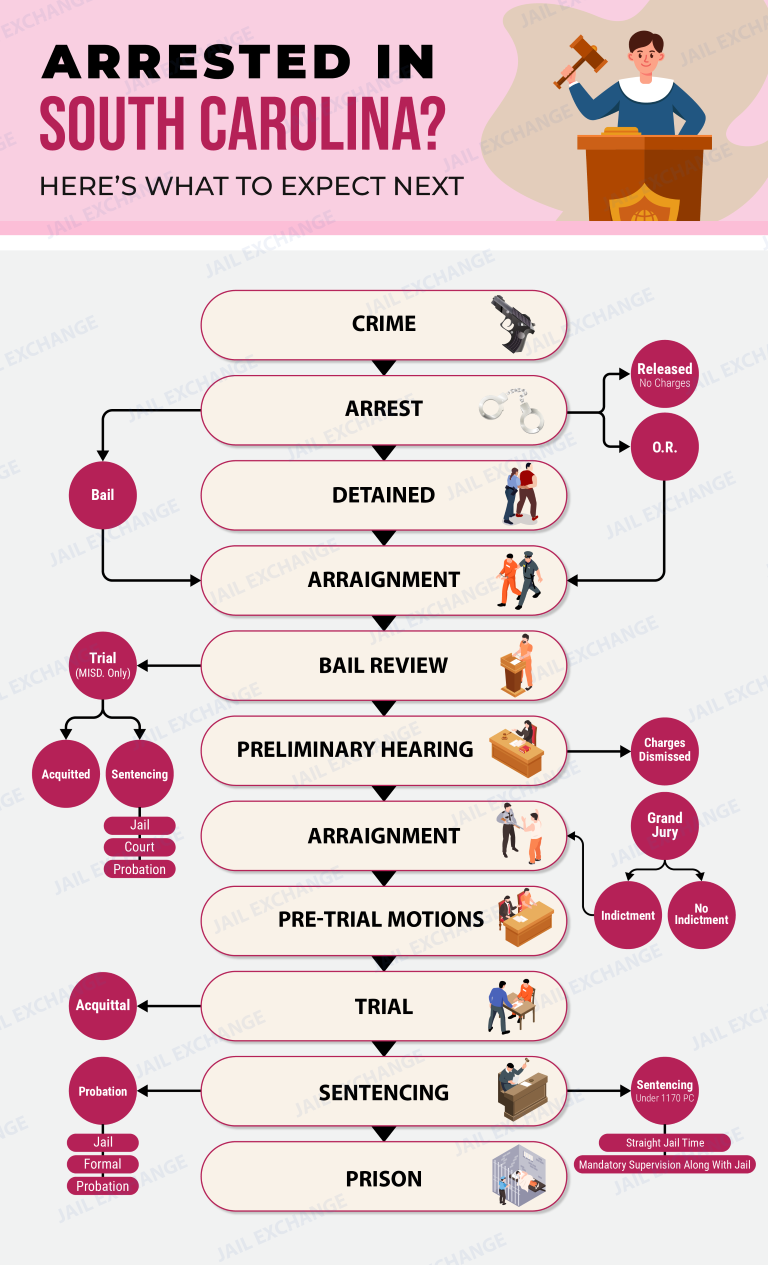
What happens after an arrest in Horry County
- Arrest and transport. Officers from Horry County Police, the Sheriff's Office, the Myrtle Beach, North Myrtle Beach and Conway police, smaller town departments, the Highway Patrol or SLED take the person into custody. Some departments hold people briefly before transport.
- Booking. At the J. Reuben Long Detention Center, staff record identifying information, fingerprints and a photograph, inventory property and check for other warrants. Booking can take hours on busy summer weekends.
- Bond hearing. Within 24 hours, a Horry County magistrate holds a bond hearing. The judge reads the charges, sets the type and amount of bond and any conditions, and allows victims to be heard. Release can be on a personal recognizance bond, a cash bond, or a surety bond posted by a licensed bondsman. For murder and other charges carrying life or death, only a circuit judge can set release terms.
- Applying for a lawyer. The court gives detainees a chance to request appointed counsel, and the application goes to the Fifteenth Circuit Public Defender.
- Preliminary hearing. On a General Sessions charge, the defendant may request a preliminary hearing within 10 days of the bond hearing. A magistrate decides whether there is probable cause.
- Grand jury and General Sessions. The Solicitor seeks an indictment from the Horry County grand jury, and the case is placed on a General Sessions roster for plea or trial.
Summary-court charges skip the grand jury entirely and go to trial or plea in magistrate or municipal court. People released on bond must keep their address current with the court and appear at every date; missing court leads to a bench warrant and can mean losing the bond.
The J. Reuben Long Detention Center
The J. Reuben Long Detention Center sits at 4150 J. Reuben Long Avenue in Conway. It is operated by the Horry County Sheriff's Office and holds both pretrial detainees and people serving shorter county sentences. Summer arrests from the beach towns can push its population up quickly.
- Main line: (843) 915-5140 for custody status, release times and general questions.
- Bond court: the on-site magistrate office, (843) 915-5145, can explain when a person's hearing will be held and how to post bond once it is set.
- Mail, phones and visits: rules on mail, video visitation, deposits and phone accounts are set by the detention center and its contractors and change periodically; ask the facility before sending money or items.
A person held on a General Sessions charge stays at the detention center until bond is posted, the case ends, or a judge modifies release conditions. After a prison sentence, the person is transferred to the South Carolina Department of Corrections.
The Fifteenth Circuit Public Defender in Horry County
Public defense in South Carolina is organized under the Commission on Indigent Defense, which funds a Circuit Public Defender in each judicial circuit. The Fifteenth Circuit Public Defender's Horry County office, (843) 915-5385, represents eligible adults in General Sessions and juveniles in Family Court, and its lawyers also appear in summary court when a defendant faces jail.
- Applying: the application is made through the court, often at bond court or the first appearance, and asks about income, assets and household size.
- Fee: state law provides for a $40 application fee, which the court can waive or reduce for people who cannot pay it.
- Conflicts: when the office cannot take a case, for example because it represents a co-defendant, the court appoints a private attorney.
Anyone who can afford a lawyer may hire private counsel at any stage. Whatever the choice, it helps to have a lawyer before the preliminary hearing deadline, which falls 10 days after the bond hearing.
The Solicitor, diversion programs and specialty courts
The elected Fifteenth Circuit Solicitor and a staff of assistant solicitors decide which charges to indict, what pleas to offer and which cases to divert. The office also runs a victim services unit that notifies victims of hearings, including bond hearings, and helps them take part.
Diversion programs
- Pretrial intervention (PTI). Available to many first-time defendants charged with nonviolent offenses. Participants pay a fee, follow a supervised plan that may include restitution, classes and community service, and have the charge dismissed when they finish. Some charges, including many violent crimes and DUI, are excluded by law.
- Alcohol education program (AEP). For certain alcohol-related summary offenses, such as underage possession, completion leads to dismissal.
- Traffic education program (TEP). Eligible drivers can complete a class to have some traffic tickets dismissed rather than paying a conviction on their record.
- Juvenile arbitration. First-time juvenile offenders can resolve some charges before a trained community volunteer instead of in Family Court.
Specialty courts
The Fifteenth Circuit has operated treatment-based courts, including a drug court, and Horry County has offered other problem-solving dockets such as mental health court. These programs combine supervision, treatment and frequent court check-ins in exchange for a reduced or dismissed charge. Eligibility, waiting lists and the programs themselves change, so a defense lawyer should ask the Solicitor's Office which programs are currently accepting participants.
Misdemeanor (for example, shoplifting, a first DUI, third-degree assault and battery, trespassing)
Misdemeanor arrests in Horry County rise sharply in late spring and summer, when bike weeks, beach traffic and nightlife along Ocean Boulevard bring DUI, open-container, disorderly conduct and shoplifting charges. Many are written on tickets payable before the court date. A custodial arrest means a ride to the J. Reuben Long Detention Center in Conway for booking.
Release
The magistrate at bond court sets a personal recognizance, cash or surety bond within 24 hours. Out-of-state visitors are sometimes asked for a cash bond because they live far away, and the court may allow a bond to be forfeited as payment of the fine on some charges. For domestic violence, a no-contact order is standard.
Trial and representation
Police officers usually present their own cases in magistrate and city court, and the Solicitor's Office may prosecute DUI and domestic violence charges. A defendant facing possible jail who cannot afford a lawyer can apply for the Fifteenth Circuit Public Defender, (843) 915-5385; a $40 application fee may be required unless waived. The case can be tried before the judge or a six-member jury.
Penalties
- Shoplifting of $2,000 or less: up to 30 days in jail or a fine; repeat offenses climb toward felony levels.
- Third-degree assault and battery: at most 30 days and $500.
- Trespassing: at most 30 days and $200.
- First DUI: for a blood alcohol level under .10, 48 hours to 30 days in jail (or 48 hours of public service), a $400 fine before assessments, a six-month license suspension with an ignition interlock option, and ADSAP. At .10 to .16, and at .16 or higher, minimum jail and fines go up. Refusing the breath test carries a separate administrative suspension, and out-of-state drivers can see the suspension reported to their home state.
Horry County summary cases close through dismissal, conditional discharge, PTI, the alcohol education program, fines, probation or jail. Some outcomes can later be expunged. Most are finished within one to three months, though jury-trial requests can stretch that.
Felony (for example, burglary, grand larceny, drug distribution, first-degree assault and battery)
Horry County carries one of the larger General Sessions dockets in South Carolina. Felony cases are charged on a magistrate's warrant, prosecuted by the Fifteenth Circuit Solicitor and heard at the Government and Justice Center in Conway, where General Sessions sits for much of the year.
Key stages
- Booking and release terms. After booking at the J. Reuben Long Detention Center, the accused appears at bond court within 24 hours. The magistrate sets bond and may add GPS monitoring, house arrest or no-contact orders.
- Preliminary hearing. The defense must request it within 10 days after the bond hearing. The magistrate decides only probable cause, but the hearing lets the defense hear the officer testify.
- Grand jury. The Horry County grand jury hears the Solicitor's evidence privately and votes on an indictment.
- Roster and pretrial work. Indicted cases go on the Solicitor's roster. Discovery, plea negotiations and motions proceed between appearances, and the case may be called several times before it ends.
- Plea or trial. Most felonies end with a plea. At trial, 12 jurors must reach a unanimous verdict.
Ranges for common felonies
- Burglary, second degree: up to 10 years, or up to 15 years for the violent form; first-degree burglary of a dwelling carries 15 years to life.
- Grand larceny: more than $2,000 but not more than $10,000, up to 5 years; over $10,000, up to 10.
- Drug distribution: set by the drug, the quantity and prior convictions. Fentanyl and other trafficking cases carry mandatory minimum terms.
- First-degree assault and battery: as much as 10 years; ABHAN, as much as 20.
South Carolina classifies felonies from A (up to 30 years) through F (up to 5 years), with some offenses carrying penalties set in their own statutes. A no-parole offense requires serving 85 percent before release. Prison terms are served with the Department of Corrections. First offenders may qualify for PTI or, in drug cases, treatment-based programs. Felony cases in Horry County commonly take one to two years.
Violent felony (for example, murder, criminal sexual conduct, armed robbery)
A defendant charged with murder or any crime punishable by life or death cannot get bond from a magistrate. A circuit judge holds that hearing, sometimes weeks after arrest, and the person is held at the J. Reuben Long Detention Center in the meantime. Laws passed in 2023 and 2024 added requirements for people charged with violent offenses while out on bond for another charge. Horry County Police and SLED handle many homicide investigations.
- Murder: 30 years to life without parole. Where the Solicitor seeks death, the jury chooses between death and life without parole; South Carolina resumed executions in 2024 by lethal injection, electrocution or firing squad.
- Criminal sexual conduct, first degree: a maximum of 30 years in prison and placement on the sex-offender registry.
- Armed robbery: 10 to 30 years under the no-parole 85 percent rule.
South Carolina's repeat-offender statute makes life without parole mandatory after a second "most serious" or third "serious" conviction. The state constitution's Victims' Bill of Rights guarantees victims notice, presence and a voice at bond, plea and sentencing, and the Solicitor's victim advocates help them use those rights. Violent felony cases in Horry County frequently last one to three years, and capital cases longer.
Juveniles (under 18) arrested in Horry County
Children under 18 who are charged with crimes in Horry County go before the Family Court at the Government and Justice Center in Conway. Since the 2019 "raise the age" law, 17-year-olds are generally in Family Court as well, with exceptions for certain serious charges.
Intake and the Solicitor
A Department of Juvenile Justice intake officer in the Horry County office reviews each referral, meets with the youth and parents and makes a recommendation to the Fifteenth Circuit Solicitor. The Solicitor may dismiss the case, send it to juvenile arbitration or another diversion program, or file a delinquency petition.
Detention
Youths who cannot be released to a parent are typically held at DJJ's Juvenile Detention Center in Columbia, a long drive from the coast, rather than in the adult jail. A Family Court judge must hold a detention hearing, usually within 48 hours of custody, not counting weekends and holidays, and can order release with conditions such as house arrest or electronic monitoring.
Possible outcomes
- Probation, restitution, counseling, community service or a supervised program.
- Commitment to DJJ for a determinate term, or an indeterminate commitment that can last until the 22nd birthday.
- Waiver to General Sessions: for an older juvenile, generally 14 or older, charged with a serious felony, the Solicitor can ask Family Court to transfer the case to adult court after a hearing.
Juvenile proceedings are confidential and many records can later be expunged. Youths who qualify are represented by the Public Defender's Horry County office, (843) 915-5385.
Federal cases (U.S. District Court) from Horry County
Federal charges from Horry County belong to the Florence Division of South Carolina's federal district court, and they are heard in Florence, roughly 65 miles inland from Conway. Florence has its own Clerk's Office, U.S. Attorney's office and Federal Public Defender office, all at 401 West Evans Street.
- McMillan Federal Building and courthouse — 401 West Evans Street in Florence (ZIP 29501), with the Clerk's Office at (843) 676-3820
- U.S. Attorney's Office, Florence — McMillan Federal Building, 401 West Evans Street, Room 222, Florence, SC 29501, (843) 665-6688
- Federal Public Defender, Florence — 401 West Evans Street, Room 221, Florence, SC 29501, (843) 662-1510
What makes a Grand Strand case federal
Federal prosecutors take cases that violate federal law and are investigated or referred by agencies such as the FBI, DEA, ATF, Homeland Security Investigations or the Secret Service. In Horry County that often means drug trafficking networks, felons with firearms, counterfeit currency and card fraud, online child exploitation, and crimes on federal property. Some cases begin with local police and are later adopted by the U.S. Attorney because federal penalties are stiffer.
Before trial
The first stop is a U.S. magistrate judge in Florence for an initial appearance, where the defendant learns the charges and receives appointed counsel if eligible. There are no bail bondsmen in the federal system. If the government moves for detention, a hearing follows, usually within three court days, and the judge applies the Bail Reform Act to either set release conditions supervised by U.S. Pretrial Services or order the person detained. When a complaint started the case, a grand jury indictment must come within 30 days of arrest, and the Speedy Trial Act sets a 70-day trial clock from indictment that judges often extend.
Resolution and sentencing
Most defendants plead guilty, usually under a written plea agreement. A jury trial requires a unanimous verdict from 12 jurors. U.S. Probation prepares a presentence report, the judge applies the advisory Sentencing Guidelines, and mandatory minimums set a floor for many drug and gun crimes. Federal sentences carry no parole; with good-conduct credit, prisoners serve about 85 percent in the Bureau of Prisons and then a term of supervised release. Appeals are taken to the U.S. Court of Appeals for the Fourth Circuit.
Finding someone in federal custody
Families can search the Federal Bureau of Prisons inmate locator by name or register number. A federal defendant held before trial in a county jail under a U.S. Marshals contract may also appear on that jail's own inmate roster. Defendants under 18 are rarely prosecuted federally.
This Horry County guide outlines the usual path of a criminal case and is not legal advice; schedules, office locations and programs in Conway and along the Grand Strand change over time. If you have been charged here, consult a defense attorney or call the Fifteenth Circuit Public Defender's Horry County office at (843) 915-5385, and confirm every court date with the clerk.