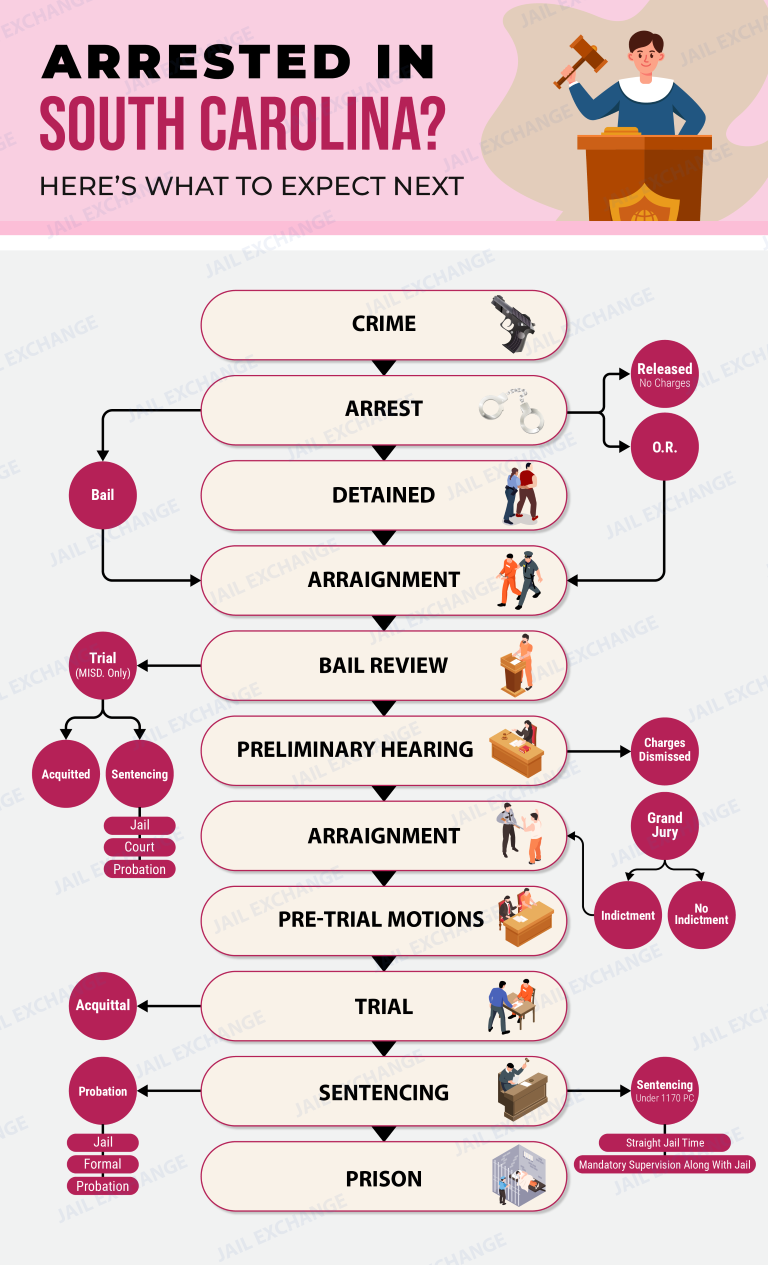
SCDJJ Juvenile Detention Complex Criminal Court Process
Criminal Court Process for Horry County South Carolina
Horry County Criminal Court Guide
Criminal cases in Horry County start in a magistrate or city court, and felonies climb to the Court of General Sessions at the Government and Justice Center, 1301 Second Avenue, Conway, SC 29526, 843-915-5080. Anyone kept in custody during a case stays at the J. Reuben Long Detention Center, 4150 J. Reuben Long Avenue, Conway, SC 29526, a Sheriff's Office jail of four buildings with an annex unit for women. This guide maps every courthouse and each step after arrest.
Search the J. Reuben Long booking and release log to see if the person is still held there. Our Inmates in Custody listing, built around arrest and custody, adds booking photos, charges, fresh bookings, appointed lawyers, current inmates, property pickup and outstanding warrants.
For a General Sessions case, ring the clerk's criminal desk at 843-915-5084. Get the case number, then ask when the next hearing is set. Until then, the steps for getting the person released are on our bond and release page.
1. Do summary courts or General Sessions take the case?
The size of the possible sentence picks the court. Magistrate and municipal courts, together called summary courts, try charges that carry no more than a $500 fine, 30 days in jail, or both (S.C. Code 22-3-550 and 14-25-65). A few laws stretch that limit. Shoplifting of $2,000 or less, for one, can stay in a summary court with a fine as high as $1,000 (S.C. Code 16-13-110).
Anything heavier belongs to the Court of General Sessions, the criminal side of circuit court. That covers every felony and the misdemeanors that carry more than 30 days or a $500 fine. Georgetown and this county together form the Fifteenth Judicial Circuit, so they share one Solicitor and one public defender office (S.C. Code 14-5-610).
Summary courts also run bond hearings and preliminary hearings for the bigger cases. That means most people stand before a magistrate first, whatever the charge.
↑ Back to the question list2. Courthouse addresses and phones across Horry County
The main courthouse and the clerk sit in Conway. Smaller courts are spread from Loris to the South Strand. Clerk offices keep weekday hours of 8:00 a.m. to 5:00 p.m.
- Government and Justice Center (General Sessions, Family Court, Clerk of Court), 1301 Second Avenue, Conway, SC 29526. Criminal desk 843-915-5084; Family Court desk 843-915-5081.
- Clerk of Court, Central Coast Complex, 332 Hinson Dr, Myrtle Beach, SC 29579, 843-915-5082.
- Bond court, Magistrate's Office at the Detention Center, 4150 J. Reuben Long Avenue, Conway, SC 29526, 843-915-5145. Hearings are usually at 9:00 a.m. and 2:00 p.m.
- Central Jury Court, for magistrate cases set for a jury, 843-915-5065.
- Central Traffic Court, 843-915-5070.
Seven magistrate offices take local cases. Call one to get its street address and hours:
- Aynor: 843-915-5296
- Conway: 843-915-5290
- Green Sea: 843-915-5294
- Loris: 843-915-5295
- Myrtle Beach: 843-915-5293
- South Strand: 843-915-5291
- Stephen's Crossroads: 843-915-5292
3. Which beach towns and cities hold municipal court?
A ticket or arrest by town police on a town charge usually goes to that town's court. Charges outside town limits go to a magistrate.
- Myrtle Beach Municipal Court, Ted C. Collins Law Enforcement Center, 1101 North Oak Street, Myrtle Beach, SC 29577, 843-918-1356. Its office is open 8:00 a.m. to 6:30 p.m. on weekdays and 9:00 a.m. to 5:00 p.m. on weekends, and it runs bond court every day.
- North Myrtle Beach Municipal Court, 1015 2nd Avenue S, North Myrtle Beach, SC 29582, 843-280-5520, open 8:00 a.m. to 5:00 p.m. Fines can be paid through the city's ticket payment page.
- Conway Municipal Court, 229 Main Street, Conway, SC 29526, 843-248-1765. Bench trials happen each week and jury trials every three months.
- Surfside Beach Municipal Court, office at 210 U.S. Highway 17 South, Surfside Beach, SC 29575, 843-913-6337, weekdays 8:00 a.m. to 5:00 p.m. Court meets at the Dick M. Johnson Civic Center, 829 Pine Dr, Surfside Beach, SC 29575, with bench trials at 4:30 p.m. on two Wednesdays a month.
- Loris Municipal Court, Public Safety Building, 3909 Walnut Street, Loris, SC 29569. Court meets once a month at 5:00 p.m. Fines go to the clerk at Loris City Hall, 4101 Walnut Street, Loris, SC 29569, 843-756-4004 (choose option 3).
- Atlantic Beach Municipal Court, 1010 32nd Avenue S, Atlantic Beach, SC 29582, 843-628-1863. Dockets run monthly.
- Aynor: the town's police and court share trials and bond hearings. Call Aynor Town Hall at 843-358-6231 for court dates.
For a Briarcliffe Acres charge, ask the Clerk of Court at 843-915-5080 which court has the case.
↑ Back to the question list4. Inside the first bond hearing at the jail
Within 24 hours of arrest, the person sees a judge for a bond hearing (S.C. Code 22-5-510). For jail cases, a magistrate holds it at the Detention Center, 4150 J. Reuben Long Avenue, Conway, SC 29526, 843-915-5145, most often at 9:00 a.m. or 2:00 p.m. Here is what to expect:
- The magistrate reads the charges aloud and decides the release terms.
- The arresting agency hands the court the person's record, other pending charges and any bonds they are already out on (S.C. Code 22-5-510(E)).
- A crime victim has the right to be told ahead of time and to speak (S.C. Code 16-3-1525).
- If money is short, this is the moment to ask for a public defender.
Next comes a choice that is easy to miss. On a charge too big for a magistrate to try, the person may request a preliminary hearing. That request must come within 10 days of the bond hearing (Rule 2(a), SCRCrimP). A magistrate then decides if the state has enough evidence to move forward. Read the bond paperwork closely, because a missed date there can bring a bench warrant.
↑ Back to the question list5. How do assault, shoplifting and DV cases move in magistrate court?
A summary court case can end with a guilty plea, a bench trial before the judge, or a jury trial. A magistrate jury has six people (S.C. Code 22-3-545). Charges seen often in these courts, with the most a judge can give:
- Third-degree assault and battery: up to $500 and 30 days (S.C. Code 16-3-600(E)(2)).
- Shoplifting of $2,000 or less: up to $1,000 and 30 days (S.C. Code 16-13-110(B)).
- Classed misdemeanors heard in General Sessions: Class A misdemeanors can bring 3 years, Class B two years and Class C one year (S.C. Code 16-1-20).
Here, the Solicitor's Magistrate Court Division prosecutes every third-degree domestic violence case. It also handles DUI cases from the Highway Patrol and county police when the defense asks for a jury. Those jury cases are tried at Central Jury Court. A Domestic Violence Court meets once a month, and a case can take six months to a year.
A domestic violence victim who wants charges dropped must file an affidavit at the Solicitor's Office, and dismissal is not promised. Questions go to 843-915-5460.
↑ Back to the question list6. Steps in an Horry County felony case
Felonies run through the Court of General Sessions at 1301 Second Avenue, Conway, SC 29526. The usual path:
- Arrest and bond hearing. A magistrate sets bond within 24 hours, except on the charges only a circuit judge can bond.
- A lawyer. The person hires one or applies to the public defender.
- Preliminary hearing. If the person asked for one in time, a magistrate checks the evidence.
- Solicitor review. Prosecutors in the Fifteenth Circuit Solicitor's Office decide how to go forward and may offer diversion or a plea.
- Trial roster. Cases ready for court appear on the monthly General Sessions trial rosters. The statewide court calendar shows when each term sits.
- Plea or trial, then sentence.
State law sorts felonies by the most prison time allowed. The top tier, Class A, carries up to 30 years. Class B allows 25, C allows 20, D allows 15, E allows 10 and F allows 5 (S.C. Code 16-1-20). For a date or a filing, call the criminal desk at 843-915-5084.
↑ Back to the question list7. Why violent charges follow stricter rules
South Carolina keeps a fixed list of violent crimes. Among them are murder, attempted murder, voluntary manslaughter, kidnapping, carjacking, armed robbery, first- and second-degree criminal sexual conduct, and first- and second-degree burglary and arson (S.C. Code 16-1-60). A charge on that list changes several things:
- Bond. A magistrate may refuse bond. Here, three charges are bonded only by a circuit judge, on a hearing the Solicitor's Office schedules: murder, criminal sexual conduct with a minor, and being an accessory before the fact of murder.
- Deposits. The 10 percent cash deposit option is closed (S.C. Code 17-15-15).
- Repeat charges. A fresh violent or gun felony charge against someone still on bond for an earlier one voids that first bond by law and sets a circuit court hearing within 30 days (S.C. Code 17-15-55(C)). The new crime is also its own felony, worth up to five years (S.C. Code 17-15-270).
- Diversion. Pretrial Intervention is off limits for violent crimes (S.C. Code 17-22-50).
Murder carries 30 years to life in prison, or death (S.C. Code 16-3-20(A)).
↑ Back to the question list8. Where are the Solicitor and public defender offices?
The Fifteenth Circuit Solicitor's Office prosecutes General Sessions cases for this county and Georgetown County:
- Main office: 1301 Second Avenue, Conway, SC 29526, 843-915-5460, weekdays 8:00 a.m. to 5:00 p.m.
- Georgetown office: 401 Cleland Street, Georgetown, SC 29440, 843-545-3169.
The Fifteenth Circuit Public Defender's Office defends people who cannot pay for a lawyer, adults and children alike:
- Main office: 1300 Second Avenue, Suite 301, Conway, SC 29526, 843-915-5385, weekdays 8:00 a.m. to 5:00 p.m.
- Georgetown office: 401 Cleland Street, Georgetown, SC 29440, 843-545-3671.
To get one, the person swears to their money situation on the application form and pays the Clerk of Court a $40 fee, which can be cut or dropped for someone who cannot pay (S.C. Code 17-3-30). A letter naming the lawyer usually follows in about three weeks.
↑ Back to the question list9. Can an Horry County case end in dismissal?
Yes, through a diversion program the Solicitor's Office runs. Finishing one leads to a dismissal, and the person may then apply to clear the record (S.C. Code 17-22-150).
- Pretrial Intervention (PTI). For people 18 and older with no serious record who have never been in PTI. A magistrate or city judge case can be self-referred before its court date; a General Sessions case needs the Solicitor's referral. The fee is $350, paid by money order or card. Bring a photo ID and Social Security card. Call 843-915-5365. PTI is closed to DUI and violent charges (S.C. Code 17-22-50).
- Alcohol Education Program. For underage drinking charges, ages 17 to under 21 (S.C. Code 17-22-520).
- Traffic Education Program. For some minor traffic tickets.
- Drug Court. A joint program with Georgetown County for nonviolent people with a substance problem. It lasts 9 to 18 months.
- Mental Health Court. For people living with a serious mental illness.
- Youth programs. Juvenile Arbitration, CHANGE and a Juvenile Diversion Program for first-time, nonviolent young people. Call 843-915-8351.
After a PTI dismissal, the Solicitor's Office handles expungement of the dropped charges for a $285 fee.
↑ Back to the question list10. Finding a case number, roster or court date
These official tools show local court records:
- Public Index: search by name or case number for General Sessions, magistrate and Family Court cases.
- Court Rosters and Dockets: upcoming magistrate hearings.
- General Sessions trial rosters: the monthly list of felony cases called for court.
- Clerk of Court rosters page.
- Statewide traffic ticket search.
- Family Court case portal.
Court records list charges and dates, while jail status lives on the booking and release log. For help with a record, call the Clerk of Court at 843-915-5080 on a weekday.
↑ Back to the question list11. Warrant checks and surrender in Horry County
Deputies serve arrest and bench warrants across the county, and town officers serve them inside city limits. Ask the Sheriff's Warrant Division about an open warrant at 843-915-8347; its warrant information page gives a tip line too. Pending cases show on the Public Index. Wanted lists: PPP Most Wanted Offenders and U.S. Marshals 15 Most Wanted. Want it cleared? Bring an attorney and surrender at whichever court issued the warrant, or phone that court about rescheduling. For General Sessions warrants, contact the Clerk of Court, 1301 Second Avenue, Conway, SC 29526, 843-915-5084.
↑ Back to the question list12. How federal charges from the Grand Strand are handled
The Florence Division of the U.S. District Court for the District of South Carolina takes federal prosecutions arising here. Its courthouse is the McMillan Federal Building, 401 West Evans Street, Florence, SC 29501, and the clerk answers at 843-676-3820, weekdays 8:30 a.m. to 4:30 p.m.
- Detention hearing. The first appearance includes a ruling on pretrial release or detention. A delay is possible: the defense may request up to five days and prosecutors three (18 U.S.C. 3142).
- Custody before trial. The Marshals Service, not the county, picks the jail for a federal detainee awaiting trial. Its Florence office is at 401 West Evans Street, Suite 341, Florence, SC 29501, 843-662-0750.
- After sentencing. People sent to federal prison show up in the Federal Bureau of Prisons inmate locator.
13. What an immigration detainer means for the state case
Even with a detainer in place, the state charges keep going, and a paid state bond leaves the detainer standing. The steps:
- ICE sends J. Reuben Long its detainer paperwork, Form I-247A, requesting a hold.
- That hold may run up to 48 hours after they would otherwise be released (8 CFR 287.7(d)).
- ICE then takes the person into federal custody and chooses the place.
- On the ICE Online Detainee Locator, families type in a name and birthplace country. An A-number also works.
When J. Reuben Long books someone on a criminal charge, it gets 72 hours to verify whether that person is in the country lawfully, and must notify the Department of Homeland Security about anyone who is not (S.C. Code 23-3-1100). The bond judge must weigh unlawful presence and flight risk too (S.C. Code 22-5-510(D)(4)). If ICE moves the person, tell the defense lawyer at once so the state court knows. ICE's South Carolina office: 3950 Faber Place Drive, North Charleston, SC 29405, 843-746-9800.
↑ Back to the question list14. Local jail or state prison after a sentence?
Short terms are served locally. Anyone sentenced to 90 days or less on a criminal charge, or to any Family Court sentence, does the time at J. Reuben Long. State law puts sentences longer than three months in the custody of the South Carolina Department of Corrections (S.C. Code 24-3-20 and 24-3-30).
State prison begins with a reception and evaluation period. Visitors can't come in person during that period unless it runs longer than 30 days. The department then assigns a prison.
- Track the person on the SCDC incarcerated inmate search, which updates nightly.
- Reach SCDC at 4444 Broad River Road, Columbia, SC 29210, 803-896-8500. The SC VINE line for custody checks is 866-727-2846.
- See our guide to South Carolina state prisons.
- Probation after release is supervised from the state office at 1201 Third Avenue, Room 126, Conway, SC 29526, 843-915-4900.
15. How Family Court handles charges against teens
Family Court handles anyone under 18. The one exception is a 17-year-old whose felony ranks in the four highest classes or can draw a 15-year term (S.C. Code 63-19-20(1)). Family Court sits at 1301 Second Avenue, Conway, SC 29526, 843-915-5081.
- A child can spend at most six hours in an adult jail. Children ten and younger are never jailed (S.C. Code 63-19-820).
- Within 48 hours, a judge looks at whether detention should continue. Only weekdays that aren't holidays count toward that limit (S.C. Code 63-19-830).
- Youth who are detained go to the Juvenile Detention Complex, 1725 Shivers Road, Columbia, SC 29210, 803-896-9440 (visits line).
- DJJ's local office is at 1201 Third Ave., Suite 107, Conway, SC 29526, 843-915-8969.
- A hearing can send teens 14 to 16 facing serious felonies to General Sessions (S.C. Code 63-19-1210).
- The public defender represents children too. Parents sign the money form and owe the fee (S.C. Code 17-3-45).
The Solicitor's juvenile programs line, 843-915-8351, explains diversion for young people.
↑ Back to the question list16. Help for crime victims in Horry County
S.C. Const. art. I, § 24 gives crime victims several rights, including notice of bond hearings and a chance to speak at them. Officers have to make a reasonable try at notifying the victim of the arrest and the bond hearing. If that notice came too late, the judge must put the hearing off (S.C. Code 16-3-1525).
- Victim Services at the Detention Center, 4150 J. Reuben Long Avenue, Conway, SC 29526, 843-915-6915, open 8:00 a.m. to 5:00 p.m. every day. It schedules bond hearings when a victim is involved, helps with crime victim compensation forms and gives out the PIN for the jail's SAVIN release alerts.
- Solicitor's Victim Witness unit, 1301 Second Avenue, Conway, SC 29526, 843-915-5464.
- SC VINE: free custody alerts at VINELink South Carolina or 866-727-2846, in English and Spanish.
- Attorney General's Victim Advocacy Division, 1000 Assembly Street, Room 519, Columbia, SC 29201, 803-737-3739.
Anyone close to the accused should avoid the victim completely, including texts and social media, and should never relay messages through friends. Contact can break bond conditions and lead to new charges.
↑ Back to the question list