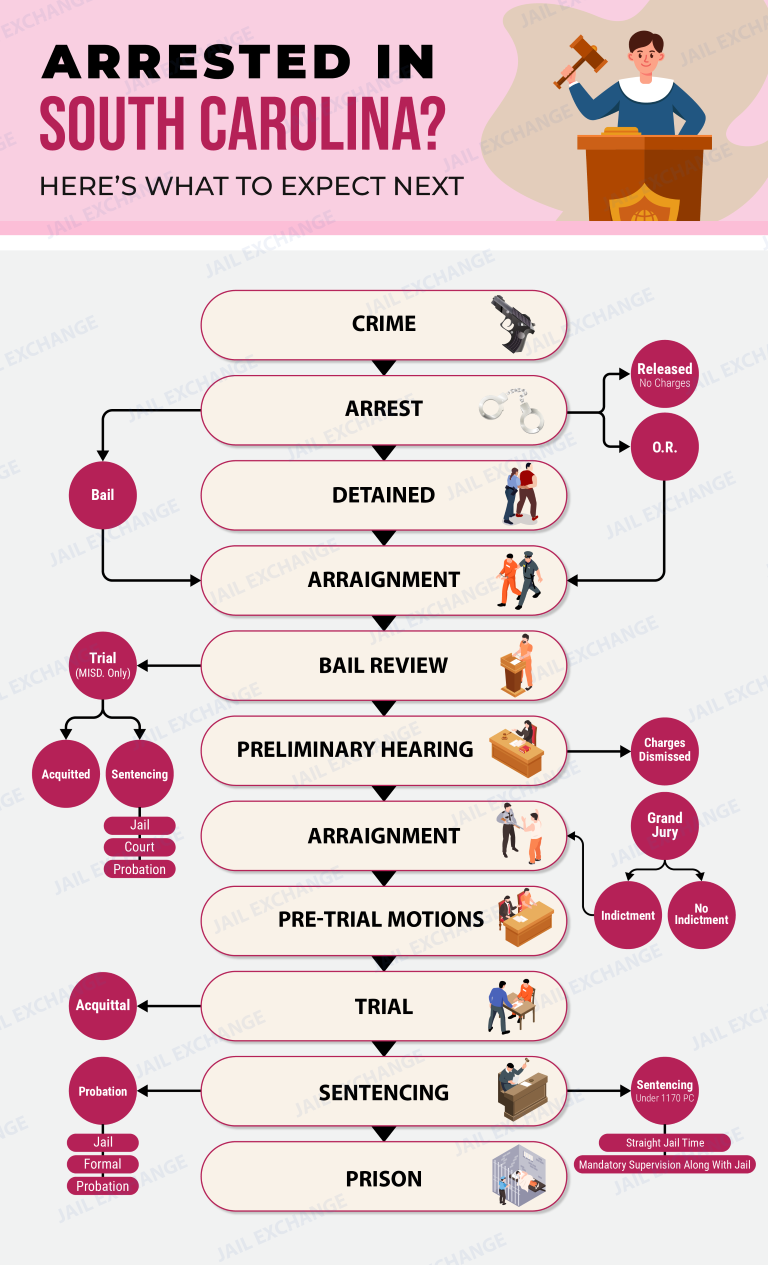
Newberry County Detention Center Criminal Court Process
Criminal Court Process for Newberry County South Carolina
Newberry County Criminal Court Guide
Criminal work here is split among three layers of court, and most of the buildings cluster near downtown. Adults facing charges are held at the Newberry County Detention Center, 3239 Louis Rich Drive, Newberry, SC 29108, the same place bond court meets. Below are the courthouse addresses, how a case moves from step to step, where the prosecutor and defender work, and notes on warrants, federal charges and teens.
To confirm custody, open the Sheriff's inmate search page. If the live search is paused, look for the weekly bookings report linked there. For the custody side, open our Inmates in Custody page: who is behind bars now, this week's bookings, booking photos, active warrants, charges, assigned defenders and getting property back.
On a felony, phone the Clerk of Court at 803-321-2110 to learn when the case may reach General Sessions. On a lesser charge, the Magistrate Court at 803-321-2144 can share the trial date. Our bail page explains how to win release before trial.
1. Magistrate, city or circuit court: who gets which charge?
Punishment decides the court. The bigger the possible sentence, the higher the court.
- Summary courts are the magistrate court plus the town and city courts. Their limit is a $500 fine, 30 days behind bars, or both (S.C. Code 22-3-550; S.C. Code 14-25-65). Shoplifting worth $2,000 or less is tried there too, with fines reaching $1,000 (S.C. Code 16-13-110). Juries in magistrate court seat six (S.C. Code 22-3-545).
- The Court of General Sessions handles the circuit court's criminal docket. Felonies and serious misdemeanors are tried in it, with trial held in whichever county saw the crime. Locally that means the Eighth Judicial Circuit, shared with Abbeville, Greenwood and Laurens.
- Family Court takes most cases of people under 18.
- Federal court deals only with crimes under federal law.
Summary judges also hold bond hearings and preliminary hearings, including on felonies they could never try.
↑ Back to the question list2. Where is each Newberry County courtroom, and when is it open?
Hours below are weekdays unless noted. Court days shift, so call first.
- Clerk of Court (General Sessions and Family Court): county courthouse, 1226 College Street, Newberry, SC 29108, 803-321-2110. Open 8:30 a.m. to 5:00 p.m. Mail goes to P.O. Drawer 10.
- Magistrate Court: 833 Main Street, Newberry, SC 29108, 803-321-2144. Open 8:30 a.m. to 5:00 p.m. Evening sessions begin at 5:00 p.m. on the month's second and third Wednesdays. A free booklet, Your Guide to Magistrates Court, explains the basics.
- Bond court: held at the Detention Center, 3239 Louis Rich Drive, Newberry, SC 29108, 803-321-2141, at 10:00 a.m. and 4:00 p.m. all seven days.
- Federal cases: heard in Anderson or Greenville. Anderson's courthouse: G. Ross Anderson, Jr. Federal Building, 315 South McDuffie Street, Anderson, SC 29624. Its clerk's calls are answered in Greenville, 864-241-2700.
Each town court gets its own entry in the next answer.
↑ Back to the question list3. Do Newberry, Prosperity and Whitmire keep town courts?
Yes. When town officers write a ticket or make an arrest inside town limits, the case usually stays in that town's court. Everything from outside the towns heads to the Magistrate Court.
- City Municipal Court: 1507 Nance Street, Newberry, SC 29108, 803-321-1010. Weekdays 8:30 a.m. to 5:00 p.m.; the payment window shuts at 4:30 p.m. City fines can be paid through its online fines page.
- Prosperity Town Court: Town Center, 250 School Drive, Prosperity, SC 29127. It sits on the first Wednesday of each month, town holidays aside, and the ticket shows the hour. For questions, reach the town's police at Town Hall, 305 N. Main Street, Prosperity, SC 29127, 803-364-2622.
- Whitmire and Little Mountain: to learn which court has a ticket from either town, call the Magistrate Court at 803-321-2144.
4. Bond court comes first: what does the judge do there?
Bond court at the jail comes first, no later than 24 hours after arrest (S.C. Code 22-5-510). Locally it is called at 10:00 a.m. and 4:00 p.m. each day. The judge names the charges, explains that the accused may have a lawyer, and fixes bond plus any conditions. Victims are entitled to notice and a chance to speak.
Felony charges above a magistrate's trial power open the door to a preliminary hearing, but only if the defense asks. The request must be made inside 10 days from bond court (Rule 2(a), SCRCrimP). A magistrate runs it. The question is simple: is there enough proof to move the case on to circuit court?
For the gravest charges, those that carry death or life, the bond decision waits for a circuit judge on a later day.
↑ Back to the question list5. How do assault and shoplifting tickets play out in summary court?
Two charges that show up often in summary court:
- Third-degree assault and battery: up to $500, up to 30 days, or both (S.C. Code 16-3-600(E)(2)).
- Shoplifting of $2,000 or less: up to $1,000, up to 30 days, or both (S.C. Code 16-13-110(B)).
After bond, a trial date arrives by mail or on paper at release. On that date, the accused may plead guilty, have the judge decide alone, or choose a six-member jury. To move a date, the magistrate's office wants a written request faxed to 803-321-2172. It no longer accepts those requests by email.
The Eighth Circuit Solicitor runs programs that can wipe a first slip off the books:
- Pretrial Intervention (PTI) for a first, nonviolent charge. In magistrate or city cases, it costs a $100 application fee by money order and $250 more once accepted.
- Alcohol Education Program, open from age 17 until the 21st birthday, for charges such as underage drinking ($250; S.C. Code 17-22-520 and 17-22-550).
- Traffic Education Program for minor traffic tickets.
6. Step by step through a Newberry County felony
Each felony class has a ceiling on prison time (S.C. Code 16-1-10; S.C. Code 16-1-20):
- Felonies: Class A tops out at 30 years, B at 25 years, C at 20 years, D at 15 years, E at 10 years and F at 5 years.
- Misdemeanors that carry a class: A tops out at 3 years, B at 2 years and C at 1 year.
The case starts with an arrest warrant and a bond hearing at the jail. Next comes a preliminary hearing, if the defense asks for one in time. Then the file moves to General Sessions at the courthouse on College Street. The Solicitor's Office prepares the General Sessions dockets, and the Clerk of Court keeps the records. It may wrap up through a plea deal, a dropped charge or a jury's decision.
A first-time, nonviolent defendant can ask the Solicitor about Pretrial Intervention. In General Sessions it carries a $350 participation fee, paid by money order. Completing the program gets the charge thrown out, and an expungement request can follow (S.C. Code 17-22-150). The circuit also runs a Drug Court; ask the Solicitor's Office whether the case fits.
↑ Back to the question list7. Violent charges: what rules tighten?
South Carolina names its violent crimes in one closed list (S.C. Code 16-1-60). Murder, attempted murder, kidnapping, armed robbery and carjacking are on it. First- and second-degree burglary and arson make the list as well. Anything left off the list is not treated as violent.
- Bond: a magistrate chooses between setting bond and saying no. If the law allows death or life in prison, only a circuit judge can act. A murder conviction brings death or at least 30 years, up to life (S.C. Code 16-3-20(A)).
- No shortcuts: the ten percent cash deposit and PTI are both closed to violent charges (S.C. Code 17-22-50).
- A new arrest while on bond: if the person, while bonded out on a violent or gun felony, is charged with another, that first bond is gone by law, and a circuit hearing follows inside 30 days (S.C. Code 17-15-55(C)). The fresh offense counts as an added felony too, up to five years (S.C. Code 17-15-270).
A first-degree burglary bond can still be heard in summary court unless the Solicitor objects (S.C. Code 17-15-10(B)).
↑ Back to the question list8. Solicitor and public defender offices near the courthouse
Prosecution. The Eighth Circuit Solicitor's Office tries General Sessions cases. Locally, its staff work at 1226 College Street, Newberry, SC 29108, 803-321-2123. Its main office is at 222 Phoenix Street, 2nd Floor, Greenwood, SC 29648, 864-942-8800.
Defense. The public defender shares the building at 1226 College Street, Newberry, SC 29108, 803-321-1435. A sworn money statement plus a $40 fee is the price of applying, though the clerk can trim or excuse it (S.C. Code 17-3-30). The statewide office that oversees public defenders is the South Carolina Commission on Indigent Defense, 1330 Lady Street, Suite 401, Columbia, SC 29201, 803-734-1343.
Asking for counsel right at bond court is wise. A slow start can burn through the 10 days allowed to request a preliminary hearing.
↑ Back to the question list9. Who can tell me the case number or hearing date?
Call whichever office holds the file. Spell out the name and give the birth date.
- Felonies and General Sessions: the Clerk of Court at 803-321-2110, 8:30 a.m. to 5:00 p.m. on weekdays.
- County misdemeanors and traffic: the Magistrate Court at 803-321-2144.
- City charges: the city Municipal Court at 803-321-1010.
The weekly bookings report on the Sheriff's inmate search page lists each new charge and how the person was released. Ask the defense lawyer for the next date too, since lawyers get notice of every hearing.
↑ Back to the question list10. How is a Newberry County warrant checked and cleared?
Deputies in the Sheriff's Warrant Division serve warrants from 550 Wilson Road, Newberry, SC 29108, 803-405-7706, weekdays 8:30 a.m. to 5:00 p.m. After hours, call 803-321-2222. Town officers handle warrants within their own limits. Links worth opening: the Warrant Division page, the federal government's U.S. Marshals 15 Most Wanted, and state probation's Most Wanted Offenders. Ask about a name by calling the division or whichever court signed the paper. A lawyer can arrange a planned surrender with the division, or the issuing court can give a fresh date. Felony papers go back to the Clerk of Court, 1226 College Street, Newberry, SC 29108, 803-321-2110.
↑ Back to the question list11. A federal charge instead: which court and which jail?
This county falls in the Greenwood Division of the U.S. District Court for the District of South Carolina, which the court pairs with Anderson. Hearings may be held in Anderson, where the G. Ross Anderson, Jr. Federal Building stands, 315 South McDuffie Street, Anderson, SC 29624, or in Greenville. Filings and questions go to Greenville's clerk, housed in Carroll A. Campbell, Jr. U.S. Courthouse, 250 East North Street, Greenville, SC 29601, 864-241-2700.
Detention is decided the moment the person first stands before the judge (18 U.S.C. 3142). Either side may seek a pause, but the law limits it: up to five days on the defense side, up to three for prosecutors. Marshals hold the defendant through trial. Their Greenville office, covering Anderson as well, is at 300 East Washington Street, Room 232, Greenville, SC 29601, 864-232-1566. After sentencing, the Federal Bureau of Prisons inmate locator shows where the person went.
↑ Back to the question list12. If ICE files a hold, what becomes of the state charges?
The state case keeps moving. The detainer mostly affects when and where the person walks out.
- A detainer request, ICE Form I-247A, lands at the jail.
- That hold can run up to 48 hours after they would otherwise be released (8 CFR 287.7(d)).
- Jails get 72 hours, starting at a criminal booking, for an immigration status check. A result showing unlawful presence goes on to the Department of Homeland Security (S.C. Code 23-3-1100).
- On the bond judge's list of must-consider items: being here unlawfully and posing a flight risk (S.C. Code 22-5-510(D)(4)).
- Once ICE has the person, relatives can use the ICE Online Detainee Locator.
If ICE moves the person and a state court date is missed, a bench warrant can follow, so the defense lawyer should alert the court quickly. ICE's South Carolina office: 3950 Faber Place Drive, North Charleston, SC 29405, 843-746-9800.
↑ Back to the question list13. Which prisons hold people sentenced here?
Anyone ordered to serve three months or less normally stays in the county jail (S.C. Code 24-3-30). Past that, custody passes to the South Carolina Department of Corrections (SCDC), which chooses the facility (S.C. Code 24-3-20). Now and then SCDC places someone in a county jail by agreement.
Before any prison is assigned, SCDC runs every newcomer through reception and evaluation. Relatives may not visit face to face in that period unless it goes beyond 30 days. Afterward, the SCDC inmate search gives the state ID number and the prison name. SCDC's main office is at 4444 Broad River Road, Columbia, SC 29210, 803-896-8500. Our South Carolina prisons page profiles each site.
↑ Back to the question list14. How does Family Court treat a Newberry County teen?
Family Court covers children, meaning anyone under eighteen. Seventeen-year-olds are pulled out of that group for felonies in Classes A, B, C and D, or for any felony with a possible 15 years or more; they begin in adult court (S.C. Code 63-19-20(1)). Family Court records sit with the Clerk of Court.
- An adult lockup may hold a youth for six hours, tops; for those ten and younger, jail is forbidden outright (S.C. Code 63-19-820).
- A detention hearing follows inside 48 hours, minus weekends and holidays (S.C. Code 63-19-830).
- For a teen of 14, 15 or 16 facing a grave felony, a hearing can end in transfer to General Sessions (S.C. Code 63-19-1210).
Teens ordered held are usually sent to the Juvenile Detention Complex, 1725 Shivers Road, Columbia, SC 29210, 803-896-9440. Local families can reach Juvenile Justice staff at 1309 College Street, Newberry, SC 29108, 803-276-8243.
↑ Back to the question list15. What does South Carolina promise to crime victims?
South Carolina's Constitution lists victims' rights, including notice of the case and a voice at every bond hearing (S.C. Const. art. I, § 24). Police must make a real effort to reach the victim about the arrest and the hearing early enough to come. Late notice forces the judge to delay the hearing (S.C. Code 16-3-1525).
- Sheriff's Office Victim Services: 803-405-7774, at 550 Wilson Road, Newberry, SC 29108.
- Attorney General's Victim Advocacy Division: 1000 Assembly Street, Room 519, Columbia, SC 29201, 803-737-3739.
- Free custody alerts by phone or text from VINELink South Carolina or at 866-727-2846, in English or Spanish.
Leave the victim alone. Any contact, even a message relayed by a cousin or friend, can be treated as breaking bond, and the accused could be rearrested.
↑ Back to the question list