
Oconee County Detention Center
Oconee County Detention Center
Jail Phone Number
864-638-4228Oconee County Inmate Search: Locating Someone Held in Walhalla
Whoever makes an arrest, from Seneca and Westminster to the small towns and lake coves, the ride ends at the Detention Center, 300 S. Church Street, Walhalla, SC 29691. The Sheriff's Office runs it, and it is the county's lone jail. Below, families can learn how to find someone there, then deal with bond, the charges, a lawyer, visiting, deposits and mail.
Begin on the Sheriff's current inmates list, a live roster of who sits in the jail today. The Sheriff cautions that entries shift quickly and can trail a fresh booking or release. Court files sit in a different system, run by the SC Judicial Branch.
Still stuck? Ring the jail at 864-638-4228, spell out the name and give the birthday, then ask about charges, bond and the next hearing. Our bond guide explains release, and our court guide tracks the case.
Read inmate search answers
 Read inmate search answers
1. Where's the Oconee County jail roster, and what does it show?
Two lists hang off the Sheriff's Inmate Search page. Here is a simple routine:
- Pull up the current inmates list.
- Hunt for the last name, then open that entry.
- Write down the booking date and any ID or booking number. With that number in hand, staff can find the file sooner.
- If the arrest was very recent, peek at the Sheriff's Arrest Report as well.
The Sheriff adds that a record might not match someone's status at this minute. Before you drive anywhere or pay anything, double-check with the Detention Center at 864-638-4228. A 2020 county plan says the building opened in 2015 with 111 cells and 192 beds.
↑ Back to the question list2. The name isn't on the roster. Now what?
Usually there's a plain explanation:
- Booking isn't done. Fingerprinting and paperwork happen before the roster catches up.
- They've left. Someone paid bond, or a judge ordered release.
- They were transferred. A different county, SCDC or a federal agency could hold them today.
- The spelling differs. Try other versions, like a nickname, a birth surname, or the middle name in front.
- They're a minor. Children don't stay in the adult jail for long.
- The arrest crossed a state line. Oconee touches both Georgia and North Carolina, and an arrest over there means a jail in that state.
For a fast answer, ring the jail at 864-638-4228. Weekdays from 8:30 a.m. to 5:00 p.m., detention administration also picks up at 864-638-4105.
↑ Back to the question list3. Might a nearby lockup have them instead?
Adults held by this county all stay in one building: the Detention Center, 300 S. Church Street, Walhalla, SC 29691, 864-638-4228. The 2020 county plan lists no annex, work camp or second site. If the arrest was near the Anderson or Pickens line, call these jails:
- Anderson County Detention Center, reached through the Anderson County Sheriff's Office, 305 Camson Road, Anderson, SC 29625, 864-260-4363
- Pickens County Detention Center, 701 S. Catherine Street, Pickens, SC 29671, 864-898-2940
Think the stop was in Georgia or North Carolina? Sheriff's dispatch at 864-638-4111 may be able to tell you which agency handled it.
↑ Back to the question list4. Are Oconee County booking photos shared?
Photos on the current inmates list may come and go, so don't plan on finding one. To request a booking photo, reach the Sheriff's Office of Public Information at 864-638-4199. State open-records law treats a jail's list of people held in the past three months as public (S.C. Code 30-4-30(D)(3)).
- Did the case end in dismissal, expungement or acquittal? If so, send any site showing that mugshot a certified letter with proof; it must remove the photo at no cost inside 30 days (S.C. Code 17-1-60).
- To get a picture immigration agents took, use the ICE records request page.
- Photos from a federal booking usually stay private, though the Marshals Service might share one to help catch a fugitive.
5. Can I sign up for a heads-up when they're released?
Yes. VINE is South Carolina's free notice system. Victims use it most, but any relative can use it to learn whether someone remains jailed, and in which facility. Sign up at VINELink South Carolina or phone 866-727-2846, which answers in English or Spanish.
- Nobody gets enrolled for you, so add the person yourself.
- When a victim asks, whoever holds the accused has to make a real effort to warn them before a release (S.C. Code 16-3-1530).
- For news the same day, phone the Detention Center at 864-638-4228 or reload the roster.
6. Who sets bond after an Oconee County booking, and how fast?
State law gives each arrested person a bond hearing in front of a magistrate or city judge no later than 24 hours after arrest, Saturdays and Sundays included (S.C. Code 22-5-510). Most charges allow bail. On a noncapital charge, release on a signed promise comes first, and the judge tacks on cash or conditions only if needed (S.C. Code 17-15-10).
- Phone the jail at 864-638-4228 to learn the hearing time and the bond amount.
- Bond may be paid in cash, written by a licensed bondsman, or posted as a 10 percent deposit if the judge permits it.
- Charges that carry death or life imprisonment send the bond question to a circuit judge.
- Once the money or paperwork is in, release has to happen inside four hours.
Our bail and bond page goes deeper into paying, bondsmen and getting money back.
↑ Back to the question list7. Which charges were filed, and by whom?
Staff at the jail, 864-638-4228, can read off each charge and name the agency behind it. At the bond hearing, the judge reviews the arresting officer's paperwork aloud.
After a case is opened, search for it through the record lookup on the SC Judicial Branch website. On felonies, the 10th Circuit Solicitor makes the final call on charges. That office sits at 205 W. Main St., Walhalla, SC 29691, 864-638-4294.
↑ Back to the question list8. Can a public defender meet them at the Walhalla jail?
Yes. When paying for a lawyer isn't possible, a judge can assign a public defender (S.C. Code 17-3-10). Applying takes a signed statement about income and bills, plus a $40 fee that the clerk may lower or excuse.
- Oconee public defender: 864-638-3133
- 10th Circuit Public Defender, 500 S. McDuffie St., Anderson, SC 29624, 864-260-4048
Hiring a private lawyer works too. Attorney meetings are among the services the Sheriff says detention deputies set up. A lawyer can arrange one by calling 864-638-4228.
↑ Back to the question list9. What are the two visiting options at the Detention Center?
- In the building. These visits cost nothing and run 30 minutes, with a cap of two per inmate each week. Book them online in advance through the scheduler linked on the Sheriff's jail page.
- From home by video. Use a laptop, smartphone or tablet. Each call is 30 minutes, and there's no weekly cap.
Masks are required in the visiting area; without one, staff will end the visit. For hours and the ID you'll need, call the jail at 864-638-4228. Our visiting guide offers broader tips.
↑ Back to the question list10. Which ways can family add money to a jail account here?
- The lobby kiosk stands by the front entrance. Feed it cash or use a credit card, and expect a fee each time.
- The web store run by the commissary vendor, linked from the Sheriff's jail page, takes deposits online.
- A money order by mail is allowed only from senders who live outside South Carolina. Address it to 300 S. Church Street, Walhalla, SC 29691, and put the inmate's name plus your return address on the envelope.
Commissary arrives each Friday, and relatives may also order snack packs. Our money guide and commissary guide cover fees and limits in general. Cash should never go in the mail.
↑ Back to the question list11. How do jail phone calls get paid for?
Outgoing calls go through the jail's phone provider, and someone has to fund them. Load a phone account through the pay-by-phone number, 888-984-1903. Home video visits use that same company.
Questions about rates, tablets or text messages go to the jail at 864-638-4228. Assume someone may be listening, and save the case talk for the lawyer. Check our jail phone guide for rates and rules, and our inmate messaging guide for e-messages.
↑ Back to the question list12. How should a letter to the Detention Center be addressed?
Use the address the Sheriff gives, with the inmate's full name on top:
Inmate's name, Oconee County Detention Center, 300 S. Church Street, Walhalla, SC 29691
- Letters, greeting cards and postcards get through.
- Photos go only to inmates the jail approves, so ask first.
- Add a return address, and leave cash out of every envelope.
Rules for books and magazines come from the jail at 864-638-4228. Our mail guide describes typical rules.
↑ Back to the question list13. Where does their stuff go after booking?
Anything taken at intake stays in jail storage, under the person's name, until they walk out. If you need to collect something on their behalf, phone 864-638-4228 beforehand. Find out whether they have to sign a release and when pickup happens. Then bring photo ID to 300 S. Church Street, Walhalla, SC 29691.
↑ Back to the question list14. Will the jail handle a medical problem or prescription?
Counties must give jail inmates basic needs, and that includes access to medical care (S.C. Code 24-5-80). The Sheriff's Office says detention deputies provide three daily meals and medical care. GED classes, religious services and drug and alcohol programs also appear on its list.
If your relative is sick, injured or on medication, call 864-638-4228 without delay. Be ready to name the drug, how often it's taken and whose prescription it is. For an emergency, call 911.
↑ Back to the question list15. Could someone have an Oconee County warrant?
Out in the countryside, Sheriff's deputies carry out warrants, while Seneca, Walhalla and Westminster officers serve them inside their towns. To check, call the Sheriff's non-emergency number, 864-638-4111, and ask for Records. Westminster police handle warrant service at 864-647-3222. Also scan two statewide lists: Probation, Parole and Pardon Services posts its Most Wanted Offenders, and there's the 15 Most Wanted page that federal marshals keep. A bench warrant can be confirmed by phoning the magistrate who signed it. Clearing it means calling a lawyer first, then surrendering at that court or asking it to reset the date. Reach the Chief Magistrate at 208 Booker Dr., Walhalla, SC 29691, 864-638-4125.
↑ Back to the question list16. Who can tell us the next court date?
Whichever court holds the case picks its dates. Phone the right one:
- Felony cases: Clerk of Court, county courthouse on West Main Street in town, 864-638-4280
- Chief Magistrate, 208 Booker Dr., Walhalla, SC 29691, 864-638-4125
- Seneca Magistrate, 207-A East North 1st St., Seneca, SC 29678, 864-888-1460
- Westminster Magistrate, 1606 E. Main St., Westminster, SC 29693, 864-647-5998
- Seneca Municipal Court, 225 E North 1st St., Seneca, SC 29678, 864-885-2731
- Walhalla Municipal Court, 101 E. Main St., Walhalla, SC 29691, 864-638-4341
Our court page follows a case from arrest to sentence.
↑ Back to the question list17. A federal hold: where would they be, and who decides?
Federal charges from the Upstate's far western edge land in the Anderson Division, which meets in the federal building at 315 South McDuffie Street, Anderson, SC 29624. Questions about those cases are answered by the Greenville clerk, 864-241-2700.
- Soon after arrest, a federal judge weighs custody against release at a detention hearing (18 U.S.C. 3142).
- While charges are pending, the Marshals Service picks the jail where the defendant waits. Its Greenville office: 300 East Washington Street, Room 232, Greenville, SC 29601, 864-232-1566.
- After sentencing, look them up in the Federal Bureau of Prisons inmate locator, by name or register number.
18. If ICE took custody, how is the person tracked down?
An immigration case usually moves through four steps:
- ICE can file Form I-247A. That paper, called a detainer, requests extra hold time past the person's release date.
- Staff may hold them up to 48 hours after they would otherwise be released (8 CFR 287.7(d)).
- Immigration officers pick the person up. South Carolina's ICE office is at 3950 Faber Place Drive, North Charleston, SC 29405, 843-746-9800.
- Search the ICE Online Detainee Locator. No match? ICE advises calling the field office.
State law adds its own step. Within 72 hours, a jail must look into the immigration status of each person it books on a criminal charge. If the check shows the person has no legal right to be here, Homeland Security is notified (S.C. Code 23-3-1100).
↑ Back to the question list19. Sentenced to SCDC: how do I track them down?
Anyone sentenced to over three months serves the time under the South Carolina Department of Corrections, known as SCDC (S.C. Code 24-3-20). Each new prisoner starts in reception and evaluation, then gets assigned to a prison.
- The SCDC inmate search reflects custody as of the prior midnight.
- A new SCDC number is issued in the first week after arrival.
- Headquarters: 4444 Broad River Road, Columbia, SC 29210, 803-896-8500.
- Our South Carolina prisons guide explains visiting and mail for each prison.
20. An Oconee County teen was picked up. What happens?
Anyone younger than 18 is handled by Family Court instead of the adult jail. State law caps a child's time locked in an adult jail at six hours. A judge then has 48 hours, skipping weekends and holidays, to hold a detention hearing (S.C. Code 63-19-820, 63-19-830). Youth who stay locked up are usually sent to the state's youth detention center in Columbia. To learn where a child is, phone the DJJ office at 203 Booker Dr., Suite B, Walhalla, SC 29691, 864-638-9537.
↑ Back to the question list21. Which Oconee County agency made the arrest: deputies, town police or troopers?
Census figures for July 1, 2025 put Oconee's population near 83,775. Officers from these agencies make arrests here:
- Sheriff's Office, 300 S. Church Street, Walhalla, SC 29691, non-emergency 864-638-4111. Deputies patrol outside town limits and cover Westminster, Salem and West Union when town officers are off shift.
- Seneca Police Department, 205 N Depot St., Seneca, SC 29678, 864-885-2718
- Walhalla Police Department, 864-638-5831. The city gives City Hall, 105 West South Broad Street, Walhalla, SC 29691, as its address.
- Westminster Police Department, 106 E. Windsor Street, Westminster, SC 29693, 864-647-3222. Its records window is open weekdays, 8:00 a.m. to 4:00 p.m.
- Salem and West Union police are small town forces. Reach either one through the Sheriff's dispatch line above.
- South Carolina Highway Patrol, Troop 3, 33 Villa Road, Suite 200, Greenville, SC 29615, 864-552-5000
Oconee County Bail and Release
An arrest in Seneca, Westminster, Salem, West Union or the countryside around them leads to one building: the Detention Center at 300 S. Church Street, Walhalla, SC 29691. It is Oconee's only jail, run by the Sheriff's Office. Below, find who sets bond, what each type costs, the offices that take payment and what may keep a person inside even after paying.
First confirm your loved one is actually being held there. The Sheriff's current inmate list names the people inside today. For more on custody, our Jail Roster page explains mugshots, open warrants, new bookings, property pickup, appointed lawyers and what each charge means.
Phone the Detention Center at 864-638-4228. Ask if bond has been decided, the amount, and what time the bond hearing starts. From there, our Oconee court guide tracks the case.
1. After an Oconee County arrest, who runs the bond hearing?
South Carolina law gives a judge 24 hours from the arrest to hold a bond hearing (S.C. Code 22-5-510). Saturdays, Sundays and holidays count toward those 24 hours. A magistrate hears most county charges. City judges also have the power to set and take bonds, so a city charge may go before one of them (S.C. Code 14-25-115).
The jail learns the hearing time after booking. Call 864-638-4228 to ask when it is. The Chief Magistrate's office is at 208 Booker Dr., Walhalla, SC 29691, 864-638-4125.
Some charges skip the magistrate. When a crime is punishable by death or life behind bars, such as murder, the bond must come from a circuit judge (S.C. Code 22-5-510(A)). Getting that hearing on the calendar often takes longer.
↑ Back to the question list2. Which bond types are open to a South Carolina judge?
For most charges, the starting point is release on the person's word alone (S.C. Code 17-15-10). A judge adds money or rules only when that word does not seem like enough. The options:
- Personal recognizance. The accused signs and goes home with no money down. A dollar figure is still written in, and it is owed if they miss court.
- Cash bond. The full sum is paid. That cash may go to the magistrate or city judge as a stand-in for the signed promise (S.C. Code 22-5-530).
- Surety bond. The family pays a fee to a licensed bondsman, who backs the full sum.
- Ten percent deposit. If the judge agrees, the Clerk of Court can accept a tenth of the bond in cash. Judges can't use this when the charge is violent, or when a gun felony was committed while already out on bond (S.C. Code 17-15-15).
- GPS monitoring. An ankle monitor can replace bond money or be added on top of it (S.C. Code 17-15-35).
Any bond carries basic terms. The person must attend court, remain in South Carolina and keep the peace (S.C. Code 17-15-20).
↑ Back to the question list3. How is the bond amount picked for common charges?
The judge sets a figure for each person at the hearing. State law spells out what goes into that choice (S.C. Code 17-15-30):
- what the charge is, and its weight
- relatives nearby, work and finances
- years spent living in the area
- a criminal record, plus any skipped hearings
- other open charges, and whether they are already free on another bond
- a listing in the state gang database
- being in the country unlawfully while posing a flight risk
The arresting officers must give the judge the person's record before or during the hearing (S.C. Code 22-5-510(E)). The most time a charge can bring also weighs in:
- Third-degree assault and battery: up to $500, 30 days, or both (S.C. Code 16-3-600(E)(2))
- Shoplifting worth $2,000 or less: up to $1,000, 30 days, or both
- Shoplifting over $2,000 but under $10,000: a felony with up to five years (S.C. Code 16-13-110(B))
- Felony classes: Class F up to 5 years, Class D up to 15, Class A up to 30 (S.C. Code 16-1-20)
- Murder: 30 years to life, or death (S.C. Code 16-3-20(A))
After the hearing, phone the Detention Center at 864-638-4228 to learn the amount in your case.
↑ Back to the question list4. How does paying bond at the Walhalla jail work?
The Detention Center sits at 300 S. Church Street, Walhalla, SC 29691, in the Law Enforcement Center it shares with the Sheriff's Office. Once bond is delivered, the jail must release the person within four hours (S.C. Code 22-5-510(B)). Take these steps:
- Call 864-638-4228. Spell out their legal name and give the birth date.
- Find out the bond amount, which charge it covers, and whether it is cash, surety or a 10 percent deposit.
- Ask where the money must go: the jail, the magistrate who set it or the Clerk of Court.
- Ask what forms of payment that office accepts and whose name belongs after "Pay to" on a money order.
- Have photo ID with you, and save each receipt you are given.
For questions the front line can't settle, try the detention administration office at 864-638-4105. Sheriff's Office hours are 8:30 a.m. to 5:00 p.m., Monday through Friday.
↑ Back to the question list5. Do magistrates or the clerk take bond money?
Yes. Under state law, cash can be handed to a magistrate or city judge instead of a signed pledge (S.C. Code 22-5-530). The Clerk of Court handles 10 percent deposits. Each office sets its own steps, so call before you drive over:
- Chief Magistrate's office, 208 Booker Dr., Walhalla, SC 29691, 864-638-4125
- Seneca Magistrate, 207-A East North 1st St., Seneca, SC 29678, 864-888-1460
- Westminster Magistrate, 1606 E. Main St., Westminster, SC 29693, 864-647-5998
- Seneca Municipal Court, 225 E North 1st St., Seneca, SC 29678, 864-885-2731, open weekdays 8:00 a.m. to 5:00 p.m.
- Walhalla Municipal Court, 101 E. Main St., Walhalla, SC 29691, 864-638-4341
- Clerk of Court, at the county courthouse, 864-638-4280
On each call, confirm the amount, the kinds of payment taken there, and how quickly the release order reaches the jail.
↑ Back to the question list6. Which forms of payment do Oconee courts take?
The county's magistrate courts do not accept personal checks. For traffic tickets they take cash, or a money order or certified check made out to the court. Seneca Municipal Court takes cash, money orders, debit cards and credit cards at its window, at 864-885-2731. Mailed payments to Seneca need to be a cashier's check or money order.
The magistrate page sends ticket payers to the SC.gov state website. That link handles fines for tickets. Bond for someone sitting in jail goes through the jail or the court instead.
For bond, ask the jail at 864-638-4228 which payments it takes today before you leave home. Never mail cash.
↑ Back to the question list7. How do bondsmen work in Oconee County?
A bondsman guarantees the whole bond to the court so the person can leave jail. The family pays the bondsman a charge known as the premium. Every bondsman and runner must hold a license from the South Carolina Department of Insurance (S.C. Code 38-53-80).
- A bondsman may charge 15 percent of the bond at most. The smallest fee allowed is $100 or 10 percent, whichever is larger (S.C. Code 38-53-170(e)).
- A payment plan needs at least $100 down and can't run past 18 months.
- The premium is the bondsman's earnings, not a deposit. It is theirs to keep however the case ends.
- Anything pledged, like a car title, comes back within 10 days of the bond's end, except when a bench warrant is out.
- Bondsmen can't solicit business at the jail, a courthouse or a magistrate's office, and they may not push you toward a lawyer.
The Department's bondsman page explains licensing. Complaints go to 1201 Main Street, Suite 1000, Columbia, SC 29201, 803-737-6160.
↑ Back to the question list8. Could anything else keep them jailed once bond is paid?
Yes. Each bond is tied to one charge. Check for these too:
- More than one case. City and county charges are bonded one by one.
- Another place's warrant. A hold from another county or state calls for its own answer.
- Probation or parole. Breaking the terms may lead to a separate hold. The state probation office for Oconee is at 203 Booker Drive, Walhalla, SC 29691, 864-638-4255.
- An earlier bond. Suppose someone already freed while a violent felony or gun felony case is pending gets a new charge of that kind. The law then cancels the first bond right away. A hearing before a circuit judge follows within 30 days (S.C. Code 17-15-55(C)).
- A federal or immigration hold. Paying state bond does not end either one.
Before you hand over money, call the jail at 864-638-4228 and have staff check the person's file for every hold.
↑ Back to the question list9. When can a South Carolina judge refuse bond?
The state constitution protects most people's right to bail and bans bail that is too high (S.C. Const. art. I, § 15). After weighing the evidence, a judge may still say no in three kinds of cases:
- crimes punishable by death
- crimes punishable by life behind bars
- violent crimes named in the law, among them carjacking, armed robbery, kidnapping and first-degree burglary (S.C. Code 16-1-60)
Picking up a new violent charge while on bond for a past one brings its own felony charge, punishable by as much as five more years (S.C. Code 17-15-270).
The 10th Circuit Solicitor's office argues for high bond or no bond. Its Oconee office is at 205 W. Main St., Walhalla, SC 29691, 864-638-4294. Use the door on Short Street.
↑ Back to the question list10. Is a smaller bond possible after the hearing?
When a magistrate or city judge picked the amount, a circuit judge may review it again (S.C. Code 17-15-55). The court with the case can also change bond rules after notice and a hearing (S.C. Code 17-15-50). Here is how a family can help:
- Have the defense lawyer put a written request before the court.
- Gather proof of a job, a local home and family who count on the person.
- Show what the family can truly afford, and offer rules such as GPS monitoring.
- Come to the hearing ready to explain how the person will get to every court date.
The Solicitor gets notice and may argue against it. To ask how such a hearing is set, call the Court House line at 864-638-4280.
↑ Back to the question list11. Does Oconee County provide a lawyer for people who can't pay?
Anyone who can't afford to hire a lawyer can have one appointed (S.C. Code 17-3-10). Each applicant swears, in writing, to what they earn and owe. The application costs $40, though the clerk may cut or drop that fee for someone who has no way to pay it (S.C. Code 17-3-30).
- Oconee public defender office: 864-638-3133
- 10th Circuit Public Defender main office, 500 S. McDuffie St., Anderson, SC 29624, 864-260-4048, open weekdays 8:30 a.m. to 5:00 p.m.
- South Carolina Commission on Indigent Defense, 1330 Lady Street, Suite 401, Columbia, SC 29201, 803-734-1343
When the client is a child, the fee and the form fall to a parent or guardian (S.C. Code 17-3-45). Call early, since a lawyer can ask the court to review bond.
↑ Back to the question list12. Which courts handle Oconee County cases?
Each of these courts takes calls on business days:
- Court of General Sessions (felonies and serious misdemeanors), on West Main Street at the county courthouse. The Clerk of Court answers 864-638-4280.
- Chief Magistrate's office, 208 Booker Dr., Walhalla, SC 29691, 864-638-4125
- Seneca Magistrate, 207-A East North 1st St., Seneca, SC 29678, 864-888-1460
- Westminster Magistrate, 1606 E. Main St., Westminster, SC 29693, 864-647-5998
- Seneca Municipal Court, 225 E North 1st St., Seneca, SC 29678, 864-885-2731
- Walhalla Municipal Court, 101 E. Main St., Walhalla, SC 29691, 864-638-4341
- Federal court (Anderson Division), G. Ross Anderson, Jr. Federal Building and U.S. Courthouse, 315 South McDuffie Street, Anderson, SC 29624. With no clerk's office in that building, calls go to Greenville at 864-241-2700.
13. How do families get bond cash back, or lose it?
A court returns deposited cash after its purpose is served, which usually means the case has closed with every hearing attended. Whoever paid applies to that court for it (S.C. Code 17-15-220). A 10 percent deposit is repaid once all bond conditions are kept, though any restitution owed to a victim is taken out first (S.C. Code 17-15-15).
A missed court date changes the picture:
- The judge signs a bench warrant for the person's arrest.
- Missing court on purpose is a separate crime. For someone freed on a felony charge, it can mean up to five years and a $5,000 fine. If the misdemeanor itself could bring a year or longer, skipping court can mean up to one year and $1,000 (S.C. Code 17-15-90).
- When three months go by after that warrant without the bondsman surrendering the person, the court takes the bond (S.C. Code 38-53-70).
- The premium is the bondsman's to keep in every case.
To get cash back, ask the court that took it. For a General Sessions case, call the Clerk of Court at 864-638-4280.
↑ Back to the question list14. What happens to their jail account and personal things at release?
Whatever was in the person's pockets at intake is normally stored by the jail until release day. Before you head to 300 S. Church Street, Walhalla, SC 29691, call 864-638-4228. Ask how the jail pays out a leftover account balance and what time of day items can be collected.
Bring photo ID. Sending a friend or relative instead? Check whether the jail wants a signed note from the person being released. Our inmate account guide describes how money goes onto an account and how it comes back.
↑ Back to the question list15. Who decides whether a federal defendant goes home?
Federal crimes from Oconee belong to South Carolina's single U.S. District Court. Its Anderson Division, which also takes Anderson and Pickens cases, meets at the G. Ross Anderson, Jr. Federal Building and U.S. Courthouse, 315 South McDuffie Street, Anderson, SC 29624. That building has no clerk's office, so call the Greenville clerk at 864-241-2700.
- When the person first comes before a federal judge, the judge decides between jail and release. That step is called a detention hearing. Lawyers on either side may request a brief pause: the defense may receive as many as five days, the government only three (18 U.S.C. 3142).
- The person stays in custody during any delay.
- Federal defendants wait for trial in U.S. Marshals Service custody. Its Greenville office, which also covers Anderson, is at 300 East Washington Street, Room 232, Greenville, SC 29601, 864-232-1566. Ask there where the person is kept.
- After sentencing, find them with the Federal Bureau of Prisons inmate locator.
A federal release order stands apart from any state bond paid at the county jail.
↑ Back to the question list16. Can ICE still hold someone after bond is paid?
Yes. Bond money settles the state charge, and nothing more. A detainer comes from the federal government and runs on its own timeline:
- ICE (U.S. Immigration and Customs Enforcement) hands the jail a written detainer known as Form I-247A.
- With that detainer, the jail may keep the person up to 48 hours after they would otherwise be released (8 CFR 287.7(d)).
- Federal officers come for the person within that window and transfer them to an ICE site. The ICE office for South Carolina is at 3950 Faber Place Drive, North Charleston, SC 29405, 843-746-9800.
- Look for them on the ICE Online Detainee Locator. Searching by A-number is quickest. Lacking it, use the name and birth country.
State law adds two rules. Jails get 72 hours to look into the immigration status of each criminal booking, and those without lawful presence get flagged for the Department of Homeland Security (S.C. Code 23-3-1100). Judges setting bond are also told to consider unlawful presence and flight risk (S.C. Code 22-5-510(D)(4)).
↑ Back to the question list17. Who keeps someone sentenced to more than three months?
Terms of 90 days or under are mostly served right here in the county (S.C. Code 24-3-30). Anything longer sends the person to the South Carolina Department of Corrections (SCDC), and SCDC decides where they go (S.C. Code 24-3-20).
- New SCDC prisoners start with a reception and evaluation stage, and in-person visits pause until it ends, unless that stage lasts beyond 30 days.
- After that, they move to a prison that fits their needs.
- The SCDC inmate search shows state prisoners through the previous midnight. People in the county jail do not show there.
- SCDC headquarters: 4444 Broad River Road, Columbia, SC 29210, 803-896-8500. Custody alerts from SC VINE: 866-727-2846.
- Our South Carolina state prisons page has details on each prison.
18. What if police take an Oconee County teenager into custody?
South Carolina's Family Court handles most arrests of people younger than 18, who count as children under state law. There is one exception. Seventeen-year-olds charged with the most serious felony classes (A to D), or any felony carrying 15 years or more, go to adult court (S.C. Code 63-19-20(1)).
- A child can't be kept in an adult jail beyond six hours. Children 10 and younger are never jailed (S.C. Code 63-19-820).
- A detention hearing comes next, inside 48 hours; skip weekends and holidays when counting (S.C. Code 63-19-830).
- Most counties' youth are held at the Department of Juvenile Justice's Juvenile Detention Complex, 1725 Shivers Road, Columbia, SC 29210. Its visitation line is 803-896-9440.
- For serious felonies, teens 14 to 16 may be transferred to adult court after a judge hears the matter (S.C. Code 63-19-1210).
Call the DJJ office for Oconee to learn the child's location and hearing date: 203 Booker Dr., Suite B, Walhalla, SC 29691, 864-638-9537.
↑ Back to the question listOconee County Detention Center Inmate Visitation
Schedule through the CIDNET portal. Choose Oconee County Detention Center in Walhalla and look up the available times for the person you want to see.
- At the jail: The Sheriff allows two free 30-minute visits per week. Book online before going to 300 South Church Street, Walhalla. Check your booking for lobby and check-in instructions.
- From home: Book a 30-minute video visit using a phone, tablet or laptop. The Sheriff does not set a weekly limit on paid home visits; check the total shown in the portal before paying.
For questions about check-in or availability, call the jail at 864-638-4108. See the Sheriff’s detention instructions for its booking link.

CIDNET Video Visitation allows families to conduct live, face-to-face video visits with incarcerated loved ones from home. Using an internet-connected smartphone, tablet, or personal computer equipped with a webcam, visitors connect directly through housing-unit video stations or handheld tablets without traveling to the facility or waiting in jail visitor lobbies.
Important: Advance Registration and Visitor Clearance Required
Detention centers do not permit unscheduled or unverified video sessions. Correctional facilities require prospective visitors to submit government-issued photo identification and receive administrative clearance before booking an appointment, an approval process that can take up to 48 hours depending on facility staffing. You should verify your visitor approval status with the facility prior to scheduling. If you do not register well in advance, you will miss your loved one's scheduled visiting window for the week.
Step-by-Step Instructions to Register and Schedule a Video Visit
- Visit customer.cidnet.net or launch the CIDNET app.
- Register your visitor profile and upload a clear photograph of your government-issued ID and a verification photo.
- Wait for email notification confirming institutional visitor approval.
- Ensure your account has sufficient Data Points to cover the duration of the visit.
- Select Video Visitation, select the detention facility, and pick an available calendar time slot.
- Log into the website or mobile app 10 minutes prior to the start time on a device with a functioning camera, microphone, and stable high-speed internet connection.
What the Inmate Needs to Do
The inmate receives a schedule notification on their housing unit video kiosk or tablet. At the appointed time, they log in with their PIN and sit before the screen. Inmates and visitors must strictly observe jail dress and conduct rules; sessions are monitored by staff and will terminate immediately upon any violation.
Official Provider: CIDNET Customer Portal | Encartele Corporate
Customer Service Telephone: 1-888-984-1903
Support Hours: Monday – Friday, 8:00 AM – 5:00 PM CST
Supported Languages: English and Spanish
Other Services Provided by CIDNET
In addition to Remote Video Visitation, CIDNET provides several other communication channels:
- Data Points (Unified Funding): Purchase the central credits that power video visitation, calling, and messaging.
• Learn more on our website: CIDNET Data Points Guide | • Visit official vendor page: Buy CIDNET Data - Inmate Messaging & Digital Mail: Send electronic text messages and digital photo attachments directly to an inmate's terminal.
• Learn more on our website: CIDNET Messaging Guide | • Visit official vendor page: CIDNET Messaging Portal - Phone PINs & Voice Calling: Fund prepaid telephone calling so your loved one can call your mobile device.
• Learn more on our website: CIDNET Phone Calling Guide | • Visit official vendor page: CIDNET Voice Calling
Oconee County Criminal Court Guide
Adults charged in Oconee wait for court at the county Detention Center, 300 S. Church Street, Walhalla, SC 29691, the Sheriff's Office jail and the only one in the county. A case begins before a magistrate or city judge and may climb to the Court of General Sessions. This guide names each court, walks through a case and lists who to call.
Is your person still locked up? Check the Sheriff's roster of current inmates. Our Inmates in Custody page takes it from there: recent arrests, mugshots, active warrants, getting property back, public defenders and the charges.
Ring the jail at 864-638-4228. Learn which court holds the case, the bond hearing time and the next court date. Working on release before trial? Our bond and release page explains it.
1. Which Oconee County court takes a small charge, and which takes a felony?
South Carolina divides criminal work between summary courts and the circuit court:
- Magistrate courts try charges that carry a fine up to $500, jail up to 30 days, or both (S.C. Code 22-3-550). They also handle bond settings and the preliminary hearings for bigger cases. Oconee has three magistrate offices.
- Municipal courts in Seneca and Walhalla handle city charges under the same limits (S.C. Code 14-25-65).
- The Court of General Sessions sits as the criminal part of the circuit court. It hears felonies and heavier misdemeanors from the county.
- Family Court takes most cases against people under 18.
A shoplifting case worth $2,000 or less may stay in summary court, where the fine can reach $1,000 (S.C. Code 16-13-110). Oconee and Anderson make up the 10th Judicial Circuit (S.C. Code 14-5-610).
↑ Back to the question list2. Where are the criminal courts in Oconee County?
Call ahead before any visit. Each office here handles criminal matters:
- Court of General Sessions and Clerk of Court, county courthouse, West Main Street, Walhalla. Phone 864-638-4280. The Clerk indexes court records from 1994 forward for public research and sells copies in person or by mail. Staff can't give legal advice.
- Chief Magistrate, 208 Booker Dr., Walhalla, SC 29691, 864-638-4125
- Seneca Magistrate, 207-A East North 1st St., Seneca, SC 29678, 864-888-1460
- Westminster Magistrate, 1606 E. Main St., Westminster, SC 29693, 864-647-5998
Magistrates can also issue bench warrants. The office nearest the arrest is usually the one with the first hearing, so start your calls there.
↑ Back to the question list3. Do Seneca and Walhalla run city courts?
Yes. Two cities in the county run their own courts for arrests by city officers:
- Seneca Municipal Court, 225 E North 1st St., Seneca, SC 29678, 864-885-2731. Mail goes to P.O. Box 4773, Seneca, SC 29679. Hours are 8:00 a.m. to 5:00 p.m., Monday to Friday. At the window, Seneca accepts cash, money orders, and debit or credit cards for fines. Anything mailed in should be a cashier's check or money order.
- Walhalla Municipal Court, 101 E. Main St., Walhalla, SC 29691, 864-638-4341.
Westminster's city phone list sends court calls to the county magistrate there, at 864-647-5998. For a charge written in Salem, West Union or another small town, phone the Chief Magistrate at 864-638-4125 to learn which court has it.
↑ Back to the question list4. Inside the first bond hearing: what happens?
Every person arrested in South Carolina gets a bond hearing inside 24 hours, weekends included (S.C. Code 22-5-510). Here a magistrate or city judge usually runs it. The jail can tell you the time at 864-638-4228. During the hearing:
- The judge sets the bond and its conditions, using the record the arresting agency must supply (S.C. Code 22-5-510(E)).
- The victim has a right to advance notice and may speak (S.C. Code 16-3-1525).
- A person who has no money for a lawyer can say so and ask for the public defender.
- The magistrate has no power to set bond in a murder case, or in any case that could end in a death or life sentence. That bond waits for a circuit judge.
If the charge is too serious for a magistrate to try, a preliminary hearing is available on demand. The defense has a 10-day window, counted from the bond hearing (Rule 2(a), SCRCrimP). That hearing takes place in magistrate court. It tests whether the evidence is strong enough to send the case to General Sessions.
↑ Back to the question list5. Third-degree assault or shoplifting: how does a minor case play out?
Minor charges stay in the magistrate or city court where they were filed. The person pleads, and pleading not guilty means a trial is set. A magistrate jury has six members (S.C. Code 22-3-545). Penalties for common charges:
- Third-degree assault and battery: a fine up to $500, up to 30 days, or both (S.C. Code 16-3-600(E)(2))
- Shoplifting of $2,000 or less: up to a $1,000 fine, up to 30 days, or both (S.C. Code 16-13-110(B))
- Class C misdemeanor: up to 1 year; Class B: up to 2; Class A: up to 3 (S.C. Code 16-1-20). These larger misdemeanors are heard in General Sessions.
Young adults from 17 to under 21 facing some alcohol charges, such as underage possession or an open container, can apply to the Alcohol Education Program, which charges $250 that can be cut or waived (S.C. Code 17-22-520 and 17-22-550). For this and other diversion, call the 10th Circuit diversion line at 864-260-4042.
↑ Back to the question list6. How does a felony case reach a verdict here?
A felony case follows these stages:
- Bond hearing within 24 hours. A circuit judge handles bond for the gravest charges.
- Probable cause check. A preliminary hearing in magistrate court, if the defense asks in time.
- Prosecution in General Sessions. The 10th Circuit Solicitor takes the case forward in the circuit court at the county courthouse.
- Plea or trial. The person may plead guilty, accept a plea offer or ask for a trial.
- Sentencing by a circuit judge.
The felony class caps the prison time (S.C. Code 16-1-20). Class A carries the most, up to 30 years. Class F carries the least, up to 5. The classes in between step down five years at a time. Stealing goods worth more than $2,000 from a store is a felony. The cap is five years under $10,000 and ten years at $10,000 or more (S.C. Code 16-13-110(B)).
Some first-time, nonviolent defendants qualify for Pretrial Intervention. In this circuit it is a one-time chance for adults 18 and over without a significant record. It may require community service of up to 60 hours, drug tests, restitution and a letter of apology. Fees are $100 to apply and $250 to take part, and they can be waived for a person who can't pay (S.C. Code 17-22-110). Someone who completes it has the charge dismissed and may then apply for expungement (S.C. Code 17-22-150).
↑ Back to the question list7. Does a violent charge follow different rules?
The law lists certain crimes as violent, such as murder, armed robbery, kidnapping, carjacking and some burglaries (S.C. Code 16-1-60). A violent charge changes almost every step:
- Bond. For a listed violent crime, a magistrate decides, after weighing the evidence, whether to allow bond at all. A circuit judge alone sets bond where death or a life term is possible.
- No 10 percent deposit. That bond option is closed to violent charges (S.C. Code 17-15-15).
- Bond revoked. Say the person is out on bond for a violent crime and then faces a fresh violent or gun felony charge. The first bond ends by law. Within 30 days, the circuit court must hear the matter (S.C. Code 17-15-55(C)).
- Extra felony. Committing a second violent crime during a violent-crime bond adds a charge worth up to five years (S.C. Code 17-15-270).
- No PTI. Pretrial Intervention is off limits for violent crimes and DUI (S.C. Code 17-22-50).
- Murder. A conviction carries death, or prison for no less than 30 years and as long as life (S.C. Code 16-3-20(A)).
8. Who prosecutes Oconee cases, and who defends them?
The 10th Circuit Solicitor prosecutes General Sessions cases for both Anderson and Oconee. The Oconee office is at 205 W. Main St., Walhalla, SC 29691, entered from Short Street, 864-638-4294. Its mailing address is 415 S. Pine St., Walhalla, SC 29691. The Solicitor also runs the Oconee Drug Court at 864-364-5820.
To get a public defender, the applicant swears to a form about income and pays a $40 application fee. The clerk may reduce or waive that fee (S.C. Code 17-3-30). Defense offices:
- Oconee public defender: 864-638-3133
- 10th Circuit Public Defender, 500 S. McDuffie St., Anderson, SC 29624, 864-260-4048, weekdays 8:30 a.m. to 5:00 p.m.
- South Carolina Commission on Indigent Defense, 1330 Lady Street, Suite 401, Columbia, SC 29201, 803-734-1343
9. How do I look up an Oconee County case or court date?
The county's magistrate court page points people to the SC Judicial Branch website. Open its record search from the Quick Links and search by the person's name. That record shows the court case. It does not show which jail is holding the person.
A phone call also works. Each office will ask for a legal name and birthday, so keep both by the phone:
- General Sessions dates: Clerk of Court, 864-638-4280
- Chief Magistrate, 208 Booker Dr., Walhalla, SC 29691, 864-638-4125
- Seneca Magistrate, 207-A East North 1st St., Seneca, SC 29678, 864-888-1460
- Westminster Magistrate, 1606 E. Main St., Westminster, SC 29693, 864-647-5998
- Seneca Municipal Court, 225 E North 1st St., Seneca, SC 29678, 864-885-2731
10. How do we learn about a warrant, and then settle it?
In unincorporated areas Sheriff's deputies serve warrants; inside towns, city officers do. Call the Sheriff's Office at 864-638-4111 and ask Records whether a warrant is active. Westminster police, who handle warrant service in that city, answer at 864-647-3222. For statewide fugitives, check the Most Wanted Offenders list from the state probation agency and the national 15 Most Wanted page kept by the U.S. Marshals. A magistrate's office can also tell you by phone about a bench warrant it issued. A lawyer's advice comes first when clearing one. Next, the person goes in person to the court behind the warrant, or phones that court's clerk about resetting the date. The Chief Magistrate sits at 208 Booker Dr., Walhalla, SC 29691, 864-638-4125.
↑ Back to the question list11. Where does a federal arrest from Oconee go?
A federal arrest in Oconee lands in the Anderson Division of the U.S. District Court for the District of South Carolina. Its hearings use the G. Ross Anderson, Jr. Federal Building, 315 South McDuffie Street, Anderson, SC 29624. Questions go to the clerk's office in Greenville, 250 East North Street, Greenville, SC 29601, 864-241-2700, open 8:30 a.m. to 4:30 p.m. on weekdays.
- Detention gets decided at the opening federal court date. That judge chooses between conditions of release and jail until trial (18 U.S.C. 3142).
- From arrest to trial, the person stays a federal prisoner in U.S. Marshals Service hands. Its Greenville office, 300 East Washington Street, Room 232, Greenville, SC 29601, 864-232-1566, also covers Anderson.
- Once sentenced to prison, the person can be found with the Federal Bureau of Prisons inmate locator.
12. Can an immigration detainer stop a release in Oconee?
State charges move ahead whether or not ICE is involved. The detainer only matters once release is near:
- The jail receives Form I-247A, ICE's written detainer request.
- The jail can then hold the person up to 48 hours after they would otherwise be released (8 CFR 287.7(d)).
- ICE takes over custody during that time. South Carolina falls under ICE's office at 3950 Faber Place Drive, North Charleston, SC 29405, 843-746-9800.
- The ICE Online Detainee Locator finds people in ICE custody. Searches run on the A-number, or on the person's name and native country.
Under S.C. Code 23-3-1100, a jail must make a check within 72 hours on anyone booked on a criminal charge. Where the check shows unlawful presence, the jail must alert the Department of Homeland Security. The bond judge also weighs immigration status, if the person is unlawfully present, along with any chance they'd run (S.C. Code 22-5-510(D)(4)).
↑ Back to the question list13. Where do people sentenced in Oconee County serve their time?
Jail terms up to three months are normally served in the county jail (S.C. Code 24-3-30). Longer terms go to the South Carolina Department of Corrections (SCDC), which assigns the place (S.C. Code 24-3-20).
- SCDC sends every new prisoner through reception and evaluation, then on to a prison that suits them. Families should plan on no in-person visits during intake, unless intake lasts longer than 30 days.
- State prison custody as of the previous midnight shows on the SCDC inmate search. People held in a county jail won't appear there.
- SCDC, 4444 Broad River Road, Columbia, SC 29210, 803-896-8500
- Our South Carolina state prisons page describes the prisons one by one.
Probation after release is supervised by the state probation office at 203 Booker Drive, Walhalla, SC 29691, 864-638-4255.
↑ Back to the question list14. What court hears a teenager's charges?
Family Court hears cases against children, meaning anyone under 18 (S.C. Code 63-19-20(1)). The main exception covers 17-year-olds accused of one of the four top felony classes, A to D, or of any felony punishable by 15 years or more. Those cases go to General Sessions.
- A held child sees a judge at a detention hearing no later than 48 hours after custody begins; the count skips weekend days and holidays (S.C. Code 63-19-830).
- Adult court is possible for a 14- to 16-year-old charged with a serious felony, once a judge holds a transfer hearing (S.C. Code 63-19-1210).
- The 10th Circuit Solicitor runs Juvenile Arbitration, a diversion program, at 864-222-6694.
- Most detained youth in South Carolina are kept at the state's Juvenile Detention Complex, 1725 Shivers Road, Columbia, SC 29210, visitation line 803-896-9440.
The Department of Juvenile Justice office for Oconee is at 203 Booker Dr., Suite B, Walhalla, SC 29691, 864-638-9537.
↑ Back to the question list15. What can a crime victim count on in Oconee County?
Victims in this state hold rights written into the state constitution: notice of the arrest and of each bond hearing, a chance to speak at those hearings, and restitution (S.C. Const. art. I, § 24). Police are required to make a reasonable try at telling the victim about the bond hearing early enough to attend. When the warning comes too late, the hearing has to be delayed (S.C. Code 16-3-1525).
- Call 803-737-3739 for the Victim Advocacy Division in the Attorney General's office.
- VINELink South Carolina sends free custody alerts. Phone sign-up is 866-727-2846, in English or Spanish.
- For questions about a General Sessions case, call the Solicitor's Oconee office at 864-638-4294.
Never contact the victim, even through a friend, and never carry notes between them and the accused. Doing so can break the bond conditions the judge set.
↑ Back to the question list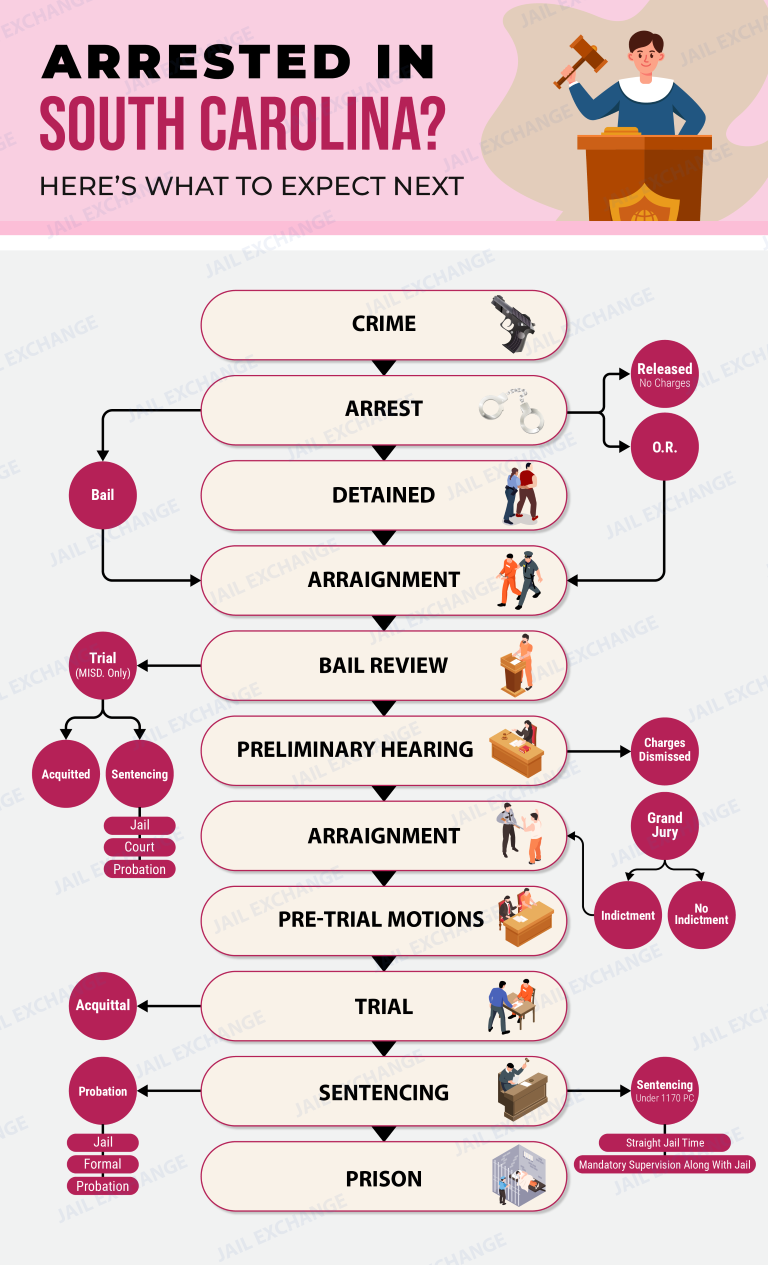
McDaniel Supply Company (operated online through the Jail Pack Store) allows family members and friends to purchase pre-approved commissary care packages, snack bundles, meats, personal hygiene kits, and apparel sent directly to an incarcerated loved one. Each package is packed to comply with individual detention center security standards, ensuring smooth intake and housing unit delivery.
Important: Package Deadlines and Delivery Windows Vary
Detention centers do not manage care package deliveries under identical schedules. While some facilities allow weekly orders, others restrict deliveries to bi-weekly or monthly distribution windows, and spending limits vary from jail to jail. You should verify the facility's active cutoff schedule and order allowances by calling them directly. If an order is submitted after the weekly processing deadline, delivery will be held until the following cycle, leaving your loved one waiting an extra cycle for fresh snacks, thermal wear, or personal care supplies.
Step-by-Step Instructions to Place a Commissary Package Order
- Confirm the inmate's legal first and last name, date of birth, and assigned booking or inmate ID number.
- Navigate to www.jailpackstore.com or mcdanielsupplyco.net.
- Select your state and detention center to open the jail's authorized merchandise catalog.
- Search for the inmate to link the purchase directly to their active housing record.
- Select allowable snack foods, candies, personal care goods, and clothing items up to the facility's allowed spending limit.
- Proceed to checkout, enter your debit or credit card billing details, and submit payment.
- Save your digital receipt and confirmation tracking number for your records.
What the Inmate Needs to Do
The inmate does not need an internet account to receive care packages. McDaniel Supply Company prepares the order in secure, tamper-evident packaging and delivers it directly to the jail commissary department. Facility staff inspect the shipment and deliver the items during regular housing unit commissary rounds, where the inmate signs for receipt.
Official Providers: Jail Pack Store | McDaniel Supply Company
Customer Service Telephone: 1-800-822-9388 or 1-912-427-9022
Support Hours: Monday – Friday, 8:00 AM – 5:00 PM EST
Supported Languages: English and Spanish
Other Services Provided by McDaniel Supply Company
In addition to Commissary Care Packages, McDaniel Supply provides trust deposit services at participating facilities:
- Inmate Trust Money Deposits: Send money directly into an inmate's jail trust account for independent canteen shopping.
• Learn more on our website: Inmate Trust Deposits Guide | • Visit official vendor page: Jail Pack Store Deposits
Buy Commissary for an Inmate in the Oconee County Detention Center
Oconee County Detention Center Inmate Commissary - Sending Money or Purchasing Commissary for an Inmate
Oconee County Detention Center allows inmates to purchase commissary. This can be snacks, hygiene products, stamps, stationary, clothing and even electronics.
You can buy commissary for an inmate using an online service called McDaniel Supply Company / jailpackstore.com.

There is a monthly limit of $200-300 on how much inmates can spend on commissary items.
This amount is subject to change so call the facility at 864-638-4228 in order to confirm the amount that cannot be exceeded.
Inmates have access to both an in-house commissary store, and commissary packages that can be purchased and shipped to the inmate by friends and family.
Scroll down for information on the Oconee County Detention Center's service they use for you being able to purchase commissary items online and have them shipped directly to the inmate.
You can also go to our Inmate Money page for information on how to send money to an inmate.
McDaniel Supply Inmate Trust Deposits allow friends and family members to transfer money directly into an incarcerated person's jail trust and canteen account using a credit or debit card online. Deposited funds give your loved one the financial balance needed to buy personal care goods, over-the-counter medical supplies, stationery, and snacks from the facility commissary.
Important: Facility Banking Policies Vary Across Jails
Once a person is booked and moved to a housing unit, facilities do not always allow cash drop-offs or phone payments directly to the jail window. Some might and you should confirm this by calling the facility and asking. But if you do not register online and fund your loved one's trust account immediately, they may be forced to wait days or weeks for standard paper processing, leaving them without essential soap, clean undergarments, basic medical sundries or snacks.
Step-by-Step Instructions to Register and Deposit Funds
- Confirm the inmate's legal first and last name, date of birth, and assigned booking or inmate ID number.
- Navigate to www.jailpackstore.com on your computer or mobile device.
- Click on Secure Inmate Deposit or Make a Deposit.
- Select the state and facility where the inmate is currently detained.
- Search for the inmate to confirm their active housing record matches the facility ledger.
- Enter your deposit dollar amount, review convenience fees, and enter your debit or credit card billing details.
- Submit payment and save the digital confirmation receipt for your financial records.
What the Inmate Needs to Do
The inmate does not need an internet account to receive funds. Once the electronic transaction clears, the balance posts directly to their jail trust ledger according to facility accounting schedules. The inmate can review their updated balance at a dayroom kiosk terminal or on their weekly trust statement and place orders on their regular commissary day.
Official Providers: Jail Pack Store | McDaniel Supply Company
Customer Service Telephone: 1-800-822-9388 or 1-912-427-9022
Support Hours: Monday – Friday, 8:00 AM – 5:00 PM EST
Supported Languages: English and Spanish
Other Services Provided by McDaniel Supply Company
In addition to Trust Money Deposits, McDaniel Supply provides direct care package delivery:
- Commissary & Care Packages: Order pre-approved snack boxes, food packages, and clothing directly to the jail.
• Learn more on our website: Commissary Orders Guide | • Visit official vendor page: Jail Pack Store Commissary
Deposit Money for an Inmate in the Oconee County Detention Center
Where you live decides how you can send money to someone at the Oconee County Detention Center in Walhalla. There are four methods, and mailing a money order is open only to people outside South Carolina.
Open to everyone
- The kiosk at the detention center's front entrance takes cash or a credit card, with a fee on each deposit.
- Jail Pack Store works from anywhere with a debit or credit card.
- A debit or credit card payment by phone goes through 800-822-9388.
Out-of-state senders only
Make a money order out to the person's full name and address it to [person's full name], Oconee County Detention Center, 300 S Church St, Walhalla, SC 29691. Your return address has to be on the envelope. South Carolina residents stick to the kiosk, the phone or the website.
Commissary comes once a week, on Friday, with hygiene items, food, drinks, cards and writing supplies for sale.
Write to someone at the Oconee County Detention Center in Walhalla by sending your letter to the Sheriff's Office building on South Church Street, where the jail is housed. Do not use the old Pine Street address, which belongs to a different office. Inmates here may get letters, cards and postcards on paper, and the envelope only needs the inmate's name above the jail's address.
Letters, legal mail, books and money orders:
Inmate's Full Name & Inmate ID#
Oconee County Detention Center
300 S Church St
Walhalla, SC 29691
- Photos: Most inmates can't receive pictures. Only certain inmates the jail has approved are allowed to have photos, so ask the person before you send any.
- Money orders by mail: Only friends and family who live outside South Carolina may mail a money order to the jail. The envelope must show the inmate's name and your return address. For an Oconee money order, the payee line gets the inmate's full name. If you are unsure, call 864-638-4228 to confirm. People in the state can send money online instead.
- Your address: In the upper left of the envelope, print your own name and mailing address. A letter that shows no sender can end up in the trash.
- Writing: Black or blue ink. No crayons, markers, felt pens or colored ink, and no drawings on the letter or the envelope.
- Extras: No glitter, confetti, perfume or lipstick, and nothing else slipped into the envelope.
- Cards: Plain greeting cards only, never the kind that plays a song.
- Reading material: Any book has to be a new paperback shipped by a publisher or a store. Magazines and newspapers must come from the publisher, and anything violent, sexual or full of profanity is taken.
- Who can't write: An Oconee inmate can't trade letters with a co-defendant, someone else behind bars, or a person under a no-contact order.
Mail arrives on weekdays only. For something faster, the jail offers electronic messages.
CIDNET Phone Calling enables incarcerated individuals to place outbound voice calls from housing-unit wall phones or handheld tablets directly to approved cell phones and landlines. Because jail phone systems cannot accept incoming calls, setting up a CIDNET account and purchasing Data Points ensures outbound calls connect immediately without wireless carrier collect blocks.
Important: Mobile Networks Block Inmate Calls Without Data Points
Wireless cellular carriers automatically block collect calls originating from jail telecommunications systems. While some traditional landline telephone providers may support monthly operator billing, mobile smartphones and VoIP numbers require an active prepaid CIDNET balance, which you can verify with your provider. If you do not register your 10-digit number online and purchase Data Points immediately, your loved one will hear an automated operator recording stating that your phone number cannot accept calls.
Step-by-Step Instructions to Set Up and Fund Voice Calling
- Go to customer.cidnet.net or launch the CIDNET Customer mobile app.
- Register your account using the primary 10-digit telephone number where you want to receive calls.
- Upload your driver's license or state ID for identity verification.
- Select the detention center where the inmate is held and link them to your contact profile.
- Purchase Data Points using a debit or credit card to cover per-minute calling rates.
- Confirm your mobile phone allows calls from automated or unknown correctional numbers and does not send them to spam.
What the Inmate Needs to Do
The inmate approaches a pod wall phone or opens the phone app on their tablet, enters their assigned inmate PIN, and dials your 10-digit number. CIDNET's automated system verifies that your account has sufficient Data Points and connects the call once you accept the automated prompt. All non-privileged conversations are recorded and monitored by the facility.
Official Provider: CIDNET Customer Portal | Encartele Corporate
Customer Service Telephone: 1-888-984-1903
Support Hours: Monday – Friday, 8:00 AM – 5:00 PM CST
Supported Languages: English and Spanish
Other Services Provided by CIDNET
In addition to Phone Calling, CIDNET operates messaging and video visitation services:
- Data Points (Unified Funding): Purchase the central credits used to pay for telephone talk time.
• Learn more on our website: CIDNET Data Points Guide | • Visit official vendor page: Buy CIDNET Data - Remote Video Visitation: Schedule and join live video visits from home using your computer or smartphone.
• Learn more on our website: CIDNET Video Visits Guide | • Visit official vendor page: CIDNET Video Visitation - Inmate Messaging & Digital Mail: Send text messages and digital photo attachments directly to an inmate's terminal.
• Learn more on our website: CIDNET Messaging Guide | • Visit official vendor page: CIDNET Messaging Portal
CIDNET Inmate Messaging provides a secure digital messaging and picture-sharing service for families of incarcerated individuals. Powered by CIDNET Data Points, outside contacts can compose electronic letters and upload JPEG photographs directly through the CIDNET web app, delivering correspondence to inmate screens within hours and avoiding paper mail sorting delays.
Important: Postal Mail Transition and Screening Rules Vary
Inmates cannot receive incoming phone calls, and physical postal mail policies differ across jurisdictions. While some detention centers accept handwritten envelopes, many facilities contracting with CIDNET have prohibited physical paper mail in favor of electronic mail scanning and direct digital messaging, which you can verify by checking facility rules. If you do not register online and purchase Data Points immediately, your loved one may face lengthy periods without direct written communication from family.
Step-by-Step Instructions to Register and Message an Inmate
- Log into your account at customer.cidnet.net or launch the CIDNET app.
- Ensure your identity verification (photo ID and selfie) is approved by the facility.
- Confirm your account has an active Data Point balance; purchase additional points if needed.
- Select Messages from your navigation menu and click on your linked contact.
- Type your message in the text editor and attach clear JPEG photo files if authorized by the facility's media rules.
- Review the estimated Data Point cost for the message length and image attachments.
- Click Send to submit your transmission to the institutional mailroom screening queue.
What the Inmate Needs to Do
All messages and photographs pass through facility screening filters. Once approved, the message arrives in the inmate's inbox on their housing unit kiosk or assigned tablet. The inmate opens the message, views the images, and types a digital response, which draws against available account points.
Official Provider: CIDNET Customer Portal | Encartele Corporate
Customer Service Telephone: 1-888-984-1903
Support Hours: Monday – Friday, 8:00 AM – 5:00 PM CST
Supported Languages: English and Spanish
Other Services Provided by CIDNET
In addition to Inmate Messaging, CIDNET provides several other communication and visitation options:
- Data Points (Unified Funding): Purchase universal credits that power voice calling, messaging, and video visits.
• Learn more on our website: CIDNET Data Points Guide | • Visit official vendor page: Buy CIDNET Data - Remote Video Visitation: Schedule and join live video visits from home using your computer or smartphone.
• Learn more on our website: CIDNET Video Visits Guide | • Visit official vendor page: CIDNET Video Visitation - Phone PINs & Voice Calling: Fund outbound voice telephone calls so your loved one can call your telephone directly.
• Learn more on our website: CIDNET Phone Calling Guide | • Visit official vendor page: CIDNET Voice Calling
CIDNET provides secure handheld wireless tablets designed specifically for correctional housing units. Operating over a private, encrypted facility network, these devices allow incarcerated individuals to exchange messages, place voice calls, conduct remote video visits, read approved digital books, access law library materials, and complete rehabilitative courses directly from their cells.
Important: Tablet Hardware Deployment and Rental Rules Vary
Detention centers do not manage tablet distribution identically. While some agencies issue individual personal tablets to every detainee at booking, others utilize shared pod docking stations or restrict tablet use to specific dayroom hours, which you should confirm with the facility directly. Although core educational and legal resources are generally provided free of charge, sending messages or making calls from the tablet requires an active balance of Data Points funded by friends or family.
Step-by-Step Instructions to Support Tablet Use
- Confirm that CIDNET handheld tablets are active and deployed at your loved one's specific detention facility.
- Register your verified user account at customer.cidnet.net.
- Complete identity verification by uploading your government photo ID.
- Link the inmate to your profile and purchase a reserve of CIDNET Data Points.
- Notify your loved one that funds are available so they can open the communication apps on their tablet.
What the Inmate Needs to Do
The inmate unlocks their assigned tablet using biometric verification or their unique facility PIN. Once logged on, they can browse institutional announcements, access educational materials, or select approved outside contacts to read messages and start calls. When quiet hours begin or tablets require recharging, inmates return devices to designated pod docking carts.
Official Provider: CIDNET Customer Portal | Encartele Corporate
Customer Service Telephone: 1-888-984-1903
Support Hours: Monday – Friday, 8:00 AM – 5:00 PM CST
Supported Languages: English and Spanish
Other Services Provided by CIDNET
In addition to Inmate Tablet Services, CIDNET provides several core communication channels:
- Data Points (Unified Funding): Purchase the digital currency required to power all tablet communications.
• Learn more on our website: CIDNET Data Points Guide | • Visit official vendor page: Buy CIDNET Data - Inmate Messaging & Digital Mail: Send text messages and photos directly to an inmate's tablet screen.
• Learn more on our website: CIDNET Messaging Guide | • Visit official vendor page: CIDNET Messaging Portal - Remote Video Visitation: Conduct scheduled live video calls directly to their tablet or pod kiosk.
• Learn more on our website: CIDNET Video Visits Guide | • Visit official vendor page: CIDNET Video Visitation
- Jail (Main): 864-638-4228
- Sheriff: 864-638-4111
The Oconee County Detention Center serves the following cities and towns of Oconee County: Cleveland, Newry, Richland, Salem, Seneca, Walhalla, West Union and Westminster.