
Richland County Detention Center
Richland County Detention Center
Physical Address
201 John Mark Dial DriveColumbia, SC 29209
Jail Phone Number
803-576-3200Richland County Inmate Search: Track Down Someone at Alvin S. Glenn
After an arrest in this county, adults go to the Alvin S. Glenn Detention Center, 201 John Mark Dial Drive, Columbia, SC 29209, a jail run by county government for both men and women. Below you'll learn to locate a detainee and handle what follows: bond, charges, lawyers, visits, deposits, letters and court dates.
Begin with the county's detainee lookup. Enter the full last name, plus a first name or booking dates if you have them. It lists people held at this moment, each with a bond code. Someone booked only hours ago might be missing, so check back later in the day.
Next, phone the jail at 803-576-3200. Staff will want a full name and birth date. Then ask for the detainee number, each charge and the bond. For getting them released, read our bail page. For records and hearing dates, see the court guide.
Read inmate search answers
 Read inmate search answers
1. How does the Richland County jail viewer work?
The county's search is called the Public Web Jail Viewer, and it covers people detained right now. Step by step:
- Pull up the jail viewer on any phone or computer.
- Key in the whole last name. A partial name returns nothing useful.
- Narrow a long list by adding the first name.
- Know the arrest date? Put a range in Booking From and Booking To.
- Read the bond code: PR for personal recognizance, CB for cash bond, SB for surety bond, BD for bond denied.
- Save the detainee number, since deposits, letters and staff calls move faster when you have it.
Expect long lists for common surnames. A March 2026 county report counted 1,011 adults held there, a few more than its 1,008 beds.
↑ Back to the question list2. No match in the viewer: now what?
Common reasons a search comes back empty:
- Booking isn't finished. Fresh arrests take time to reach the viewer.
- Released already. They may have made bond at Bond Court.
- Spelling. The viewer needs the exact, complete last name. Try the maiden name, a hyphenated version or other spellings.
- Another county's jail. Arrests on the Lexington County side of Cayce, Irmo or the capital may be booked there.
- A minor. People under 18 go into the state juvenile system.
Jail staff at 803-576-3200 can settle it fastest. The office keeps hours of 8 a.m. to 5 p.m., Monday through Saturday.
↑ Back to the question list3. Which jails hold Richland County arrests?
The county operates one adult jail: the Alvin S. Glenn Detention Center, 201 John Mark Dial Drive, Columbia, SC 29209, 803-576-3200. It houses people awaiting trial and people serving sentences, split into minimum, medium and maximum security areas. A March 2026 report to County Council put its beds at 896 for men and 112 for women.
Near the county line, check these neighboring jails too:
- Lexington County Detention Center, at the Law Enforcement Complex, 521 Gibson Road, Lexington, SC 29072, 803-785-2743. Try it for arrests on the Lexington side of Cayce, Irmo or the capital.
- Kershaw County Detention Center, Camden, 803-425-1516
- Fairfield County Detention Center, 10 Faith Lane, Winnsboro, SC 29180, 803-635-4841, alternative number 803-635-2013
- Newberry County Detention Center, 3239 Louis Rich Drive, Newberry, SC 29108, 803-321-2141
- Sumter County Detention Center, 1250 Winkles Road, Sumter, SC 29153, 803-436-2340
- Orangeburg-Calhoun Regional Detention Center, the jail for Calhoun County arrests, 803-539-2091
4. Can I get a Richland County booking photo?
Photos are handed out on request. The jail viewer itself says so, so phone 803-576-3200 and ask how to put in a request. Jail rosters in South Carolina are public records (S.C. Code 30-4-30(D)(3)).
- Has a website posted a mugshot after the charge was dropped, expunged or ended in acquittal? Send a certified letter with proof. The site must then remove it within 30 days and can't charge for it (S.C. Code 17-1-60).
- To get a booking photo ICE made, file on its ICE records request page.
- Photos from other federal bookings usually stay private, though Marshals deputies may share one while hunting a fugitive.
5. Can I get an alert when they're released?
For a detainee at Alvin S. Glenn, check the jail viewer daily or call 803-576-3200. A released person disappears from the viewer.
- VINE is a free statewide service. It reports custody status and location. Any change triggers an alert by text, email or phone call. Register on VINELink South Carolina or by phone at 866-727-2846, in English or Spanish.
- Victims who request it get notice of the accused's release. The jail's victim advocate takes calls at 803-576-3289.
6. How does bond work at Alvin S. Glenn?
A magistrate decides bond at the jail's own Bond Court, 201 John Mark Dial Drive, Columbia, SC 29209, 803-576-3281. The law requires that hearing within 24 hours of arrest, and four rounds are held daily. Once bond is delivered, release has to follow within four hours (S.C. Code 22-5-510).
- The usual outcomes are personal recognizance, a cash bond, or a bondsman's surety bond.
- Payment at the Bond Court window is limited to cash, money orders and cashier's checks.
- Where death or a life sentence is possible, bond waits for a circuit judge.
Amounts, bondsmen, refunds and holds are explained on our bond page.
↑ Back to the question list7. How can I see what they're charged with?
Jail staff at 803-576-3200 can read off each charge and its bond. After the court files the case, search the Richland Public Index by name or case number.
In General Sessions, the Fifth Circuit Solicitor makes the final charging call. That office is at 1701 Main Street, Columbia, SC 29201, 803-576-1800. The Clerk of Court's Criminal Records desk, 803-576-1939, answers record questions too.
↑ Back to the question list8. How does a detainee get a lawyer?
A detainee unable to pay for a lawyer may request one from the Public Defender's Office, 1701 Main Street, Suite 103, Columbia, SC 29201, 803-765-2592. The process means a signed affidavit about finances and a $40 application fee the clerk can reduce or waive (S.C. Code 17-3-30).
Defense attorneys see clients in private rooms at the jail, Monday through Friday from 8 a.m. to 5:45 p.m. They schedule through the Attorney Visit Planner at 803-576-3396 or ASGDCAdmin@richlandcountysc.gov.
↑ Back to the question list9. When can family visit at Alvin S. Glenn?
In-person visits run 8:15 a.m. to 8:30 p.m., Monday through Friday. Every detainee is allowed one visit per week, and it lasts an hour. Before you go:
- Register through the online visitation portal the county links from its Detention Center page.
- Two visitors at most may sit in at once, kids included.
- Show a photo ID, and dress by the jail's dress code.
- Meals, shift changes and lockdowns pause visits. Get there early, and phone 803-576-3200 beforehand to confirm visits are running.
Our visitation guide adds tips, such as how video visits generally work.
↑ Back to the question list10. How do deposits to a detainee's account work?
Account money buys commissary, which is ordered once each week. A deposit has to land by noon on Wednesday to count toward that week's order. Pick one of three routes:
- Lobby. Every day from 8 a.m. to 10 p.m., leave a U.S. Postal money order or use the kiosk, which accepts cash and debit or credit cards. The front counter won't take payments, and personal checks are refused.
- Online. The county's Detention Center page links a deposit service.
- Mail. Mail a U.S. Postal money order showing the detainee's full name, birth date and detainee number to the jail.
Call Inmate Accounts at 803-576-3217 with questions. Our inmate money guide and commissary page cover more. Cash in an envelope is never safe.
↑ Back to the question list11. How do calls and messages work at the jail?
Phone service is set up by the jail. Call 803-576-3200 during office hours to find out how to open a calling account, what each call costs, and whether tablets or messages exist there. Find out as well if calls get recorded. Keep case details off the jail phone and share them with the lawyer instead.
Background on how jail calls usually work is in our phone guide. Messaging is covered on our email and text page.
↑ Back to the question list12. How do I send a letter to a detainee?
Write the detainee's name, detainee number and housing unit, then c/o Alvin S. Glenn Detention Center, 201 John Mark Dial Drive, Columbia, SC 29209. The jail rejects mail holding any of these:
- Cash, personal checks or cashier's checks (U.S. Postal money orders are the only accepted form)
- Stamps, blank envelopes, stationery, notebooks or loose paper
- Stickers, glue, magnets or anything laminated
- Credit or debit cards, clothing, shoes, boxes or oversized greeting cards
- Photos over 5x7, Polaroids, and pictures with gang signs, drugs, alcohol, money or nudity
Right now the jail has paused all books, magazines and other publications until further notice. In normal times they had to ship straight from a publisher or bookstore, and hardcovers were banned. Our jail mail guide explains more.
↑ Back to the question list13. What happens to their belongings?
Items a detainee had at booking are stored by the jail. To arrange a pickup, phone 803-576-3200 between 8 a.m. and 5 p.m., Monday to Saturday, and ask whether the detainee needs to sign a release first. Bring photo ID to 201 John Mark Dial Drive, Columbia, SC 29209.
Leftover account money is handled by Inmate Accounts, 803-576-3217.
↑ Back to the question list14. What if they're sick or hurt?
State law makes the county give jail inmates access to medical care (S.C. Code 24-5-80). When your family member needs a medicine or treatment, call the jail's nursing staff at 803-576-3222. Have the drug's name and dose ready, plus the doctor's number.
For a mental health concern, the jail's mental health staff take calls at 803-576-3223. Describe what you've noticed. In an emergency on the outside, call 911.
↑ Back to the question list15. Is there a Richland County warrant for them?
Sheriff's deputies carry out county warrants, 803-576-3000. City arrest and bench warrants run through the police Warrant Division, 803-545-3166. Wanted lists worth checking: the U.S. Marshals' top-15 fugitive page, city police's Midland's Most Wanted, and the state Most Wanted Offenders page. For a county warrant, the Clerk of Court's Criminal Records desk can look up a name by phone, 803-576-1939. Before handling one, get legal advice; a lawyer can arrange a surrender at the jail, 201 John Mark Dial Drive, Columbia, SC 29209, or call the court that issued it. The clerk is located at 1701 Main Street, Columbia, SC 29201.
↑ Back to the question list16. How do I find their next hearing in Richland County?
Each court sets its own calendar. Use these to find the date:
- Richland Public Index for General Sessions, by name or case number
- Summary court dockets for magistrate and city court hearings
- Clerk of Court, 1701 Main Street, Columbia, SC 29201, 803-576-1950, 8:30 a.m. to 5 p.m. weekdays
- Columbia Municipal Court, 811 Washington Street, Columbia, SC 29201, criminal and traffic line 803-545-3127
Our criminal court guide follows a case from bond hearing to sentence.
↑ Back to the question list17. Federal custody: where are they and what happens?
Federal cases from the Midlands are filed at 901 Richland Street, Columbia, SC 29201 (Matthew J. Perry, Jr. U.S. Courthouse), 803-765-5816.
- The first hearing in federal court includes a detention hearing, which settles custody or release until trial (18 U.S.C. 3142).
- Before trial, Marshals deputies keep the defendant, in a jail the Marshals pick. Phone the Marshals at 803-765-5821 to learn where. Their office: 901 Richland Street, Suite 1300, Columbia, SC 29201.
- After sentencing, look them up in the Federal Bureau of Prisons inmate locator using a name or BOP register number.
18. Could ICE take custody, and how do I find them?
When federal immigration agents want a detainee, events tend to unfold in this order:
- Step one is paperwork. Immigration agents send Form I-247A, their detainer, to Alvin S. Glenn staff.
- Under the detainer, jail staff may hold the person up to 48 hours after they would otherwise be released (8 CFR 287.7(d)).
- State law adds its own step. Anyone booked on a criminal charge gets an immigration status check within 72 hours. A finding of unlawful presence is passed on to the Department of Homeland Security (S.C. Code 23-3-1100).
- Agents take custody. ICE's South Carolina office is at 3950 Faber Place Drive, North Charleston, SC 29405, 843-746-9800.
- Open the ICE Online Detainee Locator and type in the A-number. If you lack one, the name and birth country also work. Still nothing? Call that ICE office.
19. Is the person now in an SCDC prison?
Sentences longer than three months go to the South Carolina Department of Corrections (SCDC). New arrivals pass through reception and evaluation before SCDC assigns a prison.
- The SCDC inmate search shows people in state custody as of the prior midnight.
- Call SC VINE at 866-727-2846 for custody alerts, or SCDC headquarters at 4444 Broad River Road, Columbia, SC 29210, 803-896-8500.
- Our South Carolina state prisons guide gives each prison's visiting and mail rules.
The state probation and parole office for the county is at 300 Columbia Mall Blvd, Suite 110, Columbia, SC 29223, 803-734-6320.
↑ Back to the question list20. What if a Richland County youth is held?
Minors don't stay at Alvin S. Glenn. A County Council committee voted in 2024 to close the jail's youth unit, and the state Department of Juvenile Justice now houses young people from this county at its Juvenile Detention Complex, 1725 Shivers Road, Columbia, SC 29210, 803-896-9440 for visits. A judge must review the detention within 48 hours, a count that skips weekends and holidays (S.C. Code 63-19-830). For location and court dates, call the local DJJ office, 300 Columbia Mall Blvd., Suite 200, Columbia, SC 29223, 803-253-4050.
↑ Back to the question list21. Which Richland County agency arrested them?
Booking records name the arresting agency, so jail staff can say which one it was. Agencies that patrol in the county:
- Richland County Sheriff's Department, 5623 Two Notch Road, Columbia, SC 29223, 803-576-3000. Deputies cover the areas outside city limits and enforce state law in Arcadia Lakes. Blythewood has no town police force; deputies there work from the Region 6 substation, 118 McNulty St., Suite B, Blythewood, SC 29016, 803-576-3004. For an Eastover arrest, call the Sheriff's main number above to learn which agency made it.
- Columbia Police Department, 1 Justice Square, Columbia, SC 29201, non-emergency 803-252-2911. Alternative number for general questions: 803-545-3500.
- Forest Acres Police Department, 5205 North Trenholm Road, Forest Acres, SC 29206, 803-782-9444
- Irmo Police Department, 1230 Columbia Avenue, Irmo, SC 29063, 803-781-8088
- Cayce Department of Public Safety, 803-794-0456
- University of South Carolina Law Enforcement and Safety, 1415 Henderson Street, Columbia, SC 29208, 803-777-4215
- Benedict College Campus Police, 1600 Harden Street, Columbia, SC 29204, 803-253-5400
- Midlands Technical College Police, non-emergency 803-738-7850
- South Carolina Highway Patrol, Troop 1, 1626 Shop Road, Columbia, SC 29201, 803-737-8340
Richland County Bail, Bond and Release
Nearly every adult picked up by deputies or city officers here lands at the Alvin S. Glenn Detention Center, 201 John Mark Dial Drive, Columbia, SC 29209. A county government department runs it, not the Sheriff, and it books both men and women. Read on for bond court inside that building, the bond types, how to pay, bondsmen, refunds and the holds that can keep someone there.
Is your family member still there? Type their complete last name into the county's detainee lookup to check. Our Jail Roster page deals with the whole arrest: today's bookings, who sits in custody now, each charge, warrants still open, mugshots, public defenders and reclaiming belongings.
Phone Bond Court first, at 803-576-3281. Ask three things: when the hearing is, what bond was set and which forms of payment the window will take. Once bond is handled, our Richland court guide tracks what the case does next.
1. Who sets bond after a Richland County arrest?
A magistrate does, for most charges. Those hearings happen at Bond Court, an office inside the Alvin S. Glenn Detention Center, 201 John Mark Dial Drive, Columbia, SC 29209, 803-576-3281. Judges there run bond hearings four times daily. Staff keep the office open from 7 a.m. until 2 a.m. on weekdays, and from 7 a.m. until 6 p.m. on Saturdays and Sundays.
South Carolina gives each arrested person a bond hearing inside 24 hours. After the bond is delivered, release must follow within four hours at the most (S.C. Code 22-5-510).
City arrests run on a set clock. If the arrest happened in the Richland part of the capital, the hearing is at the jail at 9 a.m. or 2 p.m. If it happened on the Lexington County side, the hearing is at Columbia Municipal Court, 811 Washington Street, Columbia, SC 29201, 803-545-3150, at 8 a.m. or 1:30 p.m., holidays and weekends included.
Murder, and any charge that can carry death or a life term, is beyond a magistrate's power. A circuit judge must set that bond, so families often wait longer.
↑ Back to the question list2. What kinds of bond are there in South Carolina?
The starting point is the person's own promise. For anything short of a capital crime, the judge releases on recognizance unless that would not bring the person back or would put someone at risk (S.C. Code 17-15-10). From there, the judge can choose among these:
- Personal recognizance (PR). A signed pledge to appear. No money changes hands at the start.
- Cash bond (CB). The full sum is paid to the court and held until the case ends.
- Surety bond (SB). A licensed bondsman guarantees the sum and charges a fee for doing so.
- Ten percent cash deposit. If the judge permits it, the clerk of court can take up to one tenth of the bond in cash. Violent charges, and gun felonies charged during an earlier bond, can't use it (S.C. Code 17-15-15).
- Electronic monitoring. An ankle monitor can replace the bond or be added to it (S.C. Code 17-15-35).
The county's jail viewer shows those letter codes next to each name, and BD where bond was denied. Any bond also binds the person to appear, to remain inside South Carolina and to behave well (S.C. Code 17-15-20).
↑ Back to the question list3. What do typical bond amounts look like?
No fixed bond chart exists in this state. Each amount is set person by person. Under S.C. Code 17-15-30, the judge looks at the charge, criminal history, family, work, finances, character and years spent living here. Other pending cases, a bond already in effect and a listing in the state gang database must also be weighed.
The seriousness of the charge drives the number. These caps show the top sentence a few local charges carry:
- Assault and battery in the third degree: $500 and 30 days at most (S.C. Code 16-3-600(E)(2))
- Shoplifting worth $2,000 or less: $1,000 and 30 days at most
- Shoplifting above $2,000 and below $10,000: a felony, five years at most (S.C. Code 16-13-110(B))
- Misdemeanors ranked Class C, B and A: one, two and three years at most
- Felonies ranked Class F through A: five years at the low end, 30 at the top (S.C. Code 16-1-20)
- Murder: 30 years to life, or the death penalty (S.C. Code 16-3-20(A)), with bond only from a circuit judge
For the figure set in your person's case, ring Bond Court at 803-576-3281. Staff will need the person's name and date of birth.
↑ Back to the question list4. How do I post bond at Alvin S. Glenn?
Bond money is handed over at the Bond Court window inside the jail, 201 John Mark Dial Drive, Columbia, SC 29209. Go step by step:
- Pull up the person in the detainee lookup and jot down the bond code.
- Ring Bond Court at 803-576-3281. Get the combined bond for all charges, and ask whose name belongs on the payee line.
- Arrive during window hours: 7 a.m. to 2 a.m. Monday through Friday, 7 a.m. to 6 p.m. on weekends.
- Carry a photo ID and the whole bond, paid in cash or by money order or cashier's check.
- Hold on to the receipt. Cash refunds depend on it.
- Expect a wait. The jail may take as long as four hours to let the person out.
A surety bond is posted by the bondsman, not by you. To make sure the person is still inside before you leave home, the jail's main number is 803-576-3200.
↑ Back to the question list5. Can bond be paid at a city court or the clerk?
In some cases, yes. Each place has its own rules, so phone ahead:
- Columbia Municipal Court, 811 Washington Street, Columbia, SC 29201. On city charges, its Violations Division accepts cash, money orders and cashier's checks, and licensed bondsmen file surety bonds at that counter. Its number is 803-545-3140.
- Clerk of Court, Judicial Center, 1701 Main Street, Columbia, SC 29201, 803-576-1950. When a judge allows a 10 percent deposit, it is paid at this office, open 8:30 a.m. to 5 p.m. on weekdays.
- Forest Acres Municipal Court, 5205 North Trenholm Road, Forest Acres, SC 29206, 803-790-5947. This court schedules bond hearings when they are needed.
On the phone, confirm the office will take bond on that exact charge today.
↑ Back to the question list6. Cash, card or check: what does Bond Court take?
Bond Court accepts three forms of payment: cash, money orders and cashier's checks. Plastic cards and personal checks are refused at that window, so plan around it. The city court takes the same three for bonds.
Richland's magistrate courts link an online payment page on the state court system. It handles tickets and fines, for a small card fee. The city court adds that a fine can't go on a card after a bench warrant is out. For bond on someone sitting in jail, use the Bond Court window, and direct questions to 803-576-3281. Never send cash through the mail.
↑ Back to the question list7. How do bondsmen operate in South Carolina?
A bondsman, or surety, stands behind the full bond with the court. The family pays a premium for that promise, and the premium is the bondsman's to keep. Limits from S.C. Code 38-53-170:
- The premium is capped at 15 percent of the bond.
- The floor is $100 or 10 percent, whichever comes out higher.
- Payment plans start with at least $100 down and end within 18 months.
- Soliciting clients inside courts, magistrate offices or jails is off limits, and so is pushing a certain lawyer.
- Collateral like a vehicle title goes back within 10 days after the bond is finished, unless a bench warrant came out.
Bondsmen hold a license from the South Carolina Department of Insurance and fill out a registration sheet with the county Clerk of Court. File complaints with the Department at 1201 Main Street, Suite 1000, Columbia, SC 29201, 803-737-6160.
↑ Back to the question list8. What holds can block release after bond?
One bond covers one charge only. Watch for these other things that can block a release:
- A second case. County charges and city charges are bonded apart.
- Another county's or state's warrant. The jail may keep the person until that agency arrives.
- Probation or parole. An agent can lodge a hold. The local office of the state probation agency is at 300 Columbia Mall Blvd, Suite 110, Columbia, SC 29223, 803-734-6320.
- A fresh violent charge during bond. A fresh violent or gun felony charge, filed while the person is out on bond for one, cancels that earlier bond by law, and a circuit judge hears the matter within 30 days (S.C. Code 17-15-55(C)).
- A charge waiting on a circuit judge. Possible life sentences can't be bonded by a magistrate.
- Federal or immigration holds. These run on their own track, and the federal and ICE answers here cover them.
Before you pay anything, have jail staff at 803-576-3200 read off each hold.
↑ Back to the question list9. When can a South Carolina judge deny bail?
Bail is a right for most defendants. The state Constitution makes exceptions for capital charges, charges punishable by life, and violent offenses the legislature names (S.C. Const. art. I, § 15). That list names murder, kidnapping, armed robbery, carjacking, burglary in the first or second degree and certain drug trafficking (S.C. Code 16-1-60). Before refusing, the judge must give due weight to the evidence. Excessive bail is banned.
Committing a second violent crime during bond on the first is its own felony, punishable by as much as five years (S.C. Code 17-15-270).
Prosecutors who argue for a high bond or none come from the Fifth Circuit Solicitor's office, 1701 Main Street, Columbia, SC 29201, 803-576-1800. That office covers this county and Kershaw County.
↑ Back to the question list10. How do you seek a lower bond in Richland County?
Circuit judges may revisit a bond a magistrate set (S.C. Code 17-15-55), and after notice and a hearing the court can change bond terms (S.C. Code 17-15-50). The usual path:
- The defense lawyer files a motion for a bond hearing in General Sessions.
- Gather pay stubs, a lease and family letters, and be honest about what you can afford.
- Propose conditions such as a curfew or GPS tracking to settle the judge's worries.
- Know that victims get notice and may speak at the hearing. Stay away from the victim yourself.
Filings go to the Clerk of Court's General Sessions office, 4th floor of the Judicial Center, 1701 Main Street, Columbia, SC 29201, 803-576-1950.
↑ Back to the question list11. Where is the Richland County public defender?
You'll find the Public Defender's Office off the Judicial Center's main lobby, 1701 Main Street, Suite 103, Columbia, SC 29201, 803-765-2592, with weekday hours of 8:30 a.m. to 5 p.m. It represents people who can't hire counsel, from pretrial work all the way through a case.
Applying means signing an affidavit about income and paying a $40 application fee, which the clerk may reduce or drop for someone who truly can't pay (S.C. Code 17-3-30). The Fifth Circuit public defender line is 803-929-6150. Statewide oversight comes from the South Carolina Commission on Indigent Defense, 1330 Lady Street, Suite 401, Columbia, SC 29201, 803-734-1343.
↑ Back to the question list12. Which courthouses hear Richland County cases?
General Sessions takes felonies and the heavier misdemeanors. Lighter charges remain with a magistrate or a city judge. Every court, with its number:
- Judicial Center (General Sessions, Family Court, Clerk of Court): 1701 Main Street, Columbia, SC 29201, 803-576-1950
- Bond Court: in the jail, 201 John Mark Dial Drive, Columbia, SC 29209, 803-576-3281
- Central Court: 2500 Decker Blvd, Columbia, SC 29206, 803-576-2300
- Dentsville magistrate: 2500 Decker Blvd., Columbia, SC 29206, 803-576-2560
- Pontiac magistrate: 2500 Decker Blvd., Columbia, SC 29206, 803-576-2520
- Blythewood magistrate: 118-A McNulty St., Blythewood, SC 29016, 803-576-1580
- Lucius Road magistrate (officially the Columbia office): 3875 Lucius Rd., Columbia, SC 29201, 803-576-2510
- Dutch Fork magistrate: 1019 Beatty Rd., Columbia, SC 29210, 803-576-2540
- Eastover magistrate: 501 Main St., Eastover, SC 29044, 803-576-2580
- Hopkins magistrate: 5425 Lower Richland Blvd., Hopkins, SC 29061, 803-576-2530
- Lykesland magistrate: 1403 Caroline Rd., Columbia, SC 29209, 803-576-2500
- Olympia magistrate: 1601 Shop Rd., Suite B, Columbia, SC 29201, 803-576-2550
- Upper Township magistrate: 7615-A Wilson Blvd., Columbia, SC 29203, 803-576-2570
- Waverly magistrate: 2712 Middleburg Dr., Suite 106, Columbia, SC 29204, 803-576-2590
- City courts: Columbia Municipal Court, 811 Washington Street, Columbia, SC 29201, 803-545-3150; Forest Acres Municipal Court, 5205 North Trenholm Road, Forest Acres, SC 29206, 803-790-5947; Irmo Municipal Court at Town Hall, 7300 Woodrow Street, Irmo, SC 29063, 803-781-7050; Cayce Municipal Court, 1800 12th Street, Cayce, SC 29033, 803-550-9550
- Federal court: 901 Richland Street, Columbia, SC 29201 (Matthew J. Perry, Jr. U.S. Courthouse), 803-765-5816
13. When is bond money refunded or forfeited?
Cash deposited with a court can be reclaimed when it has served its purpose, usually when the case is over and the defendant showed up each time (S.C. Code 17-15-220). A 10 percent deposit is returned once the bond terms are satisfied, less any restitution the judge orders (S.C. Code 17-15-15). Premiums paid to a bondsman are not refunded.
Skipping a court date sets off a chain of trouble:
- A bench warrant goes out, and officers can arrest on it.
- Ninety days after that warrant, a surety bond is forfeited if the bondsman hasn't surrendered the person (S.C. Code 38-53-70).
- Willfully missing court is a crime in itself. On a felony release, the penalty reaches five years and $5,000. On a misdemeanor carrying a year or longer, it reaches one year and $1,000 (S.C. Code 17-15-90).
Refund questions go to the Clerk of Court at 803-576-1950, or to Bond Court at 803-576-3281 for money posted at its window. Have the receipt and photo ID in hand.
↑ Back to the question list14. How do I collect belongings and leftover jail money?
Settle money and property questions before release day if you can. The jail's Inmate Accounts office takes calls at 803-576-3217 about how a leftover balance gets returned.
Clothing, phones and other things taken at booking stay at the jail, 201 John Mark Dial Drive, Columbia, SC 29209. Call 803-576-3200 between 8 a.m. and 5 p.m., Monday through Saturday, to arrange a pickup time. Carry photo ID, and if you are collecting for the detainee, check whether the detainee must first sign off on the pickup. For a general overview of jail accounts, see our inmate money guide.
↑ Back to the question list15. Federal arrest: who sets the release terms?
Midlands federal charges go to the Columbia Division, U.S. District Court for the District of South Carolina. The courthouse is at 901 Richland Street, Columbia, SC 29201 (Matthew J. Perry, Jr. U.S. Courthouse), 803-765-5816. Business hours are 8:30 a.m. to 4:30 p.m., Monday through Friday.
- The first federal court appearance includes a hearing where a judge chooses between release and detention (18 U.S.C. 3142). A defense request can delay it as much as five days; a prosecution request, three.
- Marshals deputies hold federal defendants before trial, working out of 901 Richland Street, Suite 1300, Columbia, SC 29201, 803-765-5821. The Marshals can tell you which facility is housing the person.
- After a federal prison sentence, search the person's name in the Federal Bureau of Prisons inmate locator.
16. Does posting bond end an ICE detainer?
No. A paid state bond leaves an immigration detainer in place. The process usually runs this way:
- ICE, the federal immigration agency, lodges its detainer on Form I-247A.
- Under that paper, the jail may keep the person up to 48 hours after they would otherwise be released (8 CFR 287.7(d)).
- South Carolina's own law makes jails run a status check within 72 hours on anyone held on a criminal charge. A result showing unlawful presence gets reported to the Department of Homeland Security (S.C. Code 23-3-1100).
- At bond court, the judge has to consider unlawful presence along with flight risk (S.C. Code 22-5-510(D)(4)).
- ICE handles South Carolina through an office tied to its Atlanta Field Office: 3950 Faber Place Drive, North Charleston, SC 29405, 843-746-9800.
- Plug the A-number into the ICE Online Detainee Locator. Without one, a search by name plus birth country works.
17. Where is a long South Carolina sentence served?
Terms of three months or less are generally served in the county jail (S.C. Code 24-3-30). Anything longer goes to the South Carolina Department of Corrections (SCDC), and SCDC decides on the place (S.C. Code 24-3-20).
- Every new state prisoner passes through reception and evaluation. Face-to-face visiting opens only after that intake period, or sooner if it lasts more than 30 days.
- The SCDC inmate search lists state prisoners as of the previous midnight. County detainees won't show there.
- SCDC's main office: 4444 Broad River Road, Columbia, SC 29210, 803-896-8500. Custody alert line, SC VINE: 866-727-2846.
- For each prison's details, open our South Carolina state prisons guide.
18. How are Richland County juvenile arrests handled?
South Carolina treats people under 18 as children, so Family Court takes the case. A 17-year-old facing one of the most serious felonies is the exception and goes to adult court (S.C. Code 63-19-20(1)). Six hours is the most a child may be held in an adult lockup, and no child aged 10 or under may be locked up at all (S.C. Code 63-19-820).
Young people from here who need secure custody stay with the state Department of Juvenile Justice (DJJ) at its Juvenile Detention Complex, 1725 Shivers Road, Columbia, SC 29210, 803-896-9440 for visits. Within 48 hours, weekends and holidays aside, a judge decides whether detention should continue (S.C. Code 63-19-830). For the child's location and hearing date, phone the local DJJ office, 300 Columbia Mall Blvd., Suite 200, Columbia, SC 29223, 803-253-4050.
↑ Back to the question listRichland County Detention Center ON-SITE (at the jail) VIDEO VISITATION SCHEDULE
201 John Mark Dial Drive
Columbia, SC 29209
803-576-3200
Schedule Video Visits online with gettingout

- Each inmate is permitted to choose himself/herself a single one (1) hour visitation time slot per week.
- Persons under the age of 18 are counted as one of their visitors.
- Visitors must be properly dressed. (Determined by the detention staff)
- Visitors and guests must have a photo ID for identification.
- Attorney visitation may be conducted privately in the attorney visitation room or in the unit multi-purpose room areas.
- On-site Visits are free.
- Visits are 30 minutes.
- Visitation schedule subject to change.
- Inmates are allowed two visits per week
- A maximum of 2 guests are allowed per an On-site video session.
| DAY | TIME |
| SUNDAY | None |
| MONDAY | 8:15 AM - 8:30PM |
| TUESDAY | 8:15 AM - 8:30PM |
| WEDNESDAY | 8:15 AM - 8:30PM |
| THURSDAY | 8:15 AM - 8:30PM |
| FRIDAY | 8:15 AM - 8:30PM |
| SATURDAY | None |
Richland County Detention Center REMOTE (at home) VIDEO VISITATION SCHEDULE
- All visits must be scheduled at least 24 hours in advance.
- Visitation Schedule subject to change.
| DAY | TIME |
| SUNDAY | 8:15 AM - 8:30PM |
| MONDAY | 8:15 AM - 8:30PM |
| TUESDAY | 8:15 AM - 8:30PM |
| WEDNESDAY | 8:15 AM - 8:30PM |
| THURSDAY | 8:15 AM - 8:30PM |
| FRIDAY | 8:15 AM - 8:30PM |
| SATURDAY | 8:15 AM - 8:30PM |
GettingOut / ViaPath Remote Video Visits
Provider: GettingOut (Telmate) • Rebranding as ViaPath Technologies (myViaPath Visits)

GettingOut Video Visitation allows friends and family members to conduct live, face-to-face video visits with incarcerated loved ones using a personal computer, laptop webcam, or the mobile application. Telmate and GTL operate under ViaPath Technologies, and the visiting service is transitioning from GettingOut Visits to myViaPath Visits; users may encounter either brand name depending on whether their county jail has completed the platform update.
Important: Advance Background Clearance Required
Detention centers do not permit unapproved drop-in video visitation. All visitors must submit valid government photo identification and pass administrative screening before an appointment can be booked, a review that can take up to 48 hours depending on facility staffing. You should verify your visitor approval status with the facility in advance. If you do not register ahead of time, you will miss your loved one's scheduled visiting slots for the week.
Step-by-Step Instructions to Schedule a Video Visit
- Open the GettingOut / myViaPath Visits app or go to www.gettingout.com / my.viapath.com.
- Register your profile and upload clear photographs of your government ID and a verification photo.
- Wait for the facility to issue visitor approval (you will receive an email confirmation).
- Select Schedule Visit, pick your detention facility, and select the inmate.
- Choose an available 25- or 30-minute time slot from the calendar and pay the visitation fee using a credit or debit card.
- Sign into the app or website 10 minutes prior to the start time on a device with a functioning camera, microphone, and stable internet connection.
What the Inmate Needs to Do
The inmate receives a schedule alert on their housing unit video kiosk or personal tablet. At the appointed time, they log in with their PIN and sit in front of the terminal. Inmates must follow institutional dress and conduct rules; corrections staff actively monitor sessions and will terminate any call immediately if rules are broken.
Official Providers: GettingOut Visits | myViaPath Visits
Customer Service Telephone: 1-866-516-0115 (GettingOut) • 1-877-650-4249 (ViaPath)
Support Hours: Monday – Friday, 7:00 AM – 11:00 PM CST; Saturday – Sunday, 8:00 AM – 7:00 PM CST
Supported Languages: English and Spanish
Other Services Provided by GettingOut / ViaPath
In addition to Remote Video Visits, GettingOut and ViaPath provide several other communication and financial options:
- Two-Way Text Messaging: Send electronic messages and photos straight to the inmate's screen.
• Learn more on our website: Two-Way Text Messaging Guide | • Visit official vendor page: GettingOut Messaging - Inmate Tablet Rentals & Content: Provide funds for educational modules, music streaming, and news.
• Learn more on our website: Tablet Rentals & Content Guide | • Visit official vendor page: GettingOut Tablets - AdvancePay Phone Calling: Keep a funded prepaid balance to receive calls directly on your phone.
• Learn more on our website: AdvancePay Phone Calling Guide | • Visit official vendor page: ViaPath ConnectNetwork Calling - Inmate Trust Deposits: Transfer money directly into their jail trust account for canteen goods.
• Learn more on our website: Inmate Trust Deposits Guide | • Visit official vendor page: ViaPath Trust Deposits
Richland County Criminal Court Guide
Local criminal cases get their first hearing at Bond Court, which works out of the Alvin S. Glenn Detention Center, 201 John Mark Dial Drive, Columbia, SC 29209. The county itself runs that jail and keeps both men and women there before trial. Felony cases climb to the Court of General Sessions at the Judicial Center, 1701 Main Street, Columbia, SC 29201. This guide maps every magistrate office and city court, the stages of a case, the Solicitor and the public defender.
The county's detainee lookup tells you if your person is still locked up there. Our Inmates in Custody page goes wider: the latest bookings, charges, active warrants, mugshots, free legal help and recovering property.
On a weekday, dial the Clerk of Court at 803-576-1950. Request the case number, which court is in charge and when the next hearing falls. If release still comes first, start with our bond and release page.
1. Magistrate, city or circuit: who hears what?
In South Carolina, the possible sentence decides which court gets the case:
- Magistrate courts try charges carrying no more than a $500 fine, 30 days behind bars, or both (S.C. Code 22-3-550). Shoplifting of $2,000 or less is also tried here, with fines as high as $1,000 (S.C. Code 16-13-110).
- Municipal courts take that same tier of charge for offenses inside a town's limits (S.C. Code 14-25-65).
- The Court of General Sessions is the circuit court's criminal branch. It hears every felony and the bigger misdemeanors. Trial takes place in the county where the alleged crime occurred.
- Family Court takes nearly all charges against people younger than 18.
Magistrates and city judges also run bond hearings and preliminary hearings on cases bound for General Sessions. Richland and Kershaw counties together make up the Fifth Judicial Circuit.
↑ Back to the question list2. Where are the main Richland County courthouses?
Three buildings carry most of the criminal load:
- Judicial Center, 1701 Main Street, Columbia, SC 29201. General Sessions and Criminal Records share the 4th floor. Call the Clerk of Court at 803-576-1950 from 8:30 a.m. to 5 p.m. on weekdays, or Criminal Records at 803-576-1939. Postal mail goes to P.O. Box 2766, Columbia, SC 29202. Family Court occupies the West Wing's 1st floor, 803-576-3320.
- Bond Court, in the detention center at 201 John Mark Dial Drive, Columbia, SC 29209, 803-576-3281. Staffed 7 a.m. to 2 a.m. on weekdays and 7 a.m. to 6 p.m. on weekends, with four rounds of bond hearings daily.
- Central Court, the hub magistrate court, 2500 Decker Blvd, Columbia, SC 29206, 803-576-2300, weekdays 8:30 a.m. to 5 p.m.
Hearings get moved, so check the county court calendar or phone the office the day before you go.
↑ Back to the question list3. Where are the neighborhood magistrate offices?
Beyond Central Court and Bond Court, the county staffs eleven local magistrate offices, each open weekdays from 8:30 a.m. to 5 p.m. A ticket or minor charge is usually heard by the office for the area of the arrest.
Offices using a Columbia mailing address:
- Dentsville: 2500 Decker Blvd., Columbia, SC 29206, 803-576-2560
- Pontiac: 2500 Decker Blvd., Columbia, SC 29206, 803-576-2520, with 803-576-2521 as an alternative number
- Lucius Road office (its official name is Columbia): 3875 Lucius Rd., Columbia, SC 29201, 803-576-2510
- Dutch Fork: 1019 Beatty Rd., Columbia, SC 29210, 803-576-2540
- Lykesland: 1403 Caroline Rd., Columbia, SC 29209, 803-576-2500
- Olympia: 1601 Shop Rd., Suite B, Columbia, SC 29201, 803-576-2550
- Upper Township: 7615-A Wilson Blvd., Columbia, SC 29203, 803-576-2570
- Waverly: 2712 Middleburg Dr., Suite 106, Columbia, SC 29204, 803-576-2590
Offices in the smaller towns:
- Blythewood: 118-A McNulty St., Blythewood, SC 29016, 803-576-1580
- Eastover: 501 Main St., Eastover, SC 29044, 803-576-2580
- Hopkins: 5425 Lower Richland Blvd., Hopkins, SC 29061, 803-576-2530
If you can't tell which office has the case, Central Court at 803-576-2300 can sort it out.
↑ Back to the question list4. Which towns run their own municipal courts?
Four cities handle arrests by their own officers in municipal court:
- Columbia Municipal Court, 811 Washington Street, Columbia, SC 29201. Main line 803-545-3150; criminal and traffic cases 803-545-3127; jury trials 803-545-3169.
- Forest Acres Municipal Court, 5205 North Trenholm Road, Forest Acres, SC 29206, 803-790-5947. Court sits Thursdays at 8:30 a.m. The window is open 8:30 a.m. to 5 p.m. Monday through Thursday, and 8:30 a.m. to 12:30 p.m. Friday.
- Irmo Municipal Court, inside Town Hall, 7300 Woodrow Street, Irmo, SC 29063, 803-781-7050
- Cayce Municipal Court, 1800 12th Street, Cayce, SC 29033, 803-550-9550, weekdays 8:30 a.m. to 4:30 p.m.
Parts of Irmo, Cayce and the capital itself cross into Lexington County. For a citation written in Arcadia Lakes, Blythewood or Eastover, Central Court at 803-576-2300 can say which court holds it.
↑ Back to the question list5. What happens at the bond hearing after an arrest?
The law gives officials 24 hours from arrest to hold a bond hearing (S.C. Code 22-5-510). Here that hearing is held at Bond Court inside the jail, and several things happen together:
- The judge goes over the charges and rules on bond.
- The arresting agency gives the judge the person's record, any open cases and any bond already in place (S.C. Code 22-5-510(E)).
- The victim must get timely notice and may address the judge. Late notice forces a delay (S.C. Code 16-3-1525).
- The defendant may ask to be screened for a public defender.
If the charge is above a magistrate's trial limit, the defense can demand a preliminary hearing within 10 days of the bond hearing (Rule 2(a), SCRCrimP). A magistrate then weighs whether there is enough proof to send the case up.
↑ Back to the question list6. How do assault and shoplifting cases move?
Minor charges are tried by a magistrate or city judge. With a not guilty plea, the judge schedules a trial. Magistrate juries seat six people (S.C. Code 22-3-545). Top penalties for frequent local charges:
- Assault and battery, third degree: $500, 30 days, or both (S.C. Code 16-3-600(E)(2))
- Shoplifting valued at $2,000 or less: $1,000, 30 days, or both (S.C. Code 16-13-110(B))
- Most remaining summary court charges: $500 and 30 days
People aged 17 through 20 facing a first alcohol charge may fit the Alcohol Education Program. Locally it costs $250 to enroll and $100 for the class. Apply a week or more before court through the Solicitor's diversion staff at 803-576-1649. Bad check cases go to the Worthless Check Program at 803-576-1860.
↑ Back to the question list7. How does a felony case move through court?
Felonies travel from the jail to the circuit court in stages:
- Bond hearing at Bond Court, or in front of a circuit judge for the gravest charges.
- Preliminary hearing in magistrate court, when the defense asks in time.
- Transfer to General Sessions, where the Fifth Circuit Solicitor prosecutes.
- Guilty plea or trial at the Judicial Center.
- Sentencing, once guilt is admitted or proven.
Felony classes set the maximum prison term (S.C. Code 16-1-20): Class A tops out at 30 years. Each step down cuts five years, so B is 25 and E is 10. Class F, the lowest, caps at five. Stealing $10,000 or more from a store carries up to ten years. In March 2026 the county counted 902 General Sessions defendants still waiting in the jail, so expect these cases to take months.
↑ Back to the question list8. How does a violent charge change things?
A charge on the state's violent crime list reshapes the case from bond to sentence. Its entries include murder, carjacking, kidnapping, armed robbery, first- or second-degree arson and burglary, and some drug trafficking (S.C. Code 16-1-60).
- Bond. A magistrate decides whether to allow bond. For charges punishable by death or life, only a circuit judge rules on bond.
- No 10 percent deposit. That lower-cost route is barred.
- Repeat charges. A new violent or gun felony during bond wipes out the earlier bond. A violent crime done while on bond for one is also its own felony, with up to five years (S.C. Code 17-15-270).
- No PTI. Pretrial Intervention excludes violent crimes (S.C. Code 17-22-50).
- Murder carries 30 years to life, or death (S.C. Code 16-3-20(A)).
9. Who prosecutes, and where are free defense lawyers?
The Fifth Circuit Solicitor prosecutes General Sessions cases in Richland and Kershaw counties. The Richland office is at 1701 Main Street, Columbia, SC 29201, 803-576-1800, weekdays 8:30 a.m. to 5 p.m. Victim Witness staff can be reached at 803-576-1890.
The Public Defender's Office works in the same building, 1701 Main Street, Suite 103, Columbia, SC 29201, 803-765-2592. Its attorneys represent clients through every stage. Qualifying takes a sworn statement of finances and a $40 application fee, which the clerk may shrink or excuse (S.C. Code 17-3-30).
The statewide agency, the South Carolina Commission on Indigent Defense, is at 1330 Lady Street, Suite 401, Columbia, SC 29201, 803-734-1343.
↑ Back to the question list10. Can a first offense end in dismissal?
Often, yes. Entry is up to the Solicitor, so phone the diversion office at 803-576-1649 and apply as soon after the arrest as you can.
- Pretrial Intervention (PTI) serves adults with a first, nonviolent charge, but not DUI or violent crimes. Local fees run $100 to apply and $250 to participate. Expect 30 to 50 hours of community service and repayment of any loss. Finishing leads to dismissal, and the person can then seek expungement (S.C. Code 17-22-150).
- Traffic Education Program for certain minor tickets, used only once.
- Treatment courts for adult drug cases, DUI, mental health, veterans, plus the city's homeless court. Most last a year or longer. DUI court: 803-576-1836. Mental health court: 803-576-1964.
11. Where are Richland County case records online?
The state court system offers a free Richland Public Index, searchable by name or case number. Magistrate and city court calendars are on the summary court dockets page, where you choose the court under Agency.
That index won't say where someone is jailed, so pair it with the jail's detainee lookup. For felony records, ring Criminal Records at 803-576-1939; staff will ask for a name and birth date.
↑ Back to the question list12. Is there a warrant out in Richland County?
Sheriff's deputies serve county warrants, 803-576-3000. City officers handle theirs through the police Warrant Division, 803-545-3166. Wanted lists: Midland's Most Wanted from city police, the state's Most Wanted Offenders page, plus a 15 Most Wanted roster posted by the U.S. Marshals. Criminal Records at the Clerk of Court will check a name by phone, 803-576-1939. A lawyer should guide any surrender. You can turn yourself in at the Alvin S. Glenn Detention Center, 201 John Mark Dial Drive, Columbia, SC 29209, or phone whichever court signed it about resetting the date. The clerk's office is at 1701 Main Street, Columbia, SC 29201.
↑ Back to the question list13. Federal charges: which court and which jail?
Any federal crime out of Richland goes before the Columbia Division of the U.S. District Court for the District of South Carolina, at 901 Richland Street, Columbia, SC 29201 (Matthew J. Perry, Jr. U.S. Courthouse), 803-765-5816. The clerk keeps weekday hours of 8:30 a.m. to 4:30 p.m.
- The first appearance includes a detention hearing. The judge chooses between release and a cell until trial (18 U.S.C. 3142).
- Either side may ask for a pause. A defense request can stretch it five days; a prosecutor's request, three.
- Marshals deputies guard federal defendants and transport them to court from their office at 901 Richland Street, Suite 1300, Columbia, SC 29201, 803-765-5821.
- Following sentencing, the Federal Bureau of Prisons inmate locator gives the person's prison.
14. Does an ICE detainer affect the court case?
The criminal case moves forward as normal, but release can look different. ICE may lodge Form I-247A, asking jail staff to hold the person up to 48 hours after they would otherwise be released, giving agents time to collect them (8 CFR 287.7(d)).
- Within 72 hours of booking on a criminal charge, state law has the jail run a status check. If it shows unlawful presence, the jail informs the Department of Homeland Security (S.C. Code 23-3-1100).
- The bond judge must factor in unlawful presence and the chance the person will run (S.C. Code 22-5-510(D)(4)).
- Once ICE has the person, the case is handled by its South Carolina office, 3950 Faber Place Drive, North Charleston, SC 29405, 843-746-9800.
- The ICE Online Detainee Locator can show where they were taken.
15. Where do Richland County prison sentences go?
When the sentence is longer than three months, custody passes to the South Carolina Department of Corrections (SCDC), which assigns the prison (S.C. Code 24-3-20). Short terms, three months or under, are normally served at the county jail.
- Reception and evaluation comes first for all new prisoners. No in-person visits are allowed during it, unless it goes past 30 days.
- Follow the person on the SCDC inmate search, refreshed as of each midnight.
- SCDC's headquarters: 4444 Broad River Road, Columbia, SC 29210, 803-896-8500.
- Our South Carolina state prisons guide outlines visiting and mail rules for every prison.
16. What if a teenager is charged in Richland County?
Family Court, at the Judicial Center, 1701 Main Street, Columbia, SC 29201, 803-576-3320, hears most charges against people under 18. Some 17-year-olds facing the most serious felonies are handled as adults instead (S.C. Code 63-19-20(1)).
- A held youth gets a detention hearing inside 48 hours, skipping weekends and holidays (S.C. Code 63-19-830).
- Teens aged 14 to 16 accused of grave felonies can have their case sent up to General Sessions once a judge holds a hearing (S.C. Code 63-19-1210).
- Youths in custody stay at the state's Juvenile Detention Complex, 1725 Shivers Road, Columbia, SC 29210, 803-896-9440 for visits.
The local Department of Juvenile Justice county office sits at 300 Columbia Mall Blvd., Suite 200, Columbia, SC 29223, 803-253-4050.
↑ Back to the question list17. What rights do victims have in Richland County?
Under the state Constitution, victims may be heard at bond hearings, learn when the accused gets out, and receive restitution for losses (S.C. Const. art. I, § 24). Local help:
- Solicitor's Victim Witness office: 1701 Main Street, Columbia, SC 29201, 803-576-1890
- Sheriff's Victim Assistance: 5623 Two Notch Road, Columbia, SC 29223, 803-576-3115
- The jail's victim advocate: 201 John Mark Dial Drive, Columbia, SC 29209, 803-576-3289
- Attorney General's Victim Advocacy Division: 1000 Assembly Street, Room 519, Columbia, SC 29201, 803-737-3739
Sign up for no-cost custody alerts on VINELink South Carolina or by calling 866-727-2846, in English or Spanish. Relatives of the accused must never contact the victim or carry messages, because that can violate bond terms.
↑ Back to the question list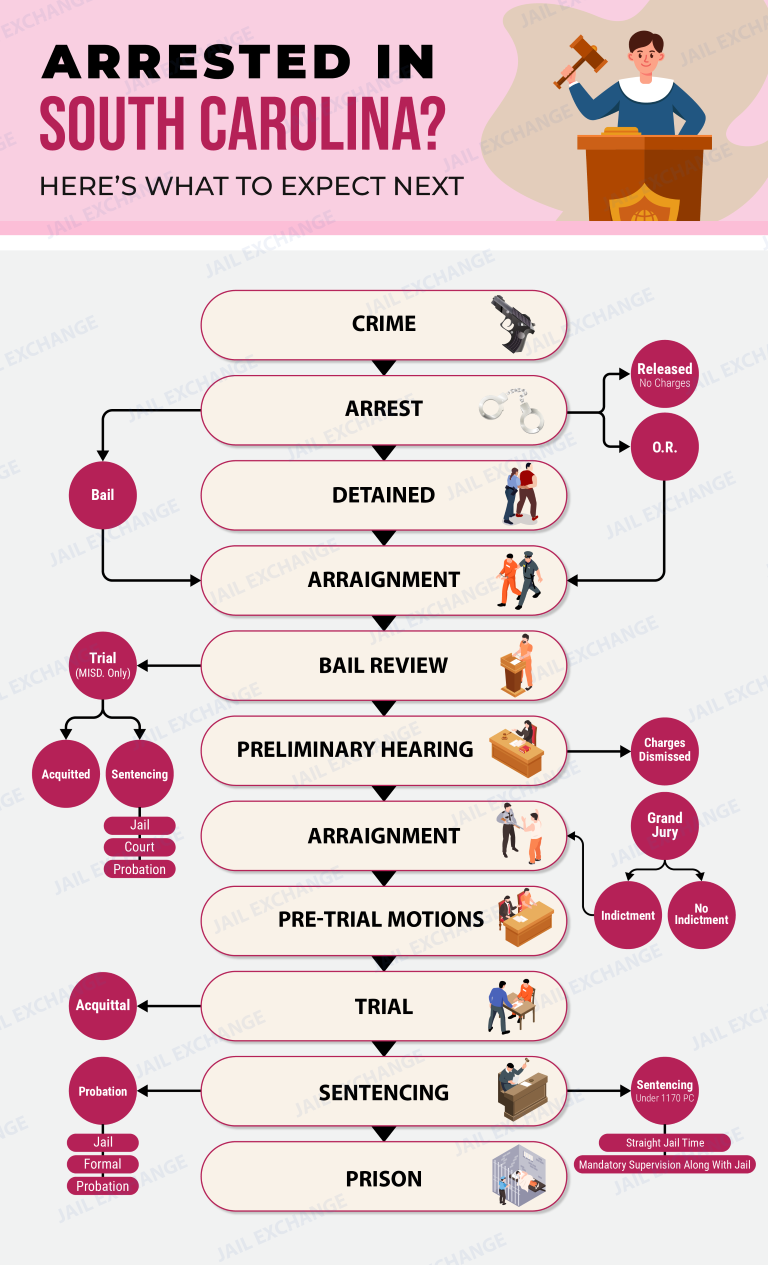
McDaniel Supply Company (operated online through the Jail Pack Store) allows family members and friends to purchase pre-approved commissary care packages, snack bundles, meats, personal hygiene kits, and apparel sent directly to an incarcerated loved one. Each package is packed to comply with individual detention center security standards, ensuring smooth intake and housing unit delivery.
Important: Package Deadlines and Delivery Windows Vary
Detention centers do not manage care package deliveries under identical schedules. While some facilities allow weekly orders, others restrict deliveries to bi-weekly or monthly distribution windows, and spending limits vary from jail to jail. You should verify the facility's active cutoff schedule and order allowances by calling them directly. If an order is submitted after the weekly processing deadline, delivery will be held until the following cycle, leaving your loved one waiting an extra cycle for fresh snacks, thermal wear, or personal care supplies.
Step-by-Step Instructions to Place a Commissary Package Order
- Confirm the inmate's legal first and last name, date of birth, and assigned booking or inmate ID number.
- Navigate to www.jailpackstore.com or mcdanielsupplyco.net.
- Select your state and detention center to open the jail's authorized merchandise catalog.
- Search for the inmate to link the purchase directly to their active housing record.
- Select allowable snack foods, candies, personal care goods, and clothing items up to the facility's allowed spending limit.
- Proceed to checkout, enter your debit or credit card billing details, and submit payment.
- Save your digital receipt and confirmation tracking number for your records.
What the Inmate Needs to Do
The inmate does not need an internet account to receive care packages. McDaniel Supply Company prepares the order in secure, tamper-evident packaging and delivers it directly to the jail commissary department. Facility staff inspect the shipment and deliver the items during regular housing unit commissary rounds, where the inmate signs for receipt.
Official Providers: Jail Pack Store | McDaniel Supply Company
Customer Service Telephone: 1-800-822-9388 or 1-912-427-9022
Support Hours: Monday – Friday, 8:00 AM – 5:00 PM EST
Supported Languages: English and Spanish
Other Services Provided by McDaniel Supply Company
In addition to Commissary Care Packages, McDaniel Supply provides trust deposit services at participating facilities:
- Inmate Trust Money Deposits: Send money directly into an inmate's jail trust account for independent canteen shopping.
• Learn more on our website: Inmate Trust Deposits Guide | • Visit official vendor page: Jail Pack Store Deposits
Buy Commissary for an Inmate in the Richland County Detention Center
Richland County Detention Center Inmate Commissary - Sending Money or Purchasing Commissary for an Inmate
Richland County Detention Center allows inmates to purchase commissary. This can be snacks, hygiene products, stamps, stationary, clothing and even electronics.
You can buy commissary for an inmate using an online service called McDaniel Supply Company / jailpackstore.com.

There is a monthly limit of $200-300 on how much inmates can spend on commissary items.
This amount is subject to change so call the facility at 803-576-3200 in order to confirm the amount that cannot be exceeded.
Inmates have access to both an in-house commissary store, and commissary packages that can be purchased and shipped to the inmate by friends and family.
Scroll down for information on the Richland County Detention Center's service they use for you being able to purchase commissary items online and have them shipped directly to the inmate.
You can also go to our Inmate Money page for information on how to send money to an inmate.
McDaniel Supply Inmate Trust Deposits allow friends and family members to transfer money directly into an incarcerated person's jail trust and canteen account using a credit or debit card online. Deposited funds give your loved one the financial balance needed to buy personal care goods, over-the-counter medical supplies, stationery, and snacks from the facility commissary.
Important: Facility Banking Policies Vary Across Jails
Once a person is booked and moved to a housing unit, facilities do not always allow cash drop-offs or phone payments directly to the jail window. Some might and you should confirm this by calling the facility and asking. But if you do not register online and fund your loved one's trust account immediately, they may be forced to wait days or weeks for standard paper processing, leaving them without essential soap, clean undergarments, basic medical sundries or snacks.
Step-by-Step Instructions to Register and Deposit Funds
- Confirm the inmate's legal first and last name, date of birth, and assigned booking or inmate ID number.
- Navigate to www.jailpackstore.com on your computer or mobile device.
- Click on Secure Inmate Deposit or Make a Deposit.
- Select the state and facility where the inmate is currently detained.
- Search for the inmate to confirm their active housing record matches the facility ledger.
- Enter your deposit dollar amount, review convenience fees, and enter your debit or credit card billing details.
- Submit payment and save the digital confirmation receipt for your financial records.
What the Inmate Needs to Do
The inmate does not need an internet account to receive funds. Once the electronic transaction clears, the balance posts directly to their jail trust ledger according to facility accounting schedules. The inmate can review their updated balance at a dayroom kiosk terminal or on their weekly trust statement and place orders on their regular commissary day.
Official Providers: Jail Pack Store | McDaniel Supply Company
Customer Service Telephone: 1-800-822-9388 or 1-912-427-9022
Support Hours: Monday – Friday, 8:00 AM – 5:00 PM EST
Supported Languages: English and Spanish
Other Services Provided by McDaniel Supply Company
In addition to Trust Money Deposits, McDaniel Supply provides direct care package delivery:
- Commissary & Care Packages: Order pre-approved snack boxes, food packages, and clothing directly to the jail.
• Learn more on our website: Commissary Orders Guide | • Visit official vendor page: Jail Pack Store Commissary
Deposit Money for an Inmate in the Richland County Detention Center
The Easiest and Securest Way of Depositing Money for an Inmate
There are several methods for depositing money on an inmate's account:
1. To send money online to an inmate in the Richland County Detention Center use McDaniel Supply / jailpackstore.
2. If you prefer to use your credit or debit card and deposit money over the phone, you can call them at 800-822-9388.
3. Deposit cash or use a debit or credit card using a dedicated kiosk for this purpose. The machine is located in the lobby or visitation area of the Richland County Detention Center.
4. The Richland County Detention Center may also allow you to *mail an inmate a money order or cashier’s check from a trusted source such as the Post Office, a local bank, or Western Union. The money order should be be made out to either the inmate or the Richland County Sheriff's Office, with the inmate’s name and ID# on the memo line of the check. To confirm this option call the facility at 803-576-3200.
*When mailing a money order or cashier’s check, send it an envelope by itself. Never send it with a letter or photos for your inmate, unless the facility allows it. Never send personal checks or cash.
5. The Richland County Detention Center has a reception desk that may accept cash, money orders or cashier checks. Call 803-576-3200 to find out the specific hours for drop off times.
Richland County's jail is the Alvin S. Glenn Detention Center on John Mark Dial Drive in Columbia. It is run by the county, not the Sheriff, and mail is still delivered on paper after staff check it. For now the center is not accepting any books, magazines, newspapers or other publications, until further notice, so send letters, photos and money orders only.
Letters, legal mail and money orders:
Inmate's Full Name & Detainee Number
Alvin S. Glenn Detention Center
201 John Mark Dial Drive
Columbia, SC 29209
- Addressing: The county asks for the detainee's name, their detainee number and their housing unit at the top of the address. Find the person first in the detainee lookup, or call 803-576-3200 for the housing unit.
- Photos: 5x7 or smaller, and no Polaroids. No nude, semi-nude or negligee pictures, no gang signs, alcohol, drugs or flashing cash, no blacked-out pictures, and no pictures taken inside the jail.
- Don't send: Stamps, envelopes, stationery, notebooks or blank paper; stickers, glue, magnets or laminated items; clothing, shoes or bank cards; oversized greeting cards or boxes.
- Stains: Anything soaked, stained or carrying a strange substance is refused.
- Amount: Don't overload one envelope with pictures, letters or papers. Legal papers don't count toward that limit.
- Money orders: U.S. Postal money orders only, never cash, checks or cashier's checks. Write the detainee's full name, date of birth and detainee number on it, and mail it to the address above. You can also drop one off in the front lobby from 8 a.m. to 10 p.m., any day of the week, or send money online.
- Commissary timing: Money has to be in by noon Wednesday to count toward that week's commissary order.
- Publications later: When the center takes books again, they must come straight from a publisher or bookstore, hardbacks are never allowed, and newspapers have to come by mail, not by carrier.
Assume an officer will read your letter, and keep talk about the court case out of it, since it can be used in court. Short updates travel faster as electronic messages.
ViaPath AdvancePay Phone Calling Accounts
Provider: ViaPath Technologies • Formerly ConnectNetwork / Global Tel*Link (GTL)
AdvancePay is the primary prepaid telecommunications service operated by Global Tel*Link (GTL) and ConnectNetwork, which have unified under the corporate identity of ViaPath Technologies (and the myViaPath platform). By funding an AdvancePay account, telephone charges are deducted per minute whenever an incarcerated loved one calls your specific telephone number, preventing calls from being rejected by cellular carriers.
Important: Cell Carriers Automatically Block Jail Collect Calls
Inmate telephone networks do not permit incoming calls, and wireless cell providers automatically block traditional collect billing by default. While select traditional landlines may support operator billing, cell phones and internet-based lines require an active AdvancePay balance, which you can verify with your carrier. If you do not register your number online and add funds immediately, your loved one will hear an automated operator announcement stating your line is blocked from receiving correctional calls.
Step-by-Step Instructions to Open and Fund AdvancePay
- Visit web.connectnetwork.com or the updated my.viapath.com portal, or launch the ConnectNetwork / ViaPath mobile application.
- Click Sign Up and register using your primary 10-digit cellphone number and email address.
- Select Add Facility, pick your state, and choose the detention center or state prison where the inmate is held.
- Search for the inmate using their full legal name or facility booking ID number and link them to your contact directory.
- Select AdvancePay Phone and choose your deposit amount ($25, $50, or custom).
- Enter your debit or credit card billing details, accept the administrative transaction fee, and complete the payment.
- Check your phone settings to confirm that automated or unknown correctional numbers are not routed straight to spam.
What the Inmate Needs to Do
The inmate approaches any housing pod telephone, enters their assigned PIN and voice biometric recognition phrase, and dials your 10-digit number. ViaPath's automated operator confirms your active prepaid balance and connects the call. All personal telephone calls are subject to recording and monitoring by facility investigators.
Official Providers: ConnectNetwork Portal | myViaPath Portal
Customer Service Telephone: 1-877-650-4249 (Automated & Live Support)
Support Hours: Automated Service 24/7; Live Operators Monday – Friday, 8:00 AM – 10:00 PM EST
Supported Languages: English and Spanish
Other Services Provided by ViaPath Technologies (ConnectNetwork)
In addition to AdvancePay Phone Calling, ViaPath / ConnectNetwork provides several other communication, financial, and visitation services:
- ConnectNetwork Trust Fund Deposits: Transfer money directly into an inmate's jail trust account for commissary store purchases.
• Learn more on our website: Inmate Trust Deposits Guide | • Visit official vendor page: ConnectNetwork Trust Deposits - ViaPath PIN Debit Phone Calling: Give the inmate their own calling funds to contact any approved phone number independently.
• Learn more on our website: PIN Debit Phone Calling Guide | • Visit official vendor page: ViaPath PIN Debit Calling - ViaPath Messaging & Photo Sharing: Send digital messages, photos, and video attachments directly to their terminal.
• Learn more on our website: Digital Messaging Guide | • Visit official vendor page: ViaPath Messaging Services - GettingOut Video Visitation & Tablets: Schedule face-to-face remote video visits and manage handheld tablet communications.
• Learn more on our website: Remote Video Visitation Guide | • Visit official vendor page: GettingOut Video Visits
ViaPath PIN Debit Phone Calling Accounts
Provider: ViaPath Technologies • Formerly ConnectNetwork / Global Tel*Link (GTL)ViaPath PIN Debit (hosted on ConnectNetwork and myViaPath) provides incarcerated individuals with their own calling funds. Unlike AdvancePay (which only funds calls placed to your specific phone number), PIN Debit funds belong directly to the inmate, allowing them to call attorneys, bondsmen, employers, or extended family members across multiple approved telephone numbers.
Important: AdvancePay Only Funds a Single Phone Number
When someone is arrested, they often need to contact multiple people—including legal defense counsel, bail agents, employers, and relatives. If you only fund an AdvancePay account, your loved one will have no calling balance to dial anyone else, as rules and call authorizations vary by facility. Adding funds directly to ViaPath PIN Debit grants them the calling flexibility needed to handle critical legal and family arrangements without delay.
Step-by-Step Instructions to Fund a PIN Debit Account
- Sign into your account at web.connectnetwork.com or my.viapath.com.
- Click on PIN Debit under the communications menu.
- Select the state and facility, and link the inmate's booking identification number.
- Enter the deposit dollar amount and review the payment transaction fee.
- Enter your debit or credit card details and submit the payment.
- Notify your loved one that their personal PIN calling balance has been credited.
What the Inmate Needs to Do
The calling balance appears under the inmate's personal identification PIN. When they pick up any dayroom telephone or tablet, they select the 'PIN Debit' prompt from the automated menu to place calls to any approved number on their personal contact list.
Official Providers: ConnectNetwork Portal | myViaPath Portal
Customer Service Telephone: 1-877-650-4249
Support Hours: Automated Deposits 24/7/365; Live Agents Monday – Friday, 8:00 AM – 10:00 PM EST
Supported Languages: English and Spanish
Other Services Provided by ViaPath Technologies (ConnectNetwork)
In addition to PIN Debit Calling, ViaPath / ConnectNetwork provides several other communication, financial, and visitation services:
- AdvancePay Dedicated Phone Calling: Fund calls placed specifically to your personal phone number.
• Learn more on our website: AdvancePay Calling Guide | • Visit official vendor page: ConnectNetwork AdvancePay - ConnectNetwork Trust Fund Deposits: Deposit money for commissary food, hygiene supplies, and stationery.
• Learn more on our website: Inmate Trust Deposits Guide | • Visit official vendor page: ConnectNetwork Trust Deposits - ViaPath Messaging & Photo Sharing: Send digital messages and photos directly to their kiosk or tablet.
• Learn more on our website: Digital Messaging Guide | • Visit official vendor page: ViaPath Messaging Services - GettingOut Video Visitation & Tablets: Schedule face-to-face remote video visits from home.
• Learn more on our website: Remote Video Visitation Guide | • Visit official vendor page: GettingOut Video Visits
GettingOut / ViaPath Inmate Messaging
Provider: GettingOut (Telmate) • Rebranding as ViaPath Technologies (myViaPath)GettingOut (a service of Global Tel*Link / Telmate) provides an instant two-way digital messaging and photo-sharing platform connecting families with incarcerated individuals via housing-unit kiosks and handheld tablets. The provider is actively rebranding as ViaPath Technologies (under the myViaPath platform); depending on the facility contract, local booking sheets and tablets may still refer to the service as GettingOut, GTL, or ViaPath, but both brand portals grant access to the same centralized messaging balance.
Important: Contact Authorization and Digital Mail Rules Vary
Inmate digital messaging rules are not uniform across all county detention centers. While some jails allow immediate two-way messaging upon registration, others require initial contact invitations or administrative ID verification, which you should verify directly with the facility. If you delay setting up an online profile and funding your Friends & Family messaging account, your loved one may face lengthy periods without direct family communication.
Step-by-Step Instructions to Register and Message an Inmate
- Visit www.gettingout.com or the newly branded my.viapath.com portal, or install the GettingOut / myViaPath mobile app.
- Create a user profile using your primary email address and 10-digit mobile phone number.
- Complete identity verification by uploading a clear photo of your government-issued driver's license or state ID and taking a verification selfie if requested.
- Search for the inmate by selecting the state, correctional facility, and their legal name or booking ID.
- Send an outside contact connection request to link your account to their tablet profile.
- Deposit funds into your 'Friends & Family Account' using a debit or credit card to cover message and photo-sharing costs.
- Compose your text message in the chat box, attach approved photos, and submit it for jail screening.
What the Inmate Needs to Do
The inmate powers on their assigned pod tablet or approaches a housing-unit kiosk and logs into the messaging application with their PIN. They accept your incoming contact invitation on the screen. Once approved by institutional monitors, incoming messages appear in their inbox, and the inmate types a reply directly on the screen.
Official Providers: GettingOut Website | myViaPath Portal
Customer Service Telephone: 1-866-516-0115 (GettingOut Support) • 1-877-650-4249 (ViaPath Support)
Support Hours: Monday – Friday, 7:00 AM – 11:00 PM CST; Saturday – Sunday, 8:00 AM – 7:00 PM CST
Supported Languages: English and Spanish
Other Services Provided by GettingOut / ViaPath
In addition to Two-Way Text Messaging, GettingOut and ViaPath provide several other communications and visitation options:
- Remote Video Visits: Schedule and join live web-based video visits from your computer or smartphone.
• Learn more on our website: Video Visitation Guide | • Visit official vendor page: GettingOut Video Visits - Inmate Tablet Rentals & Media: Fund tablet entertainment, music streaming, games, and news modules.
• Learn more on our website: Tablet Rentals & Content Guide | • Visit official vendor page: GettingOut Tablets - AdvancePay Phone Calling: Prepay for telephone calls so your loved one can dial your mobile phone directly.
• Learn more on our website: AdvancePay Phone Calling Guide | • Visit official vendor page: ViaPath ConnectNetwork Calling - Inmate Trust Deposits: Transfer funds directly into their jail trust account for commissary store purchases.
• Learn more on our website: Inmate Trust Deposits Guide | • Visit official vendor page: ViaPath Trust Deposits
GettingOut / ViaPath Inmate Tablets & Media
Provider: GettingOut (Telmate) • Rebranding as ViaPath Technologies (myViaPath)GettingOut provides specialized, secure handheld tablets for county jail inmates, offering access to messaging apps, telephone calling, legal research tools, eBooks, vocational training, and premium entertainment rentals. As part of GTL and Telmate's transition to ViaPath Technologies, tablet firmware and management platforms are moving to the myViaPath system.
Important: Tablet Feature Availability Varies by Facility
Jails manage tablet distribution according to individual facility contracts. While basic educational and legal materials are often provided without cost, access to music streaming, games, podcasts, and premium movies requires an active funded account. You should confirm the tablet rules with the facility directly. Registering and funding their media balance right away ensures your loved one has productive resources and recreation during their stay.
Step-by-Step Instructions to Fund Inmate Tablet Services
- Confirm that GettingOut / ViaPath handheld tablets are active at your loved one's specific detention facility.
- Navigate to www.gettingout.com or my.viapath.com.
- Sign into your verified user profile and link the inmate's legal name and booking ID number.
- Select Make a Deposit and choose either your Friends & Family Account (for messaging) or the inmate's personal Inmate Account (for entertainment and song rentals).
- Choose your deposit amount, review convenience fees, and complete payment with a credit or debit card.
- Notify your loved one that their tablet account balance has been funded.
What the Inmate Needs to Do
The inmate unlocks their assigned tablet or signs one out from the pod charging station using their biometric verification or PIN. Once logged in, their available balance appears on the screen, allowing them to download songs, stream educational content, and communicate with approved family members.
Official Providers: GettingOut Website | myViaPath Portal
Customer Service Telephone: 1-866-516-0115 (GettingOut) • 1-877-650-4249 (ViaPath)
Support Hours: Monday – Friday, 7:00 AM – 11:00 PM CST; Saturday – Sunday, 8:00 AM – 7:00 PM CST
Supported Languages: English and Spanish
Other Services Provided by GettingOut / ViaPath
In addition to Tablet Media & Rentals, GettingOut and ViaPath provide several other communication and account services:
- Two-Way Text Messaging: Send electronic letters and photos straight to the inmate's screen.
• Learn more on our website: Two-Way Text Messaging Guide | • Visit official vendor page: GettingOut Messaging - Remote Video Visits: Meet face-to-face over secure live video from home.
• Learn more on our website: Video Visitation Guide | • Visit official vendor page: GettingOut Video Visits - AdvancePay Phone Calling: Prepay for phone calling credits so your loved one can call your telephone directly.
• Learn more on our website: AdvancePay Phone Calling Guide | • Visit official vendor page: ViaPath ConnectNetwork Calling - Inmate Trust Deposits: Transfer cash directly into an inmate's jail ledger for commissary purchases.
• Learn more on our website: Inmate Trust Deposits Guide | • Visit official vendor page: ViaPath Trust Deposits
Richland County Juvenile Facilities
- Detention Center: 803-576-3200
- Adult Probation: 803-734-6320
- Classification: 803-576-3233
- Inmate Accounts: 803-576-3217
- Inmate Info: 803-576-3200
- Inmate Records: 803-576-3238
- Juvenile: 803-896-9440
- Police: 803-545-3400
- Public Defender: 803-765-2592
- Sheriff: 803-576-3000
- Solicitor's Office: 803-576-1800
The Richland County Detention Center serves the following cities and towns of Richland County: Arcadia Lakes, Blythewood, Columbia, East Columbia, Eastover, Forest Acres, Irmo, Pontiac and Springdale.