Richland County Juvenile Detention Center Criminal Court Process
Criminal Court Process for Richland County South Carolina
Richland County Criminal Court Guide
Local criminal cases get their first hearing at Bond Court, which works out of the Alvin S. Glenn Detention Center, 201 John Mark Dial Drive, Columbia, SC 29209. The county itself runs that jail and keeps both men and women there before trial. Felony cases climb to the Court of General Sessions at the Judicial Center, 1701 Main Street, Columbia, SC 29201. This guide maps every magistrate office and city court, the stages of a case, the Solicitor and the public defender.
The county's detainee lookup tells you if your person is still locked up there. Our Inmates in Custody page goes wider: the latest bookings, charges, active warrants, mugshots, free legal help and recovering property.
On a weekday, dial the Clerk of Court at 803-576-1950. Request the case number, which court is in charge and when the next hearing falls. If release still comes first, start with our bond and release page.
1. Magistrate, city or circuit: who hears what?
In South Carolina, the possible sentence decides which court gets the case:
- Magistrate courts try charges carrying no more than a $500 fine, 30 days behind bars, or both (S.C. Code 22-3-550). Shoplifting of $2,000 or less is also tried here, with fines as high as $1,000 (S.C. Code 16-13-110).
- Municipal courts take that same tier of charge for offenses inside a town's limits (S.C. Code 14-25-65).
- The Court of General Sessions is the circuit court's criminal branch. It hears every felony and the bigger misdemeanors. Trial takes place in the county where the alleged crime occurred.
- Family Court takes nearly all charges against people younger than 18.
Magistrates and city judges also run bond hearings and preliminary hearings on cases bound for General Sessions. Richland and Kershaw counties together make up the Fifth Judicial Circuit.
↑ Back to the question list2. Where are the main Richland County courthouses?
Three buildings carry most of the criminal load:
- Judicial Center, 1701 Main Street, Columbia, SC 29201. General Sessions and Criminal Records share the 4th floor. Call the Clerk of Court at 803-576-1950 from 8:30 a.m. to 5 p.m. on weekdays, or Criminal Records at 803-576-1939. Postal mail goes to P.O. Box 2766, Columbia, SC 29202. Family Court occupies the West Wing's 1st floor, 803-576-3320.
- Bond Court, in the detention center at 201 John Mark Dial Drive, Columbia, SC 29209, 803-576-3281. Staffed 7 a.m. to 2 a.m. on weekdays and 7 a.m. to 6 p.m. on weekends, with four rounds of bond hearings daily.
- Central Court, the hub magistrate court, 2500 Decker Blvd, Columbia, SC 29206, 803-576-2300, weekdays 8:30 a.m. to 5 p.m.
Hearings get moved, so check the county court calendar or phone the office the day before you go.
↑ Back to the question list3. Where are the neighborhood magistrate offices?
Beyond Central Court and Bond Court, the county staffs eleven local magistrate offices, each open weekdays from 8:30 a.m. to 5 p.m. A ticket or minor charge is usually heard by the office for the area of the arrest.
Offices using a Columbia mailing address:
- Dentsville: 2500 Decker Blvd., Columbia, SC 29206, 803-576-2560
- Pontiac: 2500 Decker Blvd., Columbia, SC 29206, 803-576-2520, with 803-576-2521 as an alternative number
- Lucius Road office (its official name is Columbia): 3875 Lucius Rd., Columbia, SC 29201, 803-576-2510
- Dutch Fork: 1019 Beatty Rd., Columbia, SC 29210, 803-576-2540
- Lykesland: 1403 Caroline Rd., Columbia, SC 29209, 803-576-2500
- Olympia: 1601 Shop Rd., Suite B, Columbia, SC 29201, 803-576-2550
- Upper Township: 7615-A Wilson Blvd., Columbia, SC 29203, 803-576-2570
- Waverly: 2712 Middleburg Dr., Suite 106, Columbia, SC 29204, 803-576-2590
Offices in the smaller towns:
- Blythewood: 118-A McNulty St., Blythewood, SC 29016, 803-576-1580
- Eastover: 501 Main St., Eastover, SC 29044, 803-576-2580
- Hopkins: 5425 Lower Richland Blvd., Hopkins, SC 29061, 803-576-2530
If you can't tell which office has the case, Central Court at 803-576-2300 can sort it out.
↑ Back to the question list4. Which towns run their own municipal courts?
Four cities handle arrests by their own officers in municipal court:
- Columbia Municipal Court, 811 Washington Street, Columbia, SC 29201. Main line 803-545-3150; criminal and traffic cases 803-545-3127; jury trials 803-545-3169.
- Forest Acres Municipal Court, 5205 North Trenholm Road, Forest Acres, SC 29206, 803-790-5947. Court sits Thursdays at 8:30 a.m. The window is open 8:30 a.m. to 5 p.m. Monday through Thursday, and 8:30 a.m. to 12:30 p.m. Friday.
- Irmo Municipal Court, inside Town Hall, 7300 Woodrow Street, Irmo, SC 29063, 803-781-7050
- Cayce Municipal Court, 1800 12th Street, Cayce, SC 29033, 803-550-9550, weekdays 8:30 a.m. to 4:30 p.m.
Parts of Irmo, Cayce and the capital itself cross into Lexington County. For a citation written in Arcadia Lakes, Blythewood or Eastover, Central Court at 803-576-2300 can say which court holds it.
↑ Back to the question list5. What happens at the bond hearing after an arrest?
The law gives officials 24 hours from arrest to hold a bond hearing (S.C. Code 22-5-510). Here that hearing is held at Bond Court inside the jail, and several things happen together:
- The judge goes over the charges and rules on bond.
- The arresting agency gives the judge the person's record, any open cases and any bond already in place (S.C. Code 22-5-510(E)).
- The victim must get timely notice and may address the judge. Late notice forces a delay (S.C. Code 16-3-1525).
- The defendant may ask to be screened for a public defender.
If the charge is above a magistrate's trial limit, the defense can demand a preliminary hearing within 10 days of the bond hearing (Rule 2(a), SCRCrimP). A magistrate then weighs whether there is enough proof to send the case up.
↑ Back to the question list6. How do assault and shoplifting cases move?
Minor charges are tried by a magistrate or city judge. With a not guilty plea, the judge schedules a trial. Magistrate juries seat six people (S.C. Code 22-3-545). Top penalties for frequent local charges:
- Assault and battery, third degree: $500, 30 days, or both (S.C. Code 16-3-600(E)(2))
- Shoplifting valued at $2,000 or less: $1,000, 30 days, or both (S.C. Code 16-13-110(B))
- Most remaining summary court charges: $500 and 30 days
People aged 17 through 20 facing a first alcohol charge may fit the Alcohol Education Program. Locally it costs $250 to enroll and $100 for the class. Apply a week or more before court through the Solicitor's diversion staff at 803-576-1649. Bad check cases go to the Worthless Check Program at 803-576-1860.
↑ Back to the question list7. How does a felony case move through court?
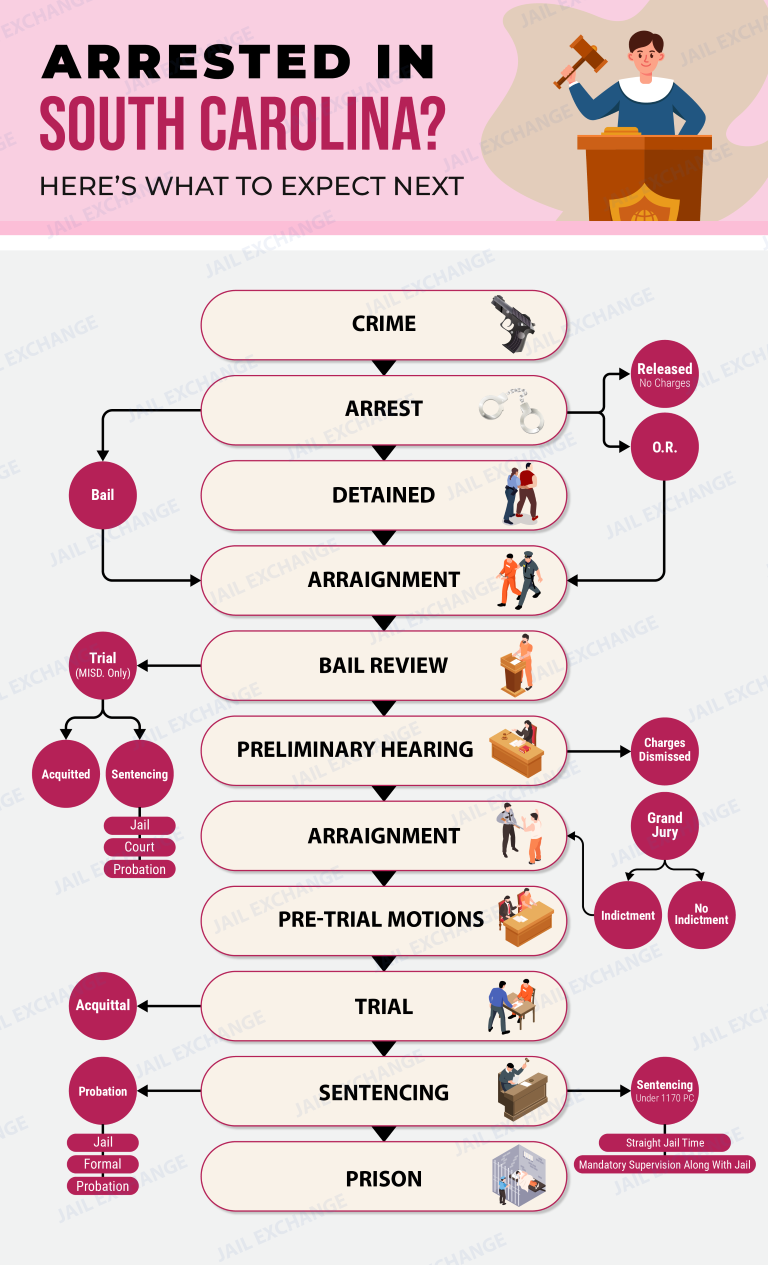
Felonies travel from the jail to the circuit court in stages:
- Bond hearing at Bond Court, or in front of a circuit judge for the gravest charges.
- Preliminary hearing in magistrate court, when the defense asks in time.
- Transfer to General Sessions, where the Fifth Circuit Solicitor prosecutes.
- Guilty plea or trial at the Judicial Center.
- Sentencing, once guilt is admitted or proven.
Felony classes set the maximum prison term (S.C. Code 16-1-20): Class A tops out at 30 years. Each step down cuts five years, so B is 25 and E is 10. Class F, the lowest, caps at five. Stealing $10,000 or more from a store carries up to ten years. In March 2026 the county counted 902 General Sessions defendants still waiting in the jail, so expect these cases to take months.
↑ Back to the question list8. How does a violent charge change things?
A charge on the state's violent crime list reshapes the case from bond to sentence. Its entries include murder, carjacking, kidnapping, armed robbery, first- or second-degree arson and burglary, and some drug trafficking (S.C. Code 16-1-60).
- Bond. A magistrate decides whether to allow bond. For charges punishable by death or life, only a circuit judge rules on bond.
- No 10 percent deposit. That lower-cost route is barred.
- Repeat charges. A new violent or gun felony during bond wipes out the earlier bond. A violent crime done while on bond for one is also its own felony, with up to five years (S.C. Code 17-15-270).
- No PTI. Pretrial Intervention excludes violent crimes (S.C. Code 17-22-50).
- Murder carries 30 years to life, or death (S.C. Code 16-3-20(A)).
9. Who prosecutes, and where are free defense lawyers?
The Fifth Circuit Solicitor prosecutes General Sessions cases in Richland and Kershaw counties. The Richland office is at 1701 Main Street, Columbia, SC 29201, 803-576-1800, weekdays 8:30 a.m. to 5 p.m. Victim Witness staff can be reached at 803-576-1890.
The Public Defender's Office works in the same building, 1701 Main Street, Suite 103, Columbia, SC 29201, 803-765-2592. Its attorneys represent clients through every stage. Qualifying takes a sworn statement of finances and a $40 application fee, which the clerk may shrink or excuse (S.C. Code 17-3-30).
The statewide agency, the South Carolina Commission on Indigent Defense, is at 1330 Lady Street, Suite 401, Columbia, SC 29201, 803-734-1343.
↑ Back to the question list10. Can a first offense end in dismissal?
Often, yes. Entry is up to the Solicitor, so phone the diversion office at 803-576-1649 and apply as soon after the arrest as you can.
- Pretrial Intervention (PTI) serves adults with a first, nonviolent charge, but not DUI or violent crimes. Local fees run $100 to apply and $250 to participate. Expect 30 to 50 hours of community service and repayment of any loss. Finishing leads to dismissal, and the person can then seek expungement (S.C. Code 17-22-150).
- Traffic Education Program for certain minor tickets, used only once.
- Treatment courts for adult drug cases, DUI, mental health, veterans, plus the city's homeless court. Most last a year or longer. DUI court: 803-576-1836. Mental health court: 803-576-1964.
11. Where are Richland County case records online?
The state court system offers a free Richland Public Index, searchable by name or case number. Magistrate and city court calendars are on the summary court dockets page, where you choose the court under Agency.
That index won't say where someone is jailed, so pair it with the jail's detainee lookup. For felony records, ring Criminal Records at 803-576-1939; staff will ask for a name and birth date.
↑ Back to the question list12. Is there a warrant out in Richland County?
Sheriff's deputies serve county warrants, 803-576-3000. City officers handle theirs through the police Warrant Division, 803-545-3166. Wanted lists: Midland's Most Wanted from city police, the state's Most Wanted Offenders page, plus a 15 Most Wanted roster posted by the U.S. Marshals. Criminal Records at the Clerk of Court will check a name by phone, 803-576-1939. A lawyer should guide any surrender. You can turn yourself in at the Alvin S. Glenn Detention Center, 201 John Mark Dial Drive, Columbia, SC 29209, or phone whichever court signed it about resetting the date. The clerk's office is at 1701 Main Street, Columbia, SC 29201.
↑ Back to the question list13. Federal charges: which court and which jail?
Any federal crime out of Richland goes before the Columbia Division of the U.S. District Court for the District of South Carolina, at 901 Richland Street, Columbia, SC 29201 (Matthew J. Perry, Jr. U.S. Courthouse), 803-765-5816. The clerk keeps weekday hours of 8:30 a.m. to 4:30 p.m.
- The first appearance includes a detention hearing. The judge chooses between release and a cell until trial (18 U.S.C. 3142).
- Either side may ask for a pause. A defense request can stretch it five days; a prosecutor's request, three.
- Marshals deputies guard federal defendants and transport them to court from their office at 901 Richland Street, Suite 1300, Columbia, SC 29201, 803-765-5821.
- Following sentencing, the Federal Bureau of Prisons inmate locator gives the person's prison.
14. Does an ICE detainer affect the court case?
The criminal case moves forward as normal, but release can look different. ICE may lodge Form I-247A, asking jail staff to hold the person up to 48 hours after they would otherwise be released, giving agents time to collect them (8 CFR 287.7(d)).
- Within 72 hours of booking on a criminal charge, state law has the jail run a status check. If it shows unlawful presence, the jail informs the Department of Homeland Security (S.C. Code 23-3-1100).
- The bond judge must factor in unlawful presence and the chance the person will run (S.C. Code 22-5-510(D)(4)).
- Once ICE has the person, the case is handled by its South Carolina office, 3950 Faber Place Drive, North Charleston, SC 29405, 843-746-9800.
- The ICE Online Detainee Locator can show where they were taken.
15. Where do Richland County prison sentences go?
When the sentence is longer than three months, custody passes to the South Carolina Department of Corrections (SCDC), which assigns the prison (S.C. Code 24-3-20). Short terms, three months or under, are normally served at the county jail.
- Reception and evaluation comes first for all new prisoners. No in-person visits are allowed during it, unless it goes past 30 days.
- Follow the person on the SCDC inmate search, refreshed as of each midnight.
- SCDC's headquarters: 4444 Broad River Road, Columbia, SC 29210, 803-896-8500.
- Our South Carolina state prisons guide outlines visiting and mail rules for every prison.
16. What if a teenager is charged in Richland County?
Family Court, at the Judicial Center, 1701 Main Street, Columbia, SC 29201, 803-576-3320, hears most charges against people under 18. Some 17-year-olds facing the most serious felonies are handled as adults instead (S.C. Code 63-19-20(1)).
- A held youth gets a detention hearing inside 48 hours, skipping weekends and holidays (S.C. Code 63-19-830).
- Teens aged 14 to 16 accused of grave felonies can have their case sent up to General Sessions once a judge holds a hearing (S.C. Code 63-19-1210).
- Youths in custody stay at the state's Juvenile Detention Complex, 1725 Shivers Road, Columbia, SC 29210, 803-896-9440 for visits.
The local Department of Juvenile Justice county office sits at 300 Columbia Mall Blvd., Suite 200, Columbia, SC 29223, 803-253-4050.
↑ Back to the question list17. What rights do victims have in Richland County?
Under the state Constitution, victims may be heard at bond hearings, learn when the accused gets out, and receive restitution for losses (S.C. Const. art. I, § 24). Local help:
- Solicitor's Victim Witness office: 1701 Main Street, Columbia, SC 29201, 803-576-1890
- Sheriff's Victim Assistance: 5623 Two Notch Road, Columbia, SC 29223, 803-576-3115
- The jail's victim advocate: 201 John Mark Dial Drive, Columbia, SC 29209, 803-576-3289
- Attorney General's Victim Advocacy Division: 1000 Assembly Street, Room 519, Columbia, SC 29201, 803-737-3739
Sign up for no-cost custody alerts on VINELink South Carolina or by calling 866-727-2846, in English or Spanish. Relatives of the accused must never contact the victim or carry messages, because that can violate bond terms.
↑ Back to the question list