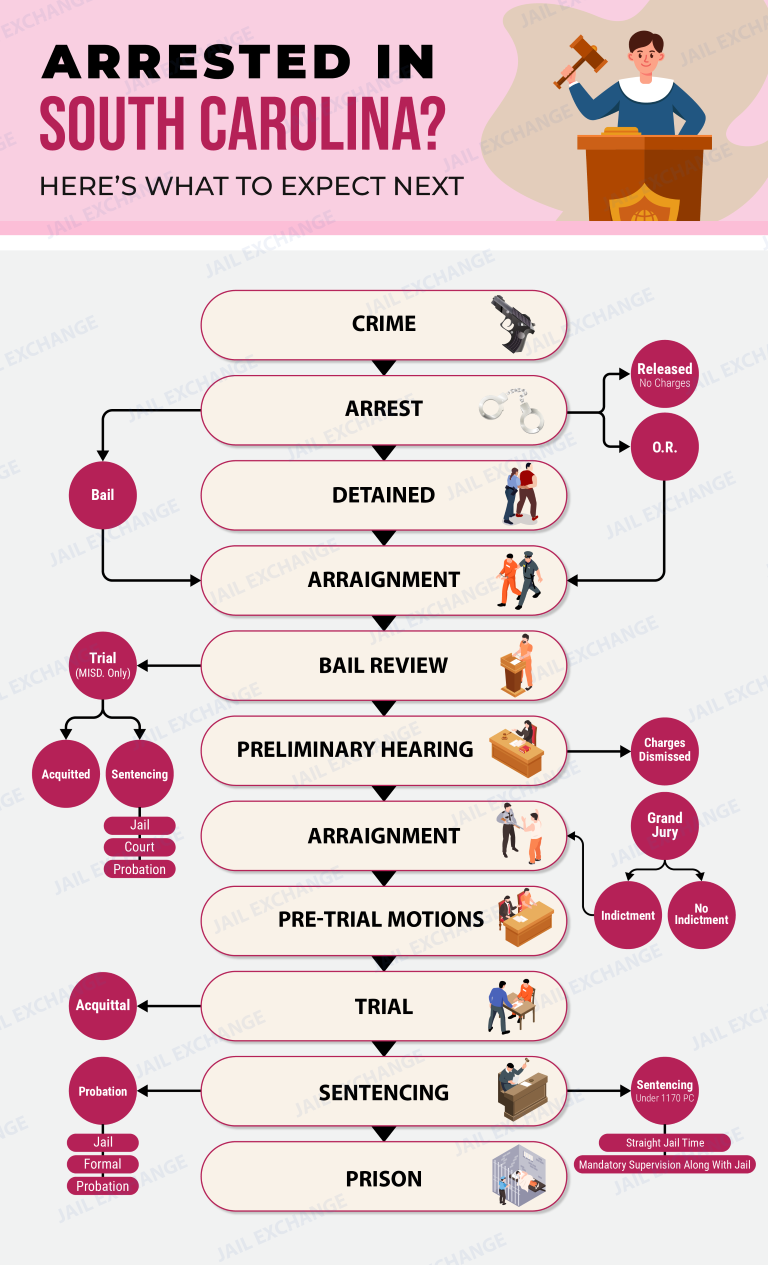
Union County Detention Center Criminal Court Process
Criminal Court Process for Union County South Carolina
Union County Criminal Court Guide
Cases from the City of Union, Jonesville, Lockhart, Carlisle and every rural road funnel into a single Main Street courthouse. Anyone not yet released waits at the Union County Detention Center, 1657 Jonesville Highway, Union, SC 29379, run by a county director instead of the Sheriff. Its Pretrial Division holds people whose cases are open, and its Prison Work Camp lodges short sentences and a small state work crew. Read on for courts, case steps and phone numbers.
Pull up the official inmate lookup to confirm your person is still on Jonesville Highway. Then try our Jail Roster page, made for the custody end of things: today's detainees, last night's arrests, outstanding warrants, filed charges, mugshots, public defender help and property pickup at the jail.
Weekdays, the Clerk of Court answers at 864-429-1630 from 9:00 a.m. to 5:00 p.m. Ask which judge has the file and the next court day on it. Release questions come first for many families; our bail page handles those.
1. Petty charge or felony: where does each go in Union County?
South Carolina sorts a charge by the harshest penalty it could bring:
- Magistrate Court holds trials where the cap is a $500 fine, 30 days behind bars, or both (S.C. Code 22-3-550). Certain statutes widen that, such as shoplifting worth $2,000 or less, which allows a $1,000 fine there (S.C. Code 16-13-110). A few laws let a magistrate go higher for certain charges. To learn the most a given charge can bring, call the Magistrate Court at 864-429-1648.
- Municipal Court judges in towns that use one have that same basic ceiling (S.C. Code 14-25-65).
- The Court of General Sessions is the circuit court's criminal branch. Every felony belongs there, along with misdemeanors beyond a magistrate's reach, and each one is tried in the county where it happened.
- Family Court deals with nearly all charges against minors.
Felonies start there too. Bond is set in Magistrate Court, and a preliminary hearing may follow. Then the clerk opens a General Sessions file.
↑ Back to the question list2. Where does Union County hold criminal court?
Almost every criminal matter is heard at 210 West Main Street, Union, SC 29379. That building's county switchboard is 864-429-1600.
- Clerk of Court: 864-429-1630, Monday to Friday, 9:00 a.m. to 5:00 p.m., holidays off. General Sessions, Family Court and civil files live here. Mail goes to P.O. Box 703, Union, SC 29379.
- Magistrate Court: 864-429-1648. With two full-time and three part-time magistrates, it covers twice-daily bond court, warrants, small criminal trials and preliminary hearings.
Files at the clerk's counter go only to parties in that case, so carry ID when you visit.
↑ Back to the question list3. Are there town courts in Union or Jonesville?
The county holds four municipalities: the county seat city plus Jonesville, Lockhart and Carlisle. Two run police forces, Union Public Safety and the Jonesville Police Department. Deputies answer calls everywhere else.
When a town officer writes the ticket, a municipal judge may end up with it. The town that filed the charge can say where it will be heard:
- City Hall, 101 Sharpe Avenue, Union, SC 29379, 864-429-1700
- Jonesville Town Hall, 131 North Main Street, Jonesville, SC 29353, 864-674-5746
Deputy and trooper charges head to the Magistrate Court on West Main, 864-429-1648.
↑ Back to the question list4. What happens at that first court hearing?
Step one is bond court. South Carolina allows no more than 24 hours between arrest and that hearing (S.C. Code 22-5-510), and Union's magistrates hold sessions twice each day. Ask the Detention Center at 864-429-2818 which session your person is set for.
- Officers give the magistrate the person's history, pending cases, incident reports and any bond already running (S.C. Code 22-5-510(E)).
- Any victim is entitled to notice and a chance to be heard (S.C. Code 16-3-1525).
- The magistrate fixes release terms, unless circuit-level bond power is required for that count.
- Speak up then if the person needs an appointed lawyer.
When a charge is too big for magistrate trial, the defense gets 10 days from bond court to ask for a preliminary hearing (Rule 2(a), SCRCrimP). The magistrate there decides if there is enough evidence to keep the case alive.
↑ Back to the question list5. Simple assault or petty shoplifting: what comes next?
Minor charges begin and end before a magistrate or town judge. A guilty plea can settle things quickly. Pleading not guilty sets a trial date, and the jury in magistrate court seats six people (S.C. Code 22-3-545). Typical top penalties:
- Third-degree assault and battery: 30 days, a $500 fine, or both (S.C. Code 16-3-600(E)(2)).
- Shoplifting up to $2,000: 30 days, a $1,000 fine, or both (S.C. Code 16-13-110(B)).
- Classed misdemeanors belong in General Sessions: one year for Class C, two for Class B, three for Class A (S.C. Code 16-1-20).
Some programs run by the 16th Circuit Solicitor end with charges dropped. Drivers with small tickets may fit the Traffic Education Program. People aged 17 through 20 facing certain alcohol counts may fit the Alcohol Education Program (S.C. Code 17-22-520 and 17-22-550).
↑ Back to the question list6. Felony charges in Union County: what are the stages?
Expect these stages:
- Bond before a magistrate, or a circuit judge on the gravest counts.
- Preliminary hearing on a timely defense request.
- General Sessions. The Solicitor's staff take charge. Per that office, a defendant should appear at each General Sessions term held in Union until the lawyer, the Solicitor or the judge says otherwise.
- Resolution by plea or jury verdict, and then sentencing.
Six felony classes set the longest possible prison terms (S.C. Code 16-1-20). Class F tops out at five years and Class E at ten. Class D reaches 15, C 20, B 25, and the most serious, Class A, 30. Shoplifting above $2,000 but below $10,000 carries up to five years, and $10,000 or more up to ten (S.C. Code 16-13-110(B)).
Someone charged for the first time with a nonviolent offense can request Pretrial Intervention. Fees are $100 to apply plus $250 to take part, with waivers for people who can't pay (S.C. Code 17-22-110). Completing PTI ends in a noncriminal disposition, opening the door to expungement (S.C. Code 17-22-150).
↑ Back to the question list7. Violent charges: what is different here?
Once a charge appears on the state's violent-crime roster, tougher rules follow at almost every turn (S.C. Code 16-1-60). Examples include carjacking, kidnapping, armed robbery, murder and attempted murder, voluntary manslaughter, burglary or arson in the first or second degree, and criminal sexual conduct (first or second degree). In 2026 Act No. 138, lawmakers added shooting at or into homes and other structures.
- Release. Magistrates may deny bond on these. Any charge that could bring death or life imprisonment needs a circuit judge.
- Repeat arrests. Out on bond for one violent felony and arrested for another? Union's judges must treat the earlier bond as cancelled (S.C. Code 17-15-55(C)). The new offense adds its own felony count too, worth as much as five years (S.C. Code 17-15-270).
- PTI. Violent crimes are barred from Pretrial Intervention (S.C. Code 17-22-50).
- Murder sentence. Death is possible; otherwise prison runs from a 30-year minimum up to life (S.C. Code 16-3-20(A)).
8. Which offices prosecute and defend Union cases?
Felonies here are prosecuted by the 16th Circuit Solicitor, whose circuit pairs this county with York. That office also handles Pretrial Intervention and Juvenile Arbitration. Union mail: P.O. Box 60, Union, SC 29379, 864-429-1639. York headquarters: 1675 York Highway, York, SC 29745, 803-628-3020.
Appointed lawyers work from 101 Sharpe Ave., Union, SC 29379, 864-319-1315. Each applicant fills out a sworn money affidavit (S.C. Code 17-3-45) and owes a $40 application fee that the clerk can reduce or skip (S.C. Code 17-3-30).
Beyond PTI, the Solicitor lists a Drug Court, a mental health court and a veterans program. Ask defense counsel about each.
↑ Back to the question list9. Where can I see the case and its dates?
The Clerk of Court's web page links the county's Public Index on the South Carolina Judicial Branch site, searchable by name. It covers court files, not jail custody.
- Upcoming General Sessions terms: the Solicitor's Union court schedule.
- Magistrate hearings: phone 864-429-1648.
- Felony and Family Court questions: the Clerk of Court, 864-429-1630.
Keep the defendant's birth date and any case number handy for the call.
↑ Back to the question list10. Warrants: how to check, and how to clear one
Warrants countywide, felony or misdemeanor, are served by the Sheriff's Office, 200 East Main Street, Union, SC 29379, 864-429-1612; ask for the warrant officer. Town police serve them in city limits. The Magistrate Court issues arrest warrants and can confirm one by phone. Official lists:
- Union Sheriff warrants and civil process page
- State probation agency's most wanted offenders
- Marshals 15 Most Wanted list
Clearing it starts with a lawyer's advice. Next, surrender at the jail, 1657 Jonesville Highway, Union, SC 29379, or phone the court that signed it. Clerk of Court: 210 West Main Street, Union, SC 29379, 864-429-1630.
↑ Back to the question list11. How are federal charges from Union handled?
Federal prosecutions from this county run through the Spartanburg Division of the U.S. District Court for the District of South Carolina. Spartanburg's Donald S. Russell Federal Building, 201 Magnolia Street, Spartanburg, SC 29306, may host hearings. With no clerk there, calls and filings go to Greenville, 864-241-2700, Carroll A. Campbell, Jr. U.S. Courthouse, 250 East North Street, Greenville, SC 29601.
- Detention or release gets argued at the person's first federal appearance (18 U.S.C. 3142). Defense counsel may win as many as five days of delay; prosecutors, three.
- The defendant stays in Marshals custody until trial; call 864-232-1566 or visit 300 East Washington Street, Room 232, Greenville, SC 29601.
- After a sentence, the Federal Bureau of Prisons inmate locator lists the prison.
12. Immigration detainers: what do they change?
Court dates go on as scheduled; the detainer mainly affects the day of release. The sequence:
- ICE agents send the Union jail a detainer, Form I-247A.
- What ICE asks: keep the person up to 48 hours after they would otherwise be released (8 CFR 287.7(d)).
- State law adds a check. A jail has 72 hours after a criminal booking to confirm a person's status. If someone is here unlawfully, the jail tells Homeland Security (S.C. Code 23-3-1100).
- Unlawful presence also counts in the bond judge's flight-risk thinking (S.C. Code 22-5-510(D)(4)).
- ICE, South Carolina office: 3950 Faber Place Drive, North Charleston, SC 29405, 843-746-9800.
- To trace someone ICE took, use the ICE Online Detainee Locator.
13. Where do Union defendants serve prison time?
Sentence length decides. Three months or under generally stays at the county lockup (S.C. Code 24-3-30). More than that transfers custody to the South Carolina Department of Corrections (SCDC), and SCDC chooses where, sometimes a county site under an agreement (S.C. Code 24-3-20). The Prison Work Camp on Jonesville Highway is one, with room for up to 20 state inmate workers.
- SCDC intake, called reception and evaluation, comes first. Visitors must wait it out, except when it runs longer than 30 days.
- Location updates: the SCDC inmate search.
- SCDC: 4444 Broad River Road, Columbia, SC 29210, 803-896-8500.
- Prison listings: our South Carolina state prisons guide.
- Probation and parole for this county: 200 South Mountain St., Union, SC 29379, 864-429-1645.
14. Under 18 and charged: which court?
Teen cases mostly go to Family Court, with files kept by the Main Street clerk (S.C. Code 63-19-20(1)). Seventeen is the tricky age. For a 17-year-old, the most serious felonies (Classes A through D) and anything punishable by 15 years or longer move the case up to adult General Sessions.
- Any child DJJ holds must see a Family Court judge inside 48 hours; Saturday, Sunday and holiday time doesn't run against that limit (S.C. Code 63-19-830).
- Between ages 14 and 16, a teen charged with a grave felony may be transferred to adult court. A Family Court investigation and hearing must come first (S.C. Code 63-19-1210).
- DJJ's Juvenile Detention Complex, where most held youth go: 1725 Shivers Road, Columbia, SC 29210, 803-896-9440.
- DJJ Union office: 200 South Mountain St., Suite 3, Union, SC 29379, 864-429-1640.
- Some youth cases can be steered into the Solicitor's Juvenile Arbitration program.
15. What help do Union County crime victims get?
South Carolina's constitution spells out victims' rights (S.C. Const. art. I, § 24). Notice must reach them when the defendant is jailed, let go or breaks out. They can attend bond hearings and speak there, and they can seek restitution. Officers must try to alert the victim ahead of bond court, and a judge has to delay a hearing when that notice fell short (S.C. Code 16-3-1525).
- County Victim Advocate: 210 West Main Street, Union, SC 29379, 864-429-1673. The office walks victims through court, case status and compensation claims.
- Release and transfer alerts, free in English and Spanish: VINELink South Carolina, phone line 866-727-2846.
- Attorney General's Victim Advocacy Division: 1000 Assembly Street, Room 519, Columbia, SC 29201, 803-737-3739.
Loved ones of the defendant: no calls, texts, visits or relayed notes to the victim, ever. Any contact risks a bond violation and new charges.
↑ Back to the question list