
Concho County Offenders are Jailed in Tom Green County
Concho County Offenders are Jailed in Tom Green County
Tom Green County Jail
325-659-6597Concho County Bail and Release
There is no working jail in Concho County anymore. Someone picked up in Eden, in Paint Rock or along a ranch road spends the night in a lockup owned by a different county. The lead we have points to the Tom Green County Detention Center, 4382 N US Highway 277, San Angelo, TX 76905. Below we walk through the magistrate, each type of bond, where the money goes and what holds a person back.
Try the official jail search first. Another free option is Texas IVSS-Counties; punch in a name to see county custody status. Our Recent Arrests page goes deeper on custody: who was booked lately, who sits in a cell today, mugshots, the charges, warrants still open, court-appointed lawyers and getting property back.
Make the Sheriff's Office your first call, 325-732-4312. Ask three things: the jail's name, whether a bail amount exists yet, and how much it is per charge. From there, our court page follows the case, and Texas bail laws covers rules for the whole state.
1. After a Concho County arrest, which official sets bail, and how quickly?
A magistrate makes that call, not the jail. For a Concho arrest, that clock stops at 48 hours, and the magistrate can meet the person in a courtroom or over a camera hookup (Code Crim. Proc. 14.06, 15.17). At this brief hearing, the person hears the charge. They are told they may remain silent and may get a lawyer. A question follows about whether the county should pay for a lawyer. The bail ruling has to come inside that same 48 hours, judged for this one person, with the lightest rules that still work (Code Crim. Proc. 17.028).
Concho, Tom Green and five other area counties run under one shared court plan. Outside Tom Green, that plan hands magistrate work to the Justice of the Peace, who begins by 1:00 p.m. daily. The Sheriff reports each new person in custody by 9:00 a.m. For arrests made without a warrant, the plan's target is one day for misdemeanors and two days for felonies.
Concho's Justice of the Peace sits at 152 N. Roberts, Paint Rock, TX 76866, 325-732-4706. Before ruling on a Class B case or anything bigger, the magistrate gets a public safety report. That summary covers prior cases. It never scores risk or proposes an amount (Code Crim. Proc. 17.021, 17.022).
↑ Back to the question list2. Which bonds and release choices exist under Texas law?
Texas recognizes a pair of bail types (Code Crim. Proc. 17.01). With a bail bond, money or a bonding company backs the promise to return. With a personal bond, the person's own signature carries it alone. In Concho cases, here is the menu:
- Cash. Someone puts up every dollar of the bail. The court sits on it while the case runs (Code Crim. Proc. 17.02).
- Bondsman. A licensed surety vouches for the full bail. What you pay that company is its fee, and you won't see it again.
- Personal bond. Here a signature stands in for money (Code Crim. Proc. 17.03). Local screening of these bonds falls to the Concho Valley Community Supervision and Corrections Department, following the judges' policies, at 3036 N. Bryant Blvd., San Angelo, TX 76903, 325-659-6544.
- Strings attached. Judges can attach terms; staying clear of the alleged victim is a common one. After a repeat DWI, the car must carry an ignition interlock, a breath-test lock. It is also required for intoxication manslaughter, intoxication assault, and a DWI with a kid in the vehicle (Code Crim. Proc. 17.441).
Some people can't get a personal bond. The list covers violent crimes the state names, terroristic threats at Class A or above, and some protective order cases. It also covers a felon found with a gun, and someone on supervision for violence who is arrested again (Code Crim. Proc. 17.03). For fine-only Class C tickets, the magistrate can skip bond and hand over a written date to appear (Code Crim. Proc. 15.17).
↑ Back to the question list3. Does Concho use a bail chart, or does each magistrate pick?
No one price chart covers Texas. Each case gets its own number. Here is what the law tells the magistrate to think about (Code Crim. Proc. 17.15):
- enough money to bring the person back for court
- never so much that bail turns into punishment
- how serious the charge is and what happened
- what the person's wallet can handle
- safety of the victim, officers and neighbors
- past record, the safety report and citizenship
Ceilings apply when police made a warrantless arrest and nobody ruled on probable cause quickly enough. For a misdemeanor, release must come by hour 24, and bail can't top $5,000. A felony allows 48 hours and up to $10,000. If the person can't afford it, a personal bond follows. Prosecutors are allowed to seek extra time, to a maximum of 72 hours (Code Crim. Proc. 17.033).
For the real figure, ring the Sheriff's Office at 325-732-4312 or the County and District Clerk at 325-732-4322.
↑ Back to the question list4. How is bail posted for someone from Concho County?
Bond gets paid at whatever jail has the person. At the Tom Green County Detention Center, 4382 N US Highway 277, San Angelo, TX 76905, look for the bonding window off the lobby. The lobby kiosk accepts cash or a credit or debit card. Steps:
- Ring the Sheriff's Office in Paint Rock, 325-732-4312. Confirm the jail and that bail exists.
- If it is Tom Green, dial 325-659-6597. Get the figure for each charge and the window's open hours.
- Paying cash? Carry the whole amount to the penny. Above $5,000, switch to a cashier's check.
- Using a bondsman? The company files its papers with the jail.
- Carry a photo ID. Save each receipt in a folder.
Ask about holds first. Family violence cases carry a short extra wait after bond, covered in the holds question on this page.
↑ Back to the question list5. Will the clerk in Paint Rock take bail money?
One office keeps both the misdemeanor and felony files: the County and District Clerk. Find it in the courthouse, 152 N. Roberts, Paint Rock, TX 76866, or write to P.O. Box 98, Paint Rock, TX 76866. Phone 325-732-4322 in business hours before making the trip, with three questions:
- Is a cash bond on this case taken here, or only at the jail?
- Which payment types work at that counter?
- Once paid here, how fast does the jail hear about it and open the door?
Online, the clerk's County and District Clerk page links a way to pay fines, court costs and other fees. It names those items, not bail. Questions on a Class C ticket bond go to the Justice of the Peace, 325-732-4706.
↑ Back to the question list6. Bills, cards or a cashier's check: what clears the bond window?
In the Tom Green lobby, a kiosk takes bills, credit cards and debit cards. Cash bonds must match the bail exactly. Past $5,000, only a cashier's check will do. Personal checks, money orders and card fees are worth a call to 325-659-6597 before you set out.
- Bring exact bills. Don't count on staff having change.
- Cash never belongs in an envelope. Hang up on strangers who phone asking for bail money.
- Bondsmen choose their own payment terms. Insist on paper.
- Paying in Paint Rock instead? The clerk, 325-732-4322, can say what the window takes.
7. Can a bondsman write bail on a Concho County charge?
Only counties with at least 110,000 residents are made to keep a bail bond board. Smaller places can set one up if they like (§1704.052 of the Occupations Code). Without a board, the Sheriff may put up a list of eligible sureties (Code Crim. Proc. 17.141). Ask the Sheriff's Office, 325-732-4312, which bondsmen it will accept on a local case.
Tom Green's jail page sends surety bonds through companies cleared by that county's board, which posts its list of approved bail bond companies. In board counties, Occupations Code chapter 1704 gives you these protections:
- Fees have no ceiling under state law. Call more than one company.
- Get a written receipt for every dollar, as the law requires.
- No bondsman may drum up business inside the jail.
- Got a title or deed tied up as collateral? Put a request in writing after the case ends; within 30 days, the company owes it back.
- A defense attorney of record may serve as the surety, too.
Can a bondsman drop the bond? Yes, but there are steps. The defense lawyer hears first. On a felony, so does the prosecutor. Last, the bondsman swears out a written request to the court (Code Crim. Proc. 17.19).
↑ Back to the question list8. What else could stall a release after the bond clears?
Paying one bond clears one case only. Other snags:
- More than one case. Separate charges can each need a separate bond.
- Wanted by a different Texas county. Bail can be taken locally on that warrant, and the bond sent where the warrant came from (Code Crim. Proc. 15.18). Some people still sit until the other county comes for them.
- Family violence. If more violence looks likely, a 4-hour wait after bond became mandatory in 2025. A magistrate's written order can stretch it by up to 48 hours (Code Crim. Proc. 17.291).
- Parole. A blue warrant for a parole violation means staying jailed until that hearing (§508.254 of the Government Code).
- ICE. Jails in Texas keep people on immigration detainers, but showing lawful status gets the hold dropped (Code Crim. Proc. 2A.060).
- Federal case. Federal court runs its own release process.
Have the jail read off each hold before you pay. Tom Green's line is 325-659-6597.
↑ Back to the question list9. Which Texas cases allow a judge to refuse bail outright?
The Texas Constitution starts from yes on bail. Capital charges with evident proof come first among the exceptions (Tex. Const. art. I, §11). Three more allow jail without bail once a hearing is held:
- certain felonies by people with prior felonies or already out on felony bail (§11a)
- a bond revoked for breaking a release rule meant to keep people safe (§11b)
- violating a protective order in a family violence case (§11c)
On November 4, 2025, Texans passed Proposition 3, which added §11d to the Constitution. Seven kinds of charges fall under it:
- any murder charge, capital or not
- kidnapping, when charged as aggravated
- robbery, when charged as aggravated
- sexual assault, when charged as aggravated
- aggravated assault, if the victim suffered serious injury or the attacker used a gun, knife, club or explosive
- human trafficking
- any charge of indecency with a child
Here is how it works. When the prosecutor proves the case at a hearing, the judge must deny bail. For flight risk, the bar is more likely than not. For danger, the bar is higher: clear and convincing proof. The defense can't trigger this hearing; only the state can. Should a judge allow bail in one of these cases, the judge has to issue findings in writing that explain it (Tex. Const. art. I, §11d).
Other changes arrived in 2025. Prosecutors may have a district judge look again at felony bail (Code Crim. Proc. 17.029). They can also take a too-small bail to a higher court in some violent cases. The appeal gets a 20-day deadline, and the person stays locked up until that ruling comes (Code Crim. Proc. 44.01).
The 119th District Attorney, 124 W. Beauregard Ave., San Angelo, TX 76903, 325-659-6583, takes felonies. The County Attorney, 152 N. Roberts, Paint Rock, TX 76866, 325-732-4315, handles county-level cases.
↑ Back to the question list10. Can a lawyer get a Concho bond cut down?
A defense lawyer can ask the court with the case, in writing, to cut the bond. Useful proof: pay stubs, a lease or deed in Concho or close by, a list of kids or parents the person supports, and a frank monthly budget. Magistrates must weigh ability to pay, and bail cannot become oppression (Code Crim. Proc. 17.15).
Time limits help too. Once the deadline below passes without the state being trial-ready, the person is generally owed a personal bond or a lower bail (Code Crim. Proc. 17.151):
- felony: after 90 days
- misdemeanor that could bring over 180 days: after 30
- misdemeanor capped at 180 days or less: after 15
- fine-only offense: after 5
Misdemeanor cases sit with the County Court; reach the County Judge's office at P.O. Box 158, Paint Rock, TX 76866, 325-732-4321. For felonies, ask the clerk at 325-732-4322 how a bond motion gets set before the 119th District Court.
↑ Back to the question list11. Is a free defense lawyer available, and who is the public defender?
The magistrate walks the person through asking for a lawyer at that first hearing and helps with the paperwork (Code Crim. Proc. 15.17). Seven counties share one appointed-lawyer plan, Concho among them. Misdemeanor requests land with the County Court and felony requests with the District Court. Expect an answer inside three working days.
Most appointments flow to the Concho Valley Public Defender's Office, 113 W. Beauregard Street, San Angelo, TX 76903, 325-229-4671. By the plan's numbers, that office may receive 85% of misdemeanor appointments and 75% of felony ones other than capital cases. Private lawyers on a list cover the remainder.
- Judges look at income, bills and dependents. Having bail money, by itself, doesn't disqualify anyone (Code Crim. Proc. 26.04).
- The newly appointed lawyer has roughly one working day to try to reach the client (Code Crim. Proc. 26.04).
- Statewide, the Texas Indigent Defense Commission answers questions about plans like this one: 209 West 14th Street, Room 202, Austin, TX 78701, 512-936-6994.
12. Where do Concho County cases get heard?
Nearly everything local happens under one roof in Paint Rock. Phone ahead during business hours:
- County and District Clerk, holding misdemeanor and felony files: 152 N. Roberts, Paint Rock, TX 76866, 325-732-4322.
- 119th District Court, felonies, a district Concho shares with Runnels and Tom Green. Settings and papers run through the clerk listed above.
- County Court, where Class A and B misdemeanors from Eden and the rest of the county are tried before the County Judge. Mail goes to P.O. Box 158, Paint Rock, TX 76866; the phone is 325-732-4321.
- Justice of the Peace, who takes traffic tickets and other small Class C matters and also acts as magistrate: 152 N. Roberts, Paint Rock, TX 76866, 325-732-4706.
- Federal court, San Angelo Division: O.C. Fisher Federal Building, 33 E. Twohig Ave., Room 202, San Angelo, TX 76903, 325-655-4506.
13. Cash bail in a Concho case: refunded or forfeited?
When the case's bond terms are met, whoever is named on the cash receipt is repaid (Code Crim. Proc. 17.02). Tom Green's jail says its cash bonds come back after the case wraps up and a judge signs off. Hang on to that receipt and your ID.
- The clerk may keep a 5% fee, capped at $50, under Local Government Code 117.055. No conviction or deferred adjudication means no fee.
- Before any refund, the cash may cover unpaid fines or court costs (Code Crim. Proc. 17.53).
- A bondsman's fee is never refunded.
A no-show in court triggers a judgment nisi, the first step to losing the bond (Code Crim. Proc. 22.01, 22.02). Bondsmen don't pay if the person lands back in custody fast enough, meaning 180 days for a misdemeanor bond and 270 days for a felony bond (Code Crim. Proc. 22.13). Missing court may also bring its own criminal charge. The level matches the case that was skipped: fine-only cases lead to Class C, jailable misdemeanors to Class A, and felonies to a third-degree felony (§38.10 of the Penal Code). For refunds, phone the clerk, 325-732-4322.
↑ Back to the question list14. Who can collect leftover jail money and the person's things?
Sort this out early. Tom Green's jail needs a signed release from the person that names who may collect for them. Whoever comes must show a state photo ID. Phone the jail's Bookkeeper ahead of time at 325-659-6597. The jail releases account funds to an outside person just once per 30-day stretch.
Held somewhere else? Ask the Sheriff's Office, 325-732-4312, where the belongings are kept. Jail account deposits and refunds get their own write-up on our inmate money page.
↑ Back to the question list15. Federal charge out of Concho: who sets the release terms?
Concho County sits in the San Angelo Division of the federal courts. Its clerk works from the O.C. Fisher Federal Building, 33 E. Twohig Ave., Room 202, San Angelo, TX 76903, 325-655-4506.
- Early in the case, a magistrate judge weighs release on conditions against jail until trial. That step is the detention hearing (18 U.S.C. 3142).
- Pretrial custody is the Marshals' job. They often keep people in county jails that rent out beds. The San Angelo Marshals office, 33 E. Twohig Avenue, Suite 106-D, San Angelo, TX 76903, 325-658-4056, has staff only during a term of court.
- District headquarters for the Marshals: 1100 Commerce Street, Room 1657, Dallas, TX 75242, 214-767-0836. They know which jail is holding the person.
- Once a federal sentence begins, the Federal Bureau of Prisons inmate locator shows where a prisoner went.
16. ICE detainer on a Concho prisoner: does a bond end it?
No. A Texas bond doesn't erase an ICE request. In order:
- It starts at the jail with paperwork. ICE (Immigration and Customs Enforcement) faxes or delivers a Form I-247A.
- Concho's prisoner may then sit in jail up to 48 hours after they would otherwise be released (8 CFR 287.7(d)).
- Jail staff in Texas must follow it. The hold ends early only if someone shows papers for U.S. citizenship or lawful immigration status (Code Crim. Proc. 2A.060). Local leaders can't adopt rules that slow immigration enforcement (§752.053 of the Government Code).
- Since 2025, Government Code chapter 753 has pushed counties that keep their own jails toward 287(g) agreements with ICE, with applications due by December 1, 2026. Concho has no jail of its own, so ask the Sheriff's Office, 325-732-4312, how its prisoners' holds are handled.
- ICE agents collect the person. The Dallas Field Office is at 8101 N. Stemmons Freeway, Dallas, TX 75247, 972-367-2200.
- Search the ICE Online Detainee Locator. Have the country of birth and the full name, along with the A-number or birth date.
17. Where are long Texas sentences served for Concho defendants?
Texas splits long sentences two ways. State jail felonies put a person in a state jail facility. Prison with TDCJ follows a felony conviction at the third degree or higher (§§12.32-12.35 of the Penal Code). Once sentenced, the person waits in a county jail for transfer. TDCJ intake staff then decide which unit fits.
- Look on the TDCJ inmate search. Last names work, and an SID or TDCJ number gives a sharper match. Data changes only on working days.
- Our Texas prison directory describes each unit.
- Local probation comes from the Concho Valley Community Supervision and Corrections Department in San Angelo, 325-659-6544.
18. What happens after a Concho County teen is picked up?
Juvenile court in Texas handles a child who was age ten through sixteen when the act happened. At seventeen, the adult system takes over (§51.02 of the Family Code). The officer has to let parents know quickly (§52.02 of the Family Code). Keeping a child locked up requires a quick hearing: two working days at most, or one for a pickup on a Friday or Saturday. A lawyer gets appointed ahead of it (§54.01 of the Family Code).
Concho belongs to a seven-county juvenile board plan. On the state's registry, the detention center nearest Concho is San Angelo's Tom Green County Juvenile Justice Center, 1253 West 19th Street, San Angelo, TX 76903, 325-655-2323. For the child's whereabouts, call the Sheriff's Office, 325-732-4312.
Adult court is possible for some teens. Only a judge can order that, at a transfer hearing. At 14, this applies to capital, first-degree and aggravated drug felonies. At 15, it reaches other felonies too (§54.02 of the Family Code).
↑ Back to the question listConcho County Criminal Court Guide
Concho County shut its jail, but the courthouse in Paint Rock still runs every local criminal case. Anyone arrested here does custody time in a jail that belongs to another county. Our lead names the Tom Green County Detention Center, 4382 N US Highway 277, San Angelo, TX 76905. Below: the three local courts, prosecutors and defenders, how a case advances and how to pin down a court date.
Is the person still in custody? Check the official inmate lookup. A second free tool, the state's IVSS-Counties system, reports county custody status when you type a name. Local bookings, filed charges, warrants, booking photos, property pickup and court-appointed counsel all get covered on our Inmates in Custody page.
Dial the County and District Clerk first, 325-732-4322. Ask which court is handling the case and when the coming hearing is. If nobody knows the jail, the Sheriff's Office keeps track at 325-732-4312. Bond amounts and release steps sit on our Concho bail page.
1. Felony or misdemeanor, which bench in Concho County takes it?
Texas ranks each crime, and that rank steers the case to a courtroom. Concho's lineup:
- Felony cases, anything from a state jail felony through capital murder, belong to the 119th District Court. Its district reaches across Runnels, Tom Green and Concho.
- Class A and Class B misdemeanors can mean jail. They are tried in the constitutional County Court, where the County Judge presides, 325-732-4321.
- Class C offenses mean a fine only. They land with the Justice of the Peace, 325-732-4706.
Each of these courts meets inside the county courthouse, 152 N. Roberts, Paint Rock, TX 76866. One clerk's office serves the felony bench and the misdemeanor bench together.
↑ Back to the question list2. What sits inside the Paint Rock courthouse, office by office?
Concho runs its whole local court system out of one building: 152 N. Roberts, Paint Rock, TX 76866. Each office collects mail at its own box number. Call during business hours before the drive.
- County and District Clerk, where both felony and misdemeanor case papers are kept. Box: PO Box 98, Paint Rock, TX 76866. Line: 325-732-4322. Fines and court costs may be paid online through the clerk's web page.
- County Judge, who presides in County Court. Box: PO Box 158, Paint Rock, TX 76866. Line: 325-732-4321.
- Justice of the Peace, for tickets and fine-only cases. Box: PO Box 44, Paint Rock, TX 76866. Line: 325-732-4706. Ticket fines can be paid online from the JP's web page.
- County Attorney. Box: PO Box 236, Paint Rock, TX 76866. Line: 325-732-4315.
3. Eden tickets and town rules: who hears them?
Concho has two incorporated towns, Eden and Paint Rock. A Class C ticket written in either town, or out on a county road, goes before the Justice of the Peace, 152 N. Roberts, Paint Rock, TX 76866, 325-732-4706. If a citation names some other court, or a town ordinance is involved, phone that town:
- Eden City Hall: 120 Paint Rock Rd, Eden, TX 76837, 325-869-2211, weekdays 8 a.m. to 5 p.m.
- City of Paint Rock: PO Box 157, Paint Rock, TX 76866, 325-732-4330.
Some Class C rules worth knowing. Officers may simply write a ticket for a Class C offense instead of jailing anyone; public intoxication is the one exception (Code Crim. Proc. 14.06). Being unable to pay is never, alone, a ticket to jail. Judges can allow installments, give $150 of credit for every eight hours of community service, or waive the amount. Before any jail time, a hearing must find that the person simply chose not to pay (Code Crim. Proc. 45A.252-45A.261).
↑ Back to the question list4. The first 48 hours: what does the magistrate cover?
Inside 48 hours of any Concho arrest, a magistrate meets the person, sometimes in a room and sometimes on a screen (Code Crim. Proc. 14.06, 15.17). Concho follows a court plan it shares with six other counties. Under it, the JP takes up magistrate work each day by 1:00 p.m. By 9:00 a.m., the Sheriff reports who came into custody.
In that short session, the magistrate will:
- read out the charge;
- tell the person they may stay silent, end any interview and have counsel present while police ask questions;
- explain the felony right to an examining trial;
- ask about a court-appointed lawyer and assist with the request form;
- fix bail and its conditions.
A family violence case may also leave this hearing with an emergency protective order in place. Expect 61 to 91 days of protection, or 91 to 121 days where someone showed a deadly weapon (Code Crim. Proc. 17.292). Bonds and how to pay them are explained on our bail page.
↑ Back to the question list5. First DWI, shoplifting, a bar fight: how do Concho County misdemeanors unfold?
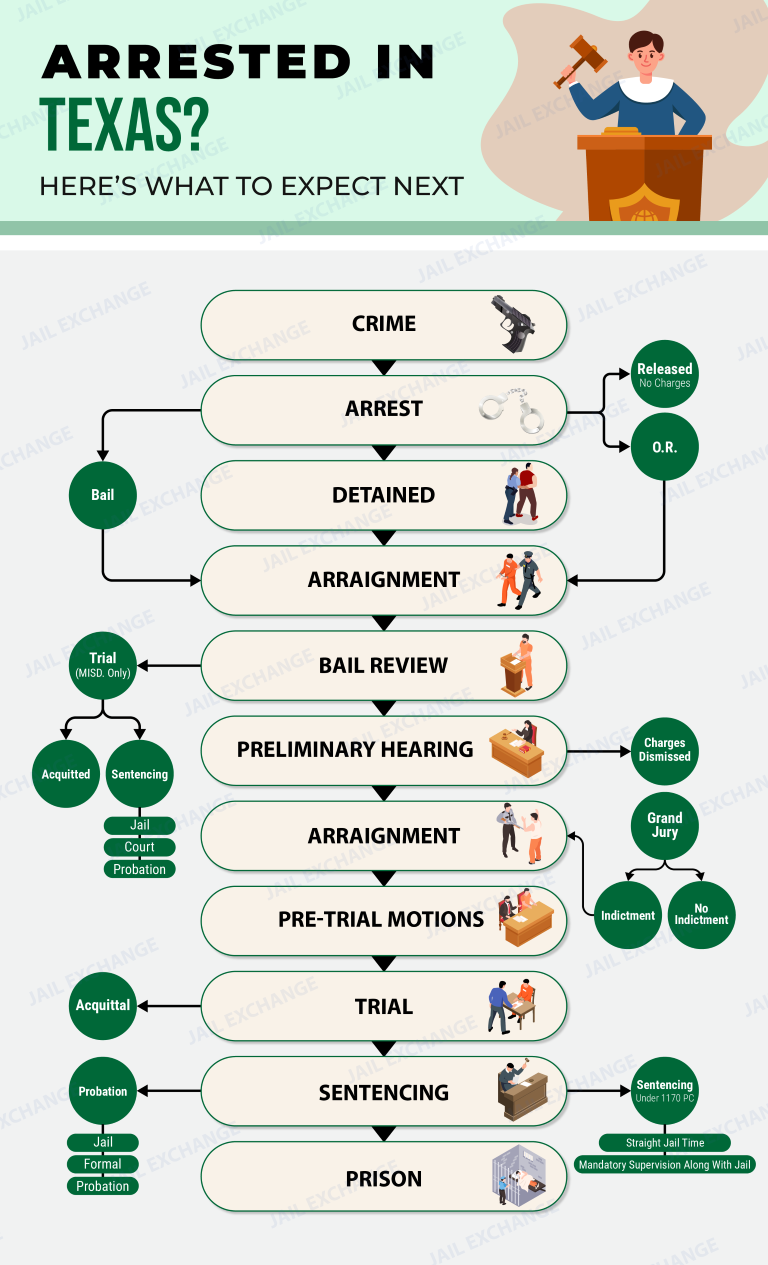
A first DWI, shoplifting, a minor drug charge or a scuffle can each be filed as a misdemeanor. The exact level depends on the facts. For Class A and B charges, the case begins with an information, a written accusation the prosecutor files. The County Court handles it from there:
- Arraignment. Standing in court, the accused learns the exact accusation and enters a plea (Code Crim. Proc. 26.01).
- Pretrial. Evidence passes between the two sides, motions get argued, and plea offers come and go.
- Resolution. If there's a deal, the judge first announces whether to honor it. Should the judge turn it down, the accused may pull the plea (Code Crim. Proc. 26.13). With no deal, a trial decides.
Top penalties under the Penal Code, by class:
- Class A: up to a year behind bars and up to $4,000 in fines, alone or combined (§12.21).
- Class B: a $2,000 fine, 180 days in jail, or both, as the most (§12.22).
- Class C: $500 at most, with no jail (§12.23).
Deferred adjudication lets a misdemeanor be dismissed without a conviction after a supervised stretch of two years or less (Code Crim. Proc. 42A.101-42A.111). Two years is also the ceiling for misdemeanor probation. Supervision runs through San Angelo's Concho Valley Community Supervision and Corrections Department, 3036 N. Bryant Blvd., San Angelo, TX 76903, 325-659-6544.
↑ Back to the question list6. Indicted on a felony: what are the steps and sentence ranges?
A felony has more stages. Until indicted, the accused can demand an examining trial, where a judge checks the probable cause (Code Crim. Proc. 16.01). Nine or more grand jurors must then agree before an indictment issues (Code Crim. Proc. 20A.301). The 119th District Court then handles arraignment, pretrial motions and either a plea or a trial.
Felony sentence ranges (§§12.31-12.35 of the Penal Code):
- Capital: the death penalty or life without any parole.
- First degree: life, or anywhere from five to 99 years.
- Second degree: between two and 20 years.
- Third degree: a two-year minimum and a ten-year cap.
- State jail felony, the lowest tier: anywhere from 180 days through two years, served in a state jail.
Fines up to $10,000 can be added at any felony level short of capital. Prior felony convictions can push the range higher (§12.42). Now and then, a state jail felony gets a Class A misdemeanor sentence instead (§12.44). Deferred adjudication and probation on a felony can each stretch as long as ten years (Code Crim. Proc. 42A.053, 42A.103).
For drug-driven cases, ask the defense lawyer about the felony drug court in San Angelo. The Criminal Associate Judge runs it at the Tom Green County Courthouse, 112 West Beauregard, San Angelo, TX 76903, 325-653-9540. Whether a Concho case can join is a question for that lawyer.
↑ Back to the question list7. Murder, robbery, sexual assault: what extra rules apply?
- Since Texas voters approved a 2025 amendment, bail must be refused for certain violent charges. Only a prosecutor can start this. At the hearing that follows, the state carries the burden on flight or on danger (Tex. Const. art. I, §11d).
- The list starts with murder and capital murder. Trafficking is on it. Kidnapping, robbery and sexual assault are covered when charged as aggravated. So is indecency with a child. Aggravated assault counts if it caused serious injury. It also counts if a gun, knife, club or explosive was used.
- Any judge who still lets bail go forward in such a case owes a written explanation.
- Personal bonds stay out of reach on many violent counts (Code Crim. Proc. 17.03).
- If the state thinks bail on one of these charges is set too cheap, it can appeal. A ruling must come inside 20 days, and until then the accused remains held (Code Crim. Proc. 44.01).
- After a family violence arrest, release is delayed four hours past posting bond if more violence looks likely. A magistrate can sign an order that tacks on as much as two more days (Code Crim. Proc. 17.291).
For capital murder, an adult can be sentenced to death or to life without parole (§12.31 of the Penal Code). When the defendant was 17 or younger, it is life.
↑ Back to the question list8. Who files the charges in Concho County, and how does a free lawyer get assigned?
Who brings the charges. Felony prosecution belongs to the District Attorney for the 119th district, at 124 W. Beauregard Ave., San Angelo, TX 76903, 325-659-6583. The County Attorney's office is in the courthouse at 152 N. Roberts, Paint Rock, TX 76866, 325-732-4315. Ask there whether that office is handling a given misdemeanor.
Getting a free lawyer. The easiest time to request one is in front of the magistrate. After that, use the online questionnaire or a written request. Send it to the County Court on a misdemeanor and the District Court on a felony. Under the seven-county defense plan, a ruling comes within three working days.
The Concho Valley Public Defender's Office, 113 W. Beauregard Street, San Angelo, TX 76903, 325-229-4671, takes most appointments. Private attorneys from a court-approved list handle the others. The appointed lawyer then has one working day to attempt contact (Code Crim. Proc. 26.04). Plans like Concho's answer to the Texas Indigent Defense Commission, 209 West 14th Street, Room 202, Austin, TX 78701, 512-936-6994.
↑ Back to the question list9. Tracking down a cause number or the next setting: where?
A phone call usually works best. Ring the County and District Clerk at 325-732-4322, giving the legal name plus birth date. Staff there can match it to a cause number, a court and the next setting. Speeding tickets and other fine-only files belong to the Justice of the Peace, 325-732-4706.
Web options:
- The clerk's Online Records Search updates overnight. It's built mostly around deeds and probate, so check with the clerk before counting on it for a criminal case.
- re:SearchTX is the state courts' record portal. Registration is free. You'll see charges and outcomes there, though hearing dates stay off it.
- The DPS conviction search covers Texas convictions statewide for a fee.
Mark every setting the moment you hear it. A no-show can cost the bond and add a bail-jumping charge.
↑ Back to the question list10. Could a Concho County warrant be waiting, and how do you settle it?
Concho warrants get served by the Constable or by deputies from the Sheriff's Office. Both work from the courthouse at 152 N. Roberts, Paint Rock, TX 76866, and share one line, 325-732-4312. Ask by name and birth date whether one is active. DPS posts a statewide Texas 10 Most Wanted list of its highest-priority fugitives. The County and District Clerk, PO Box 98, Paint Rock, TX 76866, 325-732-4322, can check for warrants attached to a court file. Getting it cleared: hire or request a lawyer, surrender at the issuing court, or call there and ask to be reset. Warrants over unpaid tickets trace back to the JP, 325-732-4706.
↑ Back to the question list11. Charged by the federal government: what's the San Angelo routine?
Federal judges hear Concho cases as part of Texas's Northern District, in its San Angelo Division. They sit in the O.C. Fisher Federal Building, 33 E. Twohig Ave., Room 202, San Angelo, TX 76903. A clerk picks up at 325-655-4506.
- The defendant meets a federal magistrate judge early on. At a detention hearing, the judge picks pretrial release with conditions, or detention (18 U.S.C. 3142).
- Prosecutors from the U.S. Attorney's Office work out of 1100 Commerce Street, 3rd Floor, Dallas, TX 75242, 214-659-8600.
- Broke defendants can have counsel appointed. Head office of the Federal Public Defender: 525 South Griffin Street, Suite 629, Dallas, TX 75202, 214-767-2746.
- Until trial, federal custody is the U.S. Marshals Service's job. Families can try its San Angelo office, 33 E. Twohig Avenue, Suite 106-D, San Angelo, TX 76903, 325-658-4056, which has staff during court terms.
- Post-sentence, track the person through the Federal Bureau of Prisons inmate locator.
12. An ICE hold on a Concho County defendant: what does it mean for court?
A detainer from ICE runs alongside the Concho case without ending it. The sequence:
- Paper first: whichever jail has the person receives a Form I-247A from ICE, the federal agency that enforces immigration law.
- That lets the jail hold Concho's prisoner up to 48 hours after they would otherwise be released (8 CFR 287.7(d)). Posting bond or getting charges dismissed doesn't change this.
- Texas requires its jails to comply with these detainers. The hold lifts early only if someone proves U.S. citizenship or lawful status (Code Crim. Proc. 2A.060). Cities and counties may not adopt rules that limit enforcement of immigration law (§752.053 of the Government Code).
- Under a 2025 law, counties operating a jail must seek ICE's 287(g) partnership by December 1, 2026 (chapter 753 of the Government Code). Since Concho operates none, questions about a hold go to the Sheriff's Office, 325-732-4312.
- Agents from ICE take custody. The Dallas Field Office: 8101 N. Stemmons Freeway, Dallas, TX 75247, 972-367-2200.
Pleading guilty can affect immigration status, so raise it with the defense lawyer before any plea. To find a person ICE has already taken, search the ICE Online Detainee Locator. The search runs on an A-number. Lacking that, try a name together with birth country.
↑ Back to the question list13. After sentencing, does the person serve time in a county jail, a state jail or prison?
A misdemeanor jail sentence is served in a county jail. Concho operates none, so the Sheriff's Office, 325-732-4312, can say where those days will be spent. Someone sentenced on a state jail felony serves it in one of the state's state jail facilities. Bigger felonies bring a prison term from the Texas Department of Criminal Justice, called TDCJ.
The first stop for a new prisoner is an intake unit. Staff there size up the person and choose a long-term unit. Transfer out of county custody may take some time.
- Type a name into the TDCJ inmate search. If you have the SID or TDCJ number, use that.
- Our Texas state prisons pages list addresses and rules for every unit.
14. Concho County kids ages 10 to 16: how does juvenile court work?
Juvenile court takes a Concho case when the child's age on the offense date was at least 10 and no more than 16 (§51.02 of the Family Code). Seventeen-year-olds are tried as adults. Once officers have a child in custody, a parent must hear from them without delay (§52.02 of the Family Code).
- Detention can't drag on without a judge. A Monday-to-Thursday pickup means a hearing inside two working days, while a Friday or Saturday pickup means the very next working day. The child's lawyer is assigned before that hearing starts (§54.01 of the Family Code).
- Juvenile matters here run under a board plan that covers seven counties. The closest state-registered detention center: Tom Green County Juvenile Justice Center, 1253 West 19th Street, San Angelo, TX 76903, 325-655-2323.
- Teens with a Class C ticket may qualify for the JP's youth diversion plan, which can keep a conviction away.
- Serious felony charges against a child of 14 or more may be certified to adult court (§54.02 of the Family Code).
The Sheriff's Office, 325-732-4312, can help you locate the child and the probation officer assigned.
↑ Back to the question list15. Hurt by a crime here: what rights and money help exist?
Texas gives crime victims rights in each criminal case (Code Crim. Proc. 56A.051). Courts must consider a victim's safety when bail is set. Victims can ask to hear about each hearing. Before sentencing, they may describe the harm in an impact statement. Jails are also supposed to try to alert a victim before the accused walks out (Code Crim. Proc. 17.29).
- Victims of a felony can call the District Attorney's office at 325-659-6583. It sits at 124 W. Beauregard Ave., San Angelo, TX 76903.
- Custody and release alerts come from IVSS-Counties or by phone at 866-268-8959. The service costs nothing, never closes and works in English and Spanish.
- The Attorney General's Crime Victims' Compensation program, 800-983-9933, can pay as much as $50,000 toward medical bills, counseling and similar costs.
Information for this service is currently unavailable.
Concho County arrests are sent to San Angelo. The county runs no working jail, so the Tom Green County Detention Center, 4382 N US Highway 277, San Angelo, TX 76905, holds them, and that is where their money ends up. A money order for one of them is made payable to "Inmate Trust Fund."
Tom Green does not post the address a money order should be mailed to, and it does not name the company behind its online deposits. Both answers come from the jail at 325-659-6597; give the inmate's legal name and birth date when you call. One address to skip: the Longview, Texas box. It scans letters and accepts no money.
Money can also leave the account. The person signs a release that names who will pick it up, no more than once every 30 days, and whoever is collecting should phone the bookkeeper ahead of time.
There is no working jail in Concho County, Texas, anymore. Anyone arrested there is held at the Tom Green County Detention Center in San Angelo, Tom Green County, Texas, and mail for them is handled under that jail's rules. Everyday letters are sent to a mail-scanning service, because mailed paper can be soaked in drugs, and the person reads the scan on a kiosk in their cell.
Everyday letters (scanned):
Inmate's Full Name & SO#
Tom Green County Jail
PO Box 591
Longview, TX 75606
Legal mail, medical mail and newspapers (straight to the jail):
Inmate's Full Name & SO#
Tom Green County Detention Center
4382 N. US Highway 277
San Angelo, TX 76905
- Write the SO number: Tom Green County uses the SO number, which is its booking number, on all mail. Put it right after the person's full name.
- Who it's from: Your name and full mailing address must be on the envelope.
- Keep it short: Five pages or fewer, nothing larger than 8.5 x 11 inches, and only one side of each page written on.
- Pictures: One photo per mailing. A second photo gets the whole mailing returned.
- Reading material: The jail does not take books, magazines or bulk mail at either address.
- Money orders: Make them payable to "Inmate Trust Fund." Online deposits through send money work too.
- Scanned originals: The paper is destroyed 30 days after scanning.
The Concho County Sheriff's Office in Paint Rock answers at 325-732-4312, and the Tom Green County jail at 325-659-6597.
Information for this service is currently unavailable.
Information for this service is currently unavailable.
Information for this service is currently unavailable.
- Tom Green County Jail: 325-659-6597
- Court: 325-732-4322
- Police: 325-869-2211
- Sheriff: 325-732-4312
The Concho County Offenders are Jailed in Tom Green County serves the following cities and towns of Concho County: Eden and Paint Rock.