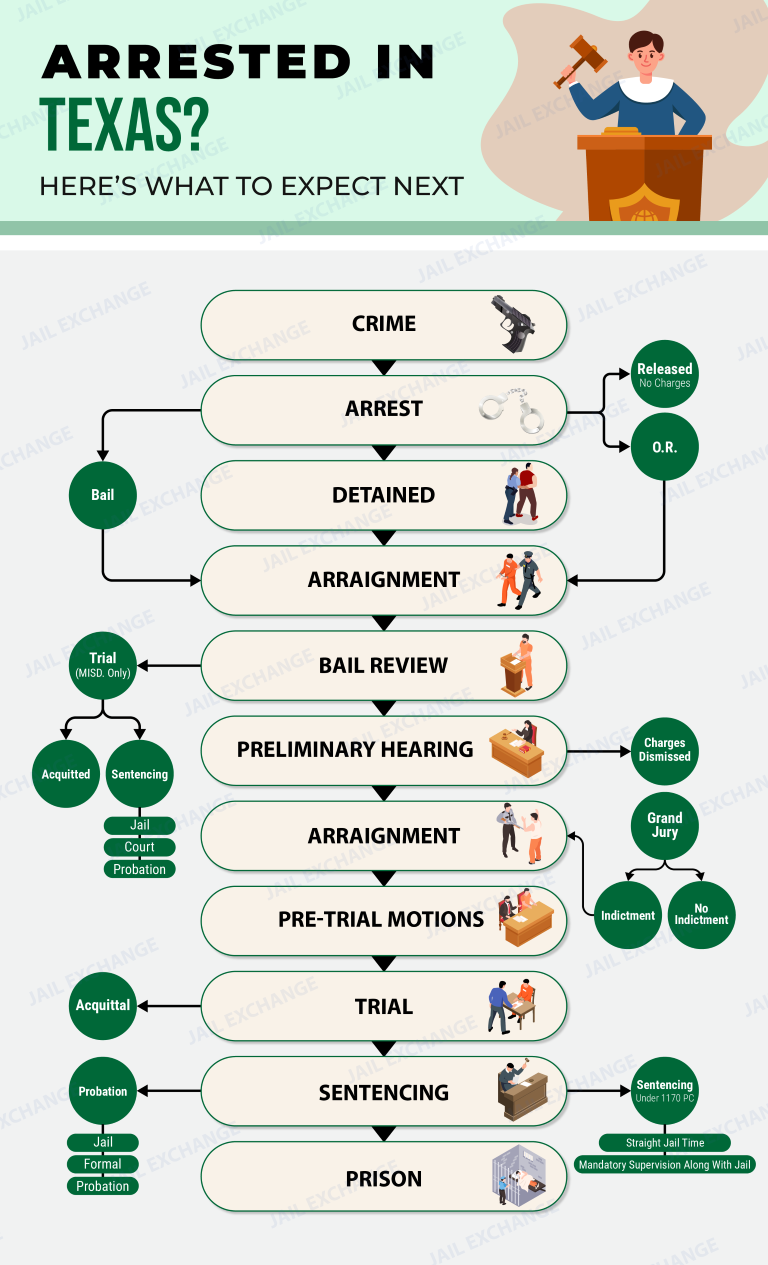
Crane County Jail Criminal Court Process
Criminal Court Process for Crane County Texas
Crane County Criminal Court Guide
Almost any criminal case in Crane County plays out in a single building, the courthouse at 201 W 6th St, Crane, TX 79731. City tickets are the exception and go to a small court on that same street. People held while a case moves sit in the Crane County Jail, 464 NW Truck Route, Crane, TX 79731. Keep reading for the courts, the path of a case, lawyers, lookups and warrants.
Start by pinning down where the person is. The state's Texas IVSS-Counties tool checks custody by name. The official jail search is a backup. Covering the arrest and the days inside, our Inmate Search page lists fresh bookings and who is held, then warrants, charges, mugshots, appointed lawyers and property.
Next, ring the clerk at 432-558-3581. Ask which judge has the file, what the case number is, and when the next setting falls. Still behind bars? Our bail page covers getting out.
1. Sorting the case: which bench takes a ticket, misdemeanor or felony?
Texas grades crimes by the worst punishment they can bring. In this county, each grade has a home:
- Class C, the fine-only level with a $500 top and no jail. County deputies and troopers send these to the Justice of the Peace. Tickets from city officers go to the Municipal Court.
- Class A and Class B, the misdemeanors that can mean jail. The County Judge hears them, sitting as the constitutional County Court.
- Felonies of every grade. The 109th District Court takes these, and that judge also serves Andrews and Winkler counties.
- Last appeals in criminal matters. Austin's Court of Criminal Appeals has the last say.
Here, a single clerk's office holds both the felony files and the County Court files. One call to 432-558-3581 can track down most cases.
↑ Back to the question list2. Where are the Crane County courtrooms?
Look first to the Crane County Courthouse, 201 W 6th St, Crane, TX 79731. Its main line is 432-558-1101.
- County and District Clerk, Room 110. The mailing box is P.O. Box 578, Crane, TX 79731. Call 432-558-3581 or write coclerk@co.crane.tx.us. Doors open 8:00 a.m. to 5:00 p.m., Monday to Thursday, and 8:00 a.m. to 4:00 p.m. on Friday. The cash drawer closes at 4:30 p.m. (3:30 p.m. Friday).
- 109th District Court, the felony bench. The court office sits at 201 N Main, Room 201, Andrews, TX 79714, 432-524-1419. Crane's court days are on the clerk's District Court calendar for 2026.
- County Court, the County Judge's courtroom for jailable misdemeanors, inside this same courthouse.
- Justice of the Peace, also in the courthouse, 432-558-1108 or jpweb@co.crane.tx.us. Its mail goes to P.O. Box 148, Crane, TX 79731. It keeps the clerk's weekday hours. Since September 1, 2026, the office is closed to the public every Tuesday.
The Municipal Court is down the street at 115 W. 6th Street, Crane, TX 79731, 432-558-7747.
↑ Back to the question list3. Is there a city court in Crane?
Yes. Crane is the county's lone incorporated town. When a city officer writes a Class C ticket inside town, the case goes to its Municipal Court.
- Street address: 115 W. 6th Street, Crane, TX 79731
- Mailing address: P.O. Box 56, Crane, TX 79731
- Phone: 432-558-7747
- Email: municipalcourt@crane.texas.gov
- Open: weekdays, 8:00 a.m. to 4:00 p.m.
A ticket from a deputy, a constable or a state trooper belongs to the Justice of the Peace instead, 432-558-1108. That court shares a courtesy letter and plea form that also spells out the driving safety course rules. Fines can go through its online payment page.
Officers may hand out a citation in place of an arrest for Class C offenses, other than public intoxication (CCP 14.06). If a fine is more than the family can manage, the judge can allow payments, waive part of it, or let community service count, at $150 for 8 hours. A judge can't jail someone for nonpayment without a hearing that shows no honest effort was made (Code of Criminal Procedure, chapter 45A).
↑ Back to the question list4. What happens before a magistrate after an arrest?
Within 48 hours of arrest, often much faster, the person meets a magistrate (CCP 15.17). The meeting can be live or by video. At that hearing, the person learns:
- what the complaint charges
- hiring a lawyer, or asking for one paid by the county
- staying silent, having a lawyer at any questioning, and ending an interview at will
- on a felony, an examining trial, which is a chance to test the evidence early
- that words spoken now can come up later in court
The magistrate also helps with the lawyer request form and decides bail. On jailable charges, the magistrate first goes through a public safety report, which lists any earlier arrests and convictions (CCP 17.021, 17.022). The county's plan routes felony lawyer requests to the District Judge and misdemeanor requests to the County Judge.
↑ Back to the question list5. DWI, theft and other misdemeanors: how they move
Jailable misdemeanors begin with an information. That is the prosecutor's written charge, filed in County Court. The steps after that:
- Arraignment, the first County Court setting. The judge reads out the charge, and a plea follows (CCP 26.01).
- Pretrial settings, where evidence is shared and a plea offer may come.
- Plea or trial. On a plea bargain, the judge announces ahead of sentencing whether the deal stands. A rejected deal lets the person pull the plea back (CCP 26.13).
How long, and how much? Penal Code chapter 12 answers:
- Class C: $500 or less, and nobody is jailed (PC 12.23).
- Class B: a fine that tops out at $2,000, a jail stay that tops out at 180 days, or both (PC 12.22).
- Top misdemeanor, Class A: 12 months or less in jail, $4,000 or less in fines, or both (PC 12.21).
Deferred adjudication skips the guilty finding. Misdemeanor terms can last as long as two years. Finish them all, and the judge drops the charge (CCP 42A.101, 42A.103, 42A.111). Plain probation on a Class A or B, which the law calls community supervision, can't pass two years either (CCP 42A.053). Adult probation keeps an office in Room 200 of the courthouse, 432-558-1107.
↑ Back to the question list6. How a Crane County felony moves to trial
Felony files belong to the 109th District Court. A typical road:
- A magistrate sees the person and sets bail inside 48 hours.
- The defense may seek an examining trial, an early hearing on whether probable cause is there (CCP 16.01).
- A grand jury meets in secret. Nine members or more must agree before it indicts (CCP 20A.301).
- The person is arraigned in District Court. Motions and hearings follow.
- A plea deal or a trial decides guilt, and punishment comes after.
What the Penal Code allows for each grade:
- State jail felony: 6 months minimum, 2 years maximum, served at a state jail unit. Fines run as high as $10,000 (PC 12.35).
- Prison felonies: for a third degree, 2 to 10 years. For a second degree, 2 to 20. For a first degree, 5 to 99, or life. Fines may reach $10,000 on top (PC 12.32 to 12.34).
- Capital felony: death, or life in prison with parole ruled out. If the defendant was 17 or younger at the offense, the sentence is life (PC 12.31).
Past felony convictions may raise the punishment range (PC 12.42). The judge may also sentence a state jail felony at the Class A level (PC 12.44). On a felony, both deferred adjudication and most probation terms can stretch to 10 years (CCP 42A.053, 42A.103). Treatment courts for drugs, veterans and mental health are listed in the state's specialty court registry.
↑ Back to the question list7. Do violent felonies follow other rules?
Yes. The law adds weight at several points:
- Personal bond. Violent-list offenses, and a handful of others, can't get one (CCP 17.03).
- No bail. Proposition 3 passed in November 2025. It covers murder, capital murder, trafficking and some aggravated crimes. The prosecutor must prove, at a hearing, a real risk that the person will skip court or harm others. Bail is then refused (Texas Constitution, Article I, Section 11d).
- State appeals. In listed violent cases, prosecutors may challenge a bail they see as too low. Until the appeals court rules, the person stays in custody (CCP 44.01).
- Family violence. A four-hour wait follows bond when there is probable cause the violence will go on (CCP 17.291). The first hearing can also bring an emergency protective order (CCP 17.292).
- Capital cases. Death or life without parole are the only sentences (PC 12.31). A regional defender that handles only capital work takes these cases.
8. Prosecutors and court-appointed defense
The county has two prosecuting offices:
- District Attorney, Crane County Courthouse, 201 W 6th St, Crane, TX 79731. Mail goes to P.O. Box 113, Crane, TX 79731. Phone 432-558-1134.
- County Attorney, 520 South Gaston, Suite B, Crane, TX 79731, 432-272-8954.
The clerk at 432-558-3581 can tell you which office is handling a case.
Appointed lawyers here are private attorneys, chosen in turn from a list under a written county plan. Ask for one with the form at the magistrate hearing. Copies are also kept at the Sheriff's Office and online through the Texas Indigent Defense Commission. In a county this small, appointment must come within three working days of the request (CCP 1.051). A family may hire its own lawyer whenever it likes.
↑ Back to the question list9. Looking up a Crane County case or court date
The clerk's page links re:SearchTX, a statewide records portal. Accounts cost nothing. Once in, you can see a case's number, court and charges, plus key filings like an indictment or a judgment. Court settings come from the court itself.
Where to ask about dates:
- District Court and County Court cases: the clerk, 432-558-3581. The felony court calendar lists the year's Crane terms.
- Class C cases from county deputies or state troopers: the Justice of the Peace, 432-558-1108.
- Class C cases from city police: the Municipal Court, 432-558-7747.
Expect to be asked for the full name and birth date of the accused. For an older case, the clerk also links the state courts' page on orders of nondisclosure, a way to keep some records from public view.
↑ Back to the question list10. Warrants from Crane County: checking and clearing them
Three agencies serve warrants here: the Sheriff's Office, 464 NW Truck Route, Crane, TX 79731, 432-558-3571; the Constable, 432-208-8295; and, within town, the Crane Police Department, 432-558-2212. Any one of them can check a name by phone. The state's own DPS Texas 10 Most Wanted page names top fugitives. On a felony warrant, the usual path is surrender at the jail after talking with a lawyer. For a ticket warrant, call the court that issued it about setting a new date. District and County Court cases are handled by the clerk in Room 110, 201 W 6th St, Crane, TX 79731, 432-558-3581.
↑ Back to the question list11. How is a federal case from Crane County handled?
When a federal charge comes out of this county, the Western District of Texas takes it. The Midland-Odessa Division clerk is at 200 East Wall, Room 222, Midland, TX 79701, 432-686-4001.
- Release before a federal trial is decided early, by a magistrate judge, often at a detention hearing (18 U.S.C. 3142).
- While a federal case runs, deputy U.S. Marshals keep the prisoner and handle every move. Their Midland office: 200 East Wall Street, Suite 213, Midland, TX 79701, 432-686-4100.
- Once a federal judge sentences someone, check the Federal Bureau of Prisons locator to learn where they were sent.
12. Immigration detainers: does the state case pause?
The state charge keeps moving through court. The difference shows up on release day:
- ICE files its detainer with the county jail on Form I-247A.
- Next comes the hold itself, for up to 48 hours after they would otherwise be released, giving ICE a window to take custody (8 CFR 287.7(d)).
- Under Texas law, jails comply with detainers and must explain them to the person held. If the person proves lawful status, or that they are a U.S. citizen, the hold ends (CCP 2A.060).
- No county may adopt rules that limit immigration work by its officers (GC 752.053). Senate Bill 8, a 2025 law, pushes sheriffs who run jails toward 287(g) agreements with ICE. The cutoff for asking is December 1, 2026. The Sheriff's Office, 432-558-3571, can say whether this county has asked.
- After ICE takes over, use the ICE Online Detainee Locator, with the A-number or with name plus country of birth.
For a noncitizen, a plea may carry immigration results. Tell the defense lawyer about the detainer at once.
↑ Back to the question list13. Where are prison sentences from Crane County served?
State jail felony time is spent at a state jail unit (PC 12.35). Higher grades, from third degree up, are served in a TDCJ prison, one of the units the Texas Department of Criminal Justice operates. Once sentenced, most people remain in the Crane jail until TDCJ moves them to intake. There, staff classify them and pick a unit.
- Track a transfer through the TDCJ inmate search. Type in a last name, or a TDCJ or SID number.
- For visiting and mail at a given unit, check our Texas state prisons page.
14. Cases against children and young teens
In Texas, juvenile court handles offenses by children 10 to 16 years old. For a crime at 17 or older, adult court takes over (FC 51.02). In this county the juvenile board is the County Judge and the District Judge, and it sets the local juvenile rules.
- After custody, a child goes to a juvenile processing office, where the stay is generally capped at six hours. A parent has to be notified quickly (FC 52.02).
- Held children see a judge at a detention hearing. The deadline is two working days, or one if the pickup came on Friday or Saturday. A lawyer is assigned before that hearing (FC 54.01).
- On some grave felonies, a hearing before the juvenile judge can end with a child of 14 or 15 facing adult court (FC 54.02).
Families can phone the Sheriff's Office at 432-558-3571, or the clerk at 432-558-3581, for the child's whereabouts and hearing time. The Texas Juvenile Justice Department is at 1711 San Jacinto Blvd, Austin, TX 78701, 512-490-7130.
↑ Back to the question list15. What help do Crane County crime victims get?
The District Attorney has a Victim Assistance Coordinator for people hurt by a crime. The office is at the courthouse, 201 W 6th St, Crane, TX 79731. Reach that office at 432-558-1134.
- Texas law lists victims' rights. A magistrate setting bail has to weigh the victim's safety. Victims may ask to be told about each court date, and they can file an impact statement (CCP 56A.051).
- Free alerts on booking and release come from Texas IVSS-Counties. Phone help, at 866-268-8959, is in English or Spanish around the clock. This system took the place of VINE.
- A victim may recover up to $50,000 for medical care, counseling and missed pay by applying to Crime Victims' Compensation, an Attorney General program that answers at 800-983-9933.