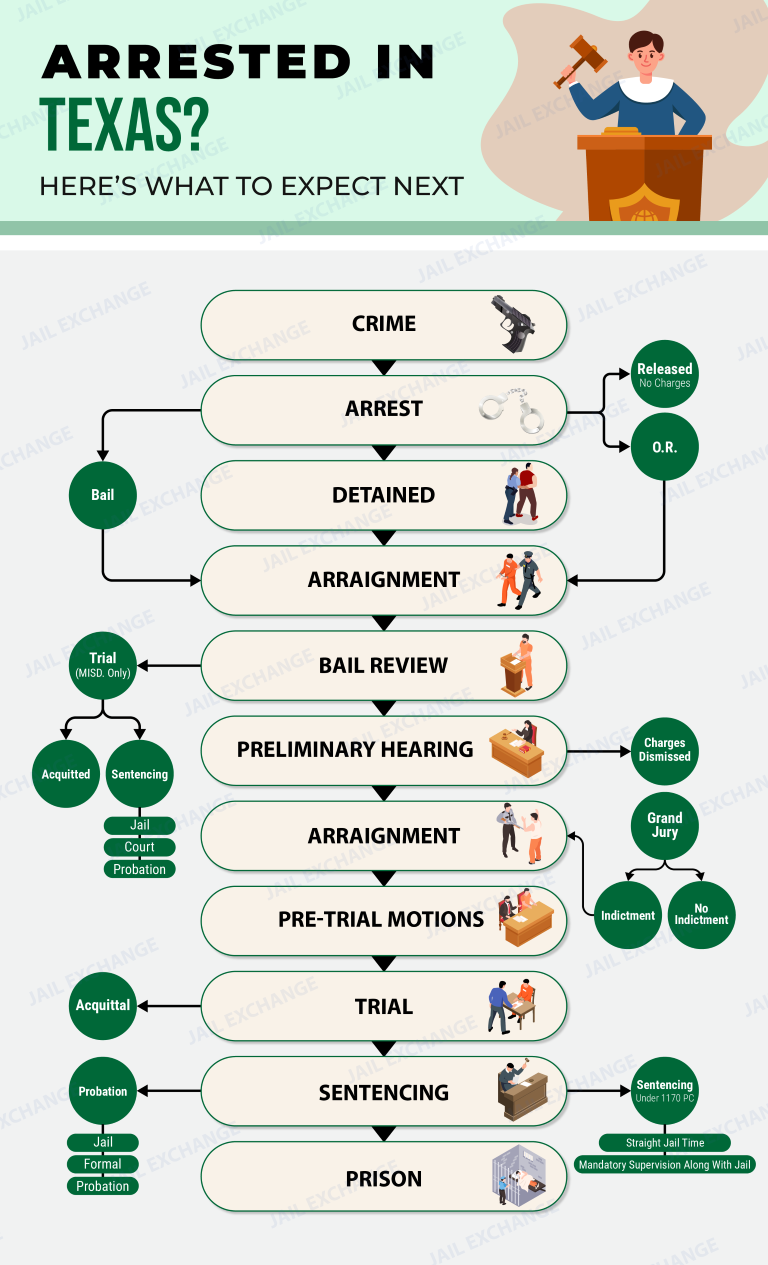
Dawson County Jail Criminal Court Process
Criminal Court Process for Dawson County Texas
Dawson County Criminal Court Guide
All of Dawson County's criminal courts share one address, the courthouse at 400 S 1st Street, Lamesa, TX 79331. Anyone held before trial stays at the Dawson County Jail, 401 S 2nd Street, Lamesa, TX 79331, which the Sheriff runs. This guide sorts out which judge gets a case, the steps from arrest to verdict, the possible punishments and how to keep track of hearings.
Wondering whether your relative remains in custody? Check the official jail search or the state's tracker, Texas IVSS-Counties. Our Recent Arrests page is about custody itself, covering current inmates, new arrests, open warrants, what someone is charged with, mugshots, appointed defenders and how property is returned.
To get a hearing date, phone the clerk who keeps the file and ask for the case number. That is the District Clerk at 806-872-7373 for felonies or the County Clerk at 806-329-3311 for misdemeanors. When release is the bigger worry tonight, start with our bail page.
1. Which Dawson County judge hears a misdemeanor or a felony?
How serious the accusation is decides where it is heard. Locally:
- Felonies belong to the 106th District Court. One district judge rides this circuit for four counties: Dawson, Gaines, Garza and Lynn. The District Clerk holds the files.
- Jailable misdemeanors (Class A and Class B) land in the county-level court, which the county website lists as the County Court at Law. Its papers are filed with the County Clerk.
- Fine-only offenses, called Class C, never bring jail. A deputy's or trooper's ticket goes to the Justice of the Peace, a single office serving the whole county.
At the top of the appeal chain, for criminal cases only, is the Court of Criminal Appeals. A court system guide from the state draws the whole ladder.
↑ Back to the question list2. Inside the Dawson County Courthouse: offices and phones
The courthouse stands at 400 S 1st Street, Lamesa, TX 79331, and its switchboard is 806-329-3313. Most offices take letters at P.O. Box 1268, Lamesa, TX 79331. Offices you may need:
- District Clerk (felony files): 806-872-7373, open business hours
- County Clerk (Class A and B files): 806-329-3311, open business hours
- Justice of the Peace (Class C tickets): 806-329-3324. The justice court page lists hours of 8:30 a.m. to noon and 1 to 5 p.m. on weekdays.
- 106th Judicial District Attorney (felony prosecutor): 806-872-2259. Mail goes to P.O. Box 1124, Lamesa, TX 79331-0008.
Small offices can step out for court, so call ahead before you make the drive.
↑ Back to the question list3. Tickets written inside Lamesa city limits
Lamesa is the county seat and the one sizable town. A citation from a city officer prints its own court, that court's location and the first appearance date. Hang on to it.
If it was lost, the Justice of the Peace at 806-329-3324 can say whether the case is on its docket. Justice court tickets may be paid online at dawsoncotix.com or by phone at 800-701-8560.
Short on money for a fine? A fine-only court may set up installments, accept community service credited at $150 per 8 hours, or forgive the fine. A judge can't jail someone over it unless a hearing first shows the person could have paid (CCP arts. 45A.252 to 45A.261). Ask the court about these options before the due date.
↑ Back to the question list4. The first hearing after an arrest in Texas
Every adult who is booked sees a magistrate within two days, either face to face or on camera (CCP arts. 14.06, 15.17). It is quick. The magistrate:
- Reads the accusation and cautions that statements may end up as evidence.
- Explains the rights to silence, to a lawyer during questioning and to stop an interview.
- Mentions the right to an examining trial for a felony, a hearing where a judge checks the evidence before any indictment.
- Accepts the paperwork for an appointed attorney from anyone who asks.
- Decides bail and any conditions.
Should the magistrate rule there was no probable cause, a written ruling must follow inside a day. In a family-violence case, this is also where a magistrate may sign an emergency protective order.
The Sheriff's Office at 806-872-7560 can tell you if the hearing has taken place.
↑ Back to the question list5. How a misdemeanor case moves in county court
Most lower-level arrests follow a set path:
- Charging. Misdemeanors are filed on a paper known as an "information," with no grand jury step.
- Arraignment. In open court, the formal charge is read, and the defendant responds with a plea.
- Settings. Each side shares evidence, motions get argued and an offer may be made.
- Plea or trial. Before accepting a bargain, the judge announces whether to go along with it. If not, the defendant may pull the plea back.
A Class B conviction allows up to 180 days in the county jail and a fine reaching $2,000. Class A raises the ceiling to one year and $4,000 (Penal Code 12.21, 12.22).
Not every case ends in a conviction. With deferred adjudication, the judge postpones any finding of guilt and sets up to two years of supervision. Finish it cleanly and the case gets dismissed. Regular probation on a misdemeanor also runs two years at most. To ask which prosecutor has a misdemeanor file, call the courthouse at 806-329-3313.
↑ Back to the question list6. Grand jury to verdict in a Dawson County felony
The 106th Judicial District Attorney prosecutes felonies here, and the 106th District Court hears them. The path usually runs:
- Examining trial. Before any indictment, the defense may ask a judge to test whether probable cause exists under article 16.01 of the Code of Criminal Procedure.
- Grand jury. Without at least nine yes votes from the grand jury, there is no indictment. If the votes fall short, the result is a "no bill."
- Arraignment and pretrial. The person answers the indictment, and motions are argued.
- Plea or jury trial. Most cases settle. A rejected plea deal may be withdrawn.
Prison ranges in Penal Code chapter 12, from lowest to highest:
- State jail felony: a 180-day minimum and a 2-year cap.
- A third-degree felony brings 2 to 10 years.
- A second-degree felony brings 2 to 20 years.
- First-degree felony: no less than 5 years, up to 99 or life.
Each level may add a fine up to $10,000, and earlier convictions can push the range higher. A felony judge can grant deferred adjudication or probation for up to 10 years. Some defendants qualify for treatment-based programs such as veterans or drug courts, found in the specialty court registry.
↑ Back to the question list7. Violent felonies and higher stakes
A violent case walks the same felony road, yet every step carries more weight.
- Capital felonies are punished by death or by life in prison without parole. For someone who was younger than 18, the sentence is life.
- Other violent crimes are often charged at the upper felony levels, where a sentence can reach 99 years or life.
- Bail is tougher. A personal bond is off limits, and since the 2025 vote on Proposition 3, a judge must refuse bail for several violent charges once a prosecutor proves the risk at a hearing.
- Defense when the state may seek death is assigned to a Lubbock-based office called the Regional Public Defender for Capital Cases, which takes mail at PO Box 2097, Lubbock, TX 79408, and calls at 806-696-3740.
Expect months or more between arrest and trial. The District Clerk at 806-872-7373 can share upcoming settings.
↑ Back to the question list8. Who prosecutes, and who defends if money is short?
On the state's side, felonies go to the 106th Judicial District Attorney, Dawson County Courthouse, 400 S 1st Street, Lamesa, TX 79331, 806-872-2259. That office covers all four counties of the district.
For the defense, anyone lacking money for counsel can ask the magistrate for an appointed one.
- Felony requests are handled under the 106th District plan. Private attorneys take turns from a list, and one must be named within three working days.
- Misdemeanor requests go to the county judge, using forms from the county court coordinator.
- Caprock Regional Public Defender Office is part of the county's lists for misdemeanors, and for felonies with the district judge's approval. Its office is at 3311 18th St., Lubbock, TX 79409, 806-742-4312.
Local appointment plans appear in a database run by the Texas Indigent Defense Commission, whose office is at 209 West 14th Street, Room 202, Austin, TX 78701, 512-936-6994.
↑ Back to the question list9. Tracking down a docket number and the next setting
The clerks know every setting first. For a felony, that's the District Clerk at 806-872-7373. Misdemeanor records live with the County Clerk at 806-329-3311 instead. Know the exact spelling and the birthday before you dial.
- The county website keeps a district court hearings page worth checking for felony settings.
- re:SearchTX lets anyone register free to see Texas filings, such as the charge papers and judgments. Hearing dates come from the clerk instead.
- The Texas Department of Public Safety sells searches of its conviction name database for finished cases.
For a ticket, the Justice of the Peace at 806-329-3324 can give the next date.
↑ Back to the question list10. Checking on a Dawson County warrant
Sheriff's deputies serve most warrants in the county, and they can say if one is active: 806-872-7560. Constables also carry out court papers; see the county constable page. Inside Lamesa, city police can serve them too. The DPS Texas 10 Most Wanted pages feature the state's top fugitives.
The clerk for whichever court issued it can also check. To resolve it, a defense lawyer can plan a voluntary surrender, post bond with that court, or ask for a new hearing date. Courts meet at the courthouse, 400 S 1st Street, Lamesa, TX 79331, 806-329-3313.
↑ Back to the question list11. Federal charges heard in Lubbock
Federal prosecutors file local cases with the Lubbock Division of the federal trial court for North Texas. Hearings take place inside the George H. Mahon Federal Building, 1205 Texas Avenue, Room 209, Lubbock, TX 79401-4091, clerk 806-472-1900.
- First appearance. A U.S. magistrate judge explains the charges and may appoint a lawyer.
- Detention hearing. Here the judge decides if conditions can make release safe, or if jail until trial is needed (18 U.S.C. 3142). Bondsmen play no role.
- Custody. The Marshals keep custody until the case ends, often renting beds in county jails. Reach the Lubbock office at 1205 Texas Avenue, Room C-126, Lubbock, TX 79401-4037, 806-472-7655.
- Defense. A defendant who cannot hire counsel is often represented by the Federal Public Defender, whose Lubbock branch sits at 1205 Texas Avenue, Room 507, Lubbock, TX 79401, 806-472-7236.
- After sentencing. Federal prisoners show up on the Federal Bureau of Prisons inmate locator.
12. Immigration detainers during a criminal case
Even with an immigration hold, the local prosecution keeps going until a judge resolves it. The hold works this way:
- The federal immigration agency (ICE) lodges a written hold, Form I-247A.
- That allows the jail to keep the person up to 48 hours after they would otherwise be released (8 CFR 287.7(d)), so agents have time to arrive.
- State law makes jails follow detainers (CCP art. 2A.060), though a person holding proof of citizenship or legal presence must be freed from it. Since 2017, a separate statute has blocked local sanctuary rules.
- Texas counties that run jails were told by Senate Bill 8 (2025) to apply for 287(g) partnerships, by December 1, 2026. Local status questions go to the Sheriff's Office.
- Locate someone held by ICE on the ICE Online Detainee Locator, by A-number. Name and birth country also work.
Pleading guilty may change a person's immigration future, so bring it up with defense counsel early.
↑ Back to the question list13. After a prison sentence: TDCJ intake and lookup
Both prisons and state jails are run by the state's prison agency, TDCJ. State jail felonies are spent in a state jail, while other felony terms are spent in a prison unit. The person first passes through intake, then moves to a unit that fits.
- After the move, check the TDCJ inmate search, which lists people in TDCJ custody right now.
- Unit-by-unit details appear on our Texas state prisons page.
- When the judge gives probation rather than prison, supervision runs through Dawson CSCD, 609 N 1st St, Lamesa, TX 79331, 806-872-5033.
14. Dawson County youths in juvenile court
In Texas juvenile law, a child is someone aged 10 to 16. Someone who is 17 goes through the regular adult courts instead, under Family Code 51.02. A local juvenile board picks which court hears youth cases, and the county has its own juvenile board plan for appointed lawyers.
- Officers must contact a parent promptly after taking a child (Family Code 52.02).
- A detained child is given a lawyer and has a hearing by the second working day after being taken in (Family Code 54.01).
- For certain grave felonies, a juvenile judge can waive jurisdiction. This is called certification, and it applies from age 14 (Family Code 54.02).
- Youths who must be held are taken out of county, for example to the Lubbock County Juvenile Justice Center, 2025 N Akron Ave, Lubbock, TX 79415, 806-775-1800.
The Texas Juvenile Justice Department oversees these centers from 1711 San Jacinto Blvd, Austin, TX 78701, 512-490-7130. To learn where a child is held, ask the Sheriff's Office.
↑ Back to the question list15. Help and notices for crime victims
Texas gives crime victims rights in criminal cases (CCP art. 56A.051). Among them:
- Their safety must be part of the bail decision.
- If they ask, they get notice of court dates, including delays and cancellations.
- A written impact statement can be shared with the judge ahead of the sentence.
Sign up for free custody alerts on Texas IVSS-Counties or by calling 866-268-8959 any hour. The person in jail never learns who signed up.
The state's Crime Victims' Compensation program can repay up to $50,000 for things like medical care, counseling and missed work. Apply through the Attorney General at 800-983-9933. For case questions, call the District Attorney at 806-872-2259.
↑ Back to the question list