Deaf Smith County Jail Criminal Court Process
Criminal Court Process for Deaf Smith County Texas
Deaf Smith County Criminal Court Guide
Every local criminal court, small or large, works out of the courthouse at 235 E 3rd St, Hereford, TX 79045. People kept in custody while their case runs stay at the county jail, 3780 N. Progressive Rd., Hereford, TX 79045. Use this guide to pair each charge with the right court, follow the steps of a case and find every office involved.
The Sheriff's jail roster is the official place to look for your person. It can run behind, so call to be sure. For the arrest side of things, our Inmate Search page covers open warrants, mugshots, the newest bookings, filed charges, appointed defenders, who is in custody and property release.
Ring the District Clerk, 806-364-3901, about felonies. Class A and B misdemeanors are tracked by the County Clerk, 806-363-7077. Have the legal name and birthday ready; either office can share the cause number and next court setting. Our bail and bond page explains release.
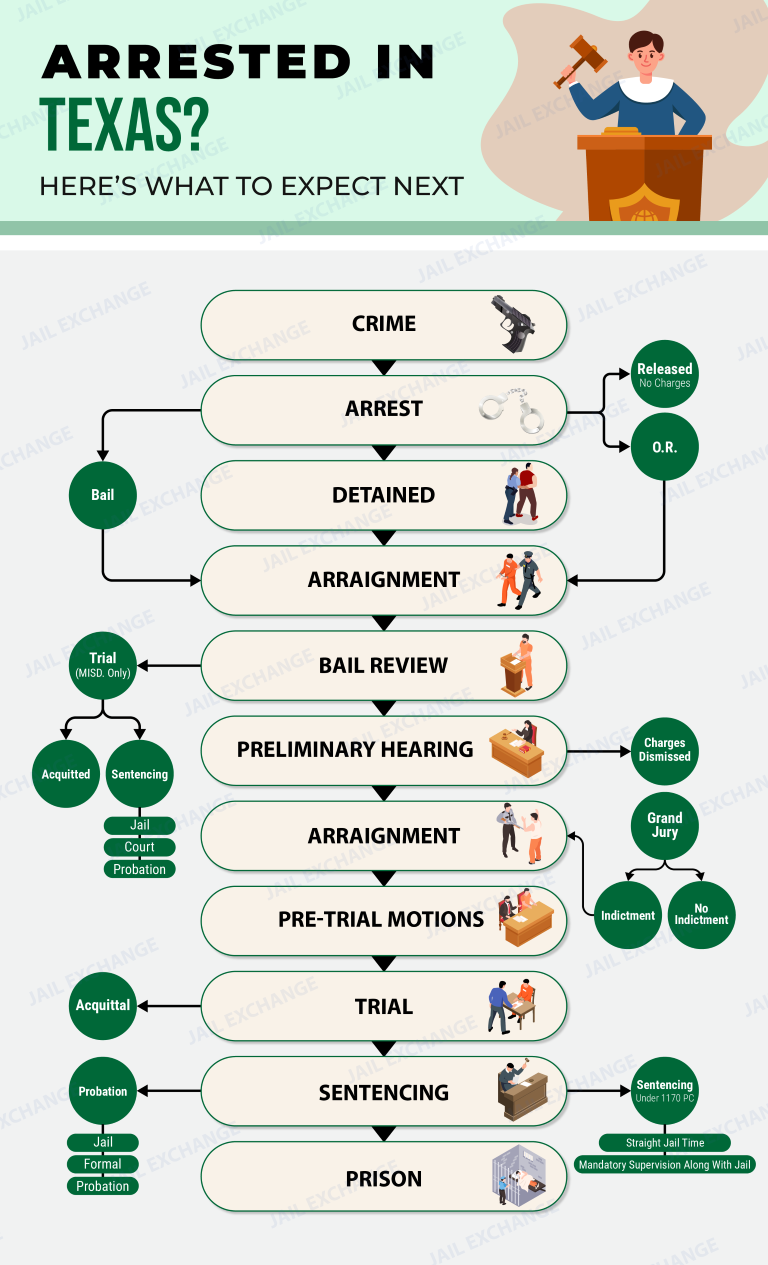
1. Matching each charge level to a courtroom
Charge level decides where a case goes.
- 222nd District Court: all felonies. This district court also serves Oldham County.
- County Court: the County Judge presides over Class A and B misdemeanors here.
- Justice of the Peace or municipal court: Class C cases, which carry fines but never jail. The municipal court hears city cases from Hereford.
The state court office explains these roles in its 2025 court system pamphlet. After a conviction, an appeal can go up the ladder, ending at the Court of Criminal Appeals.
↑ Back to the question list2. Where each court and clerk sits
Each office below sits in the courthouse at 235 E 3rd St, Hereford, TX 79045.
- 222nd District Court office: 806-364-7222.
- District Clerk (felony files), Room 304, 235 East Third Street, Hereford, TX 79045, 806-364-3901. Open weekdays 8:00 to 5:00 but closed for the noon hour. Its law library shuts at 4:30. Clerks there give out no legal advice and no forms.
- County Clerk (Class A and B files), Room 203, 235 East 3rd Street, Hereford, TX 79045, 806-363-7077. Open weekdays 8 to 5, lunch hour included.
- Justice of the Peace: 806-364-0999.
- Adult probation (CSCD), Room 204, 235 E. 3rd, Hereford, TX 79045. The District Clerk can point you to its phone line.
3. Hereford Municipal Court and the Justice of the Peace
Two local courts share the Class C caseload.
Hereford Municipal Court handles city tickets. Its mailing address is P.O. Box 2277, Hereford, TX 79045. Phone 806-363-7127, or write to municipalcourt@herefordtexas.gov. City Hall sits at 224 N. Lee Avenue, Hereford, TX 79045, 806-363-7100, if you need directions.
The Justice of the Peace takes Class C cases countywide from its courthouse office, 235 E 3rd St, Hereford, TX 79045, 806-364-0999. On its county web page you'll find dockets, the calendar, a way to pay ticket fines online and the petition for an occupational driver's license. Call the court once an online payment goes through.
Short on money? A judge can spread payments out, convert the fine into community service hours ($150 of credit for each 8 hours) or waive it. Jail for nonpayment requires a hearing first and a ruling that the person didn't really try (CCP arts. 45A.252 through 45A.261).
↑ Back to the question list4. The first hearing after a Deaf Smith County arrest
Magistration comes first, inside 48 hours. Here the Justice of the Peace does it, and the court's page notes live YouTube magistrations.
Expect the magistrate to cover:
- the charge filed
- rights: silence, a lawyer (hired or appointed, including during questioning), ending an interview at any time, and an examining trial
- a warning that anything said may come up as evidence
- the form for requesting a free lawyer, with help completing it
- bail and any release conditions
These duties come from CCP art. 15.17. If probable cause is lacking, the magistrate puts that finding on paper within 24 hours.
↑ Back to the question list5. Misdemeanor steps before the County Judge
Misdemeanors skip the grand jury. The charging paper, known as an "information," is filed with the County Clerk. Then:
- Arraignment confirms who the person is and takes a plea, unless their lawyer waives it on paper (CCP art. 26.01).
- Pretrial settings let both sides swap evidence and discuss an offer.
- Deal or trial. If the two sides reach an agreement, the judge must say openly whether the court will follow it. Article 26.13 also lets the defendant pull the plea if the judge refuses the deal.
Punishment limits sit in Penal Code chapter 12. The top Class A punishment is one year in jail and a $4,000 fine, alone or combined. For Class B, the ceiling is 180 days and $2,000. Class C allows a fine of up to $500 and no jail time.
Deferred adjudication lets a person finish terms and avoid a conviction; on a misdemeanor, the judge may set it for as long as two years. Ordinary probation on a misdemeanor is limited to two years as well (CCP arts. 42A.053, 42A.103).
↑ Back to the question list6. Felony steps in the 222nd District Court
Every felony file here sits with the District Clerk, 806-364-3901. From arrest to verdict:
- Magistration and bail within two days.
- Examining trial on request: a pre-indictment look at probable cause, where bail may also be reviewed (CCP art. 16.01).
- Grand jury review, held privately. At least nine of its members have to approve an indictment, under CCP art. 20A.301.
- Arraignment on that indictment, followed by pretrial hearings.
- Plea bargain or trial by jury.
Ranges by degree: life or 5 to 99 years at the first degree, 2 to 20 years at the second, and 2 to 10 years at the third. State jail felonies, the lightest kind, mean between 180 days and 24 months in a state jail. Any felony level can add a $10,000 fine. Prior felony convictions may raise the range a level (PC 12.42), and a judge may treat a state jail felony with Class A jail time (PC 12.44).
On a felony, deferred adjudication and probation can each stretch to 10 years. The state's specialty court list includes drug, veterans and mental health programs; your lawyer can say whether one is an option.
↑ Back to the question list7. Serious violent charges: what changes
Violent felonies bring tougher rules at almost every step.
- Sentences. For capital murder, the State may seek death. Otherwise an adult gets life without parole, and a teen under 18 gets life (PC 12.31).
- No-bail hearings. Proposition 3, approved in 2025, lets prosecutors seek a hearing to deny bail on murder, aggravated robbery, aggravated kidnapping and several more crimes named in Tex. Const. art. I, §11d.
- Few personal bonds. Many violent charges can't get one (CCP art. 17.03).
- State bail challenges. On a felony, prosecutors can ask a district judge for a fresh bail review (CCP art. 17.029). For listed violent crimes, the state may also appeal low bail, under CCP art. 44.01.
- Limits on deferred adjudication. Most murder charges, some trafficking and some repeat sex cases can't get it (CCP art. 42A.102).
On a family violence charge, release can be delayed four hours past bond, and an emergency protective order often follows (CCP arts. 17.291, 17.292).
↑ Back to the question list8. Prosecutor and public defender for Deaf Smith County
The prosecution. The District Attorney's office represents the state, 806-364-3700. Call that number for its address and to learn who has the case. Some Texas prosecutors offer pretrial diversion, so ask about it.
The defense. When a person can't afford counsel, the Panhandle Area Public Defender usually takes the case: 900 S. Polk, Suite 206, Amarillo, TX 79101, 806-242-3415. Besides Deaf Smith, it covers Armstrong, Carson, Moore, Oldham and Potter counties.
Who qualifies? Judges weigh income, property, debts, dependents and a spouse's earnings, based on a sworn questionnaire (CCP art. 26.04). A posted bail counts only as a clue about money. A person found unable to pay keeps that status through the case unless their money situation changes a lot. Courts may not threaten jail because someone asks for a lawyer.
The Texas Indigent Defense Commission keeps every county's appointment plan online; use its plan search page to read this one.
↑ Back to the question list9. Tracking the case and next court date
- Phone a clerk. Felony dates: District Clerk, 806-364-3901. Class A and B dates: County Clerk, 806-363-7077.
- Search re:SearchTX. Registration is free. Once signed in, you can see the case index, charging papers, judgments and dismissals. Hearing times are left to the clerks (re:SearchTX FAQ).
- Read the Justice of the Peace calendar. Class C dockets are on the JP's county page.
Each charge on the Sheriff's jail roster carries a case number and court type, but the file may be old. The paid DPS conviction search shows older convictions.
↑ Back to the question list10. Warrants in Deaf Smith County: how to check
Deputies handle most warrants; ask the Sheriff's Office at 806-364-2311. Constable Precinct 1, based at 235 E 3rd St, Hereford, TX 79045, answers at 806-363-7014. Hereford police take calls at 806-363-7120.
For Class C cases, scan the Justice of the Peace's warrant spreadsheet. The state's top fugitives show up on the DPS 10 Most Wanted list.
Clearing one means facing the court behind it. A lawyer can arrange a turn-in, or you can call that court and ask about a new date. Justice court: 806-364-0999. Felonies: District Clerk, Room 304, 235 East Third Street, Hereford, TX 79045, 806-364-3901.
↑ Back to the question list11. Federal charges from the Amarillo Division
Amarillo's federal court takes prosecutions from this corner of the Panhandle: U.S. District Court, 205 SE 5th Avenue, Room 133, Amarillo, TX 79101, 806-468-3800.
Soon after a federal arrest, the defendant appears before a magistrate judge. Under 18 U.S.C. 3142, that judge either sets release conditions or holds a detention hearing. A defendant ordered held stays with the U.S. Marshals until trial.
- Marshals' Amarillo office: 205 SE 5th Street, Unit 214, Amarillo, TX 79101, 806-324-2350.
- Federal Public Defender, Amarillo branch: 600 S. Tyler Street, Suite 2300, Amarillo, TX 79101, 806-324-2370.
Sentenced federal inmates serve their time with the Bureau of Prisons, searchable on the BOP locator.
↑ Back to the question list12. Immigration detainers during a state case
An ICE hold and a state case move on separate tracks.
- The detainer is written on ICE Form I-247A and goes to the jail.
- When the state no longer holds the person, the jail may keep them up to 48 hours after they would otherwise be released (8 CFR 287.7(d)).
- ICE picks them up. Look for them on the ICE Online Detainee Locator.
Texas outlawed local limits on immigration enforcement in 2017 (Gov't Code 752.053). Jails must honor detainers too. Showing U.S. citizenship or legal presence is the way out of one (CCP art. 2A.060). On 287(g): a 2025 state law orders each jail-running county to request this ICE agreement before December 1, 2026. Call the Sheriff's Office, 806-364-2311, for the local answer.
The plea is the key moment. For non-citizens, pleading guilty or no contest can trigger deportation. Judges must give that warning out loud and in writing before taking the plea (CCP art. 26.13). Talk through immigration risks with a lawyer before pleading. ICE lists its Dallas Field Office for North Texas: 8101 N. Stemmons Freeway, Dallas, TX 75247, 972-367-2200.
↑ Back to the question list13. Where a prison term from Deaf Smith County is served
Jail time on a misdemeanor is served locally. State jail felony time happens in a state jail (PC 12.35), while third-degree felonies and worse are served in state prison under TDCJ.
Each new arrival begins at an intake unit, which tests and sorts them by risk and need. Afterward TDCJ assigns a permanent unit based on that review.
The TDCJ inmate search lists people now in a TDCJ facility. Its records trail real time by at least one day. Our Texas state prisons page covers TDCJ visiting and mail rules.
↑ Back to the question list14. Charges against a child aged 10 to 16
Juvenile court in Texas covers acts done by kids aged 10 through 16 (Family Code 51.02). Seventeen-year-olds go through adult court instead. A local juvenile board decides which court hears these cases.
- Police have to notify a parent or guardian promptly, with the reason for custody (FC 52.02).
- During processing, a parent, guardian or the child's lawyer is allowed to be present (FC 52.025).
- Held in detention? Expect a hearing quickly: two working days at most, or just one if the arrest came on a Friday or Saturday. Counsel is named ahead of it (FC 54.01).
- Certification moves a juvenile case into adult court. Before that, the judge orders a full study of the child and holds a hearing (FC 54.02). For the worst felonies it can happen at 14; for other felonies, at 15.
Call the Sheriff's Office at 806-364-2311 to learn which detention center holds the child and how to reach juvenile probation.
↑ Back to the question list15. Help for crime victims in Deaf Smith County
Under CCP art. 56A.051, crime victims in Texas are owed several things:
- safety weighed in the bail decision
- advance word of hearings on request
- an impact statement the court considers before sentencing
- a waiting room apart from the defendant before testifying
Prosecutors must mail victims written notice within 10 days after charges are filed by indictment or information. They should also share plea offers when possible (CCP arts. 56A.451, 56A.453). The District Attorney's office can be reached at 806-364-3700.
For medical costs, counseling or lost pay, the Attorney General runs a compensation fund that can pay up to $50,000: 800-983-9933. To hear when the accused is booked, freed or transferred, use Texas IVSS-Counties, the free state alert service, or call 866-268-8959 at any hour.
↑ Back to the question list