Ector County Detention Center Inmate Bail & Bonds
Ector County Bail and Release
Whoever makes the arrest, adults picked up in Ector County land at the Ector County Detention Center, 2500 South US Highway 385, Odessa, TX 79764. The jail is part of the Sheriff's Law Enforcement Center, roughly half a mile south of Interstate 20. Read on for the magistrate step, bond choices, the courthouse personal bond office, licensed bondsmen, holds and getting bond money back.
Step one: check that your person hasn't already been let out. Enter a last name in the Sheriff's inmate information lookup. For custody details, the Inmates in Custody page we keep tracks bookings, the newest arrests, warrants still open, each charge, mugshots, court-appointed counsel and how to collect property left at booking.
Call the Detention Center first, at 432-335-3060. Find out whether a magistrate has already set bail, the dollar figure for every charge, and any hold sitting on the file. Once they're out, the case moves on at the courthouse, and our court guide explains each stage.
1. Who sets bail after an Ector County arrest?
A magistrate makes the call. In Texas that word covers judges and certain court officers who may hold the first hearing. Here, the arresting agency decides which one:
- Deputies and DPS troopers: their arrests are seen by a justice of the peace.
- Odessa police and the campus police at the University of Texas Permian Basin: their arrests are seen by a city municipal judge.
By statute the wait tops out at 48 hours (CCP arts. 15.17, 14.06). A judge can hold it in the same room or through a camera link. When a state agency audited local hearings in 2024, each case it sampled had been heard by day two.
In that short hearing, the charge is announced and the arrested person hears a list of rights. Those include keeping quiet, hiring a lawyer, and asking for one paid by the county. On Class B charges and anything higher, the magistrate must first review a public safety report (CCP art. 17.022). It shows past cases, warrants and skipped court dates, but it carries no score and suggests no dollar amount. Bail is then fitted to this one person. The law wants the lightest set of rules that keeps everyone safe (art. 17.028).
↑ Back to the question list2. What bond choices exist under Texas law?
Texas law calls every kind of pretrial release a form of bail (CCP art. 17.01). Families here mostly see three:
- Cash bond. The family hands the full figure to the court, and it is returned after the case, minus fees.
- Surety bond. Here a bonding company, holding a county board license, promises the court the full figure. The family pays that company a charge that stays with it for good.
- Personal bond. No money goes in at the start. The person signs, pledging to show up. The courthouse Pretrial Services office screens these and charges 3% of the bond amount.
For a burglary charge, organized crime or certain drug felonies, a personal bond needs the trial court's own approval. Other charges block a personal bond outright under art. 17.03. Examples are most violent crimes on the state's list, a felon caught with a gun, some protective order violations, and fresh charges for someone already supervised on a violent case.
Judges may attach terms to any bond, like a GPS unit or an alcohol monitor. Our Texas bail laws page lays out how the rules work across the whole state.
↑ Back to the question list3. What drives the bail figure in Ector County?
Texas has no statewide price chart for charges, so each magistrate sets a number case by case. The law lists what goes into that number (CCP art. 17.15):
- Enough money at stake that showing up beats skipping
- Never a sum meant to crush or punish
- The kind of charge, and any violence in it
- How much the person can truly pay
- Danger, if any, to the alleged victim, to police or to the wider community
- Earlier convictions, and citizenship
A separate rule protects people held after a warrantless arrest when probable cause still hasn't been decided by a magistrate in time. A misdemeanor suspect goes free by the 24th hour, with bail capped at $5,000. A felony suspect goes free by the 48th hour, with bail capped at $10,000. People who cannot afford that must receive a personal bond instead (art. 17.033).
For the actual figure, ring the Detention Center at 432-335-3060 and go through the charges one at a time.
↑ Back to the question list4. Steps for posting bond at the Law Enforcement Center
The jail never closes. It sits at 2500 South US Highway 385, Odessa, TX 79764. Inside the Sheriff's ID and Records Division works a bond clerk who handles booking, release and bond papers.
- Dial 432-335-3060 and request the bond clerk.
- Read off their legal name, birth date and, if you have it, the SO number from the lookup.
- Get the figure for every charge, plus any hold.
- Find out which payment types the jail takes right now, and whether that charge must go through a bondsman.
- Bring a government photo ID. Save the receipt, since it shows the case number.
Before booking wraps up, visits are limited to attorneys, bondsmen and officers. The Sheriff's administration offices keep weekday hours, 8 a.m. to 5 p.m. Late at night, stick with the jail number.
↑ Back to the question list5. Which courthouse offices deal with bonds?
Three offices on North Grant Avenue have a role. Phone first so you don't wait in the wrong line.
- Pretrial Services and Post Sentence Monitoring (personal bonds): 300 N Grant Avenue, Room 108, Odessa, TX 79761, 432-498-4133. Weekdays 8 a.m. to 5 p.m., with a lunch closing from noon to 1. Its officers do interviews at the jail daily. A judge signs off only after weighing the record and the new charge. The office keeps 3% of the bond amount as its fee. Anyone indicted on a felony checks in here.
- District Clerk (felony records): 300 N Grant Avenue, Room 301, Odessa, TX 79761, 432-498-4290. Weekdays 8 a.m. to 4:30 p.m. Papers come in by hand or by mail, never by fax or email.
- County Clerk, Criminal Department (misdemeanor records): 300 N Grant Avenue, Room 111, Odessa, TX 79761, 432-498-4130. Open 8 a.m. to 4:30 p.m.
Ask the right clerk if that case lets you pay a cash bond at the counter, and which kinds of money it takes.
↑ Back to the question list6. Paying for release: cash, cards and monitor fees
Payment rules at the jail can shift. Before leaving the house, ask the bond clerk at 432-335-3060 about cash, cards, money orders and any service charge.
The county's online payment page, reached from the District Clerk and justice court pages, handles court costs and traffic tickets. The city court in Odessa runs a separate card site for city citations. Release itself goes through the jail, Pretrial Services or a licensed bondsman.
Release terms can carry their own bills. Pretrial Services charges:
- GPS ankle unit: $10 per day, starting with a $100 money order
- Continuous alcohol monitor: $12 per day, starting with a $150 money order
- Drug screen: $20 apiece
- Ignition interlock or remote breath unit: $10 per month, installed within 30 days of the order, with installers in Odessa and Midland
Keep cash out of the mail. The jail turns it away.
↑ Back to the question list7. Licensed bondsmen and the Ector County bond board
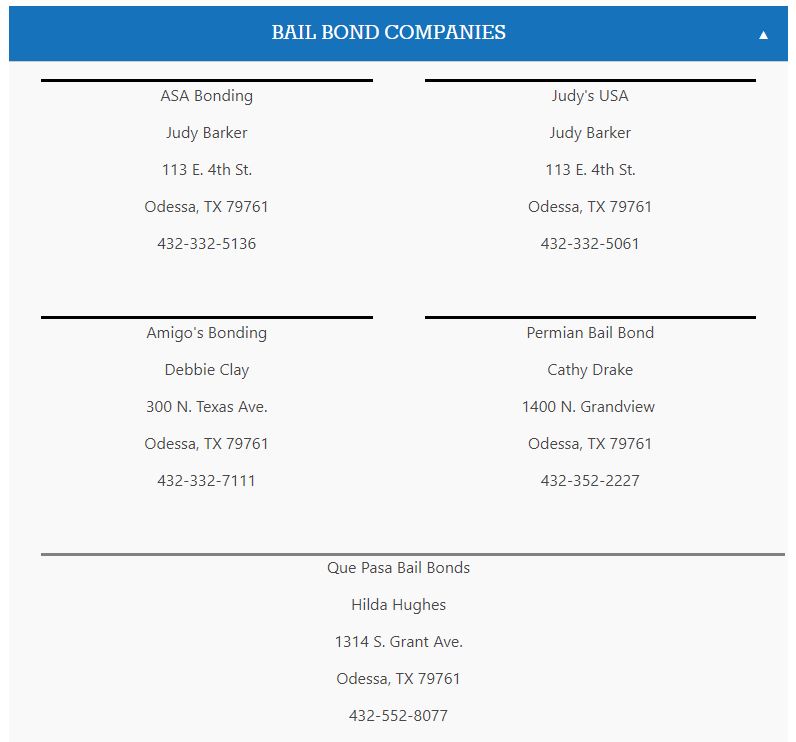
Because this county passed 110,000 residents, Texas requires it to run a bail bond board (Tex. Occ. Code 1704.051). That board licenses every bondsman working here. Its office is in the courthouse, 300 N Grant Ave, Odessa, TX 79761. Members gather at 8:30 a.m. on the third Wednesday of the month in Room 234, the County Court at Law courtroom. The Ector County Bail Bond Board page names each licensed company.
- Bondsmen set their own premiums, since Texas caps none. Get the quote in writing first.
- Expect a written receipt for every payment (OC 1704.305).
- Inside the jail, a bondsman may not ask for your business (OC 1704.304).
- After the case closes, send a written demand for any collateral, such as a pickup title. It has to come back within 30 days (OC 1704.301).
- Bondsmen can surrender a client, but the defense lawyer hears about it first, and a sworn paper gets filed (art. 17.19).
8. What else can block release after bond?
Bond on one charge leaves everything else untouched. Watch for these:
- A second charge. Every case carries its own bond.
- Another Texas county's warrant. A magistrate here may accept bail and forward it (CCP art. 15.18), though some counties send a deputy to collect the person anyway.
- A parole violation warrant. State parolees are usually kept until their violation hearing.
- Family violence cases. Under art. 17.291(b), a four-hour wait follows the bond when a magistrate thinks the violence may continue. A written order can stretch that wait to 48 hours.
- An immigration detainer. Texas jails have to honor these. Papers proving legal presence end it (art. 2A.060).
- Monitor hookup. When a GPS or alcohol device is ordered, release can wait until it is fitted.
Before paying, have jail staff at 432-335-3060 read every hold to you.
↑ Back to the question list9. When Texas judges may deny bail outright
Texas guarantees bail to almost everyone. Tex. Const. art. I, § 11 sets out the oldest exception: a capital charge with evident proof. Narrower exceptions cover certain repeat felons, people charged while out on felony bail, and people who break release terms or protective orders (§§ 11a to 11c).
Proposition 3 passed in November 2025 and created § 11d. Its list: capital murder, aggravated robbery, murder, indecency with a child, aggravated sexual assault, trafficking, aggravated kidnapping, and any aggravated assault where someone is badly hurt or a firearm, club, knife or explosive is used. Bail must be refused when the state wins a hearing showing that the accused is likely to flee or poses a danger. The defense can't start this process. Judges who set bail anyway must put their reasons on paper.
A 2025 law also lets prosecutors seek a district judge's second look at felony bail (CCP art. 17.029). The District Attorney handles felony prosecutions from its office at 300 North Grant, Room 305, Odessa, TX 79761, 432-498-4230. On a misdemeanor, the County Clerk at 432-498-4130 can point you to the office that has the file.
↑ Back to the question list10. Lowering a bond that is too high
The court that has the case is the one that can lower bail, after the defense lawyer files a written motion. Families can help by pulling together:
- Proof of steady work, a local address and family in the Permian Basin.
- An honest dollar figure the household could raise.
- A release plan that eases safety worries, like drug testing through Pretrial Services.
Delay can force a lower bond too. When prosecutors are still unready after 90 days in a felony, the person may get a personal bond or a reduced amount. Misdemeanor limits are 30 days if the charge carries over 180 days in jail, 15 days if it carries less, and 5 days when the charge is fine-only. The rule, art. 17.151, has a few carve-outs.
For felony scheduling, call the District Clerk at 432-498-4290. For a misdemeanor date, dial the County Clerk at 432-498-4130.
↑ Back to the question list11. Court-appointed lawyers in Ector County
Appointed defense here comes from private attorneys on approved lists rather than a public defender office. District judges assign felony lawyers, and the county courts at law assign misdemeanor lawyers. The District Clerk shares the roster of attorneys cleared for appointments.
- Felonies: a short sworn money form gets signed right in the magistration courtroom.
- Misdemeanors: a longer form is handed out to fill in back in the cell. Jailers pass it to the District Clerk, who routes it to court staff.
- Eligibility: public benefits come first. After that come assets and income, with household earnings below 150% of the federal poverty guidelines.
- Deadline: requests reach the appointing office within 24 hours. With under 250,000 residents here, the law allows up to three working days after the request comes in to appoint someone (CCP arts. 1.051, 15.17).
Worried a request fell through the cracks? Phone the District Clerk at 432-498-4290. Statewide oversight sits with the Texas Indigent Defense Commission, 209 West 14th Street, Room 202, Austin, TX 78701, 512-936-6994.
↑ Back to the question list12. Courthouses for cases from Odessa and beyond
Most courts share one building, the county courthouse at 300 N Grant Avenue, Odessa, TX 79761. A new courthouse is under construction, so some offices could move later.
- District Courts (felonies): 70th 432-498-4270, 161st 432-498-4260, 244th 432-498-4240, 358th 432-498-4250, 446th 432-498-4393.
- County Court at Law 432-498-4110 and County Court at Law #2 432-498-4120, which hear Class A and B misdemeanors.
- County Court, presided over by the County Judge: 300 North Grant, Room 227, Odessa, TX 79761, 432-498-4100.
- Justice courts, for Class C cases punished by a fine: 300 N. Grant, Room 208, Odessa, TX 79761. Precinct 1 432-498-4201, Precinct 2 432-498-4202, Precinct 3 432-498-4203, Precinct 4 432-498-4204.
- Odessa Municipal Court, for city citations: 201 N. Grant Avenue, Odessa, TX 79761, 432-335-3300.
- Federal court (U.S. District Clerk): 200 East Wall, Room 222, Midland, TX 79701, 432-686-4001.
13. Refunds of cash bail, and losing it
Cash bail is repaid, after fees, to the depositor listed on the receipt once the defendant has kept every court date (CCP art. 17.02). A clerk can hold back 5%, capped at $50, but only following a conviction or deferred adjudication. Cash bail may also be used to cover that defendant's own fines and court costs (Tex. Local Gov't Code 117.055).
Misdemeanor refunds start with the County Clerk's Motion and Order for Release of Cash Bond. Call 432-498-4130 with questions. On felonies, the District Clerk answers at 432-498-4290. Money paid as a bondsman's premium stays with the bonding company.
A no-show in court endangers the bond. The judge signs a judgment nisi, the first step toward forfeiting it (CCP art. 22.02). A surety escapes payment when the defendant lands back in jail soon enough, meaning a 180-day window for misdemeanors and a 270-day window for felonies (art. 22.13). Bail jumping is a separate crime too. The grade follows the underlying case. A fine-only case makes it Class C, a jailable misdemeanor makes it Class A, and a felony makes it third-degree (Tex. Penal Code 38.10).
↑ Back to the question list14. Collecting jail account money and belongings
On release day, ask the jail about leftover funds and personal items. Reach the Detention Center at 432-335-3060, or stop by 2500 South US Highway 385, Odessa, TX 79764.
- Apart from clothing, belongings may be handed to anyone the person names on a property release form.
- Clothing is released only once a state prison sentence is handed down.
- Leftover account funds go only to immediate family, with the person's approval.
Have photo ID with you. Deposits made during a stay are explained on our inmate money page.
↑ Back to the question list15. Federal charges and pretrial detention
Midland is where federal cases from this county are heard. That court is the Midland-Odessa Division, part of Texas's Western District. Its clerk works at 200 East Wall, Room 222, Midland, TX 79701, 432-686-4001.
- A U.S. magistrate judge rules on detention when the defendant first appears. The judge asks if release conditions of some kind can keep the public safe and get the defendant to court (18 U.S.C. 3142).
- Before trial, it's the U.S. Marshals Service that holds federal defendants. Its Midland office is at 200 East Wall Street, Suite 213, Midland, TX 79701, 432-686-4100.
- The Marshals contract with nearby jails for bed space, and their office can say which one has the person.
- After a federal sentence, check the Federal Bureau of Prisons inmate locator.
A bond posted on state charges at the Law Enforcement Center has no effect on a federal case.
↑ Back to the question list16. Will a state bond lift an ICE hold?
No. Even after state bail is paid, an immigration hold stays in force. The process goes step by step:
- To start, ICE files a written hold, Form I-247A, with the jail. (That agency is U.S. Immigration and Customs Enforcement.) The form asks the Detention Center to keep the person past their release time and to call ICE first.
- The jail may hold the person up to 48 hours after they would otherwise be released (8 CFR 287.7(d)).
- In Texas, jails are required to honor detainers. The only way out is papers showing U.S. citizenship or legal immigration status, per CCP art. 2A.060. Local governments, under a 2017 law, can't adopt rules that slow immigration enforcement (Tex. Gov't Code 752.053).
- Deadline news: by December 1, 2026, each jail-running Texas county, this one too, must have sought a 287(g) pact with ICE under a 2025 law. Ask the Sheriff's Office at 432-335-3050 how that is going.
- Next, ICE officers collect the person, who may be moved far from West Texas. Find where with the ICE Online Detainee Locator. Enter the person's full name together with their birth country.
17. Serving a felony sentence in a Texas prison
Texas prison sentences are carried out by the state's Department of Criminal Justice, called TDCJ. Lower-tier state jail felonies are different: Penal Code 12.35 sends them to a state jail unit. After sentencing, most people stay at the Detention Center until TDCJ has room. They start at an intake unit. Staff there run tests and decide security level, and the person is assigned to a longer-term unit after that.
- The TDCJ inmate search can be searched by surname and the first letter of the first name, or by TDCJ or SID number. Its data is updated each working day.
- JE's Texas state prisons page profiles the units.
Local probation runs through the Community Supervision and Corrections Department, 312 North Texas Avenue, Odessa, TX 79761, 432-498-4103.
↑ Back to the question list18. When a child from Ector County is detained
Under Texas law, a child is 10 through 16 years old, and 17-year-olds face adult court (Tex. Fam. Code 51.02). Kids don't post adult bail. Detained youth stay at the Ector County Youth Center, which the Juvenile Probation Department runs at 1401 E. Yukon Road, Odessa, TX 79762, 432-362-6356. County pages also call the site the Juvenile Justice Center.
- Officers must notify a parent or guardian promptly (Tex. Fam. Code 52.02).
- A detention hearing must come quickly. The cutoff is two working days, shortened to one when a Friday or Saturday arrest starts the clock. Before it starts, the youth will have an appointed attorney (Tex. Fam. Code 54.01).
- Juvenile Probation hours: Monday, Wednesday and Thursday 8 a.m. to 5 p.m.; Tuesday until 6 p.m.; Friday until 4 p.m.; closed noon to 1.
How do Bail Bonds work at Ector County Detention Center
Bonding Out of the Ector County Detention Center
Ector County licenses its bondsmen through a county Bail Bond Board. Staff on the Highway 385 line (432-335-3060) quote each bond and explain whether a surety or cash bond is possible. After a felony is filed, the court file moves to the District Clerk's office in Room 301 (432-498-4290).
Ector County Detention Center
Address:
2500 S. US Highway 385
Odessa, TX 79764
Phone:
432-335-3060