Fayette County Jail Criminal Court Process
Criminal Court Process for Fayette County Texas
Fayette County Criminal Court Guide: From the Jefferson Street Jail to the Courthouse
Fayette's criminal cases move through a short list of rooms in La Grange: felony files land with the 155th District Court, Class A and B misdemeanors at the County Court, and tickets in four justice courts plus two city courts. Anyone jailed with a case still pending waits at the county jail in the Justice Center, 1646 North Jefferson, La Grange, TX 78945, 979-968-5856. Below: addresses, case steps, sentences, lawyers and warrants.
Need to know if a relative is still locked up in La Grange? Enter the name at Texas IVSS-Counties or try our link to the official jail search. Fayette's arrest-and-custody questions get answers on our Fayette Inmates in Custody guide: who's held, fresh bookings, open warrants, charges, mugshots, appointed counsel and reclaiming property.
Families mostly begin with a clerk's phone line. Felony callers want the District Clerk at 979-968-3548; misdemeanor callers want the County Clerk at 979-968-3251. Write down the cause number they give you and the next setting. Bond money, bondsmen and release questions have answers on our bail page.
1. Which La Grange courtroom gets a felony, misdemeanor or ticket?
Texas assigns criminal cases by charge grade. Felonies belong to district courts, Class A and B misdemeanors to county courts, and fine-only Class C cases to justice or city courts (Office of Court Administration, judicial system pamphlet). Fayette's version:
- Felonies, state jail grade through capital murder: the 155th District Court, whose one judge splits time between Fayette and Austin counties.
- Class A and B charges (plenty of DWI, theft and assault cases fall here): the County Judge's constitutional County Court.
- Class C charges, such as speeding or public intoxication: a justice of the peace, or the Flatonia or Schulenburg municipal court.
The County Attorney's lawyers prosecute all three tiers. Appeals from the 155th and the County Court go to the 3rd Court of Appeals, and after that Texas's top criminal court may take the case.
↑ Back to the question list2. Fayette County courthouse rooms, clerk phones and hours
Nearly every adult case is heard at 151 N Washington St., La Grange, TX 78945. Inside you'll find:
- 155th District Court: 979-968-8500. The court has its own website.
- District Clerk, Room 102: 979-968-3548. Hours are weekdays 8 to noon and again 1 to 5. Over the counter, this office takes cash, checks or money orders, but not cards.
- County Judge, for County Court matters: 979-968-6469
- County Attorney, upstairs in Room 203: 979-968-8402
The County Clerk holds misdemeanor files at 246 W. Colorado St., La Grange, TX 78945, 979-968-3251. Its doors are open weekdays 8 to 5, except the noon-to-1 lunch hour.
Out at the Justice Center, 1646 North Jefferson, La Grange, TX 78945, the jail shares a roof with the Precinct 1 justice court, 979-968-3648.
↑ Back to the question list3. Fayette's four JP courts and two city courts
Check the ticket: it names the court. Fayette's justices of the peace also sign arrest warrants, felony ones included.
- La Grange JP (Precinct 1) at the Justice Center, 1646 North Jefferson St, La Grange, TX 78945, 979-968-3648
- Fayetteville JP (Precinct 2), mail to P.O. Box 458, Fayetteville, TX 78940, phone 979-378-2573
- Flatonia JP (Precinct 3), mail to P.O. Box A, Flatonia, TX 78941, phone 361-865-3500
- Schulenburg JP (Precinct 4), 312 Paulus St, Schulenburg, TX 78956, 979-743-4041
- Flatonia's city court, mail to P.O. Box 329, Flatonia, TX 78941, phone 361-865-2510
- Schulenburg's city court, inside City Hall at 210 East Avenue, Schulenburg, TX 78956, 979-743-4126. Its court page takes payments online, and 833-309-4335 takes them by phone.
The four JPs share one pay-by-phone line, 979-250-4039, shown on the county's justice court page. Got a La Grange city ticket? Phone the County Clerk to find out which court holds it.
Class C means a $500 cap on the fine and no jail time (Penal Code 12.23). Money tight? The JP or city judge can allow installments, a waiver, or community service at $150 credit per 8 hours worked. Jailing someone for an unpaid fine first takes a hearing (CCP arts. 45A.252 through 45A.261) and a finding that the person didn't try in good faith.
↑ Back to the question list4. Fayette County magistrate warnings and the first court date
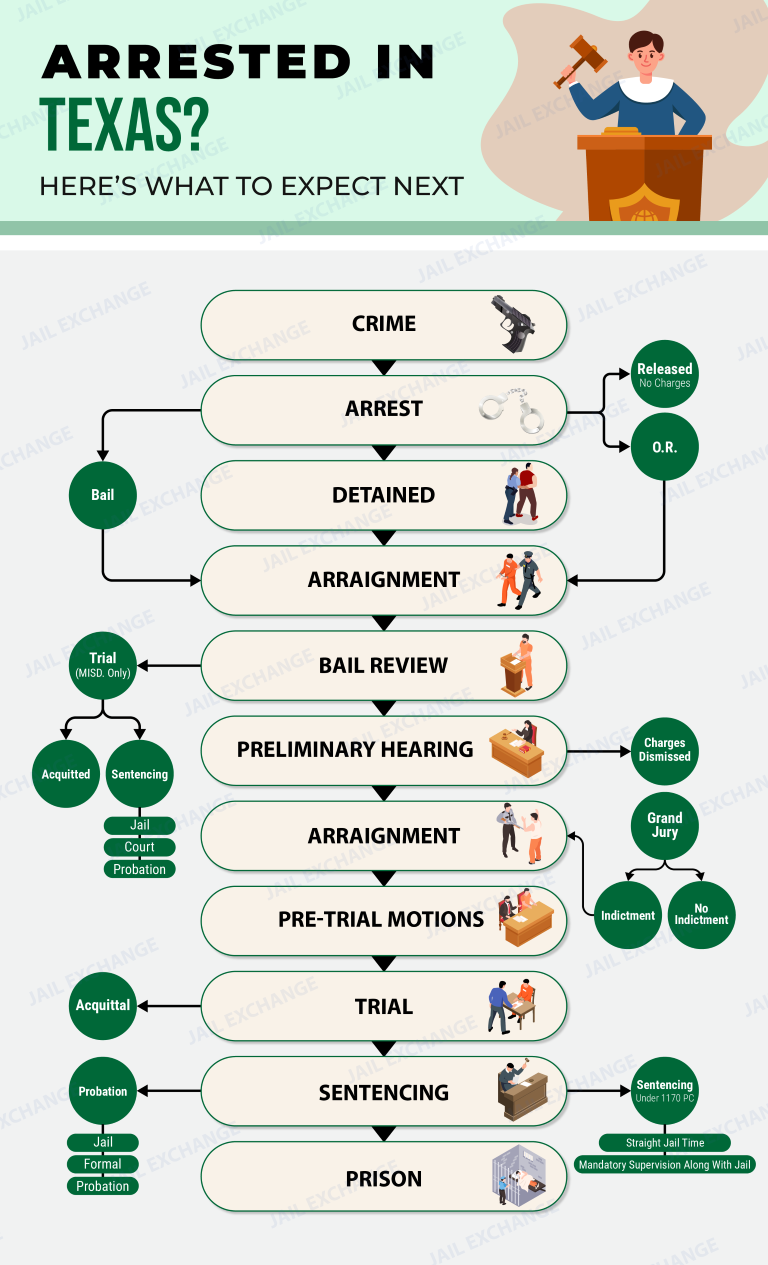
Every Fayette arrest starts a 48-hour clock, and the prisoner must be seen by a magistrate before it expires, in person or on camera (CCP art. 15.17). Three jobs get done there: the charge is read out, rights are explained, and bail gets set. That's also the moment to ask for a free lawyer.
The next step splits by charge level:
- Felony. Defense counsel may ask for an examining trial, a hearing under CCP art. 16.01. In it, a judge decides if there's enough cause to keep holding the person before indictment.
- Misdemeanor. Prosecutors file a written accusation, called an information, after which the County Court schedules a date.
Arraignment comes next. The judge makes sure it's the right person and takes the plea (CCP arts. 26.01 and 26.02): no contest, not guilty or guilty. Defense lawyers often waive this hearing in writing. Keep every court date on paper, because skipping one can mean a warrant plus a new bail-jumping charge.
↑ Back to the question list5. Class A and B cases in Fayette's County Court
DWI, theft, drug possession and assault arrests at the misdemeanor level make up much of what the County Judge hears. The usual order:
- A misdemeanor prosecutor in the County Attorney's office reads the arrest report and files the information.
- Arraignment, then one or more pretrial dates.
- Plea bargaining. If the County Judge refuses the plea deal, the defendant gets to withdraw from it, a right set out in CCP art. 26.13.
- Trial to the bench or a jury, unless a plea ends it.
Maximum punishments, per Penal Code 12.21 and 12.22:
- Class B: 180 jail days at most, up to $2,000 in fines, or both.
- Class A: at most a year of jail time, up to $4,000 in fines, or both.
Plenty of these cases end in probation. Texas calls it community supervision, and on a misdemeanor it can't run past two years, per CCP art. 42A.053. Deferred adjudication is different. No guilty finding is entered, and the charge is dropped once every term is done (CCP arts. 42A.101 and 42A.111). Fayette's probation officers work for the 155th District Community Supervision and Corrections Department, 228 North Main Street, La Grange, TX 78945, 979-968-3814.
↑ Back to the question list6. Felony cases before the 155th District judge
A felony takes more stops. In order, it usually goes:
- Magistrate warnings and bail inside 48 hours.
- If the defense asks, an examining trial.
- Grand jury. Nine or more Fayette grand jurors have to sign off on an indictment (CCP art. 20A.301).
- The 155th arraigns the defendant.
- Pretrial motions and evidence hearings.
- Plea agreement or jury trial.
- Sentencing, by the 155th's judge or by jurors.
Sentences the 155th can impose, grade by grade, per Penal Code 12.32 through 12.35:
- First degree: life, or five to ninety-nine years.
- Second degree: a two-to-twenty-year range.
- Third degree: a two-to-ten-year range in a TDCJ prison.
- State jail felony: a 180-day floor and a two-year ceiling, in a state jail facility.
Any of those grades also allows a fine as high as $10,000. Prior felony convictions can push sentencing into the next-higher grade (Penal Code 12.42), while a state jail felony can sometimes get Class A punishment (Penal Code 12.44). The deferred adjudication term on a felony caps at 10 years (CCP art. 42A.103).
↑ Back to the question list7. Fayette County murder, robbery and violent felony charges
The gravest charges change how bail, punishment and defense work.
- Bail. Proposition 3 won voter approval statewide on November 4, 2025. Prosecutors can now ask a judge to refuse bail outright. That covers aggravated sexual assault, aggravated robbery, murder and several more listed crimes. If the judge sets bail regardless, written reasons are required (Tex. Const. art. I, §11d).
- Punishment. Capital murder means one of two outcomes: execution, or prison for life with parole ruled out. A defendant who hadn't yet turned 18 gets a life sentence under Penal Code 12.31.
- Defense. Fayette belongs to a regional program for capital defendants who can't afford counsel. Under Fayette's plan, Lubbock's Regional Public Defender for Capital Cases office takes capital cases. Its mailing box: P.O. Box 2097, Lubbock, TX 79408. Phone: 806-696-3740.
Victims in violent cases may stay informed and speak in court. The County Attorney's victim coordinator can be reached at 979-968-8402.
↑ Back to the question list8. La Grange prosecutors and the appointed-lawyer system
Prosecution. There's no district attorney in Fayette. Instead, the County Attorney's felony, misdemeanor and juvenile divisions handle criminal cases out of Room 203 at the courthouse, 151 N Washington St., La Grange, TX 78945, 979-968-8402.
Defense. The county contracts with private lawyers who take appointments in rotation. The written plan, last updated May 14, 2026, sits on the state indigent defense site. Getting one:
- Ask at the magistrate hearing and fill in the form. The magistrate must help with it.
- Felony forms: the 155th District Judge, 979-968-8500. Misdemeanor forms: the County Judge, 979-968-6469.
- Three working days: that's the window the 155th or the County Judge has, counted from when the form arrives, to pick an attorney (CCP art. 1.051).
Once picked, the attorney must try contacting the client before the next workday is over (CCP art. 26.04). Fayette's plan, like every county's, answers to the Texas Indigent Defense Commission, 209 West 14th Street, Room 202, Austin, TX 78701, 512-936-6994.
↑ Back to the question list9. Getting a Fayette cause number or next hearing
Phoning is fastest. Before dialing, jot down the defendant's full name and birth date:
- Felony cases: the District Clerk, 979-968-3548. During office hours, a public terminal in Room 102 shows open files.
- Misdemeanor cases: the County Clerk, 979-968-3251.
- Tickets: the JP or city court shown on the citation.
Across Texas, re:SearchTX costs nothing after registration. Charges and judgments appear there; hearing dates don't. For someone's conviction history, DPS has a paid name search.
↑ Back to the question list10. Fayette warrant checks and how to clear one
Fayette's justices of the peace issue many warrants, and sheriff's deputies and the four constables serve them. Call the Sheriff's Office at 979-968-5856 to check, or call the court that would have issued one. The county's constable page lists each precinct. DPS keeps a statewide fugitive list, the Texas 10 Most Wanted.
To get a warrant cleared, start by hiring or requesting a lawyer. After that, surrender at the Justice Center jail, 1646 North Jefferson, La Grange, TX 78945, or call whichever court issued it to get a fresh court date. The District Clerk's office can answer felony warrant questions: Room 102, 151 N. Washington St., La Grange, TX 78945, 979-968-3548.
↑ Back to the question list11. When a Fayette arrest becomes a federal case
Federal charges, like cross-state drug trafficking or federal firearms counts, are filed in the Southern District of Texas's Houston Division. Cases are heard in Houston's Bob Casey United States Courthouse, 515 Rusk Avenue, Houston, TX 77002, 713-250-5500. For now, the College Station court site also meets in that building.
At the first hearing, prosecutors can ask a federal magistrate judge to deny release. At that detention hearing, the judge weighs whether the defendant might flee or endanger others (18 U.S.C. 3142). A detained defendant stays in the Marshals' custody until trial. Their Houston office: 515 Rusk Avenue, Room 10002, Houston, TX 77002, 713-718-4800.
If a federal defendant can't hire counsel, the Federal Public Defender's Houston office takes the case: 440 Louisiana Street, Room 1350, Houston, TX 77002, 713-718-4600. The prosecution side is the U.S. Attorney, 1000 Louisiana, Suite 2300, Houston, TX 77002, 713-567-9000. After sentencing, find the prisoner through the Federal Bureau of Prisons inmate finder.
↑ Back to the question list12. Immigration holds alongside a Fayette criminal case
A state criminal case and an immigration case are two separate things. If ICE wants a person who is sitting in the La Grange jail:
- ICE lodges its detainer form, the I-247A, with Fayette's jail.
- The person may then be held up to 48 hours after they would otherwise be released (8 CFR 287.7(d)).
- Either ICE picks the person up during that window, or the hold lapses.
- Relatives can then check the ICE Online Detainee Locator.
Texas jails must comply with a detainer, as CCP art. 2A.060 says, except when someone shows proof of lawful status. Local rules can't limit immigration enforcement either; a 2017 statute, Government Code 752.053, bars them. The 2025 law known as S.B. 8 goes further. For every Texas county with a jail, signing a 287(g) pact with ICE is mandatory, with a December 1, 2026 deadline.
A guilty or no contest plea can carry immigration consequences, so a non-citizen should consult an immigration lawyer before any plea deal is signed.
↑ Back to the question list13. Where a Fayette sentence is served
Misdemeanor jail time is served in Fayette's own lockup on Jefferson Street. Penal Code 12.31 through 12.35 decides where other sentences go. A state jail felon does that time at a state jail facility. Third-degree and higher felons serve prison terms in Texas Department of Criminal Justice units.
After the transfer, the TDCJ inmate locator finds people by name or TDCJ number. Our Texas prison directory has each unit's address.
↑ Back to the question list14. Fayette County juvenile court for kids 10 to 16
Children charged with crimes go to juvenile court rather than the adult courts. Texas law treats 10- through 16-year-olds, measured on the offense date, as children (Family Code 51.02). Seventeen-year-old defendants land in adult court. Fayette's juvenile board runs its own plan for appointing kids' lawyers.
- Detention hearings for children in custody happen by the second working day. Fayette appoints the child's lawyer before that (Family Code 54.01).
- Juvenile cases are prosecuted by the County Attorney's juvenile division.
- Certification can move some 14- and 15-year-olds charged with certain felonies into adult court. That transfer needs a hearing beforehand (Family Code 54.02).
Fayette's juvenile probation office is at 252 North Main Street, La Grange, TX 78945, 979-968-6865. Its staff know which detention center is holding a Fayette child and when the next juvenile hearing falls.
↑ Back to the question list15. Support for crime victims in Fayette's courts
Under CCP art. 56A.051, victims can have their safety weighed in setting bail, receive hearing notices on request, and present an impact statement. Fayette's County Attorney has a victim witness coordinator at 979-968-8402.
- Custody alerts: sign up at no cost on Texas IVSS-Counties, or phone 866-268-8959 any hour, in English or Spanish.
- Help with costs: up to $50,000 for medical bills, counseling and lost pay through Crime Victims' Compensation, which the Attorney General administers, 800-983-9933.
- Offender moved to state prison: TDCJ Victim Services, 800-848-4284.