Mount Vernon, a small town on Interstate 30 in Northeast Texas, serves as Franklin County's seat, and the county's courtroom business happens in the Kaufman Street courthouse. A lone justice of the peace and the Mount Vernon city court split the Class C work, the County Judge hears Class A and B cases, and felonies belong to the 8th and 62nd District Courts, which Franklin shares with Hopkins and other nearby counties. The Franklin County Attorney prosecutes misdemeanors, while felony cases are handled by the 8th Judicial District Attorney out of Sulphur Springs. Adults taken into custody go to the Sheriff's Franklin County Jail in Mount Vernon.
- Franklin County Courthouse (county and district courts), 200 N. Kaufman St., Mount Vernon, TX 75457
- Franklin County District Clerk (felony case files), Mount Vernon, (903) 537-8337
- Franklin County Clerk (misdemeanor case files), Mount Vernon, (903) 537-8357
- Franklin County Attorney (misdemeanors), Mount Vernon, (903) 537-2342, ext. 4
- 8th Judicial District Attorney (felonies), Sulphur Springs office, (903) 885-0641
- Franklin County Judge (presides over the county court), (903) 537-4252, ext. 6
- Franklin County Jail (Franklin County Sheriff's Office), South Highway 37, Mount Vernon, TX 75457, (903) 537-4539
Which court hears your case. An I-30 speeding ticket, a public intoxication arrest, a sub-$100 theft or an assault by offensive contact is a Class C misdemeanor, punishable only by a fine, and it goes to the Franklin County Justice of the Peace or, when a Mount Vernon officer issues the citation inside the city, to Mount Vernon Municipal Court. Franklin sends Class A and B misdemeanors, first DWIs among them, to the Franklin County Court, the County Judge's constitutional court, because the county has never created a county court at law. For a felony, a magistrate gives warnings first; after a grand jury indictment the case belongs to the 8th District Court or the 62nd District Court. Each of those judges travels: the 8th also serves Hopkins, Delta and Rains counties, and the 62nd serves Hopkins, Delta and Lamar, so felony hearings in Mount Vernon happen on scheduled court weeks.
Where pretrial inmates are held. Deputies, Mount Vernon police and state troopers book adults into the Sheriff's jail on South Highway 37. Anyone the magistrate keeps in custody, or who cannot raise the bail, waits there; small East Texas jails sometimes rent beds from a neighboring county when Franklin's fill up. The Sheriff's Office at (903) 537-4539 answers questions about who is in custody, visitation and release.
- Local courts in Franklin County (justice of the peace, municipal and county courts)
- Misdemeanor (for example, theft, a first DWI, assault causing bodily injury, criminal trespass)
- Felony (for example, burglary, felony theft, drug possession or delivery, aggravated assault)
- Violent felony (for example, murder, sexual assault, aggravated robbery)
- Juveniles (under 17) arrested in Franklin County
- Federal cases (U.S. District Court) from Franklin County
Local courts in Franklin County (justice of the peace, municipal and county courts)
Only about ten thousand people live in Franklin County, so its local bench is small, and every court below the district level sits in Mount Vernon. The JP takes Class C citations from deputies, constables and DPS troopers, hears small claims and evictions, and acts as a magistrate who warns arrestees and sets bond at the Franklin County Jail. Winnsboro, which lies mostly in Wood County but reaches into Franklin, runs its own municipal court in Winnsboro.
Justice of the peace
- Franklin County Justice of the Peace (countywide), Franklin County Courthouse, 200 N. Kaufman St., Mount Vernon, TX 75457, (903) 537-2342, ext. 1
Municipal court
- Mount Vernon Municipal Court, Mount Vernon City Hall, 109 N. Kaufman St., Mount Vernon, TX 75457, (903) 537-3582
County and district courts
- Franklin County Court (the County Judge's criminal docket and Class C appeals), 200 N. Kaufman St., Mount Vernon, TX 75457, (903) 537-4252; misdemeanor clerk (903) 537-8357
- 8th and 62nd District Courts (felonies), 200 N. Kaufman St., Mount Vernon, TX 75457; District Clerk (903) 537-8337
Holding a Franklin County Class C citation, you can pay, request deferred disposition or defensive driving if you qualify, or plead not guilty and go to trial in front of the JP, the city judge or a six-person jury. Lose there, and the County Judge can retry the whole case on appeal.
Misdemeanor (for example, theft, a first DWI, assault causing bodily injury, criminal trespass)
Jail, magistrate and release
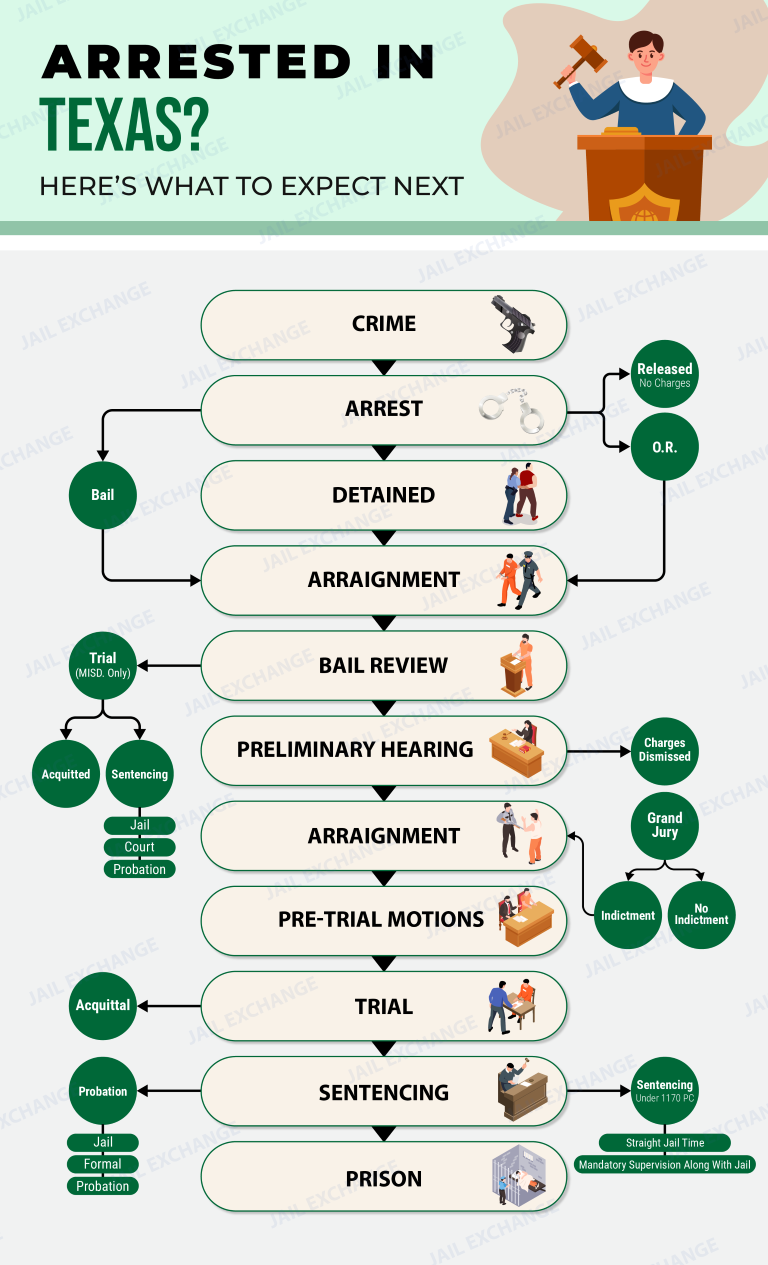
If you are arrested in Franklin County on a Class A or B charge, you will be booked at the Franklin County Jail on Highway 37 and, inside two days (art. 15.17), see a magistrate, normally the county's justice of the peace. Expect to hear the accusation, a warning that you need not talk, and an explanation of your right to a lawyer; say then if you want one appointed. With the statewide public safety report in front of the JP, your bail is set. You can post it in cash, pay a licensed bondsman to write a surety bond, or be released on personal bond, which needs only your signature but is barred by statute for violent charges.
Who represents you
Franklin has no public defender. Its indigent defense plan has the County Judge pick a private lawyer for each qualifying misdemeanor defendant, using Texas Indigent Defense Commission standards. If you bonded out before asking, apply through the County Judge's office at (903) 537-4252.
How the case moves
Your file goes from the arresting agency to the Franklin County Attorney, who decides whether to file a charging document in county court. The County Judge calls criminal cases on scheduled docket days; at your first one you plead, and the County Attorney and your lawyer start working toward a disposition that often comes by the second or third setting. You may insist on a jury: six residents of Franklin County, and they must be unanimous. Still jailed while prosecutors say they are not ready? Article 17.151 entitles you to release on personal bond or a smaller amount once you have waited 15 days on a Class B or 30 on a Class A.
Penalties for typical charges
- First DWI (Class B): three days minimum, six months maximum, a fine reaching $3,000; the minimum doubles to six days with an open container, and a reading at or over 0.15 converts it to Class A. A conviction in Franklin County court also suspends your license and requires the DWI education course, sometimes with an interlock on your vehicle. Separately, the Department of Public Safety can suspend your license through ALR if you refused or failed testing.
- Theft: Franklin County grades it by value, a Class C ticket below $100, Class B from $100 to below $750, Class A from $750 to below $2,500.
- Assault causing bodily injury: a Class A offense; the County Judge can impose up to a year and $4,000. A family violence finding will cost you the right to possess guns and can make a second assault a felony.
- Criminal trespass: Class B usually, Class A when it involved someone's home or a deadly weapon.
Your case may close with a dismissal, diversion, deferred adjudication, probation, a fine or some jail days, typically two to six months after arrest. A lawyer can tell you whether finishing deferred adjudication would let you seek an order of nondisclosure.
Felony (for example, burglary, felony theft, drug possession or delivery, aggravated assault)
First 48 hours
A felony arrest in Franklin County also starts at the Franklin County Jail and the magistrate's hearing, where probable cause is checked and a bond is set. Felony amounts run higher, and the JP may attach drug testing, a curfew or an order to stay away from the complainant. Article 17.151 gives a jailed felony defendant a right to a personal bond or reduced amount once 90 days pass without the prosecution announcing ready, except on violent charges.
The grand jury and court weeks
Prosecutors from the 8th Judicial District Attorney's office drive over from Sulphur Springs to present Franklin felonies to a Mount Vernon grand jury, which needs nine of its twelve votes to indict. Since the 8th and 62nd District judges split their time among several counties, your case is heard only during the weeks a district judge holds court in Franklin County, and gaps between settings can be long. After arraignment come pretrial dates and negotiation. Pleas resolve most cases; a trial means twelve jurors who must all agree, and you can choose whether they or the judge assess punishment.
Lawyers for felony defendants
A district judge assigns a private lawyer from the county's felony appointment list once your request from the jail is processed. Relatives can call the Franklin County District Clerk at (903) 537-8337 to learn the lawyer's name.
Punishment ranges
- State jail felony, such as stealing property worth $2,500 or more but under $30,000, or carrying under one gram of meth: from 180 days to two years.
- Third-degree felony: between two and ten years in TDCJ.
- Second-degree felony, the usual grade for home burglary and aggravated assault: between two and twenty years.
- First-degree felony, such as delivery of a large drug quantity: between five and 99 years, or life.
Each grade also allows up to a $10,000 fine, and a prior felony record can raise the range. First-time defendants in Franklin County often get deferred adjudication or probation. Inmates in TDCJ typically reach parole eligibility after serving one-fourth of the term with good time; for "3g" crimes it is one-half, never under two years. Expect a Franklin felony to take six to 18 months.
Violent felony (for example, murder, sexual assault, aggravated robbery)
Franklin County sees few homicides or armed robberies, but a violent case follows the same path as any felony, from the Franklin County Jail to a Mount Vernon grand jury to the 8th or 62nd District Court, with the stakes far higher at each stage.
Release
Texas forbids personal bonds on violent charges, and a district judge, not the JP, frequently sets the bail. Texas voters approved a 2025 constitutional amendment that lets judges deny bail in some violent-crime cases, which can keep a Franklin County defendant in custody with no bond at all. The 90-day release statute also excludes these offenses.
What the law provides
- Murder: a first-degree felony, from five to 99 years or life.
- Capital murder: only life without parole or a death sentence. Texas leads all states in executions, and defense counsel in a death case must hold special qualifications.
- Sexual assault carries two to 20 years as a second-degree felony; the aggravated version is first degree, and certain child-victim counts start at 25 years.
- Aggravated robbery: first degree, on the "3g" list, so no parole review until half the term is served.
Length of the case and victims' rights
Because the crime lab, expert witnesses and a shared district court schedule all set the pace, a Franklin violent felony can take one to three years. The state constitution's victims' rights article (art. I, sec. 30) guarantees notice, presence and a voice; the 8th Judicial District Attorney's victim staff in Sulphur Springs can be reached at (903) 885-0641. An accused person without money for a lawyer gets one appointed by the district court.
Juveniles (under 17) arrested in Franklin County
Texas sends 17-year-olds to adult court, so Franklin County's juvenile process covers only children aged 10 through 16 on the date of the alleged act. These are civil Family Code cases, built around supervision and treatment rather than punishment.
Who handles the case
When a deputy or Mount Vernon officer detains a child, the officer calls the juvenile probation department that covers Franklin County. A probation officer completes intake, reaches the parents, decides whether the child can go home, and passes the referral to the prosecutor, who chooses whether to file a petition. The Franklin County Juvenile Board names the court that acts as juvenile court, usually a district court or the County Judge's court, and the County Judge's office at (903) 537-4252 can point families to the probation officer assigned.
Detention and hearings
No juvenile detention center operates in Franklin County, and children are never held in the adult Franklin County Jail on a juvenile referral. A child who must stay in custody is typically placed, under a probation-department contract, in a certified detention center in another Northeast Texas county. Two working days is the deadline for the detention hearing, the child gets a lawyer (court-paid if necessary), and continued detention returns to court for review within ten working days at most. Juvenile court never sets bail; a released youth goes home to a parent or guardian under court conditions.
Outcomes
- A supervisory caution or deferred prosecution that closes the matter without a finding.
- Probation at home or in a residential placement after an adjudication hearing.
- Commitment to the Texas Juvenile Justice Department (TJJD) when the youth committed a felony.
- For grave offenses, a determinate sentence that can later be completed in adult prison.
Adult certification
In the most serious cases the prosecutor may ask the juvenile judge to move a youth into adult criminal court. Roughly, a youth must be at least 14 for capital, first-degree or aggravated drug charges and at least 15 for other felonies, plus a diagnostic study and a hearing. Franklin juvenile records are shielded from the public, and a later sealing order is often available.
Federal cases (U.S. District Court) from Franklin County
Under 28 U.S.C. § 124, Franklin County belongs to the Eastern District of Texas and its Texarkana Division, together with Bowie, Red River and Titus counties. Federal court for those four counties meets in the federal building that sits on the Texas-Arkansas line in Texarkana.
- U.S. District Court, Texarkana Division, U.S. Courthouse and Post Office, 500 N. State Line Ave., Room 301, Texarkana, TX 75501, (903) 794-8561
- U.S. Attorney, Eastern District of Texas, Texarkana branch at 500 State Line Ave. N., Suite 402, Texarkana, TX 75501; calls go through the Tyler headquarters, (903) 590-1400
- Defense if you cannot pay: Eastern District Federal Public Defender staff or a CJA panel attorney
When a case goes federal
Interstate 30 runs through Mount Vernon on the way between Dallas and Little Rock, and drug and cash seizures from highway traffic stops are a regular source of federal cases in Northeast Texas. Other common federal charges include methamphetamine distribution conspiracies, possession of firearms by felons or drug users, child pornography and fraud. A case investigated by local officers can be referred to the U.S. Attorney when a federal agency such as the DEA, ATF or FBI is involved.
The federal process
Forget the county-court bail bond system once a case is federal. Your first stop after a federal arrest is a magistrate judge in Texarkana, who reads the charge and names a lawyer if you qualify. A prosecution motion to detain you leads to a hearing, generally within three court days. The Bail Reform Act then gives two options: you go home under Pretrial Services supervision and conditions, or you stay locked up until trial. If you were charged by complaint, a grand jury has 30 days to indict, and although the Speedy Trial Act calls for trial within 70 days, judges extend that often.
Most Texarkana Division defendants plead guilty; a trial jury of twelve must be unanimous to convict. U.S. Probation investigates your background for the presentence report, and the judge sentences with the advisory Guidelines in mind but cannot go under a statutory mandatory minimum without a legal basis. Because federal inmates cannot be paroled, roughly 85 percent of the term is spent in the Bureau of Prisons, even with good-conduct credit, before supervised release, and appeals from Texarkana are decided by the Fifth Circuit.
Locating a federal inmate
A name or BOP register number entered in the Federal Bureau of Prisons inmate locator shows a federal prisoner's location. If the U.S. Marshals are holding the person before trial in a contract county jail, that jail's roster may show the person as well. Federal prosecutors seldom charge minors, so Franklin County youth cases are left to the state juvenile system.
Read this Franklin County summary as general information, not legal advice; officials, court weeks and phone numbers can change. If you are charged, get advice from a defense lawyer. If you cannot afford one, raise it with the magistrate at the jail, or phone the County Judge's office at (903) 537-4252 on a misdemeanor or the District Clerk at (903) 537-8337 on a felony.