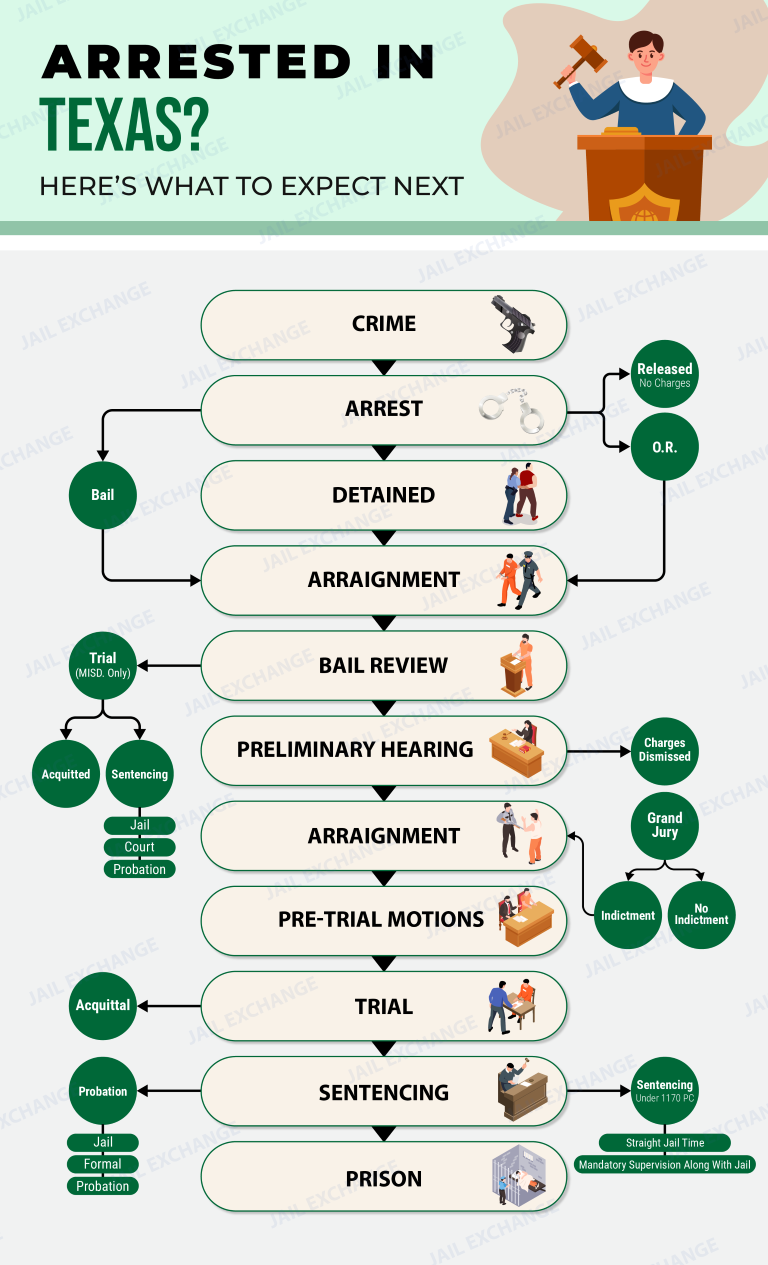
Baytown Municipal Jail Criminal Court Process
Criminal Court Process for Harris County Texas
Harris County Criminal Court Guide
Most criminal trials here take place at the Criminal Justice Center, 1201 Franklin Street, Houston, TX 77002. Defendants who can't make bond are booked at the Joint Processing Center, 700 N. San Jacinto Street, Houston, TX 77002, then housed at the 701 or 711 buildings on N. San Jacinto, the 1200 or 1307 buildings on Baker Street, or contract jails farther off. Keep reading for every courtroom, the life of a case, defense lawyers, warrant checks and online records.
Check custody first with the Sheriff's Find Someone in Jail search, using a name or SPN. Then turn to our Inmate Lists page, whose focus is the arrest and custody itself: people booked lately, those still held, outstanding warrants, the charges filed, mugshots, free counsel and getting property back.
Ring the District Clerk at 832-927-5800 for the court number and next date; a full name and birthday speed the search. Need to arrange a bond first? The bail page covers bonds and payment.
1. Felony, Class A or B, or Class C: which court hears it?
Texas sorts crimes by grade, and each grade has its own courtroom. Here is the local layout:
- Criminal district courts take every felony, from a state jail felony up to capital murder. More than twenty of them sit downtown, each known by a number, such as the 174th or the 351st.
- The sixteen County Criminal Courts at Law take Class A and Class B misdemeanors. They also hear appeals from justice and city courts.
- Justice of the Peace courts and municipal courts take Class C cases, which carry a fine and no jail time.
- The Court of Criminal Appeals in Austin has the final word on criminal appeals in Texas.
One local twist matters for families. In this county, the District Clerk keeps the files for felony and misdemeanor cases alike. The County Clerk, at 713-274-8600, handles marriage, property and probate records, so criminal questions belong with the District Clerk.
↑ Back to the question list2. Where do Harris County criminal cases go to court?
Most of the action happens in a few downtown buildings:
- Criminal Justice Center, 1201 Franklin Street, Houston, TX 77002. The felony district courts and the 16 County Criminal Courts at Law are inside. The misdemeanor courts use floors 8, 9, 10 and 11, and they hold Open Hours Court on Thursdays from 8:30 a.m. to 3 p.m.
- District Clerk, main office, 1001 Preston, Suite 630c, Houston, TX 77002, 832-927-5800. The lobby opens weekdays from 8 a.m. to 4 p.m. Mail goes to P.O. Box 4651, Houston, TX 77210-4651.
- District Clerk, Criminal Customer Service (records and copies), 1201 Franklin, 3rd Floor, Suite 3254, Houston, TX 77002. Reach it through the main number.
- District Clerk, Criminal Collections (fines and court costs), 1201 Franklin, Suite 1016, Houston, TX 77002, 832-927-5920, weekdays 8 a.m. to 4 p.m.
- Cite and Release Docket, for people given a citation instead of an arrest, Wednesdays at 1 p.m., 49 San Jacinto, 1st Floor, Houston, TX 77002.
- Probable Cause Court, the round-the-clock magistrate hearing, viewable on the second floor of 700 N. San Jacinto Street, Houston, TX 77002.
- Federal court, Bob Casey United States Courthouse, 515 Rusk Avenue, Houston, TX 77002, 713-250-5500.
Room numbers for each district court can shift, so confirm the floor with the clerk before the hearing day.
↑ Back to the question list3. Which justice and city courts handle tickets here?
Class C tickets land in one of sixteen justice courts or in a city's municipal court. Officers may write a citation instead of arresting for any Class C offense except public intoxication (CCP art. 14.06). Justice court cases can be found with the courts' Find My Case and Court Date tool, and the Justice Courts contact page lists every court's phone.
- 1-1: 7300 North Shepherd, Houston, TX 77091. 1-2: 1302 Preston, Houston, TX 77002.
- 2-1: 10851 Scarsdale, Houston, TX 77089. 2-2: 101 South Richey, Suite B, Pasadena, TX 77506.
- 3-1: 14350 Wallisville Road, Houston, TX 77049. 3-2: 701 W. Baker Road, Baytown, TX 77521.
- 4-1: 6831 Cypresswood Drive, Klein, TX 77379. 4-2: 7900 Will Clayton Parkway, Humble, TX 77338.
- 5-1: 6000 Chimney Rock, Houston, TX 77081. 5-2: 16715 Clay Road, Houston, TX 77084.
- 6-1: 333 Lockwood, Houston, TX 77011. 6-2: 1001 Macario Garcia, Houston, TX 77011.
- 7-1: 5737 Cullen Boulevard, Houston, TX 77021. 7-2: 5300 Griggs Road, Houston, TX 77021.
- 8-1: 7330 Spencer Highway, Pasadena, TX 77505. 8-2: 16603 Buccaneer, Houston, TX 77062.
City courts:
- City municipal courts, at the Herbert W. Gee Municipal Courthouse, 1400 Lubbock Street, Houston, TX 77002, 713-247-5479. Anyone who sat in jail on a city charge can ask for credit with a Motion for Credit for Time Served, plus proof of the dates in and out.
- Webster Municipal Court, 101 Pennsylvania Avenue, Webster, TX 77598, 281-338-6702. Open Monday to Thursday, 7:30 a.m. to 5:30 p.m., and Friday, 7:30 to 11:30 a.m.
- Other cities. The county has 41 incorporated cities, and each can run its own court. The state's municipal courts by city list gives the address and phone for each one.
Short on money for a Class C fine? The judge can be asked for installments, community service or a waiver. Jail for nonpayment is allowed only after a hearing that finds the person didn't try in good faith (CCP arts. 45A.252-45A.261).
↑ Back to the question list4. What happens in Probable Cause Court?
Probable Cause Court is the county's first hearing after arrest. It runs every hour of every day by video link from the Joint Processing Center, 700 N. San Jacinto Street, Houston, TX 77002, and the public may watch from a second-floor viewing room. State law caps the wait for this hearing at 48 hours after arrest (CCP art. 15.17(a)).
The magistrate must tell the person:
- what they are accused of;
- that hiring an attorney is allowed, and that the court appoints one when the person lacks the funds;
- about the right to stay quiet, since any statement may be used in court;
- that they may have a lawyer present during questioning and may end an interview at any time;
- that, on a felony, an examining trial can be requested.
Pretrial Services gives the magistrate a written report, and a public safety report lists criminal history for Class B charges and up. Any request for appointed counsel must reach the appointing court in 24 hours or less (CCP art. 15.17(a)). When probable cause is lacking, the magistrate has 24 hours to put that ruling in writing (CCP art. 15.17(h)).
The person then waits in one of the Sheriff's buildings. The processing center handles booking and release, with Inmate Information at 713-755-5300. Housing is at 701 N. San Jacinto Street, Houston, TX 77002, 346-286-2840; 711 N. San Jacinto Street, Houston, TX 77002, 346-286-2998; 1200 Baker Street, Houston, TX 77002, 346-286-2211; and 1307 Baker Street, Houston, TX 77002, 346-286-2600. Contract housing includes the LaSalle Corrections Center in Louisiana, 15976 US-165, Olla, LA 71465, 318-495-6200; the Natchitoches Parish Detention Center, 299 Edwina Drive, Natchitoches, LA 71457; the Tallahatchie County Correctional Facility, 19351 US Hwy 49 North, Tutwiler, MS 38963, 662-345-6567; and the Jefferson County Downtown Jail, 1001 Pearl St, Beaumont, TX 77701, 409-434-4653. Ask Inmate Information which groups each building holds today.
↑ Back to the question list5. How do misdemeanors like DWI or theft move here?
The charging paper, called an information, tells you the class. A DWI, a theft, an assault or a trespass can land in Class A or Class B depending on the facts and any past record. The District Attorney's Office files these cases in a County Criminal Court at Law.
- First setting. The defendant and lawyer meet the court for the first time.
- Arraignment. For a jailable misdemeanor, the court confirms who the defendant is and takes a plea (CCP art. 26.01). A lawyer may waive it in writing.
- Resets. Cases are often reset while the two sides share evidence and discuss a plea.
- Plea or trial. When the sides reach a deal, the judge announces before the plea is final whether to accept it. A rejected deal lets the defendant withdraw the plea (CCP art. 26.13).
Penal Code limits by class:
- Class A: jail as long as a year, a fine as high as $4,000, or both (PC 12.21).
- Class B: a maximum of 180 days behind bars, a $2,000 fine, or both (PC 12.22).
- Class C: no jail, with $500 the largest fine (PC 12.23).
People who were cited instead of jailed report to the Cite and Release Docket, which meets Wednesdays at 1 p.m. at 49 San Jacinto, First Floor, Houston, TX 77002. The District Attorney also runs a Marijuana Diversion Program as an alternative to a regular prosecution.
↑ Back to the question list6. What steps does a felony take at 1201 Franklin?
Expect more stops along the way than in a misdemeanor:
- Probable Cause Court sets bond and offers an appointed lawyer.
- Examining trial. Until an indictment comes down, the defense can request this hearing to challenge the evidence, and bail may be revisited (CCP art. 16.01).
- Grand jury. Felonies are charged by indictment. At least nine grand jurors must agree, and the session is secret (CCP arts. 20A.202, 20A.301).
- Arraignment. The assigned district court reads the charge and takes a plea (CCP art. 26.01).
- Pretrial settings. Motions are argued, evidence changes hands and plea offers are discussed.
- Plea or trial before a judge or a jury.
- Sentencing after a guilty plea or verdict.
Texas felony ranges (PC 12.31-12.35):
- State jail felony (lowest grade): 180 days up to 2 years in a state jail, and up to $10,000.
- Third degree: prison for 2 to 10 years, and up to $10,000.
- Second degree: 2 to 20 years, and up to $10,000.
- First degree: life, or 5 to 99 years, and up to $10,000.
- Capital felony: life without parole or death, or life for someone under 18 at the time.
Earlier felony convictions can push a case up a level (PC 12.42). A judge may instead punish a state jail felony as a Class A misdemeanor in some cases (PC 12.44).
↑ Back to the question list7. Do murder and other violent charges follow different rules?
Yes, at several points:
- Bail can be refused. Proposition 3 passed in November 2025. Its list: murder and capital murder; aggravated robbery, kidnapping or sexual assault; aggravated assault with serious injury or a deadly weapon, indecency with a child and trafficking. On those charges, bail must be denied if, after a hearing, the judge finds the prosecutor proved flight risk or public danger (Tex. Const. art. I, sec. 11d).
- The state can push back on low bail. Prosecutors may ask a district judge to review felony bail, and may appeal a low bail in listed violent cases while the person stays held (CCP arts. 17.029, 44.01).
- Family violence orders. An emergency protective order can come out of the first hearing, usually good for 61 to 91 days. Cases with serious injury or a weapon get a longer order of 91 to 121 days (CCP art. 17.292).
- Fewer second chances. Most murder charges, some intoxication crimes, certain trafficking cases and repeat sex offenses can't end in deferred adjudication (CCP art. 42A.102).
- Victims are heard. The victim's safety is weighed at bail, and the victim may offer an impact statement for the judge to consider (CCP art. 56A.051).
Capital murder is the only charge that can carry death or life without parole (PC 12.31).
↑ Back to the question list8. Which Harris County offices prosecute and defend?
Every felony and misdemeanor here is prosecuted by a single District Attorney's Office, 1201 Franklin St., Suite 600, Houston, TX 77002, 713-274-5800.
For defendants who can't afford a lawyer, there are two public options:
- Public Defender's Office, 1310 Prairie St., Suite 400, Houston, TX 77002, 713-274-6700. Weekdays 8 a.m. to 5 p.m. It is pre-assigned to courts each day at random, and it says it will never ask a client for payment.
- Office of Managed Assigned Counsel, 1310 Prairie St., Suite 1600, Houston, TX 77002, 832-927-3949. It handles appointments of private lawyers.
The request starts at the magistrate hearing, where Pretrial Services helps with the money forms. By law, the court gets one working day, counted from receipt of the request, to appoint (CCP art. 1.051(c)). For felony cases, the local plan treats a household earning under 125% of federal poverty guidelines as unable to pay. Receiving certain public benefits also qualifies. Read the felony plan or the misdemeanor plan. Statewide oversight of both plans comes from the Texas Indigent Defense Commission, 209 West 14th Street, Room 202, Austin, TX 78701, 512-936-6994.
↑ Back to the question list9. How can I find the case number and next setting?
Several free and low-cost tools cover local cases:
- District Clerk records. The District Clerk's site has a records search under Online Services for felony and misdemeanor cases.
- Sheriff's Offense Inquiry. For someone in jail, the Offense Inquiry lists each case, the offense, the next setting and the outcome.
- By phone. The District Clerk will look up a case or SPN at 832-927-5800 for a $5.00 charge.
- Justice courts. Use Find My Case and Court Date for Class C cases.
- Statewide. re:SearchTX shows filed charges and judgments after free sign-up, but not hearing dates.
Once released on a personal bond, the person can get court date reminders from Pretrial Services' Enhanced Support Division, 49 San Jacinto, 1st Floor, Houston, TX 77002, 832-927-3520, weekdays 7 a.m. to 5 p.m.
↑ Back to the question list10. Does a Harris County warrant exist, and what clears it?
Deputies, the eight constable precincts and city police all serve warrants. The Sheriff's warrant line is 713-755-6055. Search Class A and B warrants on the Sheriff's warrant list, felony cases through the District Clerk, and fine-only warrants at justice courts or city courts. The state posts the Texas 10 Most Wanted. To clear one, call a lawyer, then post bail or surrender to ask for a personal bond at the Bonding Desk, 700 N. San Jacinto Street, Houston, TX 77002, open 24 hours. Case questions go to the District Clerk, 1001 Preston, Suite 630c, Houston, TX 77002, 832-927-5800.
↑ Back to the question list11. Which courts and agencies handle a federal arrest here?
Charges under federal law come from the U.S. Attorney's Office at 1000 Louisiana, Suite 2300, Houston, TX 77002, 713-567-9000. Cases are heard at the Bob Casey United States Courthouse, 515 Rusk Avenue, Houston, TX 77002, 713-250-5500, home of the court's Houston Division.
- At an early detention hearing, the judge weighs release conditions against holding the person until trial (18 U.S.C. 3142).
- The U.S. Marshals Service holds and transports federal prisoners. Its district office is Room 10002 in the same courthouse, 515 Rusk Avenue, Houston, TX 77002, 713-718-4800.
- The Southern District's Federal Public Defender represents many people who can't pay, from 440 Louisiana Street, Room 1350, Houston, TX 77002, 713-718-4600.
- FDC Houston, a federal detention center, sits at 1200 Texas Avenue, Houston, TX 77002, 713-221-5400.
- After sentencing, the Federal Bureau of Prisons inmate locator shows where the person is serving time.
12. Does an immigration detainer change the Texas case?
A detainer doesn't pause the Texas prosecution. What it changes is the moment the person could leave jail. Expect this sequence:
- Immigration agents deliver an I-247A detainer form to the jail staff.
- Staff can then keep someone up to 48 hours after they would otherwise be released (8 CFR 287.7(d)).
- A Texas jail has to comply. Someone born here, naturalized or lawfully present avoids the hold by showing documents (CCP art. 2A.060). Local rules that limit immigration enforcement are banned by a 2017 law (GC 752.053).
- A 2025 law gives every county that runs a jail until December 1, 2026 to request a 287(g) agreement with ICE.
- ICE's Houston Field Office, 126 Northpoint Drive, Houston, TX 77060, 281-774-4816, handles pickups. The Montgomery Processing Center, 806 Hilbig Road, Conroe, TX 77301, 936-521-4900, is one place it holds people.
- Find the person through the ICE Online Detainee Locator.
Judges must give every defendant a deportation warning, spoken or written, ahead of any guilty or no-contest plea (CCP art. 26.13). A defense lawyer should weigh that risk before any deal.
↑ Back to the question list13. Where would a Harris County prison sentence be served?
The state prison agency, TDCJ, carries out felony sentences. The lowest felony grade is served in a state jail; anything from third degree up is served in prison (PC 12.34). After sentencing, the person usually waits downtown until TDCJ takes custody. TDCJ then classifies them at intake and assigns a unit based on security level and needs.
- To look someone up, type a surname, SID or TDCJ number into the state's TDCJ inmate search. Results show only those who have reached a state unit, and they lag a day or more.
- Each unit's visits, mail and money rules are on the Texas state prisons page of this site.
14. How do probation and deferred adjudication work here?
Many cases end in supervision instead of jail. Texas offers two main kinds:
- Deferred adjudication. After a guilty or no-contest plea, the judge holds off on a finding of guilt. If the person finishes the terms, the case is dismissed. The period can be up to 10 years for a felony or 2 for a misdemeanor (CCP art. 42A.101; see also arts. 42A.103 and 42A.111).
- Community supervision. This is standard probation after a guilty finding. A felony term can usually run 10 years at most. A misdemeanor term tops out at 2 (CCP art. 42A.053).
The adult probation department is the Community Supervision and Corrections Department. Its main office is at 49 San Jacinto, Houston, TX 77002, 832-927-8500. Branch offices use that same number:
- South: 3330 Old Spanish Trail, Houston, TX 77021
- West: 10585 Westoffice Drive, Houston, TX 77042
- North: 9111 Eastex Freeway, Houston, TX 77093
- East: 1000 Lee Drive, Baytown, TX 77520
Texas also runs specialty courts for drugs, mental health and veterans. Check the state's specialty court registry and ask the defense lawyer which local programs fit.
↑ Back to the question list15. What happens when a child aged 10 to 16 is charged?
Juvenile court hears cases against children who were at least 10 but not yet 17 when the offense happened. Anyone 17 or older is prosecuted in adult court (FC 51.02(2)).
- Officers have to notify a parent quickly, giving the reason for custody (FC 52.02).
- Held youths go to the Juvenile Detention Center, 1200 Congress St., Houston, TX 77002, 713-222-4100.
- The youth gets a lawyer, and a judge decides on continued detention within two working days. That shrinks to one working day for a youth taken in on a Friday or Saturday (FC 54.01).
- A detention order lasts no more than 10 working days before the judge reviews it (FC 54.01(h)).
- For serious felonies, the court may move a youth of 14 or 15 and up to adult court after a full hearing (FC 54.02).
The Juvenile Probation Department also runs the Leadership Academy, 9120 Katy Hockley Rd., Katy, TX 77493, 713-222-4600, and the Youth Village, 210 J W Mills Dr., Seabrook, TX 77586, 713-222-4700, for youths ages 10 to 17. The juvenile board's lawyer plan explains how counsel is chosen.
↑ Back to the question list16. Where can Harris County crime victims turn?
The District Attorney's Office has a victim assistance team at 713-274-0250, and a protective order unit at 713-274-0212. Both work from 1201 Franklin St., Suite 600, Houston, TX 77002.
- Under state law, a judge setting bail must consider the victim's safety. Victims can also ask to be told of hearings and may speak about the harm done (CCP art. 56A.051).
- Register with Texas IVSS-Counties to hear about a release or transfer. It works online or by phone at 866-268-8959, in English or Spanish.
- Through the Attorney General, Crime Victims' Compensation covers costs such as counseling, medical care and lost pay, up to $50,000. Apply online or call 800-983-9933.