Hays County Juvenile Detention Center Criminal Court Process
Criminal Court Process for Hays County Texas
Hays County Criminal Court Guide
Three court tracks handle crimes charged in this county. District courts keep the felony files, jailable misdemeanors (Class A and B) go to the three County Courts at Law, and fine-only Class C tickets end up with justice or city courts. An adult who can't make bond stays in the Hays County Jail, 1307 Uhland Road, San Marcos, TX 78666.
Is the person still behind bars? The Sheriff's jail search answers that by name. On our Jail Roster page you'll find everything tied to the arrest and custody itself: current inmates, the latest bookings, warrants, charge details, mugshots, public defenders and property pickup.
Court dates live with the clerks. The District Clerk at 512-393-7660 tracks felony settings. The County Clerk at 512-393-7330 tracks misdemeanor settings. Ask for the next setting and the cause number. Bond types and costs in this county are laid out on our bail page.
1. Felony, misdemeanor or Class C: which Hays County court takes it?
The charge level picks the courtroom:
- Felony, from state jail felony up to capital murder: one of the district courts. The District Clerk keeps the paperwork.
- Class A or Class B misdemeanor, where jail is possible: County Court at Law No. 1, No. 2 or No. 3, with files at the County Clerk Courts Division.
- Class C misdemeanor, fine only: a justice court, or a municipal court when city officers wrote the ticket.
Three more dockets run through the County Clerk too: Mental Health Court, Veterans' Court and Juvenile Court. If a conviction is appealed, the last word in a criminal case belongs to the state's Court of Criminal Appeals. A state pamphlet on the Texas court system draws the full picture.
↑ Back to the question list2. What is inside the Government Center on Stagecoach Trail?
The three offices families call most share the county Government Center in San Marcos. Counters keep regular weekday business hours, and a quick call first can save a wasted trip.
- District Clerk (felony files and dates): 712 S. Stagecoach Trail, Suite 2211, San Marcos, TX 78666, 512-393-7660.
- County Clerk Courts Division (misdemeanor files, County Courts at Law): 712 S. Stagecoach Trail, Suite 2008, San Marcos, TX 78666, 512-393-7330. For hearing questions in those courts, use 512-393-7625.
- Judicial Services (pretrial release and bond checks): 712 S. Stagecoach Trail, Suite 1204, San Marcos, TX 78666, 512-393-7785, open 8 a.m. to 5 p.m. on weekdays.
First appearances, bail and warrants are handled every day of the year by the Magistrate's Office, whose duties are listed on the Magistrate Court page. The jail at 512-393-7800 can say when someone in custody is due before a magistrate.
↑ Back to the question list3. Where do Class C tickets from Kyle, Buda or Wimberley go?
Fine-only Class C cases are filed in justice or city courts. The county's Justice of the Peace courts are split by precinct:
- Precinct 1, Place 2, San Marcos
- Precinct 2, Kyle
- Precinct 3, Wimberley
- Precinct 4, Dripping Springs
- Precinct 5, Buda
Each precinct page lists that court's office details, and the citation itself names the court. Tickets from city police usually go to that city's municipal court. Kyle posts its court on the Kyle municipal court page. For the San Marcos city court, ask the police non-emergency line at 512-753-2108.
The fine on a Class C charge can't pass $500, and no jail is possible (Penal Code 12.23). Can't pay? The judge can set up a payment plan, waive the fine, or give community service credit at $150 for every 8 hours. Before anyone is jailed over an unpaid fine, the court must hold a hearing and find they made no good-faith effort (art. 45A.252 to 45A.261).
↑ Back to the question list4. How do the first hours and the first setting unfold?
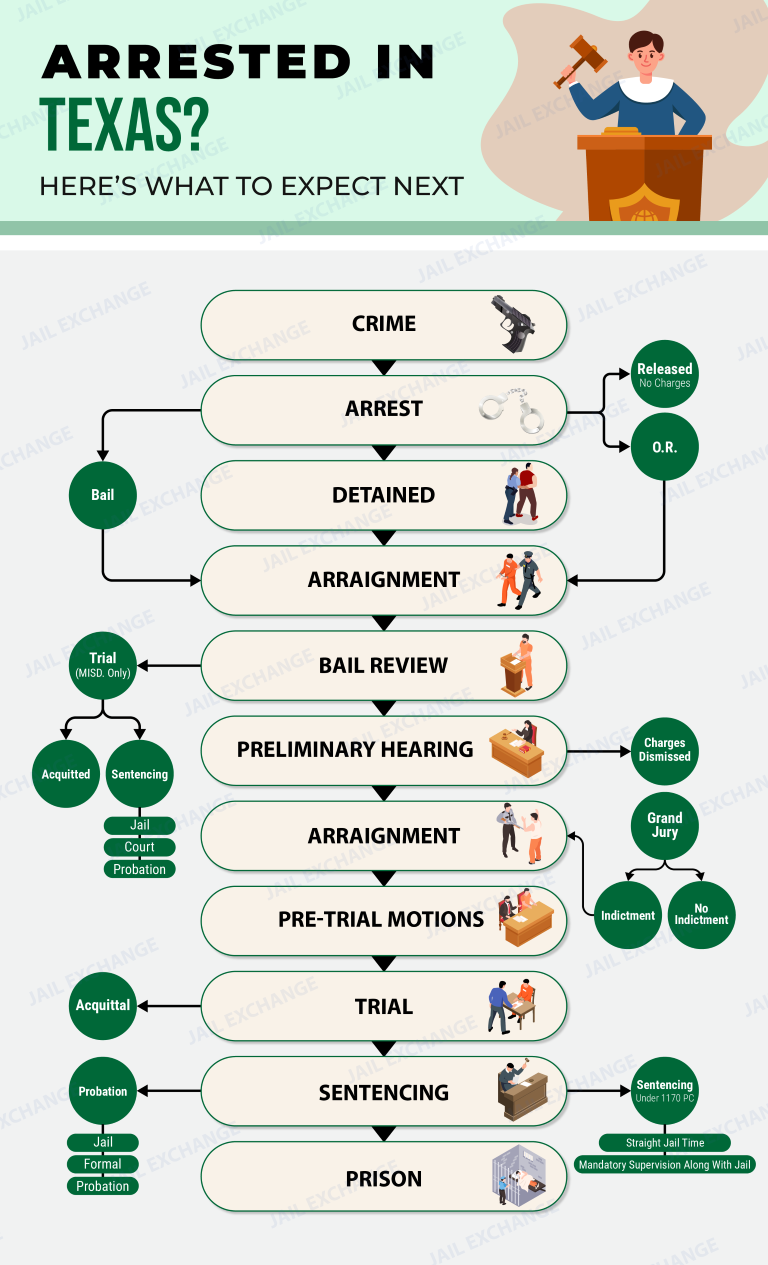
Article 15.17 sets a two-day outer limit (48 hours) for getting an arrestee in front of a magistrate. One of the Magistrate's Office associate judges reads the charge and the person's rights: silence, a lawyer present for questioning, ending an interview at will, an examining trial, and a lawyer appointed at county cost. Bail gets set in the same sitting.
Next the case goes to its trial court. The first formal setting tends to be the arraignment, where the defendant hears the charge read and then pleads (art. 26.01). Judicial Services follows each person on personal bond, tracking court dates and bond rules.
Skipping a setting has a price: forfeiture of the bond, a fresh warrant and a possible bail jumping charge (Penal Code 38.10). To double-check a date, ring the District Clerk at 512-393-7660 or the County Clerk at 512-393-7330.
↑ Back to the question list5. What path does a jailable misdemeanor take through County Court at Law?
A misdemeanor starts when the Criminal District Attorney files an information, a written charge, and the clerk assigns it to County Court at Law No. 1, 2 or 3. Stops along the way include arraignment, pretrial settings where both sides talk about an offer, and then a plea or a trial. When a deal is on the table, the court tells the defendant in advance if it will honor those terms. If the court rejects it, the person may take back the plea (art. 26.13).
Top penalties:
- Class A (Penal Code 12.21): a jail term topping out at one year, a fine up to $4,000, or the two at once.
- Class B (Penal Code 12.22): half that jail exposure, 180 days at the most, plus or instead of a fine no bigger than $2,000.
Two outcomes can keep someone out of jail. Deferred adjudication puts the guilty finding on pause. On a misdemeanor that supervision lasts two years at most, and finishing it means dismissal (art. 42A.103, 42A.111). Article 42A.053 puts the same two-year ceiling on misdemeanor probation, which Texas law calls community supervision.
To pay misdemeanor fines and costs, the County Clerk accepts money orders, cashier's checks, cash and online payment. Mailing one to Suite 2008? Put the cause number on the memo line. The online system asks for Bureau Code 6230101 plus the suffix CR on criminal cases.
↑ Back to the question list6. What steps does a Hays County felony case follow?
Felonies move through the district courts, with files kept by the District Clerk at 512-393-7660. The usual path:
- Examining trial. A pre-indictment hearing the defense may demand, where a judge checks the state's probable cause (art. 16.01).
- Grand jury. A panel reviews the evidence in secret. At least nine members must vote to indict (art. 20A.301).
- Arraignment. Article 26.01: the defendant listens to the indictment, then enters a plea to it.
- Pretrial settings. Lawyers argue motions, swap evidence and talk about offers.
- Resolution. A plea agreement, or a trial in front of a jury or the judge alone.
The Penal Code sets these prison ranges:
- Capital felony (Penal Code 12.31): the death penalty or life without parole, while someone under 18 gets life
- First-degree felony (Penal Code 12.32): life, or 5 to 99 years
- Second-degree felony (Penal Code 12.33): 2 to 20 years
- Third-degree felony (Penal Code 12.34): 2 to 10 years
- State jail felony (Penal Code 12.35): a state jail term between 180 days and 2 years
Each of these levels can add a fine of up to $10,000. Prior felony convictions can push the punishment range upward (Penal Code 12.42). On a felony, probation or deferred adjudication may run as long as 10 years (art. 42A.053, 42A.103).
↑ Back to the question list7. How are violent and serious felonies treated differently?
Serious violent charges face tighter rules at every stage:
- Bail can be refused. On November 4, 2025, Texas voters passed Proposition 3, which wrote sec. 11d into the state constitution. The listed charges: murder of either kind (capital or not), three aggravated crimes (sexual assault, robbery, kidnapping), indecency with a child, human trafficking, and some aggravated assaults. Once a hearing persuades the judge, on the state's evidence, that release would bring flight or a threat to someone's safety, bail "shall be denied." A judge who still grants bail must put findings in writing.
- No signature bonds. Article 17.03 takes personal bonds off the menu for many violent charges.
- The state can appeal low bail. Under Senate Bill 9 of 2025, prosecutors in listed violent cases can ask a higher court to raise bail. The appeals court has 20 days to rule, and the defendant waits in jail until it does (art. 44.01).
- Custody after a guilty plea. For certain serious felonies, a guilty plea sends the person straight into custody to await sentencing (art. 27.20).
- Protective orders. After a family violence arrest, an emergency protection order may be signed by the magistrate during that first hearing. Most last at least 61 days and up to 91. Article 17.292 stretches it to 91 to 121 days when a weapon or a serious bodily injury is part of the case.
The defense lawyer can explain which of these touch a given charge.
↑ Back to the question list8. Does the county offer veterans or mental health courts?
Yes. The County Clerk Courts Division clerks both a Veterans' Court and a Mental Health Court for the county. Courts like these pair treatment with close supervision by a judge, and in Texas a typical program takes one to two years.
Whether a case might qualify is something the defense lawyer can judge. To learn the current entry rules, call the Courts Division at 512-393-7330. The state's specialty court registry lists registered programs across Texas.
↑ Back to the question list9. Who prosecutes Hays County cases, and how is a free defense lawyer requested?
The prosecutor. One office handles both felonies and misdemeanors here: the Criminal District Attorney's Office. It also takes juvenile cases and runs Hot Check, Civil and Victim Services divisions. The District Clerk at 512-393-7660 can connect you with the office.
Appointed defense. The magistrate helps with the request form at the first hearing. Counties with 250,000 or more residents, this one included, have one working day after receiving the request to appoint a lawyer (art. 1.051).
- Indigent Defense: 512-878-6740. Alternative number: 512-878-6597. How to apply is on the indigent defense page.
- Hays County Public Defender's Office, operated by Neighborhood Defender Service of Texas: 1340 Wonder World Dr., Suite 108, San Marcos, TX 78666, 512-749-0690.
- Texas Indigent Defense Commission, which oversees county plans: 209 West 14th Street, Room 202, Austin, TX 78701, 512-936-6994.
10. Where can a family find the cause number and next hearing?
Begin on the County Clerk's Courts Division page. It sends users to the county's Criminal Case Records search, where you enter the defendant's name and date of birth, or a case number. The page also points to re:SearchTX.
- re:SearchTX is the state court records site. Signing up is free. Public users see the case index and key papers like the charge and the judgment, but hearing dates come from the county.
- For hearing dates, call the District Clerk at 512-393-7660 on felonies or the County Clerk at 512-393-7330 on misdemeanors.
- People on personal bond can also ask Judicial Services at 512-393-7785.
- Past convictions statewide are in the paid DPS conviction search.
11. How can someone check on, then clear, a Hays County warrant?
Constables, deputies and city police can all serve warrants here. To ask whether one is active, call the Precinct 4 Constable's Warrant Division at 512-858-7605, as its warrant check page explains. That office mails a courtesy postcard first. With no reply in one to two weeks, the warrant enters a statewide database and a deputy constable is assigned. DPS keeps a statewide list of top fugitives, the DPS Texas 10 Most Wanted.
Clearing a warrant means contacting the court that issued it, ideally through a lawyer, and arranging to surrender or post bond. Felony warrants: District Clerk, 712 S. Stagecoach Trail, Suite 2211, San Marcos, TX 78666, 512-393-7660.
↑ Back to the question list12. What happens if prosecutors file in federal court?
Federal charges out of Hays County are heard at the Austin courthouse on West Fifth Street, which houses the Western District's Austin Division. The U.S. District Clerk's Office is at 501 West Fifth Street, Suite 1100, Austin, TX 78701, 512-916-5896.
- Prosecutor: the U.S. Attorney's office for this district, headquartered at 601 NW Loop 410, Suite 600, San Antonio, TX 78216, 210-384-7100. Its Austin branch answers at 512-916-5858.
- Detention hearing: under 18 U.S.C. 3142, the judge weighs release on conditions against pretrial custody.
- Custody: the U.S. Marshals Service Austin office, 501 West 5th Street, Suite 3300, Austin, TX 78701, 512-916-5393, holds federal defendants and knows which jail has them.
- Free defense: if the defendant qualifies, the Federal Public Defender's Austin office, 504 Lavaca Street, Suite 960, Austin, TX 78701, 512-916-5025.
- After sentencing: the Federal Bureau of Prisons inmate locator tracks people sent to federal prison.
13. Does an immigration hold stop the state prosecution?
No. The state charge keeps going with an immigration hold in place. What shifts is custody, meaning who keeps the person and for how long:
- Immigration and Customs Enforcement (ICE) sends its hold request as a Form I-247A.
- It authorizes holding the person up to 48 hours after they would otherwise be released (8 CFR 287.7(d)).
- Texas jails must honor the detainer (art. 2A.060). That duty lifts only for someone whose papers settle that they are American or lawfully here. Government Code 752.053 forbids local rules that limit immigration enforcement.
- Senate Bill 8, passed in 2025, has each jail-running county apply for ICE's 287(g) program, with December 1, 2026 as the deadline. Ask the Sheriff's Office at 512-393-7800 about this county's status.
- ICE then takes the person. The San Antonio Field Office, 3523 Crosspoint Drive, San Antonio, TX 78217, 210-564-3300, handles south-central Texas.
- Search the ICE Online Detainee Locator. An A-number works best; failing that, use the full name plus birth country.
If ICE moves the person, their lawyer needs to alert the state court about it. Immigration consequences of a plea are something to raise with the defense lawyer early.
↑ Back to the question list14. Where would a TDCJ or state jail term be served?
Both state jails and prison units fall under TDCJ (short for Texas Department of Criminal Justice). Any state jail felony sentence lands the person in one of the state jails. First-, second- or third-degree felony time is spent in a TDCJ prison unit (Penal Code 12.31 to 12.35). After sentencing, intake staff classify each new arrival and pick a unit.
- The TDCJ inmate search shows only people currently held in a TDCJ facility, and its information runs at least a day behind.
- Learn about the state system on our Texas state prisons page.
15. How does juvenile court work for Hays County youths?
Juvenile court in Texas covers kids who were ages 10 through 16 when the alleged conduct took place. Turning 17 changes that, and any new charge is filed as an adult case (Family Code 51.02). Locally, the County Clerk Courts Division keeps Juvenile Court files, at 512-393-7330, and the Criminal District Attorney prosecutes juvenile offenses.
- A detained youth is held at the Hays County Juvenile Detention Center in San Marcos, 512-393-5220. Call that number for the street address and for the juvenile probation office.
- Under Family Code 52.02, officers have to tell a parent or guardian right away.
- The detention hearing clock under Family Code 54.01: two working days, or one working day after a Friday or Saturday intake. The youth will already have appointed counsel when it starts.
- Family Code 54.02 covers certification, a move to adult court. It needs a complete hearing first. Age 14 qualifies for some felonies, while others start at 15.
16. How are crime victims supported in Hays County?
Texas law gives crime victims rights of their own (art. 56A.051). The list includes having their safety considered at bail, notice of court settings on request, and a victim impact statement offered before sentencing.
- Local help: the Criminal District Attorney's Office has a Victim Services division. Its Civil division also represents family violence victims who seek protective orders.
- Release alerts: Texas IVSS-Counties, the state's free custody alert service, calls registered victims before a release. Help line: 866-268-8959, all day, in English or Spanish. If it is down, the county says to call the jail at 512-393-7800.
- Help with costs: Crime Victims' Compensation, run by the Texas Attorney General, may pay medical bills, counseling and lost wages, as much as $50,000. Call 800-983-9933.